Light language is a stream of sound that its speakers say comes through them, not from them: fast syllables, clicks, long high tones, sometimes a song, a script, a dance of the hands. It has no single alphabet, its teacher Jamye Price says. By August 2023 the tag #lightlanguage had passed 237 million views on TikTok.
Ten people sit in the living room of a rented house in Sedona, Arizona, on couches and on the floor, in candlelight and incense. One of them is the anthropologist Giovanna Parmigiani, there to study what happens next. A metaphysical teacher she calls Anna has set out crystals, tarot cards, singing bowls and flowers on a mat.
Anna closes her eyes, breathes, and begins. High-pitched syllables, rapid, rising and falling "like birdsongs." The woman nearest Parmigiani shuts her eyes and breathes "as if drinking in the sounds." When it stops, the woman puts a hand over her heart.
Nobody translates. Anna explains instead: "each of you will receive what you need: a message, an intuition, a healing, maybe an energetic upgrade."
One voice. On her account, a different message for everyone in the room.
The Script That Moved Into the Mouth
The words are older than the practice, and at first they were not spoken at all.
J. J. Hurtak's The Book of Knowledge: The Keys of Enoch, a text its publisher dates to 1973, treats the language of Light as writing: Enoch set it down, the book says, "in the flame script of Israel." A 1991 printing of Ken Carey's The Starseed Transmissions, first published in 1982, sets it against words: "the language of love, the language of light, the language of no misunderstanding." Barbara Marciniak's Bringers of the Dawn gave it a chapter in 1992: "light-encoded filaments" carrying "the Language of Light geometry."
Letters of fire. Filaments. Geometry. In the passages found from those years, nobody is making it with a tongue.
Then it reaches the body, and no document found so far shows the day.
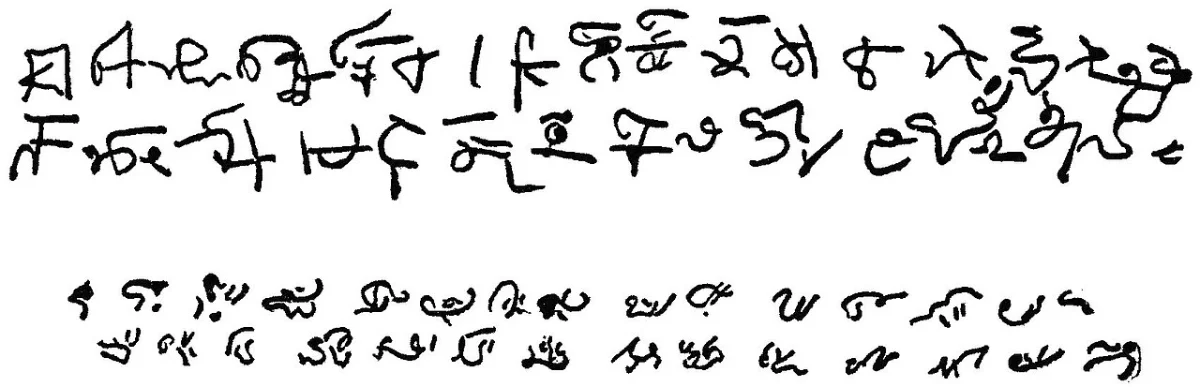
Price dates her own to the early 2000s in Sedona, around an energy-healing session called an axiotonal alignment. It began in her hands. "My hands would twitch, and then the movement got bigger and faster." Soon after, she told the writer Laura Marjorie Miller, a teacher at an event showed a slide of light language. "They were writing that in the air."
The script, on her account, had arrived before she had a name for it. She fought it. "I would actually have to sit on my hands and keep my mouth clenched shut," she said, afraid that "I would just be a weirdo." Then, at a public channeling, it got out. A client said it "came out like a storm."
Eva Marquez was living in Maine, reading Sanaya Roman's Opening to Channel, when she felt "a male energy by my right side" over the dishes and "heard the word Keneau in my head." She looked up the Pleiades. "I swear to God, I didn't even know what the Pleiades were!" Then a chant came, and she was sobbing, and she had to sit down. "I thought, This is his language!"
Price's book, Opening to Light Language, followed. In the last five years, Kathryn Post of Religion News Service wrote in March 2026, channeling from extraterrestrials "has gained traction." By 2023 one clip alone had 2.2 million views, and Dazed found polyester baseball caps promising to "remove blockages to success."
Frequencies, Not Words
Ask what it is, and the people who speak it do not describe a code.
"It is channeled, dynamic frequencies of sound and light," Price writes. "It's understood, but not consciously." The speaker gets out of the way: "Your 'human' sits aside," Marquez says, "and you let yourself communicate." Mindvalley's guide, written with Regan Hillyer, calls it "your soul's language," one that "can't be understood consciously."
So the target is not the mind. Price's page lists what it does: "Activates your pineal gland." "Repairs DNA." "Accelerates Ascension." "Heals your Body." It "speaks directly to your DNA," she writes, "activating and recoding." Althea Lucrezia Avanzo presents her own account as "Channeled from Archangel Metatron": "Like a solar flare, it is a powerful burst that bypasses all other layers." Tom Kenyon, a sound healer who says he channels the Hathors, describes "a type of proto-language, what some people call a Language of Light," in a recording addressed to one organ. "They are a communication to the pancreas gland."
George Adamski said in 1952 that he and a man from Venus talked by gestures and telepathy. Now come the star names. Price lists Arcturian and Pleiadian, angelic tongues, "elemental Languages like fairy or elven Language." Josie Danielle hears "clicks, hisses and noises" and "high pitched, long tones when angels come through." Marquez counts differently. "We all have a distinct dialect."
On that count, one dialect for every speaker alive.
The Quarrel Over the Dictionary
Inside the practice, the sharpest fight is over translation. Mindvalley: "translating light language into worldly communication defies its purpose." Price teaches it anyway, in a lesson on "Foundations for translating Light Language," with the warning that it is "most often not translated word-for-word."
And a blog called The Enchantress, written from inside the practice, asks what the others leave alone. "Why would our guides, if they are here to help us, speak in a language that no one can understand?"
As to what it most resembles, Price's book says it flat. "Light Language is speaking in tongues." Alexandra Dent, a psychologist, told Dazed the two are "ancient forms of communication" but separate.
What the Mouth Would Be For
Set aside for a moment whether any of it is true. Ask the better question. What kind of species are we if it is?
It would mean the oldest assumption about speech is wrong. Words would not be the top of what a voice does. They would be the narrow band, the part that needs a dictionary. Under them, on this account, a wider signal has been running all along, and our mouths have been able to carry it whether or not our minds could follow.
It would mean 237 million views of unopened mail. Every clip on that tag would be a transmission, each in a dialect its speaker cannot read, scrolled past on a phone.
It would mean contact is not a thing we are waiting for. The decades of listening behind the Wow! signal would have been pointed at the wrong sky. If a Pleiadian dialect is what its speakers say it is, then the first words from another star did not reach a radio telescope. They reached a woman washing dishes in Maine.
It would mean something about our bodies. A cell would be a reader. On Price's account DNA can be spoken to directly, which would make every one of us literate in a language nobody taught us, with no way to find out what we have been told.
And one thing would still be in front of us. Marquez, who met Keneau over those dishes and says she has studied with several Pleiadians since, reached a stranger conclusion about them. "It is all me."
If she is right, the visitor was never a visitor. And what we would have to learn is not how to answer the stars, but who has been speaking when we thought nobody was.
What the Tape Recorders Found
The standard account comes from recordings of the relative Price names.
The linguist William Samarin, born into a tongue-speaking sect, the Molokan Spiritual Jumpers, recorded speech in tongues for five years in Europe and North America. In 1972 he defined it as a "meaningless but phonologically structured human utterance believed by the speaker to be a real language but bearing no systematic resemblance to any natural language, living or dead." His phrase for it: "only a facade of language, although at times a very good one indeed."
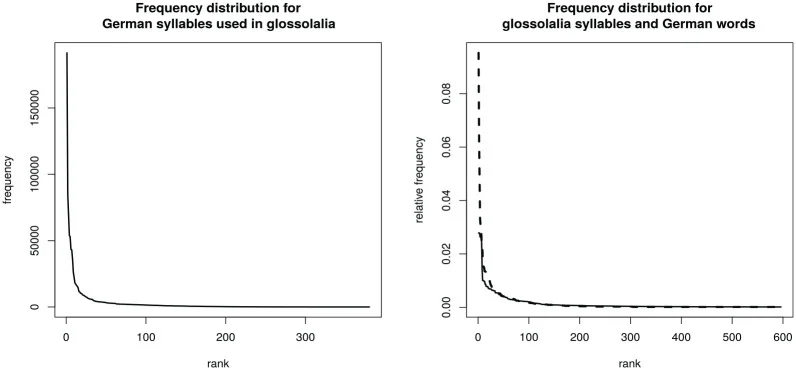
Ernest Bryant and Daniel O'Connell analysed nine samples from three speakers in 1971. Every sound fell "within the normal phonemic repertoire" of English, the speakers' own language. In 2024 Samantha Link and Fabian Tomaschek counted 7,486 syllables from 11 German speakers: 90 percent also occur in spoken German. Nicholas Spanos's team played 60 subjects a 60-second sample in 1986. About 20 percent were fluent on the first try. Of those then trained, 70 percent were.
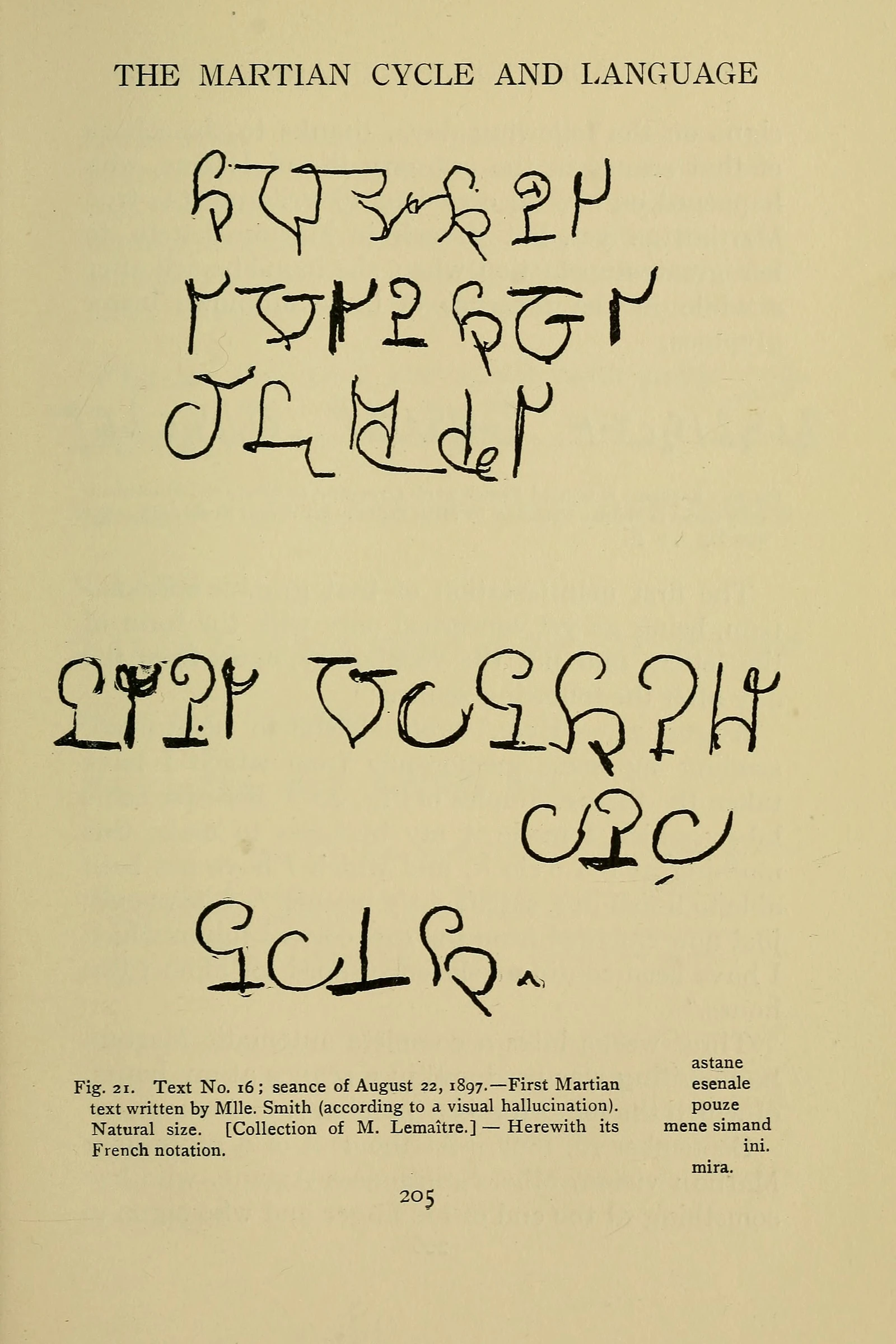
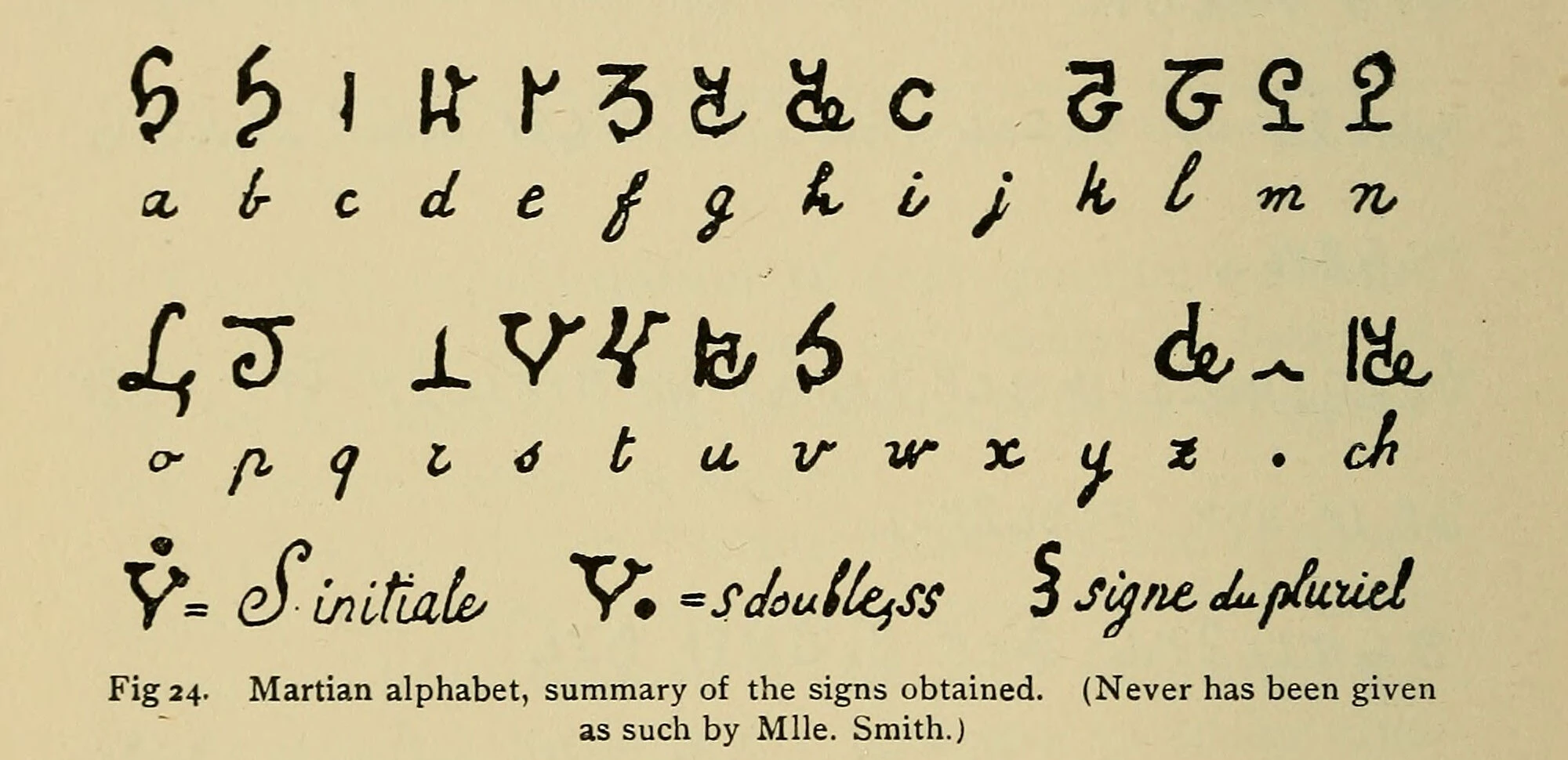
Where a revealed language held still long enough to be read, it was traced home. Theodore Flournoy, the Geneva psychologist, called the Martian of the medium Helene Smith "an infantile travesty of French." Don Laycock found Edward Kelley's language of the angels "based entirely on English." A. G. Garr sailed for India in 1906 believing he had been given Bengali. "I supposed [God] would let us talk to the natives of India in their own tongue," he wrote in 1908, "but He did not."
In 1987 Laycock reported a tape. "I have a recording of a man who claims to speak seventeen different extraterrestrial languages, but all of these are demonstrably glossolalia."
No clinical test of the DNA, the pineal gland or the pancreas turned up in the search for this article.
What the Tape Recorders Did Not Reach
None of those studies is of light language. Their speakers were mostly Christians at prayer, or volunteers in a lab. Laycock's tape comes closest, and he printed no analysis of it. Parmigiani, writing from inside a session, says it "might resemble glossolalia," but that "the message is multivocal." No phonetic analysis of a recorded session has turned up. The comparison is a reasonable label. It has not been tried on one tape.
The second gap is what was tested. The linguists asked whether the sound is a language: words, grammar, reference. Parmigiani's speakers say it "carries energy rather than meaning." A facade is no objection to a thing that never claimed the building.
And sound without words does carry something. In 2001 Klaus Scherer's team played language-free speech to listeners in nine countries, and they named the intended emotion 66 percent of the time. Shuar adults in South America picked out prohibition, approval and comfort in English-speaking mothers' voices "using only vocal cues." In 2018, 750 listeners in 60 countries could hear what songs from 86 societies were for. None of those studies tested tongues or light language, and none shows a fact passing. They do show the floor is not zero.
Then the record gets stranger. Link and Tomaschek found the commonest syllables were spoken shorter, as in natural speech, and wrote that glossolalia may have "reached the status of a 'second language'" for its speakers. And Flournoy, who called Martian a travesty, also ruled that "it is, indeed, a language," because its words kept their meanings.
And here is the strange part. He put his objections to Smith on October 16: too much i and e, a ch borrowed from French, a French word order. Seventeen days later came Ultra-Martian, "a language absolutely new," "extremely rich in a, without any ch at all." On Flournoy's own reading, the language had answered its critic.
One test went straight at the claim. Samarin and the psychologist Julius Laffal asked a minister to think of "strength" while praying in tongues, then "weakness." They looked for the thought in the sound. They did not find it. One speaker, more than fifty years ago, and "no interesting correlations."
One Tape, Two Listeners
On January 30, 2026, the Institute of Noetic Sciences announced what it calls "the first systematic characterization of non-religious glossolalists," led by Helane Wahbeh and Siri Zemel: a survey, a video interview that asks "whether the meaning of the content can be understood or interpreted by the speaker," and, on its research page, "audio analysis." As of October 31, 2026, a search turned up no results.
The tools exist. The linguist Sarah Thomason listened to 11 channeled "entities" for a 1989 paper, and caught one, said to be a sixteenth-century Scottish fiddler, using rapscallion, a word first recorded in 1699. In 1987, for speech under past-life hypnosis, she set out a retest: have the speaker translate a basic word list, wait a month, do it again. A real language comes back "mostly identical."
Light language gives that method almost nothing to hold. No accent to check. No date. No place. Only its translators can be retested at all.
Which leaves the simplest experiment. One recording, two listeners, no contact between them, and each writes down what came through.
Agreement would be a result nobody in this record has produced. Disagreement would settle very little, because "each of you will receive what you need" predicts it.
That is the irreducible thing. A sound that speaks differently to every listener cannot be caught out by two listeners who differ.
The Enchantress proposed a harder test, in one line: "can we put all light language speakers in a room to have a proper conversation?"
No record of that room turned up. It would not settle the frequency claim either, since a transmission that gives each listener what they need promises no conversation. It would answer something narrower: whether two people who say they speak Pleiadian know each other's Pleiadian when they hear it.
Nobody has to believe anything to sit in it.
Questions This Leaves You With
Is there anything a person actually does with this?
What you can do today is listen, or pay. Eva Marquez lists a one-hour session at $150; Price's book is $20. Nothing in this record shows that a session does what its seller says, and nothing shows it cannot, because no published test exists to read. If you are ill, no study here reaches your illness. The bigger question is not yours alone: whether a voice can carry more than linguists can count. Anyone selling a date for your activation is selling something.
Does this sit against a religious account of the world?
It cuts both ways. Paul wrote of the speaker in tongues that "no man understandeth him," and then: "let one interpret. But if there be no interpreter, let him keep silence in the church." So the oldest Christian text on this already asks the translation question. A deliverance ministry wrote in 2019 that light language "seems to be a counterfeit of the gift of tongues." Price calls it the same thing. Both have been argued in earnest. This site will not tell you which way it falls.
Does this change what a human life is?
If a body can understand what its owner cannot, you may be one voice in a much larger conversation, and that can make a life feel smaller: a relay, a speaker for someone else's signal. Or it can make it larger: a mind holding far more than it can say, and a throat that has known that all along. Marquez arrived at "It is all me." You may have felt one of those reactions before you finished the sentence. Notice which, and leave it there.
What would change your mind, in either direction?
Name it now, before you hear a session that moves you. Toward the claim: two listeners who never met writing down the same specific thing from one recording, again and again. A speaker whose translation of a tape matches itself a month later. Against it: a study showing light language is built from the speaker's own sounds, as Bryant and O'Connell found in tongues, plus blind listeners agreeing no better than chance. Or trainees sounding the same after two sessions, as 70 percent of Spanos's subjects did.
Do two speakers of "Pleiadian" speak the same language?
Nobody has shown it either way. Link and Tomaschek's 11 German speakers overlapped very little, even within one church, and they made no claim to share a language. Light language makes the larger claim: that a dialect has a source, a star, a character, and that speakers who never met receive it. Lay two recordings of one named dialect side by side and the question could be asked for the first time. The search for this article looked for any published attempt and came back with an empty space.
More photographs
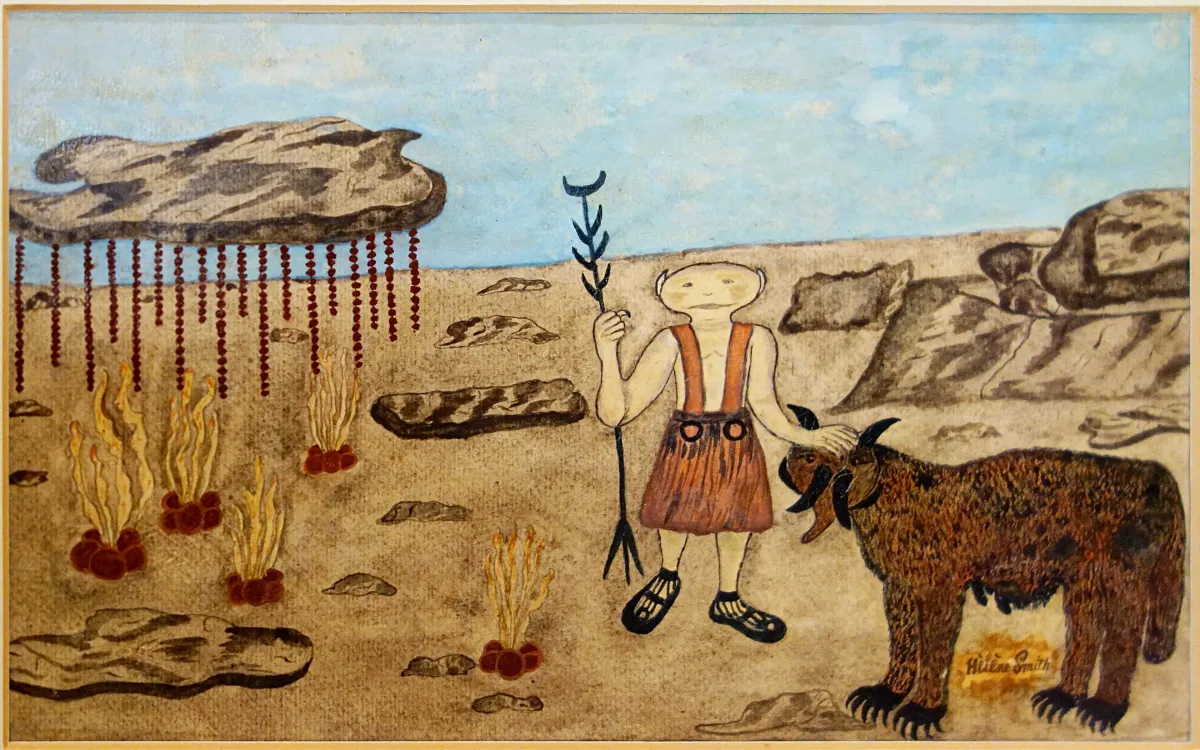
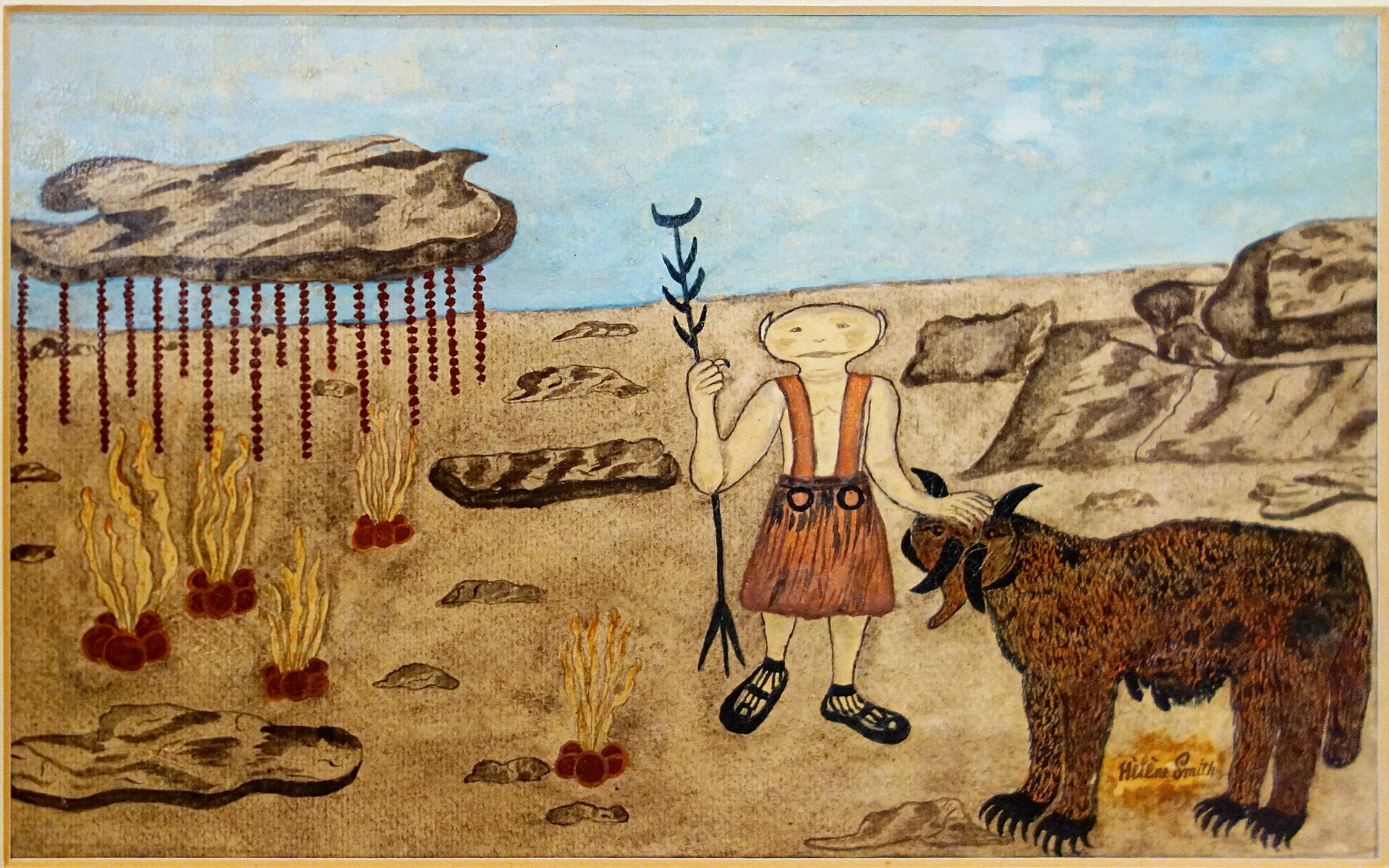
Helene Smith's painting of an "ultra-Martian" scene: a figure with a staff, a horned beast, and plants on a tan plain. Helene Smith, Paysage ultramartien, private collection, public domain, via Wikimedia Commons. 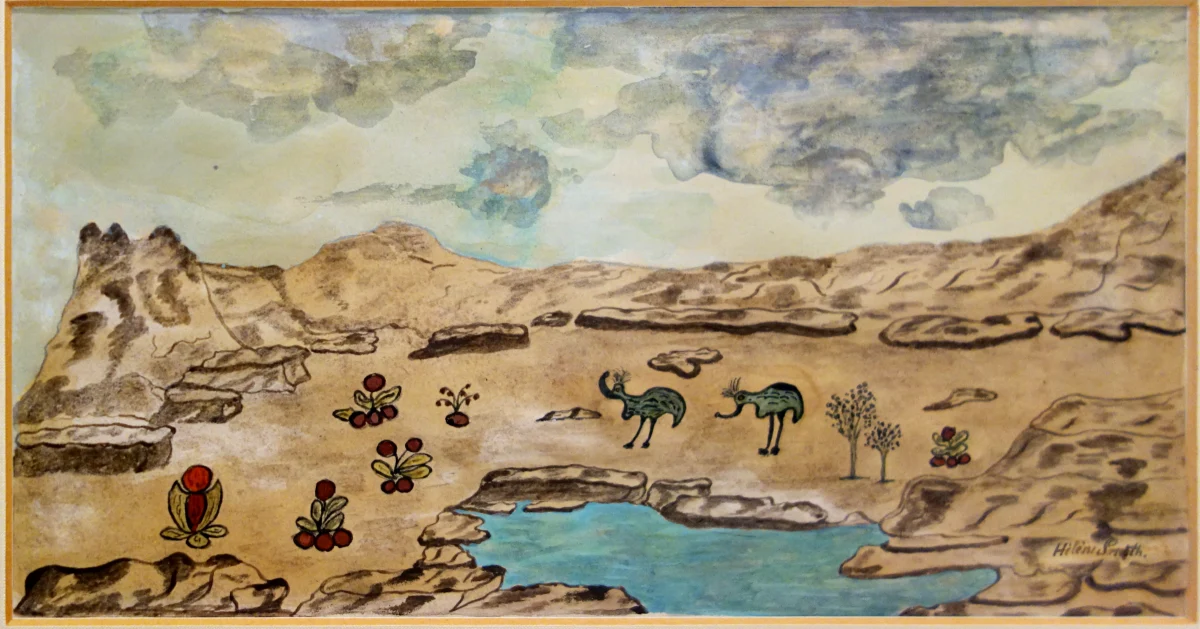
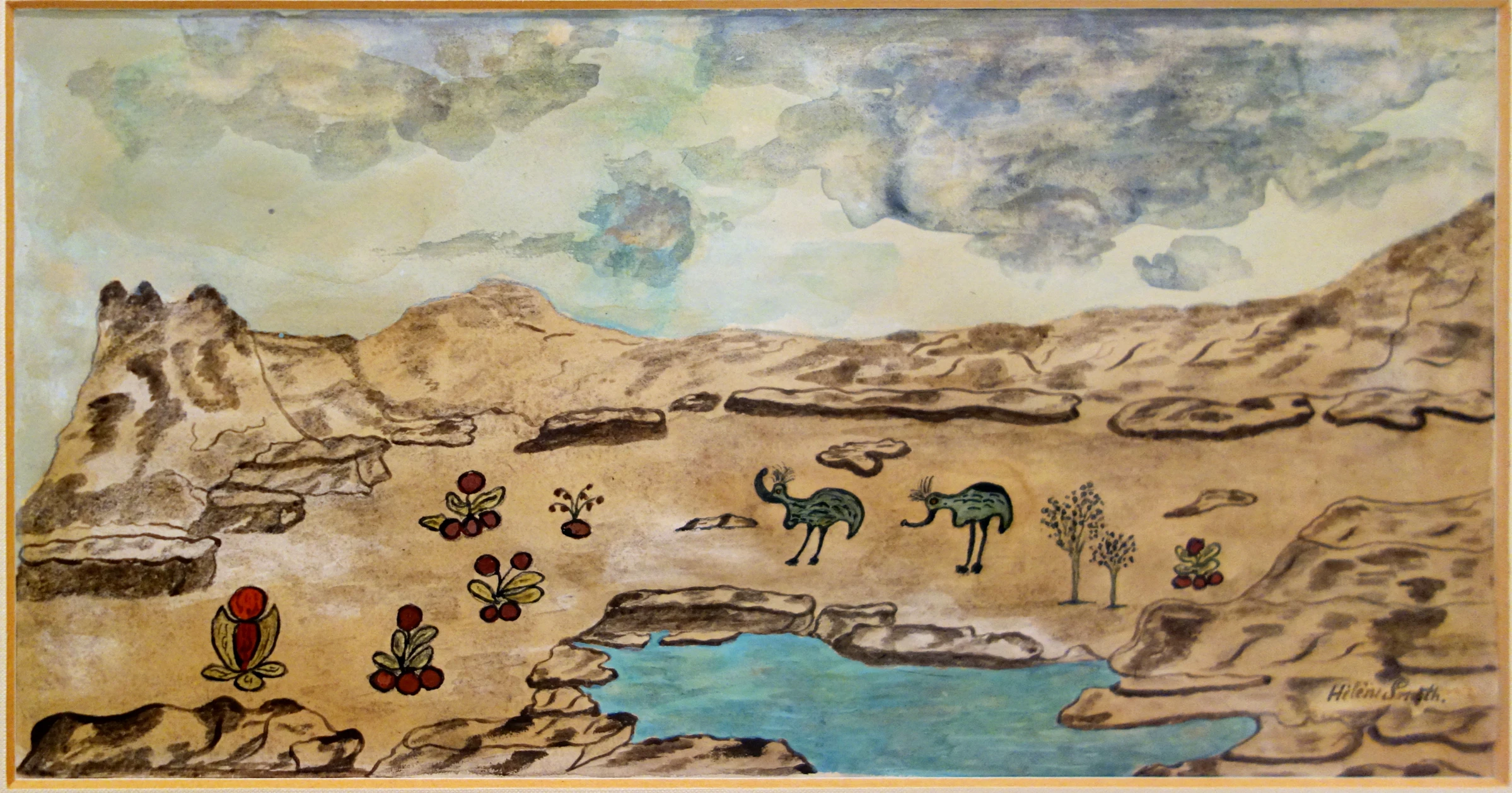
Another landscape by Smith, an extraterrestrial scene with a blue pool, long-necked birds and red-fruited plants. Helene Smith, Paysage extraterrestre, private collection, public domain, via Wikimedia Commons. 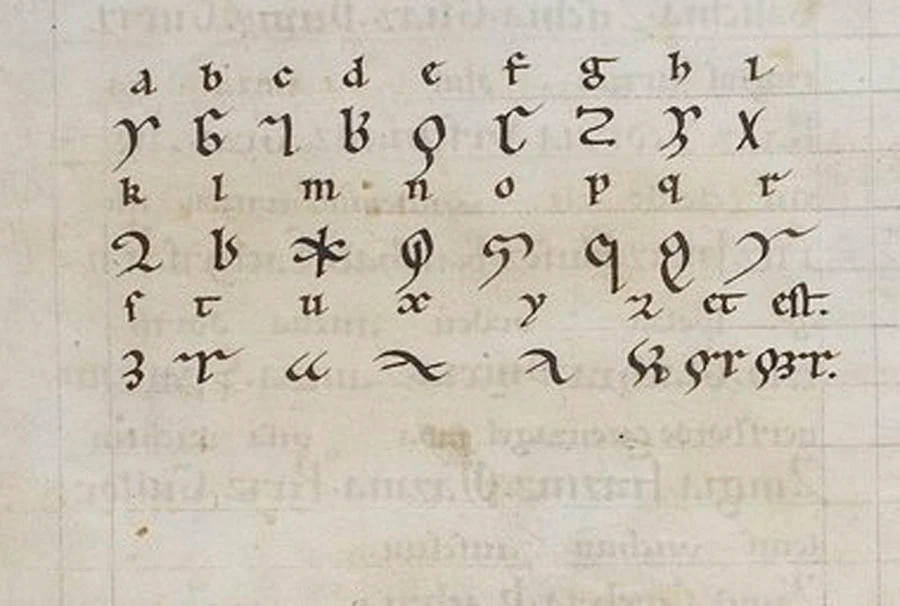
The unknown letters of Hildegard of Bingen in the Riesencodex, late twelfth century: invented signs keyed, like Smith's, to a familiar alphabet. Hildegard of Bingen, litterae ignotae, Riesencodex (Hs. 2), Hochschul- und Landesbibliothek RheinMain, public domain, via Wikimedia Commons. 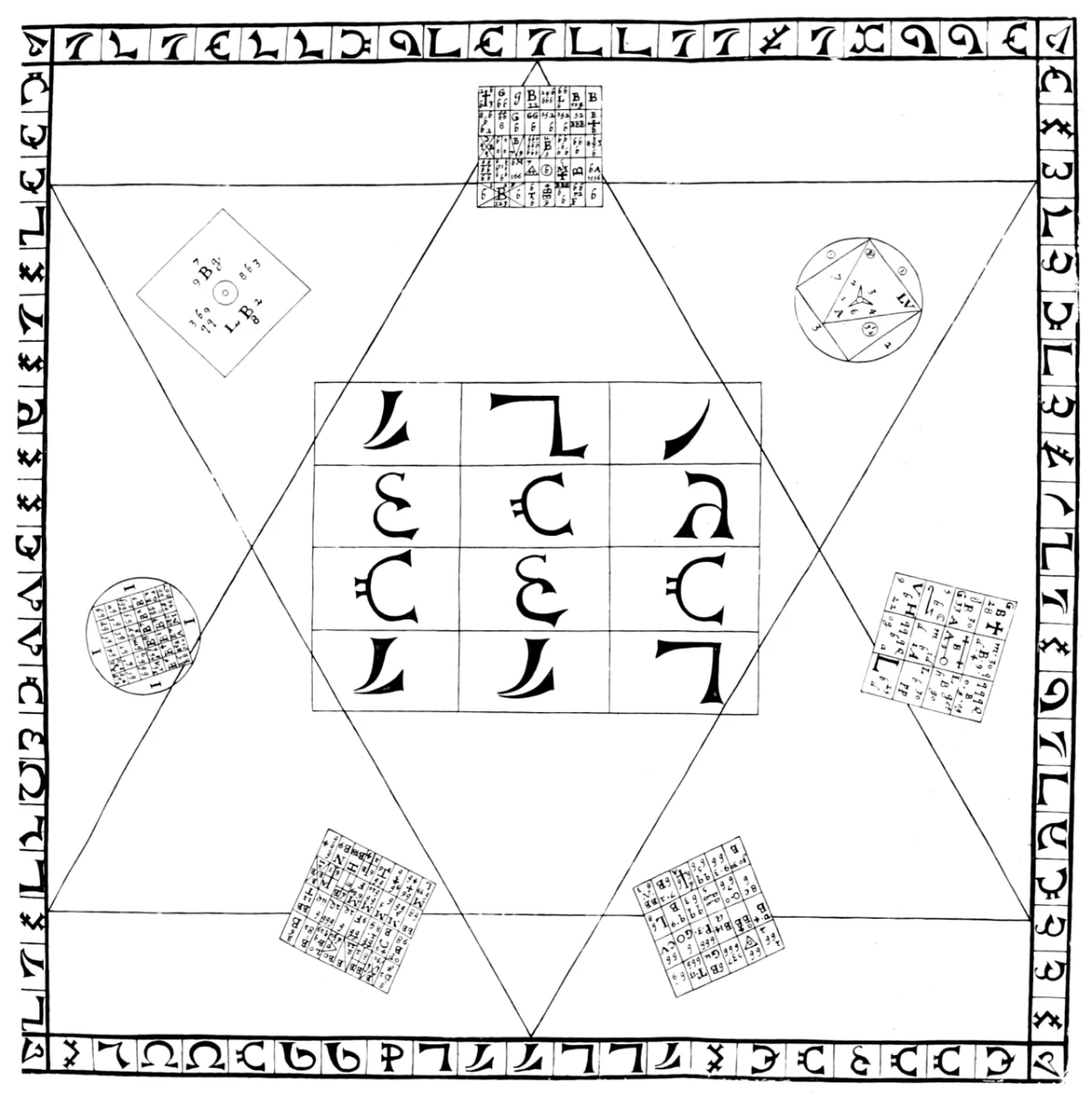
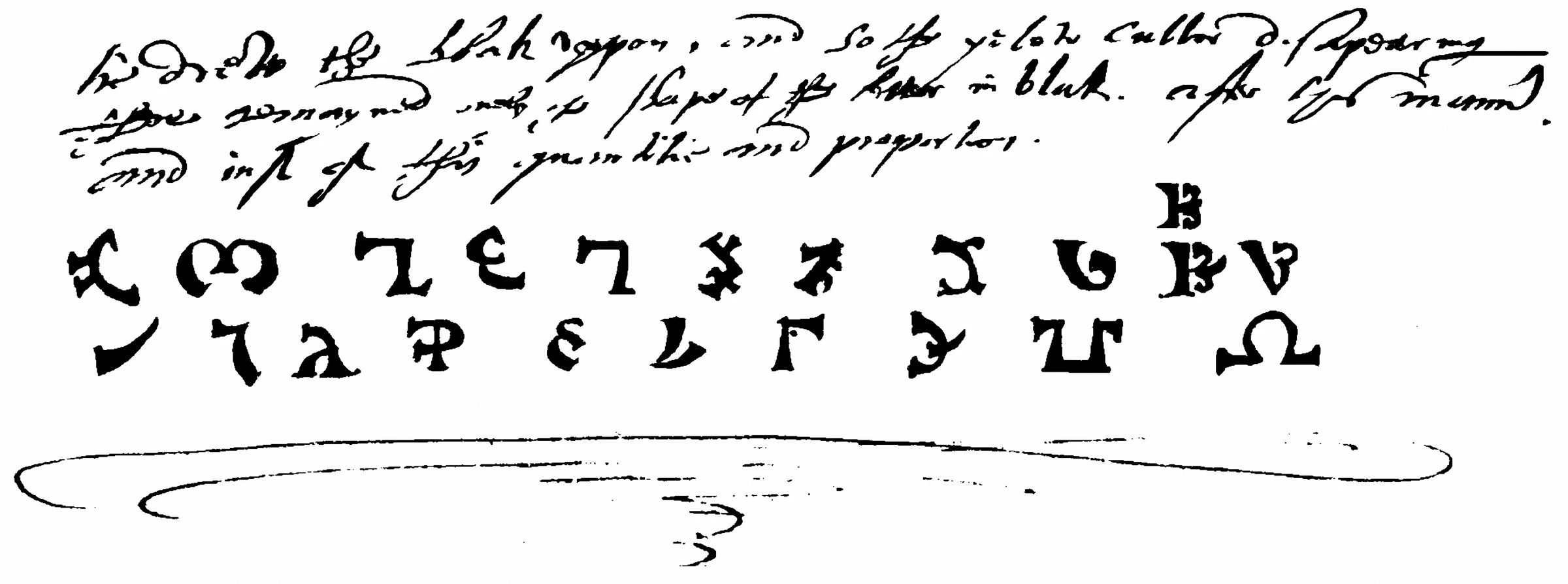
The Holy Table as printed in 1659, ringed and centred with the letters of Dee and Kelley's script. The Holy Table, in Meric Casaubon, A True and Faithful Relation (London, 1659), public domain, via Wikimedia Commons. 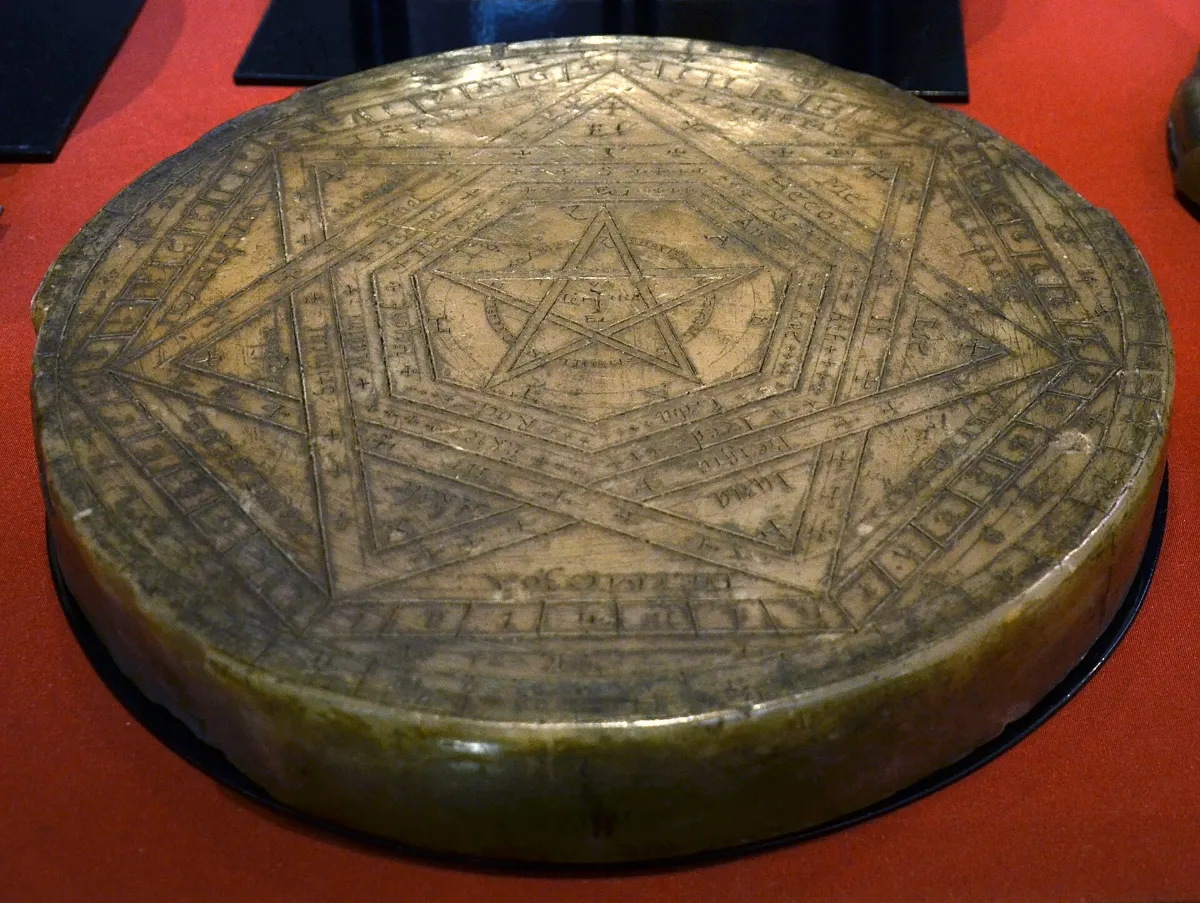
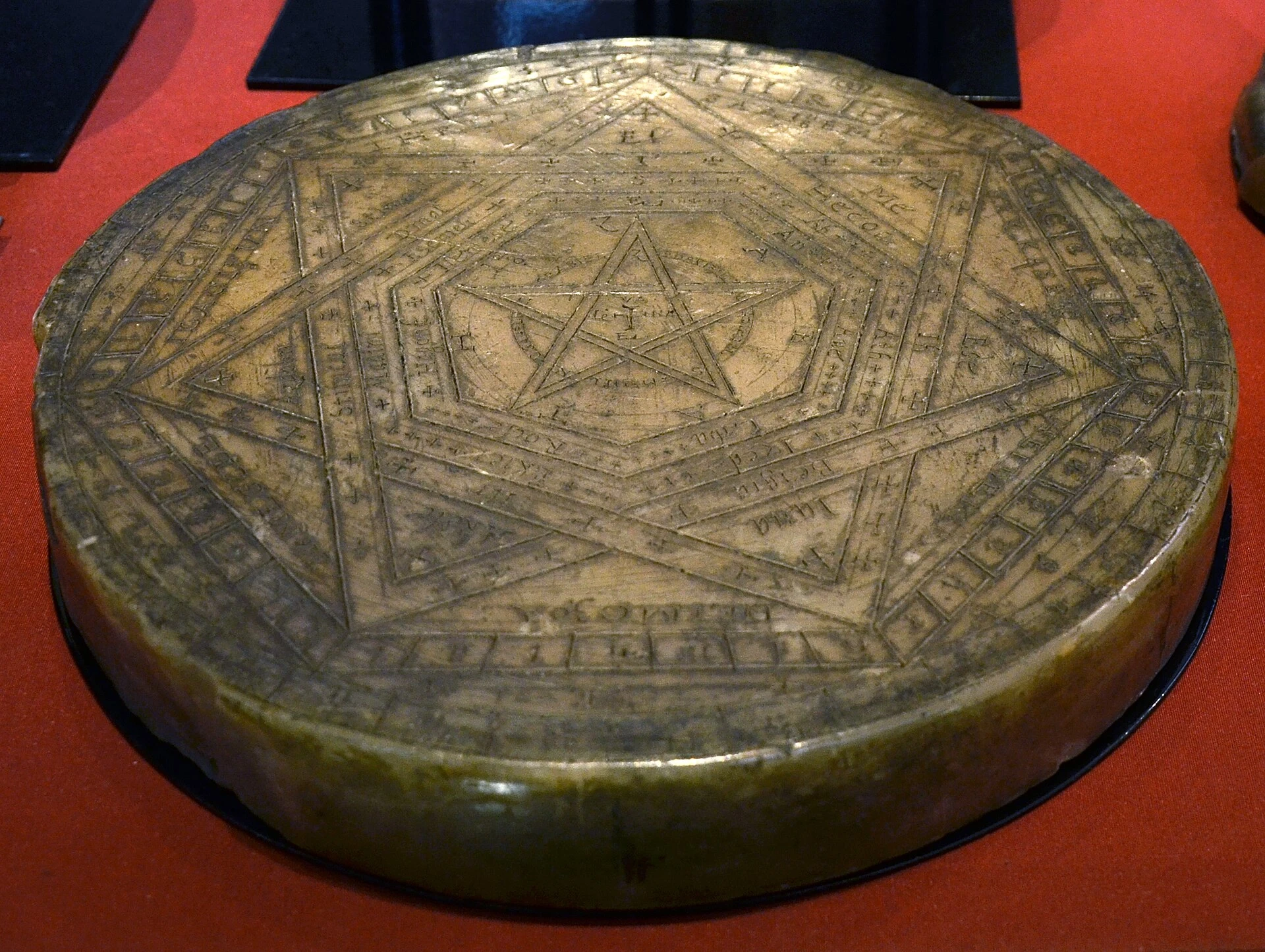
Dee's wax Seal of God, the Sigillum Dei Aemeth, in the British Museum: names and signs in a seven-sided figure. Photo: Vassil, CC0, British Museum, via Wikimedia Commons. 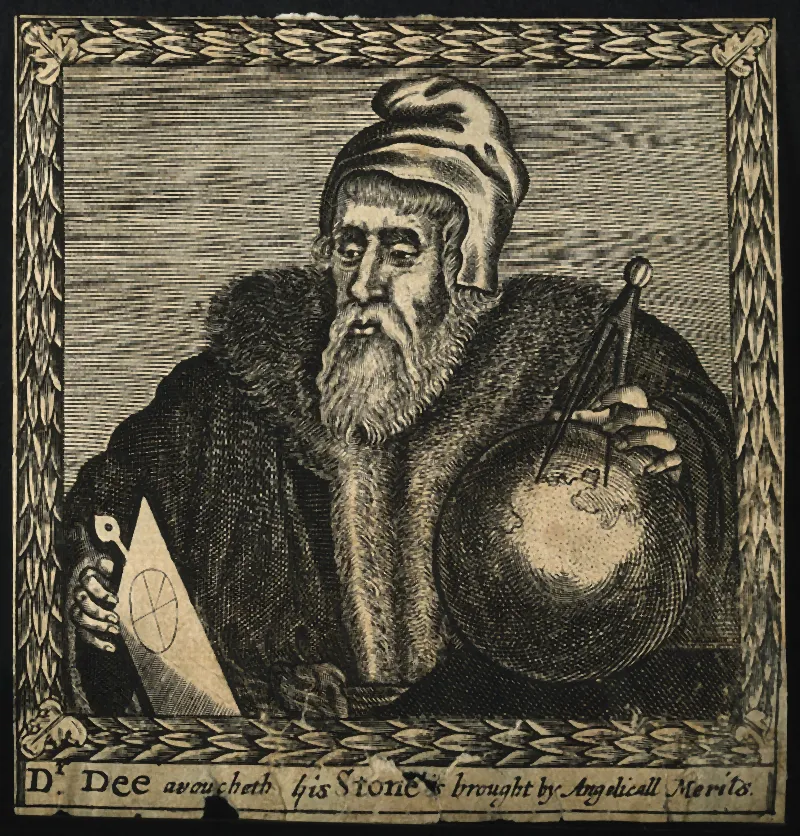
John Dee in an engraving of 1658, the year before Meric Casaubon printed his spirit records. Francis Cleyn, John Dee, line engraving, 1658, Wellcome Collection, public domain. 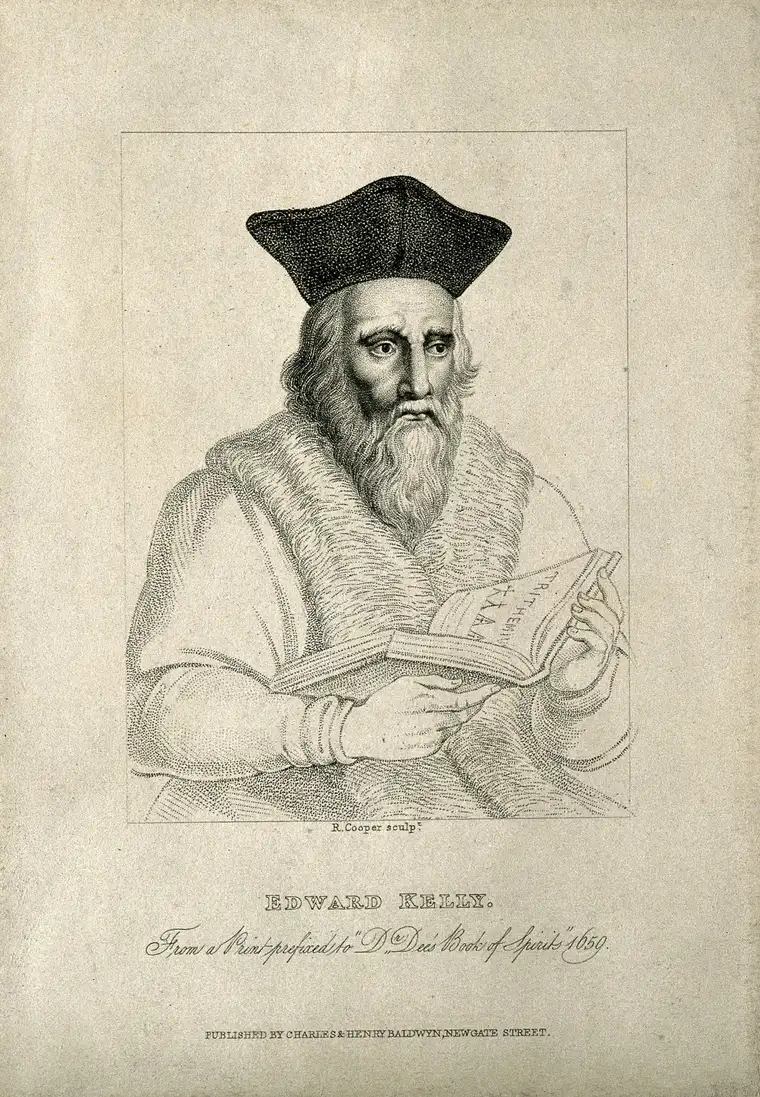
Edward Kelley, who reported the visions behind the Enochian material, in a later engraving. R. Cooper, Edward Kelley, stipple engraving, Wellcome Collection, public domain. 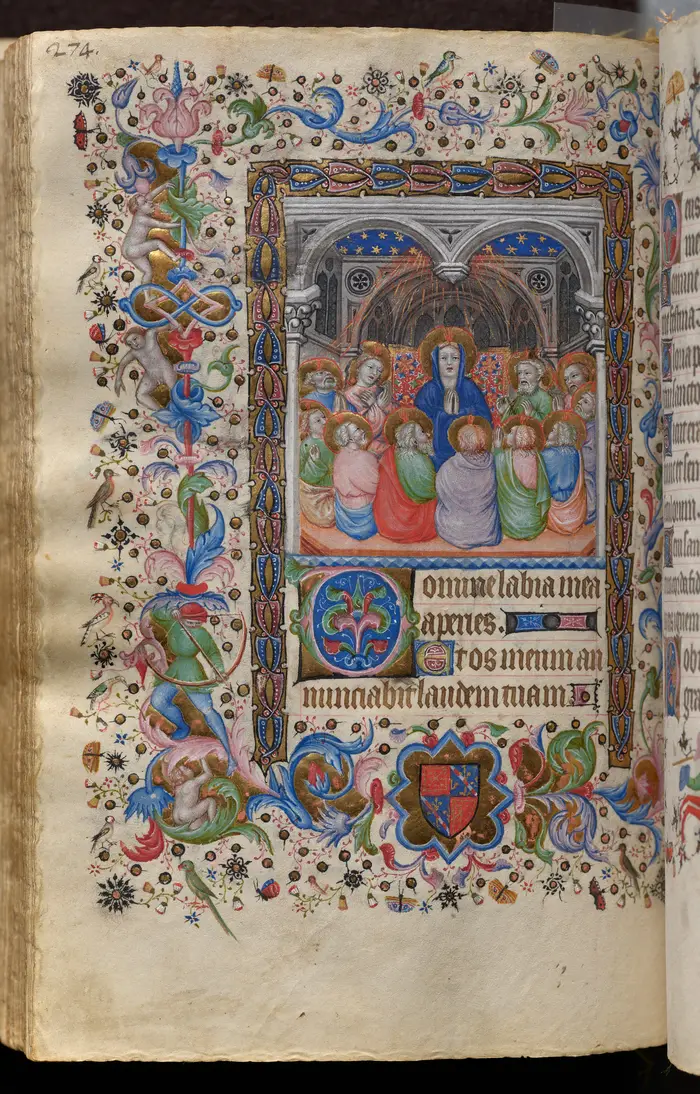
Pentecost in a French book of hours of about 1405: Mary and the apostles under rays from above, the scene Acts 2 tells of tongues as of fire. Hours of Charles the Noble, fol. 137v, Pentecost, c. 1405, Cleveland Museum of Art (CC0). 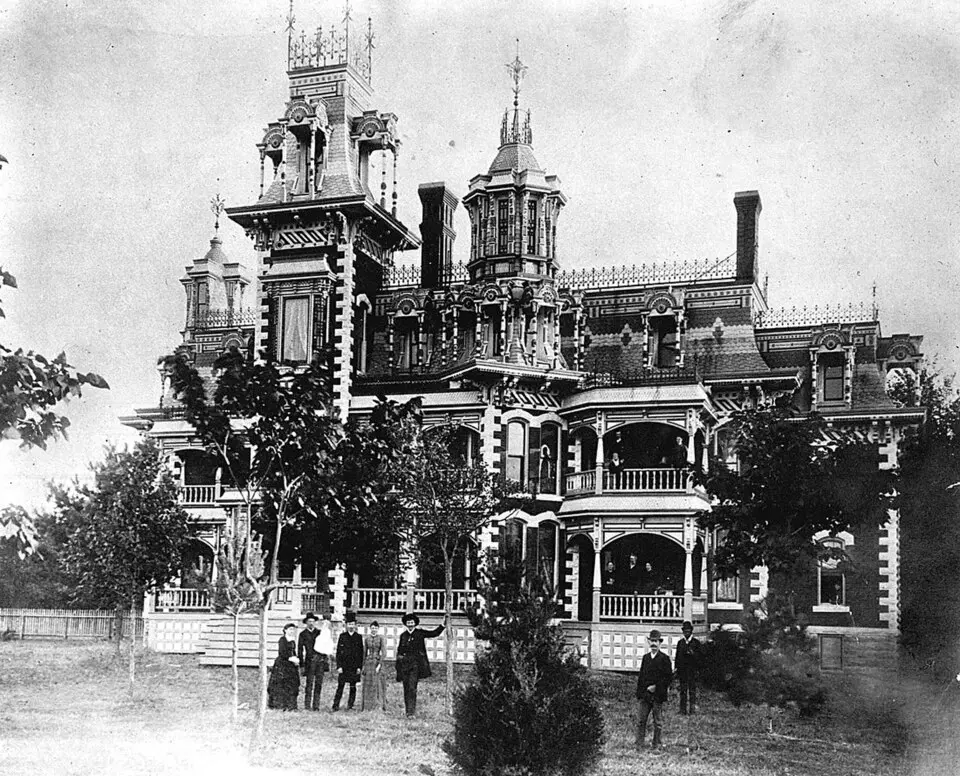
Bethel Bible College in Topeka, Kansas, about 1900, where Agnes Ozman's speaking in tongues was reported at the start of January 1901. Photo: Marion Doss, CC BY-SA 2.0 (creativecommons.org/licenses/by-sa/2.0), via Wikimedia Commons. Resized. 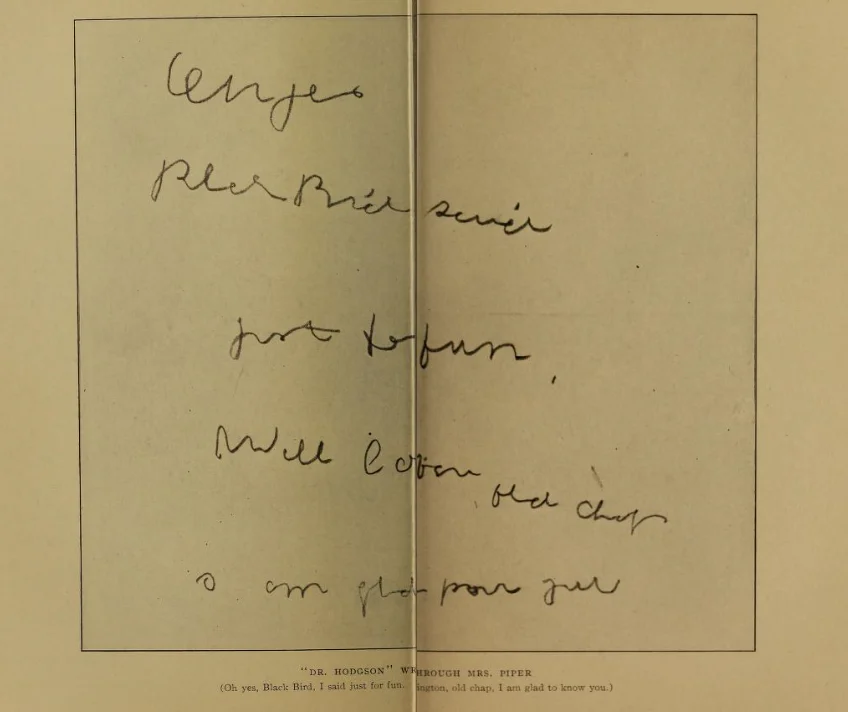
Writing by the medium Leonora Piper, claimed as from the spirit of Richard Hodgson, printed in 1911 by the same Flournoy who studied Smith. In Theodore Flournoy, Spiritism and Psychology (1911), public domain in the US, via Wikimedia Commons. 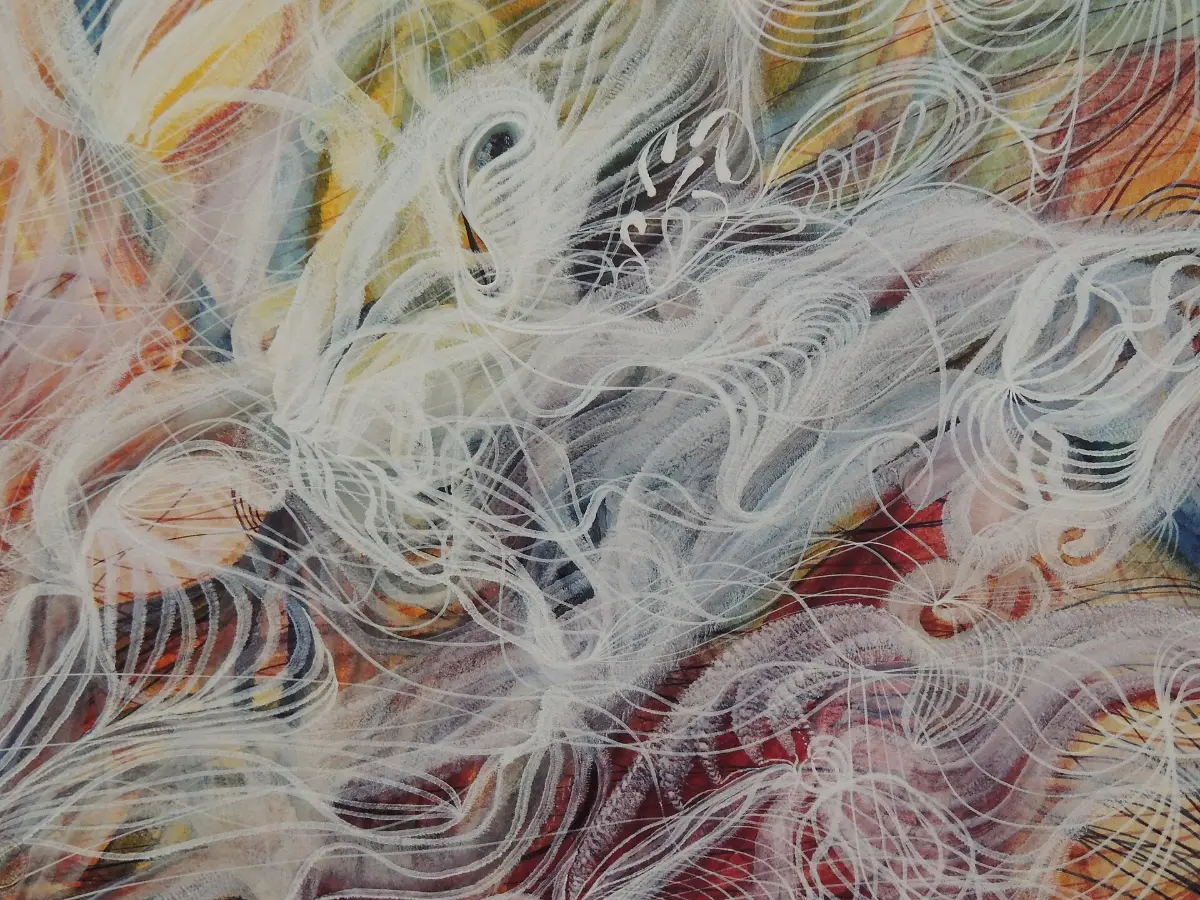
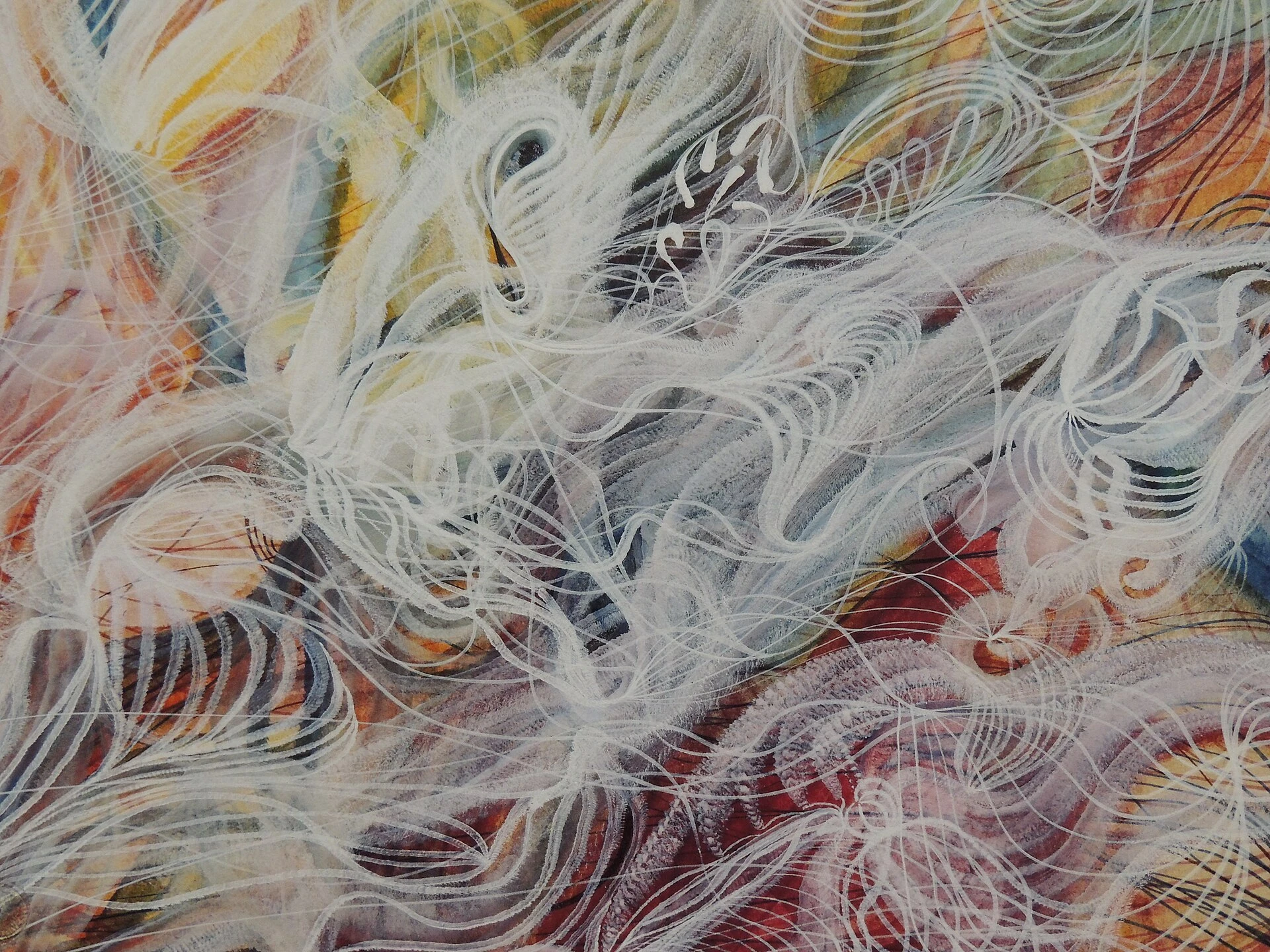
Detail of a drawing by Georgiana Houghton (1814 to 1884), a British artist and spiritualist medium. Georgiana Houghton, The Love of God (detail), public domain, via Wikimedia Commons. 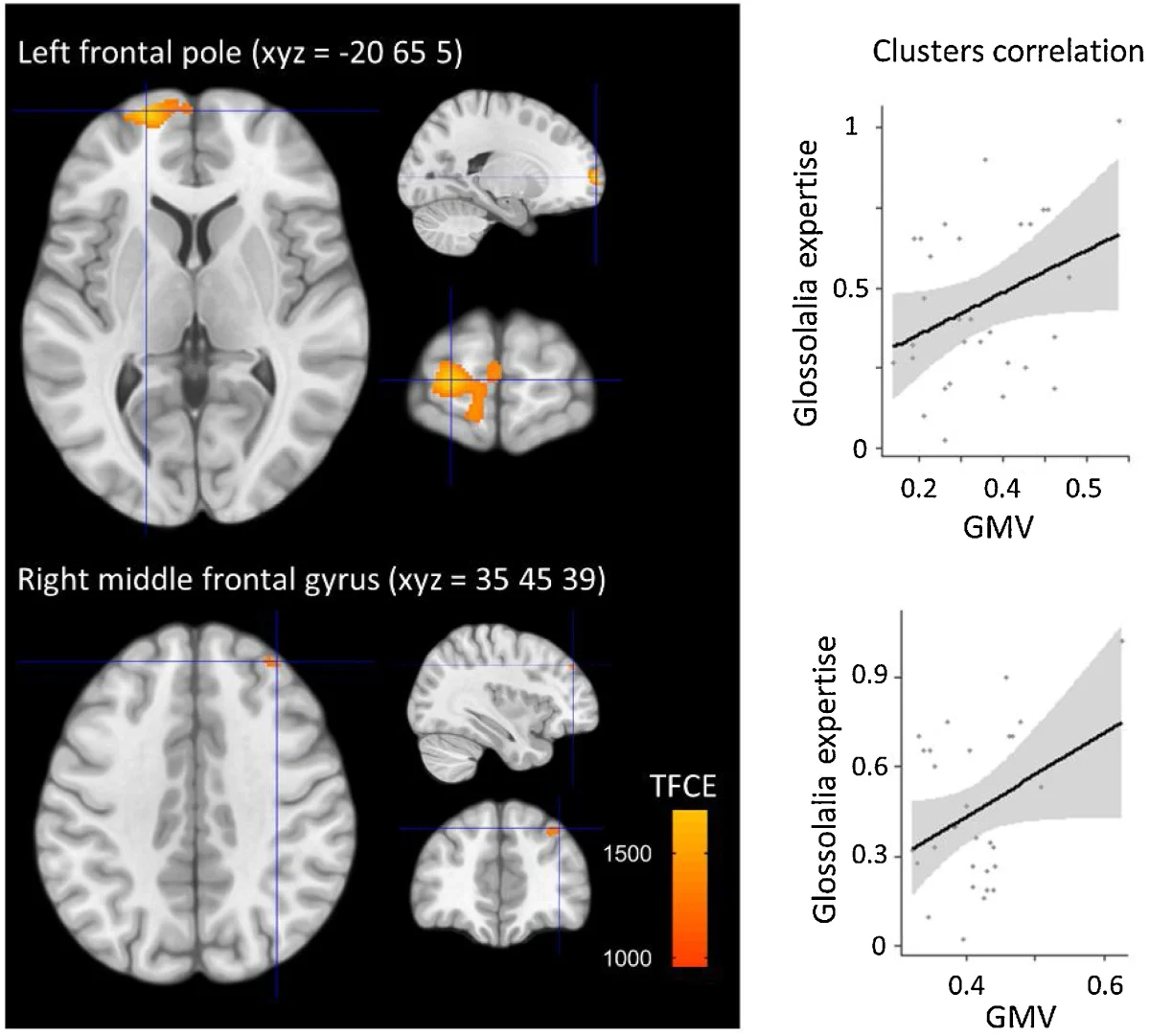
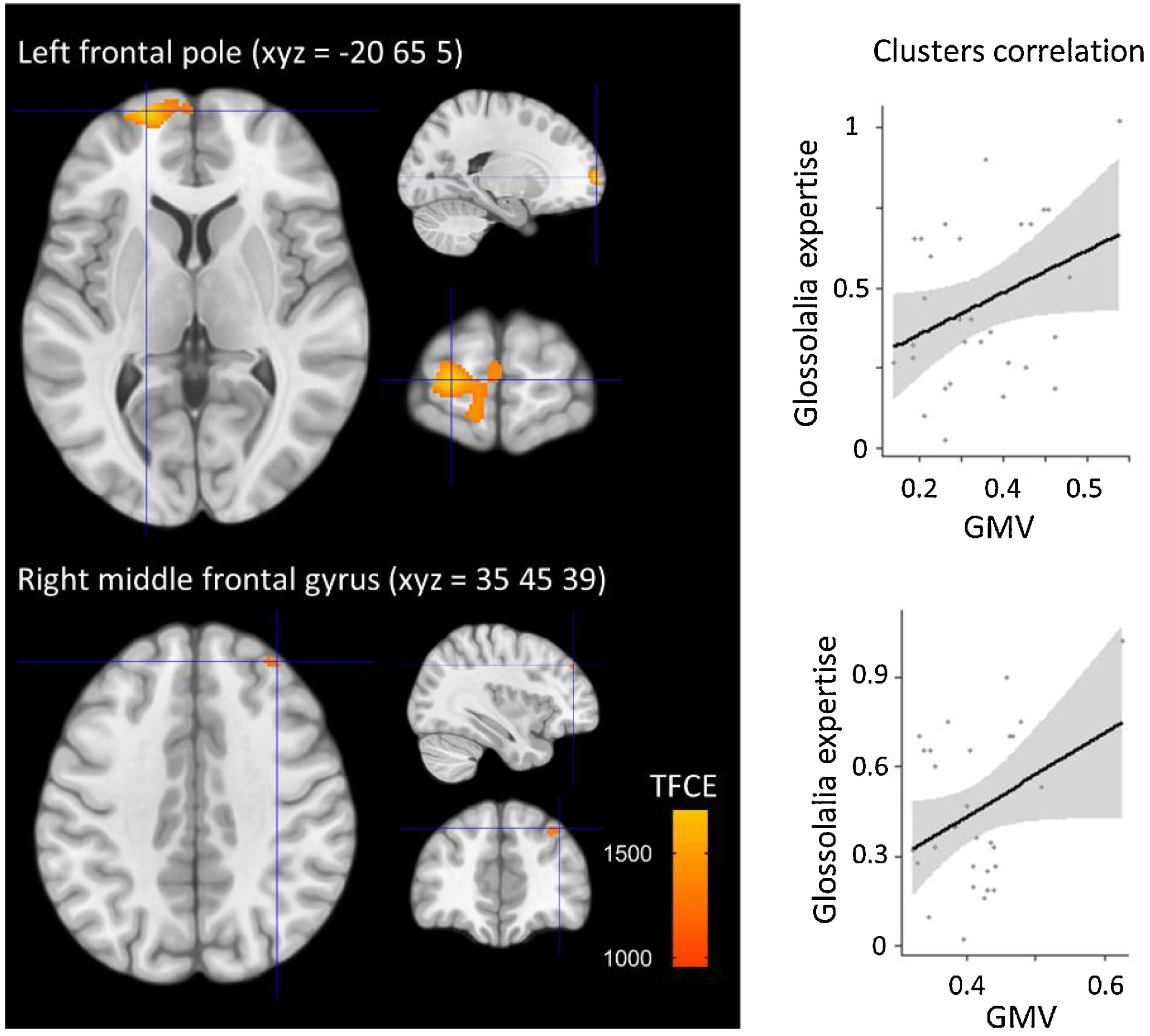
In a 2020 study of 30 experienced speakers in tongues, grey matter in two frontal regions rose with a measure of expertise. It is a correlation, and the authors place it outside the language control and production networks. Figure: Walter, Dieguez, Mouthon and Spierer, IBRO Reports 9 (2020), fig. 2, CC BY 4.0 (creativecommons.org/licenses/by/4.0), via Elsevier.
Select a photograph to see it full size, with its caption and credit.
Downloads
- Theodore Flournoy, From India to the Planet Mars, Harper, 1900, tr. Daniel B. Vermilye (Cornell copy, full PDF)Internet Archive scan; public domain in the USA, per Project Gutenberg
- Victor Henry, Le langage martien, Maisonneuve, 1901 (University of Illinois copy, full PDF)Internet Archive scan; published 1901, author died 1907
Sources
- Giovanna Parmigiani, Speaking in Frequencies, December 17, 2025 Center for the Study of World Religions, Harvard Divinity School Primary record
- Mattha Busby, Light language: the people who believe they're channelling alien energy, August 7, 2023 Dazed Study
- Jamye Price, What is Light Language jamyeprice.com Primary record
- Laura Marjorie Miller, What is Light Language?, Enchanted Living, Winter 2018 issue, web February 15, 2019 Enchanted Living Study
- Embracing the Shift, interview with Jamye Price, Spiritual Spotlight Series Buzzsprout Primary record
- Jamye Price, Opening to Light Language, publisher page jamyeprice.com Primary record
- Quotes from Jamye Price, Opening to Light Language Goodreads General reference
- Jamye Price, How to learn Light Language jamyeprice.com Primary record
- Irina Yugay, expertise by Regan Hillyer, What is light language and how to learn it?, December 6, 2022 Mindvalley Primary record
- Josie Danielle, Light Language josiedanielle.com Primary record
- Althea Lucrezia Avanzo, site althealucrezia.com Primary record
- Tom Kenyon, Transmission of Light for the Pancreas tomkenyon.com Primary record
- Tom Kenyon, Who Are the Hathors? tomkenyon.com Primary record
- Light Language - Trust Worthy or a Complete Farce?, June 1, 2022 The Enchantress Primary record
- Kathryn Post, Starseeds, government plots and an alien mantis, Religion News Service, March 6, 2026 Laredo Morning Times, syndicated Study
- Eva Marquez, sessions evamarquez.org Primary record
- The Book of Knowledge: The Keys of Enoch, overview Academy for Future Science Primary record
- Carey, Ken, Encyclopedia of Occultism and Parapsychology Encyclopedia.com General reference
- Barbara Marciniak, Bringers of the Dawn, 1992, publisher page Simon and Schuster Primary record
- Sanaya Roman and Duane Packer, Opening to Channel, 1987, catalogue record Internet Archive Study
- Casey Logan A'Hearn, Light Languages: New Age Glossolalia, September 15, 2024 blog.clahearn.com Study
- Share Your Light Language Experiences in the IONS Non-Religious Glossolalia Study, January 30, 2026 Institute of Noetic Sciences Primary record
- Channeling and light language research Institute of Noetic Sciences Primary record
- David Crystal, review of Tongues of Men and Angels, Language in Society, 1973 David Crystal Study
- Theodore Mueller, A Linguistic Analysis of Glossolalia: A Review Article, Concordia Theological Quarterly 45:3 Concordia Theological Seminary Study
- William J. Samarin, review of Felicitas Goodman, Speaking in Tongues, Language 50, 1974 University of Toronto repository Primary record
- Bryant and O'Connell, A phonemic analysis of nine samples of glossolalic speech, Psychonomic Science 22, 1971 Springer Primary record
- Link and Tomaschek, Predictability Associated With Reduction in Phonetic Signals Without Semantics: The Case of Glossolalia, Language and Speech 67, 2024 Sage Primary record
- Spanos, Cross, Lepage and Coristine, Glossolalia as learned behavior: an experimental demonstration, Journal of Abnormal Psychology 95, 1986 American Psychological Association Primary record
- Theodore Flournoy, From India to the Planet Mars, Harper, 1900, tr. Daniel B. Vermilye (Cornell copy, full PDF) Internet Archive scan; public domain in the USA, per Project Gutenberg Primary record
- Theodore Flournoy, From India to the Planet Mars, Project Gutenberg text Project Gutenberg Primary record
- Victor Henry, Le langage martien, Maisonneuve, 1901 (University of Illinois copy, full PDF) Internet Archive scan; published 1901, author died 1907 Primary record
- Don Laycock, Xenoglossy and Glossolalia, Summer 1987 Center for Inquiry archive Primary record
- Gary B. McGee, The Calcutta Revival of 1907, Asian Journal of Pentecostal Studies 6:1, 2003 Asian Journal of Pentecostal Studies Study
- Scherer, Banse and Wallbott, Emotion Inferences from Vocal Expression Correlate Across Languages and Cultures, Journal of Cross-Cultural Psychology 32, 2001 Sage Primary record
- Bryant and Barrett, Recognizing Intentions in Infant-Directed Speech, Psychological Science 18, 2007 PubMed Primary record
- Mehr and others, Form and Function in Human Song, Current Biology 28, 2018 PubMed Primary record
- Sarah G. Thomason, Past Tongues Remembered?, Skeptical Inquirer 11:4, Summer 1987 Center for Inquiry archive Primary record
- Sarah G. Thomason, Entities in the Linguistic Minefield, Skeptical Inquirer 13:4, Summer 1989 Skeptical Inquirer Primary record
- The King James Bible, 1 Corinthians 14 Project Gutenberg Primary record
- The demonic darkness behind Light Language, June 16, 2019 Jesus Truth Deliverance Primary record
- William Romaine Newbold, Spirit Writing and Speaking with Tongues, Popular Science Monthly 49, August 1896 Wikisource Primary record