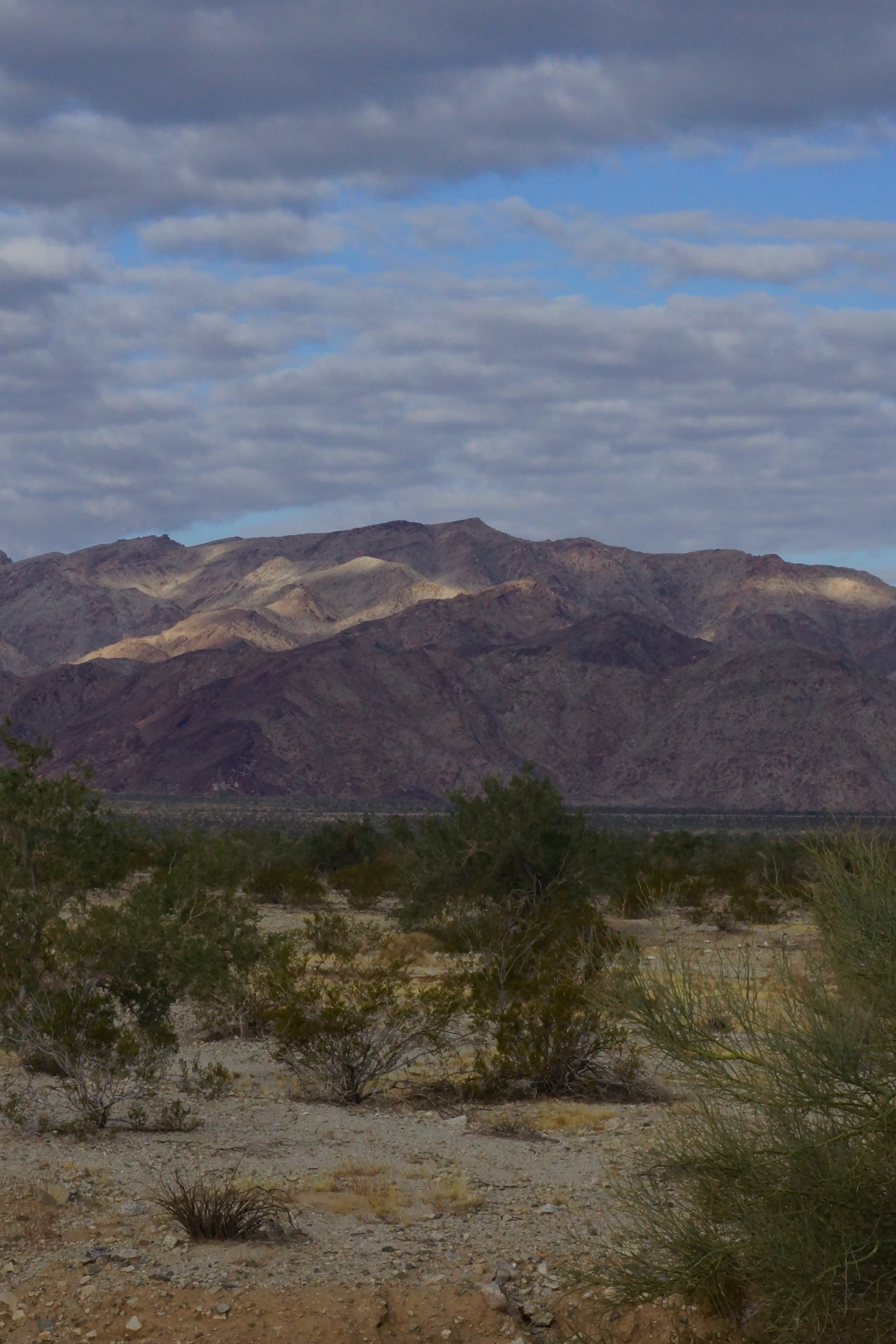
Desert Center is a small crossroads in the Colorado Desert of southern California, on the old highway east toward Arizona. Ten miles out along the road toward Parker, in Adamski's own description, the ground was sharp volcanic rock, with small bushes of silver-white desert holly and their red berries.
There, on Thursday 20 November 1952, at about half past twelve, George Adamski said he met a man from another world.
Not a light in the sky. A man.
Six people came with him that day. On his account, they stayed by the cars while he walked out alone across the rocks with a camera and a small telescope, and he was gone about an hour. When he came back, he said he had spoken with a visitor from Venus, and that the visitor had left his footprints in the ground.
Every word of what happened out there comes from testimony. Adamski's, in a book. His companions', in a statement sworn before a notary four months later. No film shows the meeting and no instrument recorded it. What exists is what people said, and what they signed, and what one of them later took back.
That testimony started a movement.
Palomar Gardens
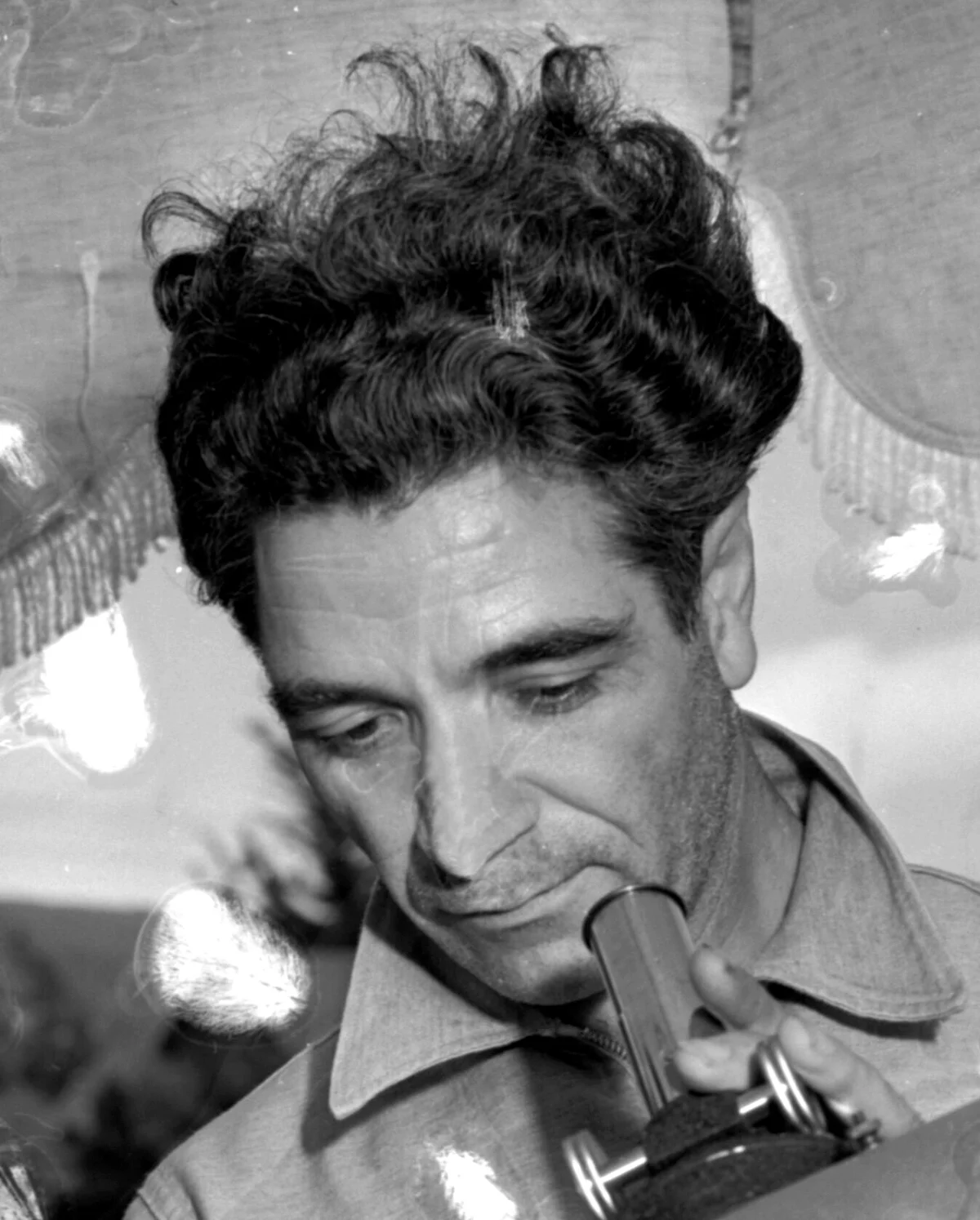
George Adamski was born on 17 April 1891 in Bromberg, then in Prussia and now Bydgoszcz in Poland, to Polish parents, and came to the United States as a small child. He served in the US cavalry from 1913 to 1916. In the 1930s, at Laguna Beach in California, he founded a group called the Royal Order of Tibet; a Los Angeles Times photographer pictured him in 1938 beside a telescope at its temple.
By the 1940s he lived on the road up Palomar Mountain, at Palomar Gardens, a campground and cafe bought with money from his follower Alice K. Wells. Visitors often took him for an astronomer at the great observatory up the hill. He was not. He had a six-inch telescope of his own, and from the late 1940s he pointed it at the sky and photographed what he said were flying saucers.
In August 1952 a couple from Winslow, Arizona, Alfred and Betty Bailey, came to see him. Through them he met George Hunt Williamson and his wife Betty, of Prescott. In Adamski's account the four were as interested in the saucers as he was, and in November they agreed to go looking together.
The party met on the highway west of Blythe on the morning of the 20th. Adamski came with Alice Wells and his secretary, Lucy McGinnis, whom the book spells McKinnis. On the road toward Parker, he wrote, they saw a large cigar-shaped craft. He set up his telescope a little way off the road, and the others waited by the cars.
In his telling they "maintained a steady watch from a distance." And in his telling he was away from them for "sixty minutes."
One hour.
The man on the rocks
What Adamski said he saw is set out in Flying Saucers Have Landed, the book he wrote with Desmond Leslie, a cousin of Winston Churchill, published in 1953.
A small craft came down in a saddle of the hills. A man walked toward him. He was of medium height, with an even suntan and long hair. "His hair was sandy in colour," Adamski wrote, "and hung in beautiful waves to his shoulders." They spoke without a shared language, by gestures and by what Adamski called telepathy, which he said he had been teaching as fact for thirty years. He drew the orbits of the planets in the air and asked: "You mean you come from Venus?" The man nodded and spoke the word himself. When Adamski asked about the explosions of atomic bombs, the visitor answered with a gesture, a sweep of the hands over the land and the words "Boom! Boom!"
Before he left, the visitor pressed his footprints into the ground, and Adamski said they carried markings, symbols he took as a message. He walked back to signal the others. Williamson, whom the book calls an anthropologist, made plaster casts of the prints; the party had brought plaster of Paris in case of exactly this.
Then the story kept going. The visitor had taken one of Adamski's photographic plate holders. On the morning of 13 December 1952, Adamski wrote, a craft passed low over Palomar Gardens, a port opened, a hand waved, "and the selfsame holder" was dropped at his feet. The plate inside held writing he had not put there. That day he photographed what he called a scout ship through his telescope, a bell-shaped craft with three spheres beneath it, and newspapers and magazines were soon printing his pictures.
The record grew. On 24 November 1952, Adamski wrote, the Phoenix Gazette published his report with photographs of the four witnesses who had told the paper the story. On 6 March 1953, at Winslow, Arizona, a statement was sworn before the notary C. O. McCauley: the signers declared that they had read Adamski's account of his meeting with a man from another world and had been witnesses to the event as recorded. The legible signatures on the page printed in the book are Alfred C. Bailey, Betty M. Bailey and George H. Williamson.
The book sold. With a second Adamski title, it passed 200,000 copies in the 1950s. Adamski lectured across the country. Edward Ruppelt, who ran the US Air Force's Project Blue Book, visited his cafe without saying who he was in 1953 and later wrote that Adamski had "the most honest pair of eyes I've ever seen." In the desert at Giant Rock, George Van Tassel's yearly spacecraft conventions, begun in 1953, drew crowds of up to 10,000 by 1959; Adamski spoke there in 1955. Others told of visitors and messages of their own. Of all their stories, Desert Center became the best known.
If the visitor was real
Set aside for a moment whether it is true. Ask the better question. What would it mean if he was?
It would mean contact has already happened, quietly, to a man with a cafe and a six-inch telescope, and not to an observatory or a government. The first meeting between our species and another would have been beside a desert highway ten miles from a crossroads, witnessed by six people from a distance and written down by the man who was there.
It would mean the message was simple. On Adamski's account the visitor came with a warning about the bombs, not with technology or demands. If that was real, then the first thing another world wanted to say to humanity in the nuclear age was: stop.
It would mean the long human habit of listening for the sky had been answered in the plainest way possible. Scientists had spent decades straining after faint signals, from Tesla's receiver at Colorado Springs onward; on Adamski's account, the answer walked up on foot and spoke a word of English.
It would mean every other channel since then deserves a hearing on its own record. The contactees who came after Adamski, and the ones who still speak today, like Nancy Lieder and her Zetas, would each be a possible line, to be tested and not dismissed.
And it would leave the largest question standing in front of us: if they came once, to one person, on a weekday in November, why have they never come to all of us at once? Which would put the choice of whom to meet, and when, entirely on their side.
What the investigators found
The standard account holds that the meeting did not happen as Adamski told it, and it rests on what his own circle and later investigators reported.
The first is the witnesses. According to the UFO historian Jerome Clark, in his UFO Encyclopedia, Alfred Bailey, whose name stands on the sworn statement, later retracted his testimony, "saying he had seen neither spaceship nor spaceman." Williamson, by the account the historian Curtis Peebles gives in Watch the Skies!, did not see the encounter itself. Jerrold Baker, an associate of Adamski who was not on the trip, told Moseley, as Clark reports, that he had heard a tape recording of "what was to transpire in the desert, who was to go, etc.," several days before the party left Palomar Gardens.
The second is the photographs. The investigator James Moseley looked into the case in the mid-1950s, and his Saucer News gathered the findings in a special Adamski issue in October 1957. Walther Riedel, a rocket engineer, told Moseley that the scout ship's landing gear looked like light bulbs, and in 2012 the researcher Joel Carpenter matched the craft to the shade of a 1930s gas lantern sold by Sears. Experts including the astronomer J. Allen Hynek dismissed the pictures as crude fakes.
The third is the planet. On 14 December 1962 NASA's Mariner 2 flew past Venus and found it hot. NASA now gives its surface temperature as about 467 degrees Celsius, under a carbon dioxide atmosphere at 93 times the pressure at Earth's sea level.

And the FBI, to whom Adamski said his material had been cleared, had him sign a statement in 1953 that the Bureau did not endorse him.
What the investigations do not reach
The investigations reach the photographs and the planet. They do not reach everything that happened on the road that day.
Something brought six people to that roadside and kept them watching. Adamski's own account says they all saw the large craft before he walked away, and that all of them saw the small one flash through the sky as it left. The retraction on the record is Bailey's alone, and it comes to us through Clark, without a date or a text of its own. What Betty Bailey, Betty Williamson, Alice Wells and Lucy McGinnis believed for the rest of their lives is not documented in any source this article could open.
No source says anyone else saw the visitor's face.
On the record, the only person who stood beside him was Adamski. That is where the investigations stop too: they test what he brought back, the pictures and the description of a planet, and they reach the people he was with. They do not reach the hour itself.
The physical evidence has gone quiet rather than been tested. The plaster casts of the footprints were photographed and sketched in 1952. The plate dropped on 13 December was printed in the book. Where the casts and the original plates are now, no source opened for this article says, and no laboratory report on either has been published.
And the tape. Baker said he heard it; Clark reports what Baker said. The tape itself has not been produced. That leaves it what the rest of this day is: testimony, on one side as on the other. A sworn statement, a retraction reported by a historian, a recollection of a tape. The case against the meeting rests on the photographs and the planet, which can be checked. The case about the hour rests on people, who cannot be recalled.
Where it stands
What the record shows is clear. On 20 November 1952 seven people drove into the desert east of Desert Center. One walked away for an hour and came back with a story. Members of the party swore to it in March 1953, and one of them, Bailey, later took his word back. The photographs Adamski published have been matched to everyday objects, and the Venus he described is not the Venus NASA found. On that record, the weight lies with the investigators.
What is still open is narrower and more human. What the other five saw, and what they believed. Whether the casts and plates still exist, and what they would show. The people who could have answered the first question are gone. The second is a matter of where things were kept after Palomar Gardens, which no source opened for this article records.
The casts, if they survive, are the one piece of that day a laboratory could still hold.
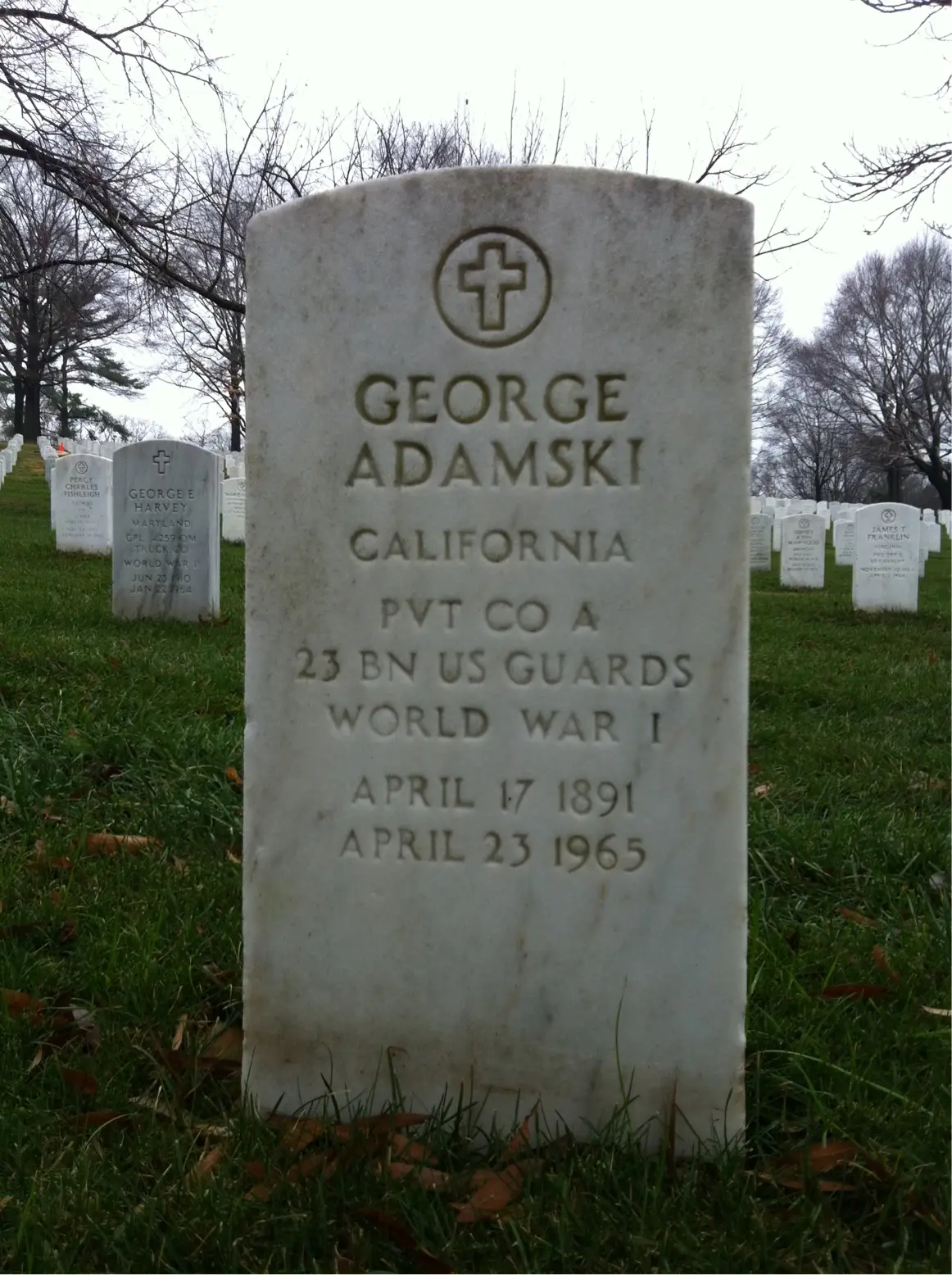
Adamski died on 23 April 1965, at Silver Spring, Maryland, and is buried at Arlington National Cemetery. The contactees he led the way for are still speaking, and their testimony is still testimony: someone's word, signed or unsigned, about a meeting nobody else saw.
Desert Center is still a crossroads. The road toward Parker still runs ten miles out across the rocks.
Questions This Leaves You With
Is there anything a person actually does with this?
Not in the sense of a change to your own life: nothing in the Desert Center story asks you to prepare for anything, and anyone who sells a date for the visitors' return is selling something. What it does hand you is a way of weighing testimony. You can ask of any account like this: who was there, who signed, who withdrew, and what physical thing was left behind that someone else could test. Those four questions travel well beyond flying saucers. They are the questions a court asks of witnesses, and they work as well on a newspaper story, a family legend or a sermon. Desert Center is a good place to practise them, because the answers are unusually well documented on one side and unusually thin on the other.
Does this sit against a religious account of the world?
It has been read both ways. Adamski presented the visitor as a messenger with a warning for humanity, and his account carries a spiritual message alongside the warning. A reader can take it as revelation, or as a very human story about what people in the atomic age hoped to hear. Neither reading needs the other to be false. This site will not tell you which way it falls for you.
Does this change what a human life is?
It depends on which story you carry. If the visitor was real, a human life sits inside a neighbourhood of worlds that has been watching us and was worried enough to warn us. If he was not, then a man with a cafe and a telescope reached hundreds of thousands of readers with nothing but a story and a few photographs, which says something remarkable about how much people want company in the sky.
What would change your mind, in either direction?
Name it now, before you are committed. It helps to know how historians weigh testimony like this. A statement made at the time counts for more than one made years later; a statement against the speaker's own interest counts for more than one that helps him; and a detail that can be checked counts for more than one that cannot. By those rules, the signed statement of 1953 and Bailey's retraction pull in opposite directions, and neither is decisive alone. Toward the meeting: the footprint casts found and tested, or a companion's own account written in 1952. Toward the investigators: the tape Baker described, produced and dated.
What did the other five see?
That is the empty space at the centre of this story. Six people stood by the cars that afternoon, and only one retraction is on the record. The paper trail from those first days is thin but real: Adamski says the Phoenix Gazette ran the story on 24 November 1952 with photographs of four of the witnesses, and a newspaper of that date sits on microfilm somewhere. What the companions told a reporter four days after the trip, before any book, any lecture or any falling out, would be the closest thing to their own words. As far as the sources opened for this article show, nobody has republished it.
Sources
- Desmond Leslie and George Adamski, Flying Saucers Have Landed (1953; later reprint, full text) Internet Archive
- Flying Saucers Have Landed, New York: British Book Centre, 1953 (catalogue record) Internet Archive
- Jennifer Brannock, Flying Saucers Have Landed (1953), Item of the Month, 2021 University of Southern Mississippi Special Collections
- George Adamski Wikipedia
- Curtis Collins, Saucer News presents: the George Adamski Expose, 2014 (quoting Jerome Clark, The UFO Encyclopedia) jimmoseley.com
- George Hunt Williamson Wikipedia
- Greg Daugherty, George Adamski Got Famous Sharing His UFO Photos and Alien Encounters, History.com A+E Networks
- George Van Tassel Wikipedia
- Mariner 2, NSSDCA Master Catalog NASA
- Venus Facts NASA Science
- FBI Files: George Adamski The Black Vault