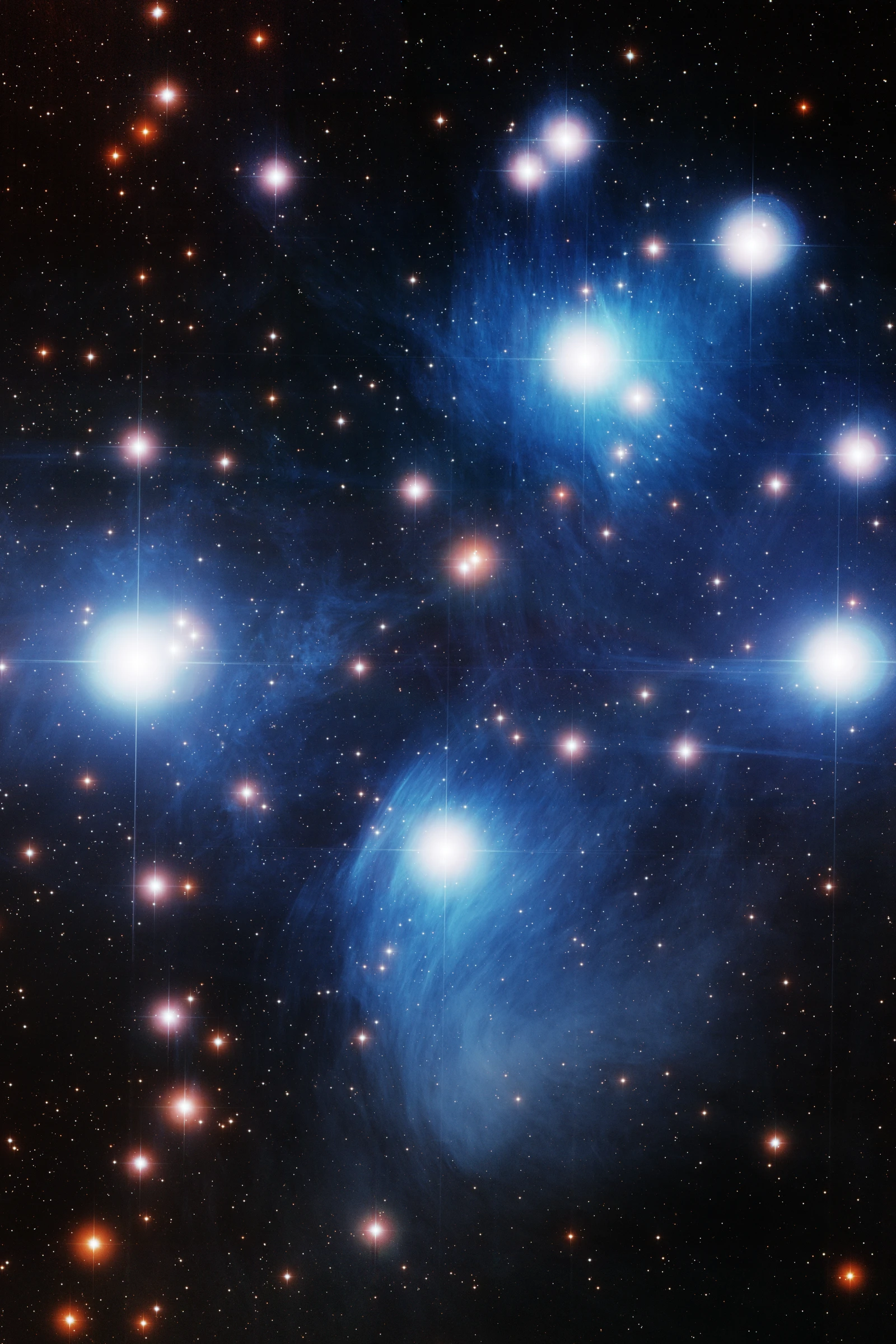
The Pleiades is a star cluster in Taurus, about 440 light-years from Earth, and the Pleiadians are the people said to come from it. That is very nearly everything the name agrees on.
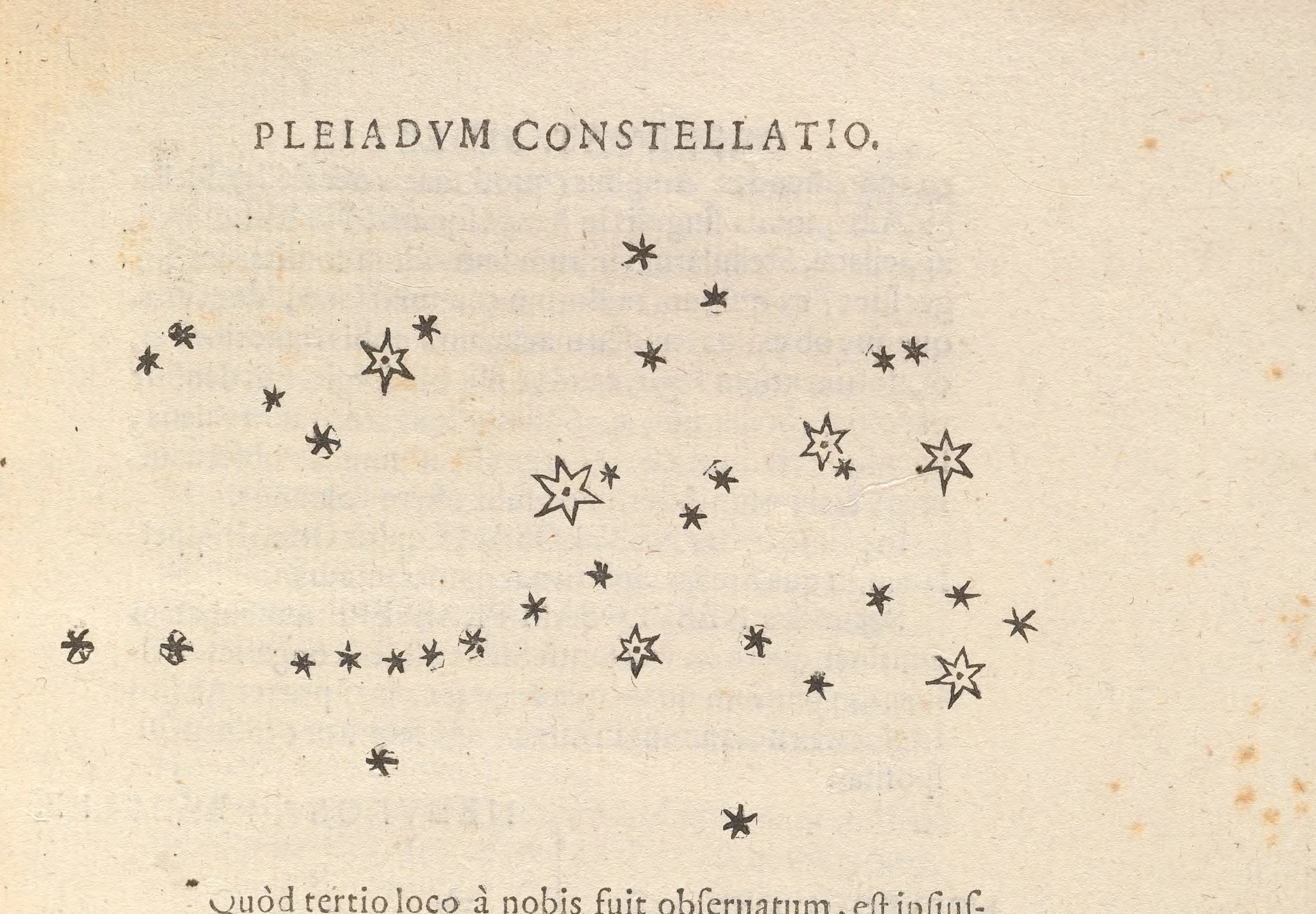
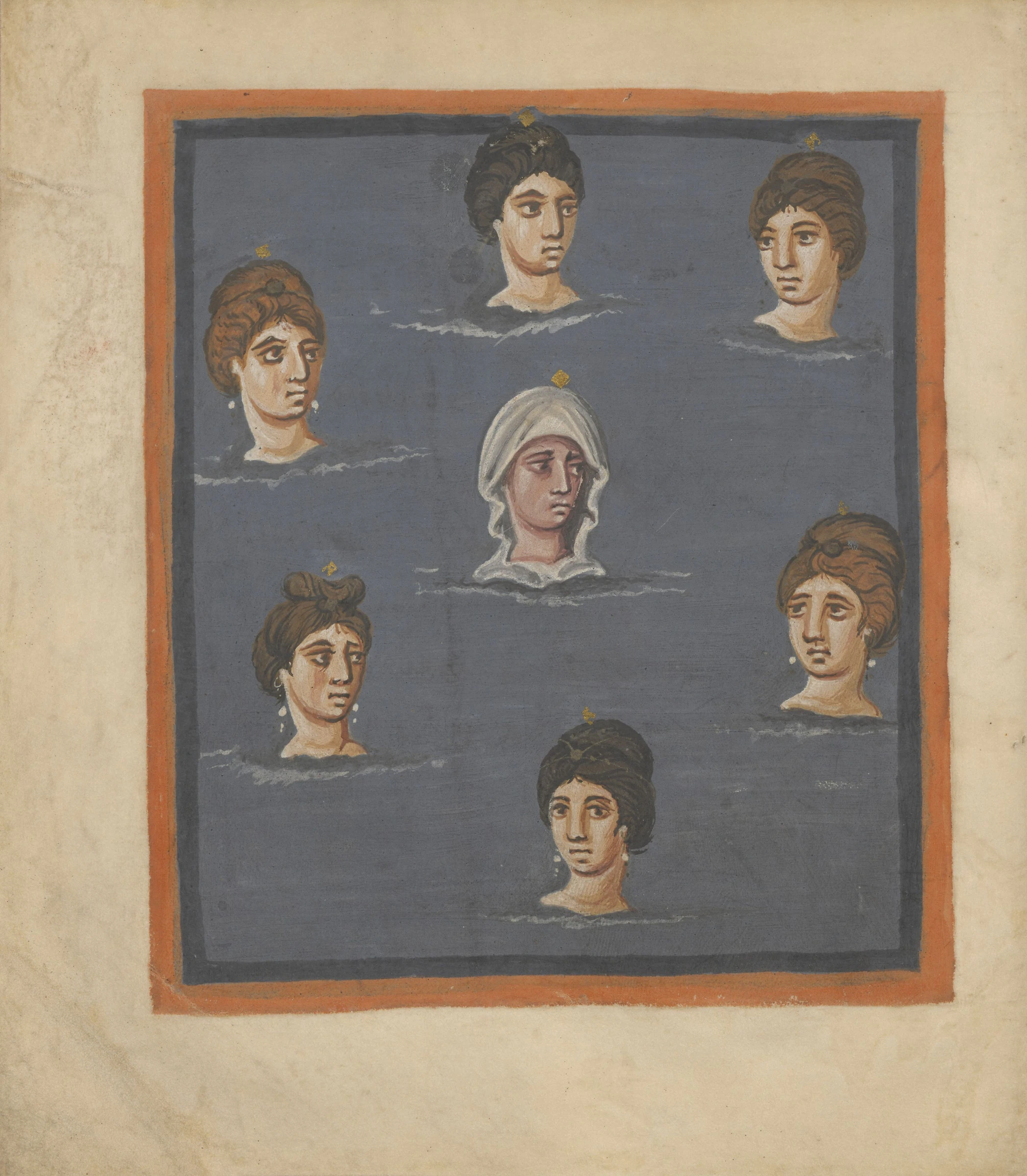
Six stars show to most eyes on a winter night, a small blue knot of them. More than a thousand belong to the cluster. Light arriving tonight left around the year 1580. Hesiod told farmers to begin the harvest when these stars rose. Japan calls them Subaru. Galileo turned a telescope on them in 1610 and saw more than forty others.
Since 1975 people have been reporting its inhabitants. A Swiss man reports a woman of 330 who landed a ship and talked with him. An American woman reports "a collective of energy." Another voice is a goddess. Another calls herself a physical extraterrestrial and speaks through a trance. One collective is numbered, the ninth dimension, and answers to "The Ps." Bodies, no bodies. Ships, no ships. One name.
And the man whose report made the name famous now says the address was false.
Tuesday, 28 January 1975, 14:34
The record gives the time to the minute. The witness was Eduard Albert Meier, called Billy, born on 3 February 1937 in Bulach, Switzerland, a shoemaker's son who had lost his left arm in a road accident in Turkey in 1965. He was 37, days from turning 38. Contact Report 1 prints the conversation as dialogue, "as far as remembered," with a ship set down where, it says, the forest and the hills hid it from afar.
"I am called Semjase and I come from the Pleiades."
Meier's reply, as printed, is the plainest line in the story.
"From the Seven Stars?"
Then the details pile up, and every one of them is physical. Semjase was 330 years old, the rough equal of a woman of 33. She stood about 1.7 meters, with fair skin, light-blond hair and long earlobes set somewhat forward. Her people, the community around Meier says, are humans with physical bodies who live about 1,000 years on average. Her planet, Erra, is a little smaller than Earth and holds about 500 million of them. Their federation counts 120 billion.
Before him the contactees had Venus. George Adamski said his visitor came from there, and so did George Van Tassel. The Encyclopedia of Occultism and Parapsychology credits Meier with suggesting this cluster as a source of contact.
His group, FIGU, dates its own founding to that same 28 January, in Hinwil. The photographs of silver craft went out. In 1979 Lee Elders, Brit Nilsson-Elders and Thomas Welch published UFO... Contact from the Pleiades in Phoenix. In 1987 Atlantic Monthly Press published Gary Kinder's Light Years, on Meier's claim of 130 encounters. Jerome Clark's encyclopedia in 2000 said more than 250. FIGU's own tally to July 2023, telepathy and visitors from elsewhere included, stands at 2,376 personal contacts and 1,324 telepathic ones.
3,700.
A Collective of Energy
On 18 May 1988, on a trip in Greece, a Seth Material student named Barbara Marciniak began to speak for what the same encyclopedia describes as "a collective from the Pleiades." Her book Bringers of the Dawn, 1992, was compiled from more than 400 hours of channeling, and it opens with no ship at all.
"We are here. We are the Pleiadians, a collective of energy from the Pleiades."
Not a woman. Not a planet. Ancestors, it says, "from another universe that had achieved completion." Humans once carried twelve strands of DNA, the book teaches, until "the library of yourselves was torn from the shelves" and two were left.
Barbara Hand Clow, who had published Heart of the Christos: Starseeding from the Pleiades in 1989, gives a third portrait. In The Pleiadian Agenda, 1995, she channels Satya, "a Pleiadian goddess," narrating a drama in nine dimensions. Amorah Quan Yin's Pleiadian Emissaries of Light tell a history running through Venus, Mars, Maldek and Earth. Christine Day speaks of fourth- and fifth-dimensional energies, Wendy Kennedy of a 9th Dimensional Pleiadian Collective.
Descendants, Cousins and Rivals
A channeled opinion of Meier came early. On 29 November 1982, "because of a request from Colonel Stevens," Meier's American investigator and publisher, the Law of One questioner asked the source called Ra about "the so-called Pleiades contact in Switzerland." Ra said it did not judge such contacts, could not confirm this one "as pure Confederation contact," and allowed "some positive material."
Then Lyssa Royal, who entered a channeling class in January 1985 and speaks for Sasha, who "says she is a physical extraterrestrial from the Pleiadian star system." In The Prism of Lyra, 1989, she and Keith Priest name Meier and set his teachings before a shift they date to 1980-1982. "Perhaps they represent an old idea. It does not necessarily mean they are not valid." Then this.
"Some claim to be the future descendants of Meier's Pleiadians."
Which puts the difference in time. Same family, later generation. The introduction to an interview on Royal's site names another idea, that "the channeling process can only be as clear as the channel." Set beside Meier, that would put the difference in the receiver.
FIGU's answer has no room in it for anybody else. Meier wrote that channelers "pop out of the ground like poisonous mushrooms" and counted 71 people who wrote or phoned him in twenty years claiming his visitors. Ptaah, as Meier reports him, accused Marciniak by name of deceit and called her, "in her delusion," a trance medium.
Then, Meier says, the visitors left, on the night of 2 to 3 February 1995, and the name changed. "Truthfully, Pleiadians simply don't exist, only Plejaren!" says the FIGU-authorised wiki. Meier, in Contact Report 710, 2018: "we started the deceptive manoeuvre with the false place of origin 'Pleiades'." The Contact Reports, as a supporter's page reproduces them, date the plan to 3 February 1945, Meier's eighth birthday, and give its purpose as "to unmask the future swindlers."
On FIGU's reading the name was left out on purpose, and every later speaker who picked it up was foreseen.
If More Than One of Them Is Right
Set aside for a moment whether any of it is true. Ask the better question. What kind of world are we living in if more than one of these people is telling it straight?
It would mean the name is a neighborhood and not a people. Bodies at one end, energy at the other, a goddess in between, and one word covering all of them.
On Royal's telling it would reach further back. Her Pleiadians began as Lyrans who chose "an open cluster of young blue stars," which would make them our cousins, and would make Earth one branch of a family with an old country somewhere else.
On Marciniak's telling it would reach into the body. If the book is right, every human ever born has carried a torn copy. Our longest-lived, our wisest, our greatest minds would all have been working with two strands of twelve. Which would mean the species has never once met itself.
If the Semjase figures hold, on a plain ratio, a person of 330 reads as 33. By that clock an 80-year-old is a child of eight. Every human history would have been written by children, and every grandmother would be a girl of nine.
And one consequence is still in front of us. Royal and Priest write that these beings "will not initiate an open contact program until humanity can embrace its brothers across the street." On that reading the delay would be ours, and the street would be the test.
Unless FIGU has it right. Then the name would be a marker laid in 1945, and a whole shelf of our spiritual writing would carry a mark it never knew it carried.
The Paper Trail
The standard account begins with the calendar. Meier in 1975, the first book in 1979, Royal's class in 1985, Marciniak in 1988, Clow's Heart of the Christos in 1989. The Encyclopedia of Occultism and Parapsychology says his picture books and videos "freely circulated through the North American New Age community beginning in 1979." It calls Clow's the first significant "post-Meier" channeled publication and says Marciniak turned to the publisher where Clow worked. Clark's telling of Meier's story has the visitors' people flee a war in Lyra, the same old country Royal's book is named for. On this account one name moved through one community, and each new voice dressed it in what that voice already knew. Marciniak already knew Seth.
The photographs have their own record. Royal and Priest held in 1989 that they "have never been proven to be false." Kal Korff's Spaceships of the Pleiades, 1995, as Joe Nickell summarized it, argues the craft are "small models placed relatively close to the camera" and that Meier's Venus pictures copy Mariner 10 images. FIGU's own wiki sets Meier's pteranodon beside the Zdenek Burian painting a Fortean Times letter compared it with, and prints his reply that a forgery was foisted on him. In an email relayed by a Meier research site, Michelle DellaFave, of The Dean Martin Show, said of a picture labeled Asket, "I just know a picture of myself when I see one." Clark reports that Meier's former wife, after their divorce, told ufologists his claims were bogus; other reports have her saying the opposite earlier.
The channels have theirs. In 1989 the linguist Sarah Thomason, who had listened to 11 entities, wrote up several in the Skeptical Inquirer under the summary "the accents are fake." One she called inconclusive.
What the Paper Trail Does Not Reach
A route is not a source. The calendar shows how a word travelled. It does not show what any of these people were in contact with, and the encyclopedia ranks Marciniak's "among the first contacts independent of references directly to Meier's work." Neither it nor her own pages show that she read him.
None of the entities Thomason names presents itself as Pleiadian. Her test needs an earthly claim to catch, an accent, a place name. One entity placed a seaport town at the Firth of Forth, which is a body of water. A being who claims no earthly speech gives that test nothing to hold.
The clinic does not close it either. Pederzoli, Tressoldi and Wahbeh, reviewing the field in 2022, report that "most channelers do not reach thresholds for mental illness." That speaks to health, not to a charge of deceit. The same paper says there is "no definitive evidence" of non-physical entities. It goes both ways and stops.
The metal is gone. Marcel Vogel, an IBM research chemist, examined Meier's samples on camera; he is quoted calling one "metal, but at the same time ... it is crystal!" The sample disappeared. When Ivan Alvarado argued in 2012 that the rare thulium was common aluminum, he was reading video.
And the cluster. In 2016 Eric Gaidos and colleagues screened Kepler K2 light curves of 1,014 candidate members for transiting planets. They found one planet, around a star they judged probably not a member. A planet of the cluster itself: they did not find one. They also calculated what they should have expected: 0.83 detections on one count, 1.78 on another. Chance alone gave a blank a 17 to 44 percent likelihood. "This begs the question: where are the Pleiades planets?" A short transit watch sees only close-in planets crossing their stars, and it leaves the rest of the question standing.
The sharpest objection to the cluster as a home comes from inside the story. Ptaah called the stars "much too young to harbor any life" at 62 million years, in a bulletin that gives the astronomers' figure as 50 million; astronomers now say about 125 million. FIGU's figures for the home stars have moved too. Beyond the visible Pleiades by 80 light-years, says one text. About 115, says a 2023 pamphlet. The crossing into their universe, says Contact Report 886, lies "almost 400 light-years beyond the Pleiades stars." J. W. Deardorff, a defender of Meier, granted that the change "might make it appear" Meier had worked out the cluster was too young, then argued the visitors plant such doubts on purpose.
Contact 939
Meier is 89. FIGU's most recent numbered report that could be checked, Contact 939, is dated 11 October 2026. The channels are still working too: Kennedy's collective holds online events, and Inner Traditions, the house behind Bear and Company, keeps a shelf called Pleiadian & Channeled Wisdom.
Three answers stand. Different groups, which needs the beings to exist. One signal bent by each receiver, which has to turn a 1.7-meter woman into a collective of energy. One name that spread, which has the best paper and says nothing about what the channels touch. Reference works and a named book back the route. None of the tests so far reaches the source.
One thing could be checked, and it is small.
The trap is dated 3 February 1945. The rename reached the public around February 1995. Official X could not establish when the Sfath passage first appeared in print. One excerpt puts it on page 18 of the first volume of the Contact Reports, nine pages ahead of Semjase. A first edition of that page has a date, and someone can find it. A date before 1988 would show the passage on paper before Marciniak spoke. A date after 1995 would show only that it reached print with the rename, which is how FIGU tells it. It would not settle who came from where. It would say how early the trap was written down.
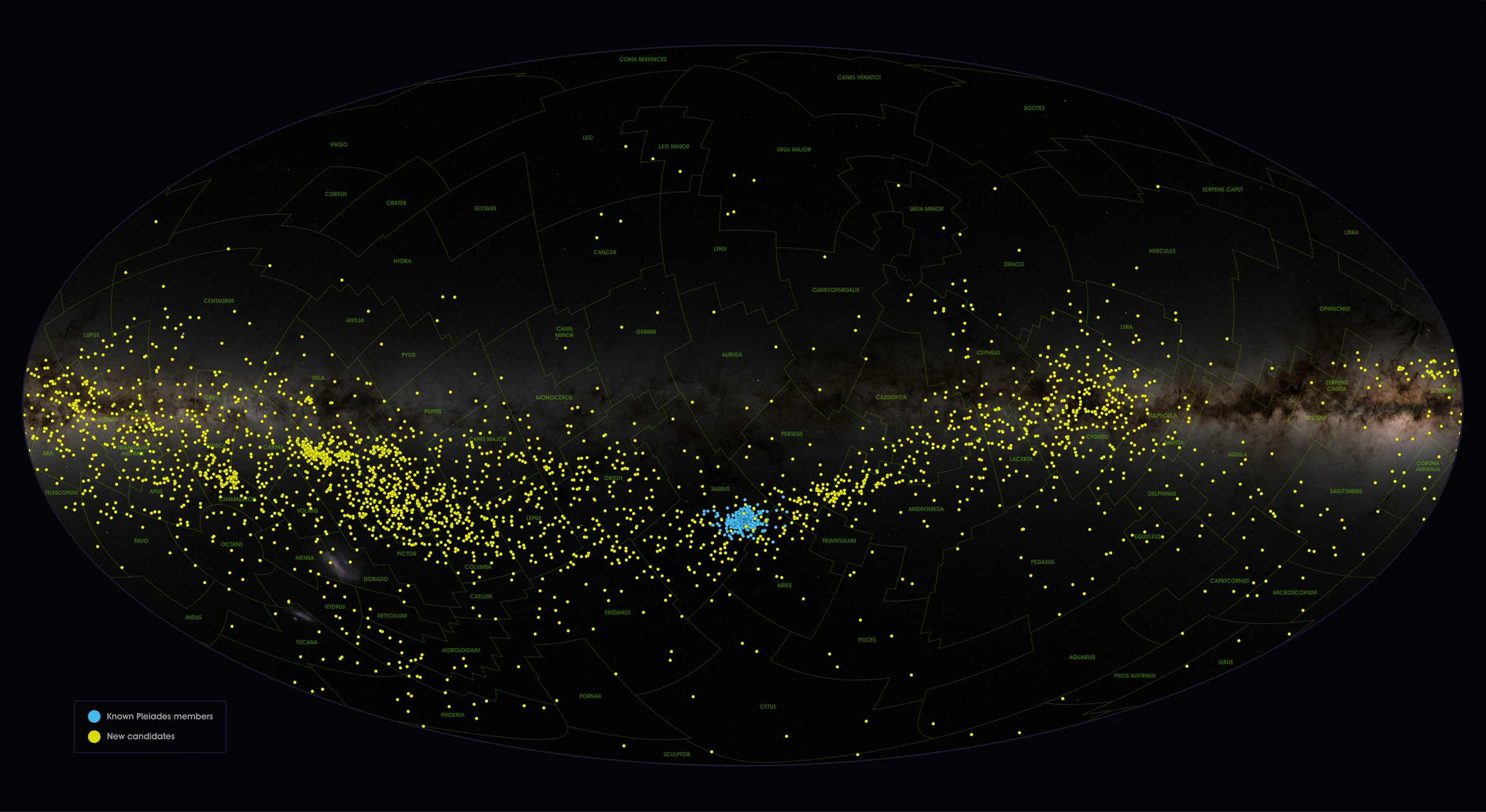
Six stars to the eye. More than forty to Galileo. More than a thousand now, three times that on NASA's 2025 map. FIGU has counted the people too: 500 million, on a planet that is not, it now says, in those stars.
Questions This Leaves You With
Is there anything a person actually does with this?
On the scale of one life, nothing has to follow. Marciniak's site tied her Pleiadians' work to the years up to December 2012, and Clow's book ran toward the same date; it came and went. Anyone selling you a date is selling something. What you can do is read the sources side by side, in order of publication, and notice what each adds. The larger question belongs to everybody: whether a culture can tell a report from a rumor once the rumor has a publisher.
Does this sit against a religious account of the world?
It cuts both ways. Clark reports that Meier's visitors were hostile to religion, "though apparently not to the notion of God as such," and Bringers of the Dawn promises to explain who our "gods" are. Read that way, these teachings quarrel with a church. Read another way they widen a heaven: more beings, more care, a human story inside something older. A sincere person can hold either. Each tradition answers for itself, and this site will not tell you which way it falls.
Does this change what a human life is?
Put your own age beside Semjase's. On her clock, you have barely started. For some readers that shrinks a life to a brief first chapter in a very long book. For others it does the opposite: if most of the universe's people live for centuries, then a life of 80 years that is noticed, loved and finished is a rare and concentrated thing. Which did you feel first? Nothing here says you should feel either, and nothing here asks you to change a thing.
What would change your mind, in either direction?
Name it now, before you are committed. Toward the claim: a channeled passage in a language the channel never learned, tested blind; a sample of Meier's metal with an unbroken chain of custody; a statement about the cluster, on record, that astronomers confirm later. Away from it: a first printing of the Sfath passage dated after 1995; notes showing a channeler working from Meier's books; first-generation negatives that show models. A planet in the Pleiades would prove only that a planet is there.
Why does Lyra turn up on both sides?
Meier's literature gives his visitors forebears who fled a war in Lyra. The Prism of Lyra builds a whole human history on Lyra, and that book names Meier. Yet FIGU rejects channeling outright. Did Lyra pass from one to the other on paper, or did both draw on something older? This survey turned up no study laying the two lineages side by side, line by line, with dates, and a wider search might. It would take a patient reader with both shelves.
More photographs
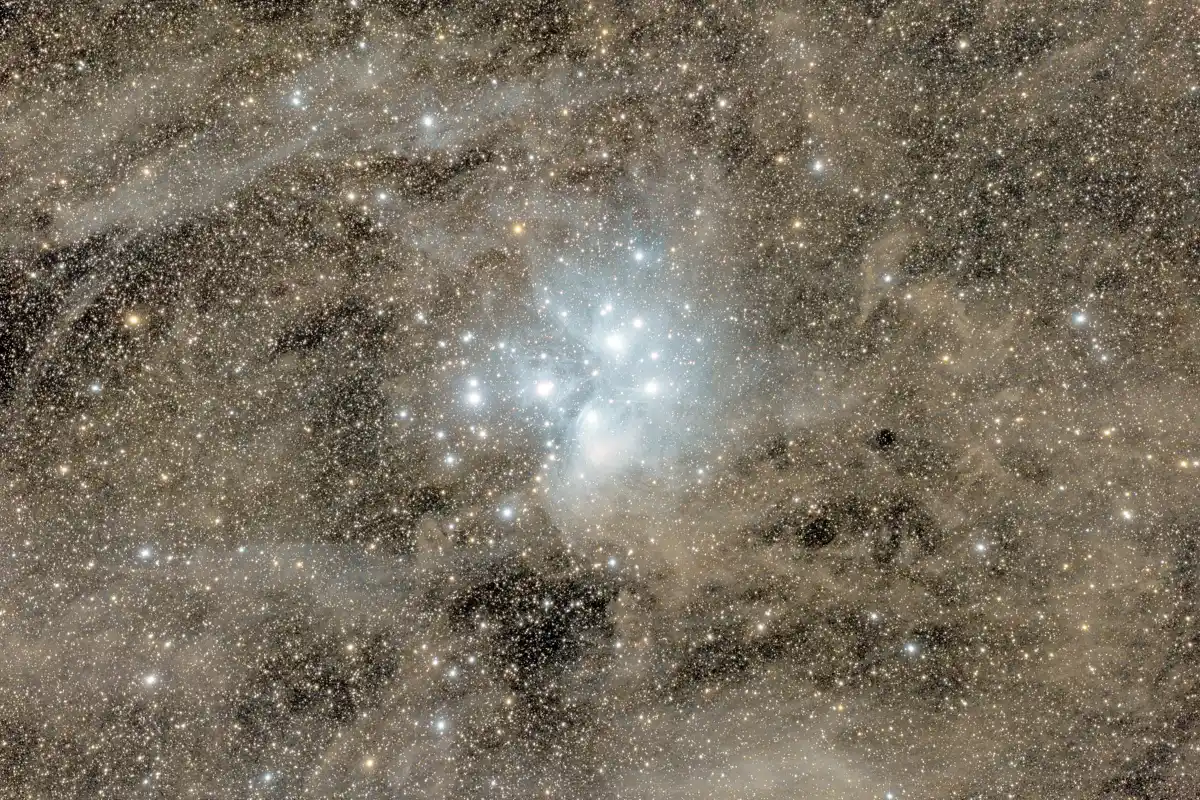
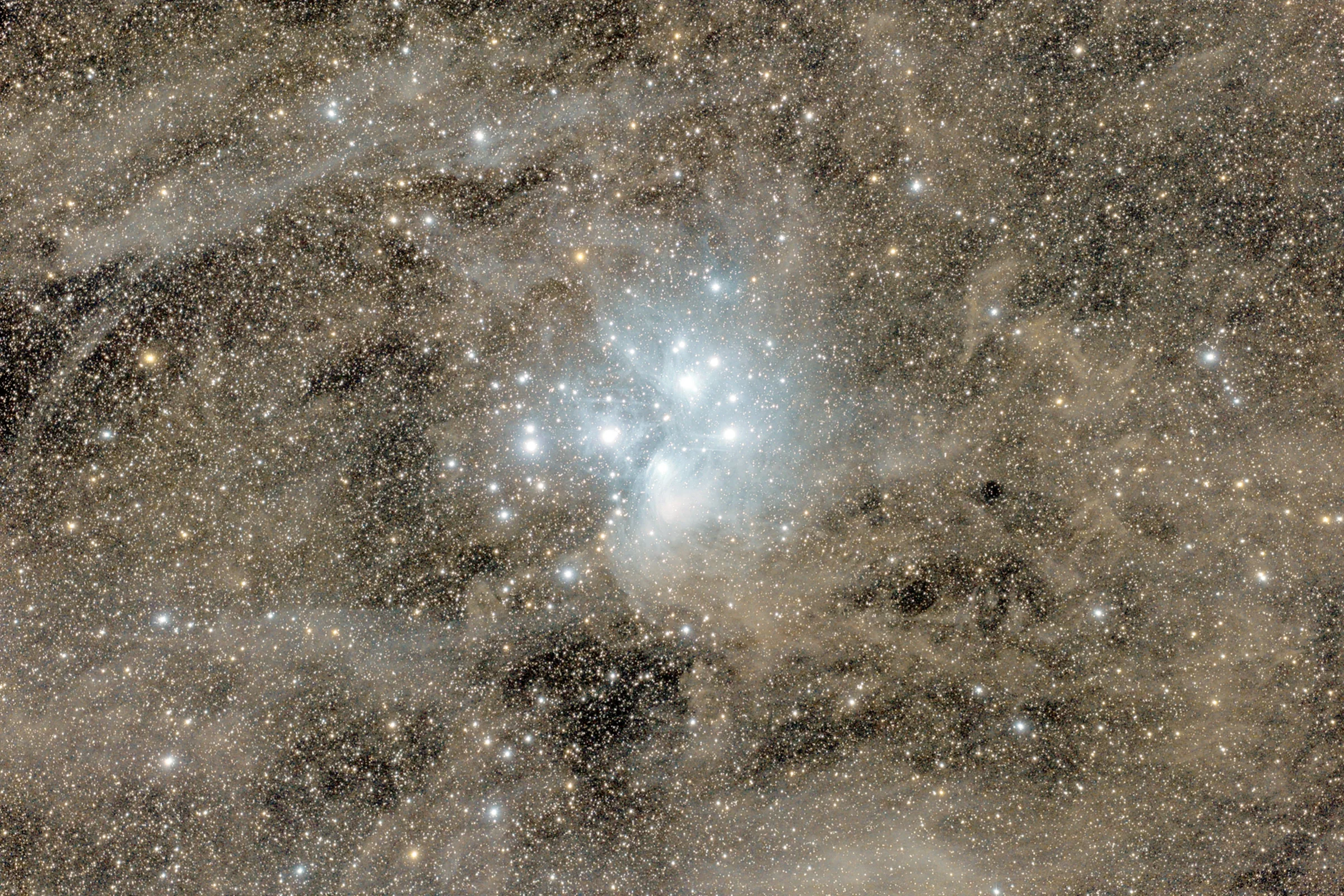
The Pleiades among faint interstellar dust, 2019. Giuseppe Donatiello, CC0, via Wikimedia Commons. 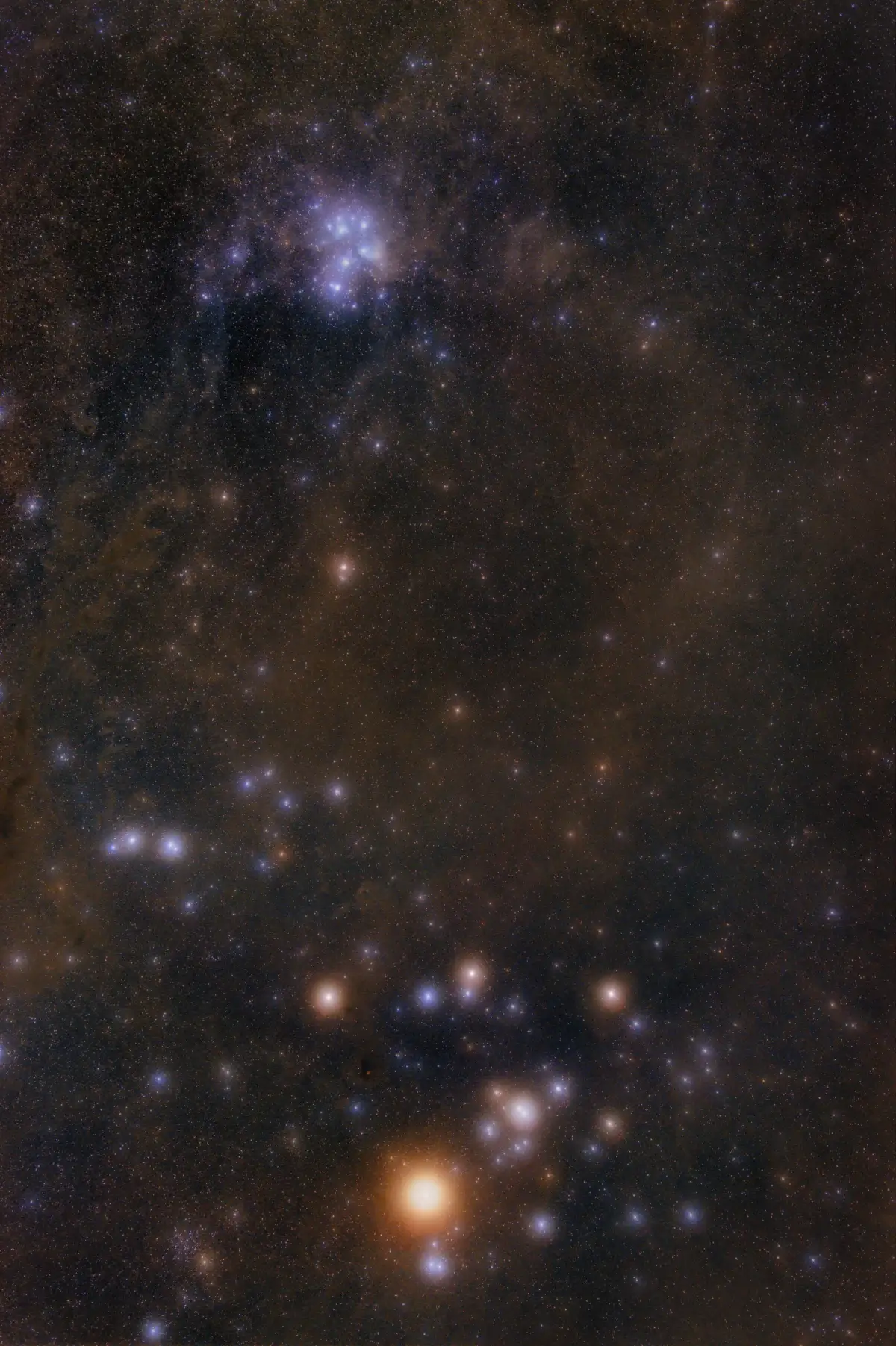
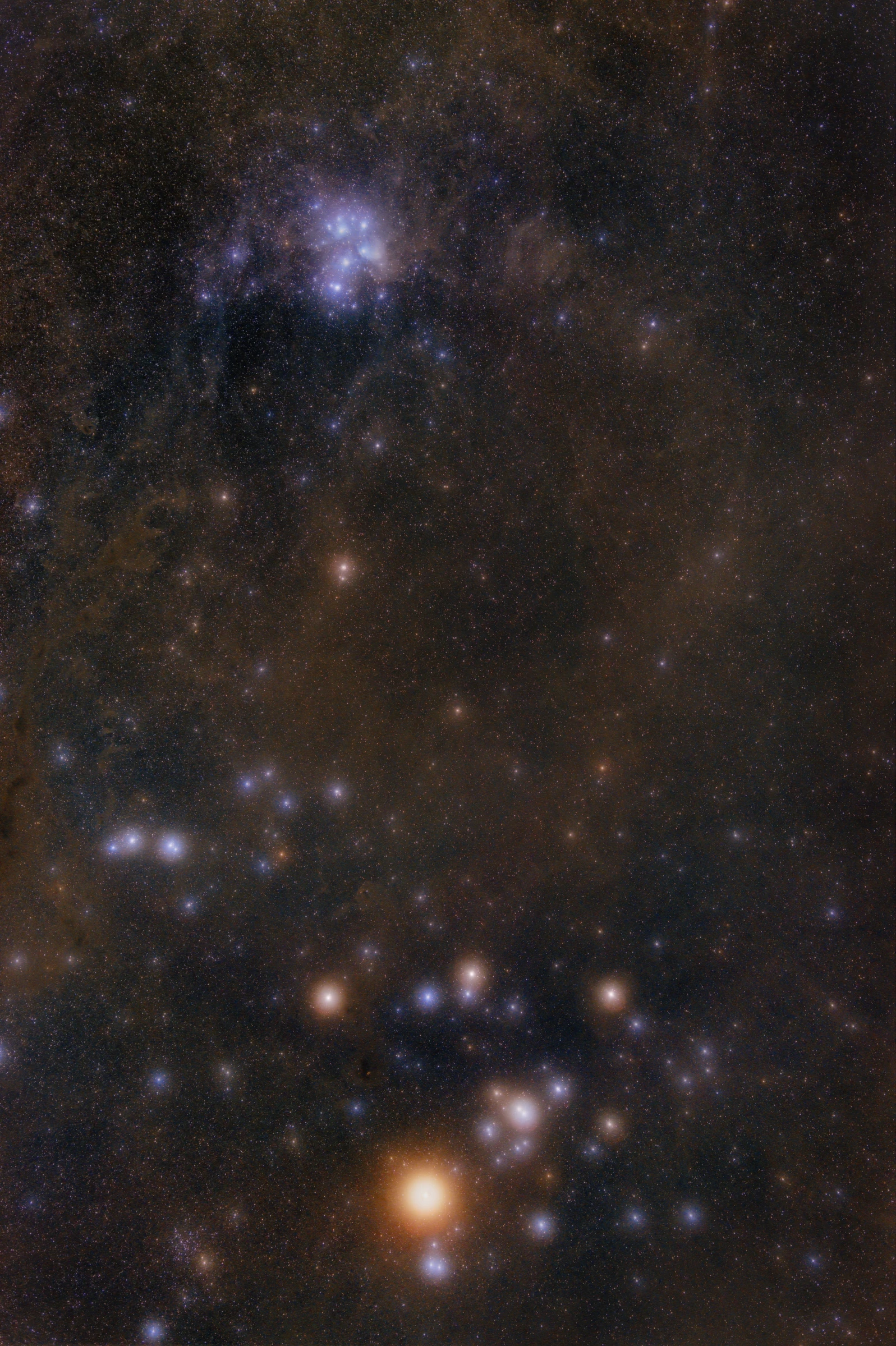
The Pleiades (top) and the Hyades (bottom), the two star clusters of Taurus, in one frame, 2019. Photo: Nico Carver (NebulaPhotos.com), CC BY-SA 2.0 (creativecommons.org/licenses/by-sa/2.0), via Wikimedia Commons. Resized. 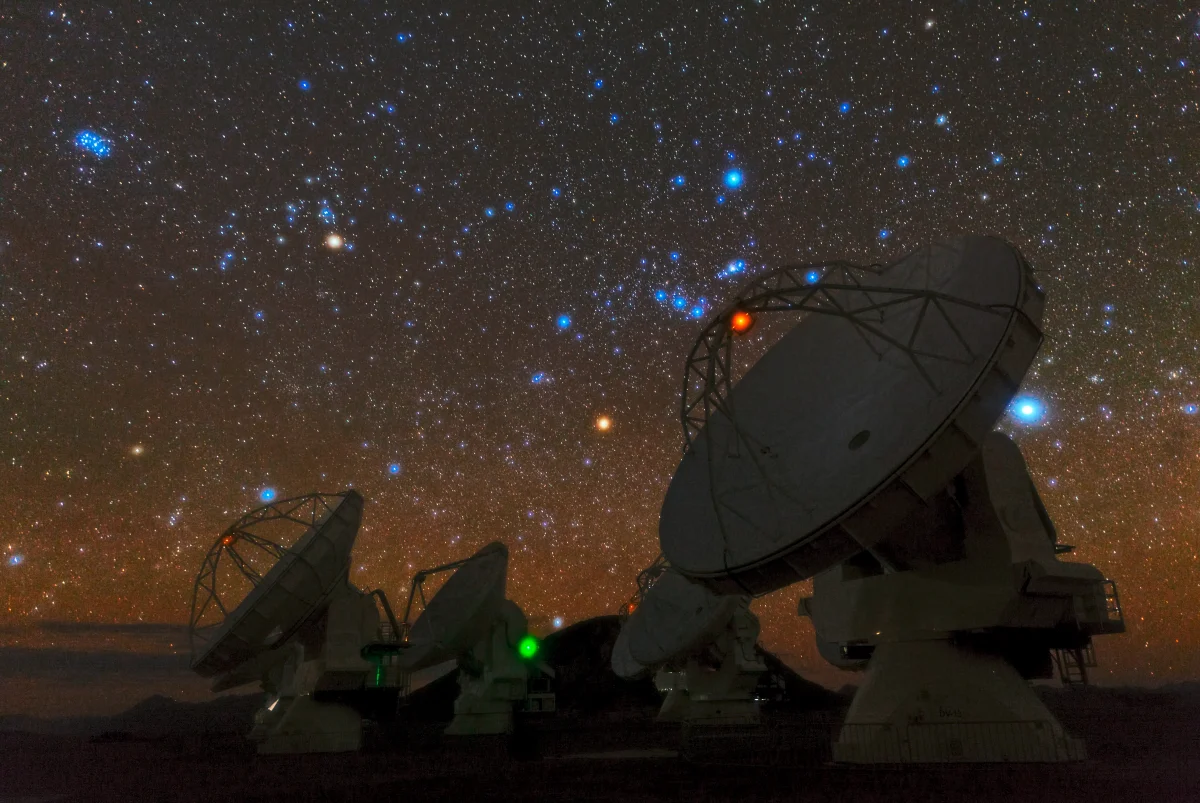
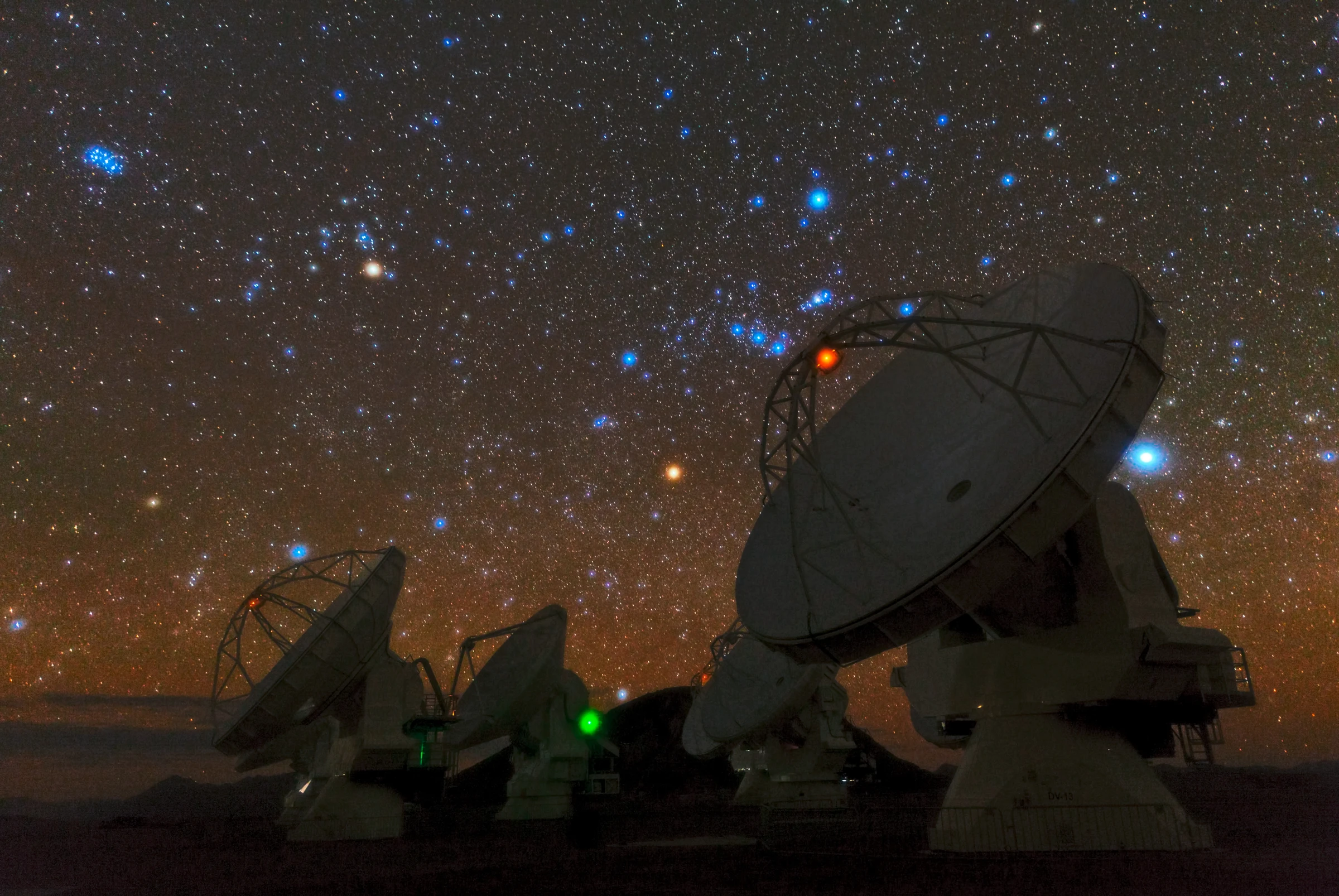
The Pleiades (upper left) and Orion in the sky over the ALMA antennas on the Chajnantor Plateau, Chile. ESO/B. Tafreshi (twanight.org), CC BY 4.0 (creativecommons.org/licenses/by/4.0), via eso.org. Resized. 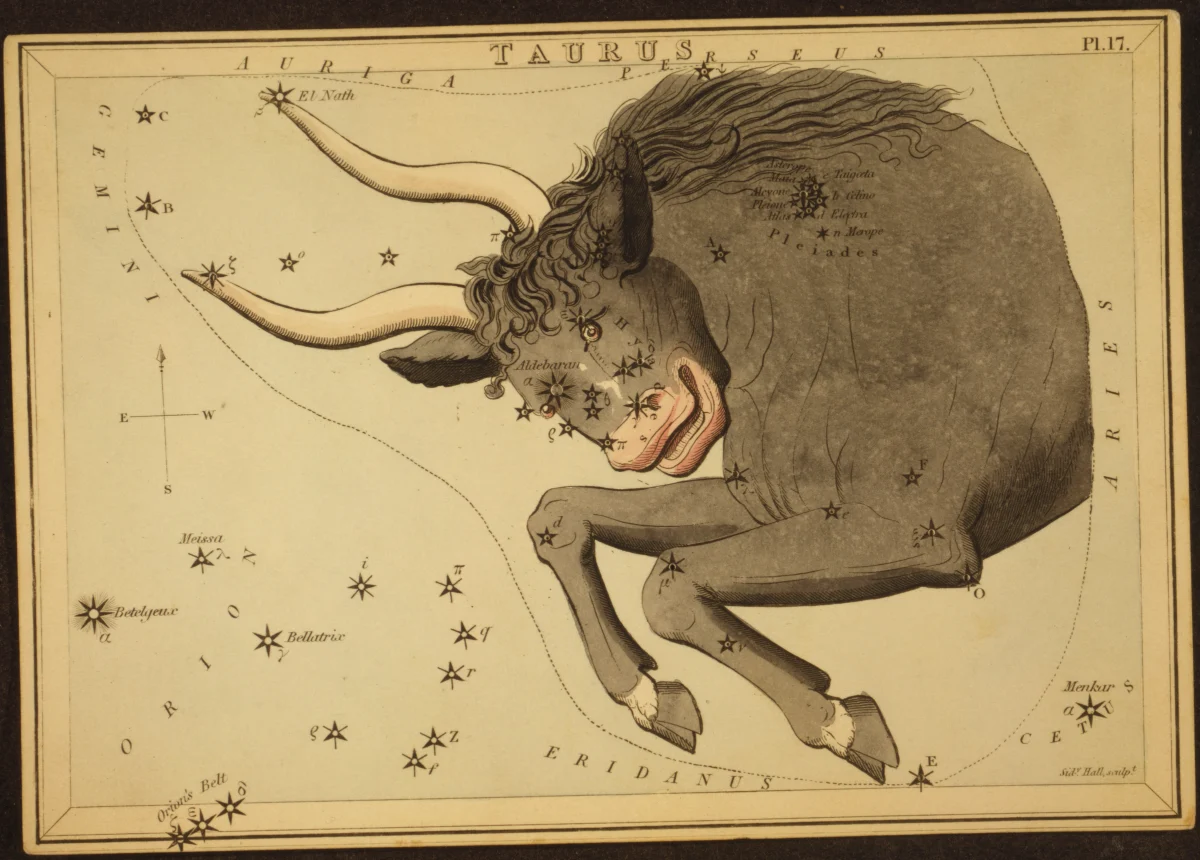
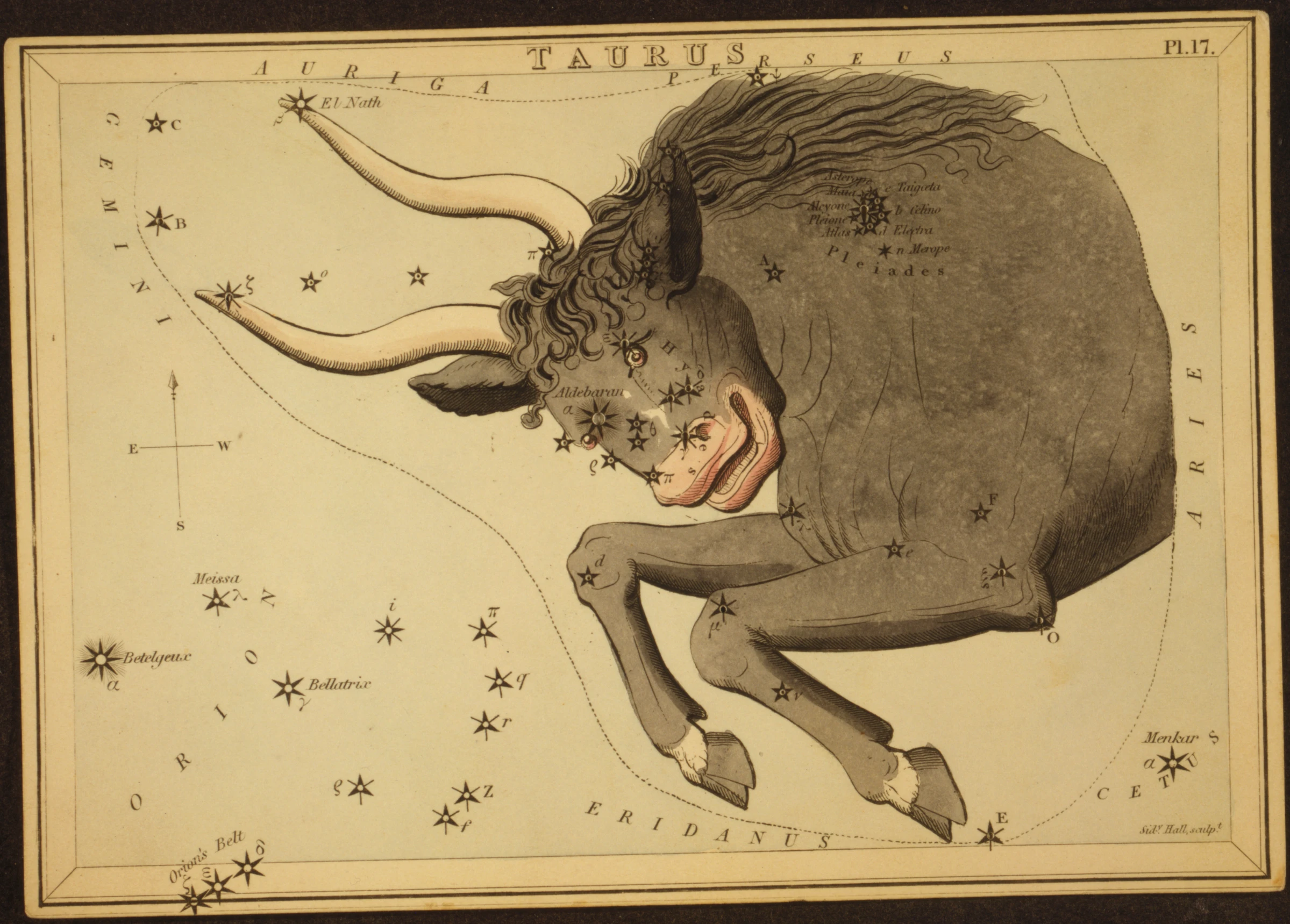
Taurus from Urania's Mirror, London, 1825. The Pleiades sit on the Bull's shoulder, each star named. Sidney Hall, Taurus, plate 17 of Urania's Mirror, London, 1825, Library of Congress, public domain. Cropped. 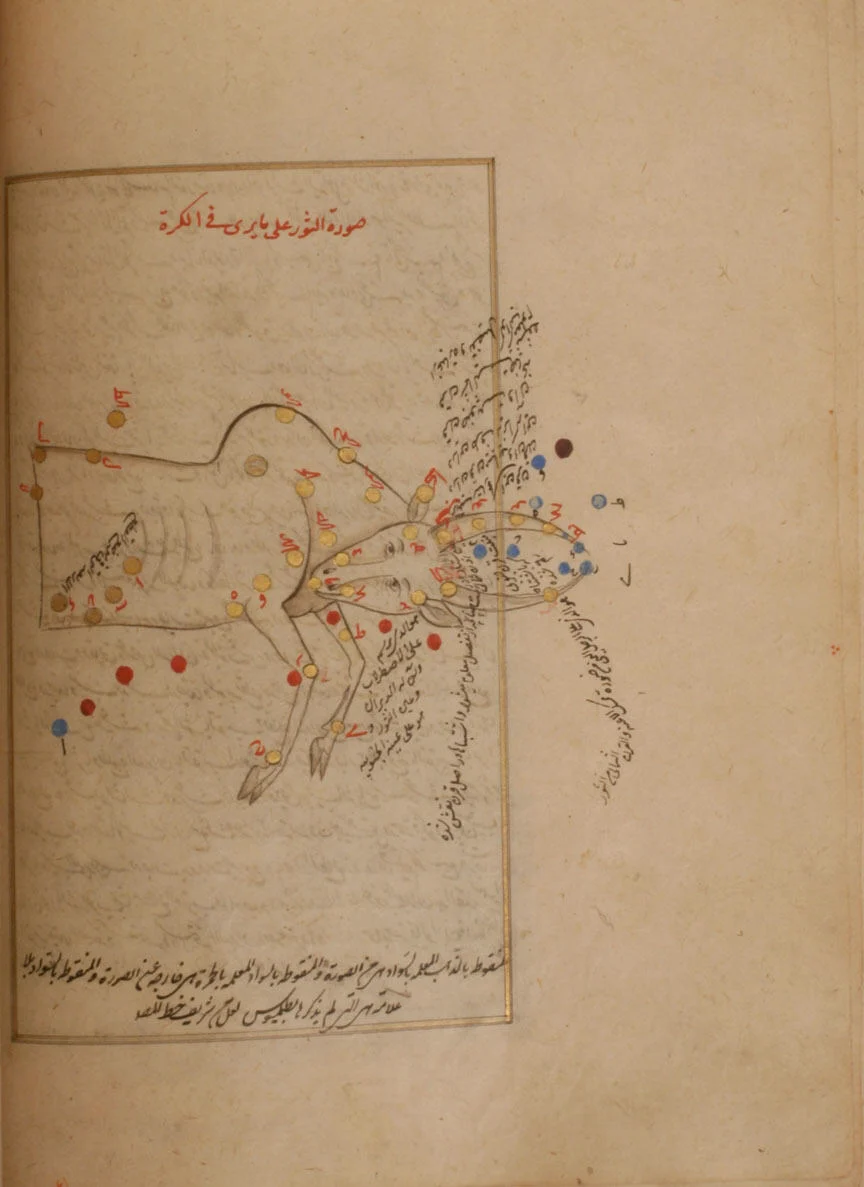
The constellation Taurus in an 18th-century copy of the star book by the Persian astronomer al-Sufi, who wrote in the 10th century. Folio from a Book of the Images of the Fixed Stars of al-Sufi, 18th century, The Metropolitan Museum of Art, Gift of Richard Ettinghausen, 1975 (CC0). 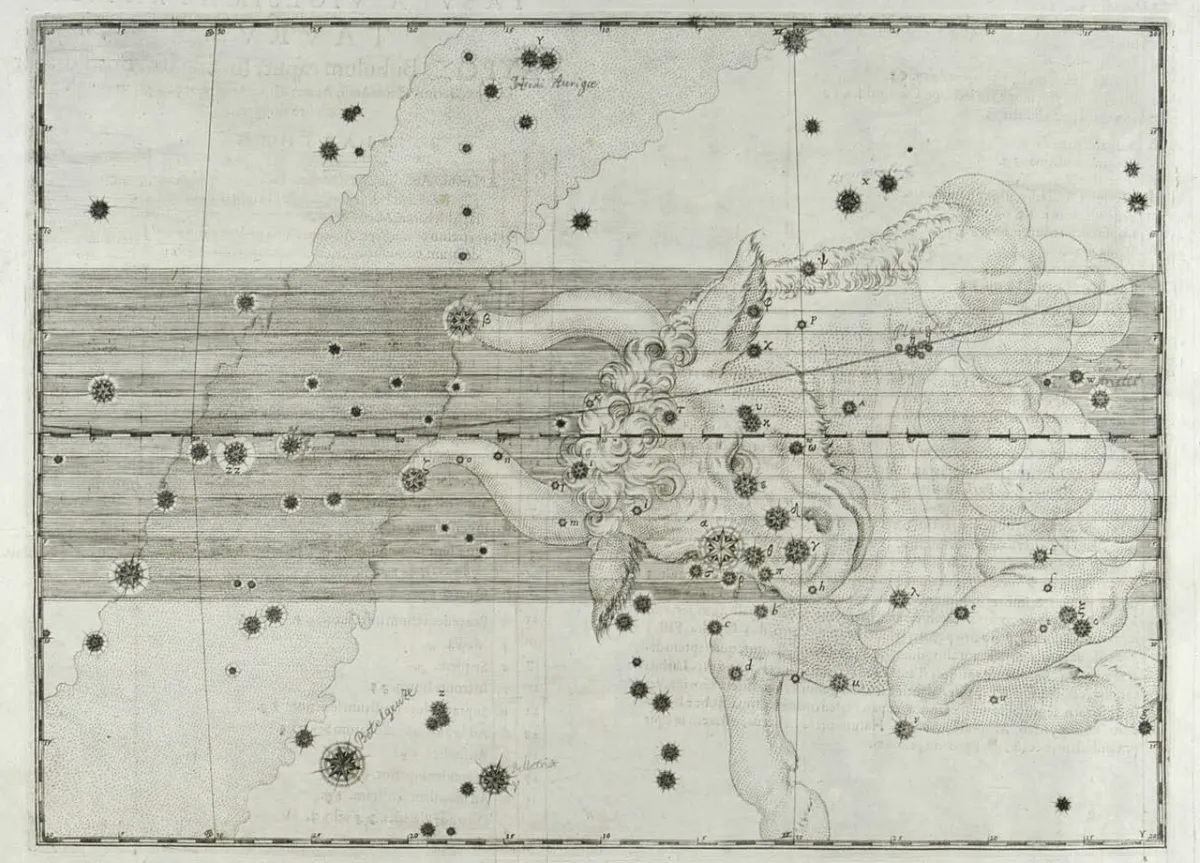
Taurus in Johann Bayer's star atlas Uranometria, in the copy at the Linda Hall Library. Johann Bayer, Uranometria, Taurus plate, Linda Hall Library, public domain, via Wikimedia Commons. 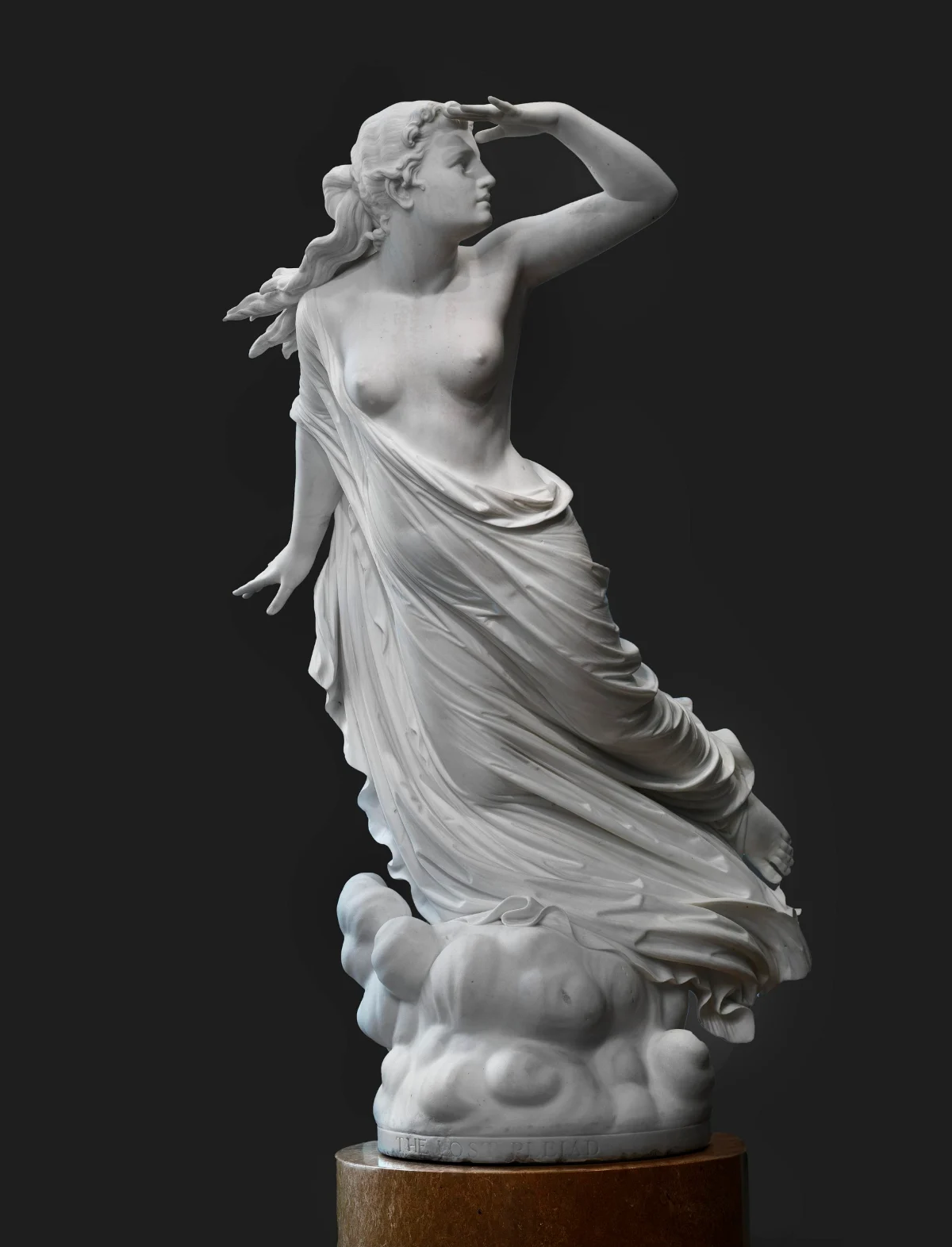
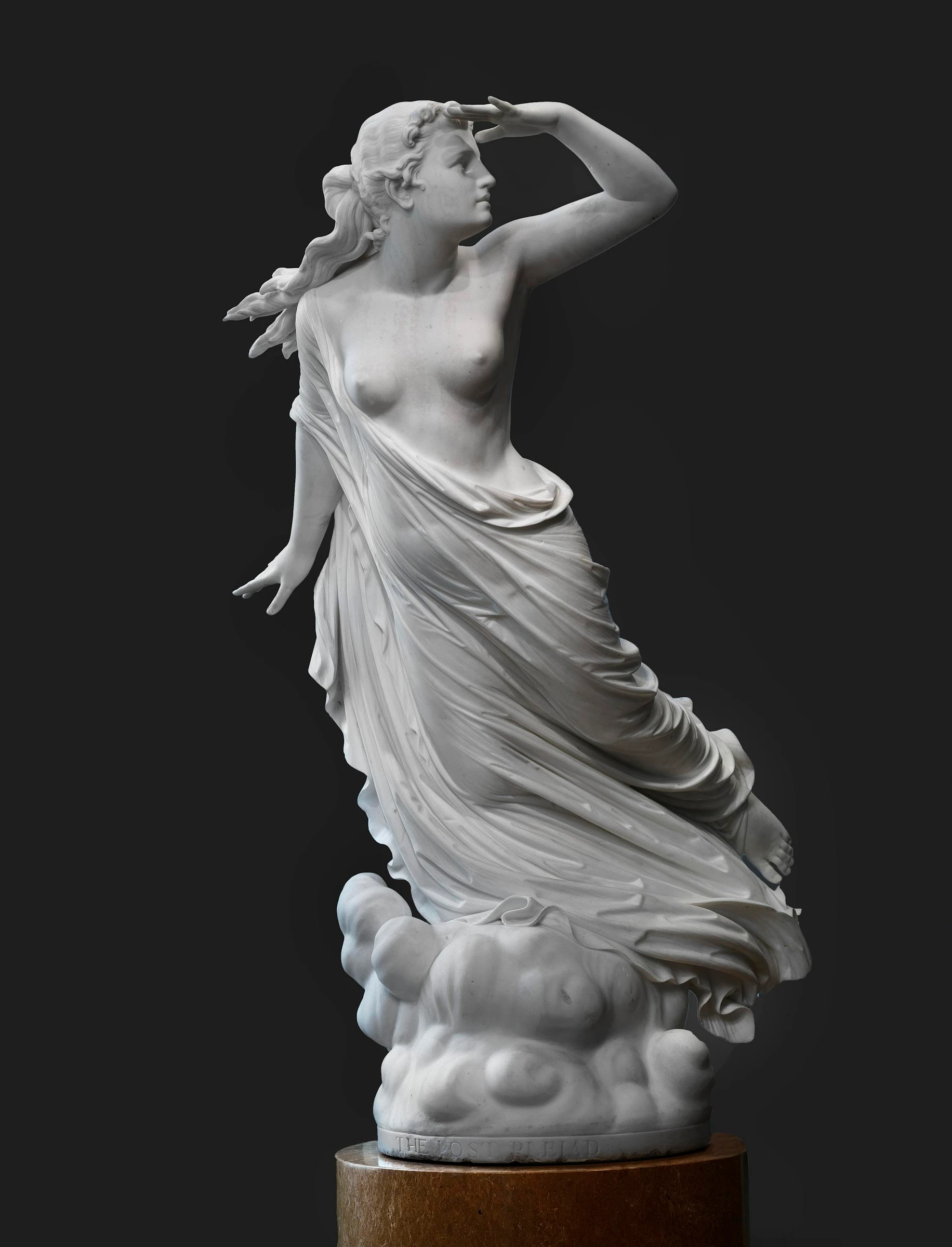
The Lost Pleiad, Randolph Rogers, marble, 1874-1875. The seventh sister, the one most eyes cannot find, shades her eyes. Randolph Rogers, The Lost Pleiad, 1874-1875, marble, Smithsonian American Art Museum, Museum purchase through the Luisita L. and Franz H. Denghausen Endowment (CC0). 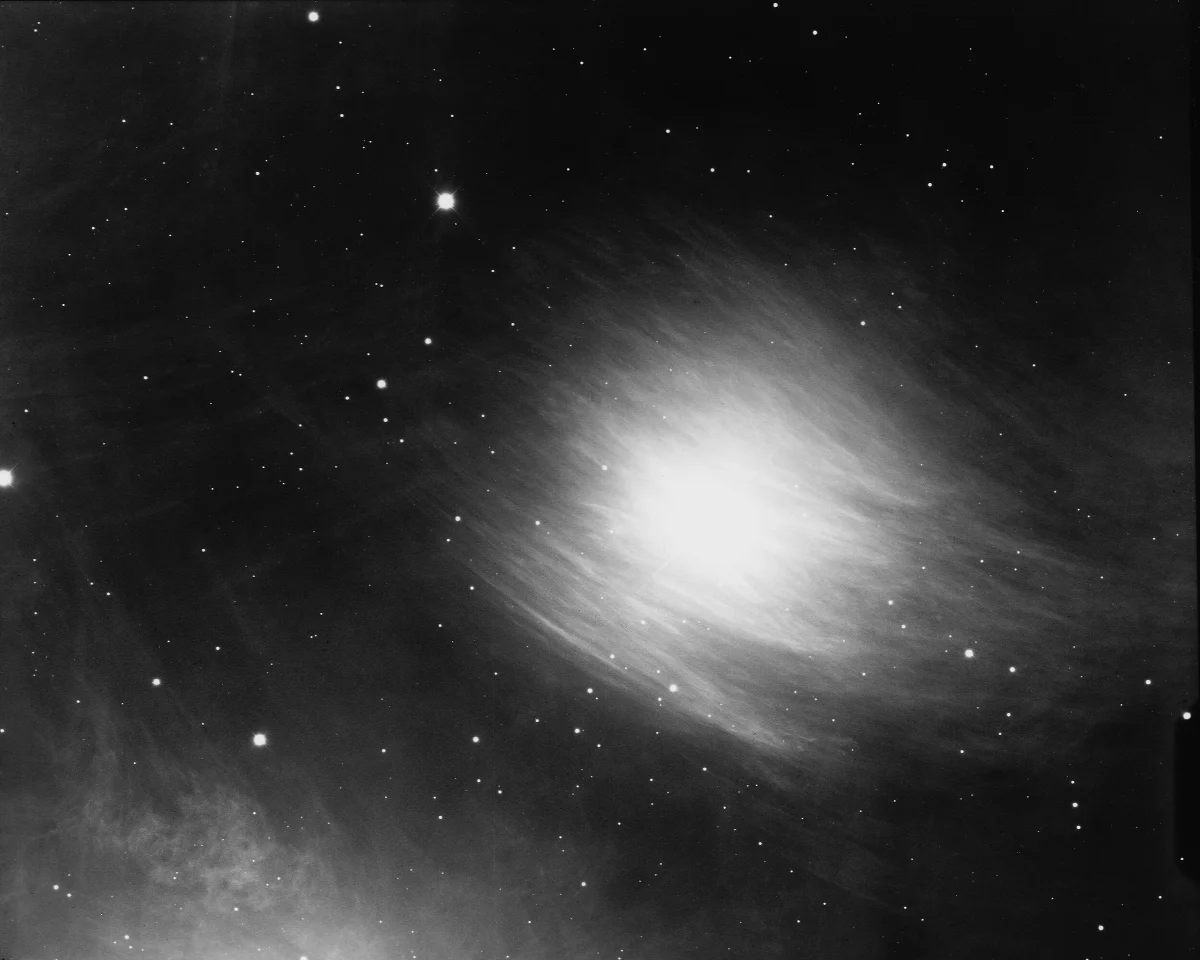
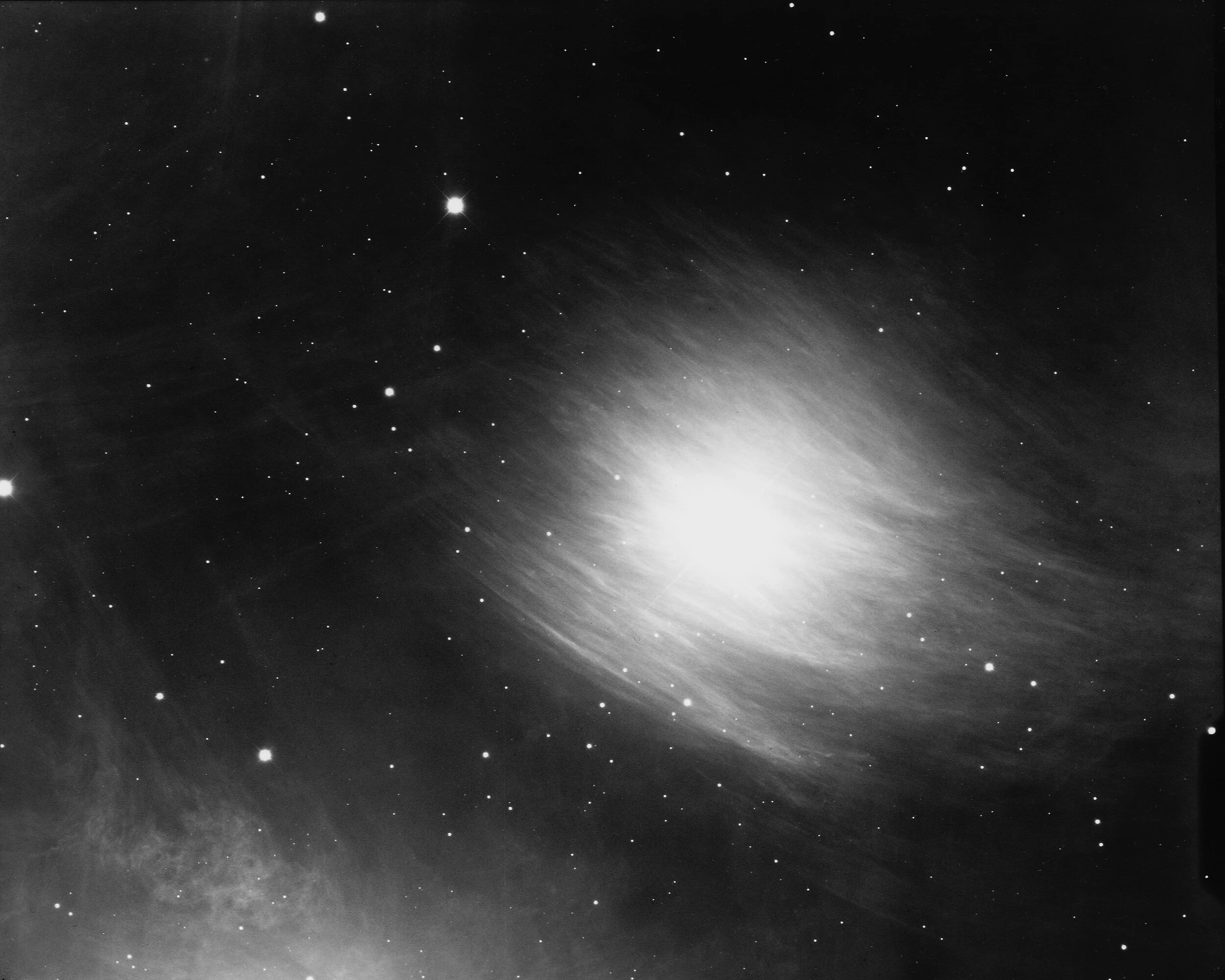
Merope, one of the bright stars of the Pleiades, and the nebula around it, photographed with the 4-meter Mayall telescope at Kitt Peak in 1975, the year of Contact Report 1. NOIRLab/NSF/AURA, CC BY 4.0 (creativecommons.org/licenses/by/4.0), via noirlab.edu. Resized. 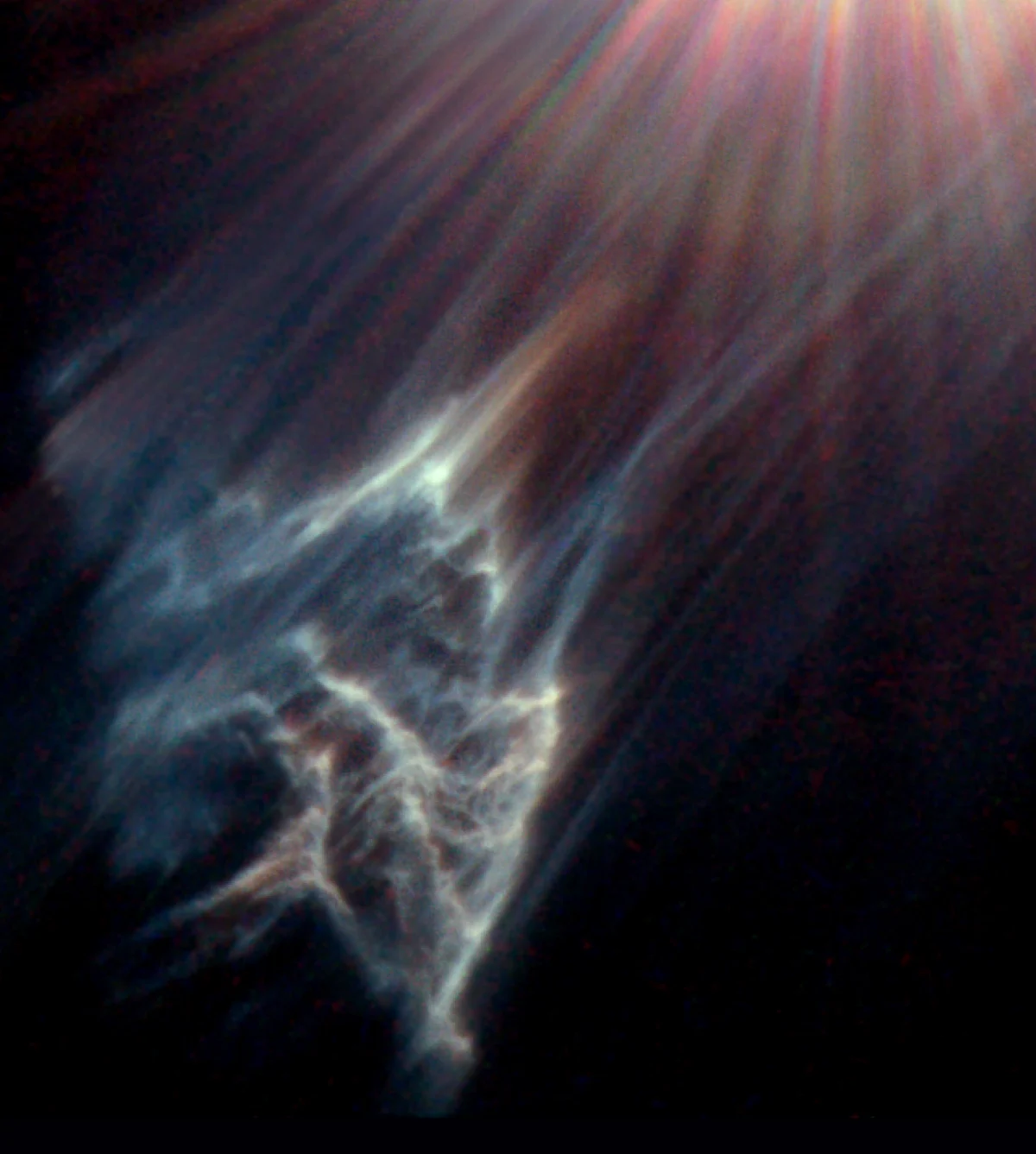
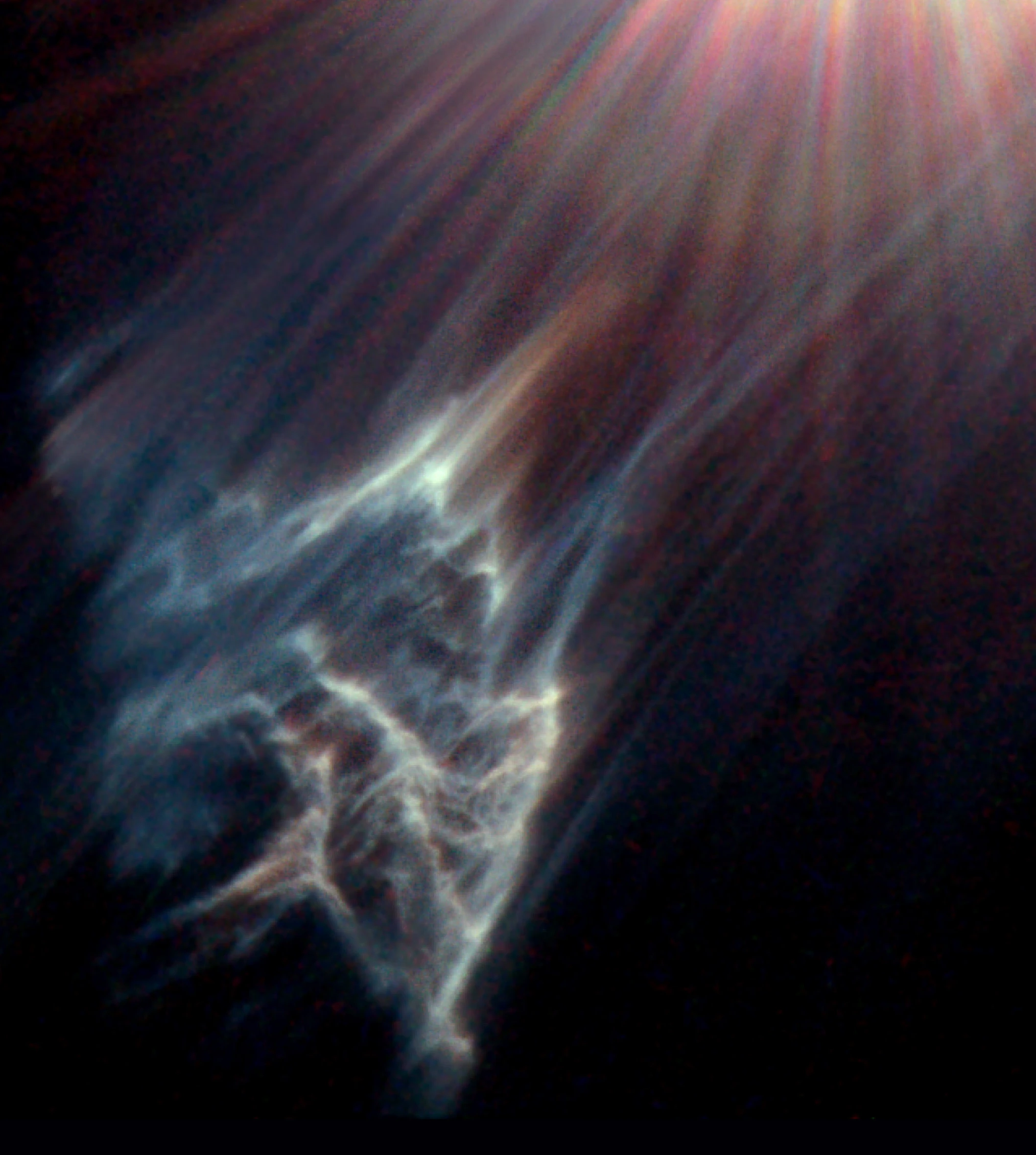
IC 349, a dust cloud close to the star Merope, from the Hubble Space Telescope, released in December 2000. The colored rays at the top are made inside the telescope. NASA and The Hubble Heritage Team (STScI/AURA); Acknowledgment: George Herbig and Theodore Simon (Institute for Astronomy, University of Hawaii). Cropped. 
The Pleiades in infrared from NASA's Spitzer Space Telescope, 2007. Clouds of dust sweep around the stars. NASA/JPL-Caltech, public domain. 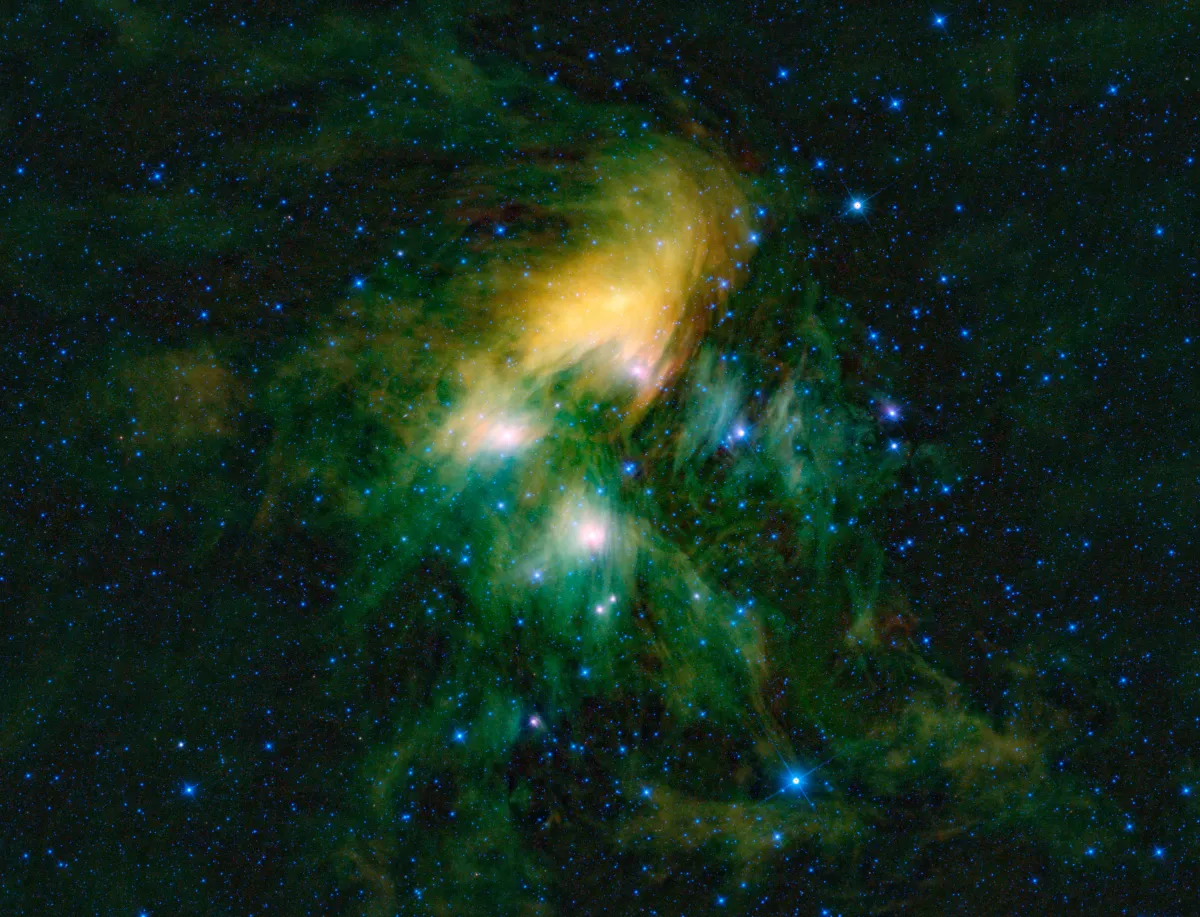
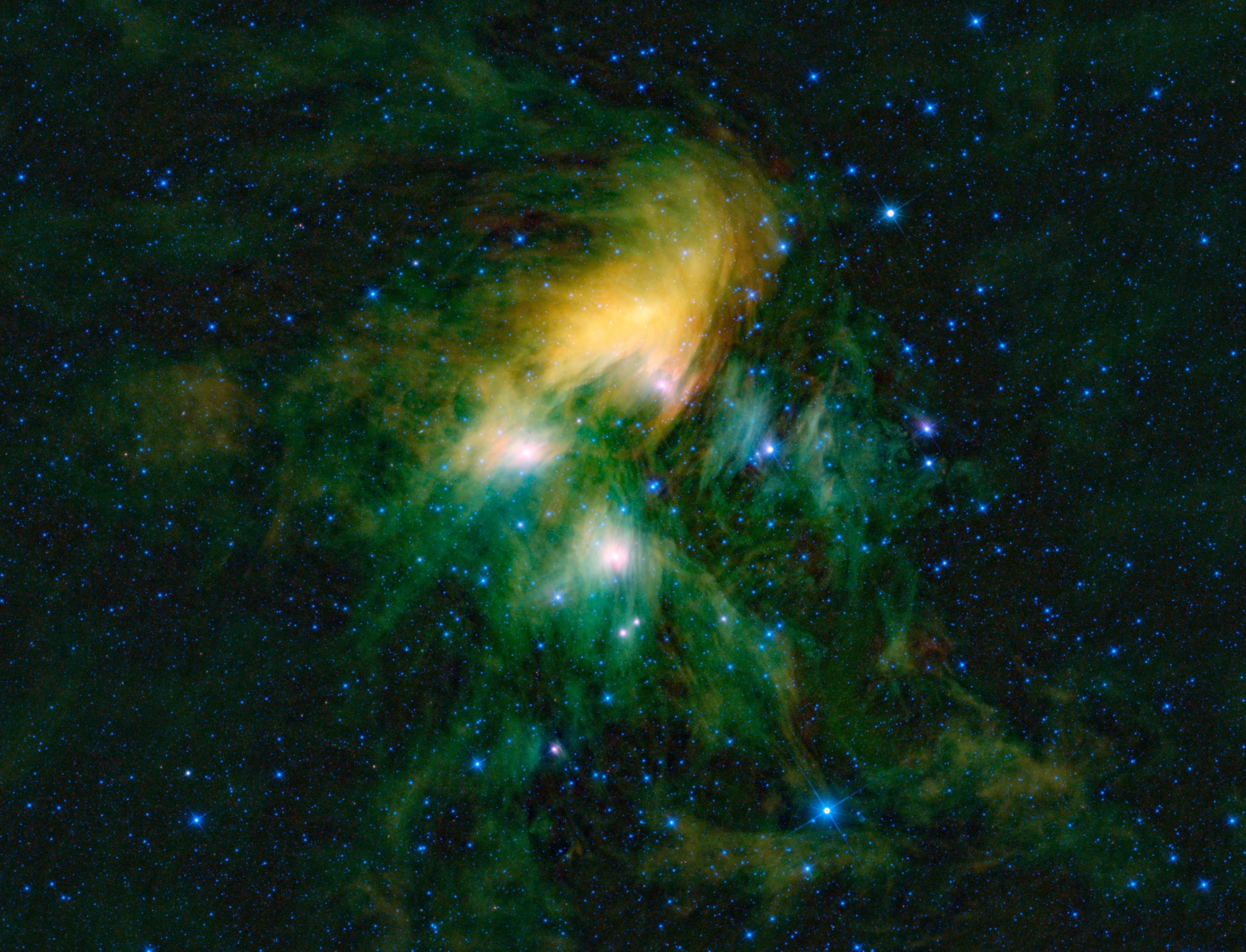
The Pleiades seen by NASA's WISE survey, 2010, in a far wider field. NASA calls it an open cluster: its stars are loosely tied and will in time go their separate ways. NASA/JPL-Caltech/UCLA, public domain. 
The Subaru Telescope near the summit of Maunakea, Hawaii. Subaru is the Japanese name for the Pleiades. NOIRLab/NSF/AURA/T. Matsopoulos, CC BY 4.0 (creativecommons.org/licenses/by/4.0), via noirlab.edu. Resized. 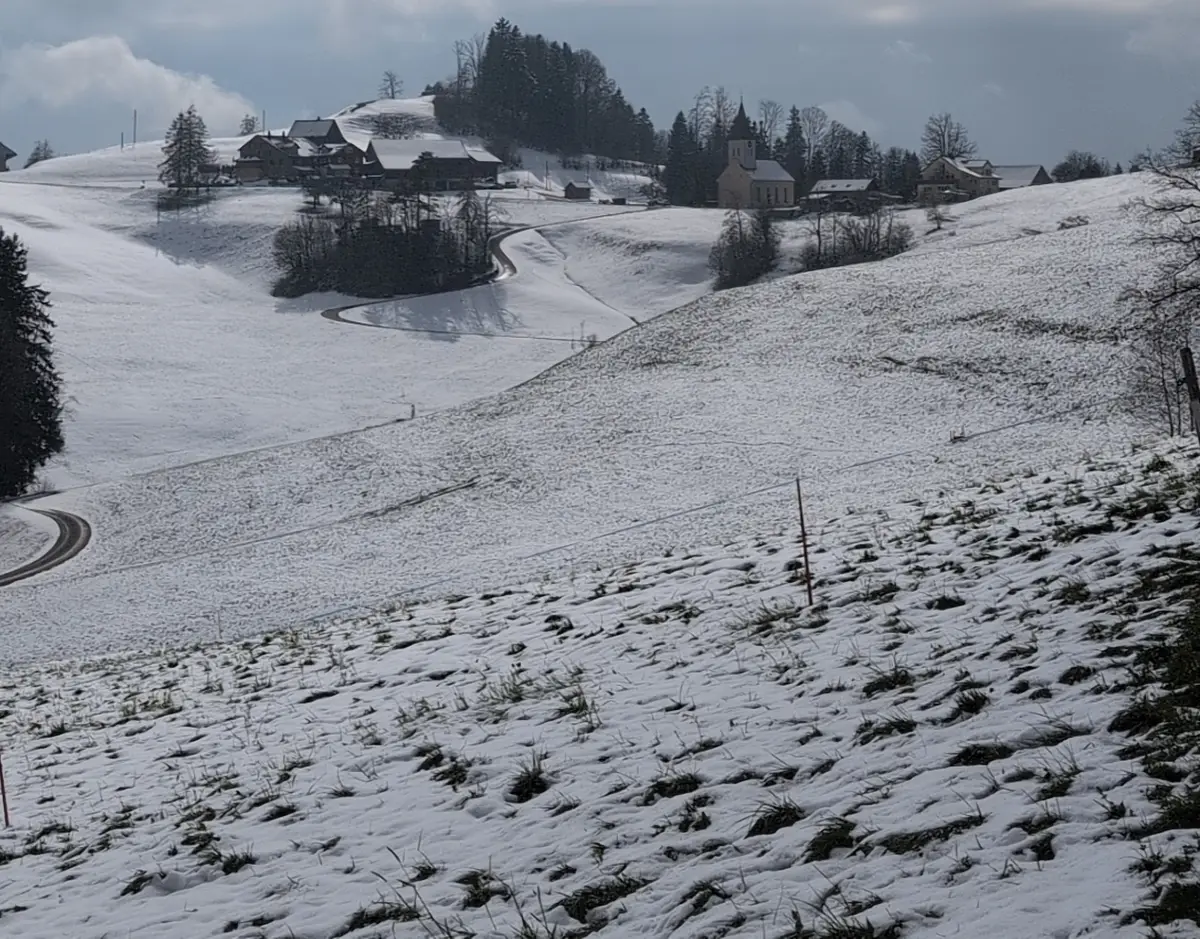
The hamlet of Sitzberg near Schmidruti, in the hill country of the Canton of Zurich. FIGU gives its address at Schmidruti; this photograph shows neither its center nor any contact site. Photo: Markus Delbrouck, CC BY-SA 4.0 (creativecommons.org/licenses/by-sa/4.0), via Wikimedia Commons. Cropped.


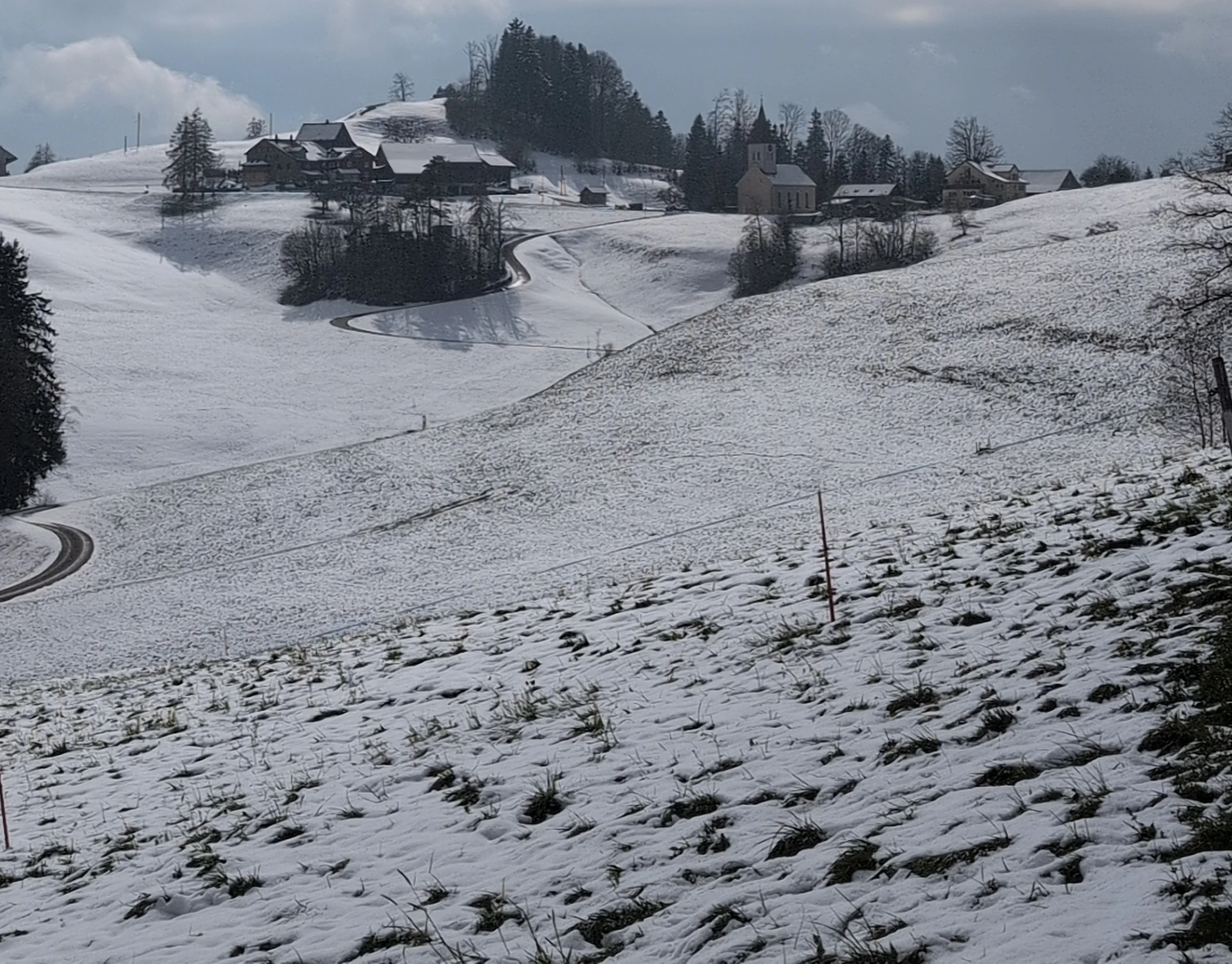
Select a photograph to see it full size, with its caption and credit.
Downloads
- Galileo Galilei, The Sidereal Messenger, translated by E. S. Carlos, 1880, full bookRivingtons, London, 1880. Internet Archive scan of the Wellesley College Library copy; out of copyright
- Hesiod, the Homeric Hymns and Homerica, translated by H. G. Evelyn-White, 1914, full bookLoeb Classical Library, 1914. Internet Archive scan of the University of Toronto copy; out of copyright in the US
Sources
- Melis, Reid, Mioduszewski, Stauffer and Bower, A VLBI Resolution of the Pleiades Distance Controversy, Science 345, 2014 arXiv copy of the Science paper Primary record
- Gaidos, Mann, Rizzuto and others, Zodiacal Exoplanets in Time (ZEIT) II, MNRAS, 2016 arXiv copy of the MNRAS paper Primary record
- Yamamoto and others, Direct Imaging Search for Extrasolar Planets in the Pleiades, 2013 arXiv Primary record
- Pleiades Wikipedia General reference
- Galileo Galilei, The Sidereal Messenger, translated by E. S. Carlos, 1880, full book Rivingtons, London, 1880. Internet Archive scan of the Wellesley College Library copy; out of copyright Primary record
- Hesiod, the Homeric Hymns and Homerica, translated by H. G. Evelyn-White, 1914, full book Loeb Classical Library, 1914. Internet Archive scan of the University of Toronto copy; out of copyright in the US Primary record
- Contact Report 1, 28 January 1975 FIGU, authorised translation on the Future Of Mankind wiki Primary record
- Semjase Future Of Mankind wiki, an unofficial but authorised FIGU publication Primary record
- Biography of Eduard Albert Meier Future Of Mankind wiki, an unofficial but authorised FIGU publication Primary record
- Kontakt-Statistik FIGU Primary record
- FIGU statutes FIGU Primary record
- Contact Report 710, 2018 FIGU, machine translation on the Future Of Mankind wiki, German alongside Primary record
- Contact Report 779, 2021, with J. W. Deardorff's essay reproduced in it FIGU, machine translation on the Future Of Mankind wiki Primary record
- Contact Report 886 FIGU, machine translation on the Future Of Mankind wiki Primary record
- FIGU Bulletin 2, quoting Contact Report 252 of 14 February 1995 FIGU, on the Future Of Mankind wiki Primary record
- Plejaren Future Of Mankind wiki, an unofficial but authorised FIGU publication Primary record
- Excerpt from Sfath's explanation to the eight-year-old Meier, 3 February 1945, Contact Reports vol. 1 p. 18 Reproduced on a page of a Meier supporter Primary record
- Der Plejaren-Kontakt-Fall, 2023 FIGU, free pamphlet Primary record
- Contact Report 939, 11 October 2026 FIGU Primary record
- The Pteranodon Photo Future Of Mankind wiki, an unofficial but authorised FIGU publication Primary record
- Marciniak, Barbara (fl. ca. 1988), Encyclopedia of Occultism and Parapsychology Gale, on Encyclopedia.com Study
- Barbara Marciniak, official site pleiadians.com Primary record
- Bringers of the Dawn, excerpts pleiadians.com Primary record
- Barbara Marciniak, Bringers of the Dawn, 1992 Bear and Company, Inner Traditions catalogue page Primary record
- Barbara Hand Clow, The Pleiadian Agenda, 1995 Bear and Company, Inner Traditions catalogue page Primary record
- Amorah Quan Yin, Pleiadian Perspectives on Human Evolution, 1996 Bear and Company, Inner Traditions catalogue page Primary record
- Christine Day, Pleiadian Principles for Living, 2013 Red Wheel/Weiser catalogue page Primary record
- Wendy Kennedy, Higher Frequencies higherfrequencies.net Primary record
- The Law of One, session 100, 29 November 1982 L/L Research text at lawofone.info Primary record
- Interview with Lyssa Royal on channeling lyssaroyal.com, Wayback Machine copy Primary record
- Lyssa Royal and Keith Priest, The Prism of Lyra, 1989, revised 1992, catalogue record Open Library. Wording checked in a scan, pp. 54-56; the scan is not linked because the book is in copyright Primary record
- Jerome Clark, Extraordinary Encounters, ABC-CLIO, 2000, catalogue record Open Library. Wording checked in a scan, which is not linked because the book is in copyright Study
- Gary Kinder, Light Years, Atlantic Monthly Press, 1987, review Publishers Weekly Study
- Lee J. Elders, Brit Nilsson-Elders and Thomas K. Welch, UFO... Contact from the Pleiades, 1979, catalogue record Open Library; Genesis III, Phoenix Primary record
- Kal K. Korff, Spaceships of the Pleiades, Prometheus, 1995, catalogue record Open Library Study
- Joe Nickell, Fakeships of the Pleiades, Skeptical Inquirer, March/April 1996 Center for Inquiry Study
- Outer Space Pictures of Asket, Nera and Semjase, a summary billymeieruforesearch.com Study
- Exploring the Billy Meier case Open Minds Study
- Sarah Grey Thomason, Entities in the Linguistic Minefield, Skeptical Inquirer 13.4, Summer 1989 Skeptical Inquirer Primary record
- Pederzoli, Tressoldi and Wahbeh, Channeling: A Non-pathological Possession and Dissociative Identity Experience or Something Else?, Culture, Medicine, and Psychiatry, 2022 PubMed Central Study
- Marcel Vogel on the Meier metal, as quoted theyfly.com, a FIGU representative's site quoting Kinder Study
- Ivan Alvarado, Deconstruction of Billy Meier's Metal Samples, 2012 Open Minds Study
- Barbara Hand Clow, Heart of the Christos: Starseeding from the Pleiades, Bear, 1989, library catalogue record Consejo Superior Universitario Centroamericano union catalogue Primary record
- The Greater Pleiades Complex, 2025 NASA's Goddard Space Flight Center Primary record