
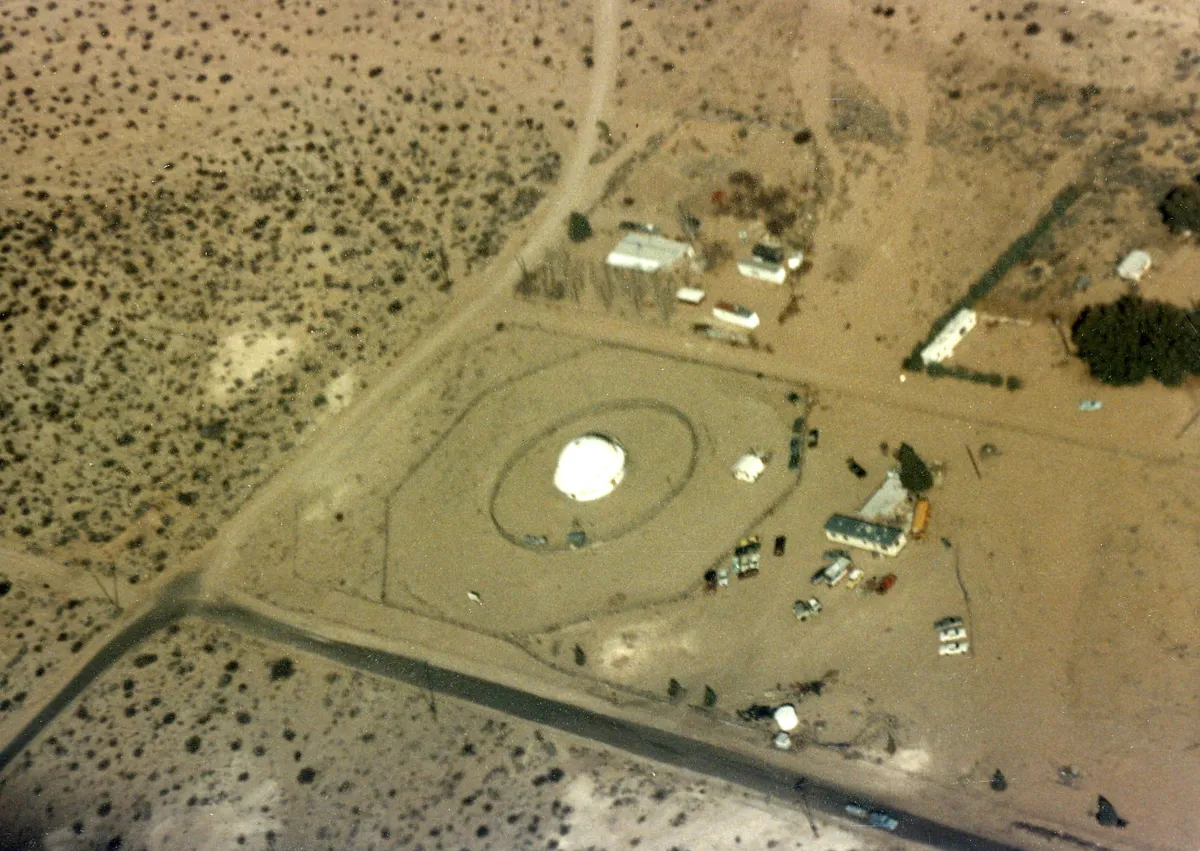
On a flat of sand and creosote bush at Landers, in California's Mojave Desert, stands a white wooden dome called the Integratron. George Van Tassel, a former aircraft inspector who kept a desert airstrip at Giant Rock, began it in 1958. He said its purpose came from a visitor who woke him at about two in the morning on 24 August 1953 and gave his name as Solgonda. The visitor, Van Tassel told the FBI, came from Venus.
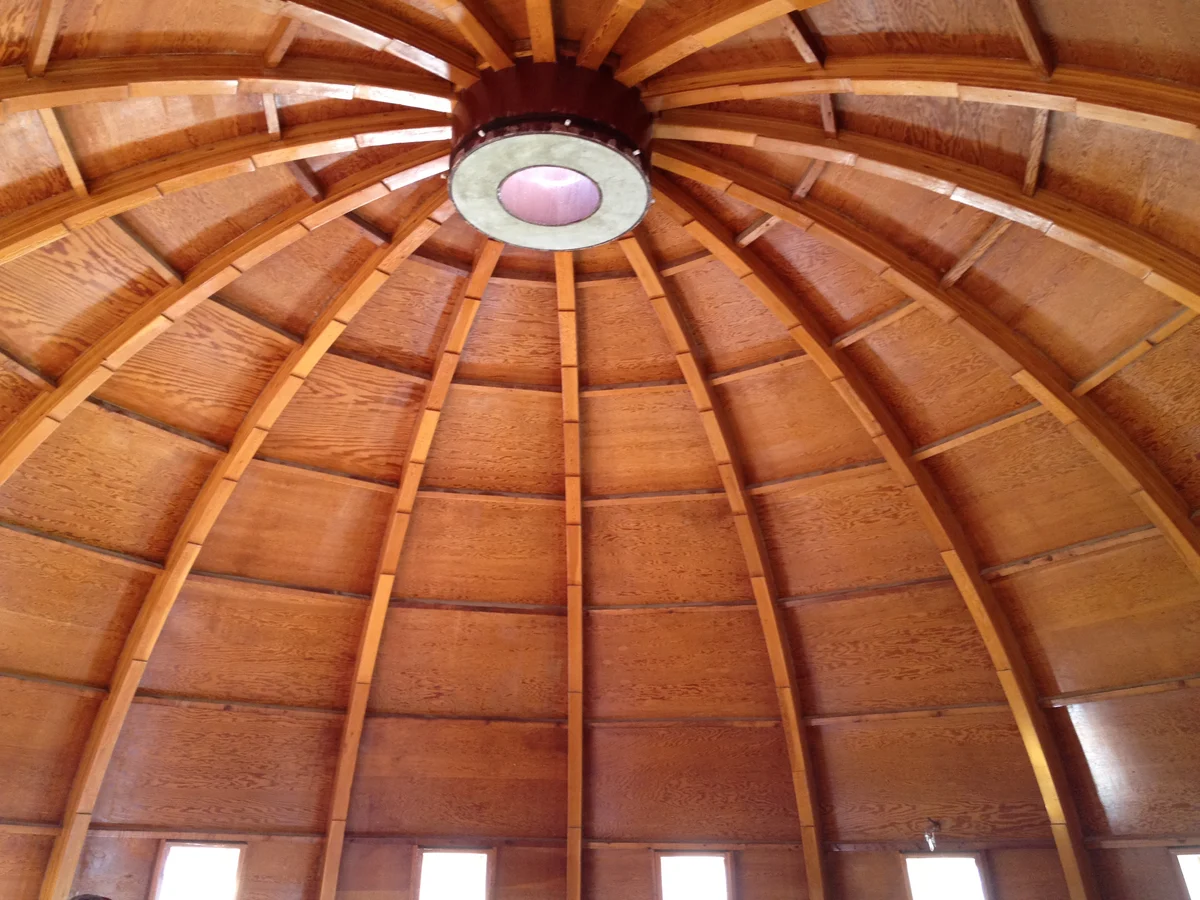
Sixteen ribs of glued Douglas fir rise from a round base and meet at the crown in a ring of poured concrete, a ton and a half of it, lined with Micarta. The dome is held together by dowels and the weight of that ring. Around the eave runs a belt of 64 aluminium rods. The upper room, in the words of its National Register nomination, "is a whispering gallery, and its acoustics are stereoscopic."
Van Tassel added machinery to it for twenty years. He died on 9 February 1978, aged 67, with the work unfinished.
The building is real. The machine was never finished.
A Night at Giant Rock
George Wellington Van Tassel was born on 12 March 1910 in Jefferson, Ohio, and spent his working life in aircraft: a lead man at Douglas from 1934, then from 1941 test-flight inspector for Howard Hughes, then Lockheed, which he left in 1947. That year he moved his wife Eva and their daughters to Giant Rock, a boulder seven stories tall in the desert north of Yucca Valley. A prospector, Frank Critzer, had held the ground by squatter's rights and built an airstrip. Van Tassel applied to the Bureau of Land Management to lease it, and in 1947 the lease was granted.
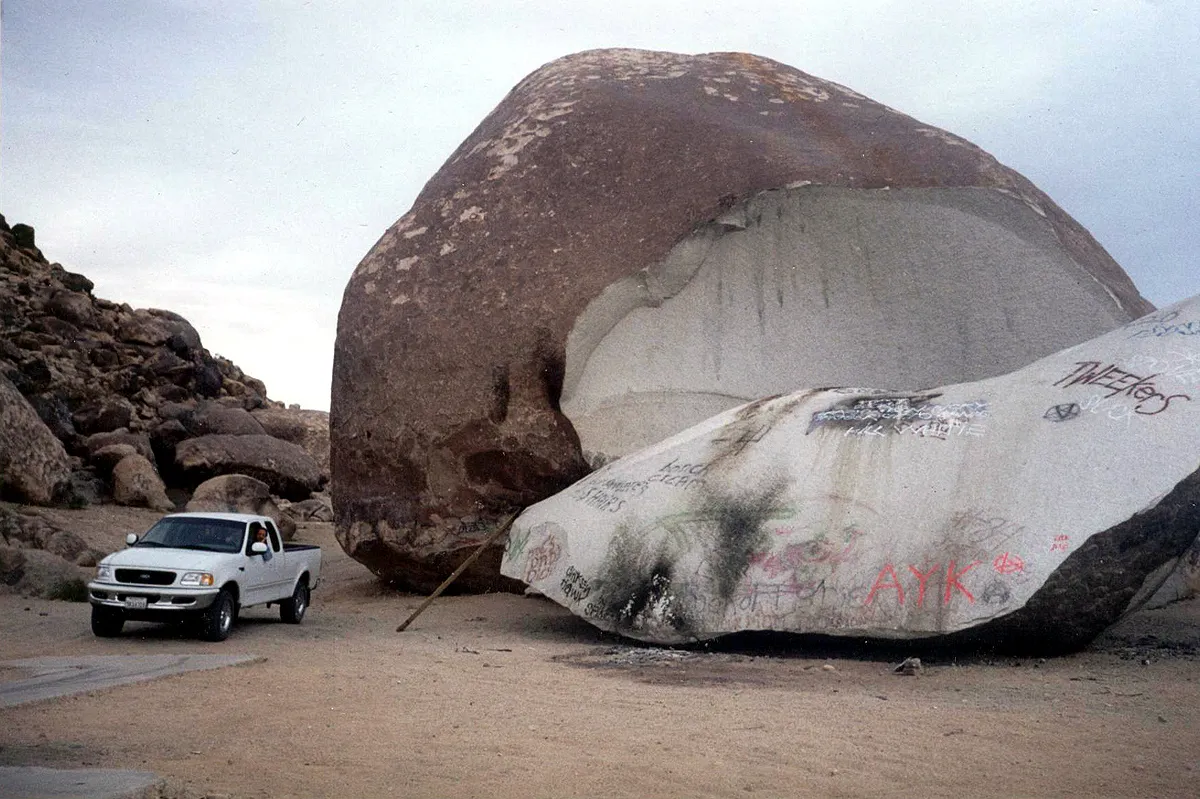
In 1952 he began reporting telepathic contacts. He printed the messages in the Proceedings, the newsletter of his College of Universal Wisdom.
On the night of 24 August 1953 he and Eva were sleeping outdoors. At about 2 a.m., he said, a man woke him. In his 1958 book The Council of Seven Lights Van Tassel gave the man's first words: "My name is Solgonda." The craft waited a hundred yards off, hovering, he wrote, about eight feet off the ground, "about 36 feet in diameter and about 19 feet high." He went aboard. Eva, he wrote, would not wake. In her own interview with the FBI in November 1954 she "was quick to point out she was not awakened and did not see the spaceman or his means of transportation."
Seven months later the first Interplanetary Spacecraft Convention opened at Giant Rock, on Sunday 4 April 1954. About 2,500 people came. The conventions ran most years until 1977. George Adamski and Orfeo Angelucci spoke at the first; by the late 1950s Daniel Fry, Truman Bethurum and George Hunt Williamson had followed. LIFE covered the 1957 gathering, and local press put the 1959 crowd at 10,000.
What the Visitor Asked For
The Bureau already kept saucer reports; the Hottel memo of March 1950 is one. On 16 November 1954 its agents interviewed Van Tassel at Giant Rock. Their memorandum says that "a year ago last August, while sleeping out of doors with his wife in the Giant Rock area, and at about 2:00 a.m. he was awakened by a man from space." The craft, he told them, was bell-shaped and "approximately 35 feet in diameter", and its crew were from Venus and "by no means hostile."
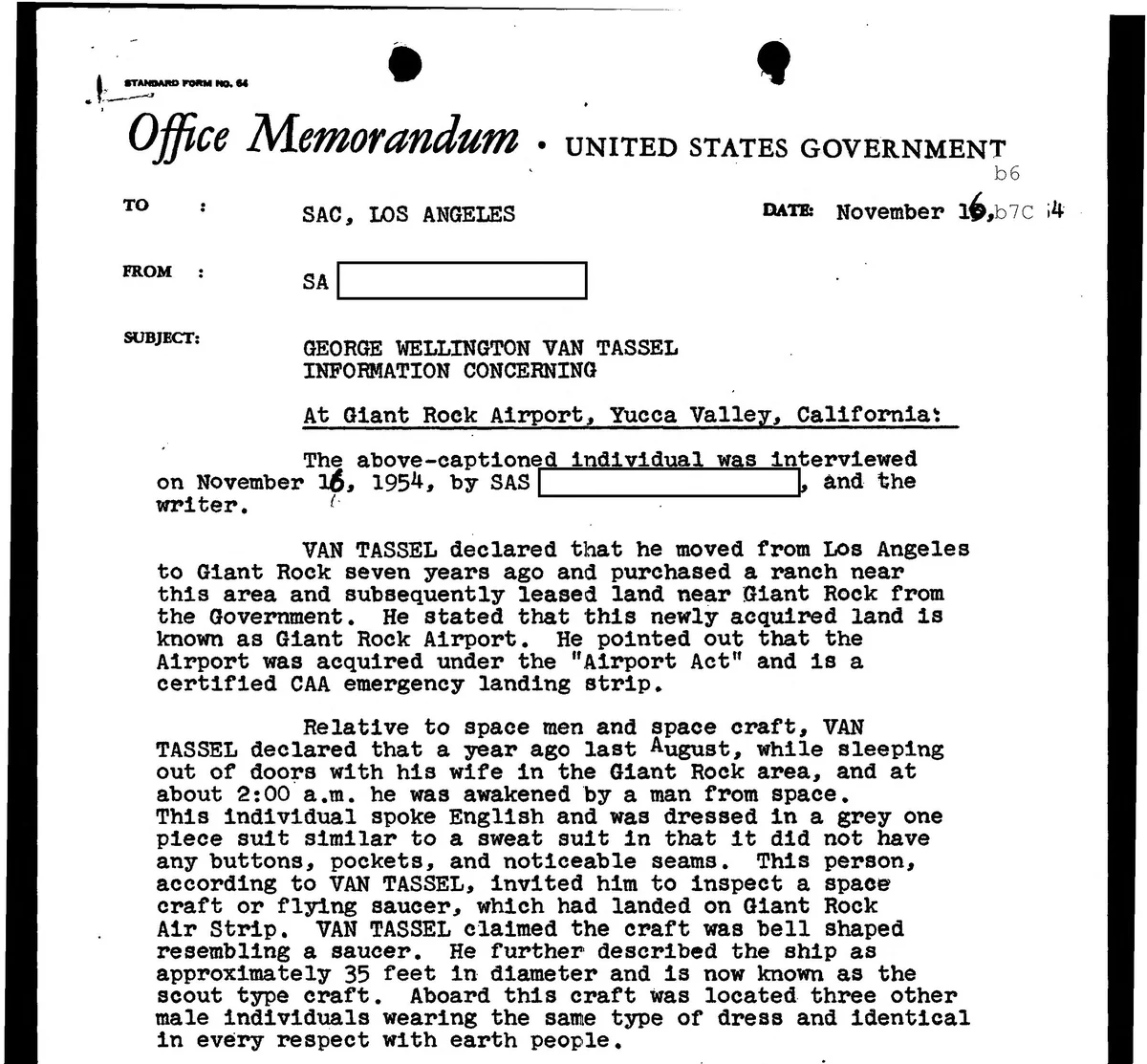
The same memo carries the purpose. Van Tassel "claims that space people have imparted to him a means of rejuvenating earth peoples' life expectency from what it is today to 300-1500 years... through a principle of light energy rejuvenation." And it carries a building rule: "many of the buildings will be made free of metal, which will be keeping within the request of the space men." Eva, interviewed three days earlier, passed on the reason: "earth men should give up using metal as they are ruining radio frequencies with the over-use of metal."
A Machine Made of Wood
The footings were poured by March 1958, the year Van Tassel's Ministry of Universal Wisdom was incorporated. The ribs were laminated by Woodlam of Tacoma, Washington, under the 1959 building contract, and the dome was complete by 1960. On 4 May 1959 an anonymous donor gave $30,000 to the building fund and $10,000 to the Ministry: "a man who has closely investigated our operations for nearly five years."
Its stated job was to be "a high voltage electrostatic generator to recharge cells and supply a broad range of frequencies." Van Tassel drew on Georges Lakhovsky's multiple-wave oscillator, and in the Proceedings he went further: antigravity and time travel, by caging a frequency. His formula was F = 1/T.
The apparatus came in stages. A Wimshurst spinner in May 1967, which he called "the heart of the Integratron." In 1969, he wrote, the work was 82 percent complete. In 1971 he redesigned it around 64 aluminium dirods of the type designed by A. D. Moore. They were made by the summer of 1972.
They went up in 1977.
If the Dome Was Drawn Elsewhere
Set aside whether any of it happened. What kind of world would we be living in if Van Tassel's account were true?
The building first. On his account, the Integratron would be the one structure on Earth whose design brief came from off the planet: a request for a metal-free shelter, carried out in Douglas fir and dowels by a man who had spent his working life inspecting wooden airframes.
Then the history of contact. If Solgonda came, the first face-to-face meeting, on his account, between our species and another was not at a summit or an observatory. It was at a desert airstrip with a cafe, and the message went to an aircraft inspector who printed it in a newsletter of a thousand copies. Which would mean the event the century kept waiting for had already happened, in the open, and drew 2,500 people on a Sunday.
Then the body. The figure in the FBI memo is 300 to 1,500 years, a span that would put a person born in the year of the first convention alive past 2250. On that reading the span of a human life is not a fixed fact of biology but a setting, and someone elsewhere would know how it is set. Every generation since would have died early. The limit would not be in us. It would be in what we had not yet been told.
And the last consequence is still standing. The dome is there. If the plan was real, the machine it describes was never completed, and what it would do when run would still be an open question, in a building anyone can walk into.
What the Record Weighs
The standard account is set out most fully in the National Register nomination written by the architectural historian Daniel D. Paul in 2017. On what it was for, it says: "At the time of Van Tassel's 1978 passing, the Integratron was unfinished and inoperable. It is unknown if the Integratron ever worked as Van Tassel intended, and he kept many engineering specifics to himself." The tests it records are all small: in a workshop in 1958, preliminary experiments in the early 1960s with a friend, Bob Simmons, and an electrostatic field meter in 1969. Paul also suggests an earthly influence: the all-wood Hughes D-2, which Van Tassel had tested.
The FBI's Los Angeles office summarized its file on 12 April 1965. Between 1954 and 1958, it says, Van Tassel brought the office allegations of espionage, sabotage and Nazism on at least seven occasions, and none was substantiated. His writings "appear to be the writings of an eccentric."
And the details shift between tellings. The FBI's November 1954 memo has the craft landed on the airstrip and 35 feet across; a newspaper interview the next month has it hovering a little way off the ground, and the 1958 book has it hovering eight feet up and 36 feet across. In 1954 the visitors offered 300 to 1,500 years; in 1958 the book spoke of adding 50 to 80 years to the average span.
What the Record Does Not Reach
The counter does not reach several things.
The FBI interviewed Van Tassel and his wife and summed him up in 1965. Nothing in its 319 released pages, as far as the scanned text shows, concerns the Integratron.
The "no metal" request on record in 1954 matches the structure built four years later. The nomination calls it "constructed with no metal whatsoever", the ribs doweled to the oculus. The match has limits: the outside carries the aluminium rods, a metal spark-gap rod and a metal ladder. The wooden dome follows the request; the machine around it does not.
The donor of 1959 is still unnamed in any record. The nomination says only that the donor is widely believed to have been Howard Hughes. That is a belief, not a document.
The building's size is not settled. The nomination measures it at 43 feet across and 33 feet tall; the owners' own history and PBS give 55 feet and 38 feet. One possibility is that the larger figure takes in the eave and the ring of rods. No measured drawing reconciling the two was found.
Nancy Karl, one of the owners, told the programme Life and Times in 2007 that "the building was put right here at an intersection of geomagnetic activity." No survey of the site was found.
No test of rejuvenation, antigravity or time travel is recorded in the nomination, the FBI file or the owners' history.
Official X found none.
The Plans in the Library
A couple bought the Integratron in 1987 for $50,000; in 2000 three sisters, Joanne, Nancy and Patty Karl, bought it and opened it for sound baths. Giant Rock split in February 2000. On 23 April 2018 the Integratron was listed on the National Register of Historic Places, reference 100002317.
In October 2026 LAist reported that the Huntington Library had acquired the McKinney Collection of George W. Van Tassel papers, gathered by Donald McKinney of Morongo Valley, who met Van Tassel in 1969. It includes blueprints of the Integratron, an architectural model and about 120 reel-to-reel tapes of his channelings.
Those blueprints are the irreducible thing.
Until now the plans were known from his own descriptions and the building. Drawn plans can show what the rods were to connect to, and how far the 1977 installation was from a finished circuit. They could show whether the Integratron, completed, would work as an electrostatic generator. They cannot show where the idea came from, or what happened at Giant Rock at two in the morning on 24 August 1953.
His epitaph, as PBS reports it, reads: "Birth through Induction, Death by Short Circuit." The plans for the circuit are at the Huntington now, waiting to be read.
Questions This Leaves You With
Is there anything you can actually do with the Integratron?
You can visit it. The dome is open, the sound baths run, and the acoustics are the one property of the building that nobody in this record disputes. Beyond that, honestly, nothing here gives you a use. The machine was never finished, so there is no treatment to book and no frequency to receive, and anyone selling you a date when it will be switched on, or a device built on its plans, is selling something. The larger question is not yours alone: whether a design handed over in the desert could ever be tested fairly, by whom, and who would pay to try.
Does a message from Venus sit against a religious account of the world?
It can be read either way, and the record here does not settle which. Van Tassel built his work as a ministry and called its subject universal wisdom, which could be read as faith widened to take in other worlds rather than replaced. The same pattern, a messenger at night, a rule handed down about metal, a promise of longer life, could also be read as a new revelation standing beside older scripture and competing with it. This site will not tell you which way it falls for you, because that judgment is not in any document and never could be.
Would a life of 300 years change what a life is?
Put your own decades beside the figure the FBI wrote down. If a span is a setting rather than a fact, then the length of your life is an accident of where and when you were born, and that can make it feel smaller. It can also make it feel rarer: the weight of what you do now comes partly from having less time than you want. Van Tassel passed on, as the space people's words, that the biggest trouble on this planet is that death intervenes once people get smart enough to use what they know. You may already know which reaction you had.
What would change your mind, in either direction?
Name it now, before the blueprints are catalogued. Drawings that describe a coherent high-voltage circuit, with values an electrical engineer could build and measure, would move the question from testimony to apparatus. So would a recording among the tapes that dates a design detail earlier than the published work it resembles. In the other direction, drawings that copy Lakhovsky and Moore part for part, or show no closed circuit at all, would weigh heavily. A field test of the finished dome could show what it emits. It could never show who first described it.
Who was the man who had watched the project for five years?
In May 1959 someone gave $30,000 toward a dome in the desert, and $10,000 more to the Ministry, and was described only as a man who had closely investigated the operation for nearly five years. That phrase fits a donor, an engineer, an investor or an investigator, and the record does not say which. Howard Hughes is the name people supply, and no document yet supplies it. If the Huntington papers include the correspondence behind that gift, the one person who looked hardest at the plans before paying for them may finally have a name on paper. Until then, that space is empty.
Sources
- Daniel D. Paul, National Register of Historic Places Registration Form: Integratron, National Park Service, 2017 National Park Service Primary record
- National Park Service, NPGallery record NRIS 100002317, Integratron National Park Service Primary record
- Federal Bureau of Investigation, George Van Tassel file, FOI/PA 1440352-0, 319 pages, Internet Archive Federal Bureau of Investigation via Internet Archive Primary record
- George W. Van Tassel, The Council of Seven Lights, DeVorss & Co., 1958 DeVorss & Co. Primary record
- Kim Stringfellow, Giant Rock, Space People and the Integratron, PBS SoCal Artbound, 2018 PBS SoCal Study
- Integratron, History Integratron (owners) Study
- Heather Downie, Life and Times transcript, USC Annenberg, 15 Aug 2007 USC Annenberg (Life and Times) Primary record
- Josie Huang, LAist, 3 Oct 2026, on the Huntington's McKinney Collection of Van Tassel papers LAist Study
- National Park Service, National Register of Historic Places weekly lists, 2018 National Park Service Primary record