At Frankfurt's airship port, two German Zeppelins remained three years after the Hindenburg disaster. By the end of spring 1940, both had been dismantled. The giant halls that had sheltered them were demolished too. The surviving ships did not share the fate of the ship that burned at Lakehurst. Their destruction was ordered.
That difference changes the question. A photograph of Hindenburg in flames can explain the loss of Hindenburg. It cannot, by itself, explain the later decision to break up LZ 127 and LZ 130, recover their materials and remove the buildings around them. Between the fire and the demolition stand officials, proposals and instructions.
The Hessian historical institute's photographic record assigns the Frankfurt destruction to Hermann Goering's command. The Zeppelin Museum's archival investigation follows the instructions further, to Ernst Udet and a secret copy dated 4 March 1940. The record has names. What it does not supply so easily is a complete comparison of the futures that were discarded.
The machines remained. Then came the decision.
A Decision With More Than One Date
The first thing to recover is the sequence. Retirement, dismantling and demolition describe different acts. A ship can stop carrying passengers while remaining intact. A stored ship can become a museum. A dismantled ship cannot resume service by receiving another permission.
Sabine Ochaba's 2025 investigation for the Zeppelin Museum describes Udet asking for scrapping proposals on 14 February 1940, before Goering's March inspection. Her second installment reports a secret copy of instructions dated 4 March: dismantle LZ 127 and LZ 130, allocate their materials and the prepared material for LZ 131 to the Luftwaffe, and reuse the halls' materials. Selected structural pieces were to serve research and teaching.
The implementation followed quickly. Ochaba dates the start of LZ 127's dismantling to 8 March and its completion to 1 April, reported in a later company memorandum. The halls were blasted on 6 May. Ships first. Shelter afterward.
To begin, LZ 127 was lowered to two metres above the hall floor. Its walkway came out; its covering, wiring and instruments followed. The museum's sequence makes dismantling tangible: a ship suspended in its shelter became separate objects that could be carried away. The process reversed the joining that had made it a ship.
The Deutsches Historisches Museum independently records both ships' scrapping in 1940. The record at the Hessian institute supplies the wider scene: ships and halls destroyed across March-May under Goering. The whole structure of an airship port was being changed, from the vehicle inside to the building around it.
The Future That Was Taken Apart
The strongest reason to keep asking is the scale of what was removed. One airship could be grounded. Two could be stored. Demolishing their halls removed the place in which those particular giants could be kept together. A decision about material became a decision about the shape of any return.
Airship captain Albert Sammt later read something more into it. As Ochaba reports his memoir, he suspected an effort to erase the memory of airships and the peaceful international contacts they recalled. His suspicion reaches beyond the immediate military use of recovered metal. It places memory itself among the possible targets of destruction.
There were named advocates for another future. Ochaba follows Deutsche Zeppelin-Reederei director Walter Issel's proposal for a trans-Siberian service in October 1939. In February 1940, Walter Bruns advocated selling airships to the Soviet Union in exchange for raw materials. The proposals placed the same machines inside a different plan: keep them useful through another route or another owner.
The difference is substantial. A sale would transfer a ship; scrap would dissolve its identity into material. A new route would require decisions about destinations and operations; demolition would remove a great shelter from the list of available places. These were different actions with different physical endings. Treating all of them as the airship era ending makes the choice disappear inside the label.
The mast network built for the Norge shows why a ship's story reaches beyond its envelope. The stations associated with R100 pose the same infrastructure question. A vehicle, its shelter and its destinations form a system. Removing the shelter changes what keeping the vehicle could mean.
If Destruction Could Choose the Future
Set aside whether Sammt was right about an intention to erase memory. If that reading held, the important loss would extend beyond two airships. It would mean that an apparently inevitable technological ending had been helped into permanence by a choice about what could remain whole.
A complete museum ship would have offered one kind of future. A stored hull awaiting a buyer would have offered another. Neither would guarantee a successful service. Each would, however, leave a different starting point from a pile of recovered metal. On this reading, the state would have chosen between possible starting points as well as immediate uses.
Our picture of progress would have to make space for that choice. A machine's disappearance would not tell whether it had exhausted its usefulness, lost its patron, become inconvenient to store or been denied a further trial. The surviving record would need to show which question the decision makers were answering.
The larger consequence would concern what later generations could examine. An intact vessel would let our history retain relationships between parts: where people worked, how equipment fitted, how rooms met the structure. A detached instrument could preserve its own construction while losing much of that setting. Preservation would shape the questions still available to ask.
Which would make the most consequential act the one after the last flight. Our lost alternatives might have survived long enough to leave a dismantling instruction. If so, the future would have narrowed while the machine was still on the ground. The decisive record would be the comparison between the options, rather than the photograph of what followed.
What the Military Explanation Contains
The Zeppelin Museum's interpretation is direct: wartime demands for materials and space drove the destruction. It also records the regime's earlier financial support and propaganda use of Zeppelins. The history does not support a simple picture of a government consistently hostile to airship technology.
A 1975 MIT assessment preserved by NASA independently summarizes both Grafs' dismantling and the conversion of their scrap to military uses. That is later technical history, not a newly discovered 1940 instruction. Its narrower point agrees with the disposal account: material recovered from the ships was put to other uses.
There is physical survival as well. Zeppelinheim's museum identifies an original LZ 127 Maybach engine, an LZ 130 Telefunken radio, structural pieces, controls and a gondola ladder among its exhibits. Those objects prevent a literal claim that every trace or technical lesson was eliminated.
The military explanation therefore has substance: an authority, a stated use for resources and surviving components. It answers what the administration said it was doing and what happened to some material. Establishing that explanation as the sole motive would require a different kind of evidence from demonstrating that salvage occurred.
The Comparison Still Missing From This File
The remaining question is narrower than a hidden hand behind every airship loss. Goering's authority is identified. Udet's instructions are described. The outstanding task is to reconstruct how the alternatives were evaluated and which objections decided their fate.
LZ 127 had already served as a museum ship, according to Ochaba. Complete preservation was a use that existed, not a modern proposal invented for this investigation. Yet the opened material supplies no side-by-side estimate of retaining a complete ship, maintaining its hall, selling it or taking its scrap. That limit belongs to this research file. It is not a declaration that such records never existed.
The sale proposals raise another test. Who was prepared to buy, under what terms, with whose permission and at what cost? A letter advocating a sale cannot answer for a buyer. A proposed service cannot supply the missing agreement. The survival of a proposal establishes an alternative being discussed; a decision record would show why it failed.
And here is the strange part. The same event can be both an irreversible removal and an act of selective preservation. An engine saved for study does not preserve a complete passenger ship. A complete ship destroyed does not prove an attempt to extinguish every technical memory. Both facts have to remain in the frame.
The cruise-ship comparison opens a useful test: speed alone cannot decide whether slower travel has a purpose. That still leaves the economics of these particular Zeppelins to establish. Crew, maintenance, gas, shelter, weather, ground handling and revenue would enter the comparison. No operating balance sheet in the material opened here establishes that these ships were destroyed because their transport was too inexpensive to tolerate.
What an Intact Ship Could Have Shown
An explanation for stopping a service is not automatically an explanation for destroying its last complete examples. Keeping that question separate is the point of following the orders beyond Hindenburg. Safety, military priorities, storage and preservation each ask something different of the same vessel.
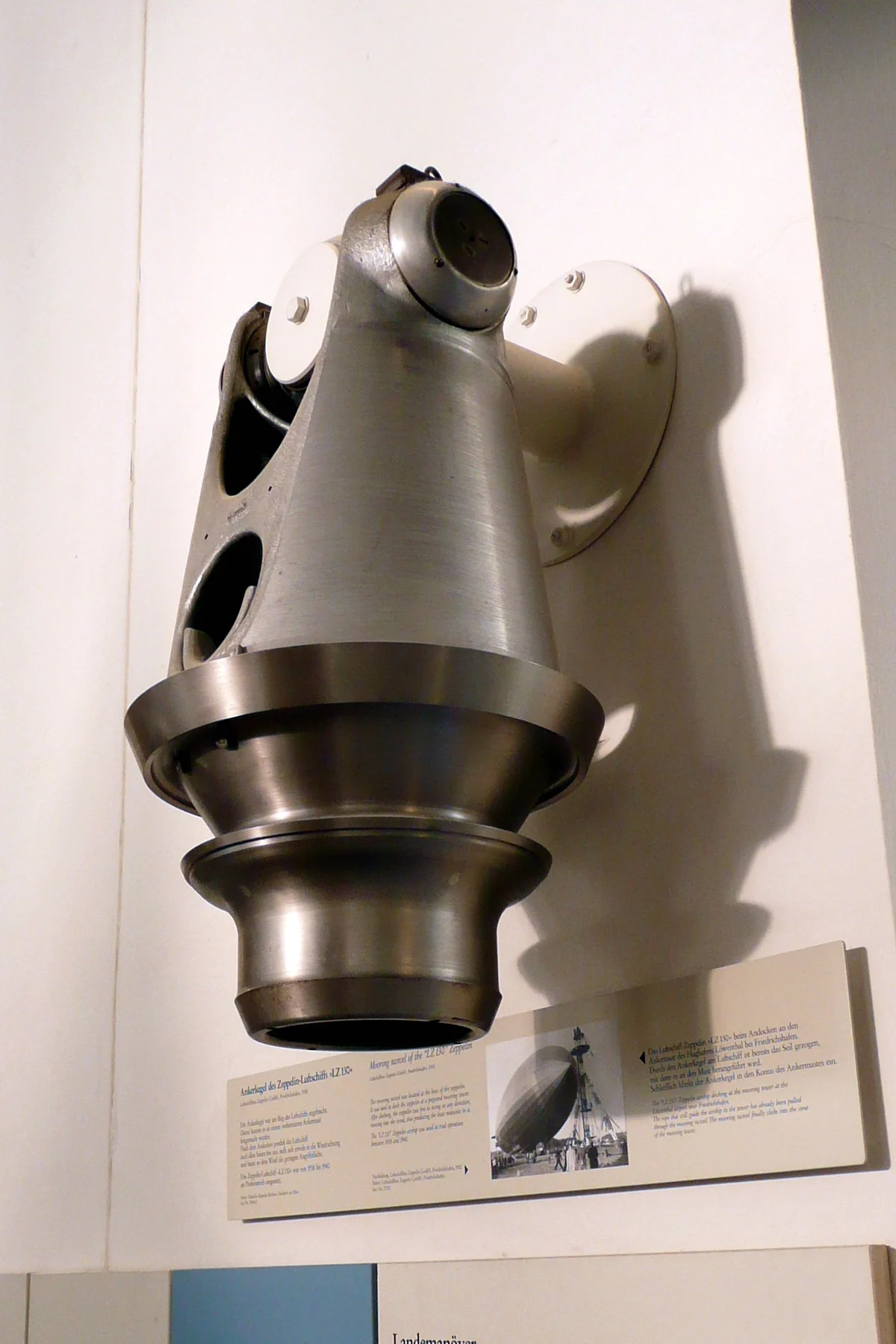
A photograph at the Deutsches Museum shows a mooring cone from LZ 130. The object is mounted on a pale wall, its metal body pierced by openings, with a circular mouth at its narrow end. Below it, a museum label names the airship. The whole fitting is visible. The ship to which it belonged is absent.
That is a different ending from anonymous scrap. Here a particular part retained an identity that a label can still recover. Its survival allows a close look at the metal, the openings and the shape. A display can preserve a fragment with care while leaving the scale of its former setting outside the frame.
The photograph was taken decades after the dismantling. It does not show the act of removal, the decision to save this fitting or every stage between the ship and the wall. Those belong to its history of custody. The image gives something smaller and firmer: an identified object available to examine, after the complete vessel was lost.
The cone remains under the name LZ 130. What would the papers about keeping the whole ship add to the story that this surviving piece can tell?
Questions This Leaves You With
1. Does this history call for anything in ordinary life?
Nothing in these destruction records gives you a timetable for a personal decision. Anyone selling a date is selling something. You can separate that from the longer public question: what should survive when a large technology loses its immediate use? An entire ship, a representative machine or a set of drawings would each preserve something different. The practical question is how a society chooses among them while the whole still exists. You do not have to assume a hidden motive to find that choice worth examining.
2. Does a lost technological future say anything about faith?
You could read a deliberate loss as compatible with a religious view of human responsibility, or approach the same loss through secular choices and institutions. Neither reading follows automatically from a dismantling order. You could also hold a religious understanding of history while accepting the military explanation for this particular event. These documents do not adjudicate those commitments, and this site will not tell you which to hold. The narrower question is what human decisions did to these ships; the larger meaning you find in that remains yours.
3. Does it change how a single human life fits into history?
You might find the scale diminishing: a lifetime spent learning a machine can end with another person's instruction to take it apart. Or you might find the same scale enlarging: one person's retained photograph, object or written memory can leave a question available to people who never saw the whole. Neither reaction requires you to change your work or beliefs. The tension is between what a person can build within a lifetime and what institutions can choose to keep after that work has ended. Which side of that tension stays with you?
4. What record would change your reading most?
You might choose a documented preservation bid with an affordable cost and a rejection unrelated to military need. That could strengthen a case that other priorities were decisive. Or you might find a detailed comparison showing that storage, restoration or sale could not meet the conditions imposed at the time. That would give the military explanation firmer support. In either direction, you would want the actual proposal and response, with dates and authority, rather than a later statement that keeping the ships was possible or impossible.
5. Why was no complete ship retained?
You now have named decision makers, a documented destruction and evidence that selected equipment survived. The remaining question asks for the comparison behind the choice. LZ 127's museum use and the proposed alternative uses make that a concrete archival task. You could follow the museum's file references into the correspondence, then test whether they contain appraisals, objections or rejected terms. Until that material is inspected, the question remains bounded by what this investigation has opened. What would those papers add to the decision that the surviving objects cannot show?
Sources
- Sabine Ochaba, Zeppelin Museum, Mehr als nur Schrott, Part 1 (24 March 2025). Secondary archival account. Zeppelin Museum Study
- Sabine Ochaba, Zeppelin Museum, Mehr als nur Schrott, Part 2 (24 April 2025). Archive-based secondary account; reports the 4 March secret copy and disposal. Zeppelin Museum Study
- Zeppelin Museum, Nur Schrott? Institutional interpretation of military demands and prior regime support. Zeppelin Museum Study
- Hessisches Institut fuer Landesgeschichte, LAGIS historical photograph 164-032. March-May 1940 destruction and Goering authority; photograph itself not cleared for reuse. Hessisches Institut fuer Landesgeschichte Study
- Carola Juellig, Deutsches Historisches Museum, LeMO: Zeppeline (10 May 2011). Independent institutional confirmation of both ships' 1940 scrapping. Deutsches Historisches Museum Study
- Joseph F. Vittek Jr., editor, MIT Flight Transportation Laboratory, An Assessment of Lighter Than Air Technology (June 1975), printed page 15, NASA-hosted full report. Later technical history, not a 1940 order. MIT / NASA Technical Reports Server Study
- Zeppelin-Museum Zeppelinheim, Museum information. Current institutional description of original surviving components; does not establish every object's wartime custody chain. Zeppelin-Museum Zeppelinheim Primary record
- WerWil, photograph of LZ 130 mooring cone, Deutsches Museum (2009), Wikimedia Commons. CC BY 3.0; original image and identifying label visually inspected. WerWil / Wikimedia Commons Primary record