
The mooring mast at Saint-Hubert, on the south shore of Montreal, stood 60 metres high in an open field, built by Canada for one British airship service. At daybreak on 1 August 1930 R100 came in over it, 219 metres of linen and hydrogen in a white sky, with a lamp burning in the masthead below her.
She had left Cardington in Bedfordshire almost 79 hours earlier. The fabric of her fins had been torn open over the St Lawrence. Her crew brought the nose down to the head of the tower, the line went across, and the biggest airship in the world stopped moving.
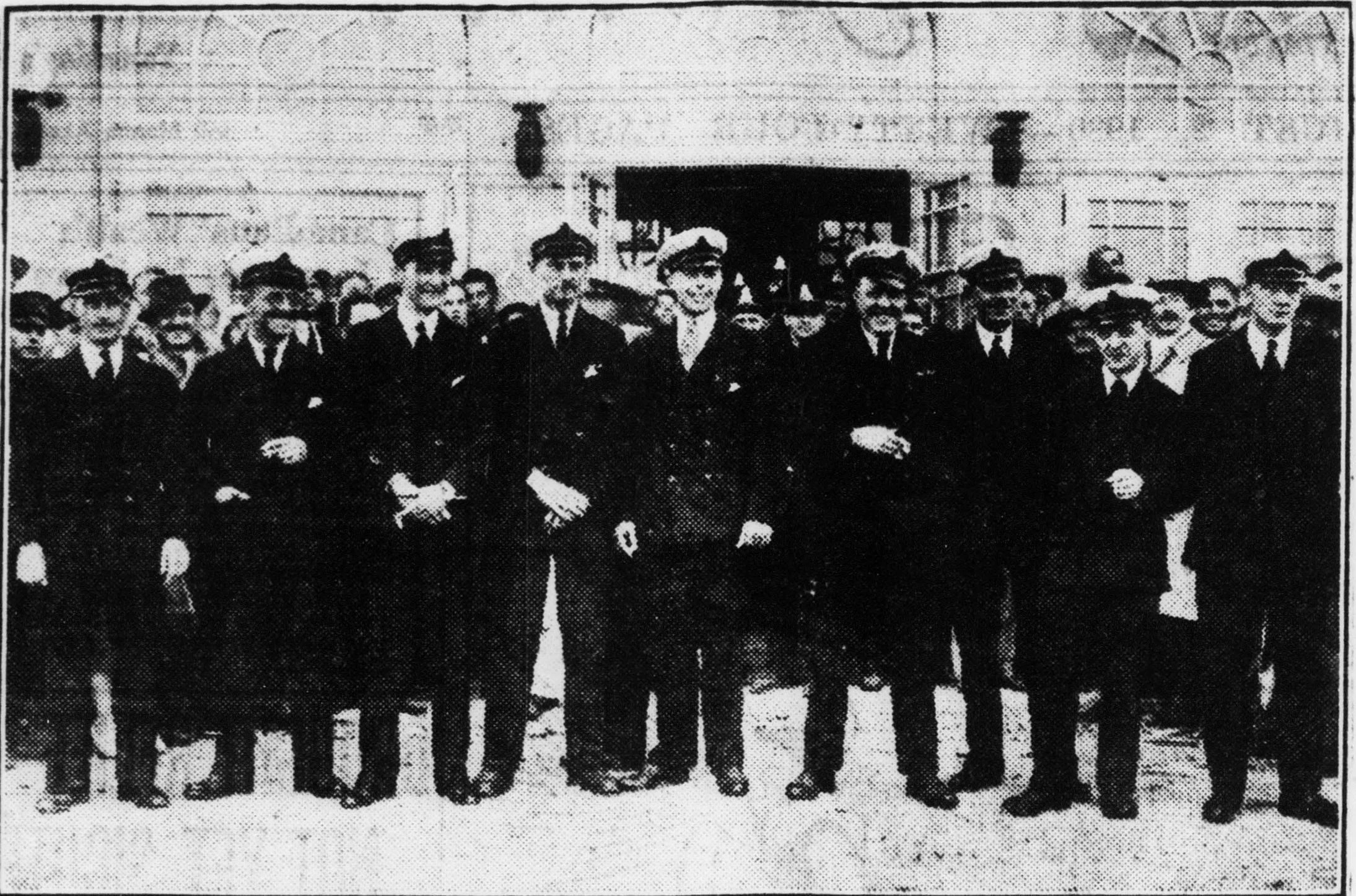
The cameras stayed. The crew posed at the airport that first morning.
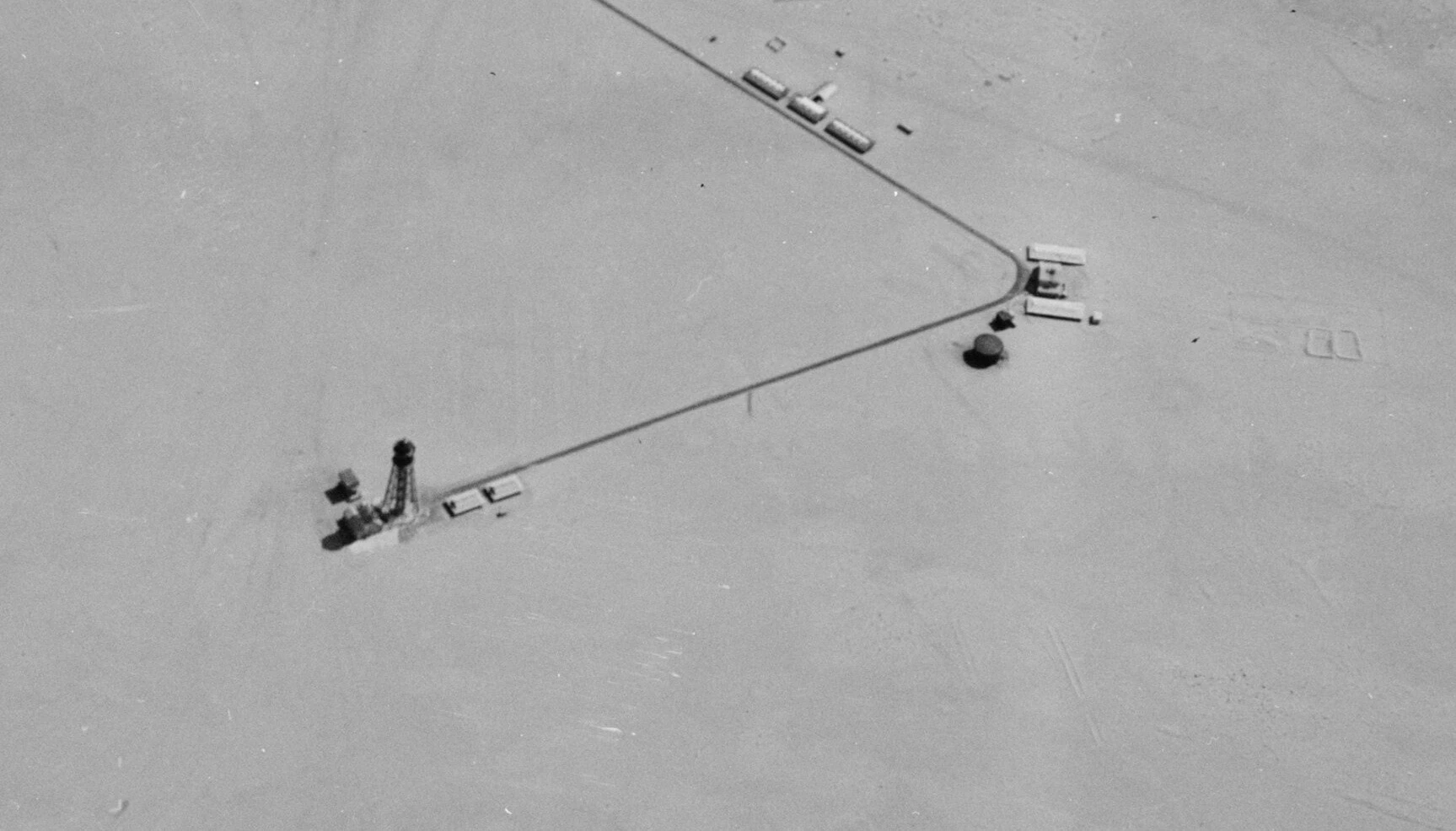
Elsewhere on the same imperial map stood two more stations. A mast in the sand at Ismailia in Egypt. A steel shed at Karachi 850 feet long, with gasholders and its own railway spur.
One ship came to one of the three, for twelve days. The Saint-Hubert mast stood for seven more years.
Nothing is on record tying up to it again.
Two Questions From the Floor
The record of those twelve days sits in Ottawa: 120 photographs at Ingenium, captioned like a working log. Start of mooring operations. Refuelling at mast.
On 5 April 1927 J. S. Woodsworth asked Mackenzie King in the Canadian House of Commons whether Canada could be committed to imperial air routes with no vote. King said no, then explained his one commitment. Britain's Air Minister had asked, in an informal way, for one or more dominions to put up a mooring mast. King's words: "We felt that we would be derelict in our duty" not to get the first flight for Canada.
On 11 April J. L. Ralston, the defence minister, named a preliminary sum in vote 103a for an air field and mooring mast. Maj. G. H. Scott, the Air Ministry's airship man, sailed that April to choose the ground.
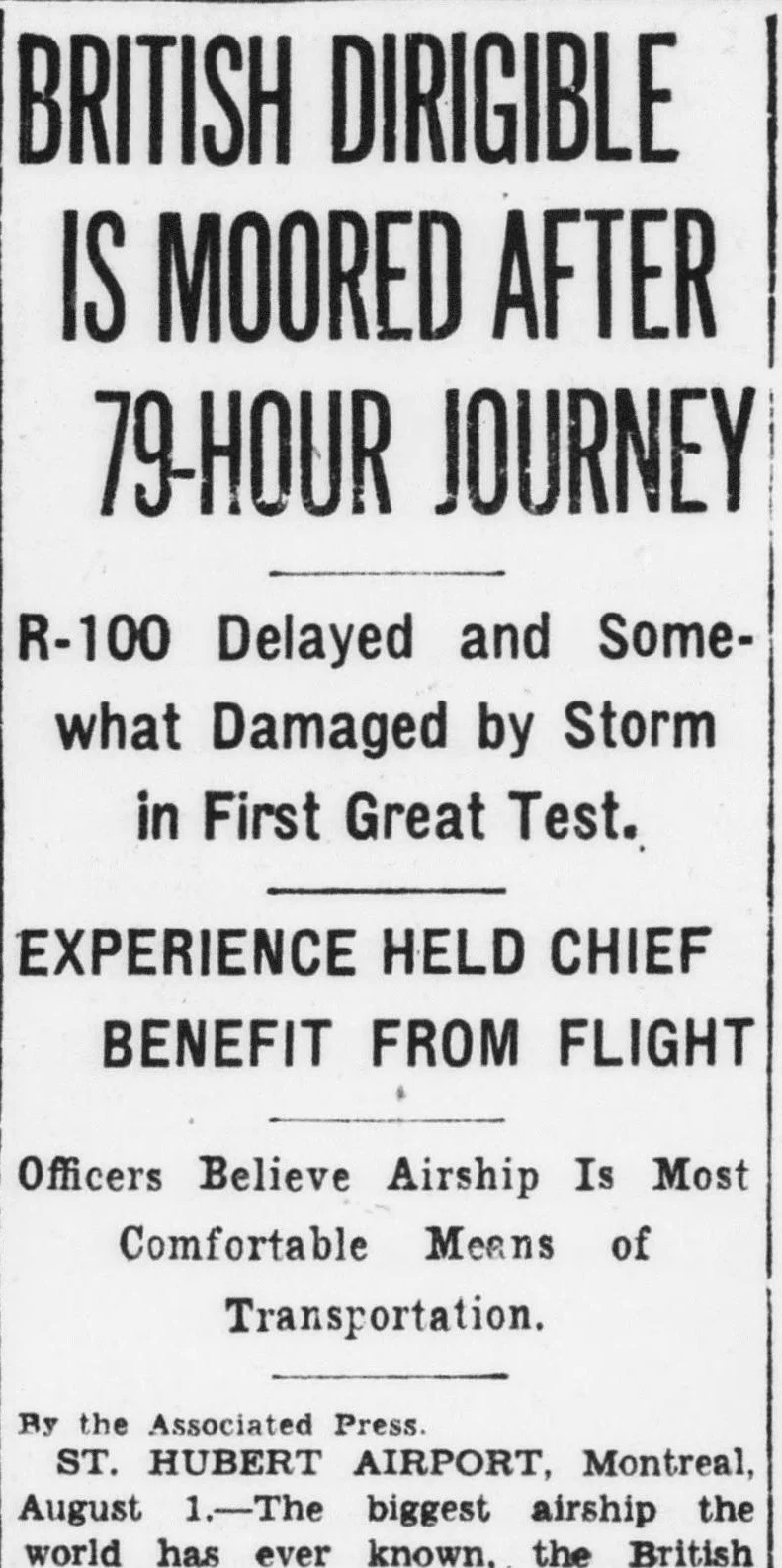
The Associated Press had her secured at 4:36 a.m., Eastern standard time, to a mast "erected here especially for its use." Sir Dennistoun Burney told reporters everything had gone perfectly until Father Point. Aboard, the engineer Nevil Shute Norway, later the novelist Nevil Shute, was writing the diary reprinted in Slide Rule: two twelve-foot tears, and supper thrown up the corridor.
On 11 May 1931 a member named Dorion asked the cost of the anchorage mast, "including land, buildings, equipment and all improvements." The answer, for aerodrome and airship base together, came to the cent.
$1,846,569.16.
A month later he asked whether Britain had contributed. The answer was one word. No. Which leaves the whole bill in Ottawa.
Empire by Mast
The idea behind that mast was enormous. Burney had been pressing it since 1921: lines of airships to India, Canada, Australia, New Zealand and South Africa. The programme, as Ramsay MacDonald later laid it out, was two giant ships, the works at Cardington and masts at Ismailia, Karachi and Montreal, at 2,350,000 pounds. Canada and India paid for their own masts, MacDonald agreed.
At Karachi the first steel went up on 9 October 1926, for a shed the Airship Heritage Trust sizes at 850 feet by 180 by 170, built for a class of ship that was never laid down.
A Fleet in the Towers
In the Tartaria videos, a fleet of airships worked the cities of the old world from the 1880s, and by 1913 the network was dead and the memory with it. Tartaria Britannica, on 8 January 2023, takes the idea up the buildings themselves: many had ornate entrances at the top, it says, "where people would board an airship." On that reading the name on the maps, Great Tartary, is the name of whoever ran it all.
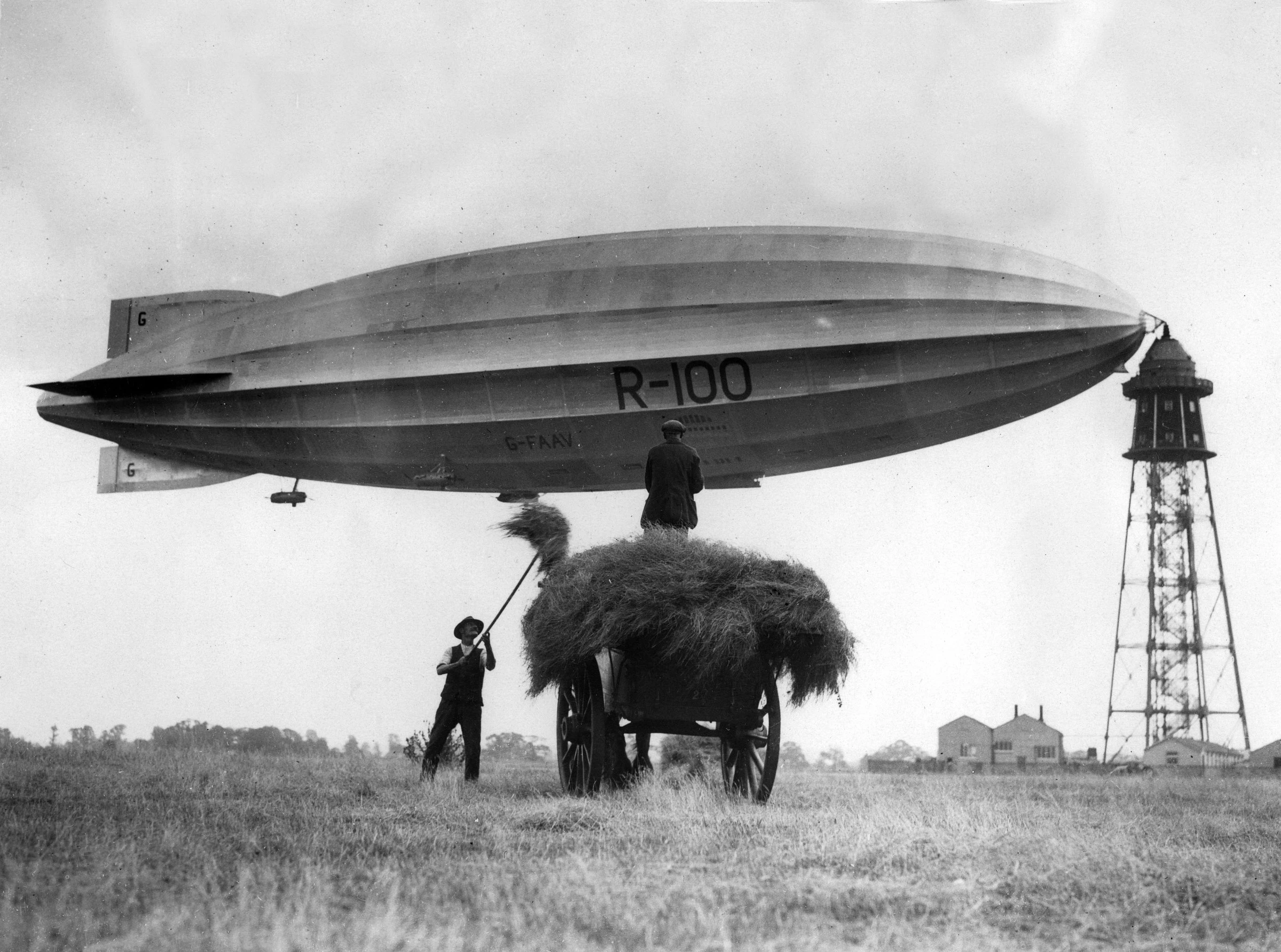
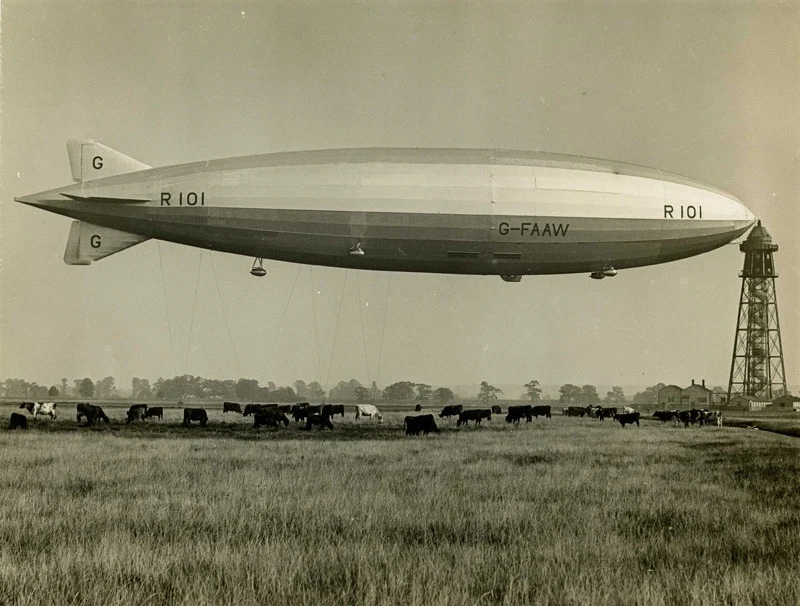
The real ships are already in that story. On 7 January 2024 a user of r/Tartaria posted 48 uncaptioned Airship Photos in three parts. The same user had announced a live stream of airship photos a week earlier, calling such craft a thing that "appear to be a remnant of the previous civilization." Part 3 holds R100 above the Cardington haymakers and R101 over grazing cattle.
Nothing in that album names a station, and one search, in English, found no Tartaria page naming Saint-Hubert, Ismailia or Karachi. The step to the empty stations is this article's own. The outline rhymes, and a rhyme is all it is. In 1999 the museum's curator, Renald Fortier, wrote that people tend to forget Britain ever had such a scheme.
What an Empty Mast Would Mean
Set aside for a moment whether any older fleet ever flew. Ask the better question. If a chain of airship stations across three continents can slide out of common memory inside one lifetime, what are we standing on?
It would mean, first, that an airship age does not have to end in fire. The fire would be only the part we remember. The ending would be a maintenance bill, a scrap contract, a line in an estimates debate. On that reading every lonely tower with no known purpose would deserve a second look, because an empty mast would be what the end of an airship network looks like from the ground.
It would mean that infrastructure outlives its reason, and that the outliving is the normal case. A shed for ships nobody built. A railway spur to a door nothing used. Our cities would be full of such things, and we would walk past them the way the traffic now passes Saint-Hubert. The odd thing would not be a tower with no purpose. The odd thing would be a tower that kept one.
It would mean that our memory is shorter than our bodies, for a McGill student who saw that ship at Saint-Hubert in 1930 lived until 2018. Which would mean the whole British airship empire, from first steel to scrap, fits inside one human span, and a person could outlive the common knowledge of what she saw with her own eyes.
And it would leave one question still in front of us. If our species can mislay a thing this large with the paperwork still on the shelf, what would it take to mislay one with the paperwork gone? Which of our own stations would look like this to somebody, and what would they need to find?
Dated, Signed and Filed
The standard account, in the work of Fortier and of Peter Davison's 2015 paper in the Journal of Aeronautical History, starts with size. This was two ships, not a fleet, prototypes Davison calls severely limited in lift. Nothing was lost. R100 came home on 16 August to about 200 cars and, in Shute's words, never flew again. R101 left for Ismailia and Karachi on 4 October and struck the ground near Beauvais at 2.08 a.m., killing 48 of the 54 aboard, among them Lord Thomson, the Air Minister.
Sir John Simon's inquiry heard 42 witnesses and reported on 27 March 1931, as Command Paper 3825, with Davison quoting its finding of a substantial loss of gas from the fore part of the ship. Cardington went from 860 workers to 380. By 10 March 1932 Sir Philip Sassoon was listing the decision to break up R100 among the economies. In May 1935 Mr. Sutherland, who had answered Dorion, told the Commons $500,000 had gone into a mast "for an airship that made only one trip."
On this account a real network leaves exactly this: votes, contracts, witnesses, a named man answering a question. The fleet in the videos has shown none of it.
Where the Paper Thins
All of that holds for the crash and the sums. It thins fast at the edges.
Davison quotes the inquiry tying the loss of gas to "a specific misfortune such as a ripping of the fore part of the envelope." Its assessor Moore-Brabazon listed, in his own notes, technical problems subordinated to political pressure. Peter Masefield, in a draft quoted by Davison, called such charges ill-judged, and thought R100 would probably not have survived that night either.
Nobody counted the crowds. Organisers planned for 600,000. Shute says over 100,000 a day, McGill's library 800,000, the museum more than a million.
For the mast alone there is only the $500,000 in a 1935 speech. MacDonald told the Commons in May 1931 that Canada had not answered on the mast's upkeep. Canada's House of Commons debates, searched by machine for airship, mooring mast and anchorage mast to 1939, show no answer, and no order for the removal in January 1938, which rests on the museum and the Airship Heritage Trust.
The stations are worse. Karachi's dismantling, agreed in 1961, with the steel going to Pakistan Railways, rests on one Trust page with no footnotes. Ismailia rests on another. It says the mast was still standing in 1939, then dismantled quickly, with confirmed sightings that it was gone by 1939/40. A Matson air view catalogued as 1932 shows it up. The page does not say who gave the order or where the steel went. Official X looked for a primary record of that order in one site-limited search of British Hansard. Air Ministry files at Kew and Egyptian records were not tried.
It did not find one.
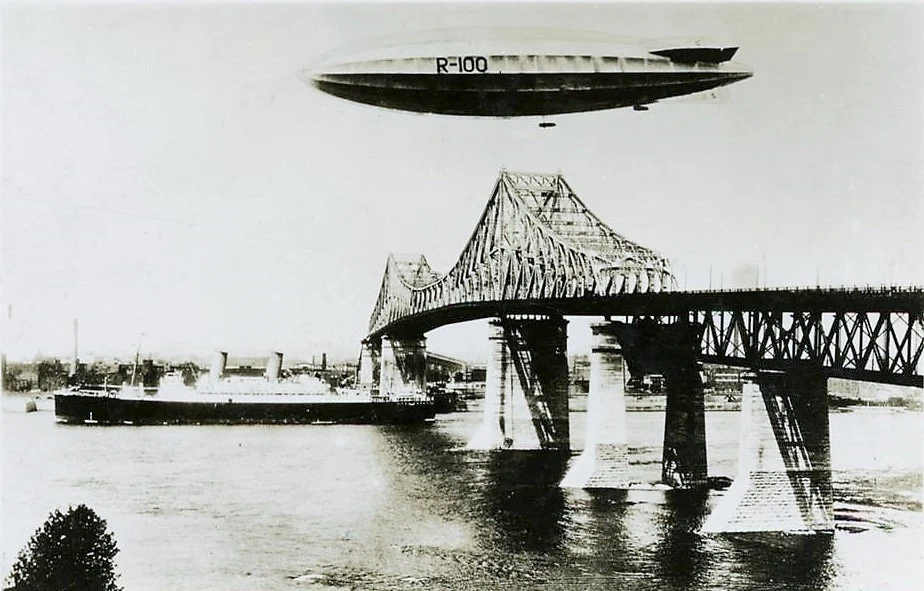
And a real ship does not protect a picture. The City of Toronto Archives titles its print of R100 over the harbour a composite.
Paper for an Empty Mast
Pieces remain. The Airship Heritage Trust reports that in 2007 historians located many of Saint-Hubert's 24 concrete mooring blocks and a tether ring, now in the Montreal Aviation Museum. A control wheel and a berth from R100 went to the museum in Ottawa. The field became what Ralston told the Commons it always was, a national airport. The two great sheds still stood at Cardington when Davison wrote. Karachi's site lies under the city's airport. Pictures of R100, R101 and the Ismailia mast are gathered in The Airship Record.
So the open question is narrower than a date. Ismailia's mast is placed to within about a year, on one page with no footnotes. What is missing is the paper. Who ordered a finished station of a real airship empire taken down in 1939 or 1940, and who carried the steel away? Air Ministry files at Kew or an Egyptian record may hold it. A file would prove no fleet and rule none out. It would show whether an empty station ends with a signature or without one.
One order, for one mast.
The smallest object in the file may be the plainest. It is a printed sheet headed Pass For One, to the Royal Airship Base, Karachi, for the arrival of H.M. Airship R-101. It warns of unseen wires sweeping the landing ground. It says responsible officials will wear a purple armlet on the left arm, and employees a green one. It is signed W. H. Watt, Officer-in-charge.
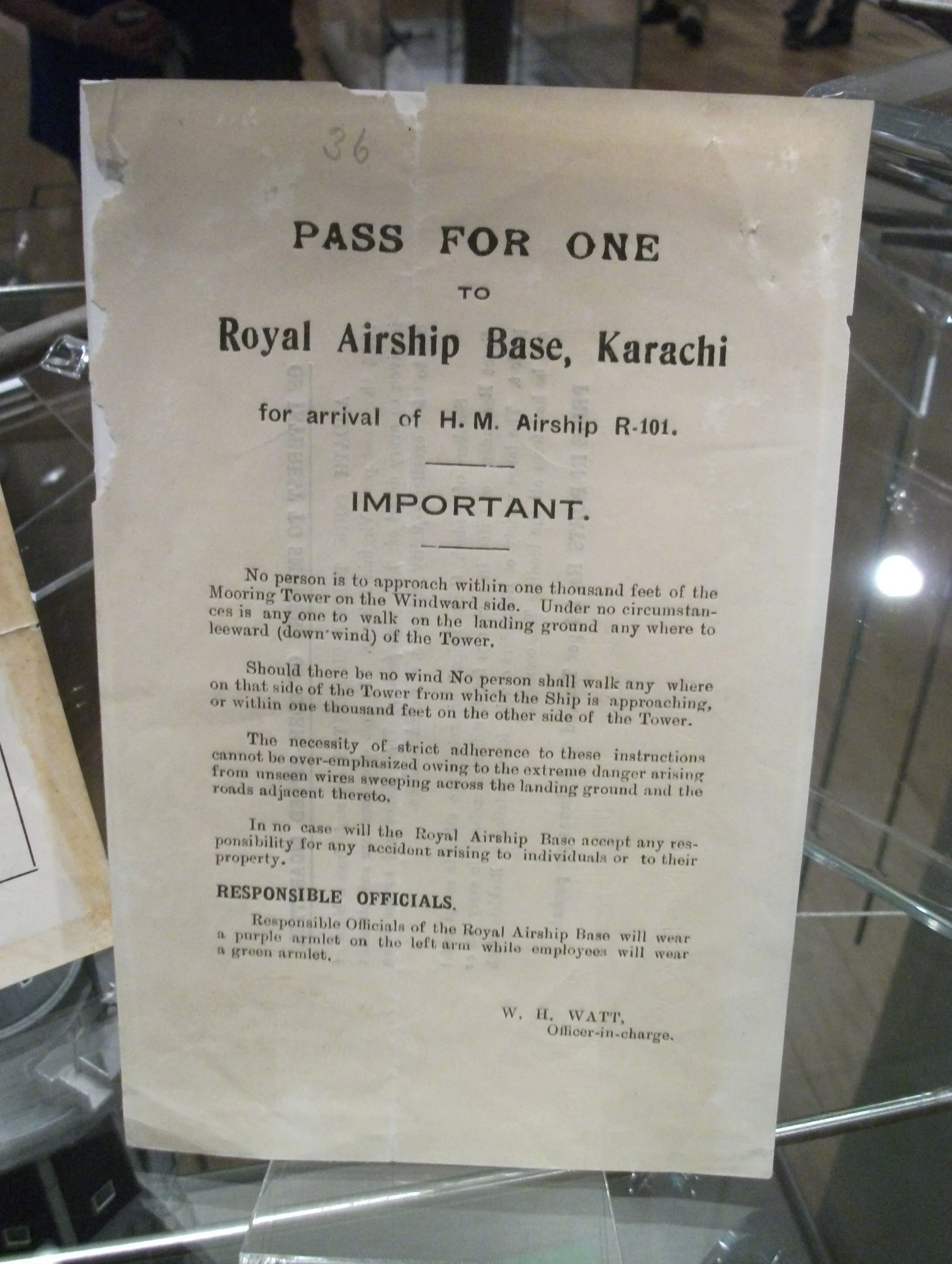
Photographed in a case at Bedford in 2010, it was still good for one.
Questions This Leaves You With
Is there anything a person actually does with this?
Nothing in your own life follows from it, and anyone selling you a date or a secret is selling something. What you can do is local. Find the oddest old structure near you, a tower, a slab, a siding, and go to the municipal minutes before you go to the internet. Canadian members of parliament were asking the price of a mast within a year of the flight. That habit is the useful part. The larger question is not yours alone: who keeps the record of what a society stops using?
Does this sit against a religious account of the world?
Hardly, and it cuts both ways. A chain of towers raised for a scheme that was gone within a few years can read as a very old warning about pride and high buildings. It can read the other way too, as people doing a brave and useful thing, and losing men over it, with no help from above and no need of any. Serious readers have taken both views of human ambition for a long time. Which way this falls for you is yours to decide, and this site will not tell you.
Does this change what a human life is?
Put your own span beside the scheme. From the first steel at Karachi to the scrap at Cardington took less time than a mortgage. One way, that makes a life small: you can give your working years to something and see it flattened and sold by weight before you retire. The other way, a life gets larger: a student stands in a field in 1930 and carries that ship past the end of the century, long after the mast has gone. You may already know which of those you felt first.
What would change your mind, in either direction?
Name it now, while it is easy. Towards an older lost network: one mast or shed with a construction file earlier than the first known airships, or one tall building whose own plans show a boarding deck in the 1880s. Against it: the towers in these pictures traced one by one to named masts, contractors and dates, the way Saint-Hubert can be. Ask, too, what you would accept as a record of absence. Hansard could not tell you when a mast came down. Would you have expected it to?
Could the R100 have done what the R101 was sent to do?
Nobody knows, and the people who were there did not agree. Her captain, Ralph Booth, wrote in 1954 that he was thankful to get Canada, and never fancied the Cairo and India trips. Davison says she could not have flown again without serious money and time. Masefield thought she would not have lived through that night over France. Shute's team thought the other ship the bad one. She never made the attempt, so there is no flight to read. The empty space is the exact size of one journey to Karachi.
More photographs
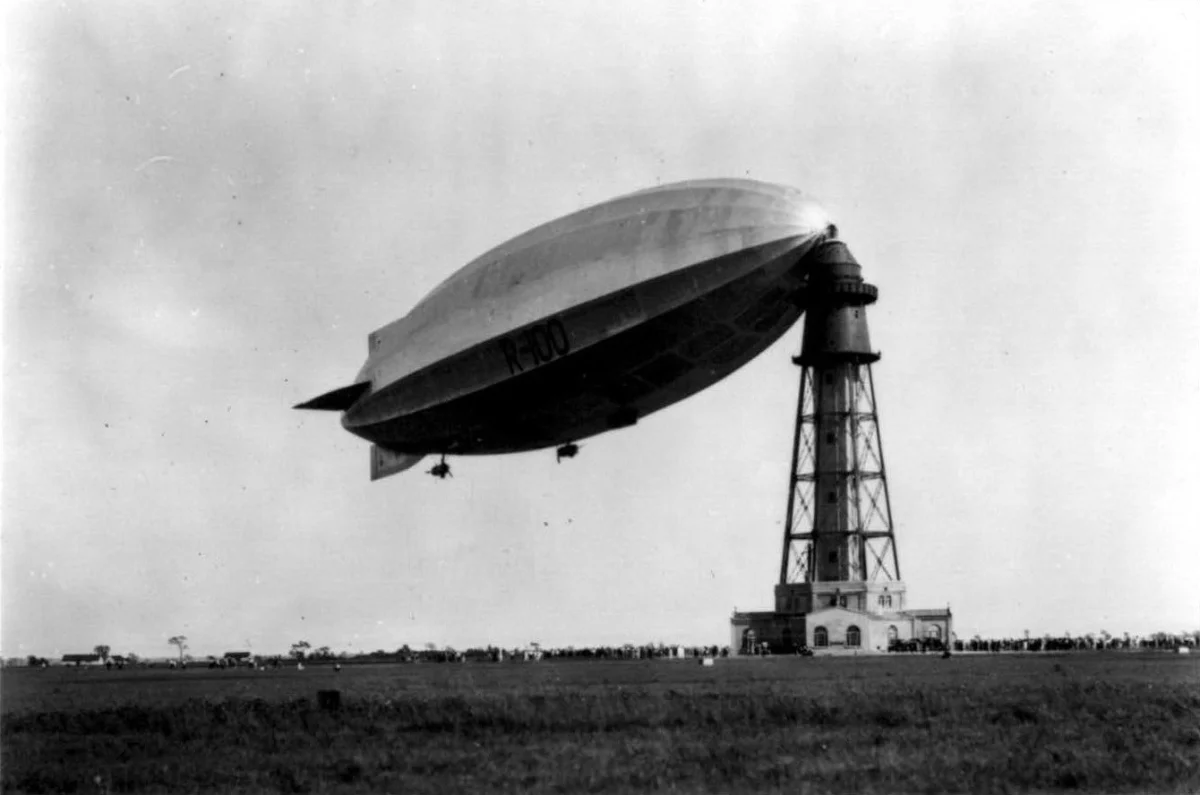
Crowds at Saint-Hubert airport under R100, August 1930. Ingenium Archives, CAVM Photograph Collection, CAVM-18353, creator unknown, public domain in Canada as the holder states (Public domain/Domaine public (Canada)). 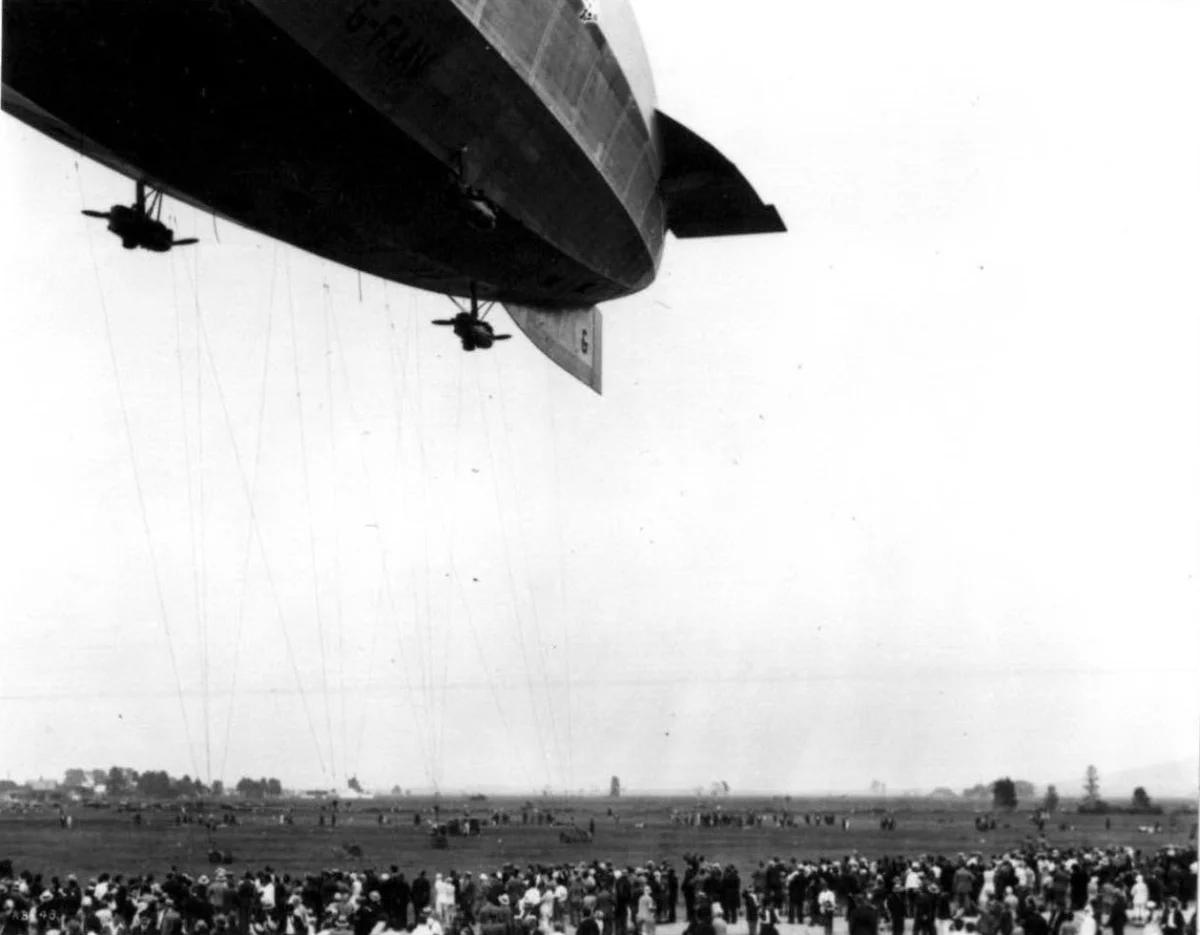
The rear of R100 from below, with land lines and crowds, August 1930. Ingenium Archives, CAVM Photograph Collection, CAVM-18352, creator unknown, public domain in Canada as the holder states (Public domain/Domaine public (Canada)). 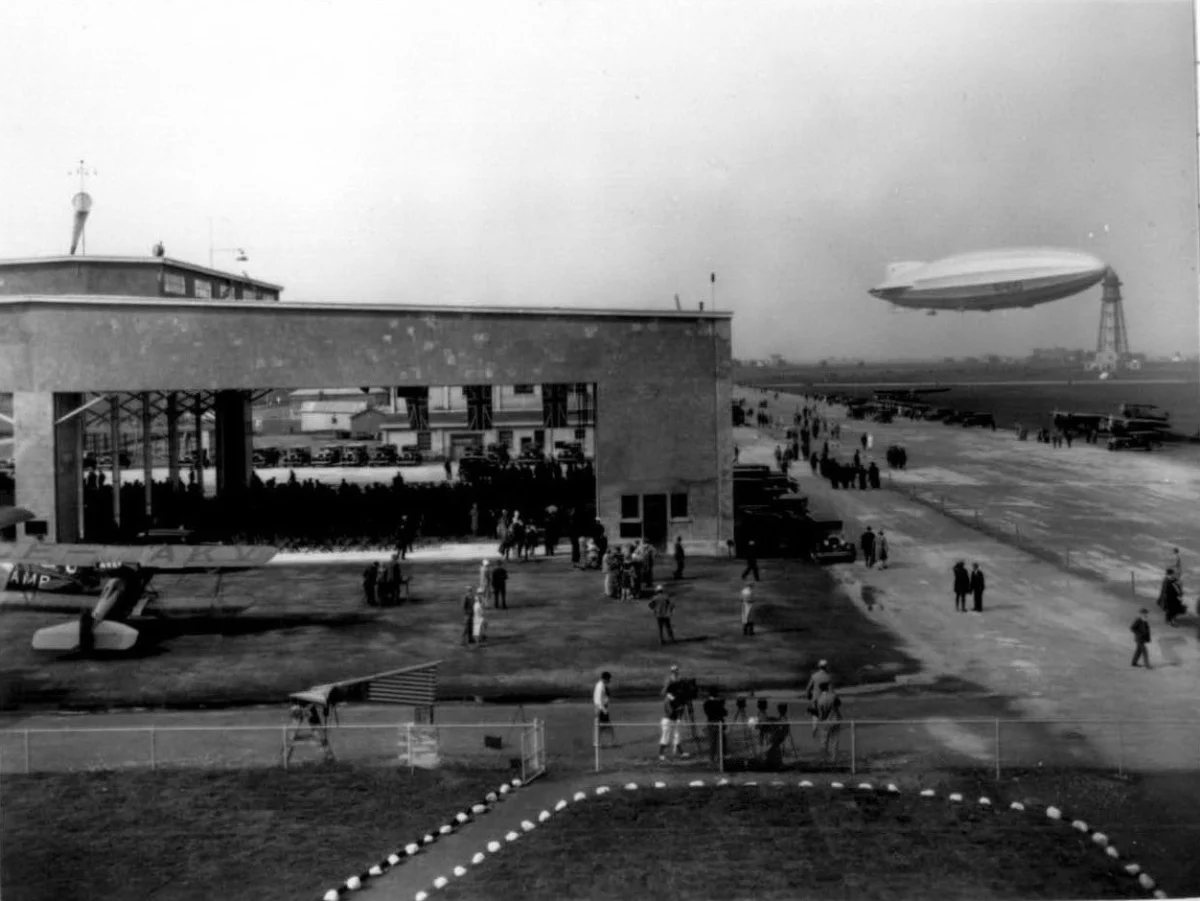
The airfield buildings at Saint-Hubert with R100 at the tower in the background. Ingenium Archives, CAVM Photograph Collection, CAVM-08442, creator Steadman Collection, public domain in Canada as the holder states (Public domain/Domaine public (Canada)). 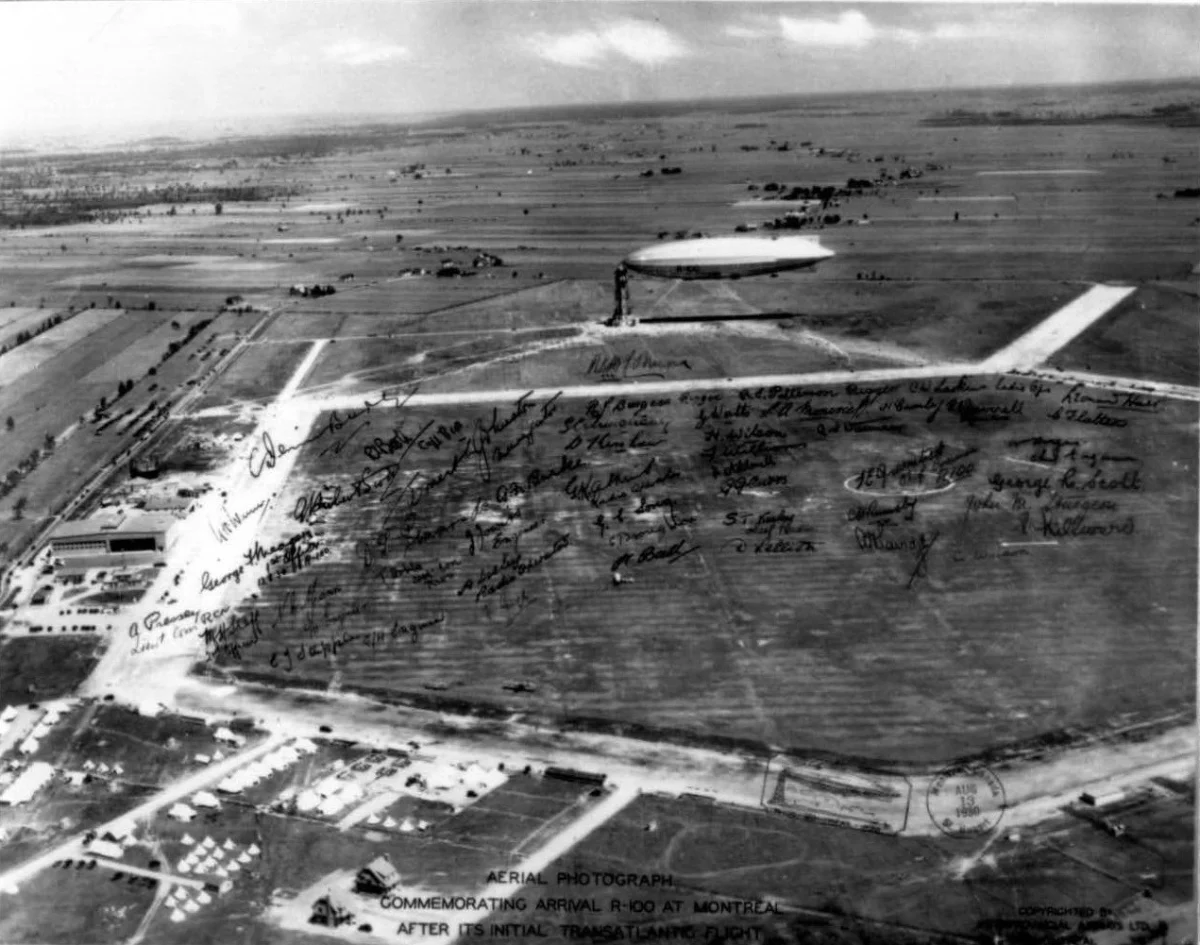
The whole of the Saint-Hubert field from the air, August 1930, with R100 tethered to the mast. Ingenium Archives, CAVM Photograph Collection, CAVM-10657, creator P.A. Osgood Collection, public domain in Canada as the holder states (Public domain/Domaine public (Canada)). 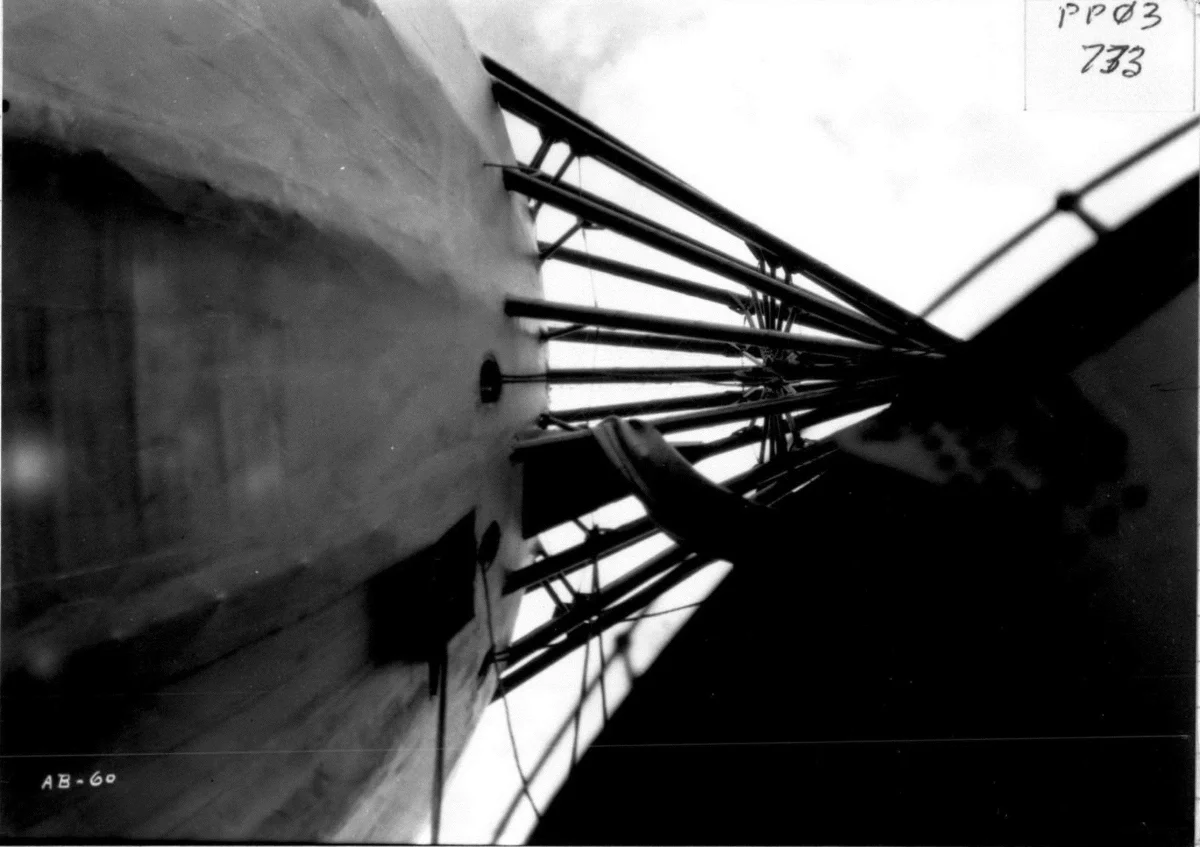
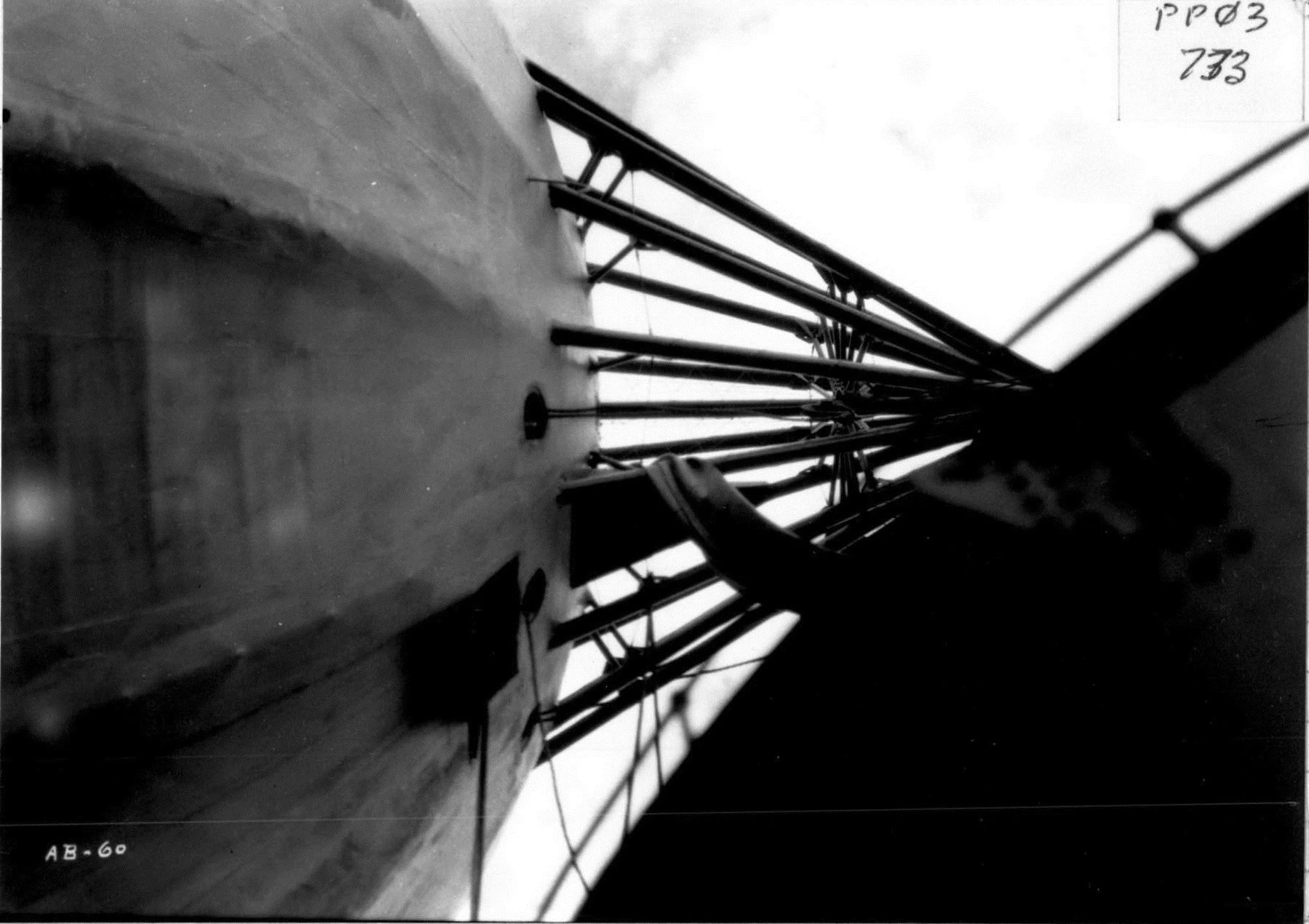
Refuelling at the mast, looking up the bow from the masthead gallery. Ingenium Archives, CAVM Photograph Collection, CAVM-02599, creator unknown, public domain in Canada as the holder states (Public domain/Domaine public (Canada)). 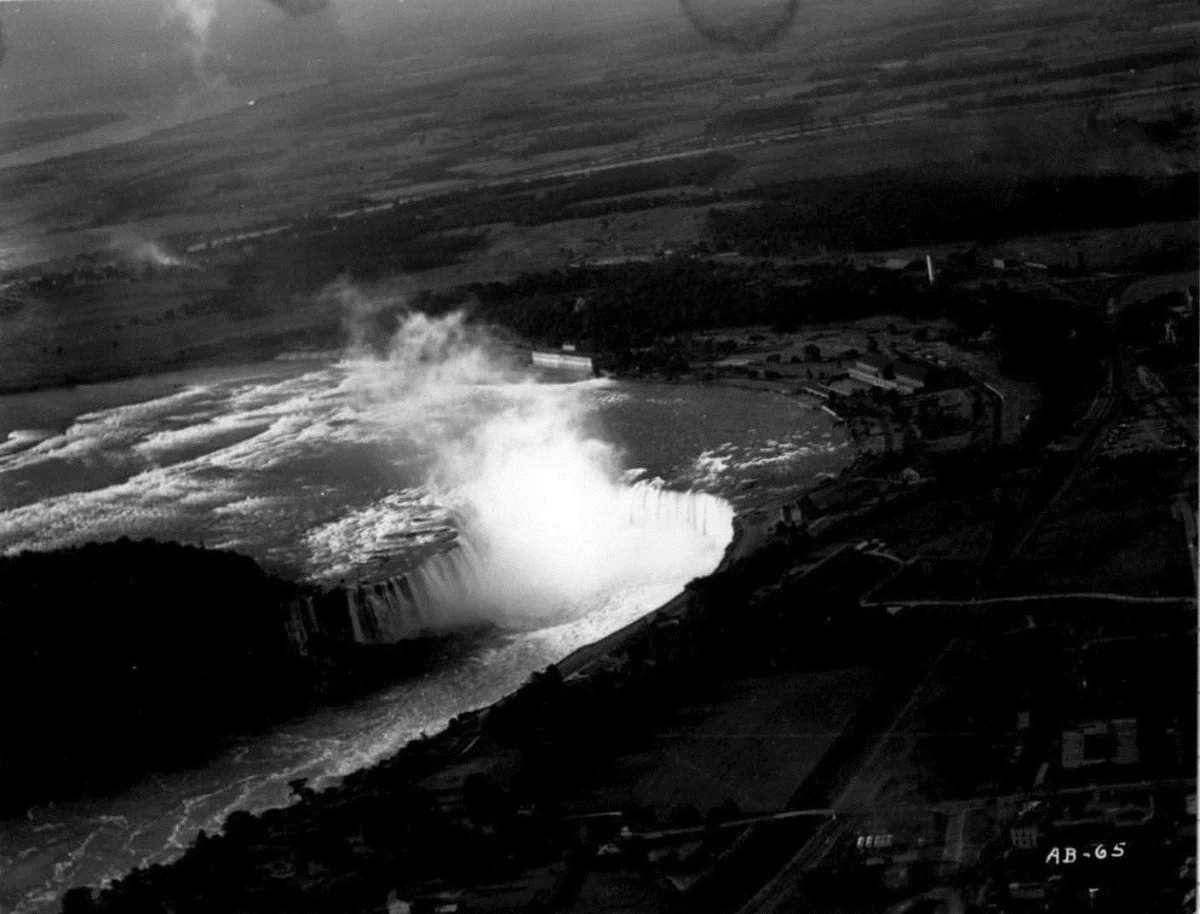
Niagara Falls from R100 on the Ontario flight, 10 and 11 August 1930. Ingenium Archives, CAVM Photograph Collection, CAVM-02603, creator unknown, public domain in Canada as the holder states (Public domain/Domaine public (Canada)). 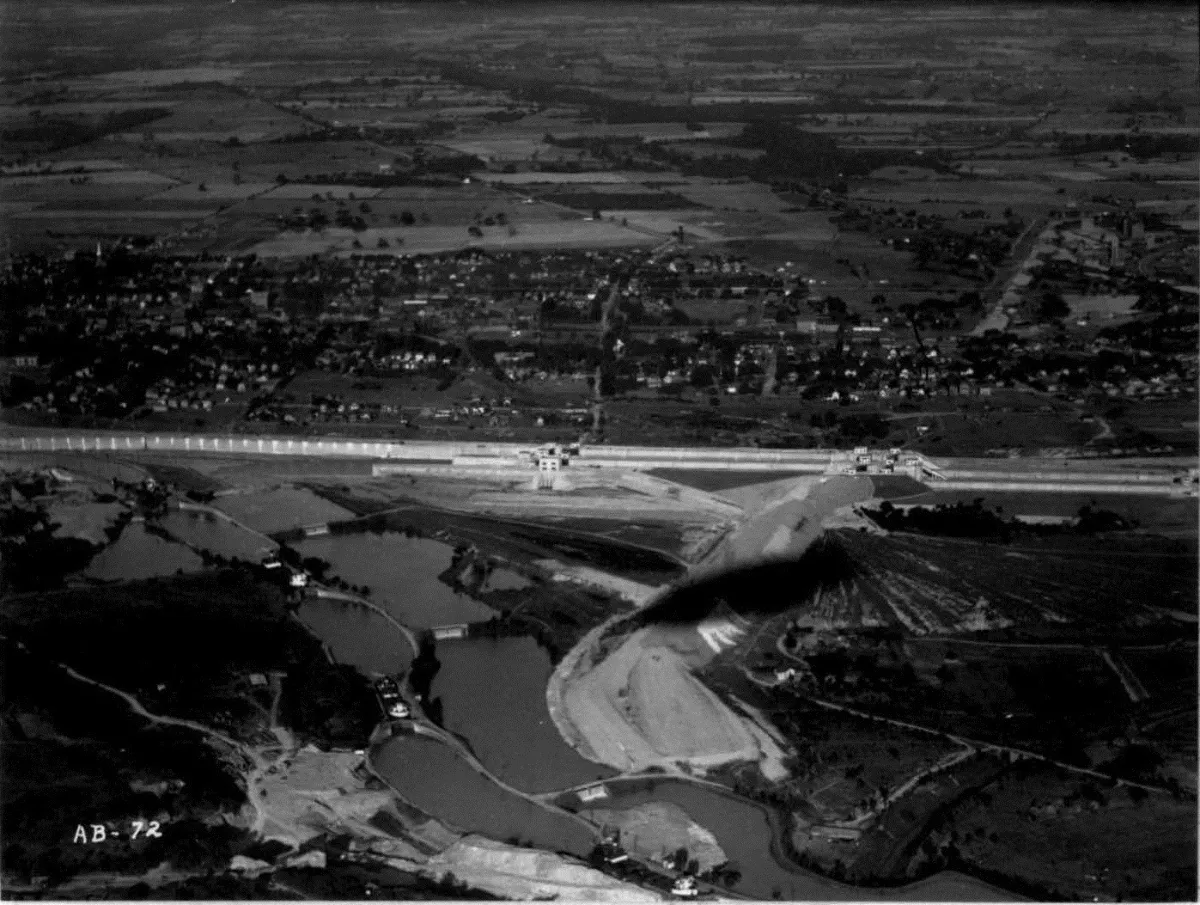
The Welland Canal works from R100 on the same flight. Ingenium Archives, CAVM Photograph Collection, CAVM-02604, creator unknown, public domain in Canada as the holder states (Public domain/Domaine public (Canada)). 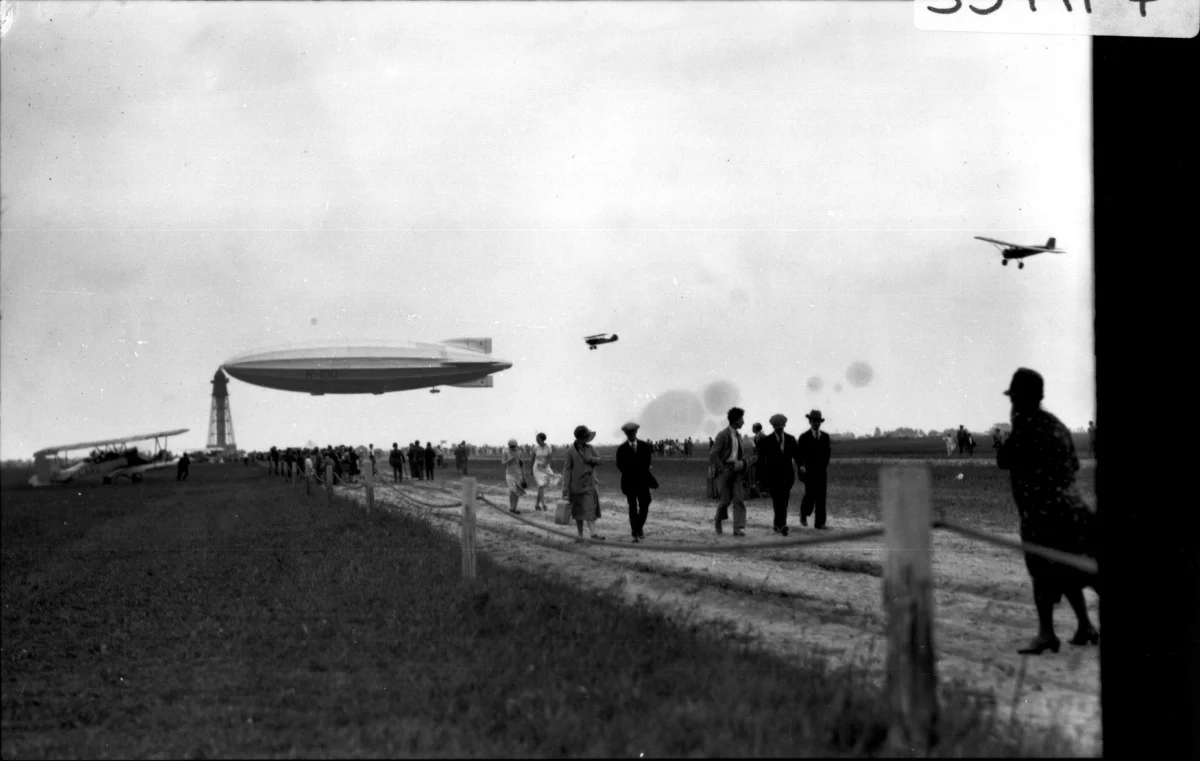
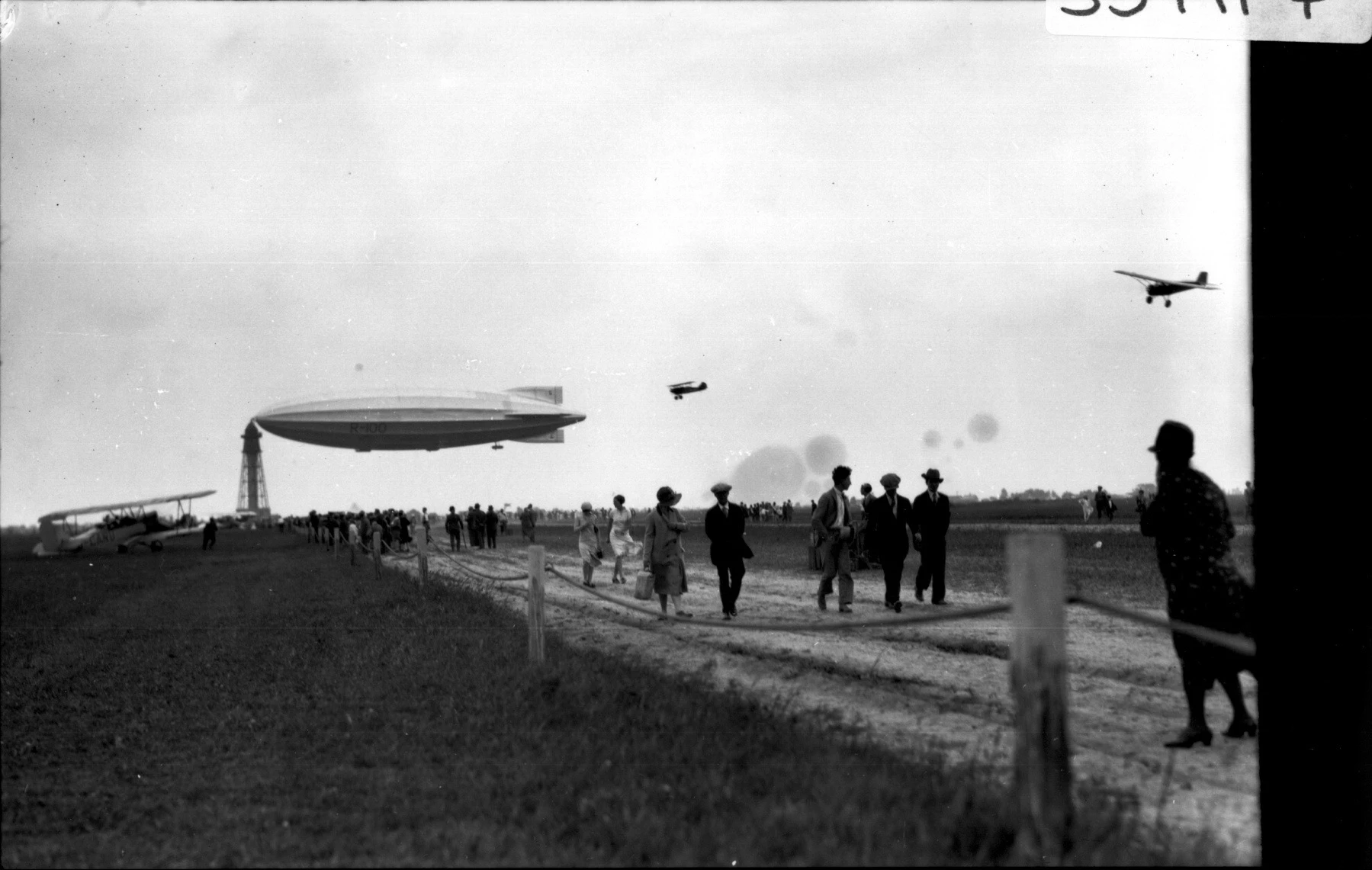
Dignitaries and journalists on the field at Saint-Hubert, with aeroplanes overhead. Ingenium Archives, CN Images of Canada Collection, 33491-7, creator unknown, public domain in Canada as the holder states (Public Domain/Domaine public (Canada)). 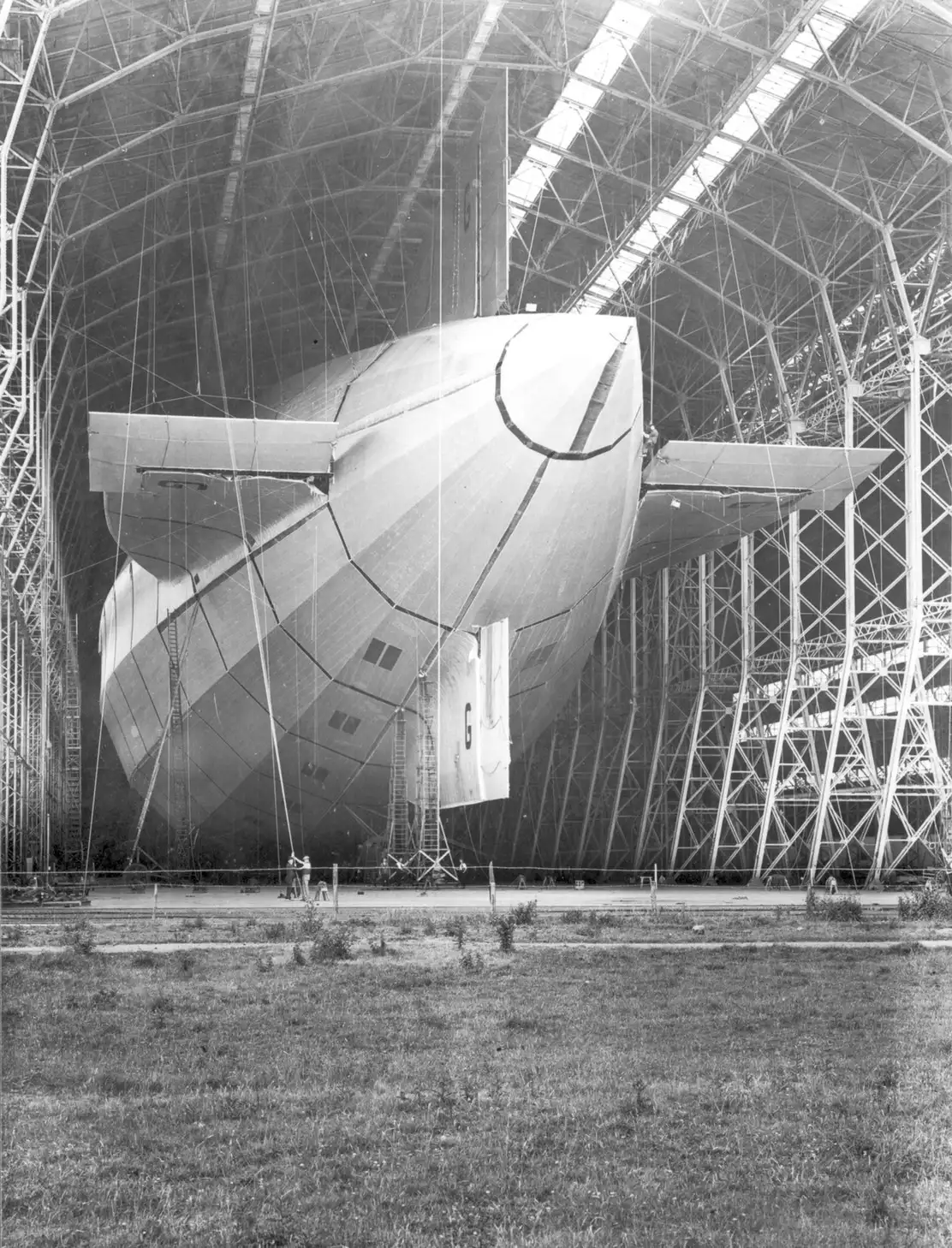
R100 in her shed, about 1929. The holder names no shed here; a companion print says Howden, in Yorkshire. Ingenium Archives, CAVM Photograph Collection, CAVM-11215, creator unknown, public domain in Canada as the holder states (Public domain/Domaine public (Canada)). 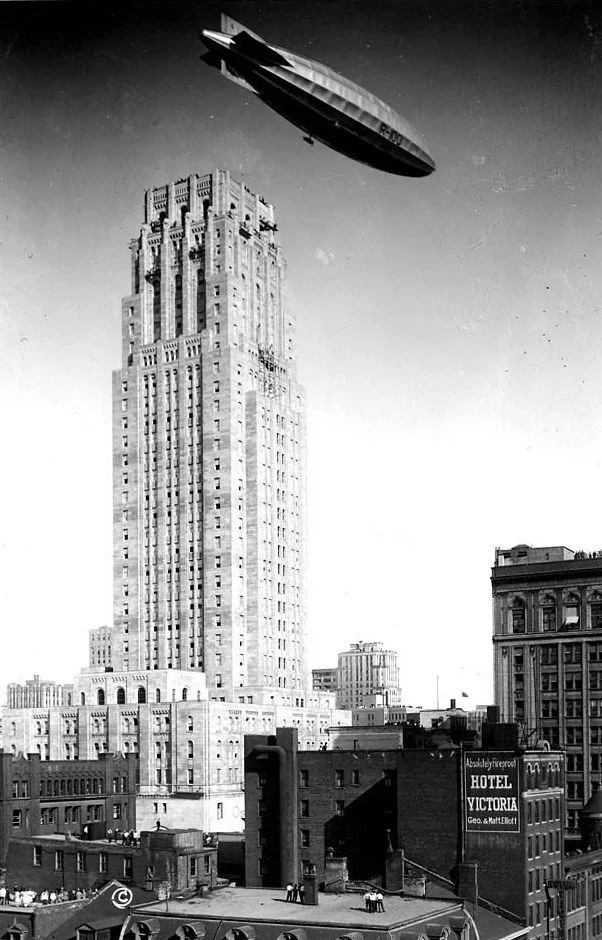
R100 over the Canadian Bank of Commerce in Toronto, 11 August 1930. This file is 602 pixels wide. Alfred Pearson, 11 August 1930, City of Toronto Archives, Fonds 16, Series 71, Item 7921, public domain, via Wikimedia Commons, which marks it as also public domain in the US as a pre-1946 Canadian image. 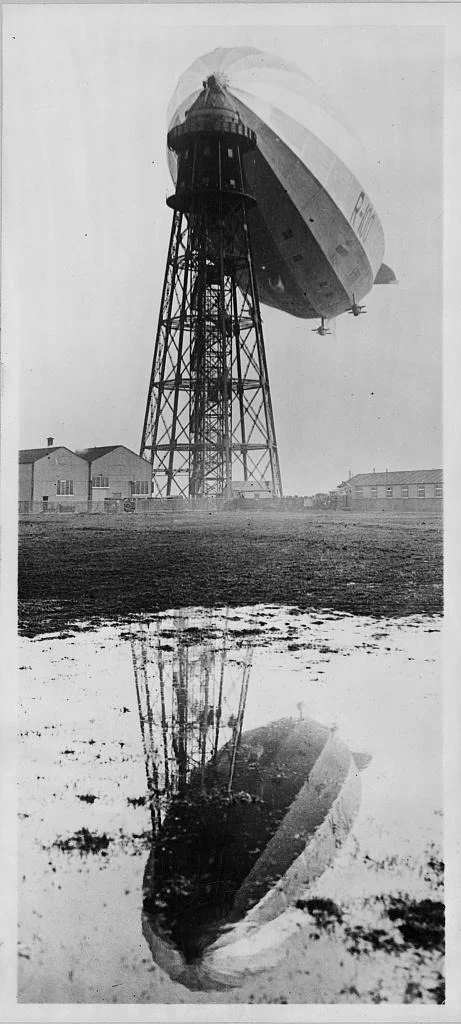
R100 at the Cardington mast, reflected in floodwater. The Library dates this 1928, before she flew, so the date is wrong. A file 461 pixels wide. Library of Congress, Prints and Photographs Division, 2002721429, no known restrictions on publication, no copyright renewal found. 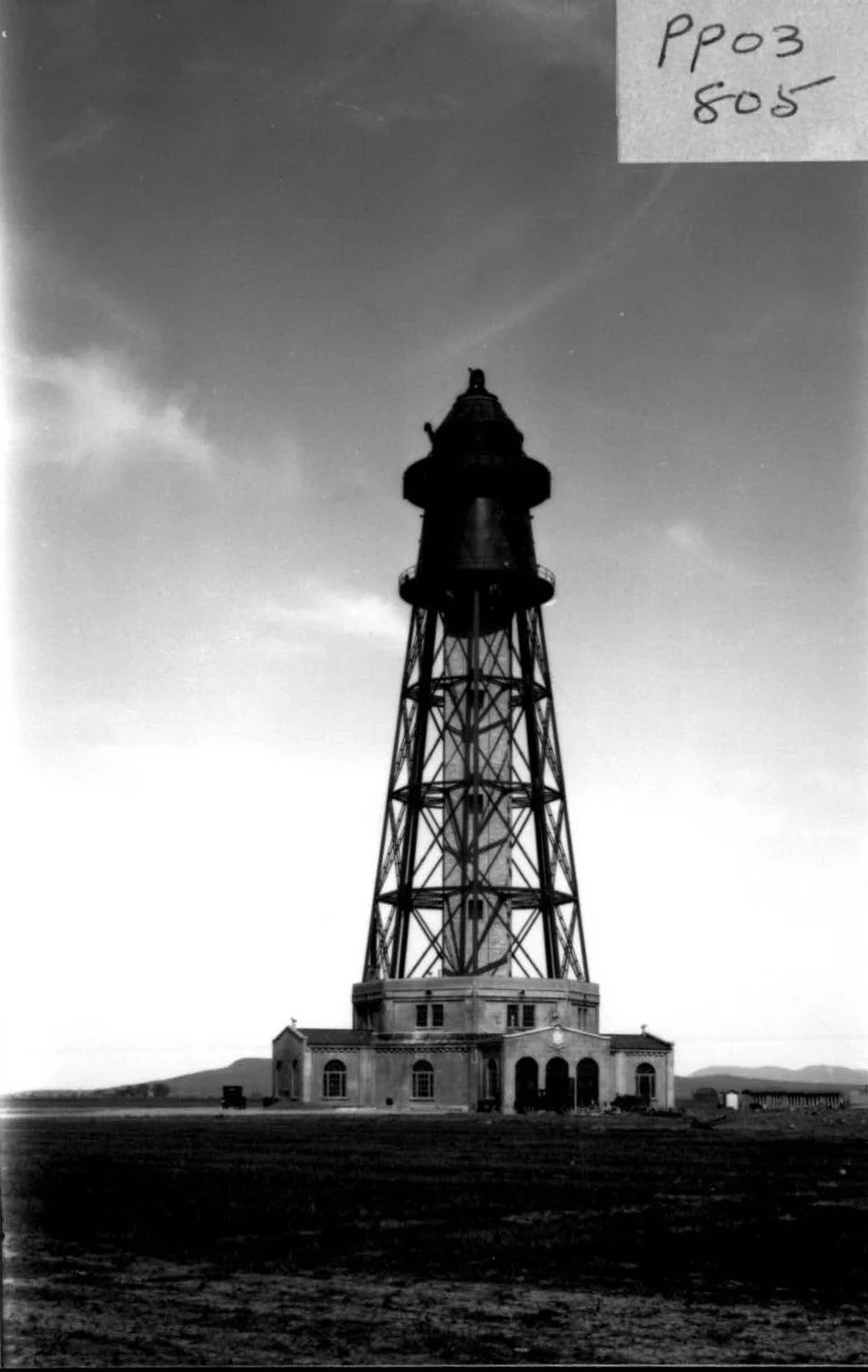
The Saint-Hubert mast standing empty, dated 15 May 1930 by the holder. Ingenium Archives, CAVM Photograph Collection, CAVM-17467, creator Doug Burt, public domain in Canada as the holder states (Public domain/Domaine public (Canada)).
Select a photograph to see it full size, with its caption and credit.
Sources
- House of Commons Debates (Canada), 5 April 1927, pp. 1912-1913: Woodsworth and Mackenzie King Parliament of Canada, Canadian Parliamentary Historical Resources Primary record
- House of Commons Debates (Canada), 11 April 1927, p. 2278: Ralston on vote 103a Parliament of Canada, Canadian Parliamentary Historical Resources Primary record
- House of Commons Debates (Canada), 15 May 1930, p. 2116: British airship R-100, bilingual announcer Parliament of Canada, Canadian Parliamentary Historical Resources Primary record
- House of Commons Debates (Canada), 11 May 1931, p. 1441: St. Hubert, anchorage mast Parliament of Canada, Canadian Parliamentary Historical Resources Primary record
- House of Commons Debates (Canada), 15 June 1931, p. 2610: Anchorage mast, St. Hubert Parliament of Canada, Canadian Parliamentary Historical Resources Primary record
- House of Commons Debates (Canada), 20 May 1935, pp. 2908-2909: Sutherland and Ralston on St. Hubert Parliament of Canada, Canadian Parliamentary Historical Resources Primary record
- House of Commons (UK), 14 May 1931, Statement by the Prime Minister and debate Hansard, UK Parliament Primary record
- House of Commons (UK), 10 March 1932, Sir Philip Sassoon's statement Hansard, UK Parliament Primary record
- House of Commons (UK), 4 June 1930, Airships Hansard, UK Parliament Primary record
- Evening Star (Washington), 1 August 1930, p. 1: British Dirigible Is Moored After 79-Hour Journey Library of Congress, Chronicling America; Associated Press Primary record
- Evening Star (Washington), 2 August 1930, p. A-2: Crew Brings R-100 Safely Through Storm; Repairing R-100 Starts in Canada Library of Congress, Chronicling America; Associated Press Primary record
- Airship Photos Part 3, 7 January 2024, crossposted to r/Tartaria Restitutor_Orbis_214, Reddit Primary record
- A live stream exploration of astounding airship photos, 31 December 2023 Restitutor_Orbis_214, r/Tartaria Primary record
- Nevil Shute, Slide Rule: The Autobiography of an Engineer, 1954, publisher's page Penguin (Vintage) Primary record
- Peter Davison, The R.101 Story: a review based on primary source material and first hand accounts, Journal of Aeronautical History Paper 2015/02 Royal Aeronautical Society journal; copy at the Airship Heritage Trust Study
- Renald Fortier, The R.100 in Canada, 1999 National Aviation Museum, Ottawa; Library and Archives Canada web archive Study
- Report of the R.101 Inquiry, Cmd 3825, March 1931, catalogue record HMSO; HathiTrust record Primary record
- St Hubert (Canada) Airship Heritage Trust Study
- Karachi (India) Airship Heritage Trust Study
- Ismailia (Egypt) Airship Heritage Trust Study
- Kristy von Moos, It's a bird, it's a plane... it was a massive rigid airship called the R-100, 8 April 2021 Ingenium Study
- R-100 Atlantic Flight, CAVM-18351 Ingenium Archives Primary record
- Airship Mooring Mast (R 100), CAVM-17467 Ingenium Archives Primary record
- R-100, start of mooring operations, CAVM-18349 Ingenium Archives Primary record
- R-100, refuelling at mast, CAVM-02599 Ingenium Archives Primary record
- R-100, over Niagara Falls, CAVM-02603 Ingenium Archives Primary record
- How Do You Board an Airship?, 8 January 2023 Tartaria Britannica Primary record
- Tartaria's Airships That Lifted Buildings Into Place, 9 January 2026 Tartaria Vault, YouTube Primary record
- Labiba Faiza, Fly High!, Library Matters, 14 September 2022 McGill University Library Study
- Air views of Palestine... Ismalieh. The mooring mast for air ships, 1932, matpc.15898 Library of Congress, Matson Collection; Wikimedia Commons Primary record
- Pass for one to Royal Airship Base, Karachi, photographed at Bedford Museum, 2010 Simon Speed; Wikimedia Commons Primary record
- Jean-Claude Germain, The Night of the R-100 Geist Study
- Composite image of HM Airship R100 flying over Toronto, 1930, Fonds 1244, Item 10045 City of Toronto Archives; Wikimedia Commons Primary record