What was USS Patoka giving the airship tied to the top of its tower?
An oil tanker lies on flat water, 477 feet from bow to stern. From that stern a lattice mast climbs some 125 feet above the sea. At the tip of the mast, held by the nose, hangs USS Shenandoah: 680 feet of pale fabric, about two hundred feet longer than the ship beneath it. No dock. No ground. A harbor with nothing under it but a hull.
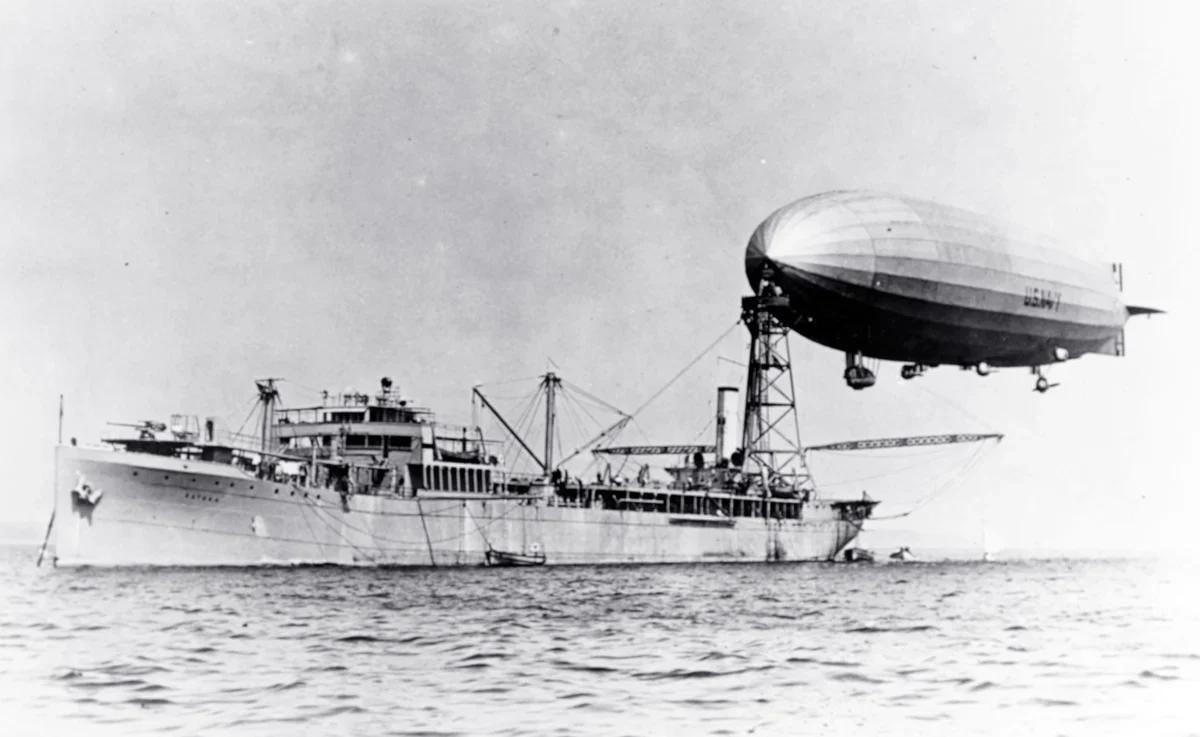
My Lunch Break looked at the top of that mast and saw a plug. "They had charging docks in the middle of the water," he told viewers in episode 48 of his series, Barbarians in Airships? On his reading the tanker is one surviving piece of something far larger: towers on land and sea, old buildings pulling energy out of the earth, flying machines that never paid for a gallon of fuel. And a reason all of it had to vanish.
Photographs of that mooring are real. The negatives sit in the Library of Congress with the year on them. 1924. Not a thousand years ago. A hundred.
It all comes down to the tip of the mast.
The Tanker That Grew a Tower
Patoka was built to carry oil. Launched at Newport News in July 1919, she hauled fuel oil from Port Arthur, Texas, across the Atlantic to the Clyde, then out to the Adriatic and Constantinople. Nothing about her was strange.
Then, in 1924, the Navy picked her to wait on an airship.
At the Norfolk yard, workmen raised the mast. They added quarters for Shenandoah's crew and for the men who would handle her. They built in facilities for helium, gasoline and other supplies, and room for three seaplanes. The job finished shortly after 1 July.
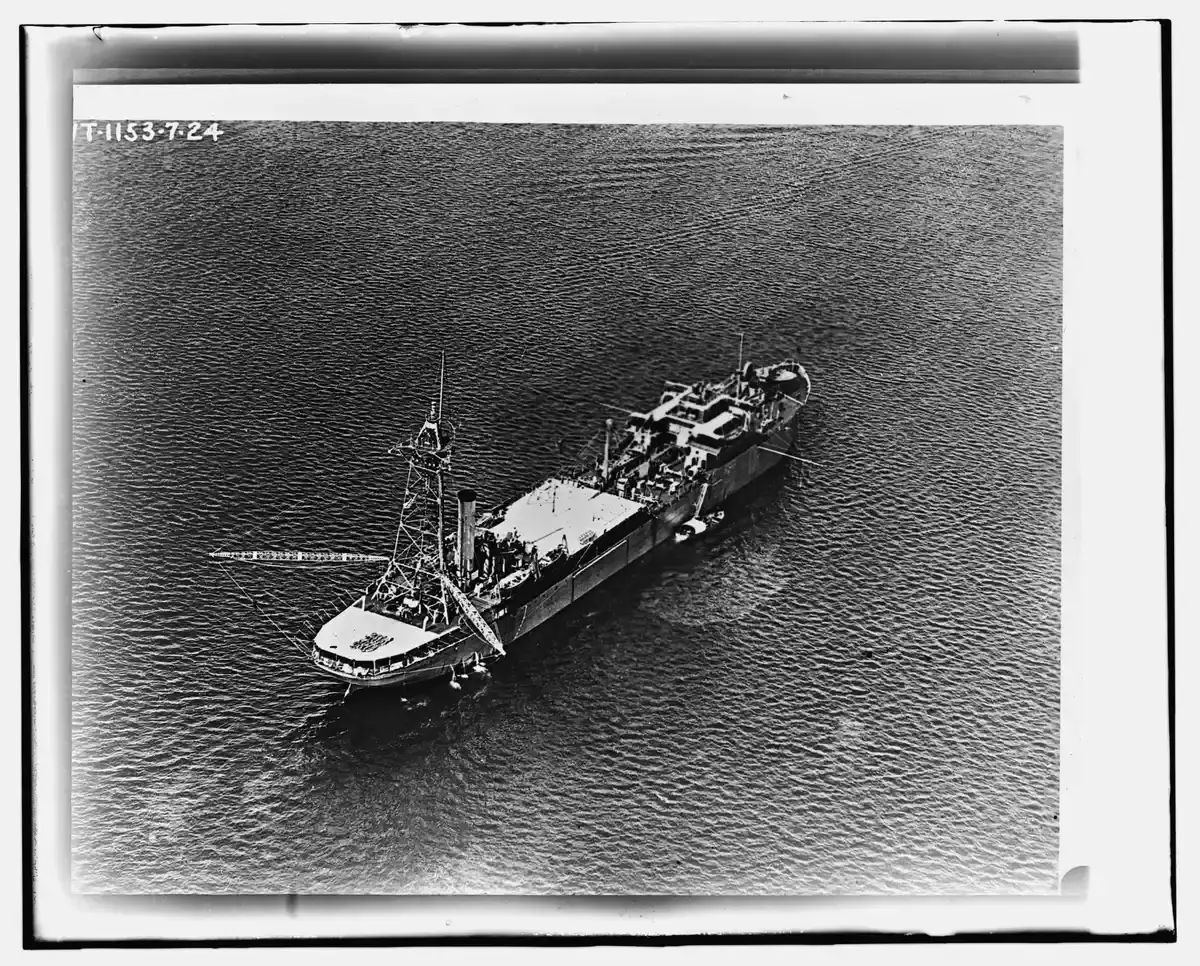
On 7 August a National Photo Company camera caught Patoka alone, and that negative is still at the Library of Congress. The mast stands bare over the stern. Long booms reach out across the water. Nothing blocks the tower.
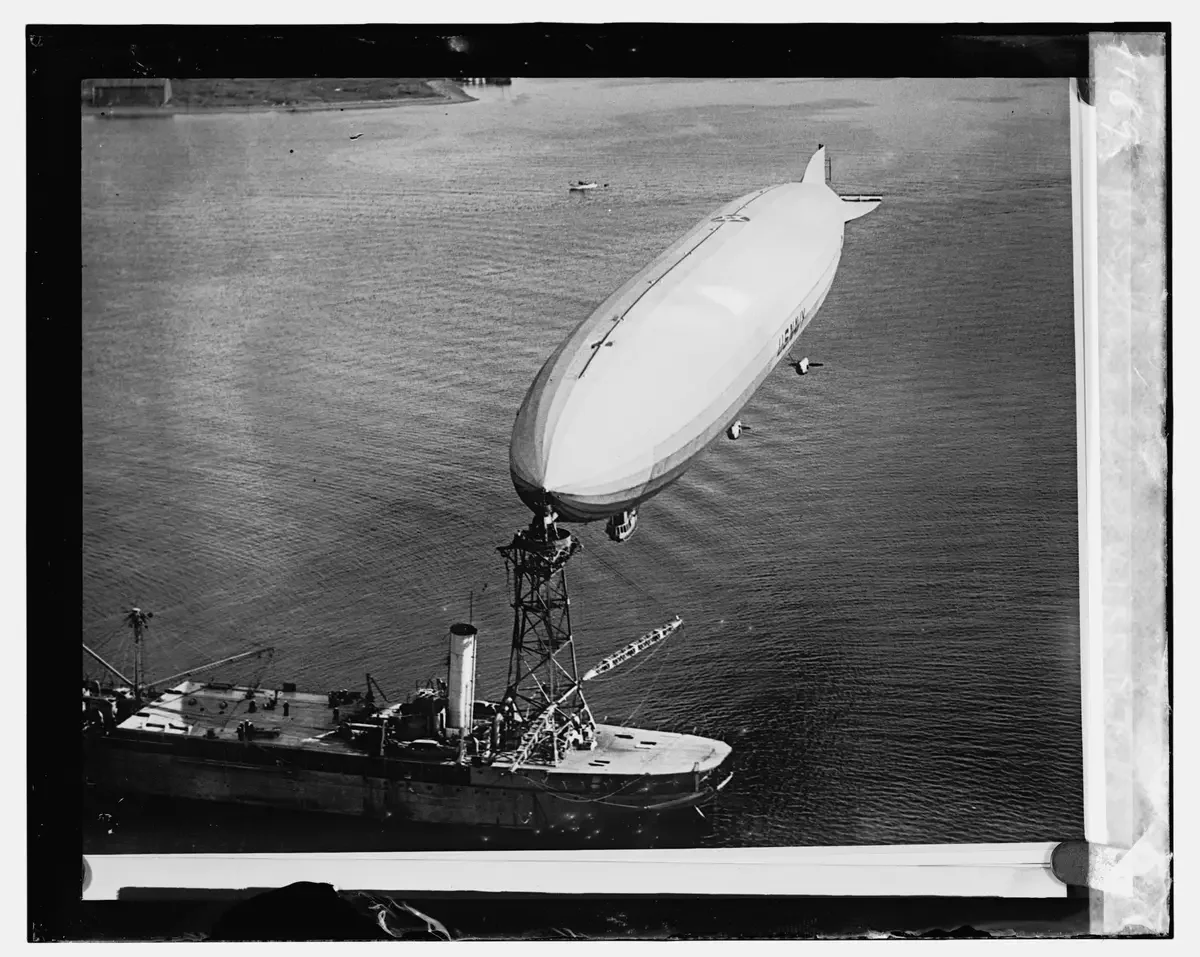
The next day, 8 August 1924, came the first successful mooring. The next summer she was towing Shenandoah while the airship rode at the mast. An oil tanker, pulling an airship by the nose.
A century later that scene reached My Lunch Break, who bills himself as a private investigator of history. In episode 48 he builds up to it one picture at a time: a diploma from the 1905 fair in Portland, Oregon, with two airships in its background; an airship between the spires of an old building; an airship on a tower in July 1931. Then he goes out to the water. He puts up a Navy airship of 1924, zooms to the top of the mast and says it is charging. Another angle, which he places in Rhode Island, and then a further one, shows what he calls the charging tool, right at the top of the tower, about to connect.
A Fleet Hidden in the Skyline
It starts with the sky. In My Lunch Break's telling the old pictures normally blank it out, and the schools never mention what was up there. Airships were everywhere, far older than the textbooks say, with the Army and Navy flying them in the 1800s. They did not run on gas. They did not run on helium alone. They charged.
Which means, on his reading, that they needed somewhere to charge. The airship between two spires, the airship on the tower in 1931, the airship at Patoka's mast: to him these are one scene, again and again. The crown of a city spire and the top of the mast, he says, have the same features. He allows the old buildings may have had a second purpose. He does not doubt this one.
Stations. All of them.
Which, on his reading, puts a machine inside every old building. They were made, he says, to generate free energy, drawing the earth's natural energy and turning it into fuel. A previous civilization raised them, and not long ago. On his account those people flew craft far more powerful than any airship, faster than anything can fly today. The airship is the slow end of the technology. And the machinery is still up there. It is his opinion, he says, and he guarantees it anyway: they still turn on.
On his account, a thing that size did not fall out of history by itself. His first exhibit is the Hindenburg. He asks whether anyone would really fill an airship with a gas that flammable and fly it over massive cities. His answer is that the disaster was a planned event, a scare tactic to make airships look faulty and wipe a free way of traveling out of the history books.
And he gives the motive in a word. Free. Free transport and free energy would benefit a whole civilization, he says, and he asks whether the why needs to go any further.
Then he sends his viewers back outside, to look again at the tops of the buildings in their own towns.
One fitting on a tanker's mast. On his reading, the line from it runs to the roof of every old city on Earth.
If the Journey Did Not Need a Fuel Bill
Set aside for a moment whether any of it is true. Ask the better question. What kind of world are we living in if it is?
It would mean the airship was never running out of anything. A flight would end where the towers ended, not where the tanks ran dry. A 125-foot mast on a ship would be a filling station with nothing to sell, and the ocean would be a road with stops on it.
It would mean our maps have been wrong in a way no surveyor could catch. Every spire a port. Every skyline a route. On that reading our cities would be the ruins of a transit system, and we would be walking past the platforms on the way to work and calling them decoration.
Which would mean our own story runs backward. We tell it as a climb, each century faster than the last. If he is right, somebody crossed these same skies faster than we can, on nothing but the earth beneath them, and the whole age of the oil tanker would be what came after the fall. Every barrel pumped. Every gallon burned to carry a human body from one place to another. Not progress. A detour.
And it would not have been an accident. If the Hindenburg was staged, our dependence was arranged. The fuel bill would not be a fact of nature. It would be a sale, and it would still be collecting.
One consequence would still be in front of us. If the buildings still turn on, they are standing there now, over our heads, paid for long ago. What does a world built on the fuel bill do on the day a spire wakes up?
What the Surviving Machinery Says
The standard account holds that Patoka was a floating mooring and supply base, and the Navy's own history of the ship lists what went aboard: the mast, the quarters, the facilities for helium and gasoline. On that account the opening question has a plain answer. Gas for lift. Gasoline for the engines.
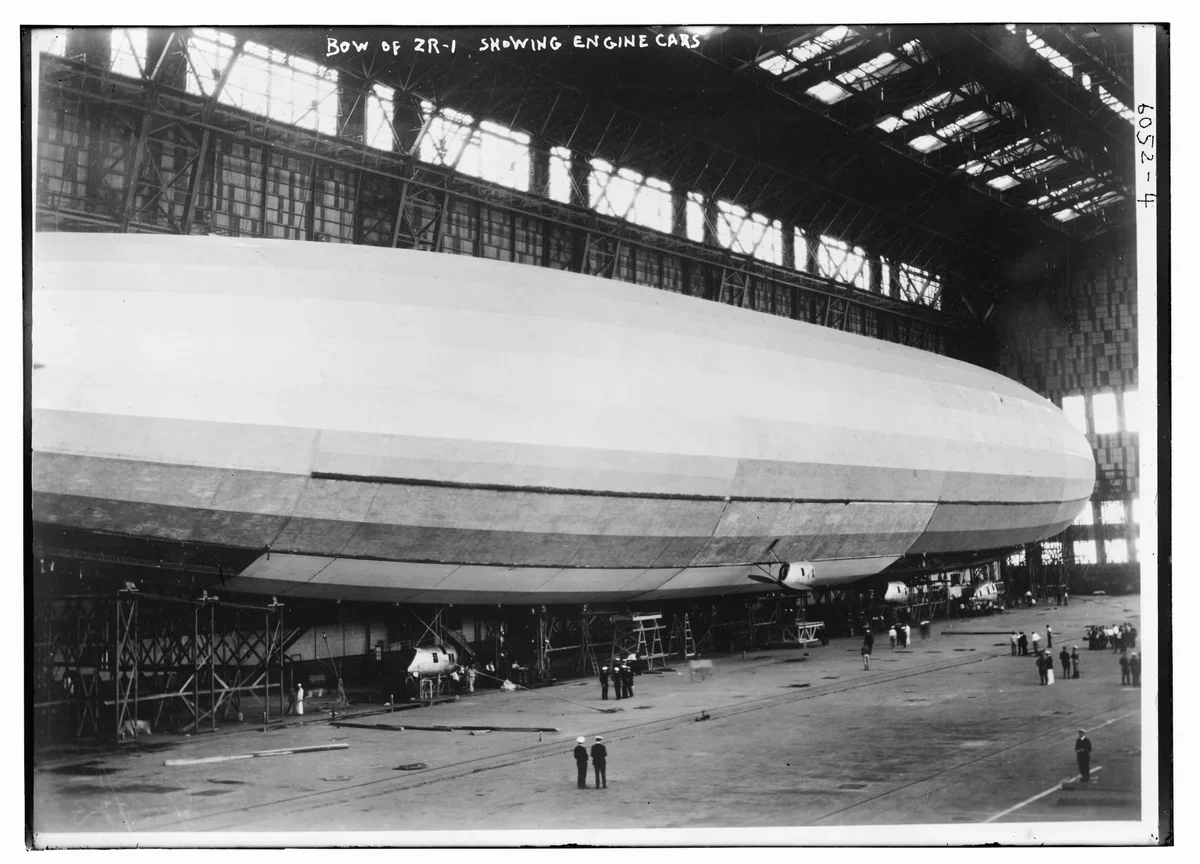
The engines left hardware. The Smithsonian holds a wooden Shenandoah propeller 210 inches across, more than 17 feet, and its record gives the application as Packard gasoline engines.
In April 1924 Science and Invention printed the plan: a cutaway of a proposed polar-flight base, helium going up to the masthead, gasoline lying in the tanks below. Some labels name a second ship, Ramapo. NASA-CR-166253, a 1981 technical study, describes the method: booms, a haul-in line, a grappling hook.
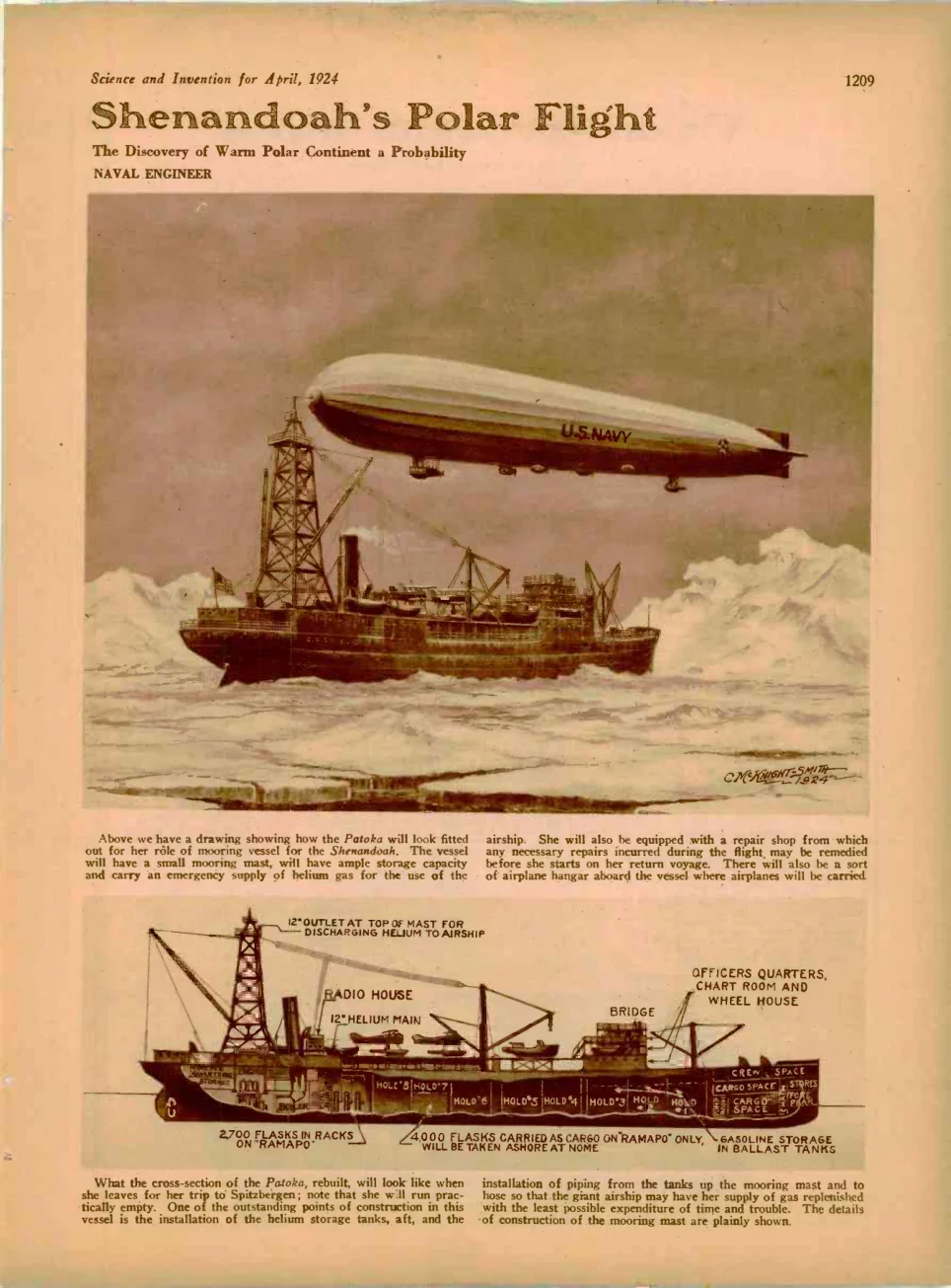
The gas matters too. Shenandoah was the first rigid airship filled with helium rather than hydrogen, and she took much of the world's reserves. Which gives the tanker a plain job: keep that gas coming.
A gasoline airship, tied to a supply ship. That is what those records describe. They carry more weight than the charging reading, and none of them mentions charging. On the Hindenburg they say nothing either way.
What the Paperwork Does Not Reach
Those records say what was built and what was carried. They do not say everything that ran up that mast.
Official X went looking for the plan: a complete as-built drawing of the masthead, its piping and its wiring. It did not find one.
Without it, the best picture of the supply system is the magazine cutaway, and that cutaway is a proposal, printed in April 1924. The work on the ship finished in July. The only labeled drawing found was in print before the job was done.
No record here says current never reached her. A radio house stood on that drawing. Lights, perhaps. These pages do not settle it, and the gap sits exactly where he is pointing.
The pictures have their own gaps. The exact frame in his film has not been matched to a surviving negative, and his diploma, his spires and his 1931 tower have not been traced to their originals for this article.
And all of this paper concerns one ship. The Navy's files on Patoka say nothing about what a spire in an old city was for, or who designed it. Most of his case stands on land.
And here is the strange part. On the floating dock itself, the Navy's history confirms him. A tanker with a tower did meet airships above the water. Patoka went on to serve the airship Los Angeles on long flights to Puerto Rico, Panama and Florida. A working aerial harbor, afloat, for eight years. Then Los Angeles was decommissioned in June 1932, and Patoka followed in August 1933.
Gone.
The Ship Is Gone, the Spires Are Not
Shenandoah never made her polar flight. She was lost in a storm on 3 September 1925, and on the Navy's account the plan went with her. Patoka served out a second war and was sold for scrap on 15 March 1948. Nobody can climb that mast now.
My Lunch Break is still at it, and the community around the question, he says, keeps getting bigger. The record behind his pictures keeps growing too: the airships that landed on buildings, the Zeppelins printed into old postcards, the Norge and its road of masts.
The paper, as far as it goes, favors the mooring: gasoline, helium, a line and a hook. No document here shows a charge.
Two things could move that. A drawing of the masthead could show what ran up the mast. It could not say what a spire was for.
The second is stranger, and it is his own. He guarantees the buildings still turn on. That is the rare claim in this subject with an address. A spire stands on a street. An instrument can be carried to it. A reading could show whether one particular spire is doing anything at all. A flat reading could not show what its builders meant, or what stopped a century ago. But the spire is there to be asked.
Patoka went for scrap. The spires did not.
Questions This Leaves You With
Is there anything you can actually do with this?
For your own life, nothing follows. No date is coming, and anyone selling a date is selling something. Nobody can sell you a spire that runs your house, and nothing here asks you to prepare for anything. What you can do is smaller and more satisfying: take any old airship picture you meet and follow it back to its collection, its title and its year. The bigger question is not yours alone. If a floating harbor can slip out of common memory inside a century, what else has?
Does this sit against what you believe about God?
It can cut either way, and serious people have argued both. An earlier, greater age could sit easily with a story of a fall from something better. It could just as well read as people reaching those heights entirely on their own. Energy rising from the ground for the taking might sound to you like a gift. To someone else it might sound like engineering and nothing more. Official X will not tell you which way it falls. A photograph of a tanker cannot settle it.
Does this change how you look at your own town?
You may catch yourself looking up. Set your own span against the scale in those pictures: a few decades, inside a story that might hold a whole lost age. One reaction makes a life smaller: you arrived after the best of it, paying for what was once free. The other makes it larger: you live among things nobody has finished understanding, and the street you take to work may still have something to say. Neither one is the right one. Which did you feel first?
What would change your mind, in either direction?
Name it now, before you have settled, because it gets harder later. Toward charging: an as-built Navy drawing showing a power line at the masthead, motors aboard Shenandoah that could use it, or an instrument reading from a spire that repeats for anyone who brings the same equipment. Toward the mooring: the complete masthead plan with every line labeled and none left over, or flight logs showing gasoline taken aboard and burned, gallon for gallon, over a voyage. Decide which of those would really move you, and which you would explain away.
Where is the drawing of the top of that mast?
This is the plain gap. A Navy yard built that mast in 1924, so somebody must have drawn it. That sheet is not among the records opened here, and it may not have survived. Think about what you would be reading if it turned up. A line marked helium. A line marked gasoline. Those two you already expect. The whole argument lives in whether the sheet carries a third line, and what is written beside it. For now the place where that drawing should be is empty. What would you expect the third line to say?
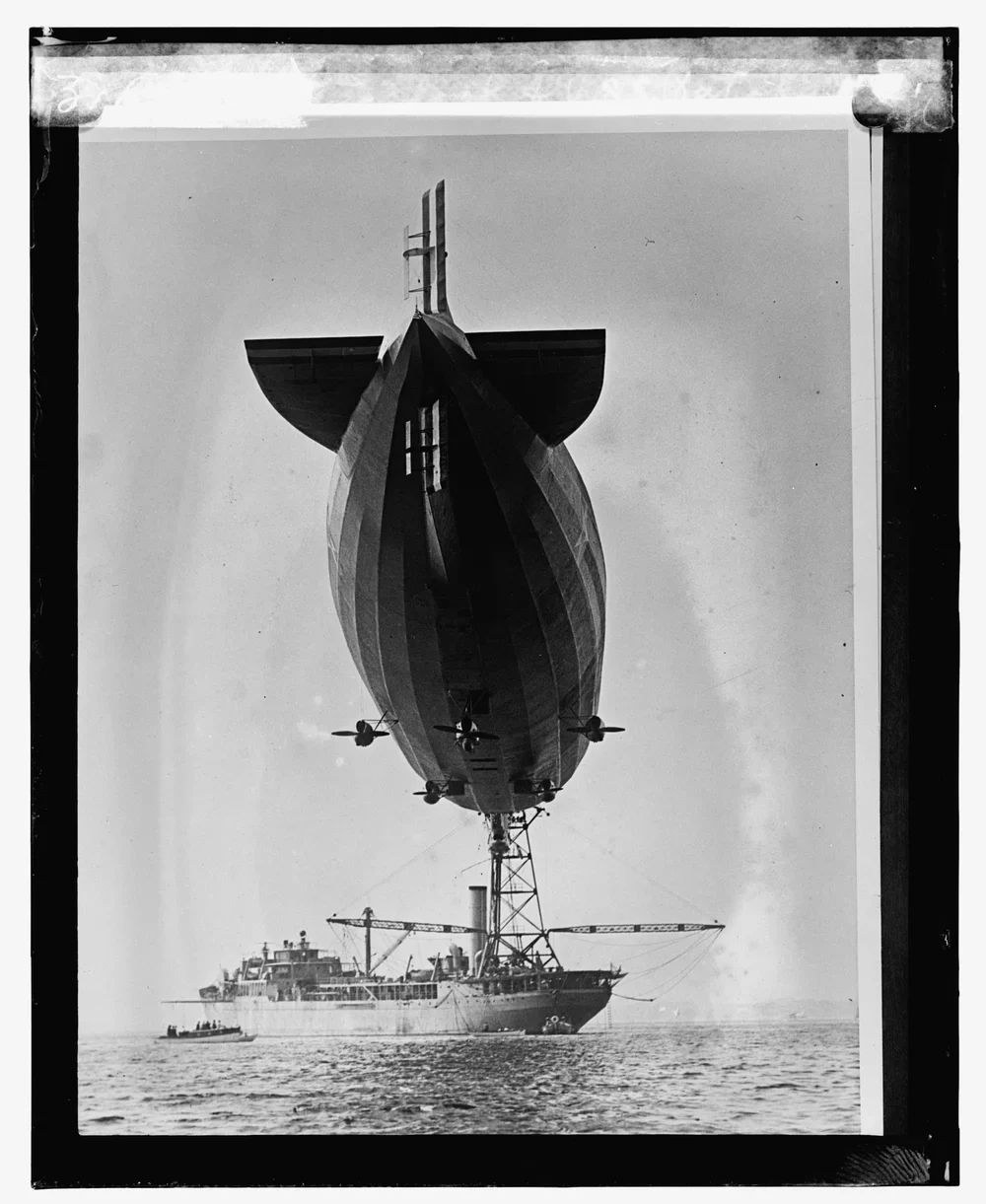
A second 1924 negative, looking from behind the airship toward the mast. National Photo Company Collection, 1924, Library of Congress, LC-DIG-npcc-11996, no known restrictions on publication. Resized.
Sources
- My Lunch Break, Barbarians in Airships?, original Rumble video Original archive or creator Primary record
- Library of Congress, U.S.S. Shenandoah & U.S.S. Patoka, National Photo Company, 1924, LC-DIG-npcc-11994 Library of Congress Primary record
- Library of Congress, U.S.S. Shenandoah & U.S.S. Patoka, National Photo Company, 1924, LC-DIG-npcc-11996 Library of Congress Primary record
- Library of Congress, U.S. airship tender - U.S.S. Patoka, 8/7/24 Library of Congress Primary record
- Library of Congress, Bow of ZR-1, showing engine cars Library of Congress Primary record
- Smithsonian National Air and Space Museum, Shenandoah Propeller, Fixed-Pitch, Two-Blade, Wood Original archive or creator Primary record
- Naval Historical Center, USS Shenandoah landing on and moored to ships, 2002, preserved primary catalogue Original archive or creator Primary record
- NASA-CR-166253, Study of ground handling characteristics of a maritime patrol airship, March 1981 NASA Primary record
- Science and Invention, April 1924, pp.1208-1209 Original archive or creator Primary record
- National Archives, NAID520808, July1925, via DocsTeach Original archive or creator Primary record
- My Lunch Break, Barbarians in Airships?, transcript03:06-06:54 Podscan, episode transcript Primary record
- Dictionary of American Naval Fighting Ships, Patoka Naval History and Heritage Command Study
- Naval Historical Center, USS Shenandoah (ZR-1), Airship 1923-1925, 2002 Naval Historical Center Study
- USS Shenandoah (ZR-1) Wikipedia General reference