
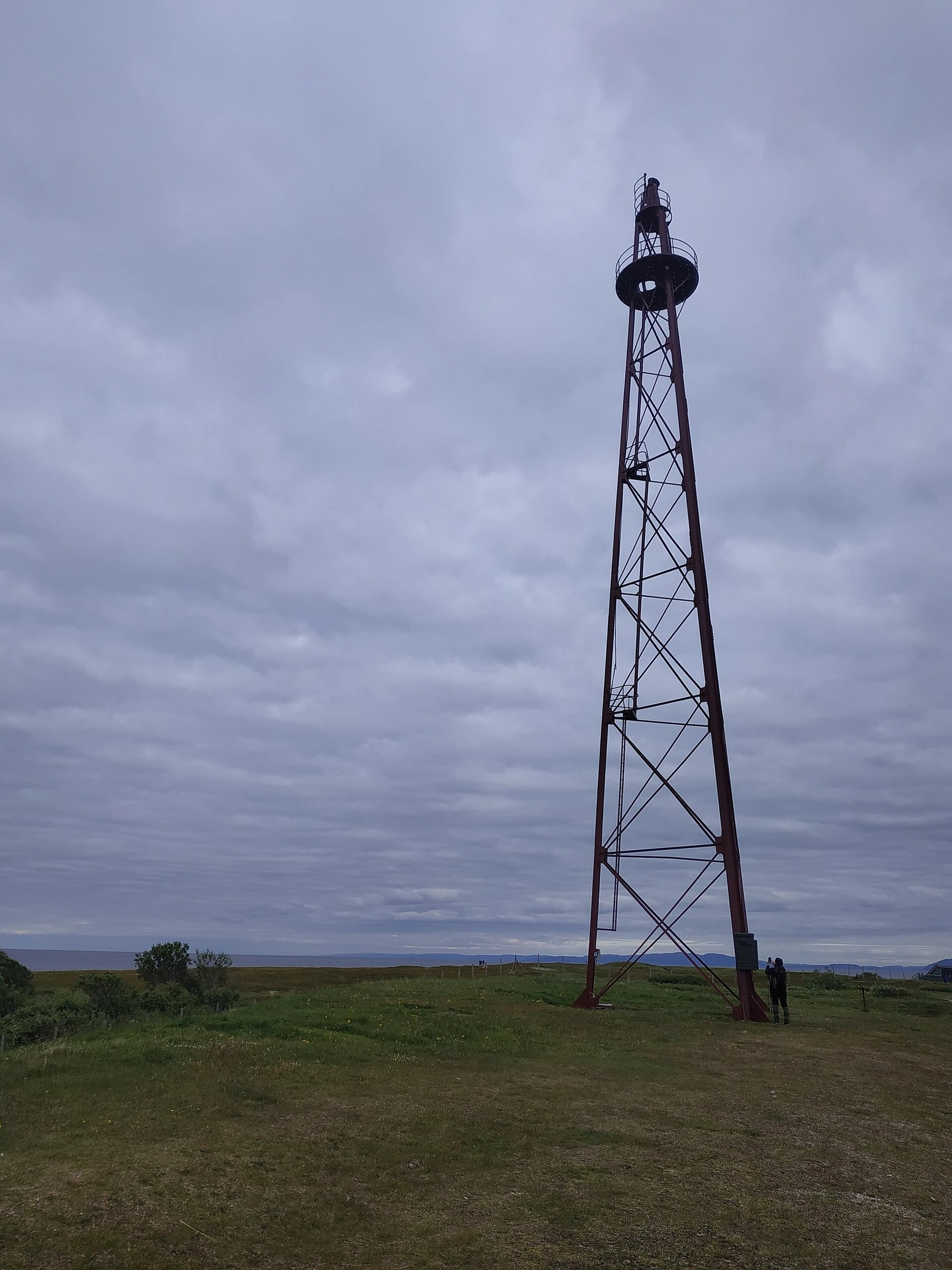
The mooring mast at Ny-Alesund stands by the shore of Kings Bay in Svalbard, at 79 degrees north, a thin lattice tower 35 metres high. It was built for one airship, the Norge, for the flight over the North Pole in May 1926, and it is still there.
For something so thin it is a heavy object. Fourteen tons of steel, shipped from Italy in pieces. A triangular base 6 metres across, each corner locked to a 40-ton block of concrete poured through the polar night. Foundation bolts 2 metres long. It was put together flat on the ground, then hauled upright by tackle, men and the coal mine's own winches, with its foot set against the one heavy rock in reach.
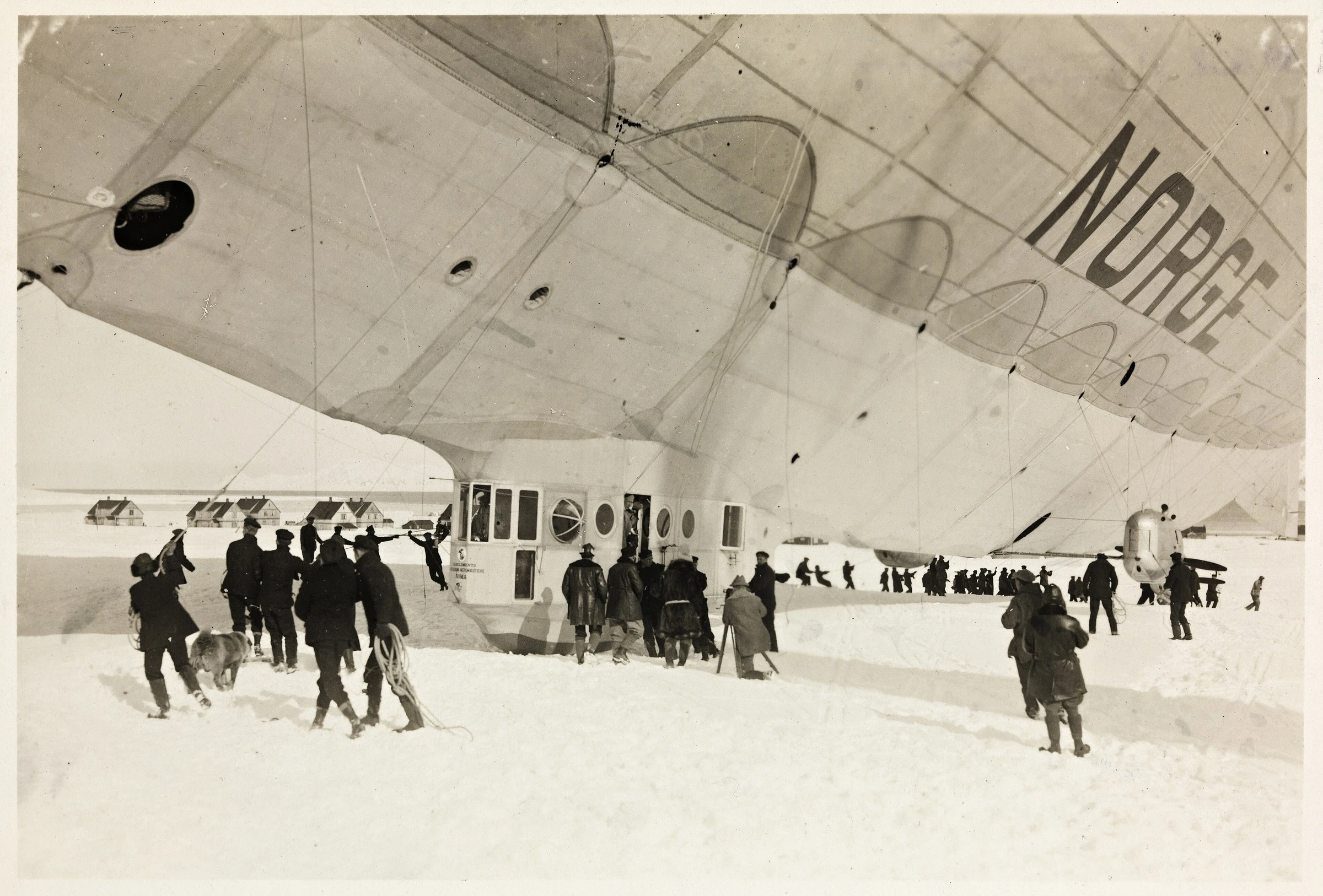
The ship came in on the morning of 7 May 1926, in air so still that pipe smoke rose straight up. A rope dropped. Hundreds of hands took it. She was hauled down to the snow and walked into a hall of timber and canvas, and the expedition's own book says of the mast, that day, that there was no use for it.
In neither the book's account nor Nobile's does she touch it.
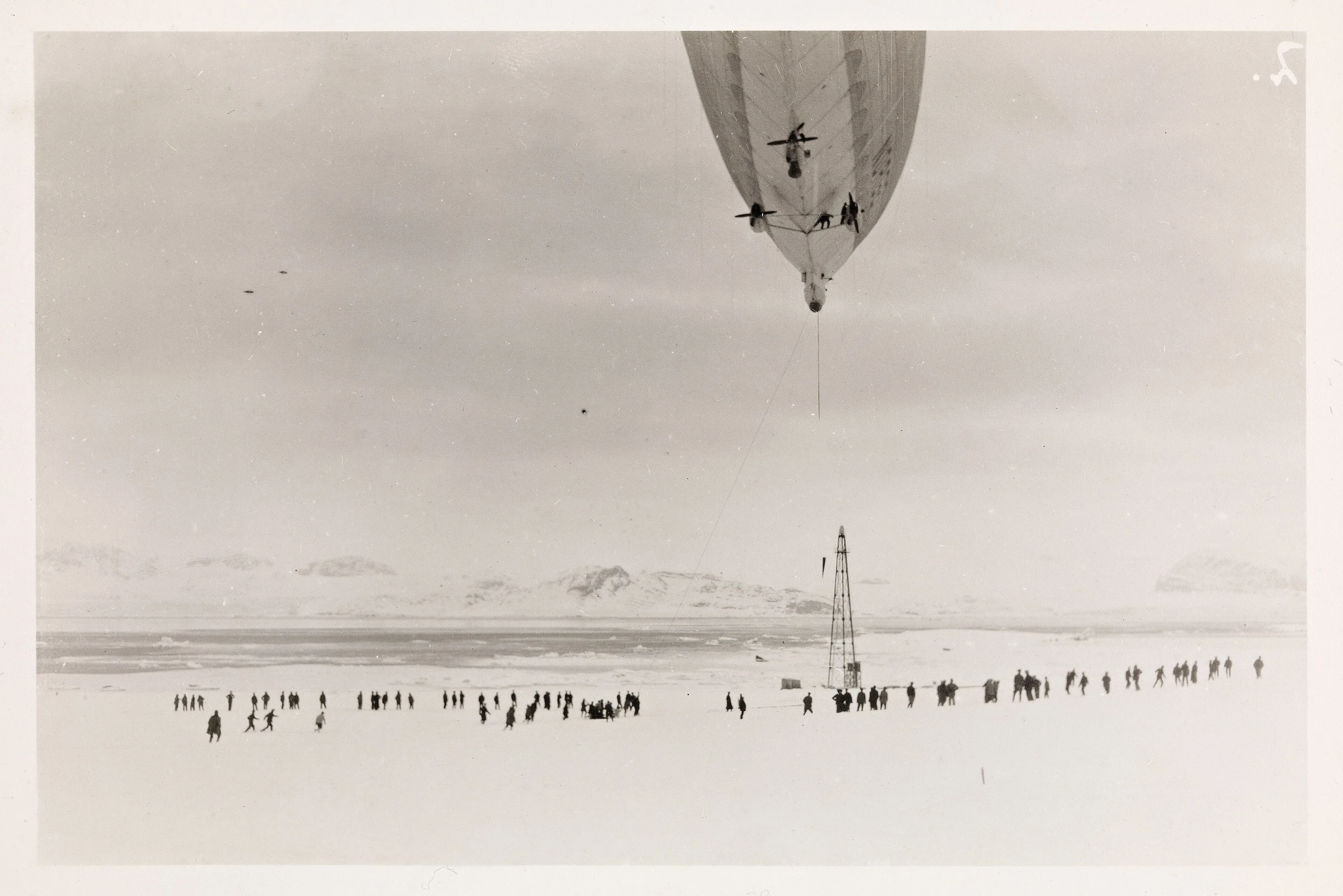
A Station at 79 North
The record of that mast is unusually complete, because the man who sited it wrote everything down. First Lieutenant Johan Hover gave one chapter to First Crossing of the Polar Sea, the book signed by Roald Amundsen and Lincoln Ellsworth, copyright 1927, and it reads like a ledger kept by someone trying not to complain.
Hover reached Kings Bay on 17 October 1925. He walked the ground with a polar dog called Jacob watching from a distance, then stepped off 300 metres here and 400 there with the mine manager, Sherdal. On 23 October the ship Alekto landed the master builder, Arild, with twenty-one men, 600 cubic metres of timber and 50 tons of iron. Thirty-two men wintered. The sun went on the 26th.
They built in the dark, in 35 degrees of frost, with beams that came out of the snow slippery. Twenty-seven kilometres of timber. Twenty-three pairs of trestles. A hall 110 metres long, 34 wide and 30 high, with no roof at all. On 15 February 1926 the flag went up on its frame. Then came 10,000 square metres of French canvas, laced on like sail.
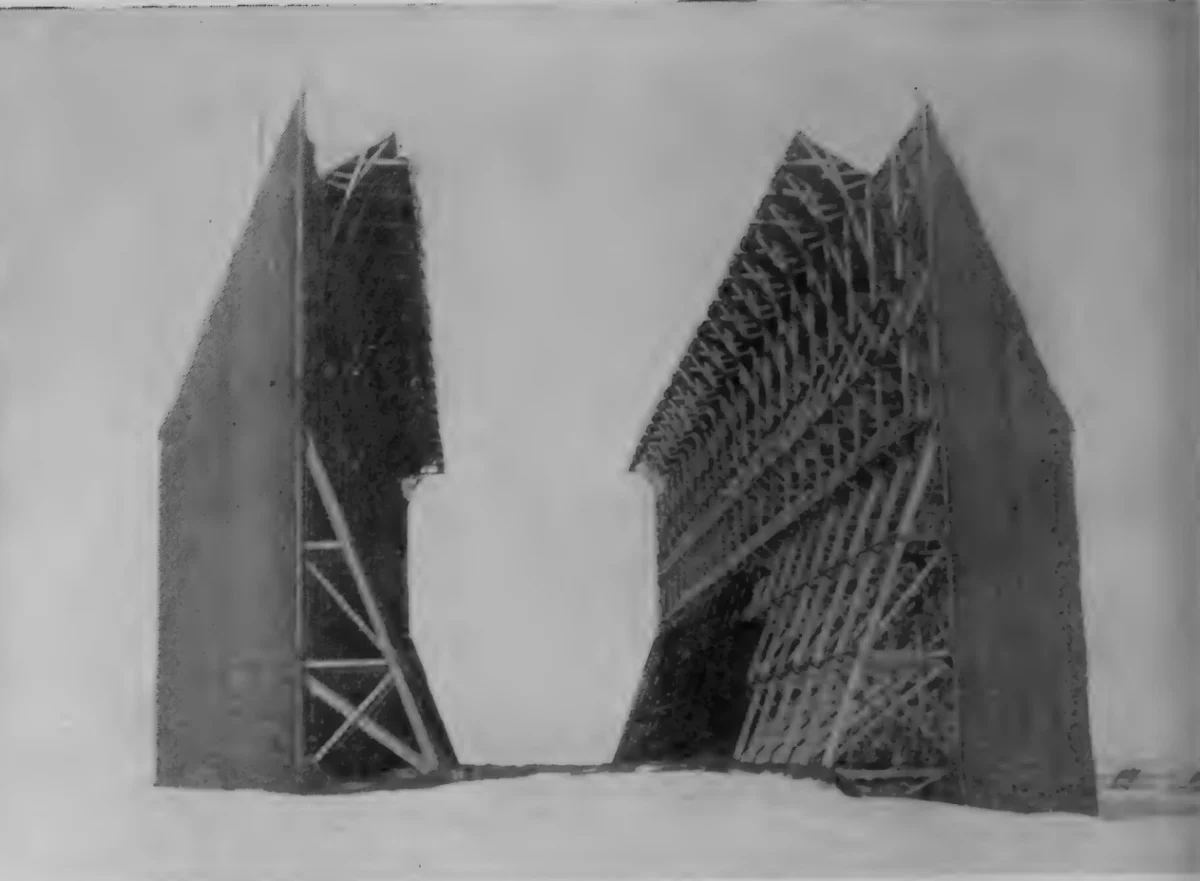
And here is the strange part. The hall was the easy half. The gas came last, and the gas is the number. It went north in steel: 900 cylinders on the Hobby, 140 tons, then 3,900 on the Knut Skaaluren, 625 tons. Ten cubic metres of hydrogen in each. Fjord horses and sledges took them up through the snow.
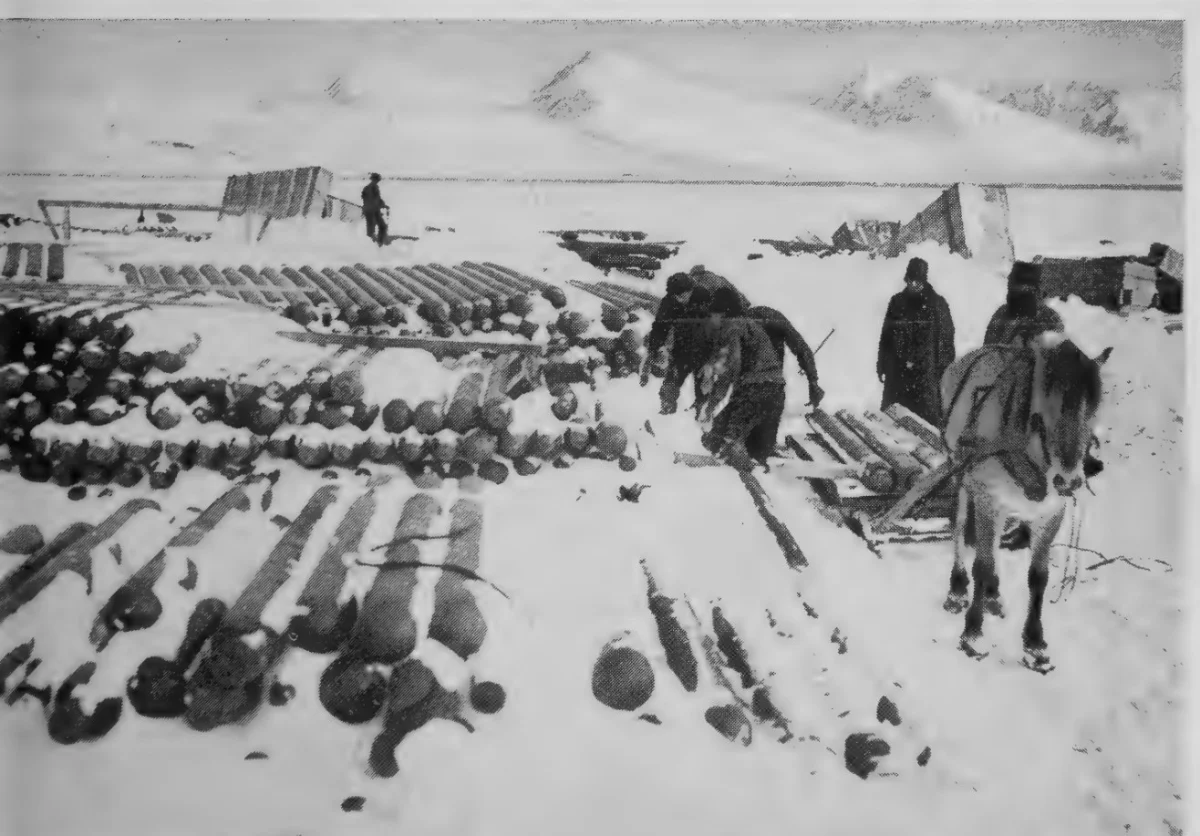
By this site's sum that is 48,000 cubic metres, about two and a half fillings of a ship Nobile rated at 18,500. Which means one filling travelled as nearly 300 tons of steel bottles. Hover's total for 1926 was nearly 2,000 tons of cargo.
Doors in the Sky
The rooftop idea is stated most plainly at Tartaria Britannica, in "How Do You Board an Airship?", posted on 8 January 2023. Many city buildings, it says, had "ornate entrances at the top of the building" where passengers boarded. Masts were "semi-permanent structures" that could go up almost anywhere, part of a "large-scale, affordable air industry". The Tartaria Vault film of January 2026 goes further: airships working over the great buildings as ordinarily as cranes, the fleet of an old world that the maps call Tartary.
The Norge hands that reading some real paper. Hjalmar Riiser-Larsen, who trained as an airship pilot in England, wrote in the same book that the mast "makes it possible to undertake the enterprise of an airship-route", where hangars demanded an enormous number of people. And masts did go up fast. Vadso's reached the town from Italy on 26 March 1926 and stood ready on 26 April. One month, on an island in the Arctic.
Seven Stops
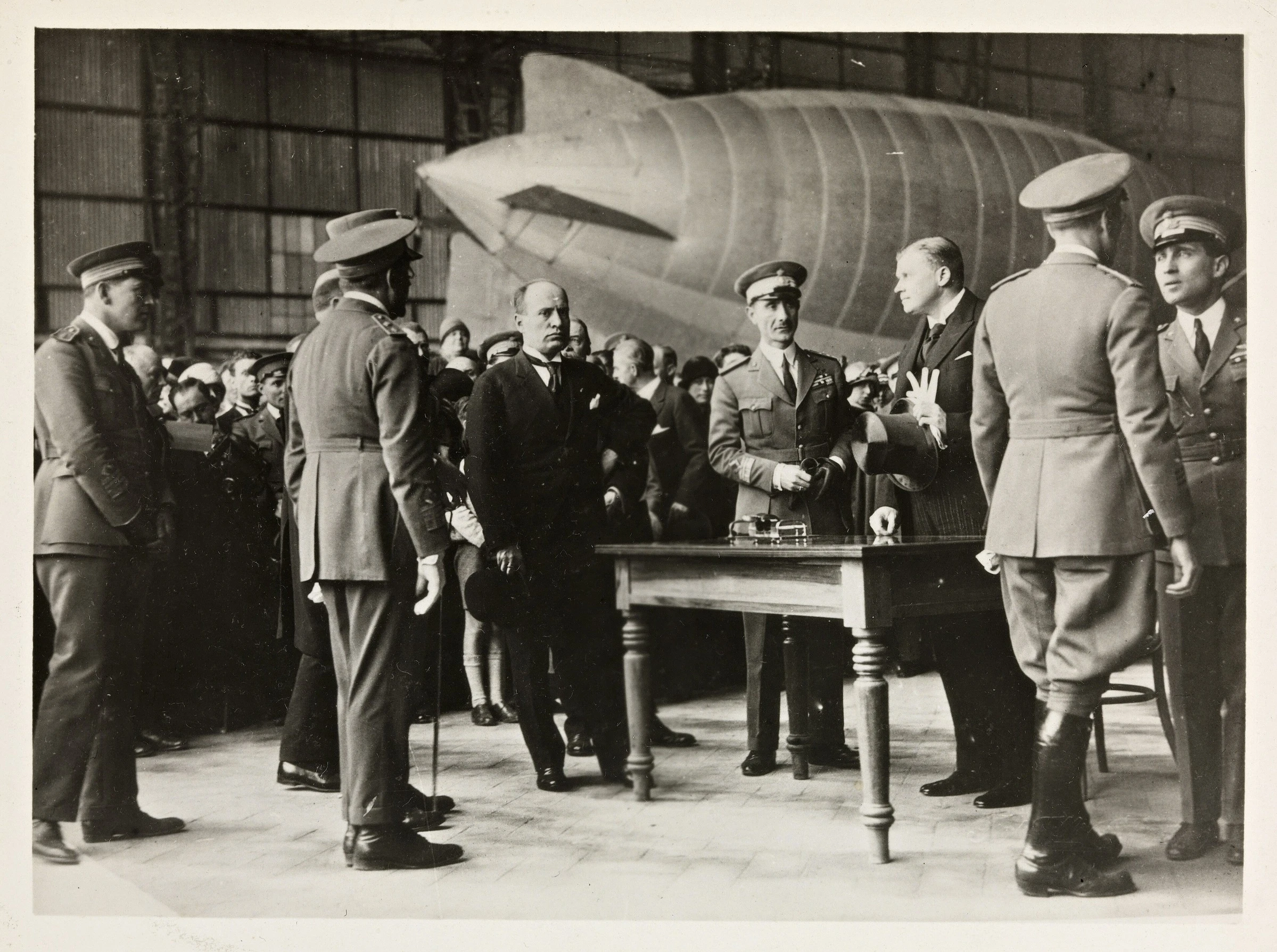
Ciampino, outside Rome: on 29 March the Norwegian flag went up in a hall big enough to hold three airships, Mussolini at the table, and N 1 became the Norge. About 200 men had walked her out for her trial flight. She left on 10 April, and the flying suits made to measure in Berlin were taken away at the last minute. The Norwegians flew north in sports suits.
The Italians wore fur.
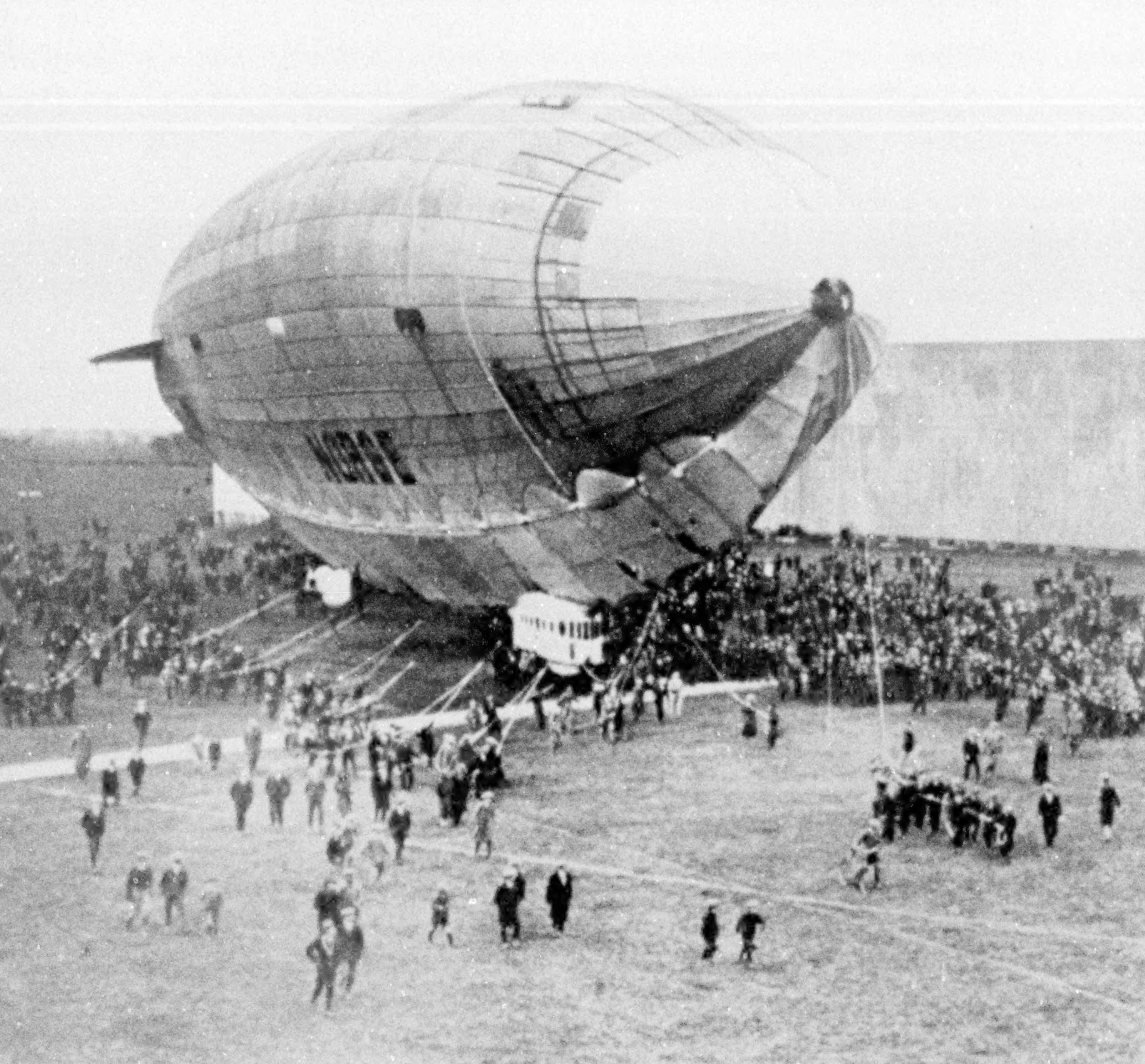
Pulham, Norfolk, 11 April: over the shed at 3:20, down at 5:50, about 3,000 people watching.
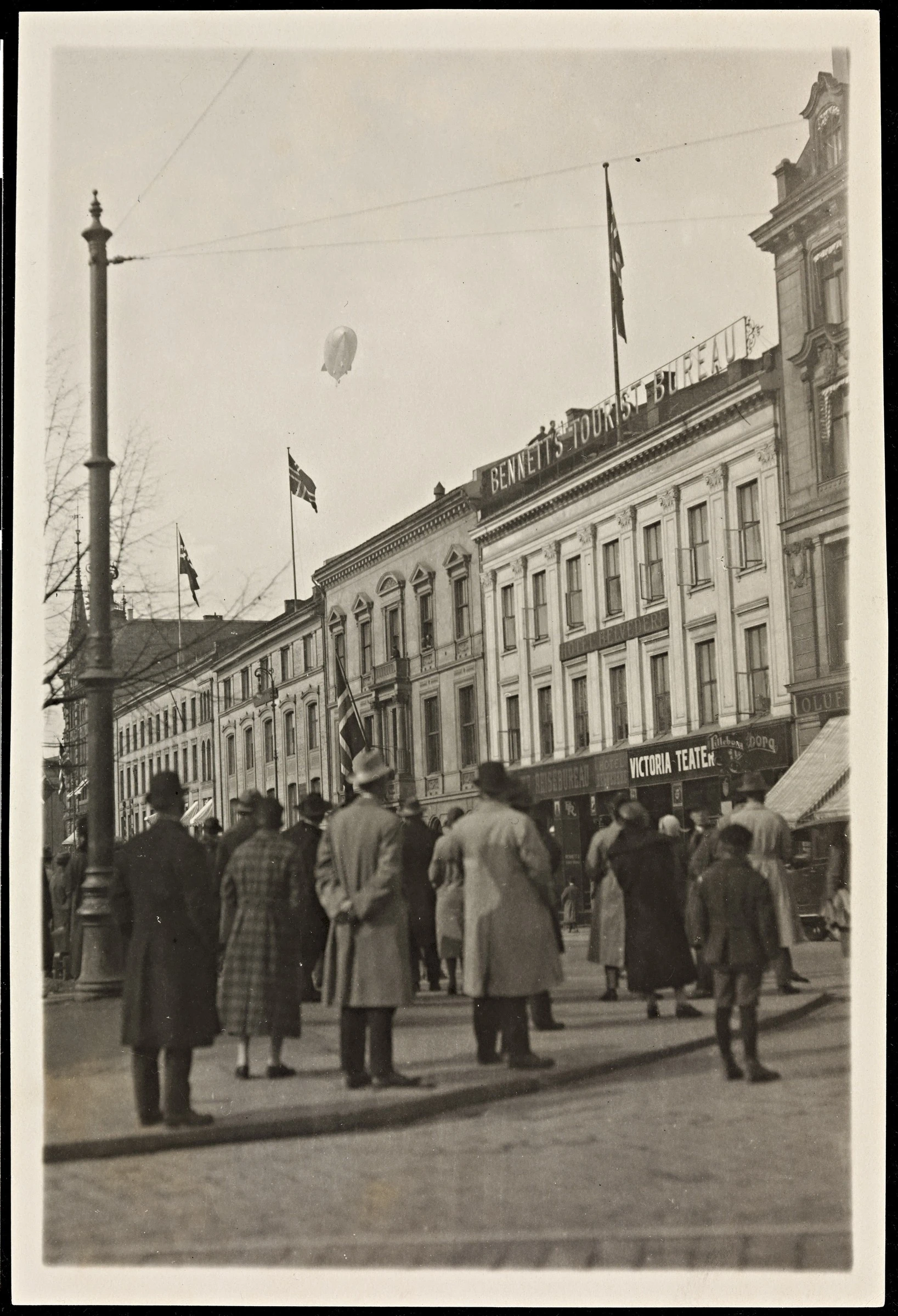
Ekeberg, Oslo, 14 April: a mast built in Norway with a head borrowed from Rome, in use, Nobile's caption says, for about ten hours.
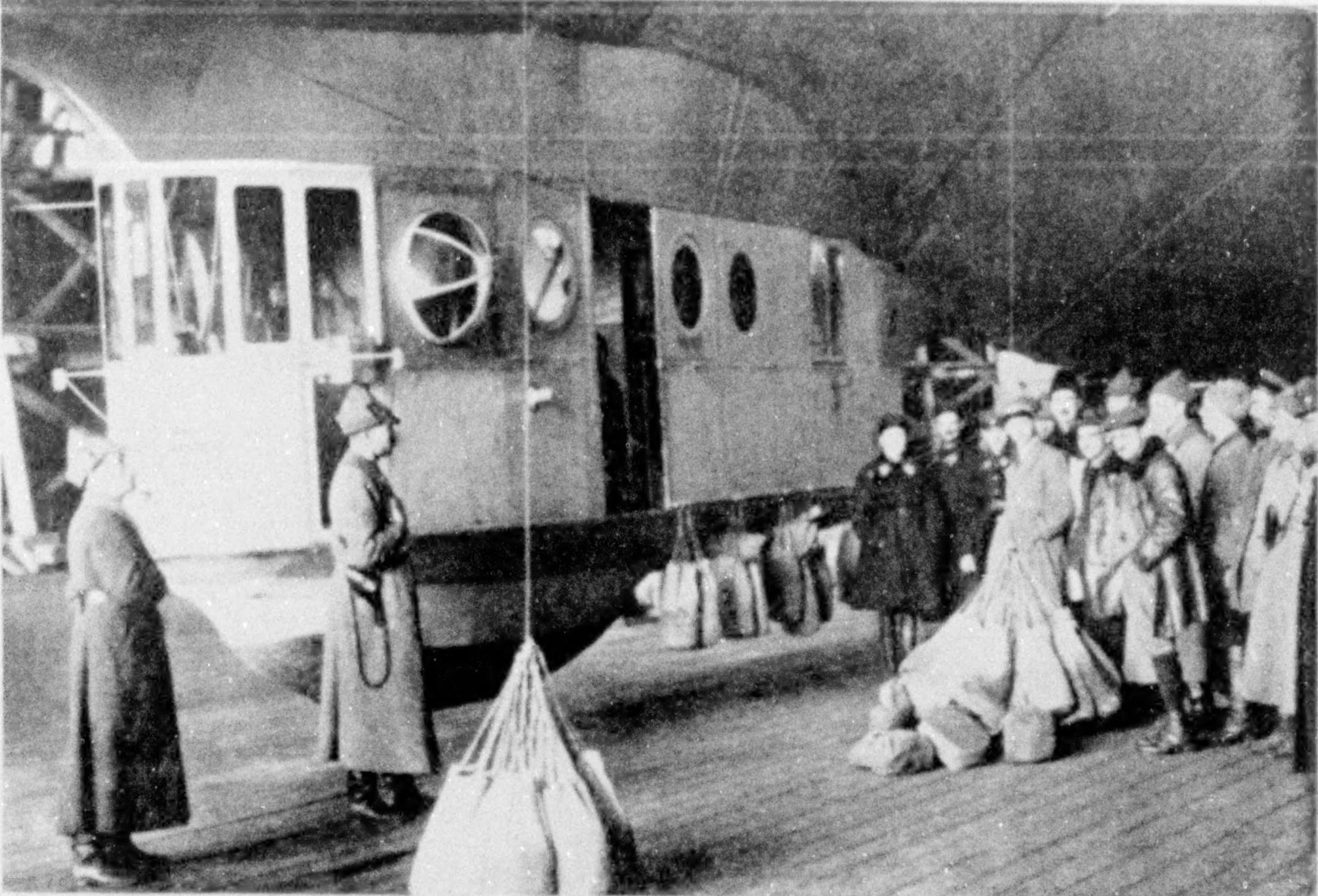
Gatchina, the night of 15 April: soldiers in long capes, a wooden hall with no doors at one end, sentries with fixed bayonets, the ship held to the floor by bags of ballast, a reported ten thousand visitors on the first Sunday. At Gatchina she stayed twenty days, waiting for the ground at Kings Bay to be ready. Nobile had wanted one week.
Vadso, 6 May: moored at 5:30 in the morning, gone by 3 in the afternoon. Ny-Alesund, 7 May. Twenty-seven days and 7,600 kilometres, with a crowd under her at every stop.
A Fleet at the Rooftops
Set aside for a moment whether it is true. Ask the better question. What kind of past are we standing on if those doors at the top of the old buildings once opened onto air?
It would mean, first, that the men of 1926 were not pioneers at all. Hover pacing out a site in the snow, Riiser-Larsen learning the mast in England, Nobile fitting a stiff nose to a soft ship: all of them would be fumbling back towards a trade their great-grandfathers took for granted. The crowds at Pulham and Ekeberg, staring up as if at something new, would have been looking at a thing their own city had forgotten it once did every day.
It would mean that the old cities were built around gas. On the Norge's own figures, every filling of a ship that size is nearly 300 tons of steel. On that reading a fleet would have asked for that again and again, in every capital, and behind each town hall there would have been a yard of bottles, a rail spur and a horse.
It would mean that our bodies were once part of the skyline. Two hundred men on the ropes at every departure, a regiment for each ship, in every city, for decades. A whole way of earning bread, and it would have left the memory of our grandparents inside one long lifetime. If that can happen, the floor under everything we think we remember is thinner than we have supposed.
And it would leave one question still in front of us. If a world can forget a thing that large, which of our own towers will stand a century from now with nobody able to say what they were for?
What a Station Is
The standard account comes from the people who did the work, and in it an airship station is ground before it is a building. Hover measured Kings Bay against Pulham, Cuers and Nordholz, and his first days went on wind and levels: 120 metres of flat, the long side laid along the prevailing wind. No stop on the Norge's road was a city building. Each was a field, a hill, an island or the ice, with room for the ship to swing and a crowd to hold her.
The mast solved the hall. It did not solve the wind.
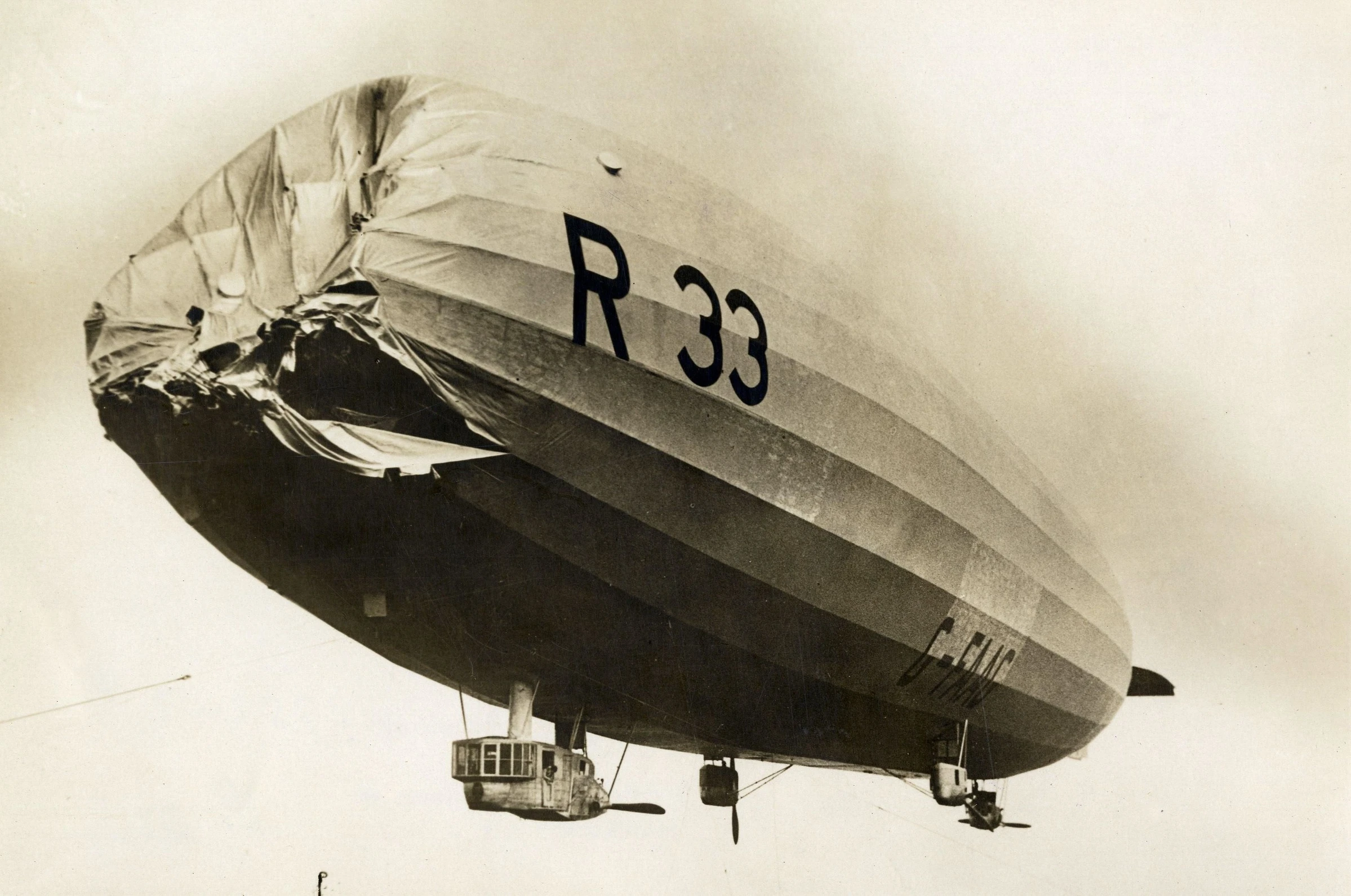
Beside the Norge at Pulham lay R33, which had been torn from the Pulham mast in a gale on 16 April 1925 with 20 men aboard and came home the next day with her nose crushed.
On a skyscraper it went worse. The Museum of the City of New York records three failed attempts at the Empire State mast, mostly through wind, and no dirigible ever docked there. The nearest thing was a blimp, the Enna Jettick, which made fast for a moment on 15 September 1931.
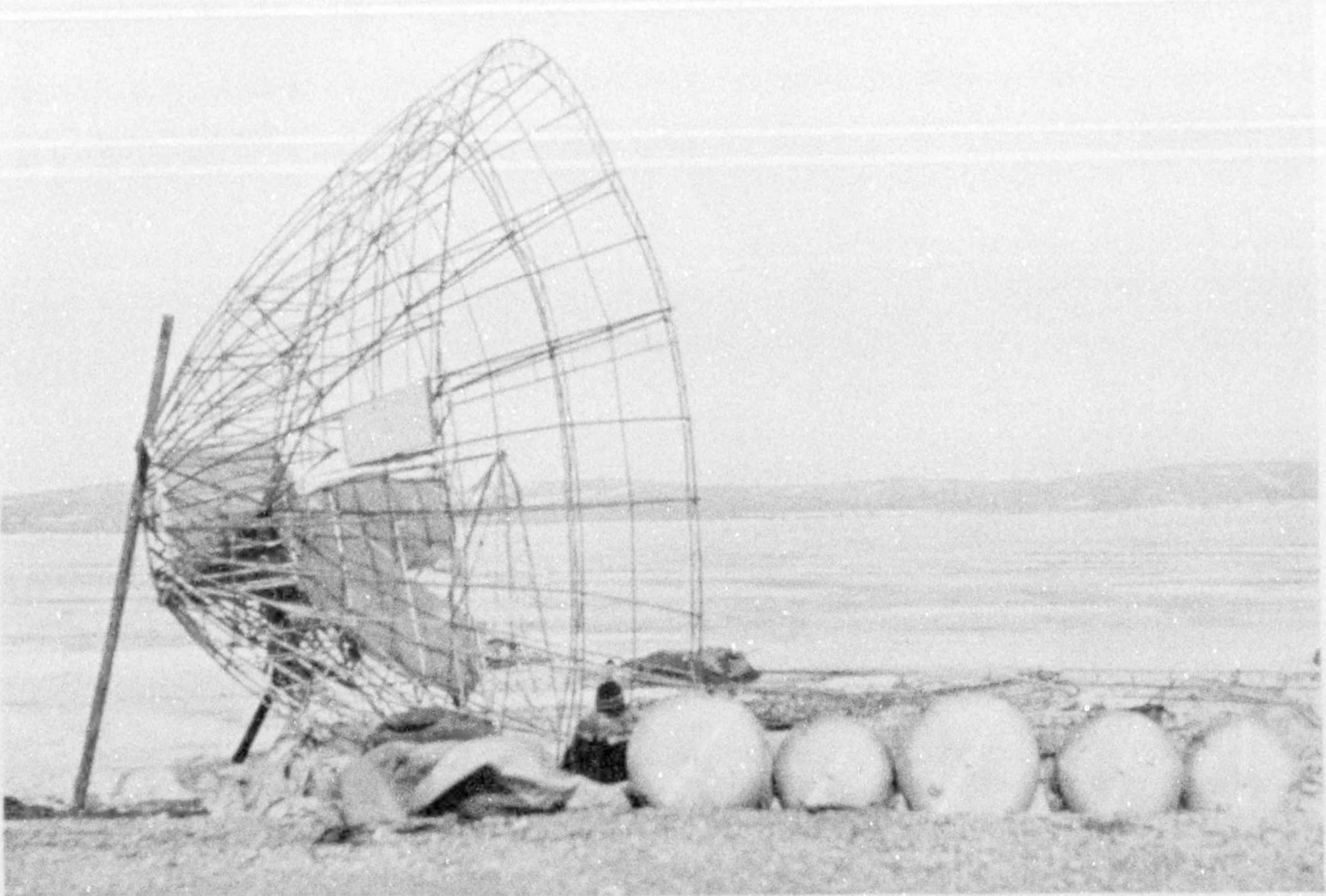
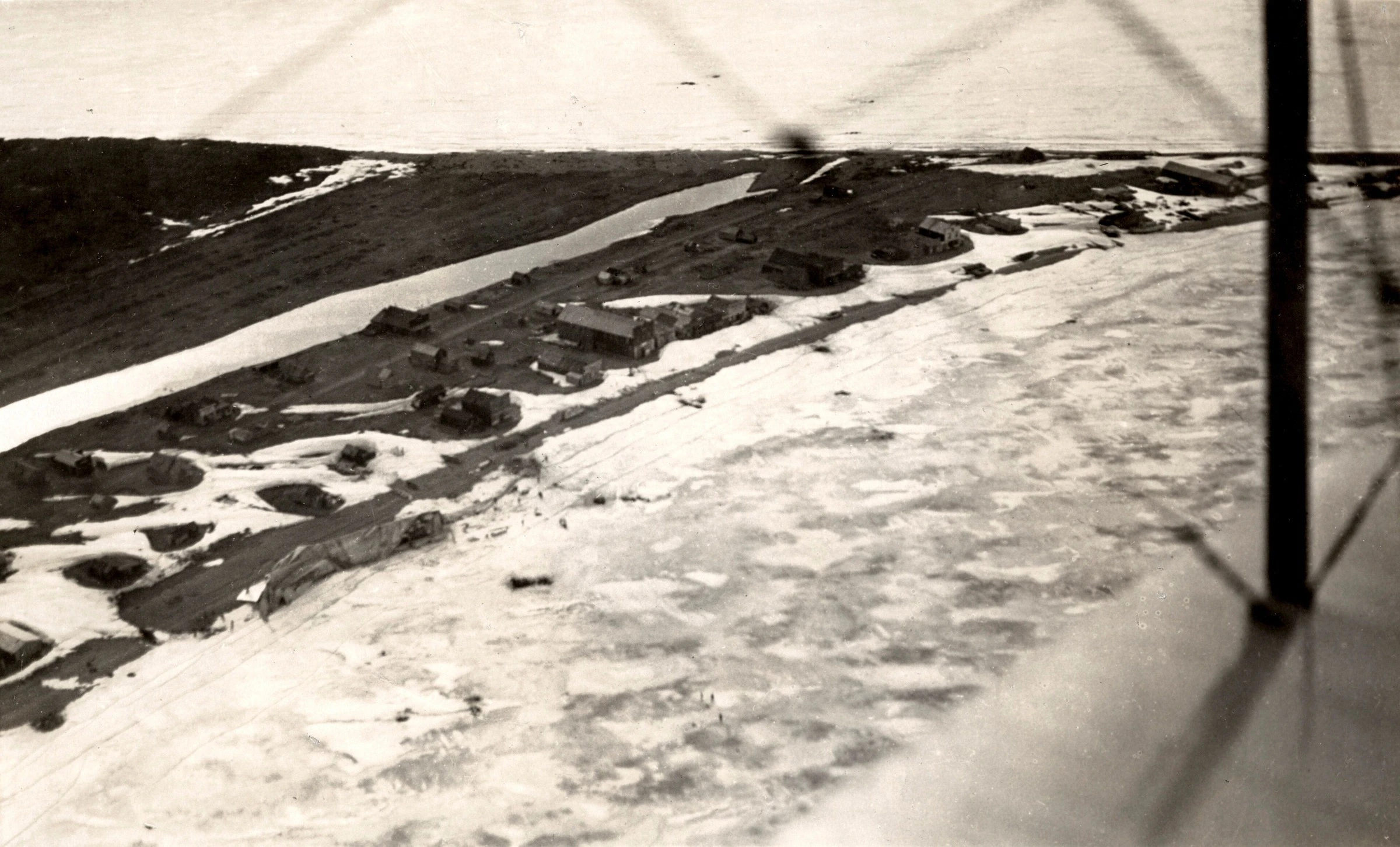
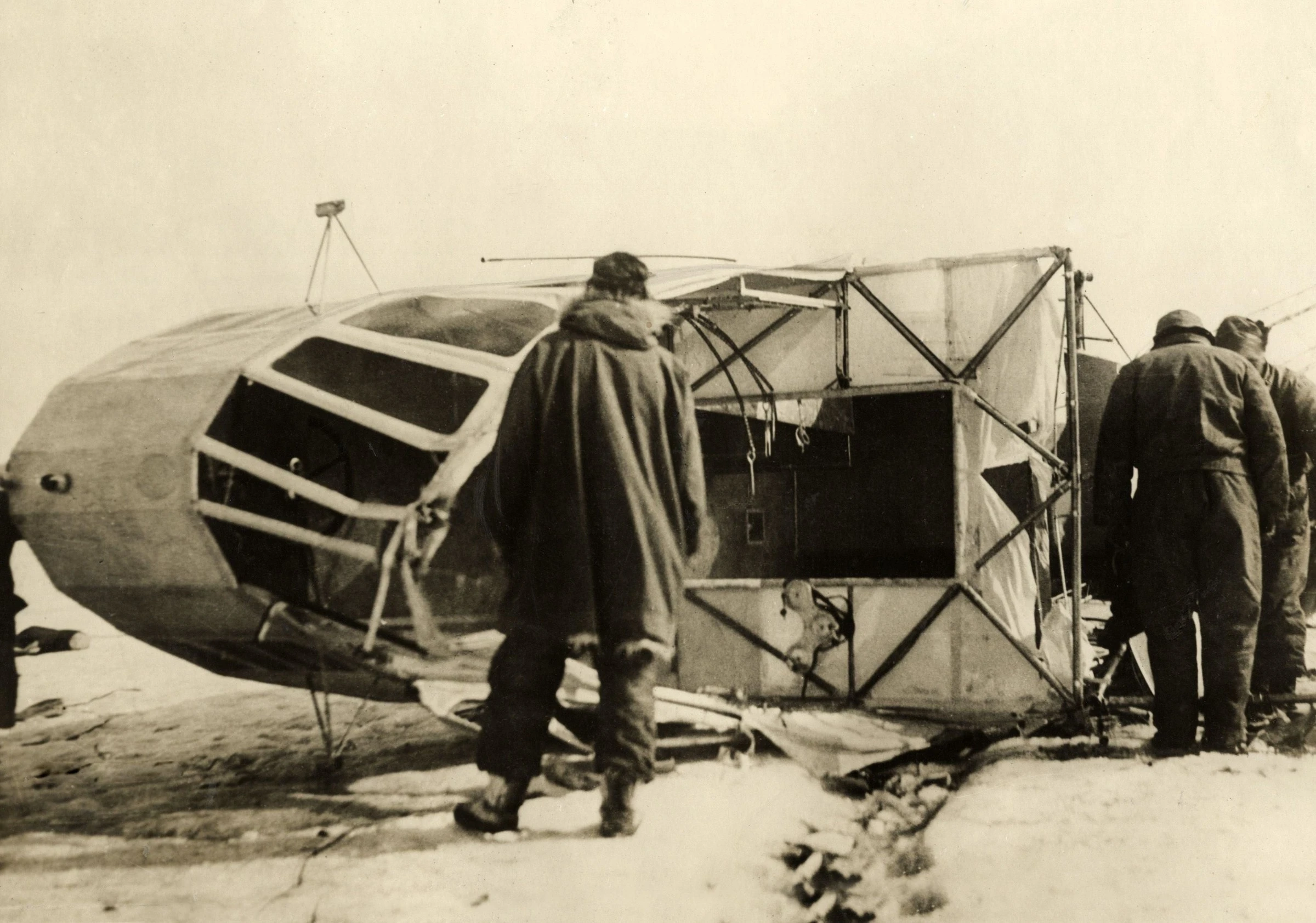
Which leaves the last stop, where the road ran out. On 14 May 1926, Greenwich time, after about 70 hours in the air, she came down on the ice at Teller, Alaska, a place Nobile gives 55 inhabitants. No mast. No hall. The anchor would not bite, and the villagers held the rope. The gas was let out and the bag sank into a shapeless mass. Nobile wrote of "how heartless it seemed that it was I who had struck her down". She was cut up for crates and never flew again.
What the Ledger Does Not Reach
Those figures are the bill for one expedition, in a hurry, at the edge of the map, with its gas brought by sea. They do not reach a settled service with a supply of its own. They do not reach the craft in the film, which it says worked on other principles that it does not name, so there is nothing to weigh. And a ledger from 1926 says nothing direct about 1890.
The picture search behind this site's airship record was run apart from this article. It looked for a ship riding at a mast on a building, to 1937, for longer than a touch. It did not find one. What it did gather is in The Airship Record, with each craft and building named wherever the record names them. Small craft did land on roofs and leave again, as the Comet did at Bloomington, Illinois, in 1910. The American Navy's history pages and NavSource refused the search, and the National Archives catalogue was not tried. That silence is weaker than it sounds. The same search came back with no picture of the Norge at Gatchina, and one had been sitting in National Geographic since 1927.
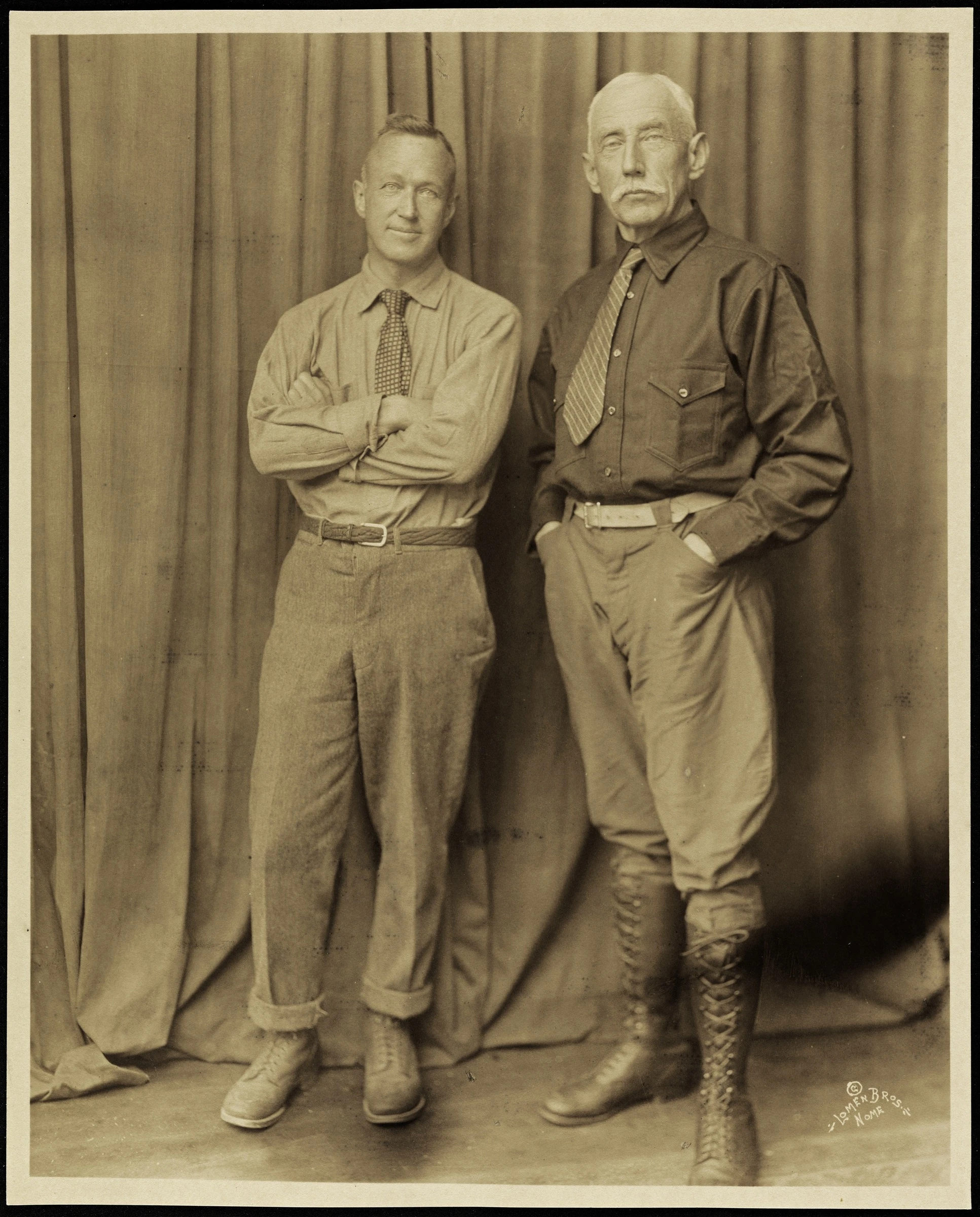
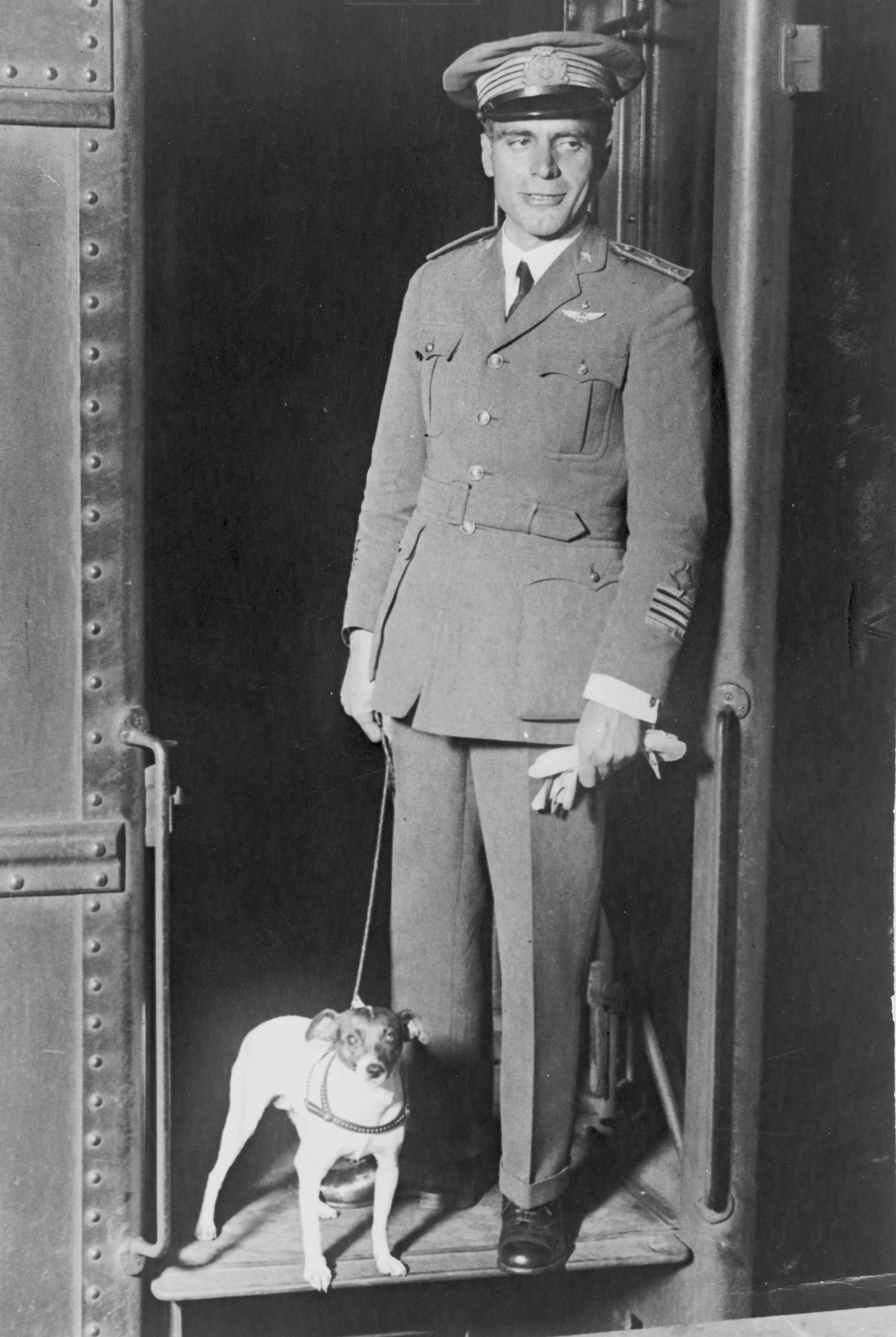
Nor does a dated record stay clean. Sixteen men crossed the Pole in that ship, and its two famous names could not agree on whose flight it was. Amundsen's My Life as an Explorer, in 1927, calls Nobile a hired pilot on 55,000 kroner, and has the ship leaving Rome on 29 March, twelve days early by his own expedition's book. In National Geographic that August, General Nobile says his polar plan took shape by June 1925, and that Amundsen's idea "was conceived independently of mine, but after mine". He closes on the fasces carried on his cabin. Lincoln Ellsworth, whose money the book calls the foundation of the whole business, stood with Amundsen. The book says they reached Seattle in miners' clothes, and found Nobile in a gorgeous uniform.
A 2025 paper in Polar Research records that the Fascist regime claimed all the credit. Both men's versions are in print. Neither man is a referee.
What Is Left at the Water's Edge
A century on, most of the road has gone. Ekeberg's mast came down in the Second World War and a small plaque marks the spot. The hall at Kings Bay fell in the early 1930s, its wood went into the coal mines, and its foundation blocks can still be seen. Vadso's mast stands. It held Nobile's Italia on her way north in 1928, and in May 2026 it was reported protected by the Norwegian state. Ny-Alesund marked the hundredth year from 8 to 12 May.
Amundsen did not see the argument finished. In June 1928 he vanished flying north to help search for the crew of that same Italia.
What survives of a real airship station turns out to be foundations and paperwork. A 40-ton block stays where it was poured. A cargo list needs no photograph. Which leaves a narrow test for the rooftops, and it is not a picture: one old building with the anchorage for a mast in its structure, or one bill for gas delivered to a roof, with a date on it. That would show one ship at one building. It would not prove a fleet or an inheritance, and failing to find it at one city hall would clear no other.
The Norge's list runs to nearly 2,000 tons.
Nobile, who built her, wrote her epitaph in 1927: "She had been made fast to mooring masts, she who loved the liberty of the sky". At Ny-Alesund the mast is still waiting for her.
Questions This Leaves You With
Is there anything a person actually does with this?
Nothing in your own life follows from it, and anyone selling you a date or a secret is selling something. What you can do is small. Next time you see a tower or a rooftop door called a docking station, ask the plain questions a builder would ask: where did the gas come from, where did the ropes go, who held them? The larger question is how a culture checks a story about its own past, and that one belongs to everybody.
Does this sit against a religious account of the world?
Hardly, and it cuts both ways. A lost age of greater skill can read as a fall from something better. The same story can read as human cleverness with nothing above it. Even the men of 1926 split: the expedition's book thanks Providence for the calm at Teller, and Nobile, though he too calls it miraculous, credits the gear provided in Rome. Neither reading needs a fleet, and neither is ruled out without one. Which way it falls for you is yours to decide, and this site will not tell you.
Does this change what a human life is?
Set your own working life beside Hover's winter. Thirty-two men spent the polar night building a hall the Norge used for four days. You can read that as a small thing, months of a life for a shed that later fell down. Or you can read it the other way: the ship crossed the top of the world because a carpenter stood on an icy beam in the dark. You may already know which of those you felt first.
What would change your mind, in either direction?
Name it now, while it is easy. Towards the rooftops: a mast footing found in the structure of a building older than 1900, a gas contract with a city, a harbour record of hydrogen landed for a town hall. Against them: the buildings' own plans opened and shown to carry no such load, the doors traced to roof repairs. An engineer would start with the drawings and the weight a parapet can hold against a ship pulling in a gale. Which of those would you accept?
Whose flight was it?
This is the open problem, and it has nothing to do with Tartaria. Amundsen's memoir says Nobile was a paid skipper. Nobile says the idea was his first. Each prints what suits him, and both were writing within a year or so of the event, with money and flags at stake. The Aero Club's contract with Nobile, with the words Amundsen says were added to it, was not opened for this article. Whoever reads it, and the telegrams around it, may narrow the gap. Until then it stands empty, a hundred years on.
More photographs
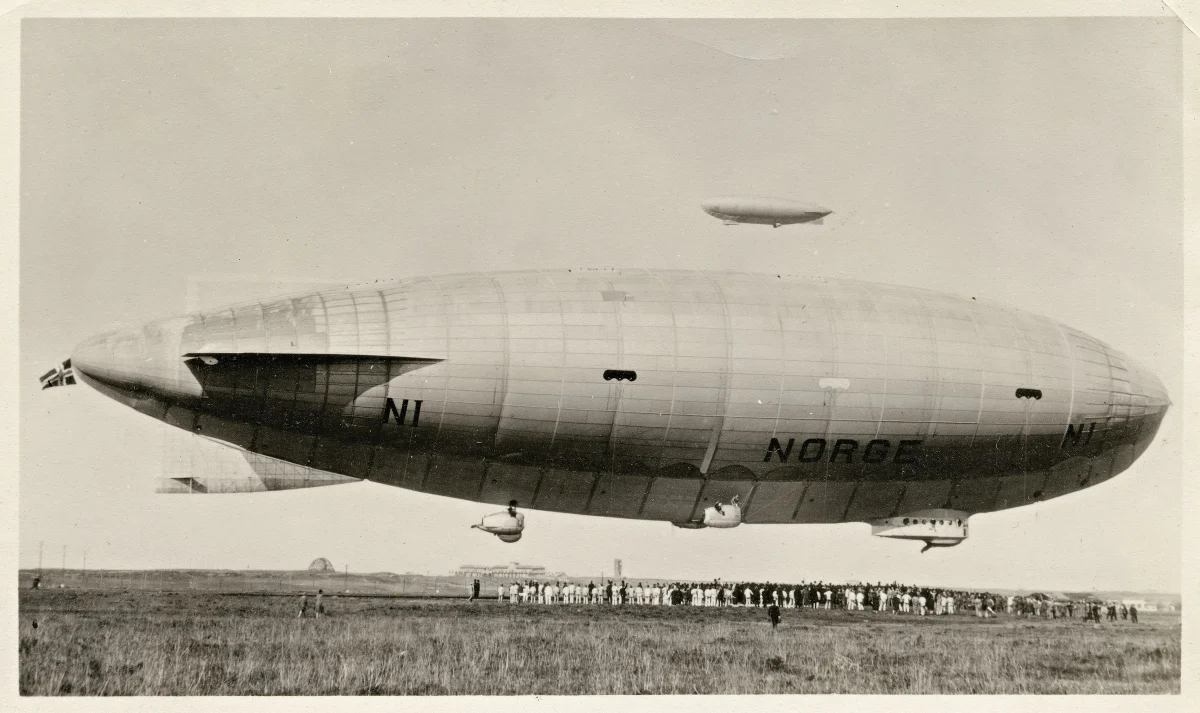
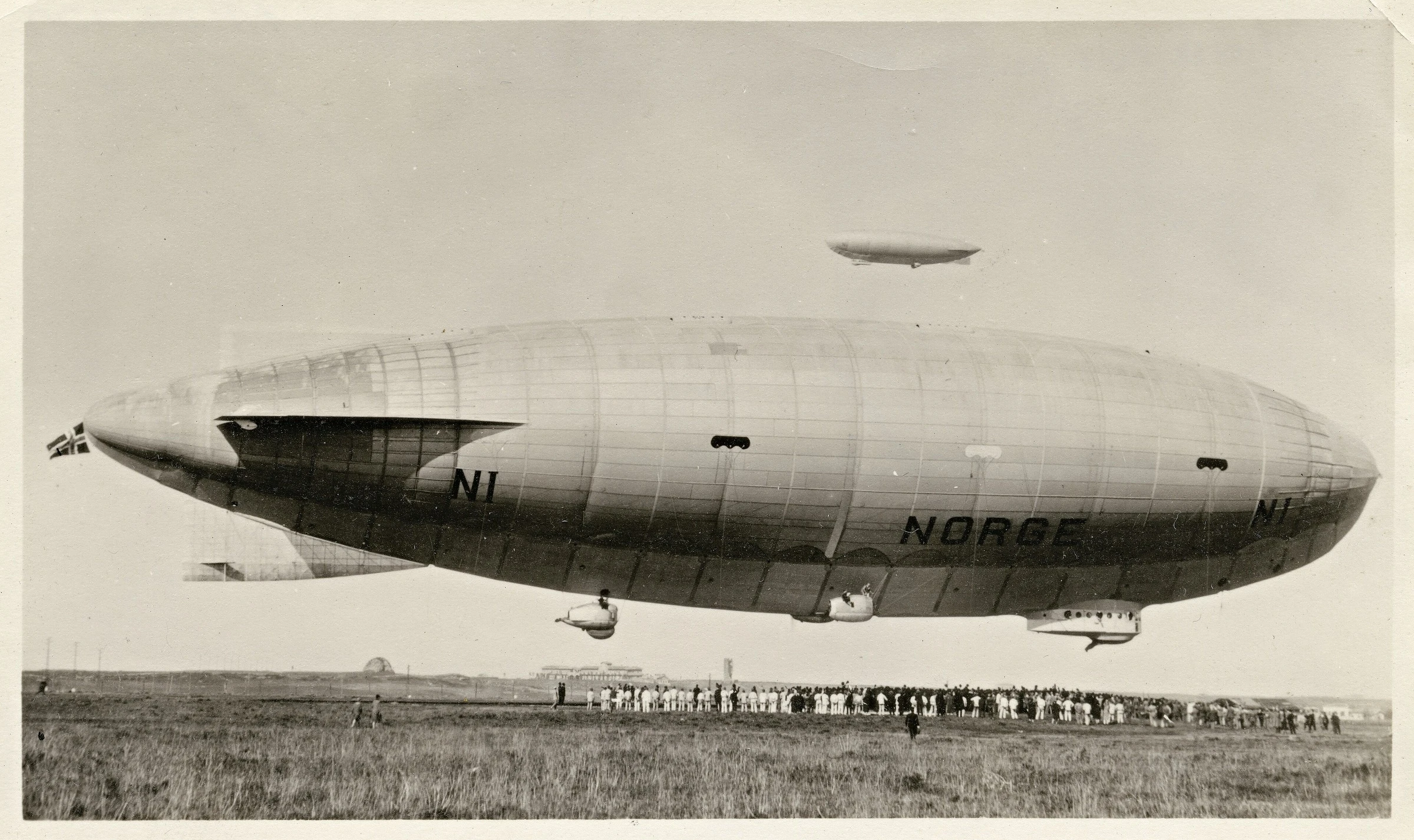
The ship just above the ground at Ciampino in March 1926, the long line of the handling party under her. A smaller airship flies behind. Photo: photographer unknown, National Library of Norway, CC BY 2.0 (creativecommons.org/licenses/by/2.0), via Wikimedia Commons. 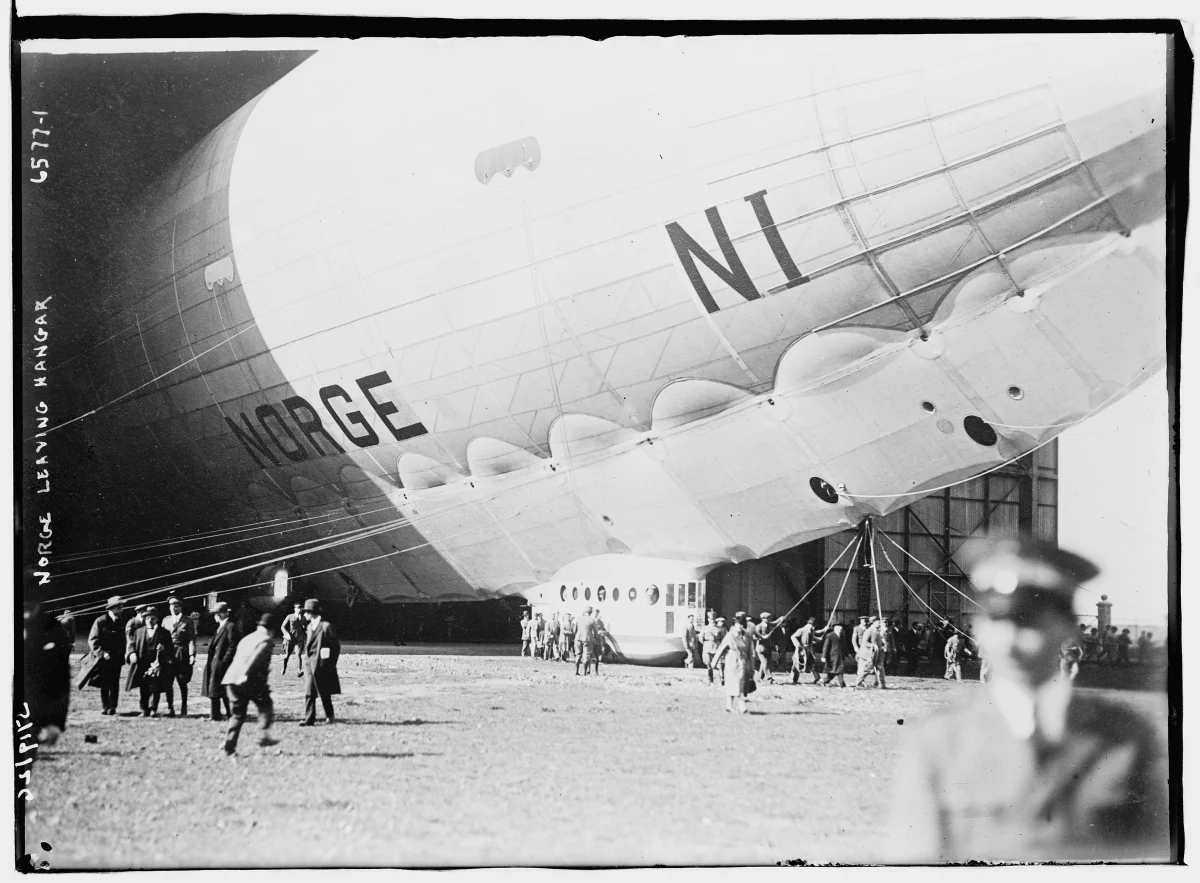
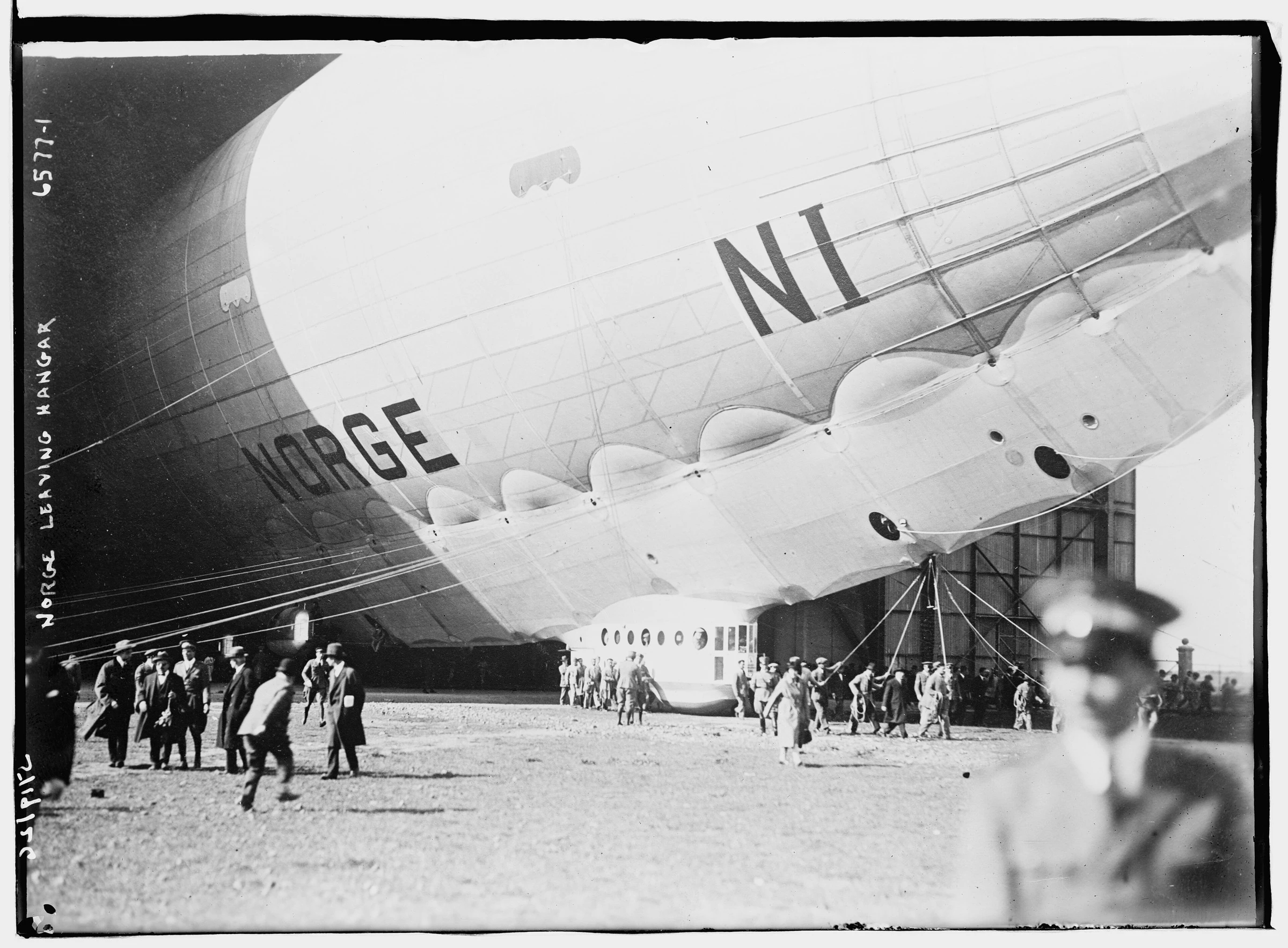
Norge Leaving Hanger, the Bain negative's own title. The Library of Congress names no place; the ground crew are on the ropes. Bain News Service, 1926, Library of Congress, public domain, via Wikimedia Commons. 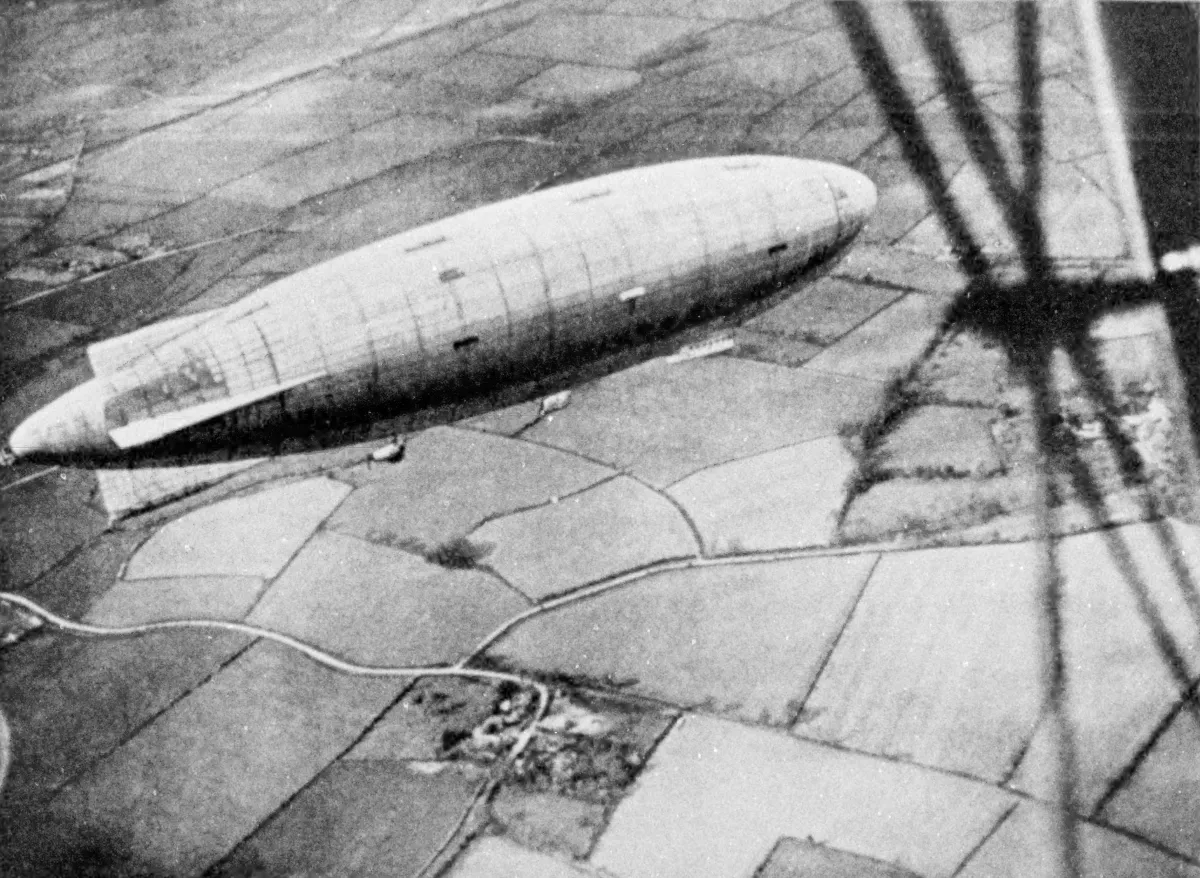
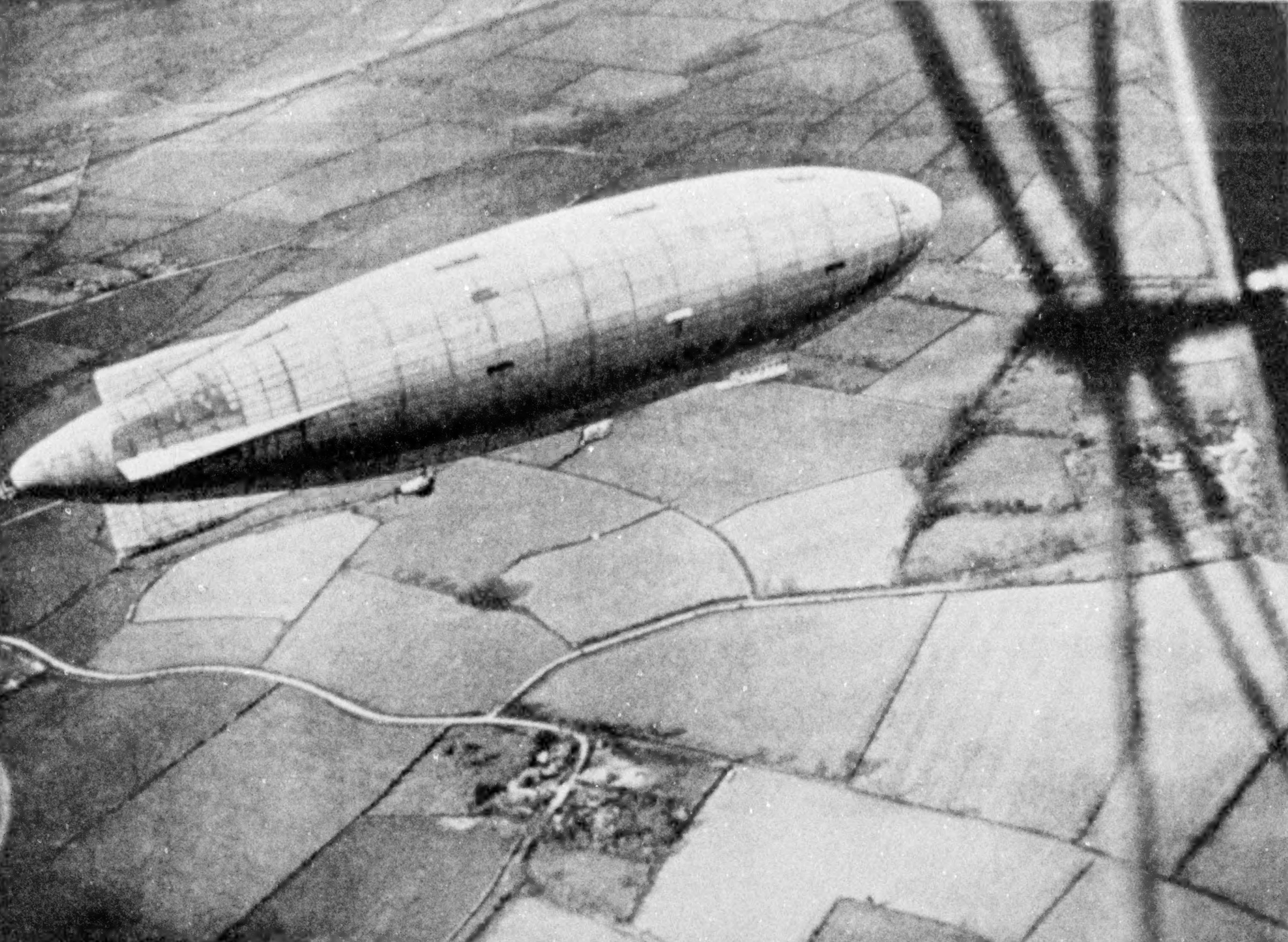
The Norge Nearing Pulham, National Geographic's title for this view from above the Norfolk fields, April 1926. Its caption has her over the field at 3:20 and not down for two and a half hours. Photograph by Underwood and Underwood, in National Geographic Magazine, August 1927, p. 191, published 1927, public domain in the US, scan via Internet Archive. Cropped. 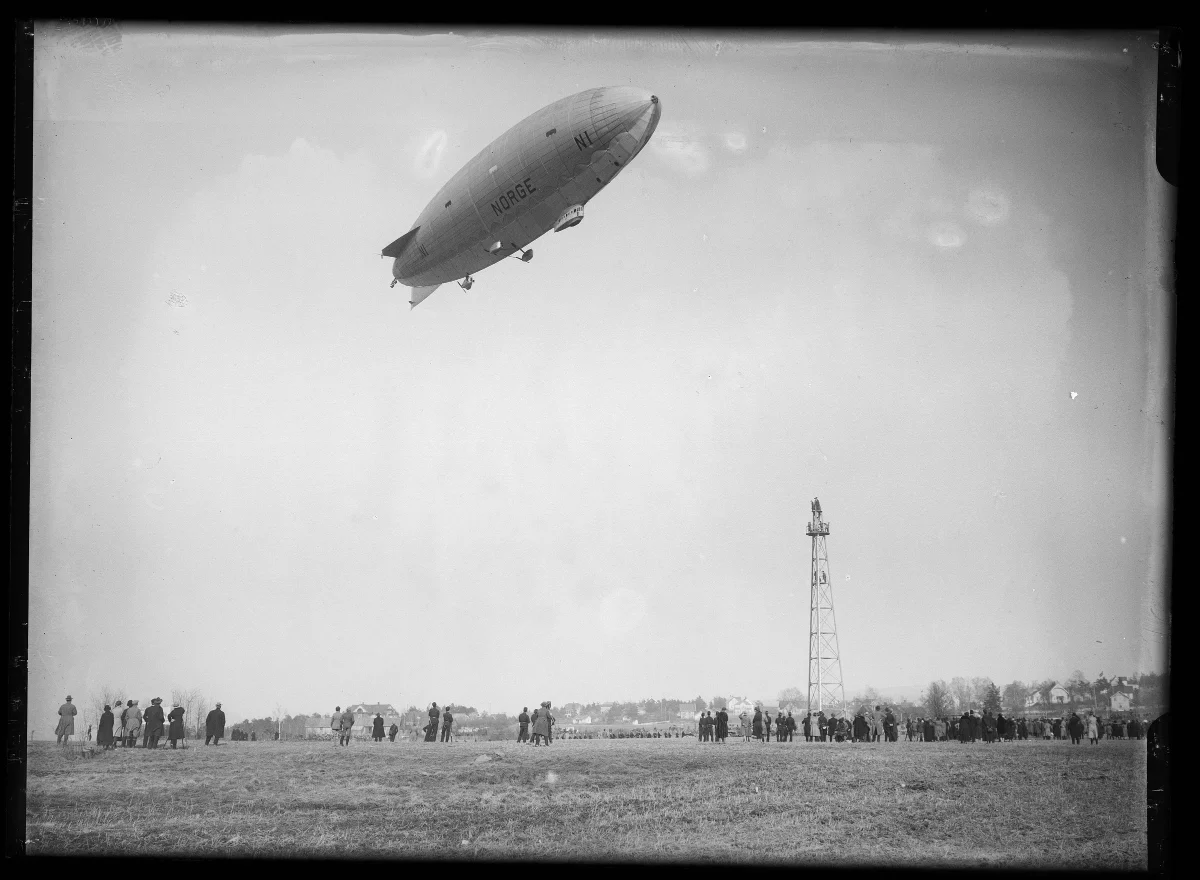
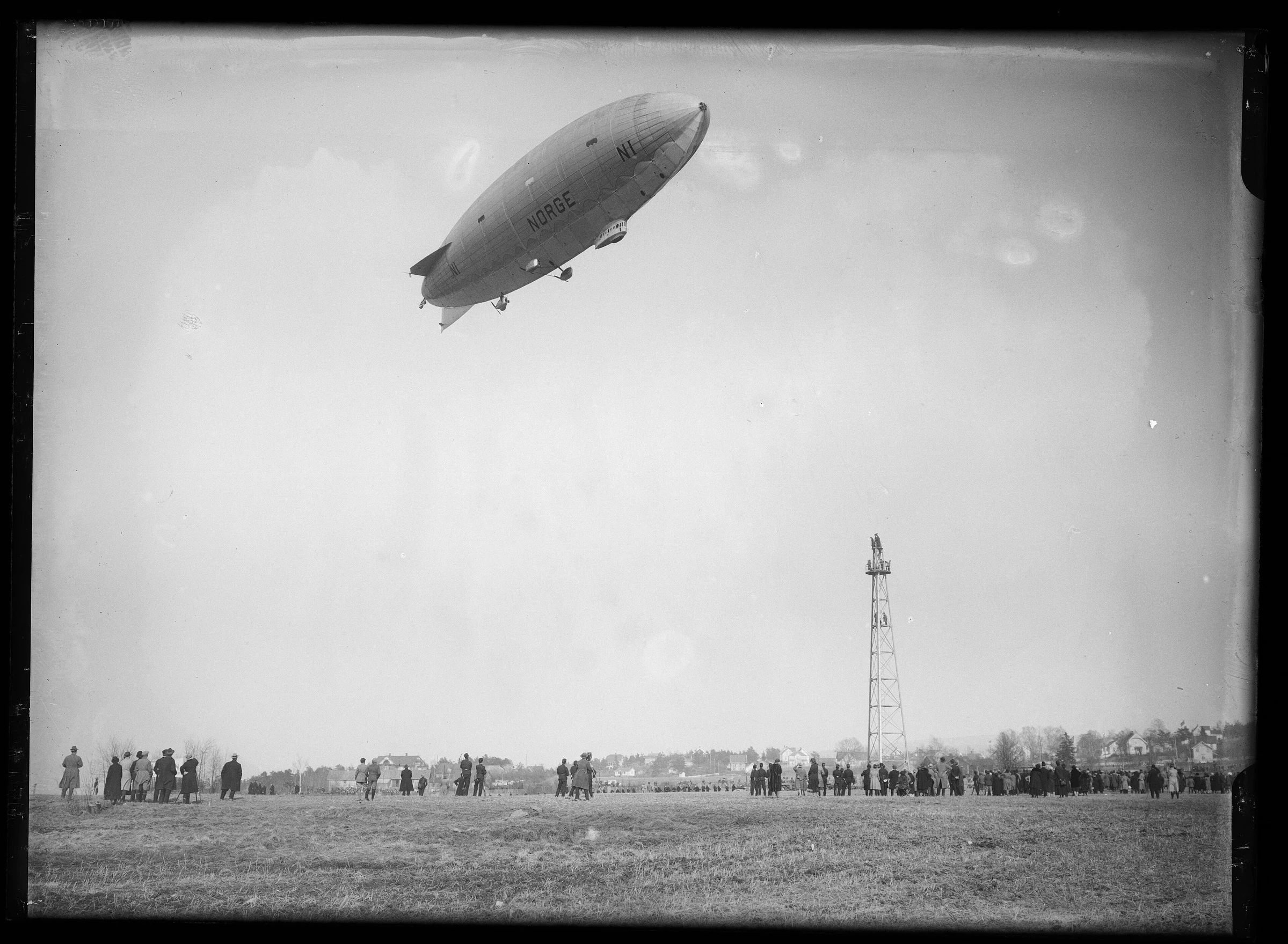
The Norge in the air above the Ekeberg mast, a glass plate by Narve Skarpmoen. The holder's note places it at Ekeberg. Narve Skarpmoen (1868-1930), 1926, National Library of Norway, public domain, via Wikimedia Commons. 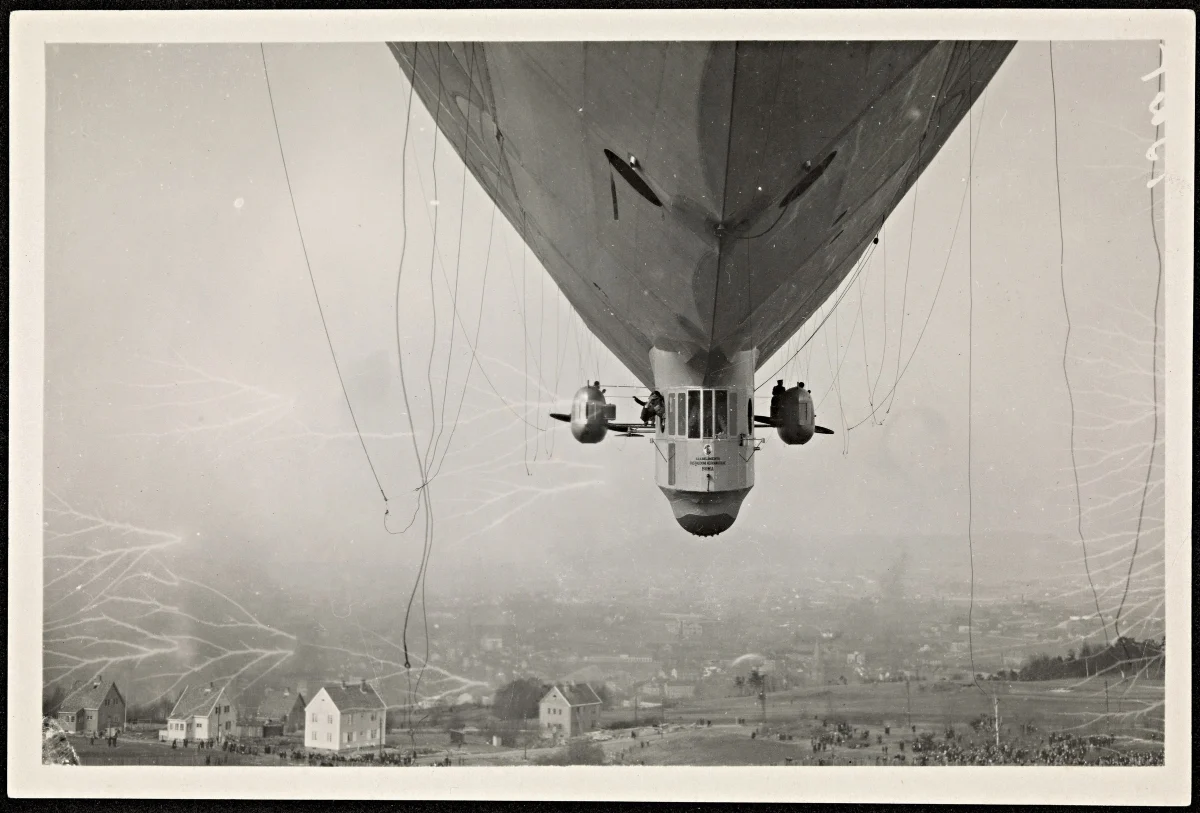
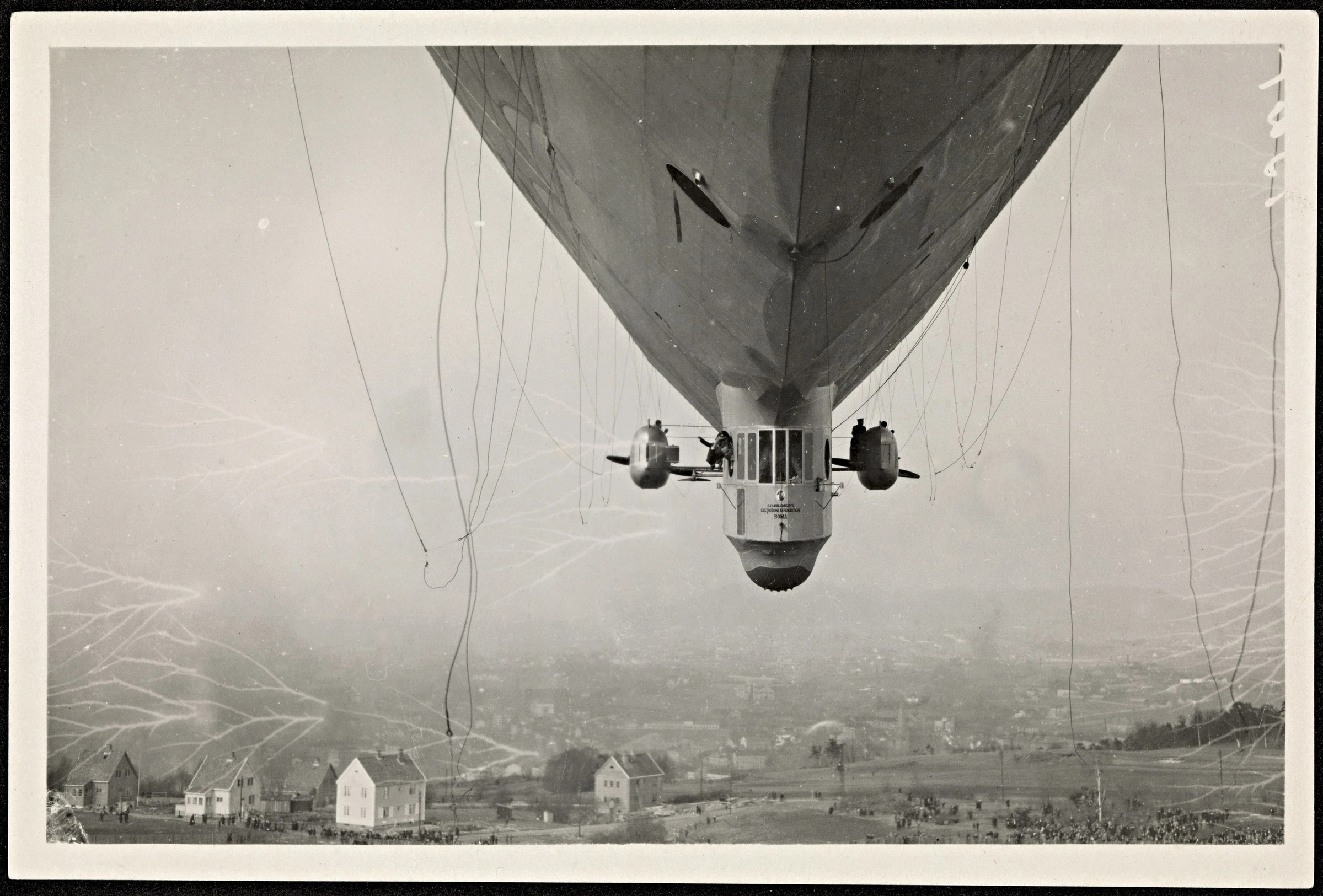
Directly under the ship at Ekeberg, 14 April 1926: the commander's cabin, two engine gondolas and the lines hanging to the field. Photo: photographer unknown, National Library of Norway, CC BY 2.0 (creativecommons.org/licenses/by/2.0), via Wikimedia Commons. 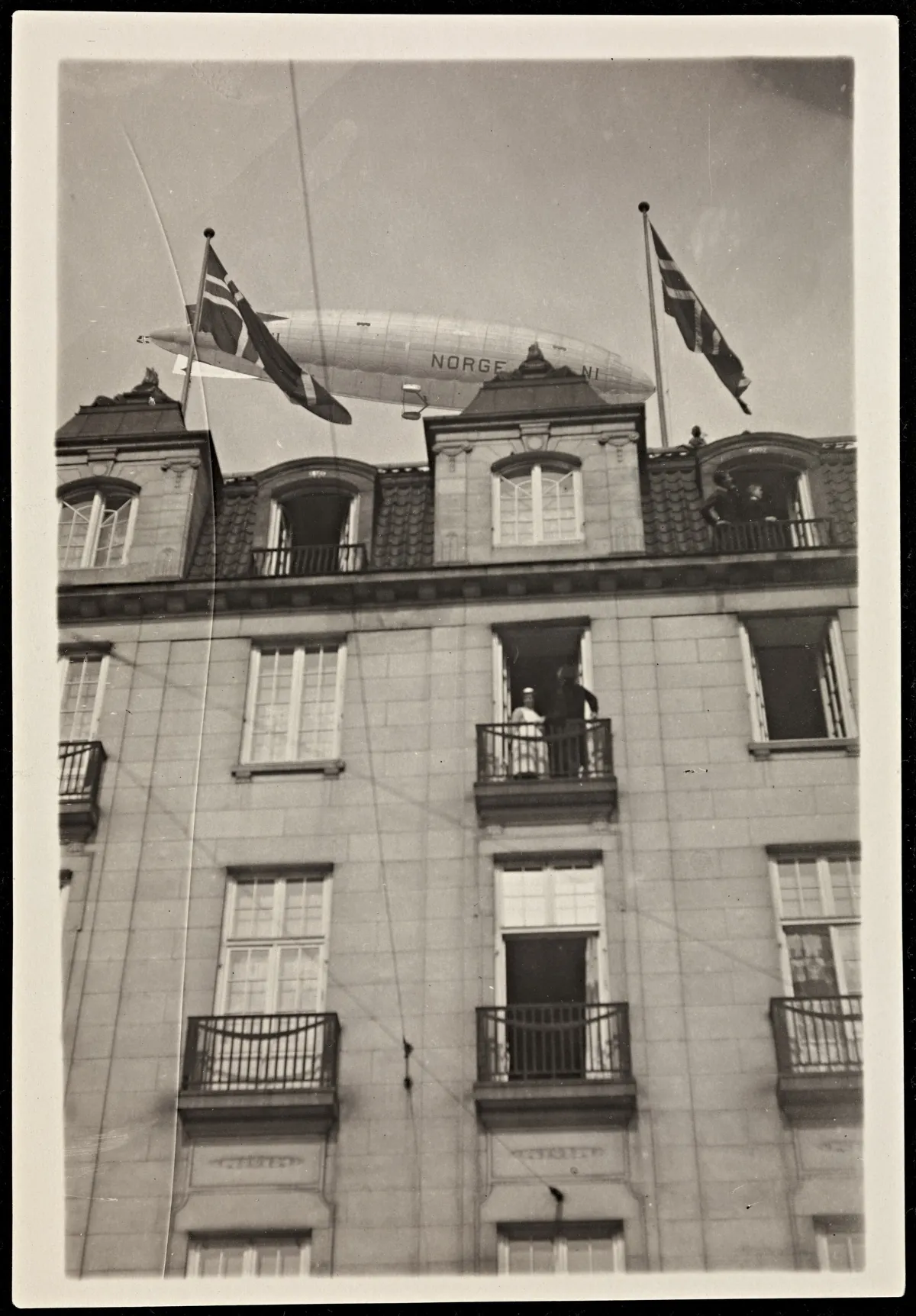
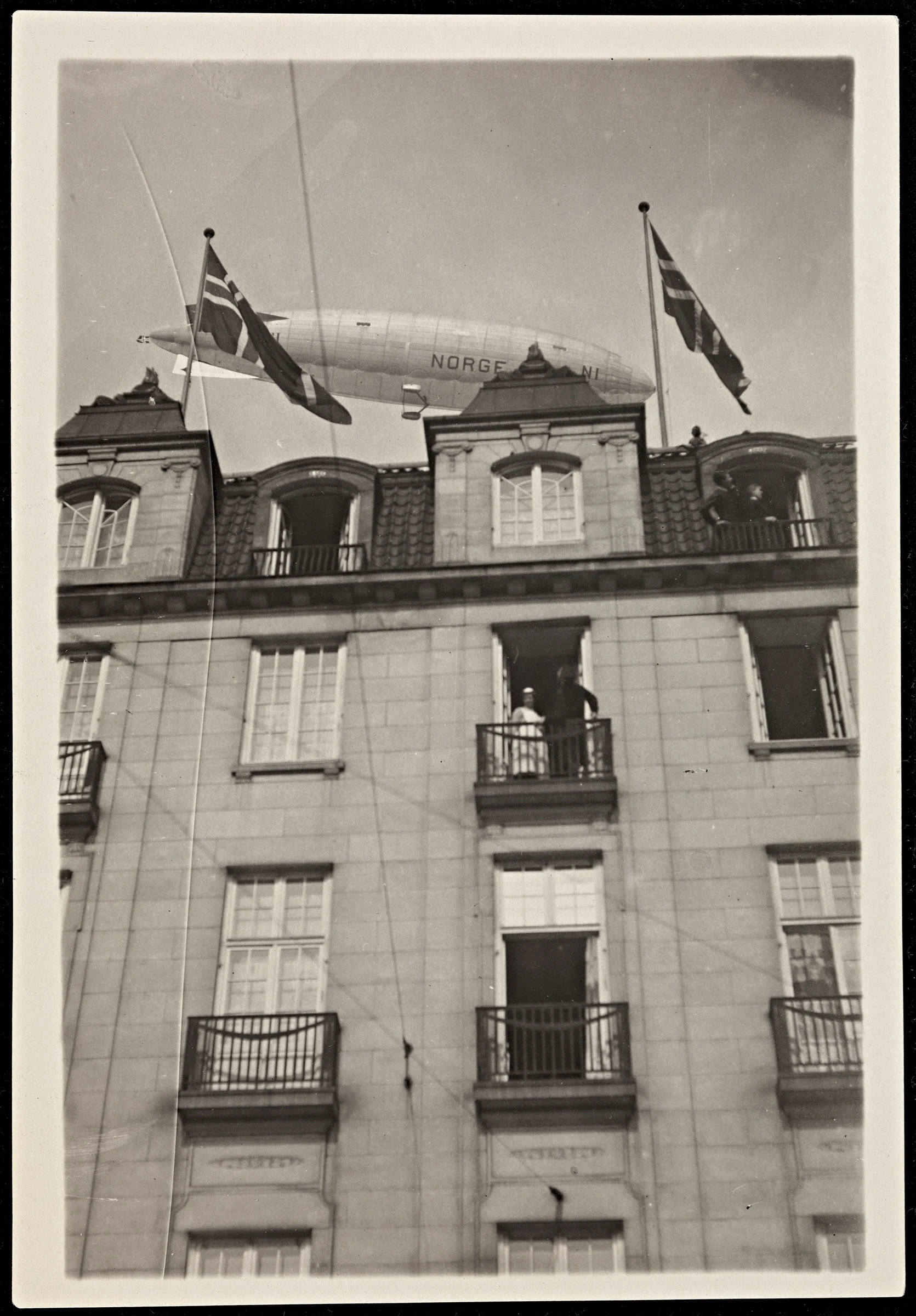
Over the roofs of Oslo between two flags. Nobile printed the same view in National Geographic in 1927. Photo: photographer unknown, National Library of Norway, CC BY 2.0 (creativecommons.org/licenses/by/2.0), via Wikimedia Commons. 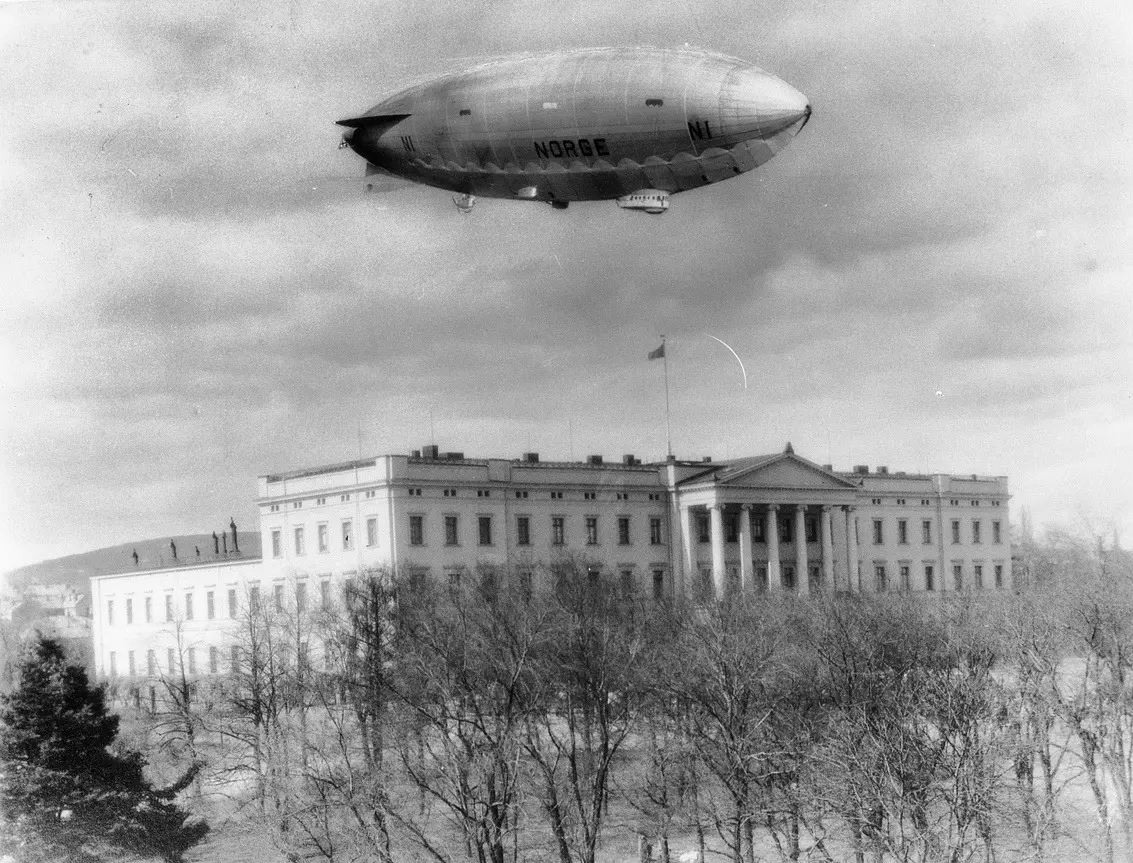
The ship over the Royal Palace in Oslo in April 1926. A flying visit, and the closest thing on this road to the rooftop pictures. Photo: Anders Beer Wilse, Oslo Museum, CC BY-SA 3.0 (creativecommons.org/licenses/by-sa/3.0), via Wikimedia Commons. 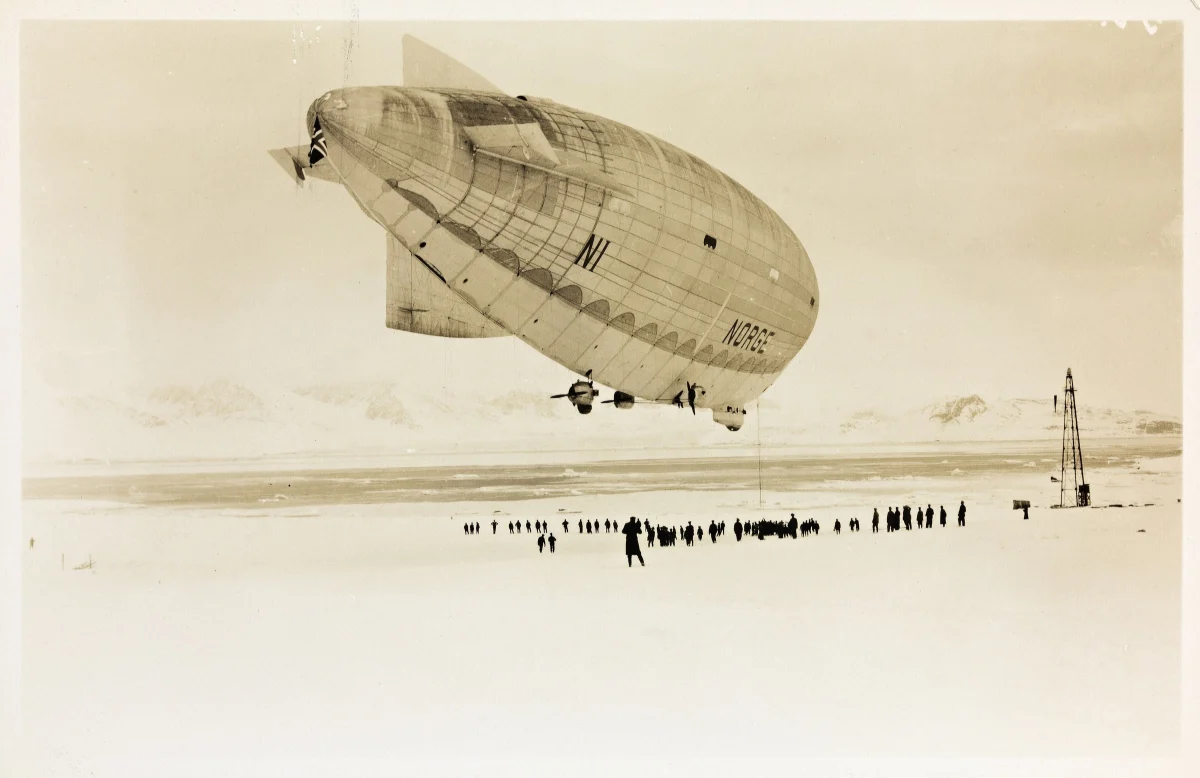
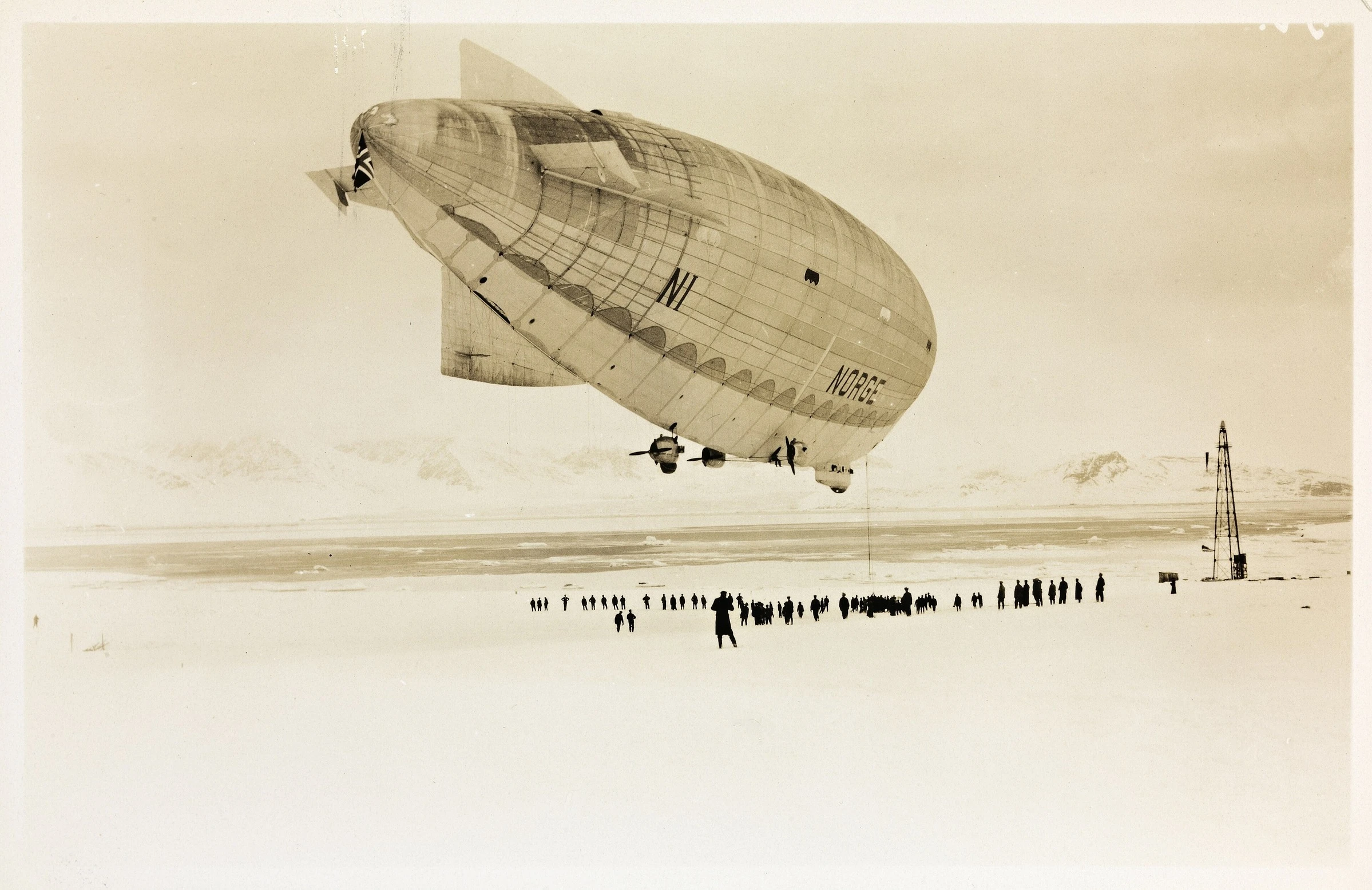
Ship, mast and handling party at Ny-Alesund in May 1926. The ship is in the air, the mast well off to the right. Photo: photographer unknown, National Library of Norway, CC BY 2.0 (creativecommons.org/licenses/by/2.0), via Wikimedia Commons. 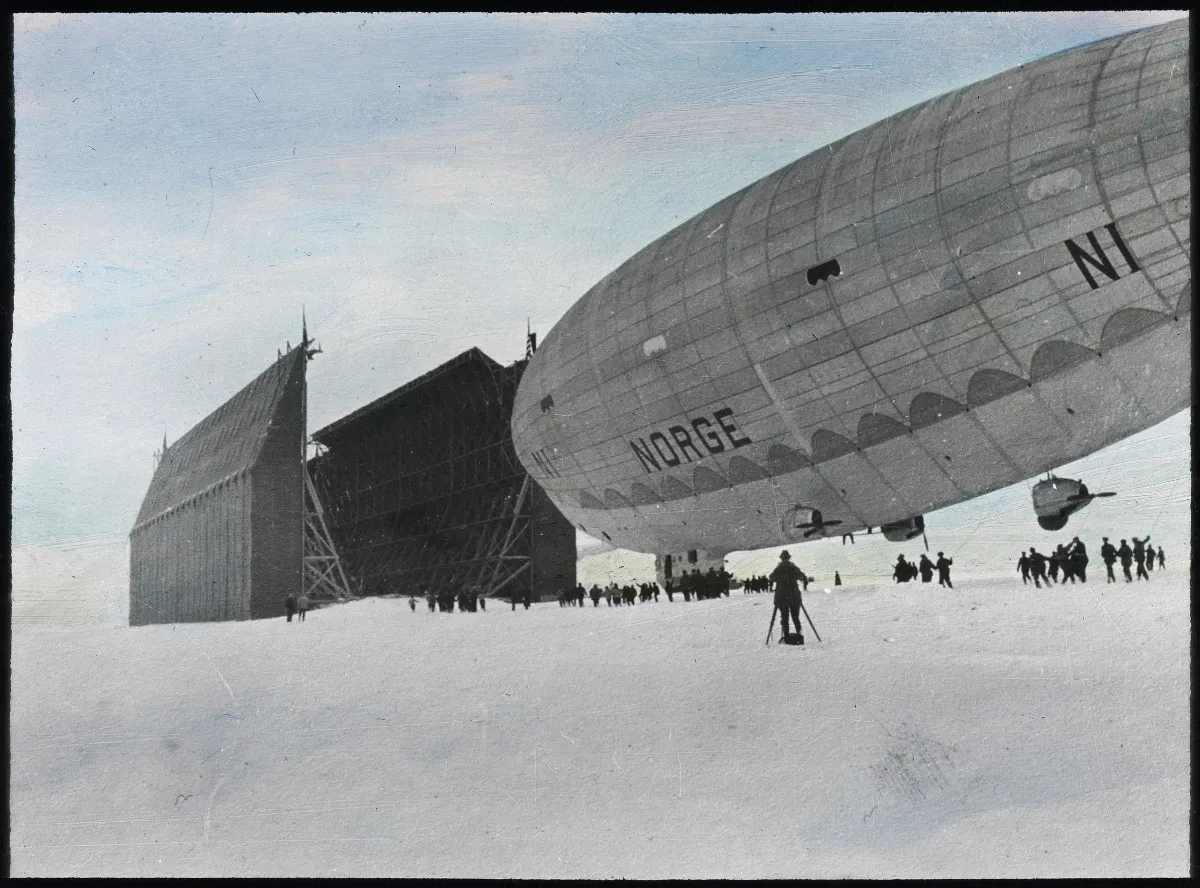
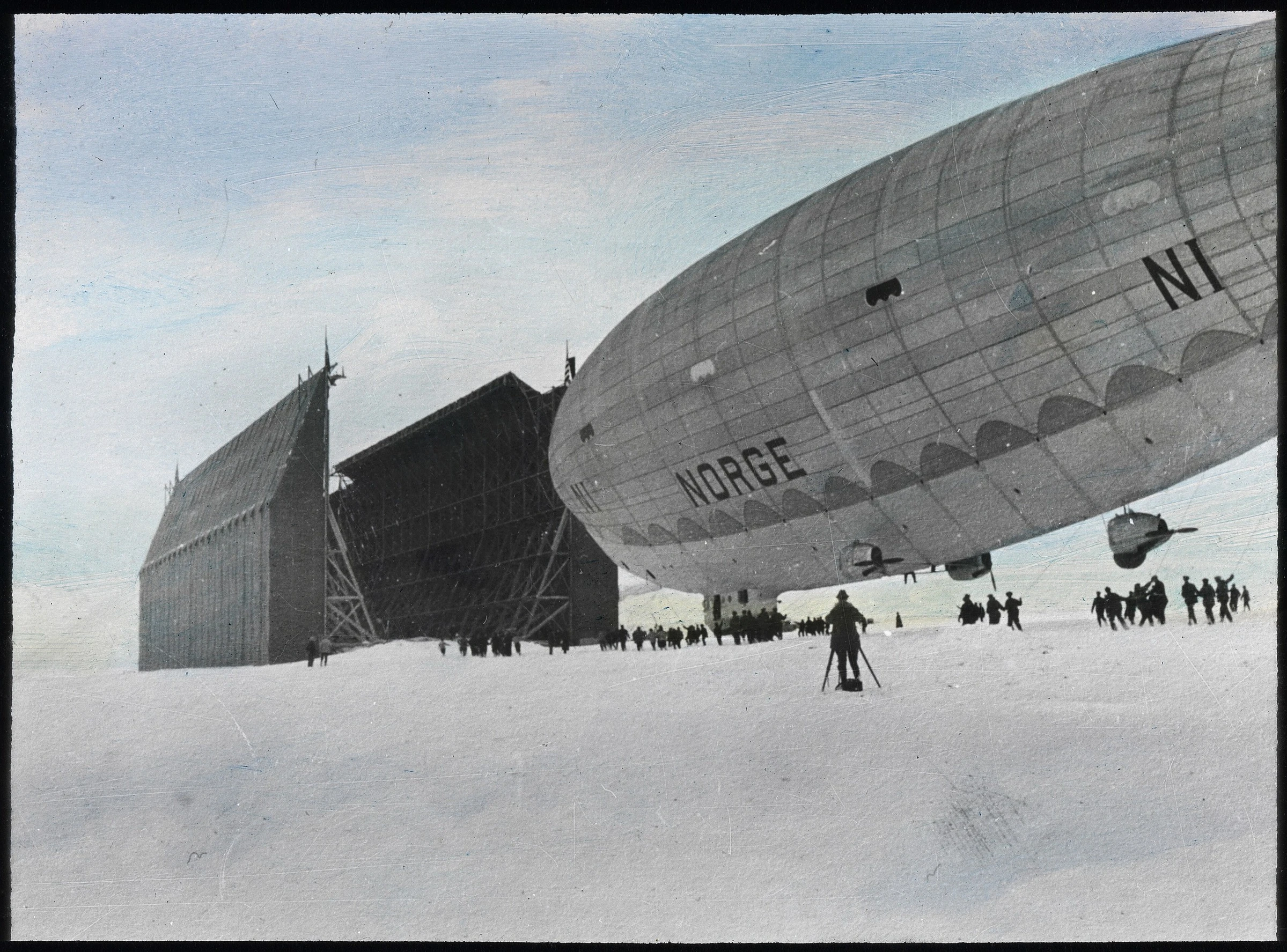
Hand-coloured glass slide: the ship being drawn towards the hall, 7 May 1926, a cameraman on the snow. Photo: photographer unknown, National Library of Norway, CC BY 2.0 (creativecommons.org/licenses/by/2.0), via Wikimedia Commons. 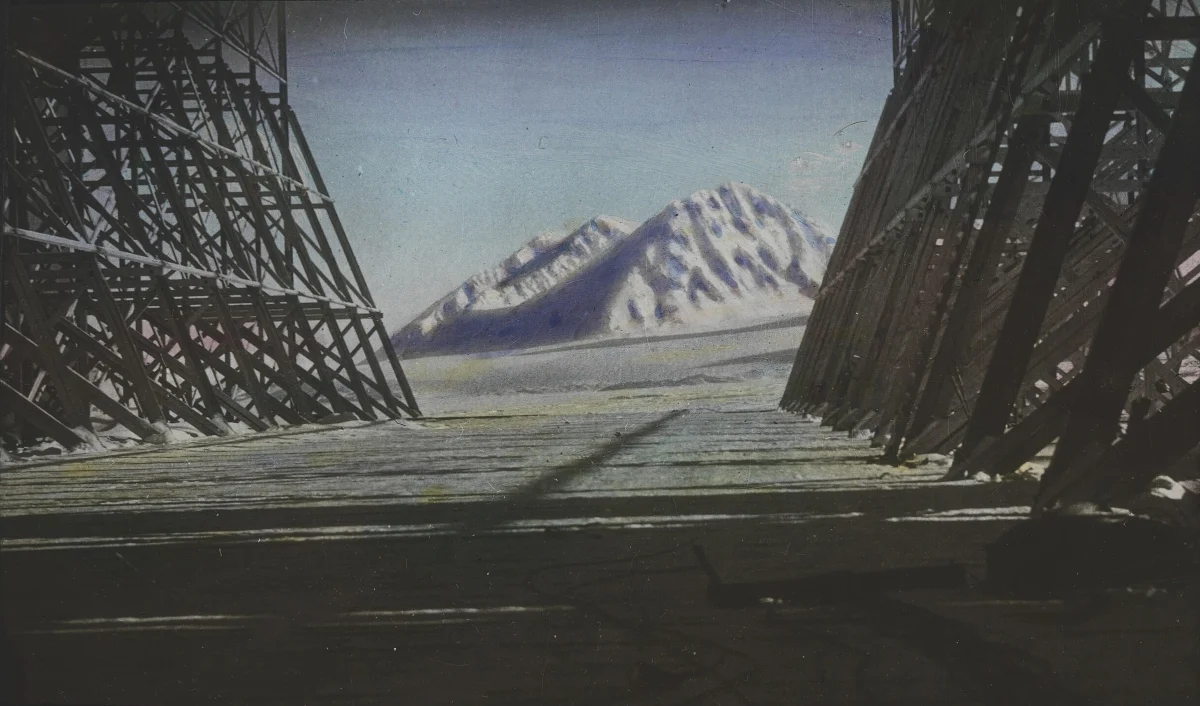
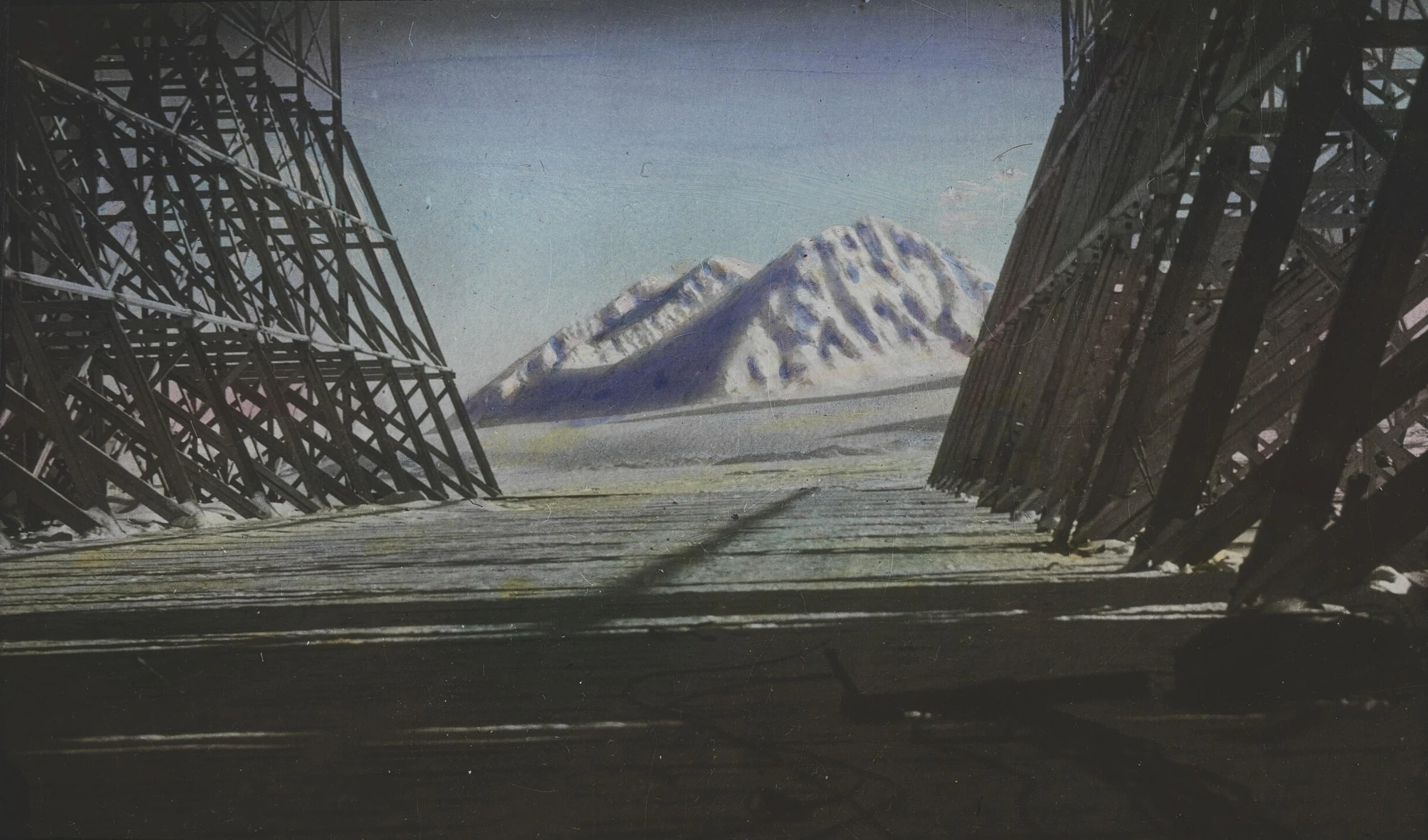
From inside the hall at Ny-Alesund, spring 1926: bare trestles and a white mountain through the open end. A tinted lantern slide. Lantern slide marked Worm-Petersen, Oslo, National Library of Norway, public domain, via Wikimedia Commons. Cropped to the picture. 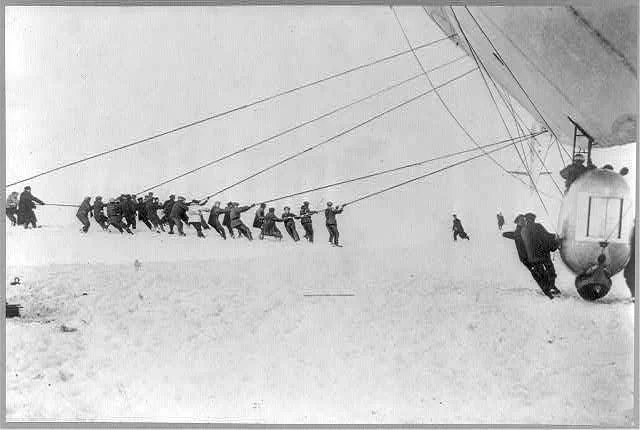
Crew hauling the ship out of the hall for the start, 11 May 1926. Men in a line on one rope were the mooring system on this morning. Library of Congress, Prints and Photographs Division, 2002721911, no known restrictions on publication. 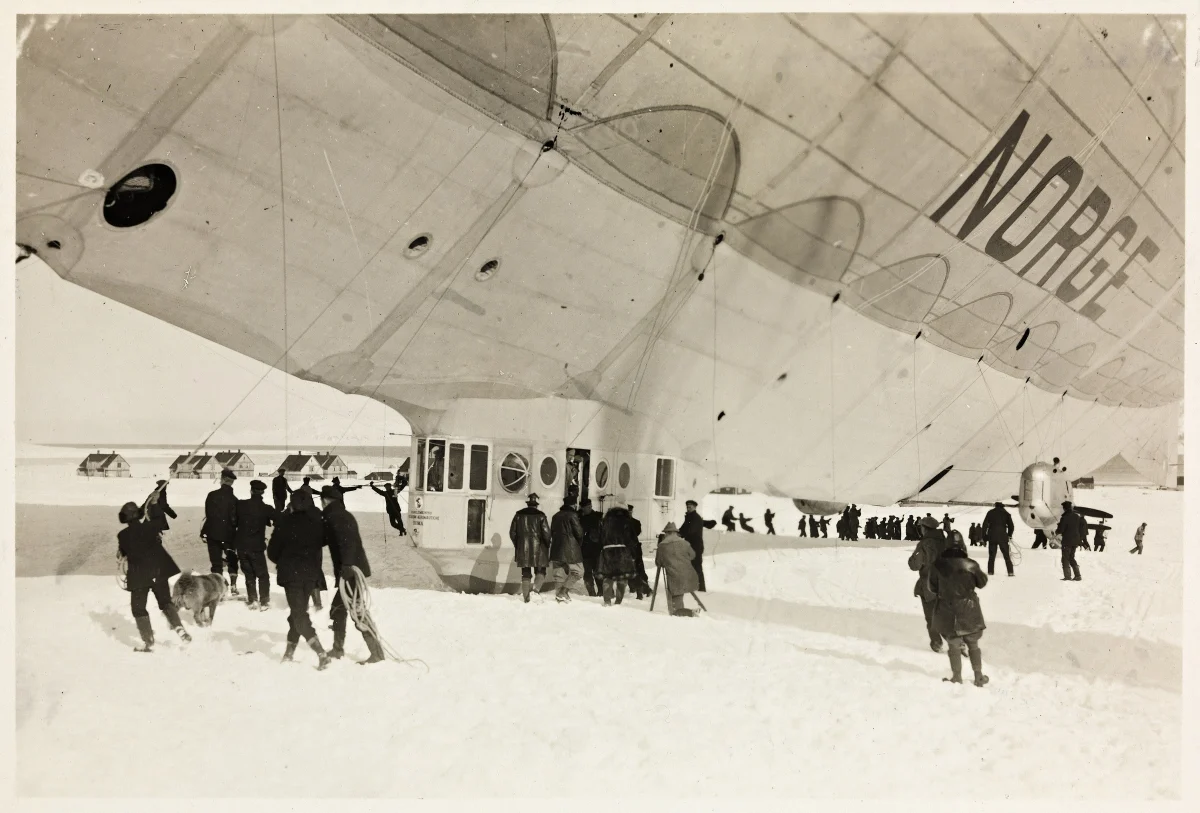
Just before the start from Ny-Alesund, 11 May 1926, the ship held at the ground by men in the snow. Photo: photographer unknown, National Library of Norway, CC BY 2.0 (creativecommons.org/licenses/by/2.0), via Wikimedia Commons. 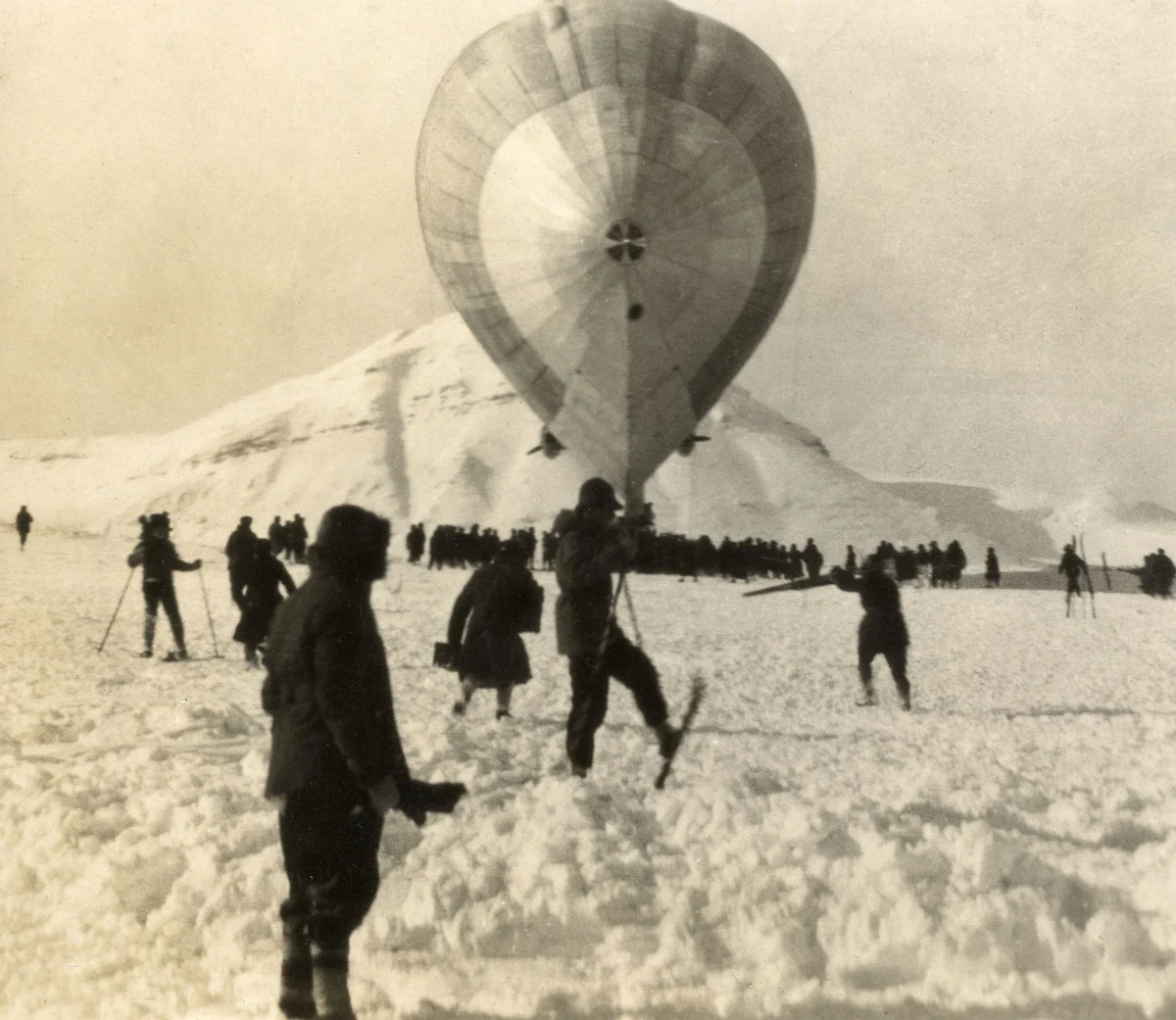
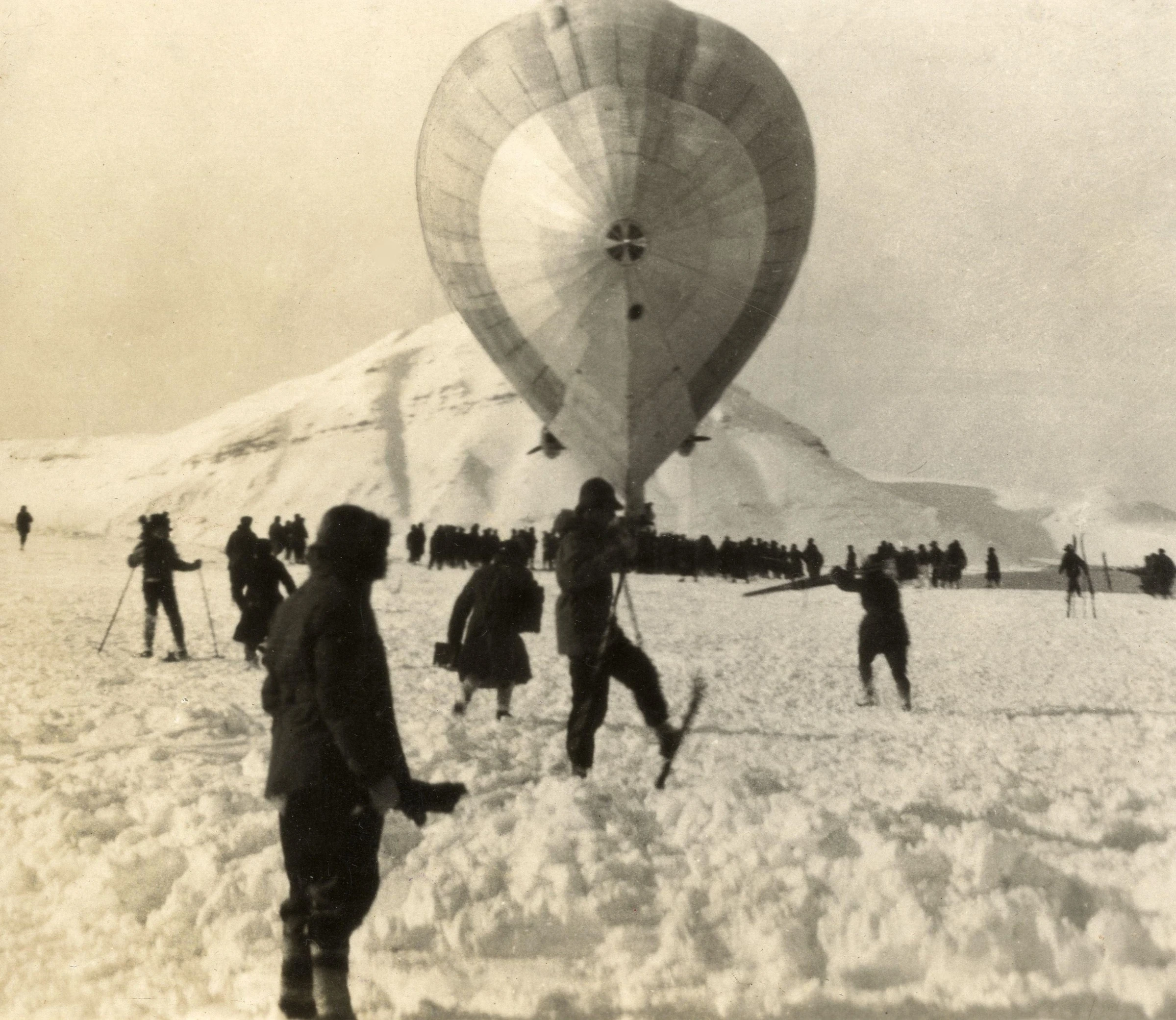
Two years later: Nobile's Italia at Kings Bay in 1928, seen tail-on over men on skis, before her last flight. Spaarnestad Photo, public domain, via Wikimedia Commons. 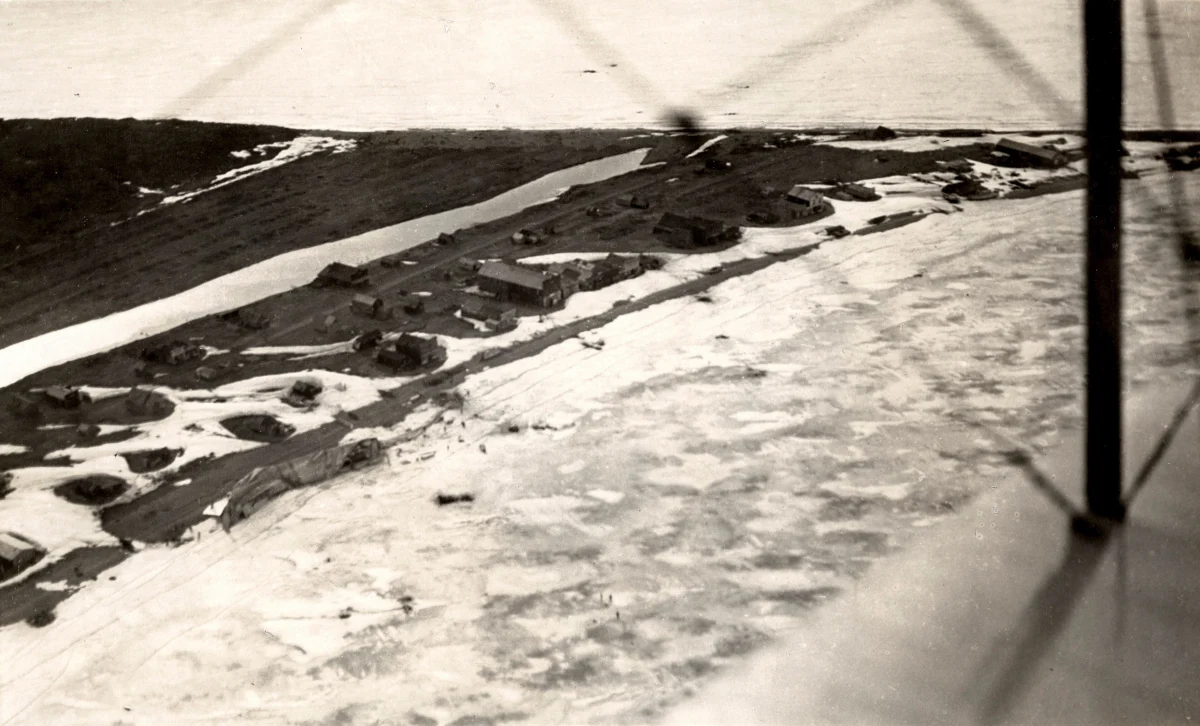
Teller from the ship as she prepared to land, per the Spaarnestad caption: a strip of shore, snow and a few houses. Spaarnestad Photo, public domain, via Wikimedia Commons. 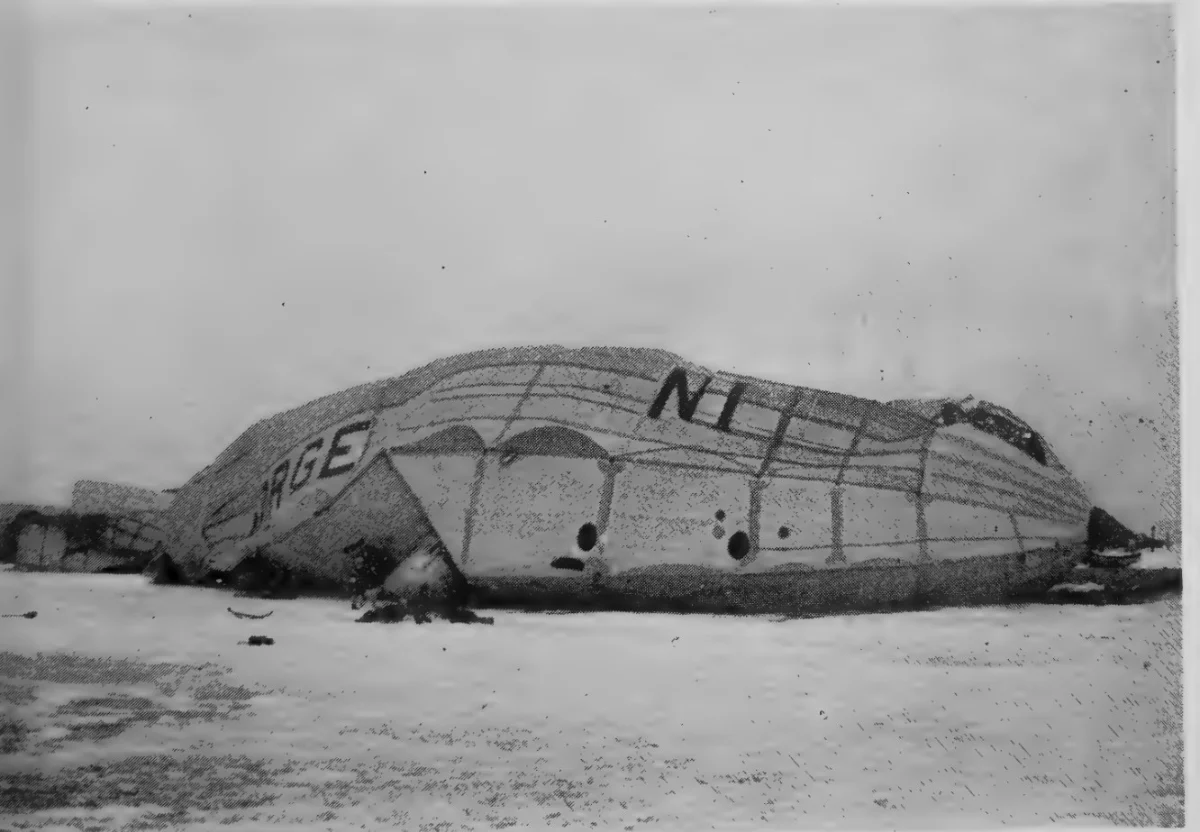
After the Flight, the book's plate says: the Norge deflating on the ice at Teller. Plate in Amundsen and Ellsworth, First Crossing of the Polar Sea, 1928, facing p. 240, published 1927, public domain in the US, scan via Internet Archive. Cropped. 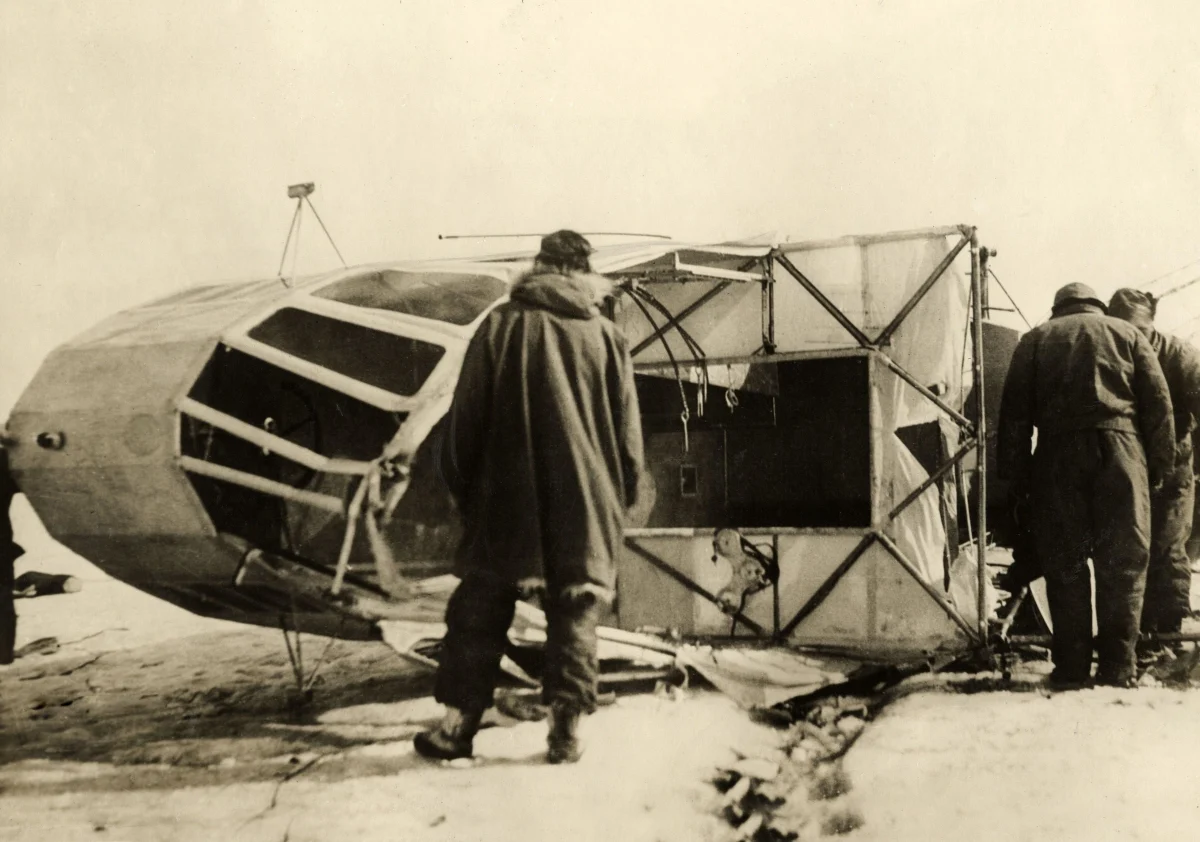
Men taking the Norge apart at Teller, 1926: the cabin's frame stripped of its covering. Spaarnestad Photo, public domain, via Wikimedia Commons.
Select a photograph to see it full size, with its caption and credit.
Sources
- Roald Amundsen and Lincoln Ellsworth, First Crossing of the Polar Sea, 1928 printing, copyright 1927 Doubleday, Doran; scan via Internet Archive; public domain in the US Primary record
- Umberto Nobile, Navigating the Norge from Rome to the North Pole and Beyond, National Geographic Magazine, August 1927, pp. 177-215 National Geographic Society; scan via Internet Archive; public domain in the US Primary record
- Roald Amundsen, My Life as an Explorer, 1927 Doubleday, Page; scan via Internet Archive; public domain in the US Primary record
- Amundsen and Ellsworth, D'Europe en Amerique par le pole nord, tr. Charles Rabot, 1927 Project Gutenberg Primary record
- How Do You Board an Airship?, 8 January 2023 Tartaria Britannica Study
- 100 year anniversary for the airship Norge crossing the North Pole, 2026 Kings Bay AS Study
- The Norge Flight 1926 Fram Museum Study
- Airship Norway Norsk Teknisk Museum Study
- The airship mast in Vadso is being preserved, 6 May 2026 High North News Study
- R33-class airship, citing Flight, 23 April 1925 Wikipedia General reference
- The English airship R33 with its nose damaged after breaking from its mast, 1925 Spaarnestad Photo via Wikimedia Commons Primary record
- Airship Italia Wikipedia General reference
- Anne DiFabio, Doomed Dirigible Dock, 2011 Museum of the City of New York blog Study
- Tartaria's Airships and the Zeppelin Over the Leipzig Monument Official X Study
- The semi-rigid blimp Enna Jettick, just before it made fast for a moment to the Empire State Building mooring mast, 1931 Library of Congress, New York World-Telegram and Sun collection Primary record
- Bill Kemp, Airship pays visit to downtown Bloomington in 1910 McLean County Museum of History Study
- P.P. Alfei, Norwegian support to the airship Italia polar expedition, Polar Research 44, 2025 Norwegian Polar Institute Study
- Dirigible Norge and Umberto Nobile Collection, guide Anchorage Museum Study
- Mast Technical Information Airship Heritage Trust Study