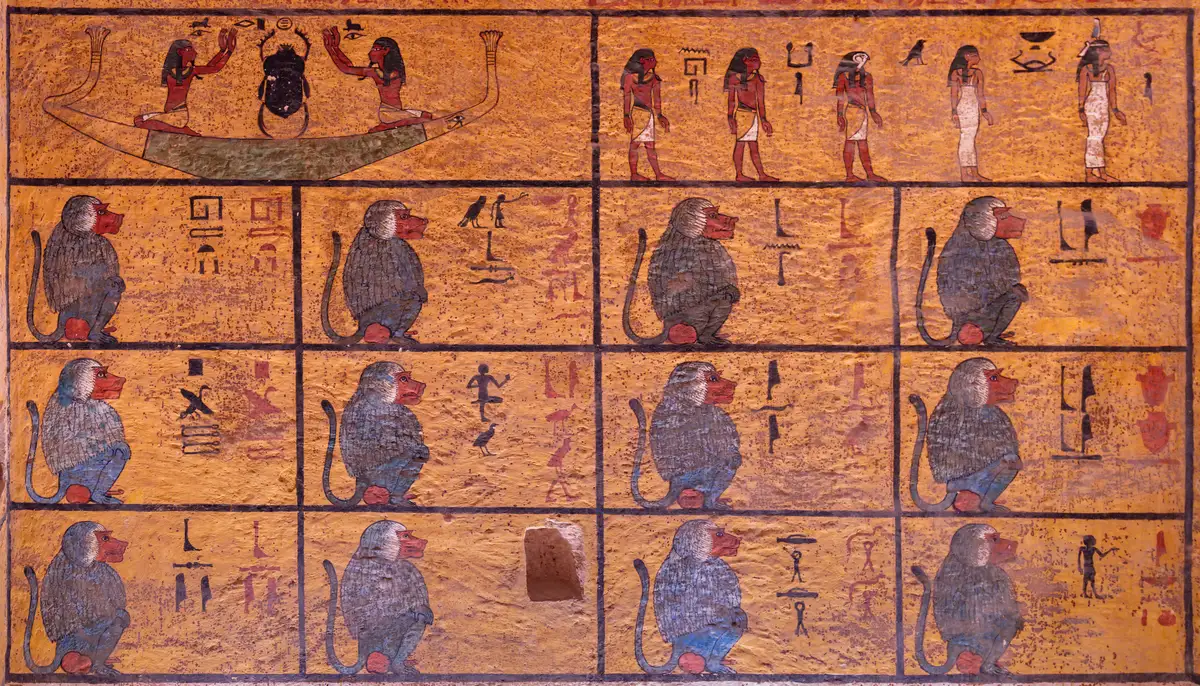
Start at the right-hand end of the wall. A man in a leopard skin holds a tool to the face of a mummy: Ay, the king who came after Tutankhamun, performing the Opening of the Mouth. In the middle, the sky goddess Nut greets the dead king. At the left, Osiris takes him in his arms, with the king's ka behind him. Now look past the figures, at the plaster they are painted on. In 2015 the Egyptologist Nicholas Reeves studied a high-resolution scan of that surface and saw straight lines running under the paint.
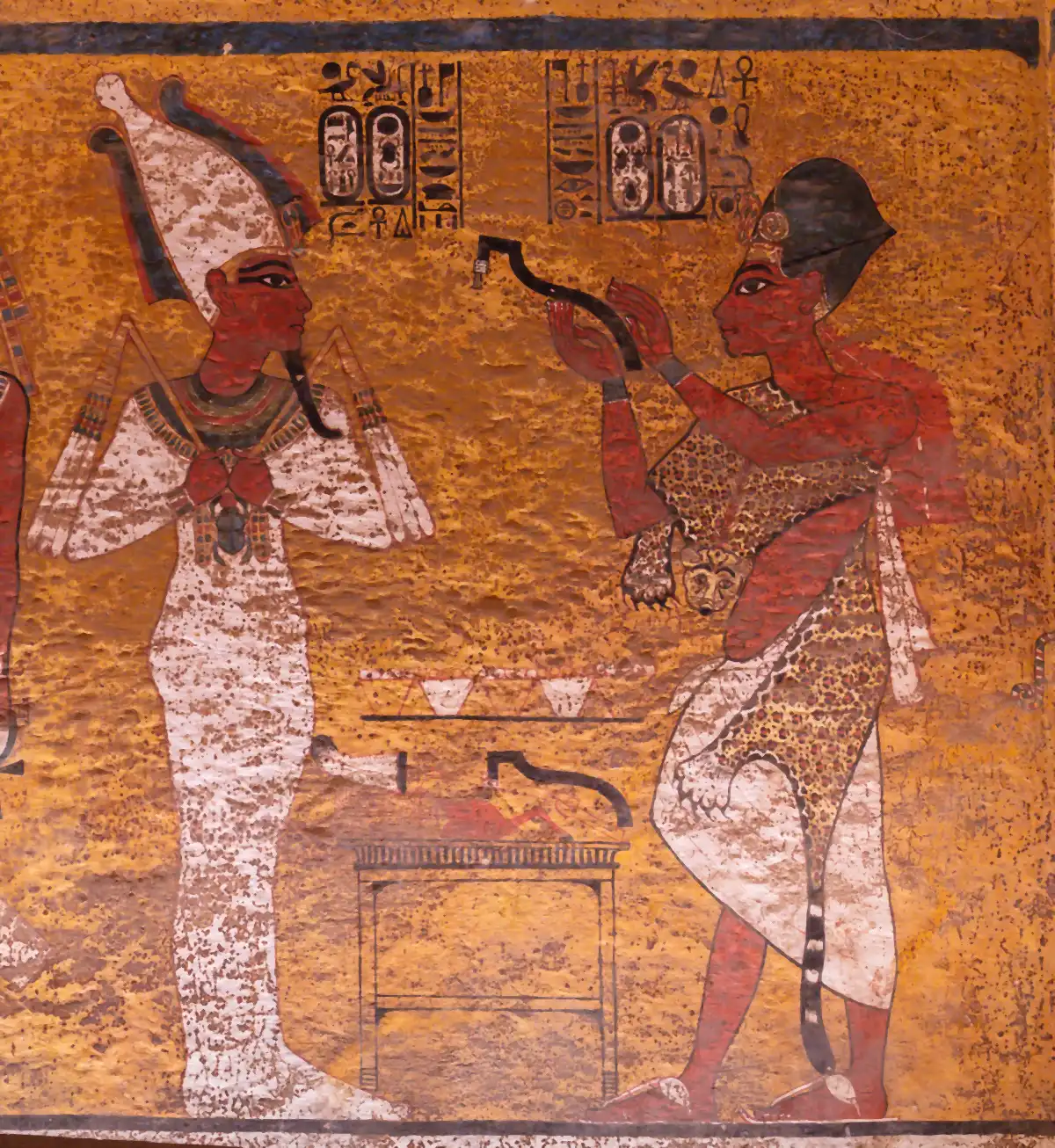
Then set two drawings side by side. One is Howard Carter's sketch-plan of 1923: sixteen steps, a passage, four small rooms. The other is Figure 59 of a report published in 2026, which draws chambers and corridors in the rock beyond the painted wall, the two its authors trust most in yellow and the rest in magenta. Carter drew the tomb he could walk through. The second plan is what radar and a gravity survey suggest to the people who made it. Which one would you want tested first?
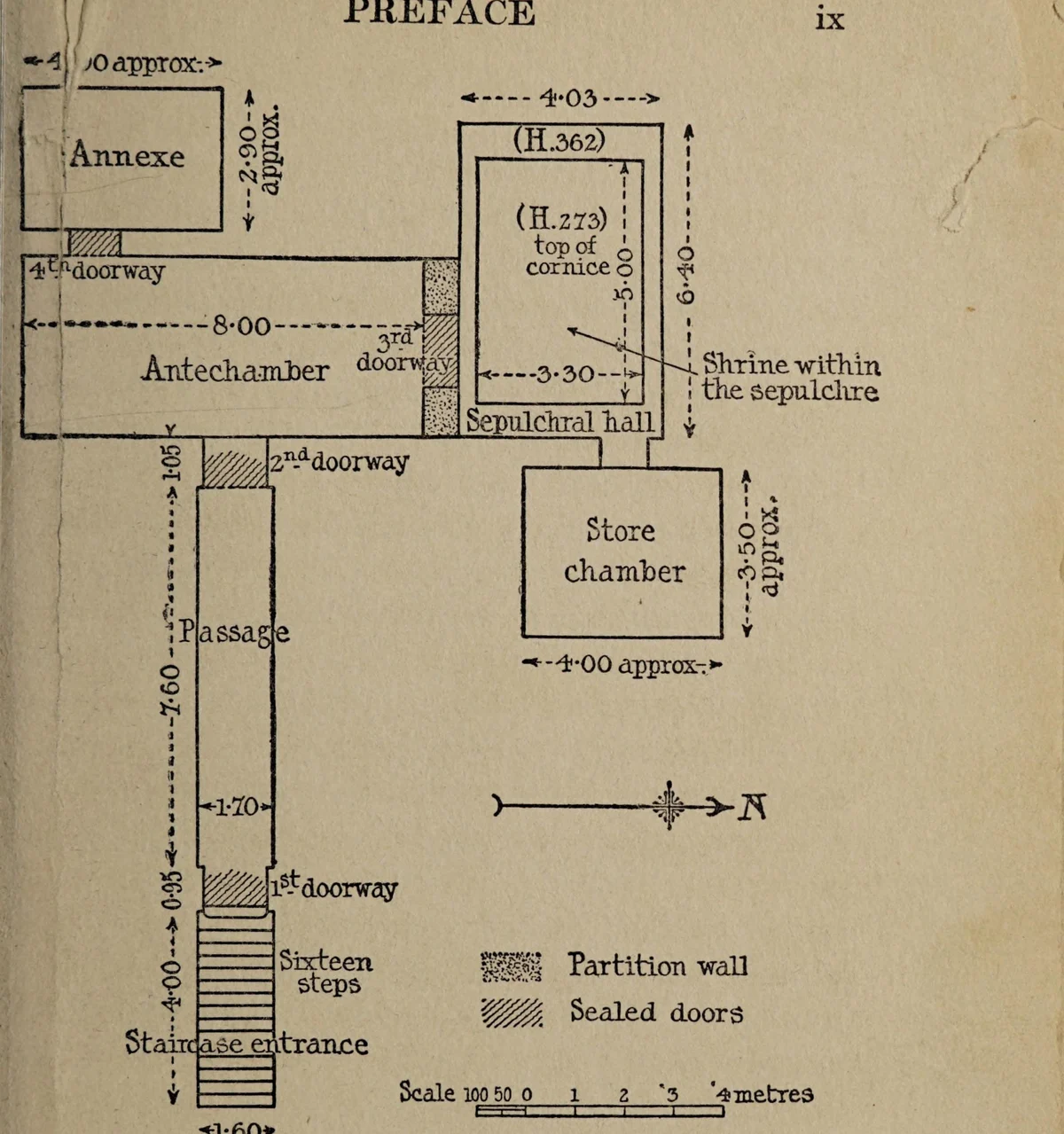
What is behind the painted north wall of Tutankhamun's burial chamber? The room lies in KV 62, the tomb Carter opened in the Valley of the Kings, across the Nile from Luxor, in November 1922. Of its four rooms, it is the only one with paintings on its walls.
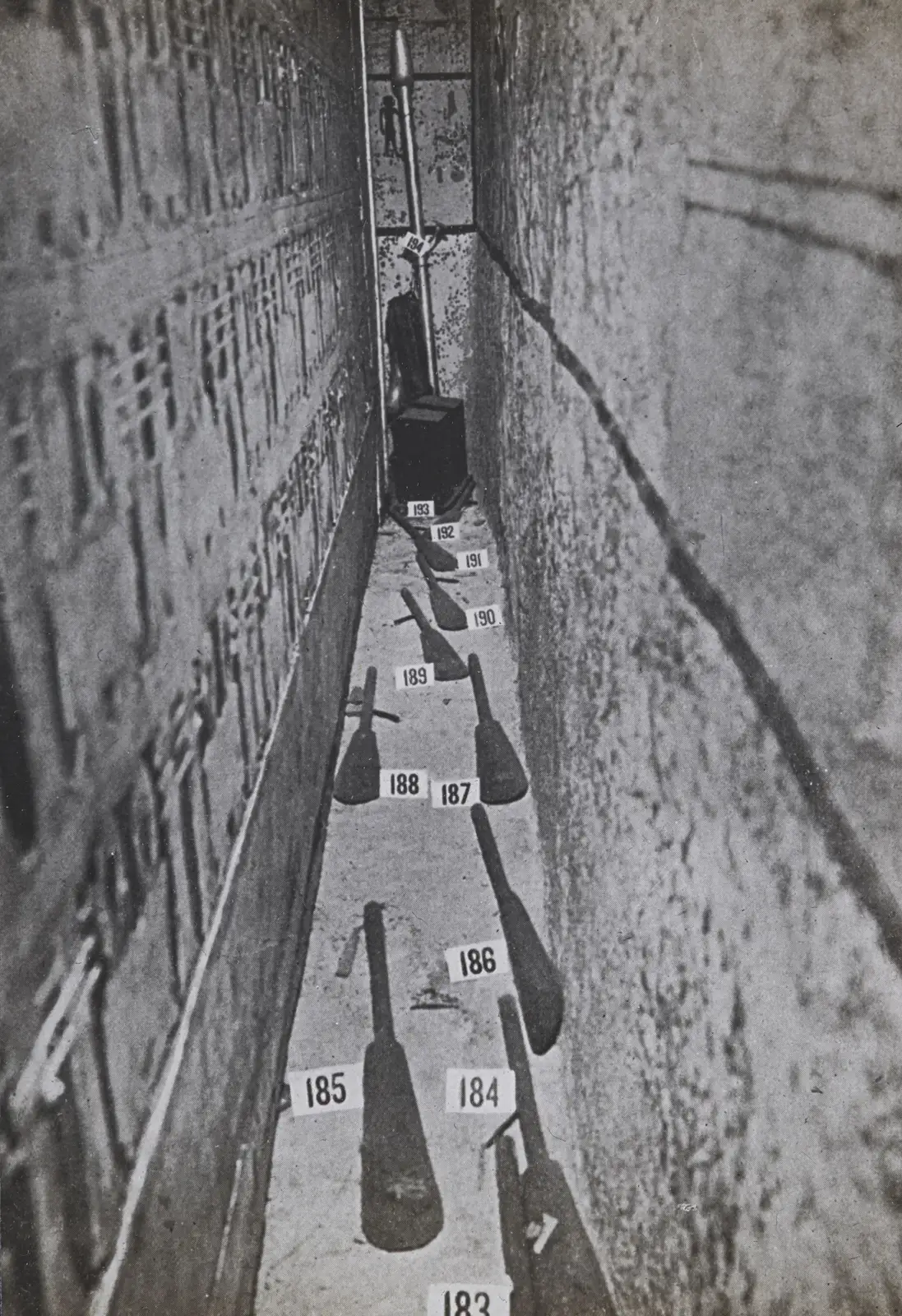
It is small. When Carter's team reached it, the outermost gilded shrine filled it so nearly that only a narrow gangway was left between the gold and the paint, and the king's ritual oars lay on the floor of that gap.
Four rooms. One painted chamber. And, on one reading, a door.
A small tomb, and a puzzled excavator
Carter saw the oddity before he saw the gold. Standing at a sealed doorway at the foot of the steps in November 1922, he later wrote, "One thing puzzled me, and that was the smallness of the opening in comparison with the ordinary Valley tombs." Could it be the tomb of a noble, he asked, or a cache? "Or was it actually the tomb of the king for whom I had spent so many years in search?"
It was the king's. It was also, in the Getty Conservation Institute's words, "one of the smallest of the royal tombs in the Valley of the Kings." A stair and a passage lead down to an antechamber, with an annexe off it; Carter found the passage "filled completely from floor to ceiling with stones and rubble". A plastered wall, stamped with seals and guarded by two statues of the king, closed the burial chamber, and a store room, now called the Treasury, opens from the chamber's east side. Carter's team took that plastered wall down.
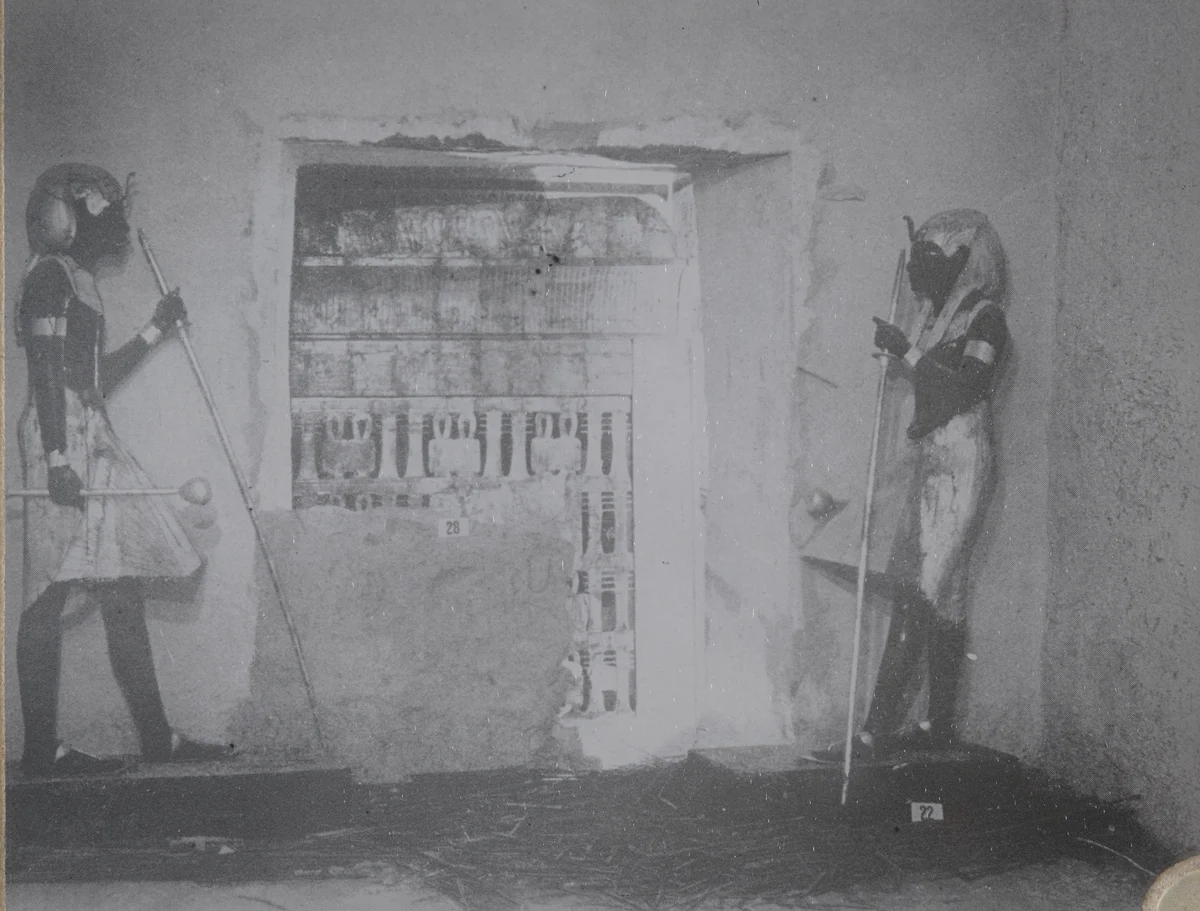
In 2009 the chamber was recorded again, this time without a trowel. The Madrid workshop Factum Arte scanned its four walls in three dimensions and in colour, and the scans went online.
Nicholas Reeves, director of the Amarna Royal Tombs Project and once of the British Museum, read them closely. In a paper of July 2015, The Burial of Nefertiti?, he reported linear traces under the paint, "tentatively identified as the 'ghosts' of two hitherto unrecognized doorways": one in the west wall, to a store room, and one in the north wall, a "pre-Tutankhamun continuation of KV 62 towards the north."
Egypt took it seriously. In November 2015 the Japanese radar specialist Hirokatsu Watanabe scanned the chamber, the kind of survey since run under Khafre's pyramid at Giza, and on 28 November the antiquities minister, Mamdouh Eldamaty, told a press conference in Luxor that the chance of a hidden chamber was 90 percent.
Ninety percent. Behind a wall that had been photographed for ninety years.
A queen's tomb, on Reeves's reading
Reeves's case begins with the shape of the tomb. Kings' tombs of the period turn right on the way down; KV 62 turns left, like WA D, begun for Hatshepsut as queen. Two store rooms where four was usual; no well. Which means, on his reading, a queen's tomb with a king in its front rooms.
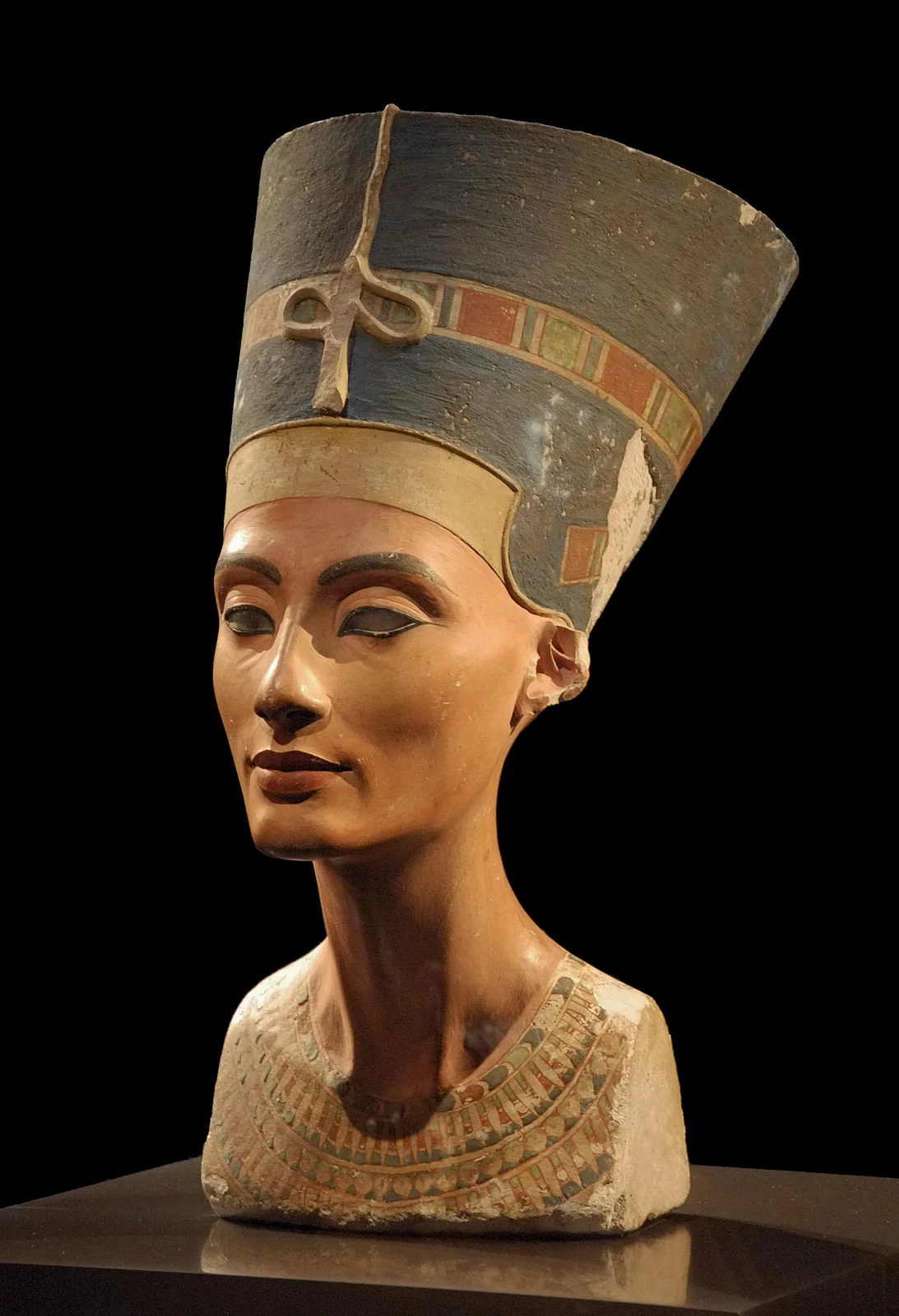
In Reeves's account of the Getty's study of the plaster, the north wall was painted first, on a white ground; the other walls were yellow from the start. He finds the north wall laid out on the 20-square grid of the Amarna years, the others on the later 18-square grid. Egyptologists read a scene by its names, as with the Dendera crypt reliefs, and under Ay's cartouches Reeves reads traces of Tutankhamun's own names. So the scene first showed, on that reading, Tutankhamun burying a woman who had ruled as king: Nefertiti, Akhenaten's queen. Of his outline overlays of two painted faces, on the Berlin bust of Nefertiti and on a portrait of Tutankhamun, he writes: "In each case, the match is identical."
One line under the paint lines up with the antechamber's west wall and with a chiselled line on the ceiling: an old corridor, Reeves reads, running on through the north wall, whose central part has a gritty finish like the blockings Carter took down.
In photographs of 1931-32 and 1936 Reeves finds repainting at the left end of the north wall, over a probe Carter made in 1932; Carter found bedrock there. The right-hand end, where a queen's corridor would run, was "never fully tested".
Twenty-five metres of rock
In 2023 and 2024 George Ballard of the Cambridge firm GBG and Abbas Mohamed Abbas of Egypt's geophysics institute, NRIAG, went back, under Eldamaty, with Reeves; they reported in 2026.
Ballard starts from what the earlier radar was built to find. Corridors of this period were "regularly filled from floor to ceiling with rock dust and scree/excavation spoil", as this tomb's own first passage was. On Ballard's argument, radar tuned for an empty room would not show such fill as a void.
The new radar, read that way, shows "the potential for access passageways through both the north and ... west walls". From the Treasury's west wall, as Ballard reads it, it shows natural rock 450 mm thick, then something "neither limestone nor concrete, and therefore probably fill", for 1.7 to 1.9 metres.
On the hill they measured gravity, which reads low where the ground is lighter than limestone: a cut room, loose fill, or a natural cavity. Two lows, S7 and S10, show as spaces "square to rectangular in shape", "probably c. 1.5m lower than" the tomb, with a higher reading inside S7. If S7 is a chamber, the authors write, the likeliest explanation is material "such as those one might encounter, in fact, in a wellstocked, undisturbed funerary chamber."
Their summary, drawn as Figure 59: a corridor from the east end of the north wall to "a funerary complex of generally recognisable type extending some 25-30m to the north of KV 62", where "five or six chambers are likely to exist."
If the wall is a door
Set aside for a moment whether it is true. Ask the better question. What kind of history are we living in if it is?
It would mean the most famous tomb in the world is a porch. Tutankhamun, dead young, would have been laid in the front rooms of someone else's house, his painters working over her scene, and the king's whole golden burial would turn out to be the smaller of the two in the hill.
It would mean the end of the Amarna story is lying in the dark, sealed and in order. The Encyclopaedia Britannica's answer to how Nefertiti died ends: "Her body has never been found." On Reeves's reading, the queen at the centre of those years was buried as a king, and her burial has been within a few metres of Carter's lamps the whole time.
It would mean we get to see a royal burial as it was left. Not reconstructed from a dig diary. Left. Every object where the last hand put it, more than three thousand years ago. Eldamaty's conclusion says plainly that a confirmed extension would be "the most important discovery in the Valley of the Kings since the uncovering of Tutankhamun's tomb in 1922."
And it would leave one choice in front of us, the one the team has already asked for: a hole no wider than a coffee cup, drilled down from the hillside, and a camera lowered into the dark. What would we owe to a burial nobody has seen, before we let a lens into it?
Bedrock, on the standard account
The standard account: a small tomb finished in haste after Tutankhamun's early death, its paintings on plaster over solid rock. Four amulet niches cut through the decoration show solid limestone, as Reeves himself notes. The Egyptologist Zahi Hawass said in September 2026: "It is more probable that KV62 was originally a small tomb intended for Ay".
Of three radar runs inside before 2023, only Watanabe's was read as showing voids. In 2016 National Geographic's 400 and 900 MHz antennas found no large voids. In February 2018 a Polytechnic University of Turin team led by Francesco Porcelli used three radar systems from 150 to 3,000 MHz. At the lower frequencies, to an estimated 3 to 4 metres, the rock gave "a homogenous response not supporting the presence of voids (i.e. empty chambers) or masonry structures concealing blocked doors". Their radar did pick out a known ancient repair patch on the north wall; "similar or stronger effects distributed over larger areas would have been expected if an artificial blocking made by splinter of limestone was present. However, this type of effects was not visible in the data." Their conclusion: "no hidden chambers immediately adjacent to the Tomb of Tutankhamun".
The gravity model has not been repeated: "The microgravity has no corroborative data from other researchers," the report says, "but is precisely geolocated and appears well supported by the various ERT surveys of the Polytechnic University of Turin". Its authors match earlier surveys only to "+/-1-2 metres", head the section with Figure 59 "Speculative model", and call its corridors "highly speculative". In 2021, before the new data, David Ian Lightbody concluded in the Journal of Ancient Egyptian Architecture that the evidence "stands overwhelmingly against the hypothesis."
What the radar was looking for
The first negative was framed around empty space. "Since no large voids were detected," the National Geographic team wrote, "no proposed chamber walls could be measured." But "Reeves has at no point suggested the existence of any voided chamber immediately behind that north wall," the 2026 report says, "but rather filled corridor space." And when Ballard reprocessed the National Geographic data himself, he read in it the same packed fill behind the Treasury wall.
The Turin team did look for blocking, and reported none. Its full radar data has never been released, Ballard writes, so others can study only "relatively low-resolution graphical outputs". The new team offers its own 2023-24 data for independent analysis.
The new survey agrees with Turin on the near zone, and says exactly what it agrees with: "no discernible evidence of voided chambers or other structures in the near vicinity (within 2m) of the Burial Chamber, thus confirming the outcome of the previous, historical investigations but not necessarily the conclusions."
The Turin group also found something outside. In 2017 its electrical resistivity survey picked up two anomalies a few metres from KV 62, one about 12 metres from the north wall and higher than the tomb's ceiling. Its paper treats them conditionally: "If these anomalies are of anthropic origin". The 2026 report places one of its own features, S2, "not well resolved", beside another Turin anomaly about 30 metres north of the tomb.
What the counter does not reach is the east end of the north wall: the part Carter did not probe, and which the 2018 and 2023-24 radars read from several centimetres off the paint, because the painting cannot be touched.
Nobody has seen a chamber. Nobody has opened the east end of the wall either.
A hole the size of a coffee cup
On 17 September 2026 the journal Nature reported the new results, and Ballard told it that work could begin as early as November if the Supreme Council of Antiquities agreed. The plan, as the team has described it, does not touch the paint. It is a set of holes about seven to eight centimetres wide, drilled from the surface of the hill toward one of the strongest low readings north of the burial chamber, through about 20 metres of limestone by the Telegraph's account, with a camera to go down them.
Official X found no announcement of a decision by Egypt's antiquities authorities in the Egyptian or international press up to 8 November 2026. The request, as far as the record shows, is waiting.
A camera at the bottom of one of those holes would settle the narrow question. It would see solid rock, or rubble, or the cut wall of a room. If there is a room, it might see what is on its floor. It could not, on its own, put a name to any of it. That would take writing found in place: a name on a coffin, a sealing, a label, with enough around it to say whose burial it is.
Which leaves one square on a gravity map. A low reading the authors model as a space about a metre and a half below the level of Tutankhamun's tomb, square to rectangular in shape, with a denser reading at its centre. The authors themselves allow that it may be "simply a fortuitous collapse feature."
Or it may be a room that has been waiting for a light since the day the wall went up.
Questions This Leaves You With
Is there anything a person can actually do with this?
Nothing in it changes your week, and no date is attached to it: the decision sits with Egypt's antiquities authorities, on their timetable. What you can do is look for yourself. Factum Arte's high-resolution recording of the north wall is online, and Reeves's papers are free to read. The lines he describes are there to be found or not found on your own screen. The larger question is not yours alone: how much a living country should open of its own past, and how fast.
Does this sit against a religious account of the world?
It cuts both ways. The painted wall is itself a religious scene: a rite for the dead king, and two gods receiving him. Some readers see in a sealed, undisturbed burial a faith kept exactly as its makers meant it, and ask whether a camera breaks that. Others see in the same scene a record people made to be read. This site will not tell you which way it falls for you.
Does it change how you see a life?
Put a life against the wall. Tutankhamun died young, and his painters, on Reeves's reading, worked his figure into a scene made for someone else. Read one way, that makes a life small: even a king can be fitted into another's story. Read the other way, it makes a life rare: some lives are remembered precisely because they sit in front of a door. Which one did you feel when you read what it would mean?
What would change your mind, in either direction?
Name it now, before the camera goes down. Toward a door: the raw radar data from 2018 released and read as a blocking by a third team; a second gravity survey, by an independent team, finding S7 and S10 in the same places; the camera showing cut walls. Toward bedrock: the camera hitting solid limestone at the first strong low reading; a fresh radar pass at the east end of the wall showing rock all the way through.
What is the heavy reading inside S7?
That is the gap. The 2026 map shows a low reading, with a higher one sitting symmetrically inside it. The authors give two answers and keep both: dense material in a chamber, or a collapse in the rock that happens to look like one. No second team has measured it, and no published reading can tell those two apart. One hole and one camera could. Until then the square on the map is empty in the plainest sense: nobody knows what fills it.
More photographs
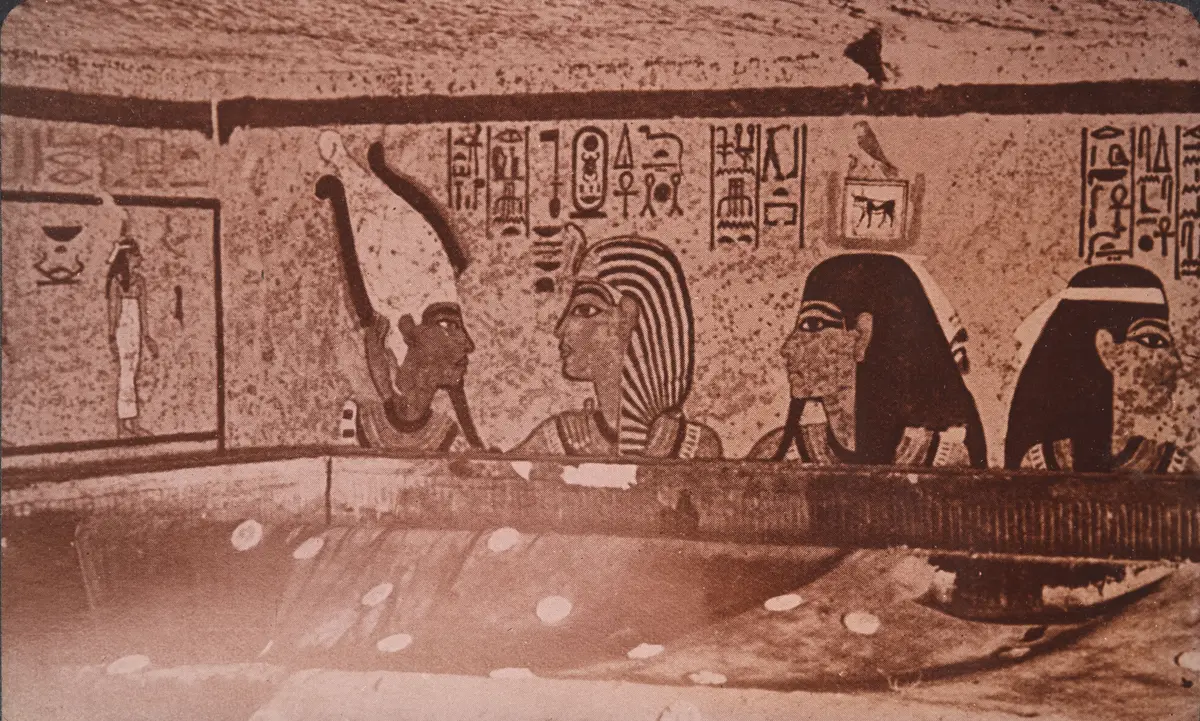
The north wall in a photograph of the 1920s attributed to Harry Burton: the king before Nut, and the king with his ka before Osiris. Photograph attributed to Harry Burton, 1920s. Glass slide GDE002163, KU Leuven (Glass slides in the Leuven University Libraries). Public domain, via Wikimedia Commons. Resized. 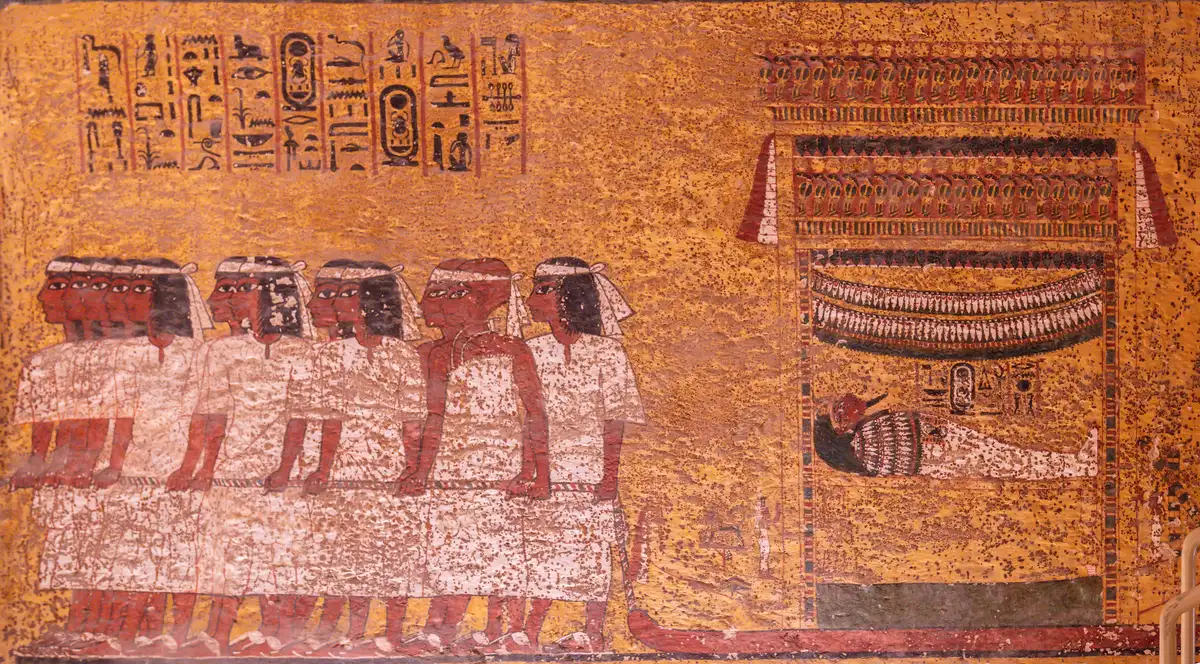
The east wall of the burial chamber: the king's mummy under a canopy on a sledge, drawn by men in white. Photo: Diego Delso, delso.photo, CC BY-SA 4.0 (creativecommons.org/licenses/by-sa/4.0), via Wikimedia Commons. Resized. 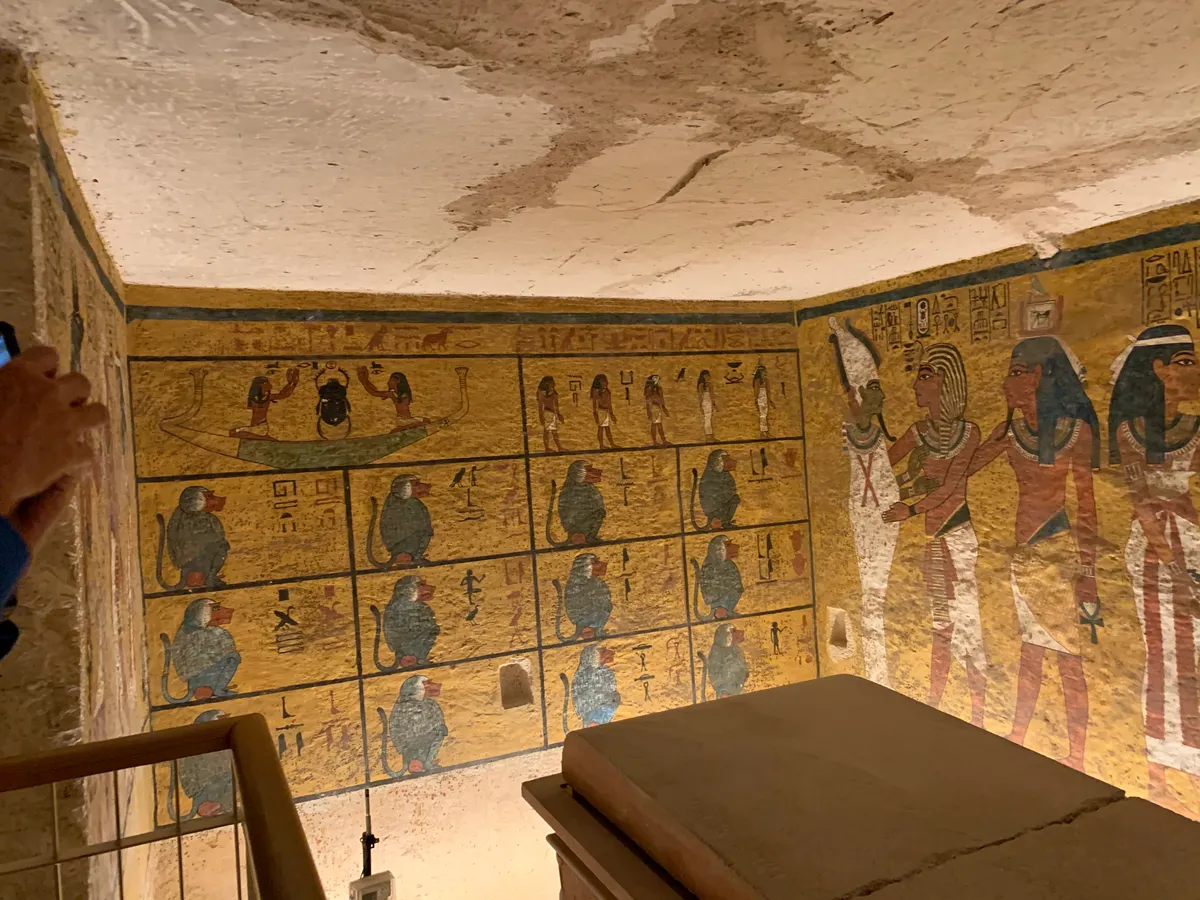
The burial chamber today, with the stone sarcophagus below the painted walls. Photo: Romagy, CC BY-SA 4.0 (creativecommons.org/licenses/by-sa/4.0), via Wikimedia Commons. Resized. 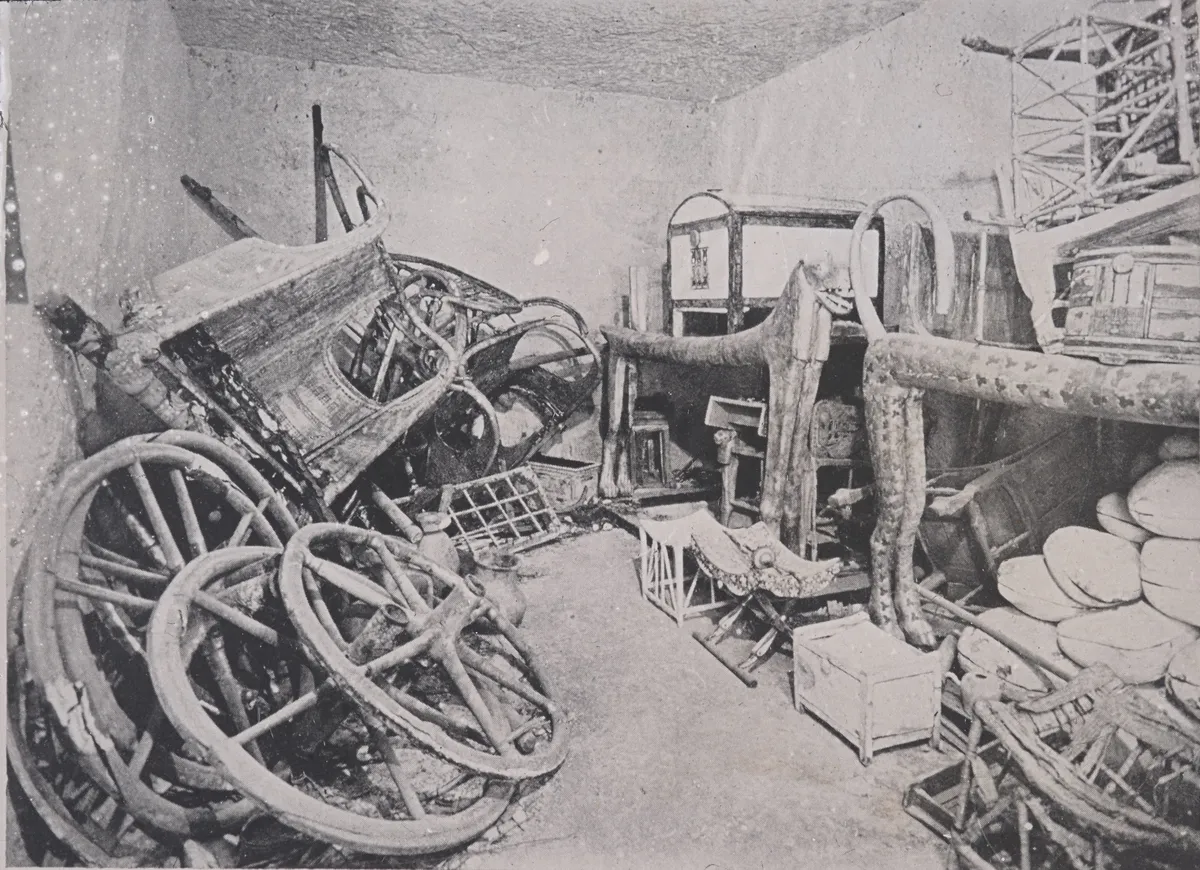
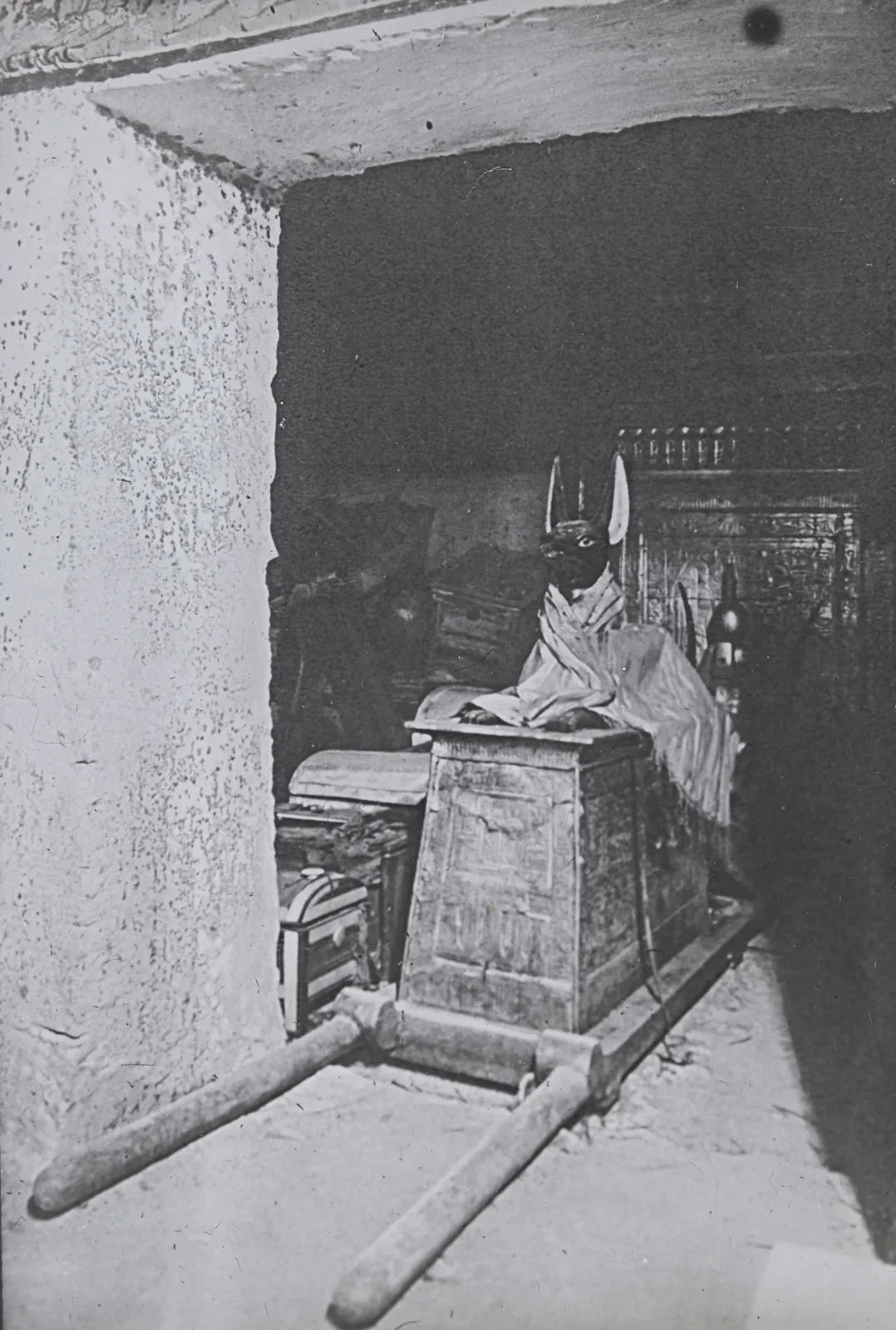
The antechamber as found in 1922: dismantled chariots, funeral beds and boxes along its south side. Photograph: Harry Burton, 1920s. Glass slide GDE002071, KU Leuven (Glass slides in the Leuven University Libraries). Public domain, via Wikimedia Commons. Cropped. 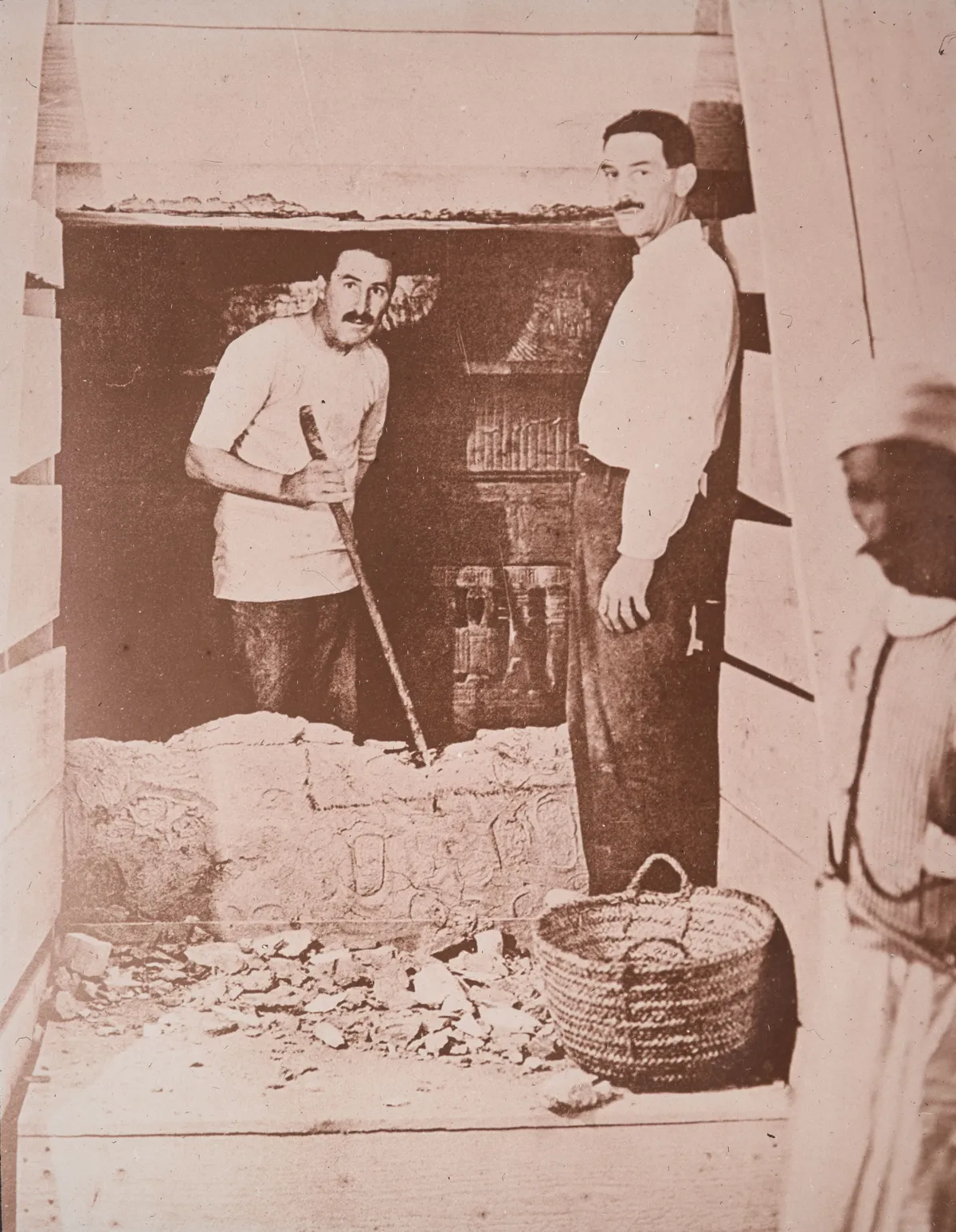
Howard Carter, left, and a colleague in the opened doorway to the burial chamber, the gilded shrine behind them. Photograph: Harry Burton, 1920s. Glass slide GDE002069, KU Leuven (Glass slides in the Leuven University Libraries). Public domain, via Wikimedia Commons. Resized. 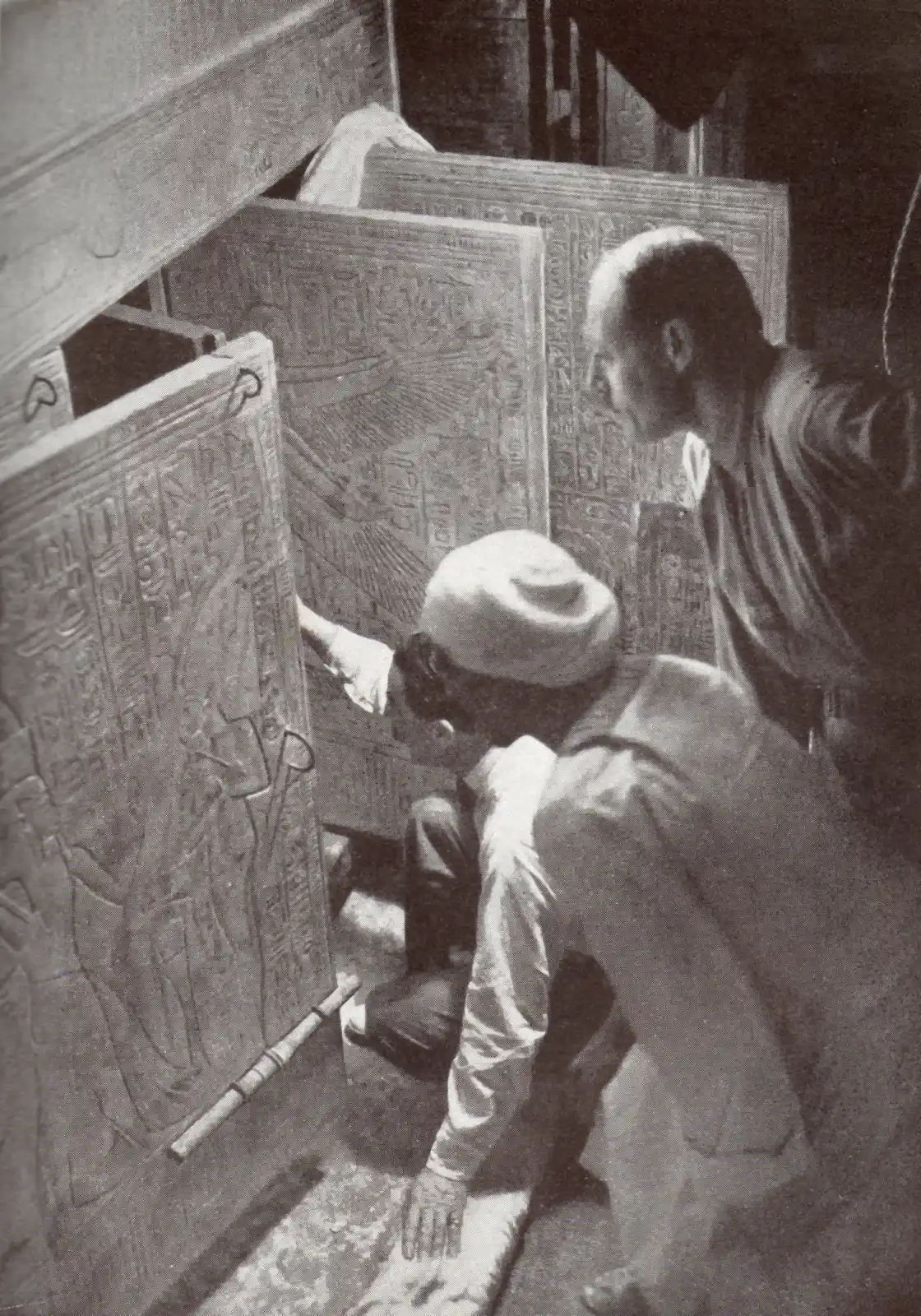
Howard Carter and an Egyptian member of the team open the doors of the gilded shrines in the burial chamber, January 1924. Photograph: Harry Burton, January 1924. Public domain, via Wikimedia Commons. Resized and smoothed. 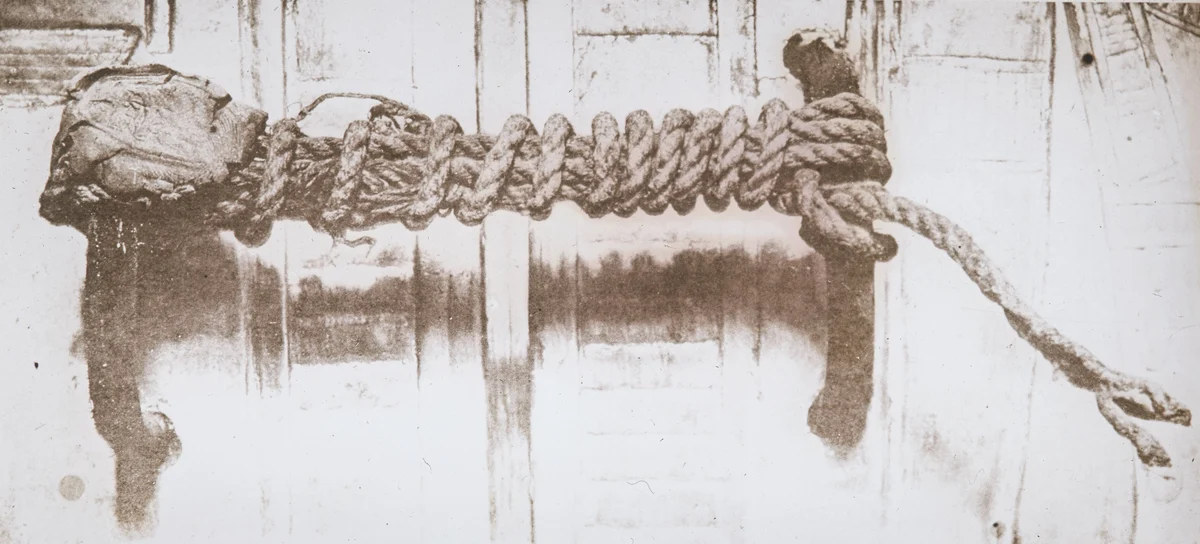
A rope still tied through the handles of the doors of a gilded shrine in the burial chamber, as Carter's team found it. Photograph: Harry Burton, 1920s. Glass slide GDE002082, KU Leuven (Glass slides in the Leuven University Libraries). Public domain, via Wikimedia Commons. Cropped. 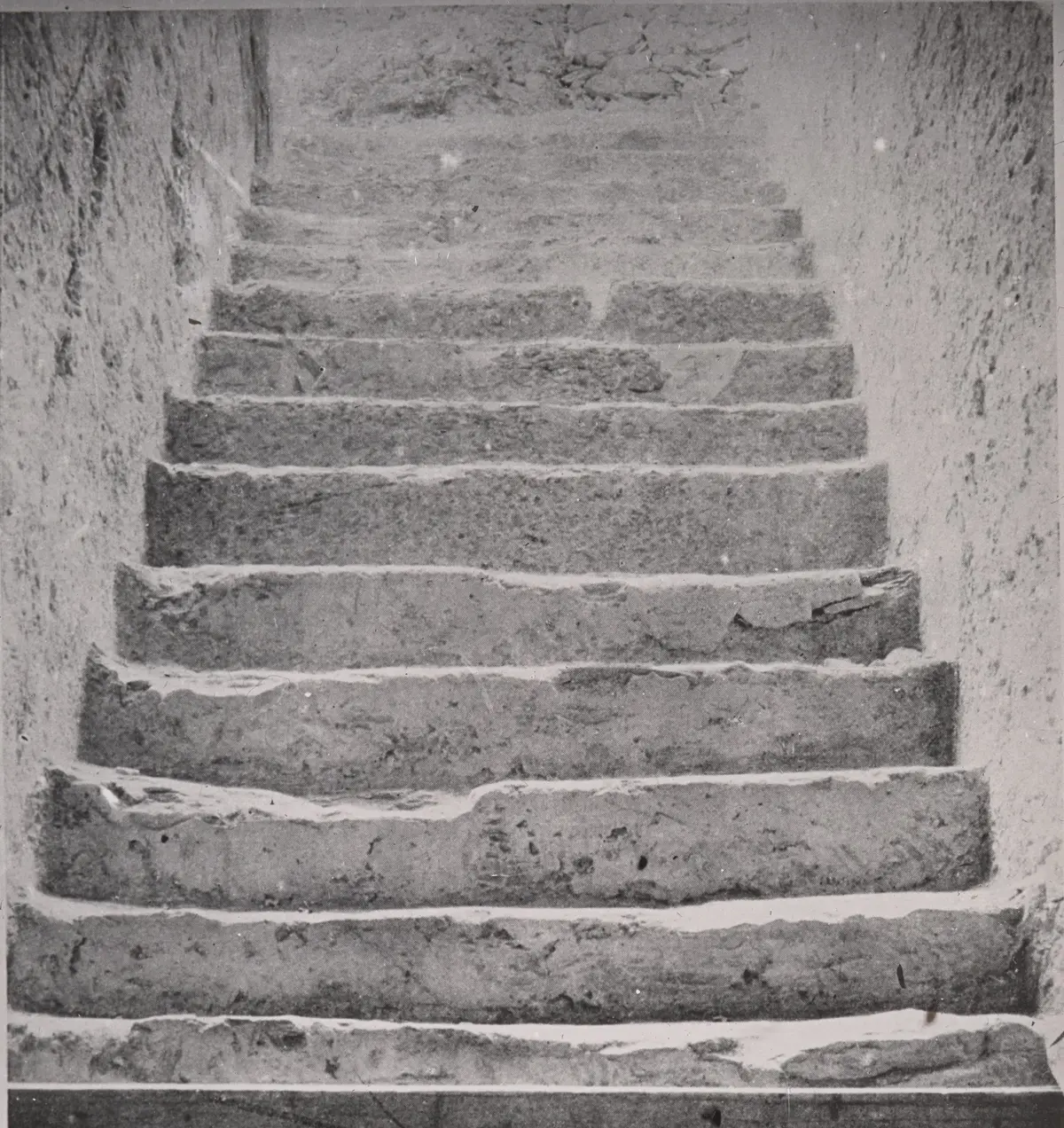
The sixteen steps down into the tomb, cleared. Photograph: Harry Burton, 1920s. Glass slide GDE002073, KU Leuven (Glass slides in the Leuven University Libraries). Public domain, via Wikimedia Commons. Cropped. 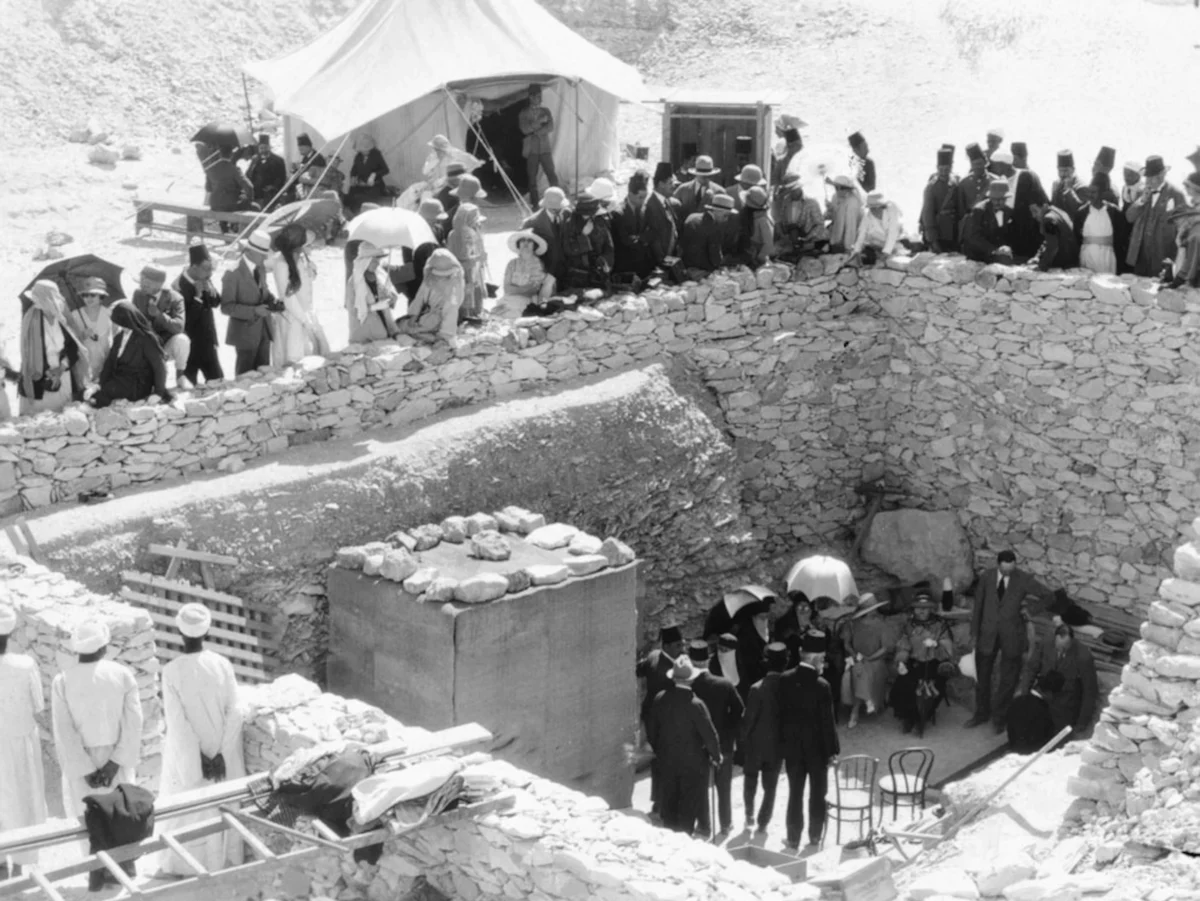
Visitors crowd round the entrance to the tomb during the clearance, February 1923. Photograph: Maynard Owen Williams, February 1923. Public domain, via Wikimedia Commons. Resized. 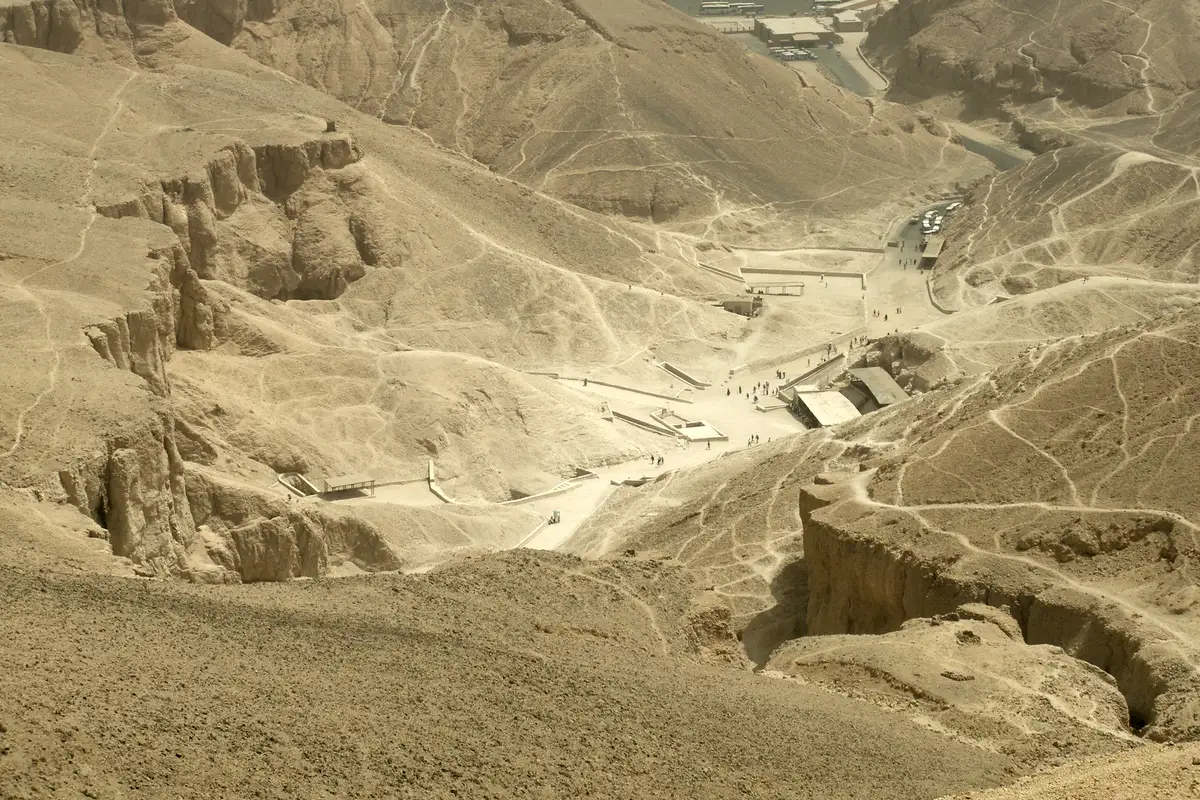
The Valley of the Kings from the hills above. Photo: Vyacheslav Argenberg, CC BY 4.0 (creativecommons.org/licenses/by/4.0), via Wikimedia Commons. Resized.
Select a photograph to see it full size, with its caption and credit.
You have seen the painted wall, Carter's plan and the new map. If the camera goes down one hole from the hillside, what would you need to see on that screen before you believed the painted wall was a door?
Downloads
- Howard Carter and A. C. Mace, The Tomb of Tut.ankh.Amen, vol. 1, 1923New York: George H. Doran; public domain in the US (MIT Libraries scan, Internet Archive, No Copyright - United States)
- Howard Carter, The Tomb of Tut.ankh.Amen, vol. 2, 1927New York: George H. Doran; public domain in the US (Phillips Academy scan, Internet Archive, NOT_IN_COPYRIGHT)
Sources
- Eldamaty, Abbas, Ballard and Reeves, An Archaeo-Geophysical Review and Assessment of the Structure and Morphology of Tutankhamun's Tomb (KV 62) (The Burial of Nefertiti? IV), 2026 Amarna Royal Tombs Project, Occasional Paper No. 8 (posted by Nicholas Reeves); copyright ARTP/Project KV 62 Primary record
- Nicholas Reeves, The Burial of Nefertiti?, 2015 Amarna Royal Tombs Project, Occasional Paper No. 1 (copy published by Factum Arte) Primary record
- Nicholas Reeves, with George Ballard, The Decorated North Wall in the Tomb of Tutankhamun (KV 62) (The Burial of Nefertiti? II), 2019 Amarna Royal Tombs Project, Occasional Paper No. 3 Primary record
- Nicholas Reeves's hypothesis. Nefertiti: A possible discovery? Factum Arte Study
- Howard Carter and A. C. Mace, The Tomb of Tut.ankh.Amen, vol. 1, 1923 New York: George H. Doran; public domain in the US (MIT Libraries scan, Internet Archive, No Copyright - United States) Primary record
- Howard Carter, The Tomb of Tut.ankh.Amen, vol. 2, 1927 New York: George H. Doran; public domain in the US (Phillips Academy scan, Internet Archive, NOT_IN_COPYRIGHT) Primary record
- Carter MSS i.G.4, Plan of the tomb with intact sealed doorways Griffith Institute, University of Oxford, Tutankhamun: Anatomy of an Excavation Primary record
- Conservation and Management of the Tomb of Tutankhamen, 2009-2019 Getty Conservation Institute Study
- 90 Percent Chance King Tutankhamun's Tomb Holds a Hidden Chamber: Egypt's Antiquities Minister, 28 November 2015 Egyptian Streets Study
- Peter Hessler, King Tut's Tomb Scanned Again, 1 April 2016 National Geographic Study
- Sambuelli, Comina, Catanzariti, Barsuglia, Morelli and Porcelli, The third KV62 radar scan: Searching for hidden chambers adjacent to Tutankhamun's tomb, 2019 Journal of Cultural Heritage 39, 288-296 (author manuscript open at the University of Turin repository) Primary record
- Kristin Romey, King Tut's Tomb Has No Hidden Chambers, 6 May 2018 National Geographic Study
- No hidden room in Tutankhamun burial chamber, 8 May 2018 Egypt Independent Study
- Fischanger, Catanzariti, Comina, Sambuelli, Morelli, Barsuglia, Ellaithy and Porcelli, Geophysical anomalies detected by electrical resistivity tomography in the area surrounding Tutankhamun's tomb, 2019 Journal of Cultural Heritage 36, 63-71 Primary record
- David Ian Lightbody, The Tutankhamun-Nefertiti Joint Burial Hypothesis: A Critique, 2021 Journal of Ancient Egyptian Architecture 5, 83-99 (the journal's own open-access copy) Study
- Fady Francis, New scans revive hunt for Nefertiti's tomb behind Tutankhamun's burial chamber, 23 September 2026 Arab News Study
- Jo Marchant, Exclusive: New evidence for hidden chambers beyond Tutankhamun's tomb, 17 September 2026 Nature 657, 861-862 Study
- Nefertiti burial chambers: Tutankhamun tomb, 19 September 2026 GreekReporter Study
- Mark Milligan, New evidence points to possible hidden chambers beyond Tutankhamun's tomb, September 2026 HeritageDaily Study
- Cameron Henderson, Nefertiti's long-lost tomb may be hidden behind Tutankhamun's, 23 September 2026 The Telegraph, via Yahoo News Study
- Paul Carey, Do hidden chambers beyond Tutankhamun's tomb hold remains of Nefertiti?, 23 September 2026 The National Study
- How did Nefertiti die? Encyclopaedia Britannica General reference