
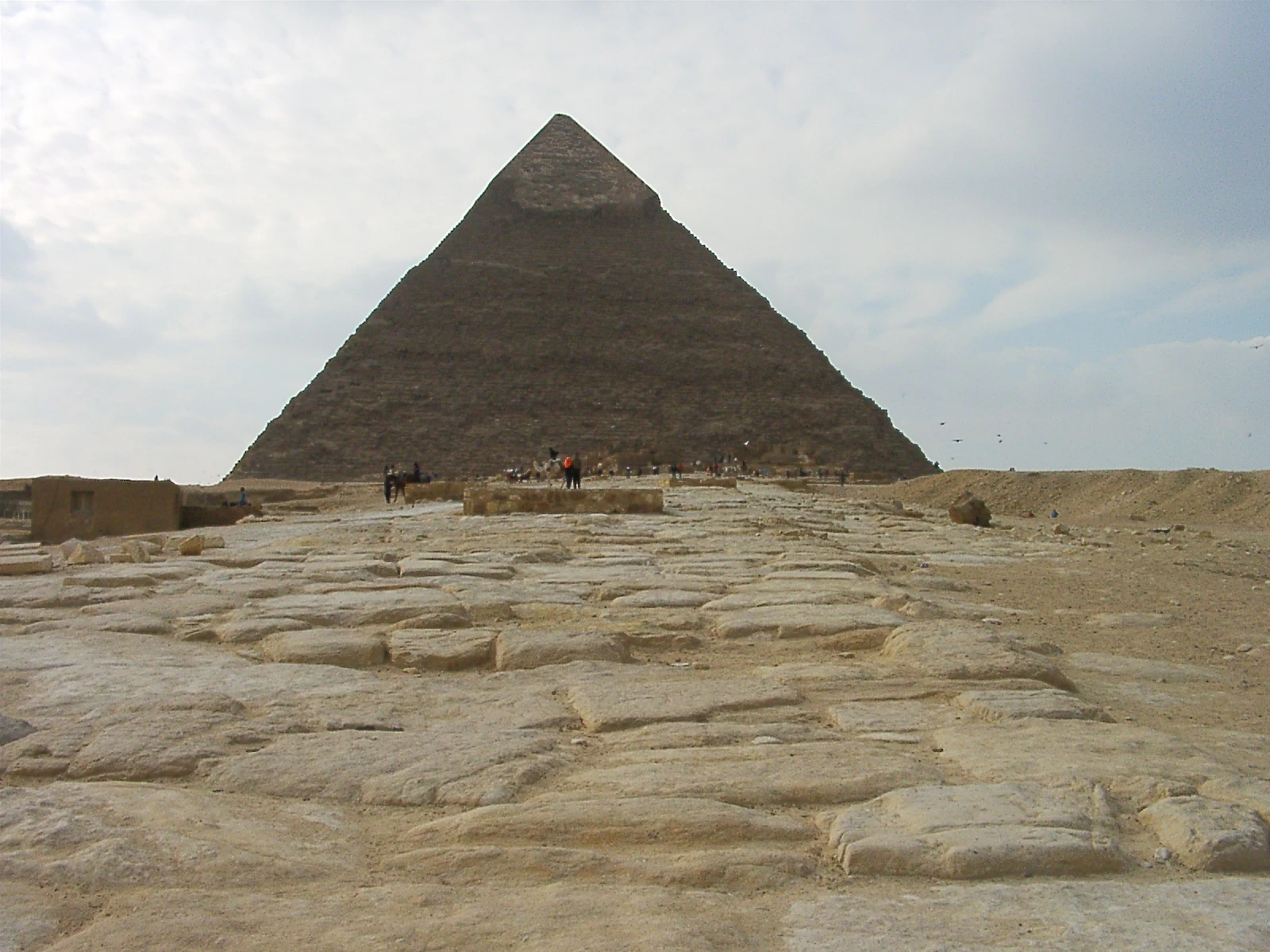
The Pyramid of Khafre is the middle of the three great pyramids at Giza, on the limestone plateau at the edge of Cairo, and it still wears a cap of its smooth casing at the top. Its base runs about 215 metres a side. It stood about 143 metres high when it was finished, some 4,500 years ago.
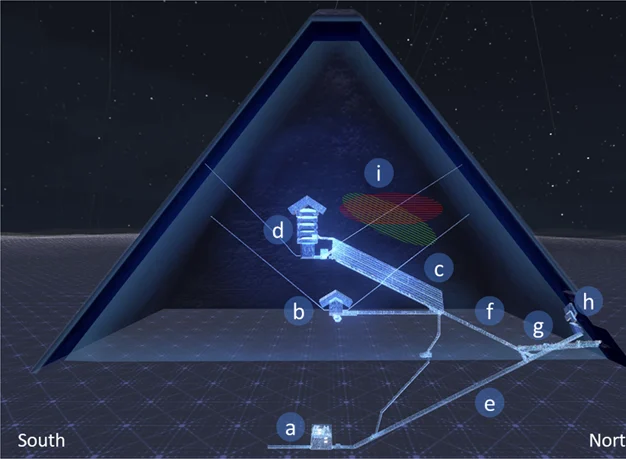
A passage goes in through the north face, drops into the bedrock and levels out. At its end is a long room a little over 14 metres by 5, cut down into the living rock under a gabled roof. A granite sarcophagus sits sunk in the floor. On the wall is the line left by the man who reached it on 2 March 1818: Scoperta da G. Belzoni.
That room, a lower passage and a small side chamber are as deep as the known pyramid goes. Under them, on the surveyors' plans, the paper is blank.
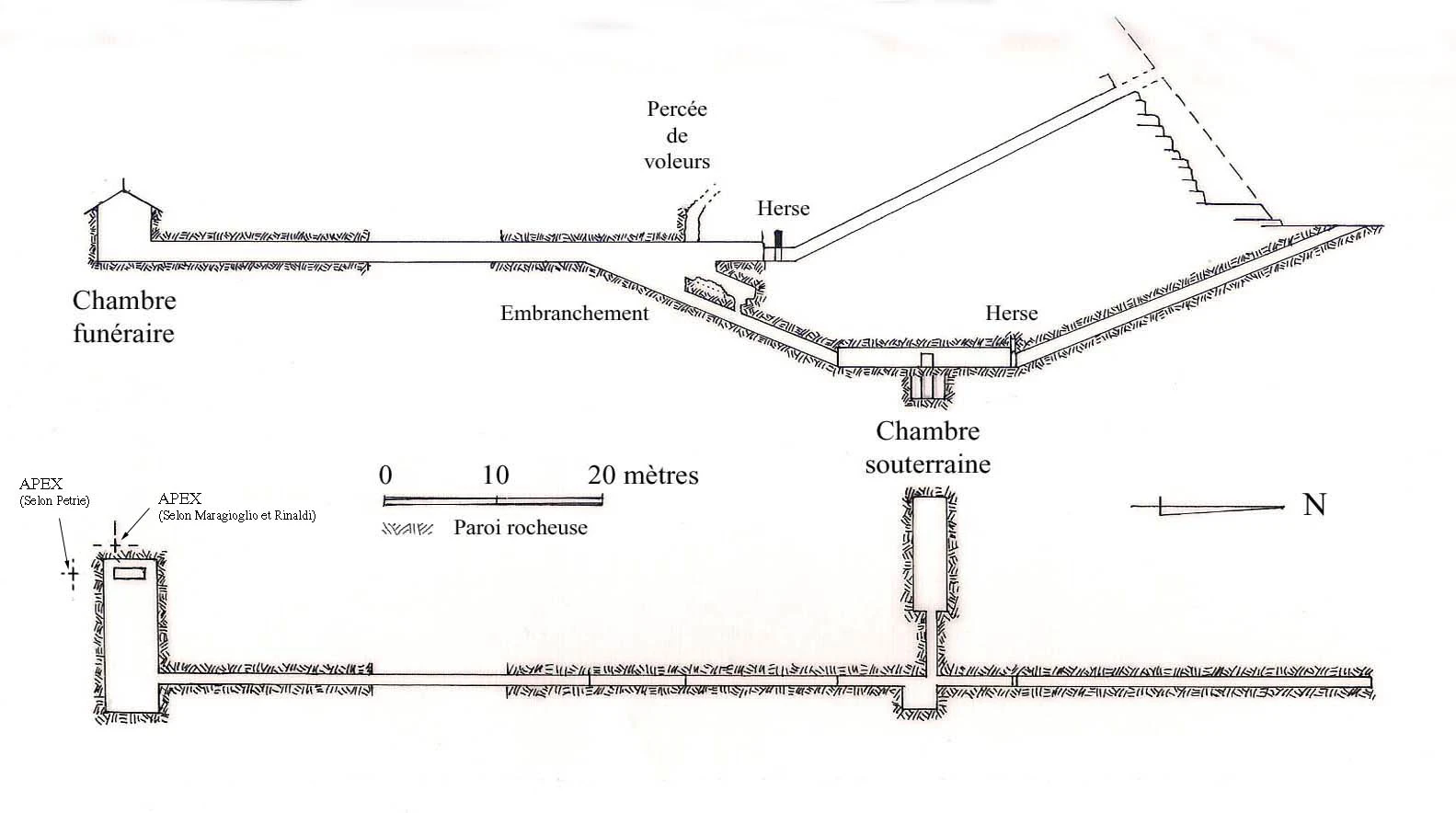
In March 2025 three Italian researchers said a satellite had shown otherwise. Eight vertical wells, they said, wrapped in spiral paths, running down from under this pyramid into the rock for more than 600 metres. The answer from Cairo came back with a different word, and the word stuck.
Columns.
An Engineer, a Dam and a Pyramid
The method did not begin at Giza. Filippo Biondi, a telecommunication engineer with a doctorate from L'Aquila, has published for years on reading tiny motion out of radar images: from one image, split into slices of its Doppler spectrum, he estimated how surfaces shake. In 2020 he and colleagues turned it on the Mosul Dam in Iraq, in an IEEE journal.
Then came the pyramids. With Corrado Malanga, an organic chemist at the University of Pisa, Biondi took 12 COSMO-SkyMed products from the Italian Space Agency and processed them into what the two called sonic images. Their paper appeared in Remote Sensing on 19 October 2022. It was retracted on 10 August 2026.
Its abstract conceded the problem: "due to the poor penetrating action of electromagnetic waves inside solid bodies, the capability to observe inside distributed targets is precluded." The way round it, the authors wrote, was vibration. Background seismic waves shake the monument, and a satellite 650 kilometres up reads the surface. From that they reported "high-resolution full 3D tomographic imaging of the pyramid's interior and subsurface". The paper covered the Pyramid of Khufu and listed 20 structures by number.
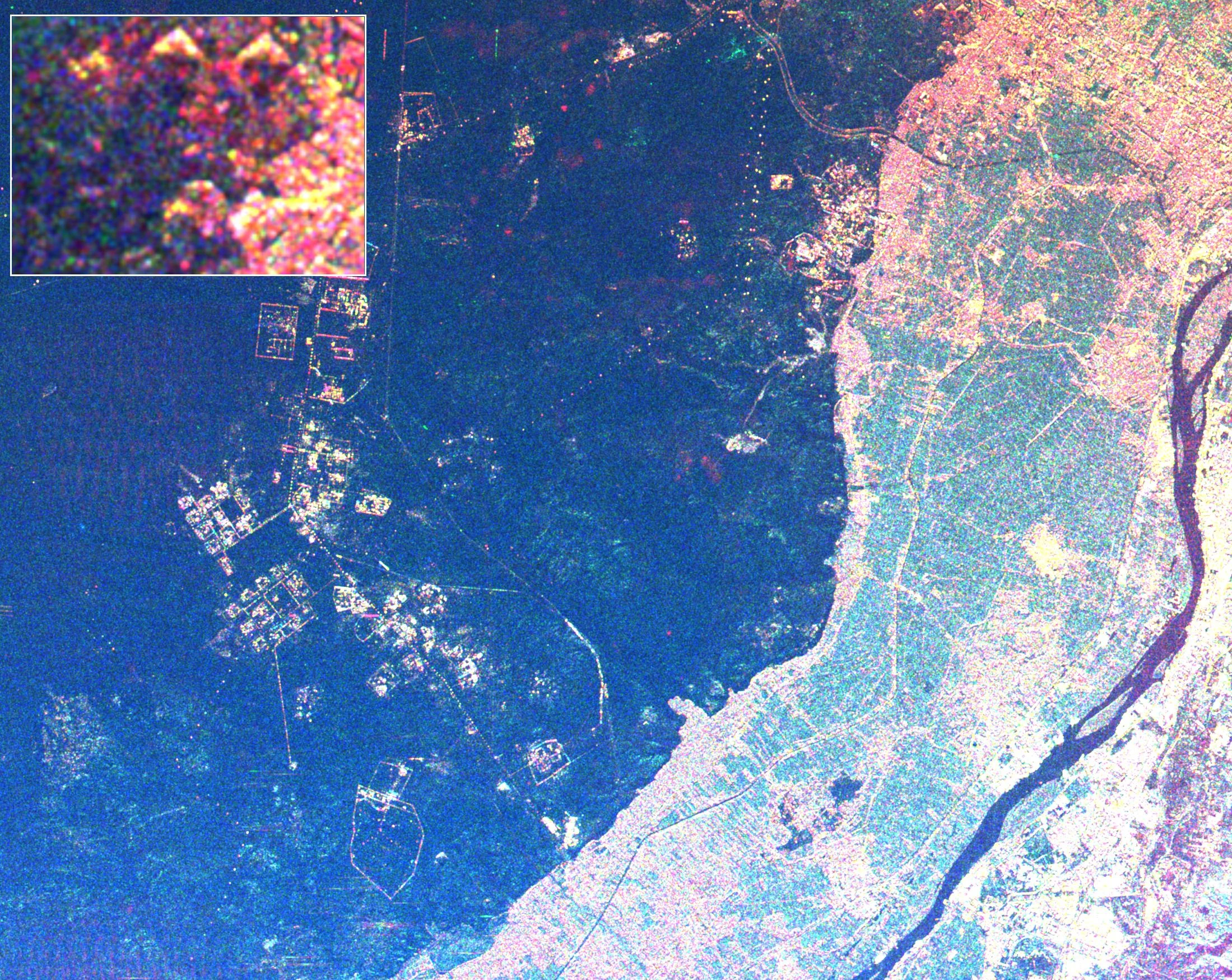
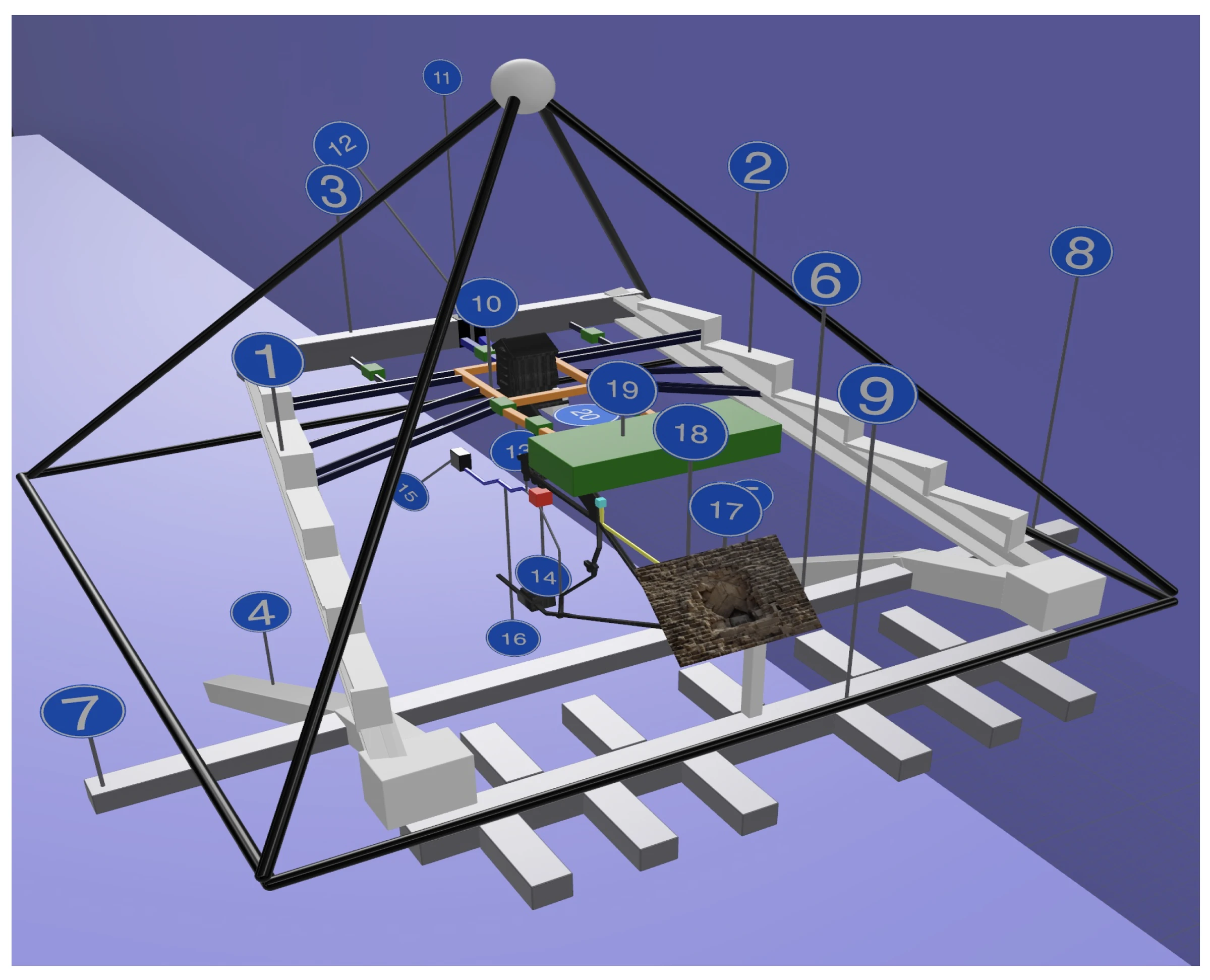
Khafre never got a paper. On 15 March 2025 the project announced its findings at a hotel conference in Bologna, and a week later on YouTube, with Biondi, Malanga and Armando Mei speaking and Nicole Ciccolo moderating. Official X could not find the press release, and neither could Snopes, so the figures below come from those who summarised it.
Eight Wells, Two Cubes
As Greg Reese's summary of the release gives it, five identical structures stand near the base of the pyramid, each with five levels and a sloping roof. Below them are eight vertical cylinders in two rows running north to south, hollow, each circled by a descending spiral path. At 648 metres they merge into two cubes about 80 metres on a side. The whole system reaches about 2 kilometres under the plateau. Other reports give other figures.
Khafre's original height goes into 648 metres four and a half times.
Ciccolo, as spokesperson, tied the vast chambers to the Halls of Amenti, a name out of The Emerald Tablets of Thoth, the book Maurice Doreal published in the 1940s or early 1950s. The Hall of Records came with it, the store of knowledge Edgar Cayce said refugees from Atlantis left near the Sphinx. National Geographic reported a date of 38,000 years.
The idea is older than the satellite. Herodotus wrote of Cheops that the king meant the underground chambers on the hill to be burial places, and that he "encompassed them with water, bringing in a channel from the Nile."
The method's fullest defence is by Dakota Pilicy, on Graham Hancock's site in June 2025. Critics keep answering a claim the team did not make, he argues: this is radar reading surface motion, not radar passing through stone. The newsletter of the physicist Sabine Hossenfelder, which doubts the result, said that recovering an object's inside from its surface vibrations is correct in principle and is what geophysicists do with magma chambers under volcanoes.
What It Would Mean
Set aside for a moment whether it is true. Ask the better question. What would it mean if eight wells really do go down under that floor?
It would mean, first, that the pyramid is not the monument. On that reading one of the most famous stone buildings on Earth is a lid, or a marker, set over something far larger by people who knew what was beneath it. Everything written about Khafre's burial would describe the top storey of a building nobody has entered.
It would mean that the history of deep work has to be redrawn. If 648 metres of cut rock with a spiral path around it is real, then somebody carried that work down through a plateau and far below its water, with a craft whose tools and records would still be waiting to be found.
If the age reported from the team's side is the right age, then people were building on this scale when, on the record we have, our species lived by hunting and gathering. Gobekli Tepe already pushed the floor of what we think hunters could raise. This would take the floor out.
And it would leave one consequence still in front of us. A sealed place would still be down there, and we would have to decide who opens it. Who would hold the right to it, a country, a science, or all of us?
The Paper, the Notice and the Water
The standard account starts with the paper, because the Khafre claims rest on its method. The journal's notice says a reader raised concerns, and that its investigation "confirmed serious methodological flaws and statistical errors that were deemed to undermine the scientific conclusions of the article." The authors, it adds, disagree.
Lawrence Conyers of the University of Denver, a specialist in radar for archaeology, told Retraction Watch that a sensor measures only what it directly sees, and that the micro-vibrations are far below what a satellite could detect. "I don't care what magical properties you are using, it just doesn't work," he said. The same newsletter objects to the images: it found no discernible relation between the 2022 tomograms and the structures named from them. The paper itself says its reconstruction "does not claim to indicate the true measurements of the objects shown".
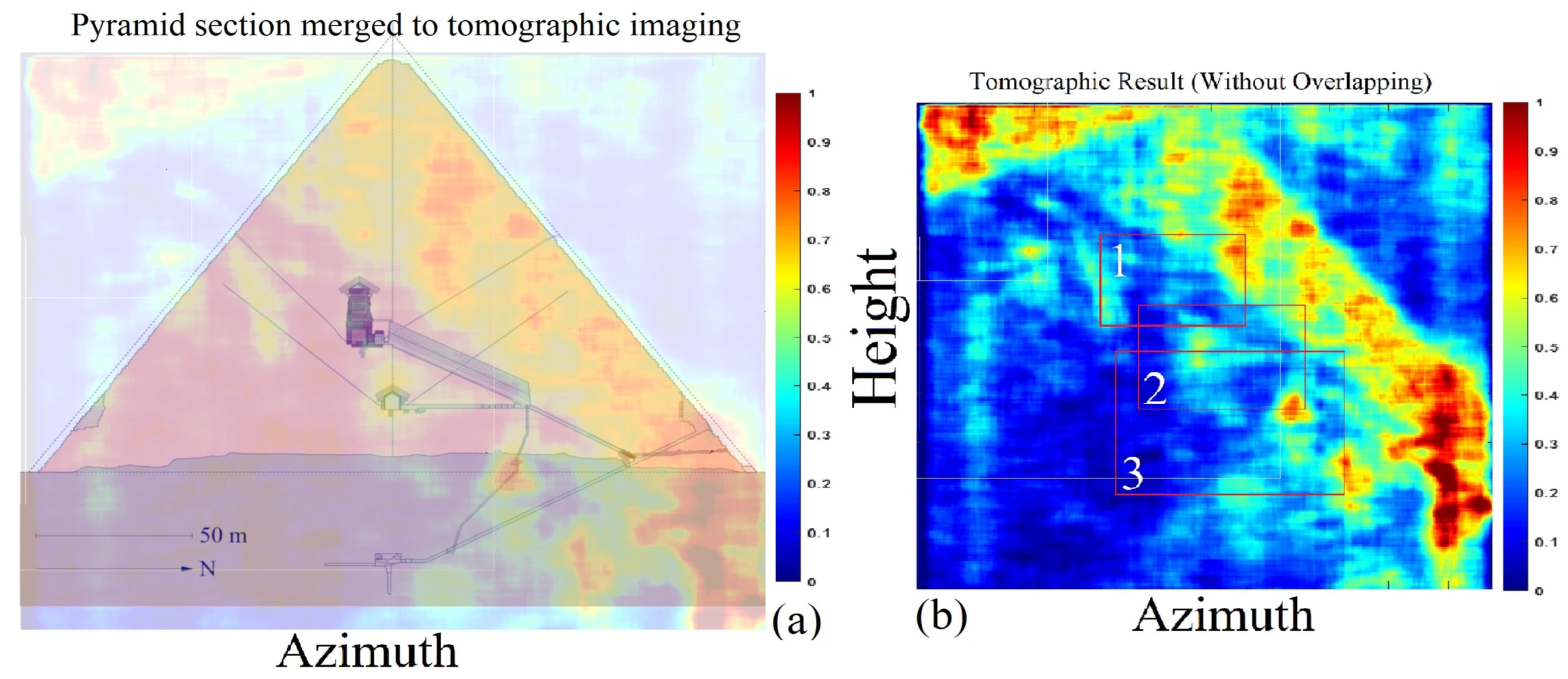
Simone Pomposi's independent reproduction attempt, an unreviewed preprint revised on 23 October 2026, could test only part of the chain and found no target-specific result.
The word columns belongs to the Egyptian reply. The team's summaries say wells and cylinders; Zahi Hawass's statement of 26 March 2025 called claims of columns under Khafre fabrications, and said the Supreme Council of Antiquities had given no permit for work inside. Mohamed Ismail Khaled, its secretary-general, told Al-Ahram Weekly that the Doppler reading is theoretically possible but highly questionable here, and asked for the data and methods. Yasser Al-Shayeb, a Cairo University rock engineer, said the limestone is well documented and holds small voids and fissures.
Then the water. Sharafeldin and colleagues, in 2019, put the average water table around the Sphinx at about 15 metres above sea level, and Flint Dibble of Cardiff University argued in National Geographic that anything so deep would always have stood under groundwater. And Herodotus says of this pyramid in particular: "It has no underground chambers."
What the Answer Does Not Reach
Hawass answered that no radar had been used inside the pyramid. The team's radar was in orbit. The objection that radar cannot pass through stone is true, and it is conceded in the first lines of their own abstract.
Herodotus fails here too. Belzoni's room is cut into the bedrock, so "no underground chambers" fails on the one chamber it can be checked against.
The notice names no reader, lists no error and alleges no misconduct. On Khafre it is silent. Egypt's refusal is not a measurement either: it says who may work at the site, not what is under it.
The most famous experiment at this pyramid does not touch the question at all. In the 1960s Luis Alvarez and a joint Egyptian and American team set a muon detector in the Belzoni Chamber, and in Science in 1970 they reported no hidden rooms in the 19 percent of the volume they covered. Muons fall from the sky. The detector looked up. It says nothing about the rock under its own feet. The ScIDEP project, now building muon telescopes for this pyramid, is after internal structures too.
A 9-metre corridor behind the Great Pyramid's north face was measured in Nature Communications in 2023. Conyers himself, as The Jerusalem Post reported, allowed that small shafts and chambers might lie beneath the pyramids, older than the stone above, as Mesoamerican pyramids were raised over caves. The city he called a huge exaggeration. The small shaft he left open.
And there are pillars under Giza. Down a chain of shafts beneath Khafre's causeway, in the place called the Osiris Tomb, Archaeology magazine described in 2000 a damp grotto nearly 100 feet below the plateau: four eroded pillars cut from the rock around a pit with a granite sarcophagus, clear water on three sides. Real columns, real water, about 30 metres down. Not 648.
Confirmation looks like that corridor: named instruments, published data, error bars. The wells have had none of it. No independent group has confirmed them. Nobody has seen one.
Where the Question Stands
A technical paper on Khafre was still being promised in June 2025. By late October 2026 none could be found in the journals, on arXiv or on Zenodo. Newsweek reported that a Khafre Project video said plans for non-invasive measurements and applications for excavation permits went to Egypt's ministry on 22 August 2026, 12 days after the retraction. Nothing on the record says they were granted.
On the record as it stands, the wells exist in a presentation and nowhere else.
Conventional geophysics could look: eight shafts more than 600 metres deep and two cubes 80 metres wide are not subtle objects, though Al-Shayeb warns that seismic and electrical surveys cannot resolve fine detail at such depths. A blind test could go further. Point the method at the Osiris Tomb without telling it where to look. That would not prove a 648-metre well. It would show whether the method sees what it was not told about.
One sum has still not been shown in public: how a shake measured on a limestone surface from 650 kilometres up turns into a shape 648 metres below it.
The journal took down the published version of that step. The rock has not been asked.
Questions This Leaves You With
Is there anything a person actually does with this?
Nothing that touches your own life. No date attaches to these wells, and nothing needs preparing; anyone selling a date on what lies under Giza is selling something. A trip to the plateau shows you the same stone it showed Belzoni. The larger question is a civic one: who gets to test a claim about a nation's monument, and on what terms? Egypt controls the permits, the critics include the people who issue them, and the claimants hold the method. That question is open, and it does not depend on what is down there.
Does this sit against a religious account of the world?
It can be read both ways, and people have read it both ways. One person hears of a hidden civilisation beneath the pyramids and finds the old sacred histories confirmed, with their floods and their lost ages. Another finds a rival to scripture, a past with no place in it. The Halls of Amenti as a hidden place under Giza come from a twentieth-century book, not from a temple wall, and that matters to some readers and not to others. This site will not tell you how it falls. The pyramid was a holy place to the people who built it, on any reading.
Does this change what a human life is?
Hold your own years against the scale in this story. If the stones are 4,500 years old, a life is a short visit to a very old room. If something under them is many times older, it is shorter still. One reaction is that this shrinks you: a whole civilisation could vanish and leave a rumour. The other is that it enlarges you, because people like you once cut rock to stand against exactly that vanishing. You may already know which one you had.
What would change your mind, in either direction?
Name it now, before you are committed. Toward the wells: the full method and data released and repeated by a group with no stake in it, a blind test that finds a hidden known target, a seismic or gravity survey showing a deep anomaly where the team's images put one, a core or a cleared shaft. Away from them: the same method, run fairly, drawing the same structures under an empty control site, or a deep survey of the ground around Khafre that comes back plain. A press conference would not move it either way, and neither would a refusal. Decide what would.
What could a surface vibration carry?
This is the open problem. Geophysicists do read depth from waves, with sensors in the ground and known sources. No published demonstration shows that a single satellite image of shaking limestone can carry the shape of an object 600 metres down. Conyers says it cannot, and the journal's notice lists no specific error, and the method's full chain has not been released. So the place where a working proof or a clean disproof should sit is still empty, and it could be filled without lifting a single stone.
Sources
- Synthetic Aperture Radar Doppler Tomography Reveals Details of Undiscovered High-Resolution Internal Structure of the Great Pyramid of Giza (retracted), Remote Sensing 14(20), 5231, 2022 F. Biondi and C. Malanga; MDPI Primary record
- Retraction notice, Remote Sensing 18(16), 2679, 10 August 2026 MDPI, Remote Sensing Primary record
- Biondi and Malanga, preprint of the 2022 paper, arXiv 2208.00811 arXiv Primary record
- Biondi et al., paper on the Mosul Dam from COSMO-SkyMed data, IEEE JSTARS 13, 6337-6351, 2020 IEEE; University of Strathclyde repository Primary record
- Helen Santoro, report on the retraction, 31 August 2026 Retraction Watch Study
- Jordan King, report on the retraction, 2026 Newsweek Study
- Joey Esposito, fact check of the Giza structures claim, March 2025 Snopes Study
- The Reese Report summary of the Khafre press release, 18 March 2025 (repost) Greg Reese Study
- Candida Moss, Is there a secret city under the pyramids?, 16 April 2025 National Geographic Study
- Report on the Khafre claims, with Conyers's and Ciccolo's remarks, March 2025 The Jerusalem Post Study
- Dakota Pilicy on the Khafre research and its critics, 27 June 2025 grahamhancock.com Study
- This Week's Science News from SWTG: Structures Under The Pyramids, 4 April 2025, by Marcus Science without the gobbledygook (Sabine Hossenfelder's newsletter) Study
- Simone Pomposi, On the Reproducibility of Single-Pass SAR Doppler Tomography for Subsurface Imaging, version 2, 23 October 2026 (preprint, not peer reviewed) Zenodo Study
- A Statement from Dr. Zahi Hawass re: The Khafre Project, 26 March 2025 Zahi Hawass Primary record
- Nevine El-Aref, Controversy over Pyramid claims, 8 April 2025 (archived copy) Al-Ahram Weekly Study
- Sharafeldin et al., Shallow geophysical techniques to investigate the groundwater table at the Great Pyramids of Giza, Egypt, 2019 Geoscientific Instrumentation, Methods and Data Systems Primary record
- Herodotus, Histories, Book 2, 124-127, trans. A. D. Godley, Loeb, 1920 LacusCurtius Primary record
- Luis W. Alvarez et al., Search for Hidden Chambers in the Pyramids, Science 167, 832-839, 1970 Science Primary record
- Gamal et al., The ScIDEP Muon Radiography Project at the Egyptian Pyramid of Khafre, 2025 arXiv; Journal of Applied Physics 138, 044901 Primary record
- Procureur et al., Precise characterization of a corridor-shaped structure in Khufu's Pyramid by observation of cosmic-ray muons, Nature Communications 14, 2023 Nature Communications Primary record
- Angela M. H. Schuster, Tales from the Crypt, Archaeology 53(5), 2000 Archaeology magazine Study
- Pyramid of Khafre Wikipedia General reference
- The Emerald Tablets of Thoth the Atlantean Wikipedia General reference
- Hall of Records Wikipedia General reference
- Plan and section of the funerary apartments of Khafre, Franck Monnier Wikimedia Commons Study
- Space Radar Image of Giza Egypt, with Enlargement, PIA01793, 1994 NASA/JPL Primary record
- Pyramid of Khafre (Pyramid of Chefren), photograph by Mstyslav Chernov, 2009, CC BY-SA 3.0 Wikimedia Commons Study
- Khafre causeway, photograph by HoremWeb, 2006, CC BY-SA 4.0 Wikimedia Commons Study