
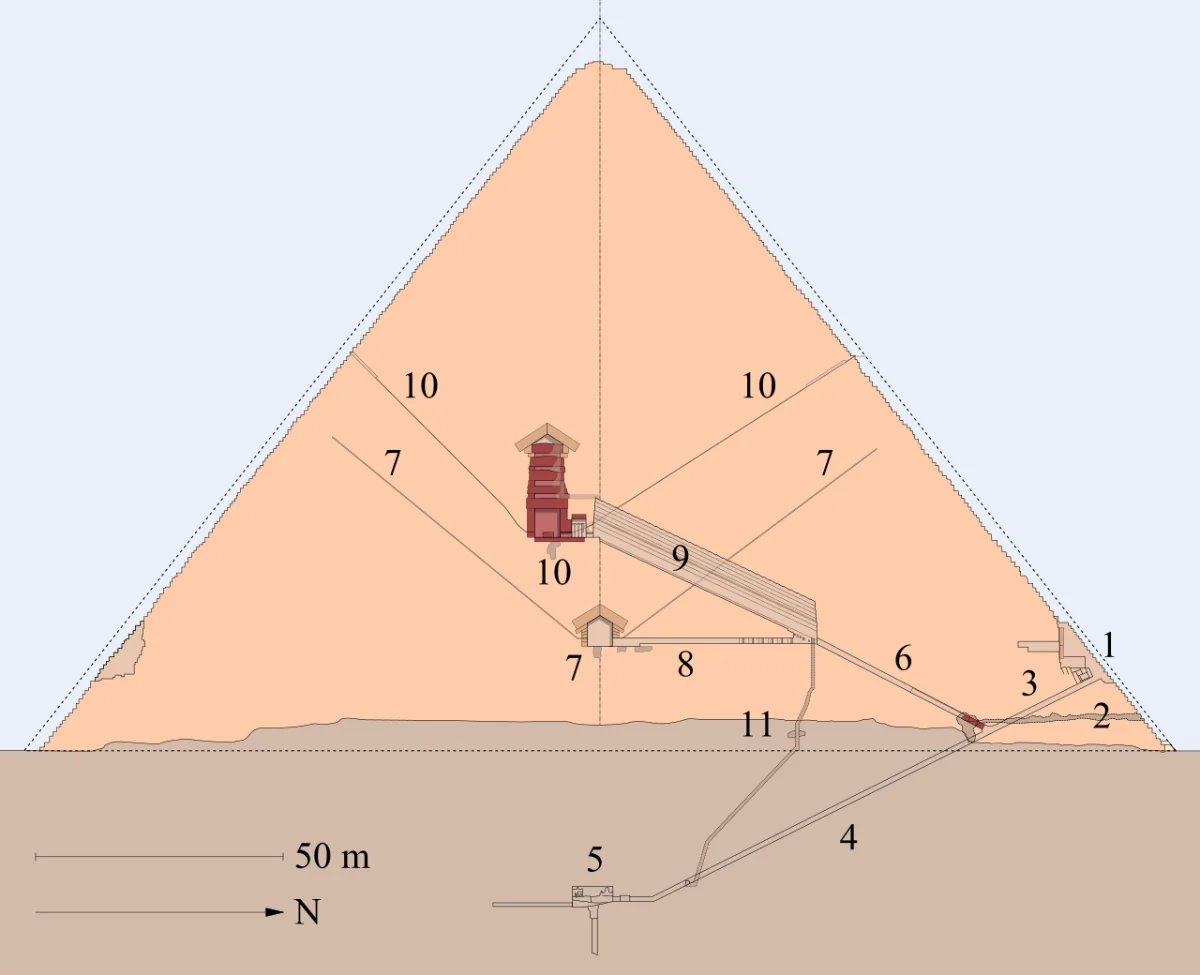
The Great Pyramid of Giza, in Egypt, has five low spaces stacked above the ceiling of its King's Chamber. In them, in red paint, is the name of the king Khufu. Zecharia Sitchin, the author who made the Anunnaki famous, argued that those gods raised this pyramid millennia before any king of Egypt, and that the name was forged in 1837.
The top space has a roof. Two slopes of limestone lean together overhead. Underfoot runs a row of lumpy granite beams, the upper side of the ceiling below, left rough because no one was meant to walk on them.
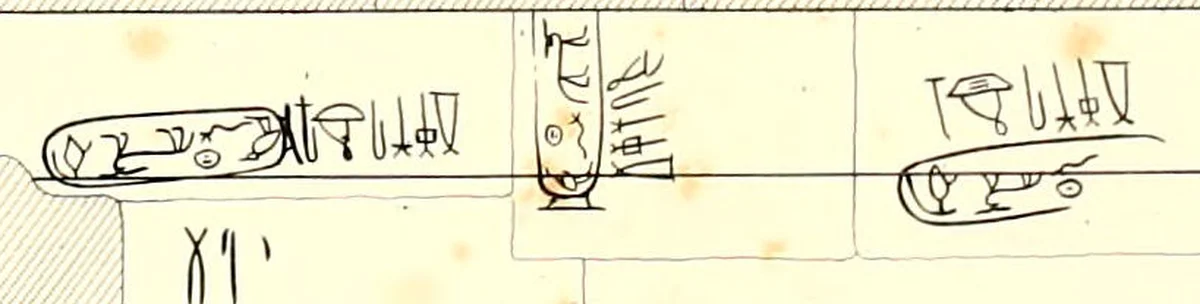
The red is on the bare stone, laid on with a loaded brush. Birds, loops, lines ruled by a mason. On one roof beam, inside a long loop of paint, four small signs stand in a row: a circle, a bird, a snake, a bird.
Everything after this depends on who held the brush.
Gunpowder Above the Ceiling
In the spring of 1837 a British colonel, Howard Vyse, had a crew working inside the Great Pyramid. The lowest of the five spaces had been known since Nathaniel Davison reached it in 1765. Vyse sent his quarrymen, led by a man named Daoud, up through the stone above it with gunpowder.
On March 30 Vyse crawled through the new hole with J. R. Hill, who had run the Pacha's copper mills and later kept the hotel at Cairo. He described the floor and the walls, and no marks went into the printed account. That evening he went back with two engineers, John Perring and James Mash, and two pages on is the line the whole argument hangs from: "we found the quarry marks."
He named the space for the Duke of Wellington, and the next afternoon, with Hill, "the Duke's glorious name was inscribed on the southern wall."
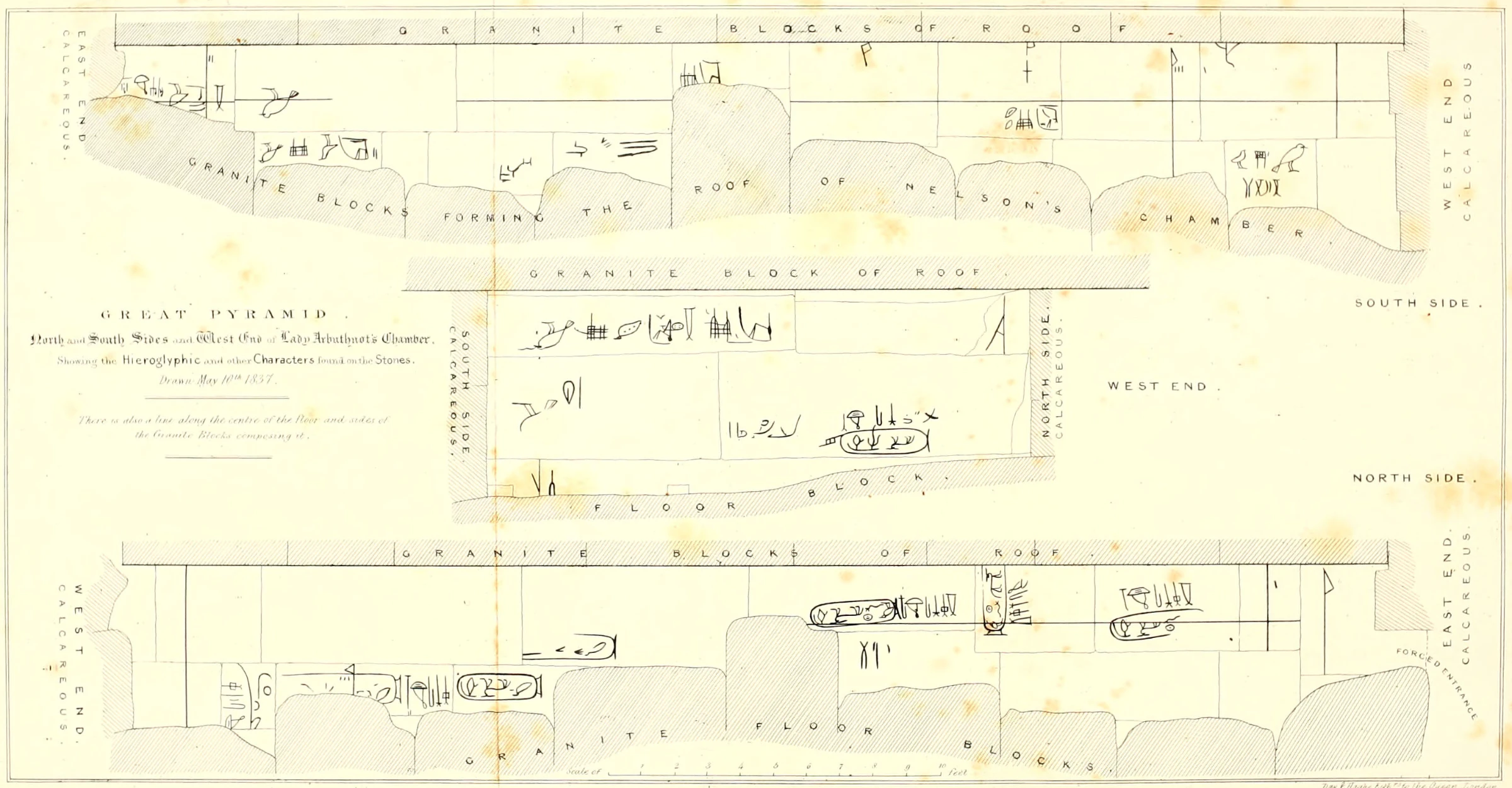
Three more spaces followed by May 27: Nelson's, Lady Arbuthnot's, Campbell's. Each had red marks, the royal cartouches about two and a half feet long on the plate of Lady Arbuthnot's. Hill copied the marks at full size, four men signed that the copies were true, and the sheets went to the British Museum, where a young assistant, Samuel Birch, read two royal names.
Beacons for the Anunnaki
Sitchin's Anunnaki come from earlier pages: the twelfth planet, the seal he read as a solar system, the creation poem he read as a collision. The pyramids come in his second book, The Stairway to Heaven, published in 1980.
After the Deluge, which he placed about 13,000 years ago, the Anunnaki needed a new way down to a spaceport in Sinai. One line of the landing corridor had a mountain to fix it. The other had nothing. He writes the moment as a scene: "We will have to erect there a pyramid, the commander said." He flags the scene as his own, but is "pretty certain that that is how the pyramids came to be in Egypt."
After a scale model at the Third Pyramid, "the larger two were built as a pair of guiding beacons for the Anunnaki." By The Wars of Gods and Men, in 1985, it is flat: "built not by Pharaohs but by the Anunnaki millennia earlier."
For that to stand, the name in the chambers had to go. Sitchin had a stone to set against it: the Inventory Stela, found at Giza in the 19th century, which on his reading shows the Great Pyramid "already standing" when Khufu arrived.
Not Khufu, but Raufu
Sitchin's charge fell on Hill. "By night, we suspect, Mr. Hill also entered the chambers."
Sitchin laid out the pattern as he read it. The cartouches turned up only in the spaces Vyse opened, none in Davison's, open for 72 years. A few marks apart, nothing was on the east walls, the side Vyse's tunnel came through. The inscriptions were "either upside down or vertical", as though drawn by someone doubled over in a low space. Scott Creighton's book of 2017 makes the forgery a case of its own, by Jason Colavito's account of it.
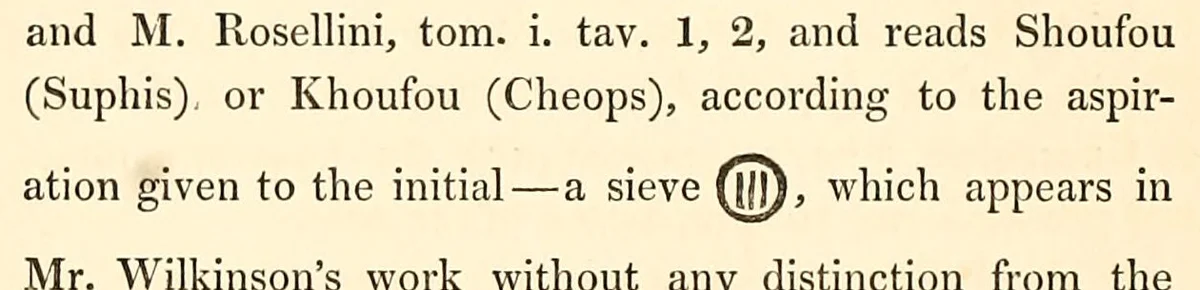
Then what he called the forger's mistake. Birch called the first sign of Khufu's name a sieve, and remarked that it "appears in Mr. Wilkinson's work without any distinction from the solar disc." The book was John Gardner Wilkinson's of 1828. A circle with a dot in it is the sign of Ra, the sun god. And a circle with a dot in it is what Vyse's own plates print in the cartouches.
To Sitchin that was the forger's fingerprint: a man copying from a faulty book had written a god's name where a king's belonged: "not Khufu, but Raufu." In 1978, he wrote, the British Museum brought out Hill's sheets, and there was "a dot or a smudge inside a circle." In 1983 a reader named Walter Allen sent him a family note about a mason ancestor, Humphries Brewer, who had worked for Vyse. "Faint marks were repainted, some were new."
If the Name Was Painted in 1837
Set aside for a moment whether it is true. Ask the larger question. What kind of past are we standing on if it is?
It would mean the Great Pyramid is not a tomb that happens to be large. On Sitchin's reading it is equipment, a fixed mark on a flight path, and every king of Egypt who built a pyramid was copying something he had found.
It would mean the first great stone monument on the Nile was not the work of the people who lived there. The climb from mud brick to a mountain of cut stone would not be our climb at all. We would be the ones who moved in afterward, around a landing field.
It would mean the record itself has a hole in it. If one forged cartouche could hold up the date of the largest monument in Egypt for nearly two centuries, then the history of the ancient world rests on far fewer stones than anyone supposed, and on the honesty of a few men with candles.
It would reach into the body. Sitchin's larger story makes humanity a labour force bred for the mines. On that reading our hands and backs were designed by somebody else for a purpose of theirs, and the pyramid is what the employers left in the yard.
And it would leave one consequence still in front of us. A beacon is built to be read. If this is one, then the stones on the Giza plateau are a sign addressed to someone else, and our species has spent 4,500 years walking around it without the language. Whether anyone still reads it would be the only question left.
What the Stones and the Papers Hold
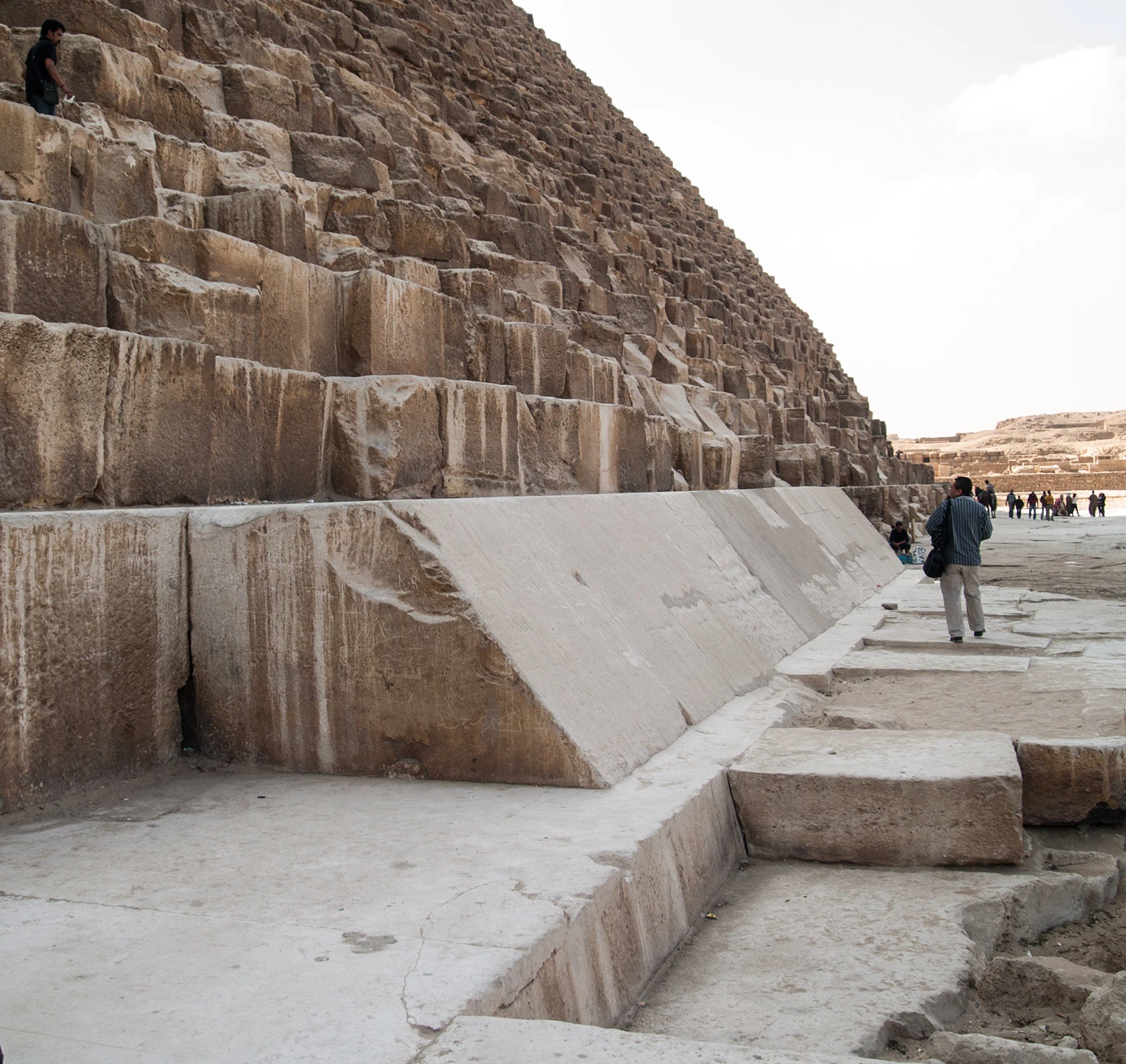
The standard account holds that the marks are what Vyse called them: the working notes of Khufu's crews. Flinders Petrie surveyed the chambers and reported in his book of 1883, in Wellington's, on the east side Vyse came through, "a large cartouche of Khnumu-Khufu, nearly all broken away by Vyse's forced entrance." On the standard reading the hole broke a name already there. Vyse had that hole enlarged on March 30, and Petrie records the break, not the day.
Birch's remark was about Wilkinson's printing, not the marks, and on that page he prints the sign as a circle with three lines through it. On the next he writes of the Khnum-Khufu cartouche and "the absence of the solar disc". Martin Stower, who went through Sitchin's case line by line in the 1990s, printed a photograph of the Campbell's Chamber cartouche from Rainer Stadelmann's book. In that photograph the circle is hatched. Vyse's plate of Campbell's Chamber prints the same cartouche with a dot. The dot is on the 1839 plates, not on that stone.
In 1931 George Reisner printed the crew names Alan Rowe had read in the chambers, "Cheops-excites-love" among them, beside "Mycerinus-is-drunk" from the temple he dug out at Menkaure's pyramid, blocks still buried in 1837. One chamber name, Horus Medjedu, was shown to be Khufu's only later. Sitchin himself quotes James Henry Breasted on the Inventory Stela: "the orthographic evidences of its late date are entirely conclusive."
In 2013 Pierre Tallet's team at Wadi al-Jarf, on the Red Sea, found hundreds of fragments of papyrus from the end of Khufu's reign. One log was kept by an inspector named Merer, with some 40 men: "Inspector Merer casts off with his phyle from Tura [South], loaded with stone, for Akhet-Khufu; spends the night at She-Khufu." Tallet reads Akhet-Khufu, the Horizon of Khufu, as the pyramid and the works around it, "being created at the very moment these documents are being written". Sitchin died in October 2010, before any of it came up. Allen's note, by Sitchin's own account, is a family memory written down in 1954, and the letters behind it were never found.
What the Diary Does Not Reach
The diary records the end of a job, a few months in the year after Khufu's 13th cattle count. Tallet writes that the white Tura stone was "most probably but not exclusively" for the outer casing, and that "there is no mention of the construction techniques". The core of the pyramid is not in it.
When the papyri went on show in 2016, Graham Hancock told Preston Peet they sounded like the record of "renovation and completion" of "a much older project", the facing stones rather than "the building of entire pyramids". Boats full of white limestone would look the same either way. Hancock's position needs no forger: by Colavito's quotation he gave up the forgery in 1998, because some signs run back into joints no brush could reach.
The marks have gaps of their own. Stower's photograph shows one sign, in one cartouche, at the top of the stack. Sitchin's Raufu also rests on the Khnum-Khufu cartouches in the chambers below it, and no published close-up of that sign turned up. Hill's own sheets were not found online.
The Edgar Cayce Foundation helped pay for radiocarbon dates on Old Kingdom monuments in 1984, because Cayce had put the Giza pyramids at 10,500 BC. They averaged 374 years older than the history books, and a second run in 1995 came in 100 to 200 years older. Either way, thousands of years short of Sitchin's date.
Mortar is not paint. In April 2013 two Germans scraped samples from a Khufu cartouche, hoping to show the pigment modern. A Giza court sentenced nine people over the affair in November 2014.
No published result has turned up. They did not settle it. Nobody has shown a date for the paint.
The Brush
Work goes on around the marks. Muon scans reported a void at least 30 metres long above the Grand Gallery in 2017, and a corridor of about 9 metres behind the north face in 2023. The 2017 paper says "there is no consensus about how it was built". No photograph of Merer's pages is free to reuse, so they are described here and not shown.
On who built it, the record does not sit level. A cartouche Petrie found broken by Vyse's hole, crew names on the pattern of a neighbouring pyramid's, stone delivered to a place named for Khufu, mortar within a few centuries of his reign. Sitchin himself writes that on accepted readings "no one in Mesopotamia was ever aware of the existence of the Egyptian pyramids", and his answer is to read the Ekur of those texts as the Great Pyramid.
A close photograph of every Kh in the Khnum-Khufu cartouches, set beside Hill's sheets, would settle the spelling. A paint test could settle less. A modern ingredient would reopen everything. A clean ochre would prove little, because Vyse's book records that the same red, moghrah, was still used in the quarries in 1837.
Merer put his own name in the log. The hand that painted the circle in the dark above the King's Chamber left only the king's.
Questions This Leaves You With
Is there anything you can actually do with this?
For your own life, nothing follows, and the honest answer is that it never did. No date is attached to any of this, and anyone selling a date for the return of the Anunnaki is selling something. What you can do is read. Vyse's three volumes are scanned and free, the plates included, and the page where Birch prints the sign is page 280 of the first. You can hold the plate against what Sitchin says of it. The larger question belongs to everyone: how a civilization decides whose handwriting it is looking at.
Does this sit against a religious account of the world?
It cuts both ways, and both have been argued by serious people. A reader of faith could take a pyramid of the gods as one more human story about heaven coming down, or as a rival to scripture, since Sitchin rebuilt the Nephilim of Genesis into his visitors. Another could find the diary the more moving record, ordinary men sleeping beside a basin in the service of a king. None of the records here settles what a god is or is not. This site will not tell you which way it falls.
Does it change what a human life is?
Hold the 4,500 years up against yours. If Sitchin is right, your species is the staff who stayed on after the owners left, and that may make a life feel smaller. If Merer's log is the truer picture, forty men spent their days hauling stone, drew their bread and sailed back up the river, and they helped raise something that outlasted every language they knew. That may make a life feel rarer. You probably felt one of those before the other. Nobody can tell you that it should change anything.
What would change your mind, in either direction?
Name it now, because it gets harder later. Toward Sitchin: a Brewer letter dated 1837 with a provenance, a modern ingredient in the paint from under a joint, or a Mesopotamian text that describes a pyramid at Giza in plain words. Toward the crews: close photographs showing hatching in every Kh, a papyrus that records the start of the work, or a mark found on a core block deep in the structure, away from any tunnel. Decide which of these would count for you before any of them turns up.
Who laid the first stone, and when?
This is the open problem. The record we have comes from the end. Merer's boats sail in the last known years of the reign, and the marks are hidden in the upper works. No document anyone has published records the day the plan was drawn, who drew it, or how the first courses went down. Any logs that recorded it may be gone. The space where the beginning should be is empty for Khufu's people and for Sitchin's alike.
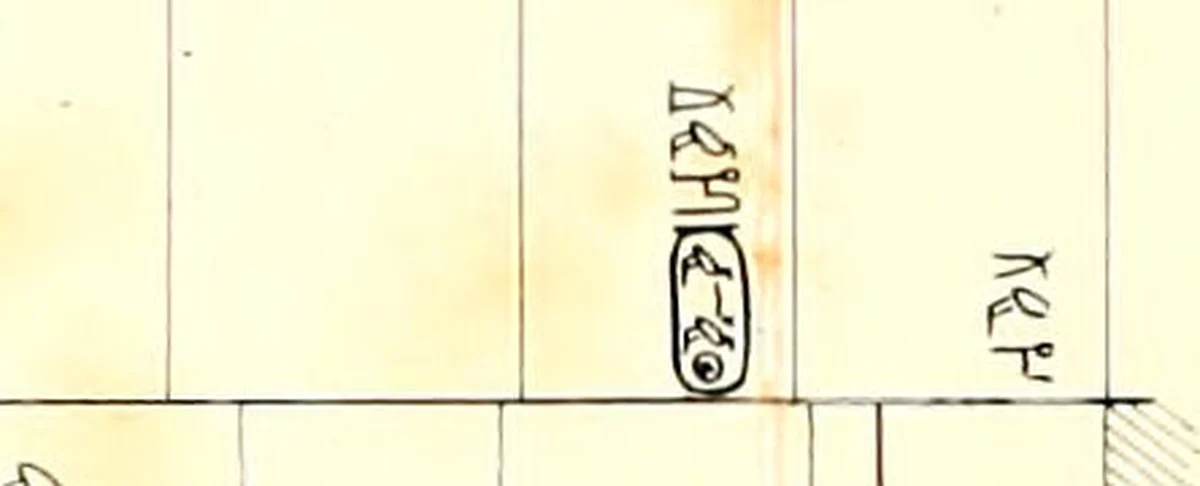
The Khufu cartouche on the south side of Campbell's Chamber, as the 1839 plate prints it, with a dot in the circle. In the photograph Stower reproduced, the same circle is hatched. Detail of the plate of Campbell's Chamber, south side, in Howard Vyse, Operations Carried On at the Pyramids of Gizeh, vol. I, plate imprint 1839; public domain; University of Pittsburgh scan via Internet Archive. Cropped and enlarged. 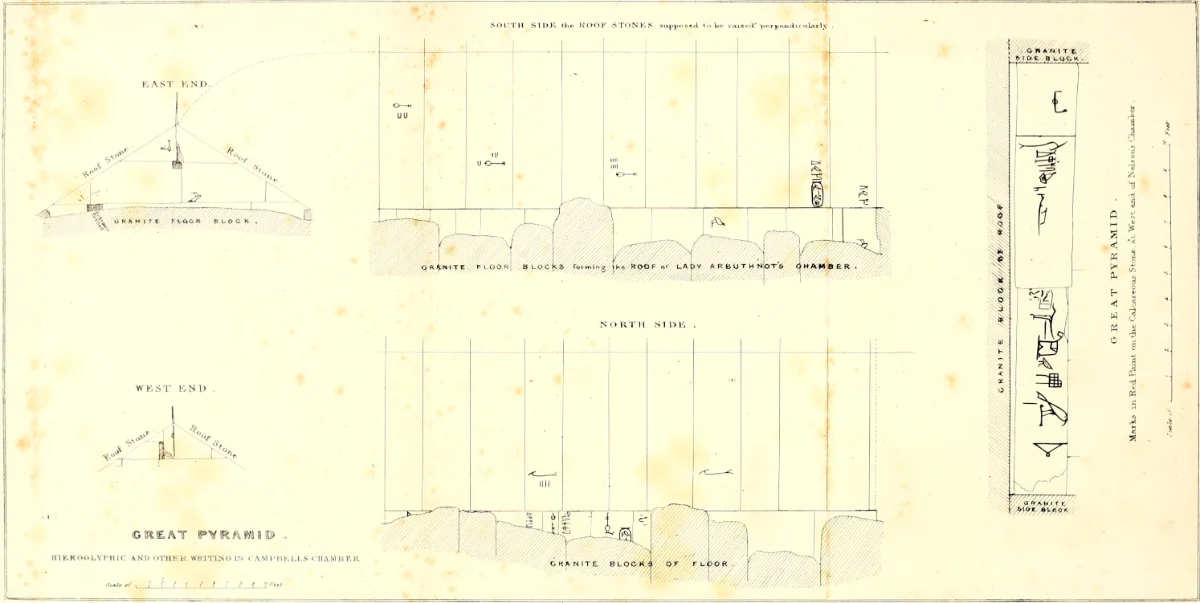
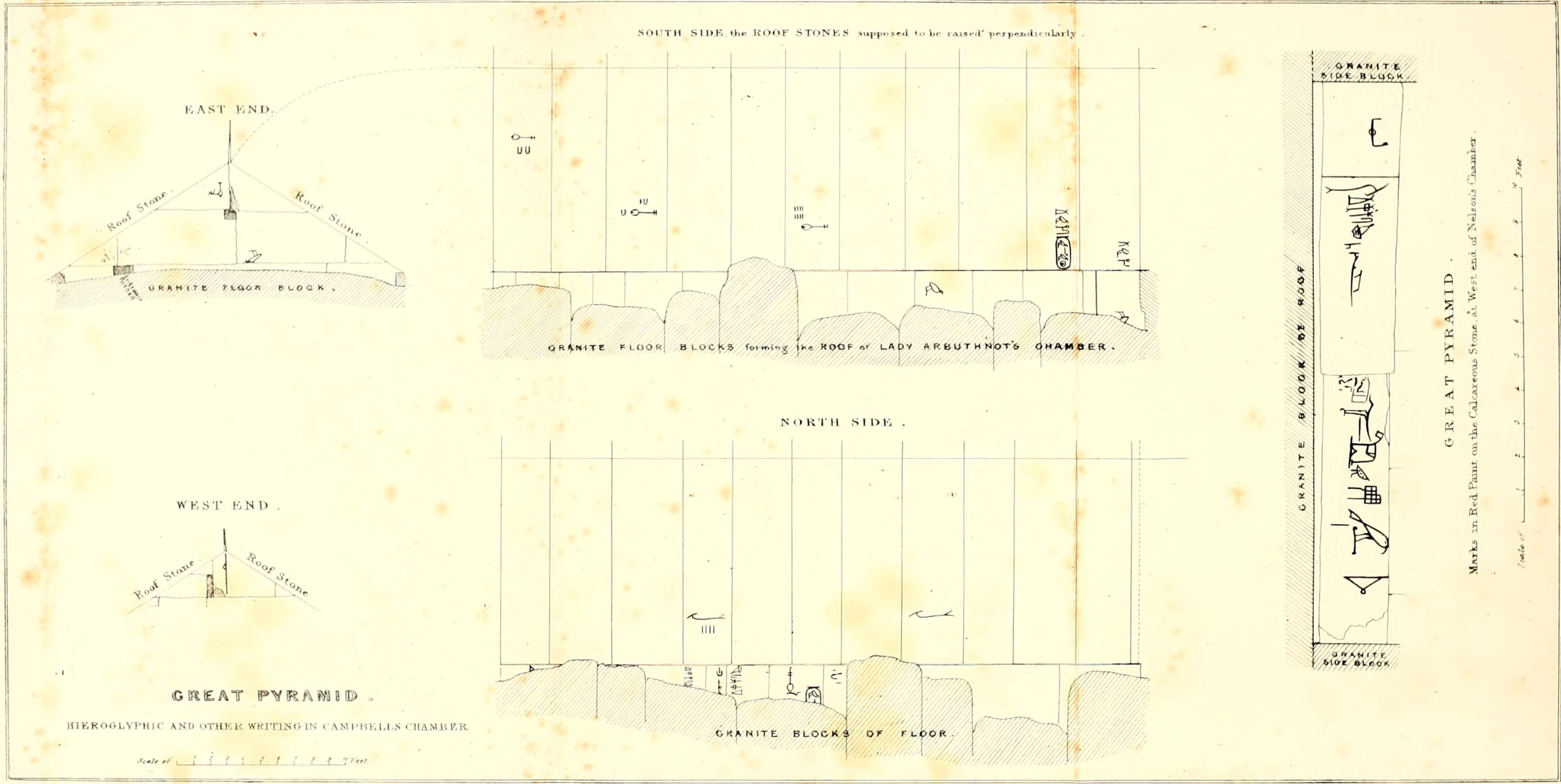
Vyse's plate of Campbell's Chamber, with the sloping roof stones at each end and the two long walls opened flat. Plate of Campbell's Chamber, in Howard Vyse, Operations Carried On at the Pyramids of Gizeh, vol. I, plate imprint 1839, lithograph by Day & Haghe; public domain; University of Pittsburgh scan via Internet Archive. Cropped to the plate. 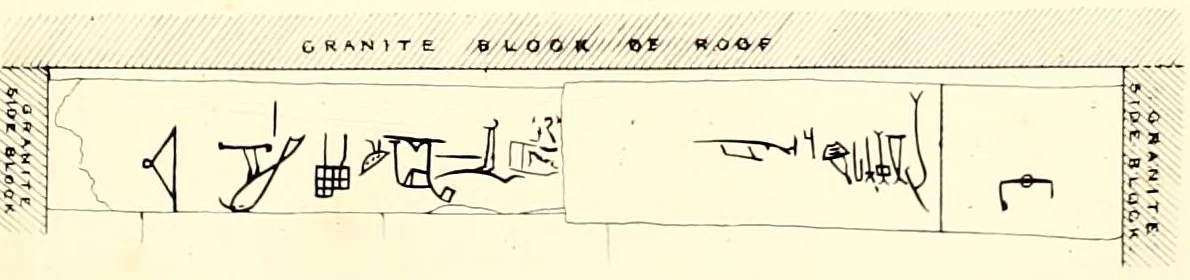
Red marks at the west end of Nelson's Chamber, as Vyse's plate draws them, turned here to read across the page. Marks at the west end of Nelson's Chamber, from the plate of Campbell's Chamber in Howard Vyse, Operations Carried On at the Pyramids of Gizeh, vol. I, plate imprint 1839; public domain; University of Pittsburgh scan via Internet Archive. Cropped and turned 90 degrees.
Sources
- Operations Carried On at the Pyramids of Gizeh in 1837, vol. I, 1840 Colonel Howard Vyse; James Fraser, London; University of Pittsburgh scan Primary record
- Samuel Birch's note on the quarry marks, in Vyse, Operations, vol. I, pp. 279-284 Samuel Birch, in Vyse, 1840 Primary record
- The Pyramids and Temples of Gizeh, 1883 W. M. Flinders Petrie; Field and Tuer, London Primary record
- Mycerinus: The Temples of the Third Pyramid at Giza, 1931, Appendix E George A. Reisner; Harvard University Press Primary record
- Les papyrus de la mer Rouge I: Le Journal de Merer, excerpt with English translation, 2017 Pierre Tallet; IFAO, MIFAO 136 Primary record
- Les papyrus de la mer Rouge I, catalogue record, 2017 Institut francais d'archeologie orientale Primary record
- The Stairway to Heaven, 1980, publisher's record Zecharia Sitchin; Bear & Company Study
- The Wars of Gods and Men, 1985, publisher's record Zecharia Sitchin; Bear & Company Study
- Journeys to the Mythical Past, 2007, publisher's record Zecharia Sitchin; Bear & Company Study
- Misspelling the Pharaoh's name? (1), archived 1999 Martin Stower Study
- Misspelling the Pharaoh's name? (2), archived 1998 Martin Stower Study
- Forging the Pharaoh's name?, archived 1997 Martin Stower Study
- New Claims About The Great Pyramid, Citing The Oldest Papyrus Ever Found, 2016 Preston Peet; grahamhancock.com Study
- Who Built the Great Pyramid? Jason Colavito Study
- Review of Scott Creighton's book, part 1, 2016 Jason Colavito Study
- The Great Pyramid Hoax, publisher's record Scott Creighton; Bear & Company Study
- Radiocarbon Dates of Old and Middle Kingdom Monuments in Egypt, Radiocarbon 43(3), 2001 Bonani, Haas, Hawass, Lehner, Nakhla, Nolan, Wenke, Wolfli Primary record
- Dating the Pyramids, Archaeology 52(5), 1999 David H. Koch Pyramids Radiocarbon Project Study
- Discovery of a big void in Khufu's Pyramid by observation of cosmic-ray muons, Nature 552, 2017 Morishima et al. Primary record
- Precise characterization of a corridor-shaped structure in Khufu's Pyramid by observation of cosmic-ray muons, Nature Communications 14, 2023 Procureur et al. Primary record
- Men Who Vandalized Egyptian Pyramid To Prove Theory Face Charges, 2014 Scott Neuman, NPR, via KNKX Study
- 3 Germans and 6 Egyptians sentenced for stealing from Great Pyramid, 2014 Mada Masr Study
- R.I.P. Zecharia Sitchin, 2010 Alan Boyle, NBC News Study
- Limestone inventory stela, Digital Giza record Giza Project, Harvard University Study
- Herodotus, Histories II.124-126, tr. Macaulay Herodotus Primary record