
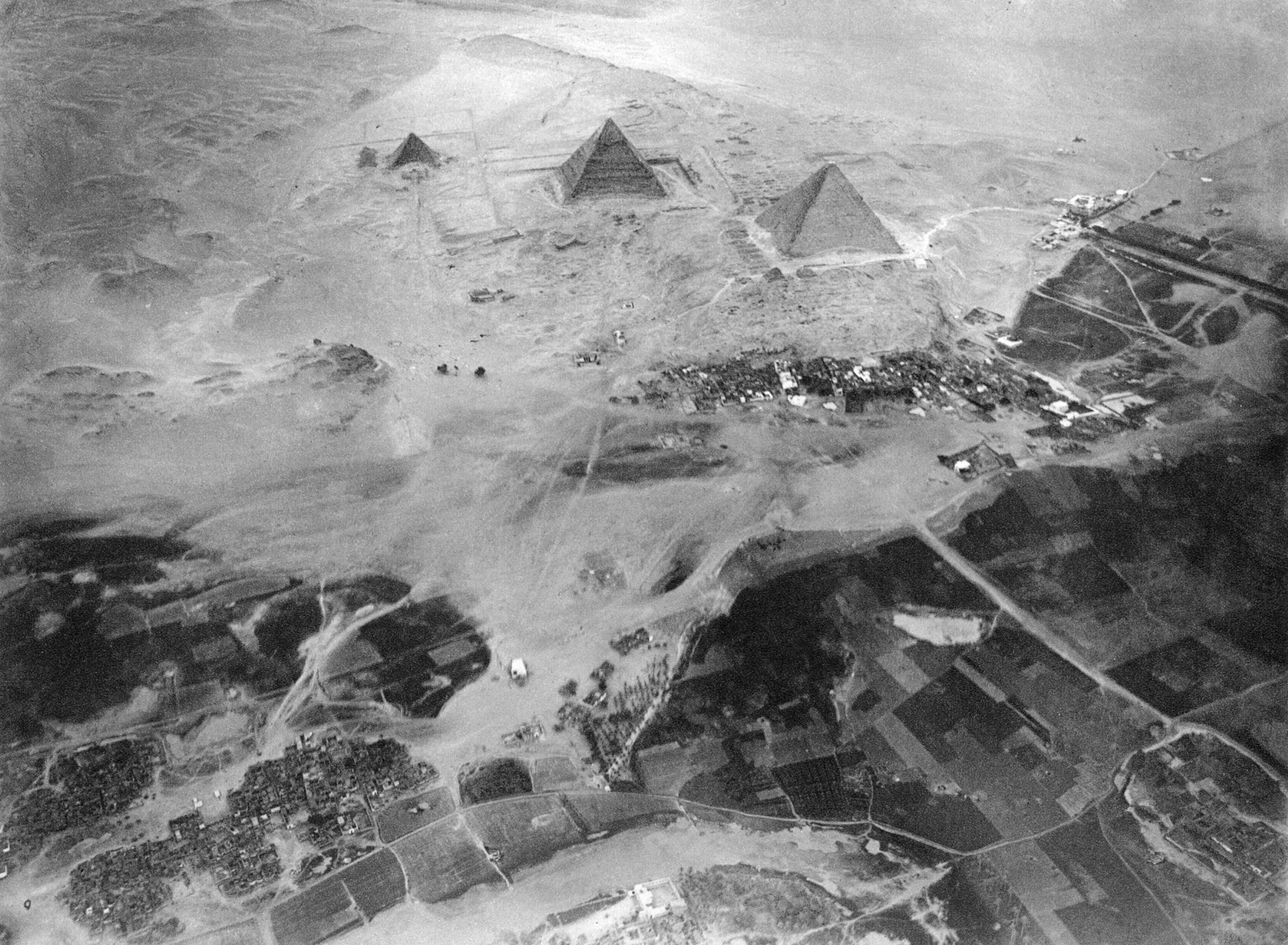
The three pyramids of Giza stand at the edge of Cairo, on the west bank of the Nile, on a line that is not quite a line. The centres of the two largest, built for the kings Khufu and Khafre, run south-west across the plateau. The third, Menkaure's, does not stay on that line. It falls about 90 metres off it, toward the south-east.
Khufu's pyramid stood 146.7 metres high with its casing whole, Khafre's 143.9, Menkaure's 65.1. Two giants and a small one, 936 metres from the first centre to the last, on a limestone ridge that goes cold and quiet after dark.
Above that ridge, on a winter night, three stars climb the southern sky in a row. Alnitak, Alnilam, Mintaka: the Belt of Orion. Two bright and one fainter, spaced so evenly that the eye joins them without being asked, and the faintest sits a little off the line of the other two. They are not neighbours. On current estimates Alnilam lies far behind the others, and the row exists only from here.
Two small kinks, one in stone and one in light. Between them, 2.7 degrees of sky and 936 metres of rock.
In November 1983 a building engineer looked up at the second and said the name of the first.
A Poster in Cairo, a Dune Near Riyadh
Robert Bauval, born in Alexandria in 1948, was by his own description a setting-out building engineer: the person who marks on the ground where a structure will stand, and who notices when something is off the line. His contracts took him to Sudan and then to Saudi Arabia.
The story is told in his book, and the book is the only record of it. On a visit to Cairo he stopped at a large poster on a gallery wall, an aerial photograph of Giza taken from directly above. Until then he had paid the third pyramid little attention. Seen from overhead, he wrote, it "stuck out like an out-of-plumb frame on a wall."
Early in November 1983 he took his wife and daughter and a friend, Jean-Pierre, camping in the dunes about twenty kilometres outside Riyadh. He woke at three in the morning, found Orion in the southern sky and went to wake the friend, who remarked that the stars of the Belt "are not perfectly aligned": the smallest was offset. Bauval cut him short. "The three pyramids of Giza," he said.
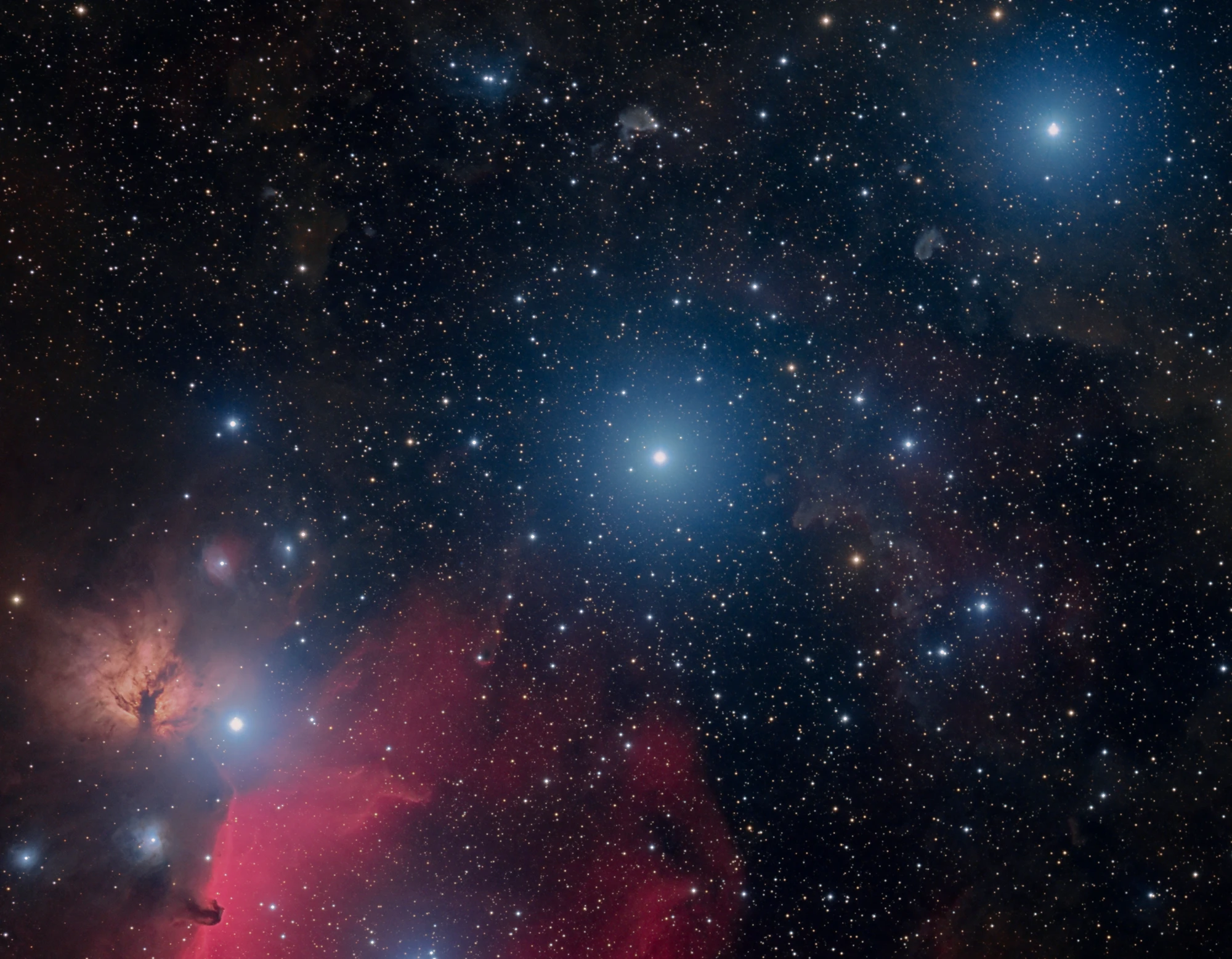
The idea went round for six years before it went into print. Bauval sent an unpublished paper to several Egyptologists between 1983 and 1986. In 1989 the journal Discussions in Egyptology ran it in volume 13: Alnitak for Khufu, Alnilam for Khafre, Mintaka for Menkaure. He set out four correspondences. Both groups slant to the south-west. The small member of each sits off to the east. The small pyramid goes with the faintest star. The middle member is almost equidistant from the other two.
His conclusion was plain. "A Masterplan with intent to correlate the Great Pyramids of Giza with the pattern of the Belt Of Orion appears very likely indeed." He dated it to about 2600 BC, under Khufu.
There is no 10,500 BC anywhere in that paper. That number came later.
The King's Star and the Sky of 10,500 BC
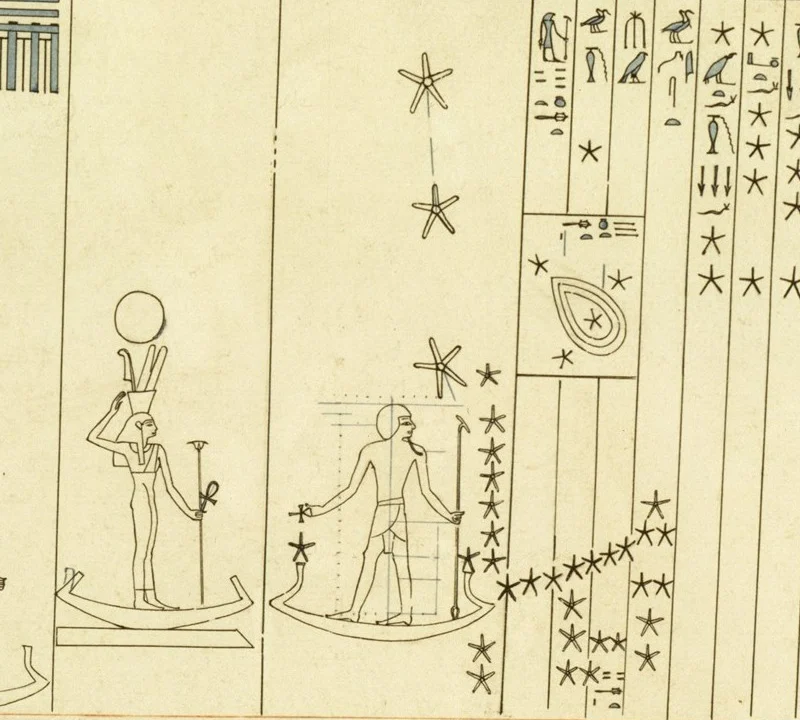
Behind the idea stands something no specialist disputes. The Egyptians watched Orion, whom they called Sah, and tied him to the dead king. In the Pyramid Texts, as Raymond Faulkner translated them and Bauval quoted them, the king goes up to him: "Behold, he has come as Orion, behold Osiris has come as Orion". The ceiling of Senenmut's tomb, a thousand years after Khufu, still shows Sah on his boat with three stars above him.
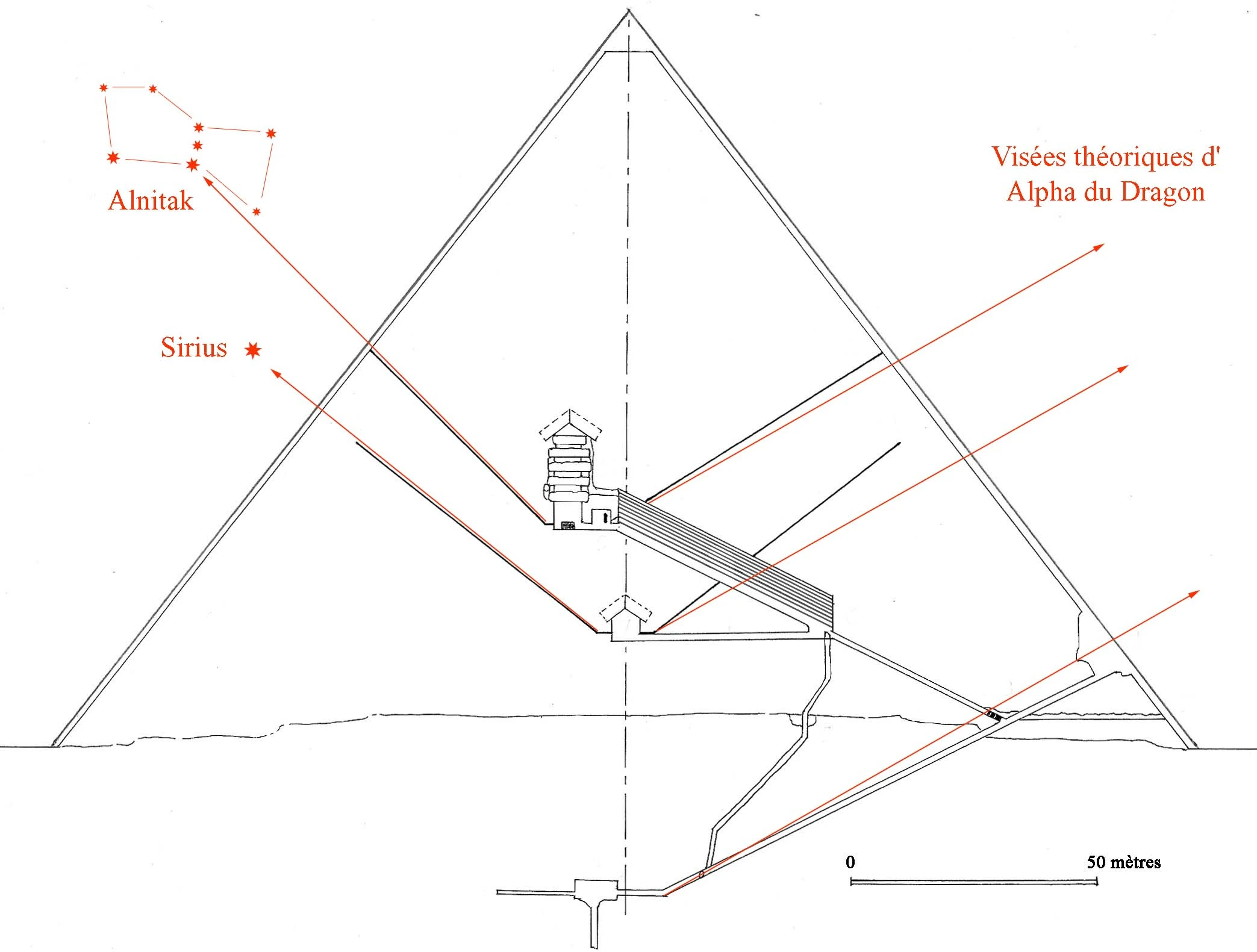
Stone had already been tied to that star. In 1964 the astronomer Virginia Trimble and the Egyptologist Alexander Badawy published side by side on the two narrow shafts that run from the King's Chamber of the Great Pyramid to the outer faces. Trimble took the southern shaft at 44 and a half degrees and found that a star of the Belt crossed the sky at that height between about 2840 and 2480 BC. She read the shafts as ways for the king's soul to rise. In 1993 Rudolf Gantenbrink, working the shafts with his small robot Upuaut for the German Archaeological Institute, gave that southern shaft as 45 degrees exactly. Bauval moved his date with it: "In c. 2450BC, when the Great Pyramid was built", the book says.
The Orion Mystery, written with Adrian Gilbert, came out in 1994, and a BBC2 programme that February reached several million viewers. The plan had grown. The pyramid at Abu Rawash became the star Saiph, the one at Zawyet el-Aryan became Bellatrix, and the Nile became the Milky Way, with Giza to its west as the Belt lies west of that band of light.
Then came the date. The slow wobble of the Earth's axis, called precession, lifts and lowers the stars over about 26,000 years. In Khufu's time the Belt crossed the meridian at Giza about 45 degrees up. Near 10,500 BC it was at the bottom of its swing, about 9 degrees above the horizon. Only then, the book argued, did the Belt beside the Milky Way match the pyramids beside the Nile "with uncanny precision." In Keeper of Genesis, 1996, Bauval and Graham Hancock wrote: "It is not until 10,500 BC, however - 8000 years before the 'Pyramid Age' - that the perfect correlation is finally achieved". They tied it to Zep Tepi, the First Time, the Egyptians' time of the gods.
They never said the pyramids were built then. Hancock told the BBC: "I accept Egyptological opinion the great pyramids were built in 2,500BC." The reading is that the masons of the Fourth Dynasty set down a sky already eight thousand years old.
The date had a history of its own. Bauval's book notes that the American trance reader Edgar Cayce placed the start of the Great Pyramid near 10,450 BC, built by survivors of Atlantis, and that in 1974 Mark Lehner, who went on to map and dig the plateau, gathered those readings into a book. The Cayce Foundation helped pay for the 1984 radiocarbon dating of the pyramids' mortar for the same reason. Khufu's samples came back at about 2860 to 2640 BC. Bauval's book calls the readings "eerie."
Eighteen Metres
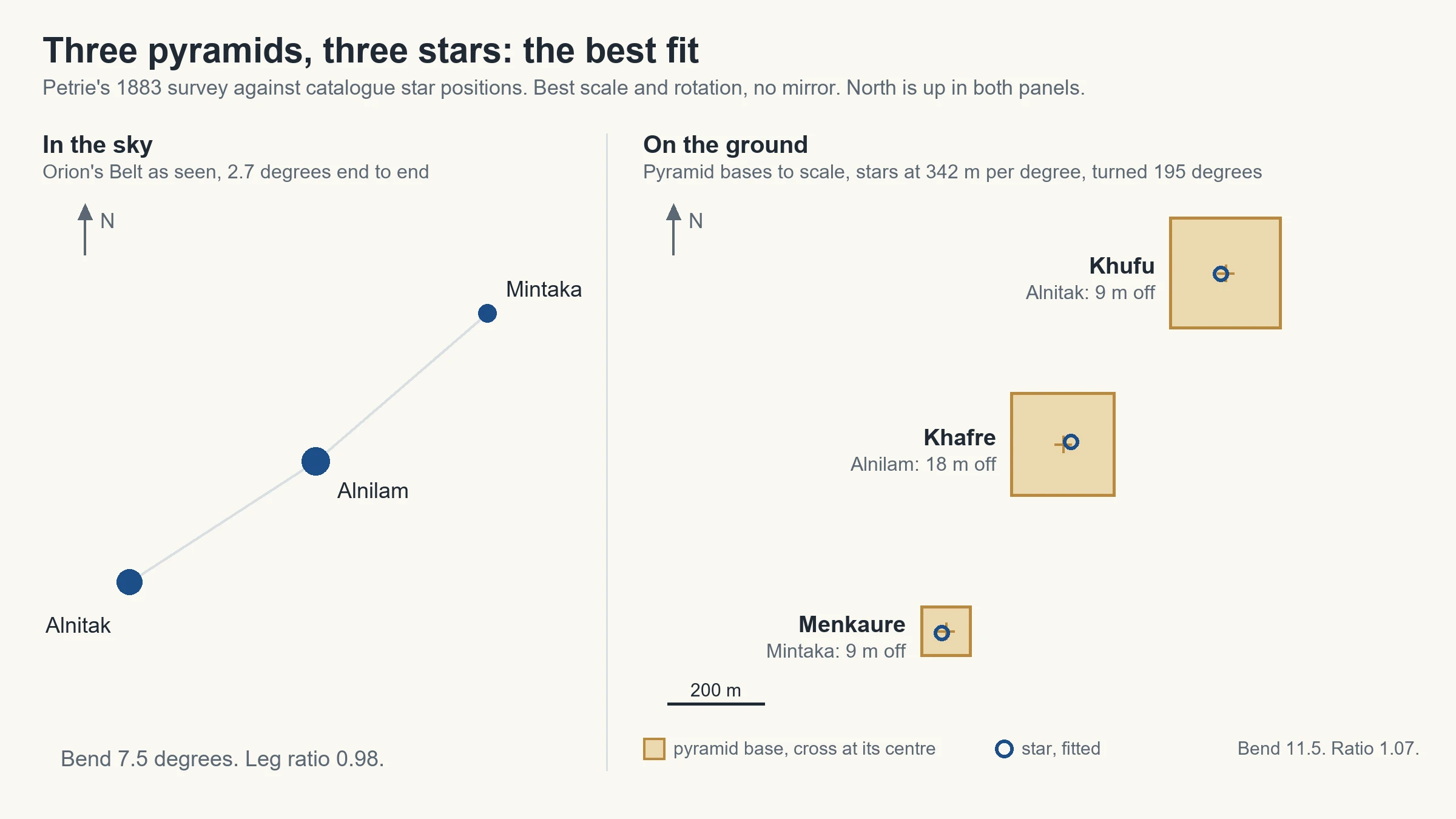
A likeness has to be measured. In 1881 Flinders Petrie triangulated the plateau and printed the offsets between the pyramid centres, in inches, to a tenth of an inch. Official X set those offsets against the catalogue positions of the three stars and let scale, rotation and position float to the best fit.
At 342 metres to one degree of sky, Khufu's centre misses Alnitak by 9 metres. Menkaure's misses Mintaka by 9. Khafre's misses Alnilam by 18.
Eighteen metres.
Over a span of 936 metres the average miss is 12.7 metres, about 1.4 percent. Pin the two ends exactly on their stars and Alnilam comes down 27 metres from Khafre's apex, well inside a base 215 metres wide. On the sky the misses are 1.6 to 3.2 arcminutes, and Vincenzo Orofino puts the best naked eye at about 3.
If the Drawing Is Real
Leave the truth of it on the table for a moment, and ask the larger question. What kind of past would we be living after, if it holds?
It would mean, first, that Giza is one drawing. Three pyramids would be three points of a single design, carried through Khufu, Khafre and Menkaure and the reign of Djedefre between them, across most of a century, while the people who drew it grew old and died. On that reading somebody kept the sheet, or kept it in memory, and each king built where the plan already said he would.
It would mean, on the 10,500 BC reading, that the drawing is a record. Eight thousand years would lie between that sky and the masons. That is more than 300 generations, longer than all of written history. Either the position of three stars was carried across that gap, or somebody worked it backward through the wobble of the Earth's axis, a motion no Egyptian text has been shown to describe.
It would mean that what we call a beginning is a middle. We tell our story forward from the first cities. If a monument of about 2500 BC is quoting the sky of 10,500 BC, then people with no cities that we know of, with the last ice sheets still melting and the pillars of Gobekli Tepe not yet raised, were watching those three stars closely enough for their watching to matter to kings. The floor under what we think our species knew, and when, would be a good deal lower.
And it would leave one thing in front of us. The Belt now stands close to the top of its swing, about 58 degrees above Giza, near the far end of the pendulum from the sky the monument would be remembering. If the builders truly read that clock, the question left to us would not be when anything happens. It would be what else was set down in stone for someone to read, and whether we would know it if we were looking at it.
North, South and the Angle
The standard account starts with the compass. The astronomer E. C. Krupp put it in Sky & Telescope in February 1997: "To make the pyramids match the sky, you have to turn Egypt upside down." The fit above needs exactly that, a rotation of about 195 degrees that puts the sky's north at Giza's south. Yet the pyramids' sides are set to the cardinal directions, and the shafts aim north and south. "The Egyptians were perfectly capable of drawing the pyramids right if they wanted to," Krupp told the BBC.
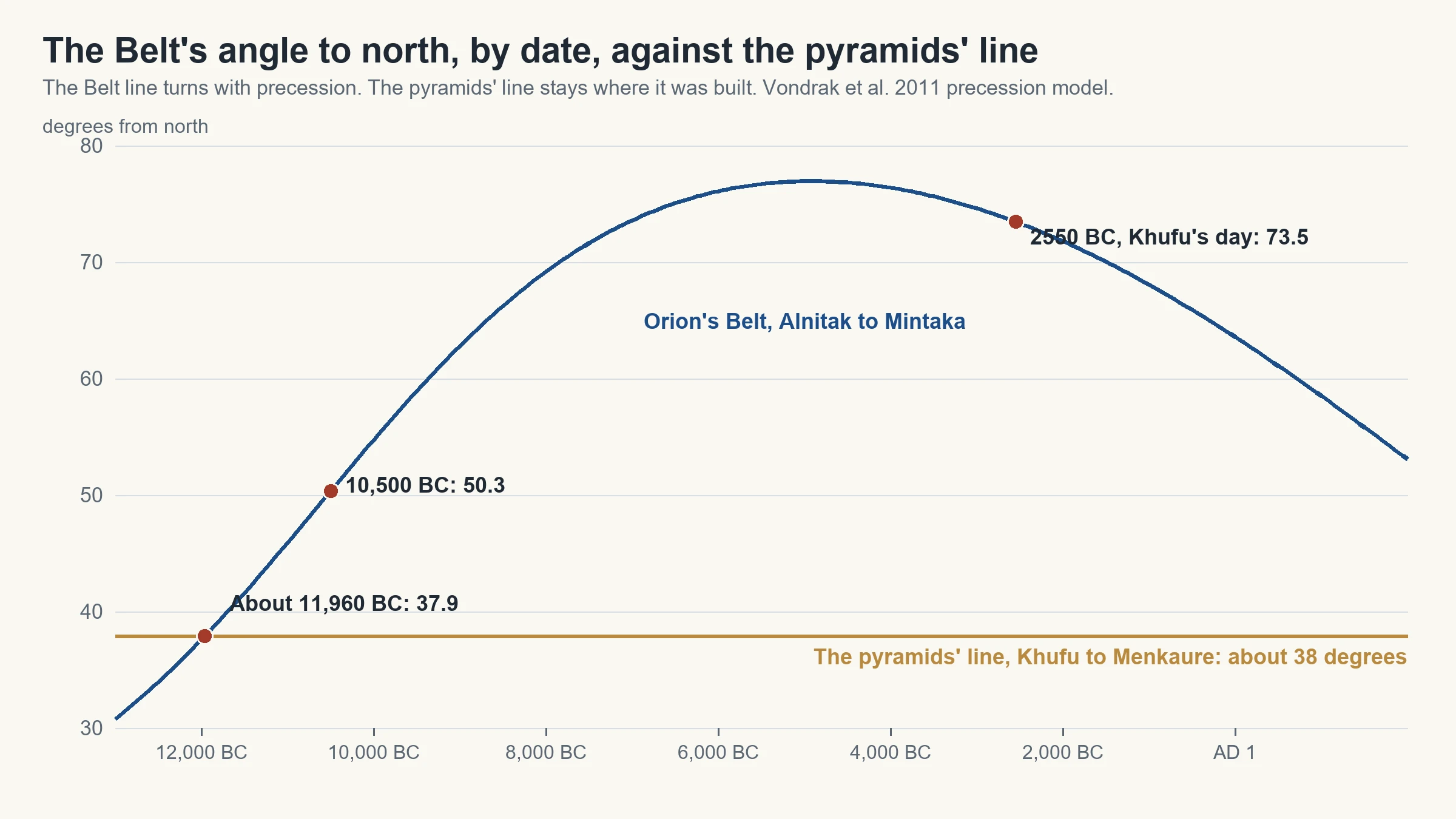
Then the angle. The astronomer Anthony Fairall wrote in Astronomy & Geophysics in 1999 that "while the line of the two outer pyramids is set 38 degrees from north, the angle of Orion's Belt to north in 10500 BC is close on 50 degrees!" The long-term precession model of Vondrak, Capitaine and Wallace, published in 2011 and run here on the same catalogue positions, agrees: about 73.5 degrees in Khufu's day, 50.3 at 10,500 BC. The Belt reaches 38 only about 11,960 BC, more than 1,200 years before its lowest point. He also passed on a point of Krupp's: the two lines bend opposite ways, the pyramids' toward the north and the Belt's toward the south.
The wider map does not scale. John Legon worked out in 1995 that at Giza's scale Saiph should fall about 2.7 kilometres from Khufu. Abu Rawash is about 8 kilometres away on today's maps.
And the ground offers its own reason. Kate Spence said on the BBC that it is "entirely possible to explain the position of the pyramids relative to each other just through the geology of the site and the nature of the pyramids themselves." Mark Lehner, David Jeffreys and Giulio Magli point to a straight line through the south-east corners, aimed at Heliopolis; Orofino puts Khafre's corner about 12 metres from it. Set squares of unequal size with their corners on one line and the small one's centre falls to the south-east of the others. Petrie, who measured it all, saw no "exact relation between their centres."
What the Compass Does Not Reach
The flip is less fatal than it sounds. A map's north is a habit, and Krupp himself grants that the orientation of a map is "a matter of convention and arbitrary." Orofino reports Bauval's reply, that Egyptians "probably drew their geographic maps with South 'at the top'", toward the river's source. Which way they would have laid a star plan on the ground, if they ever did, nobody can show. When Hancock and Bauval took the BBC's Horizon film Atlantis Reborn to the Broadcasting Standards Commission, it rejected most of their complaint and found the makers had acted in good faith, but it upheld one point: the film had unfairly left out one of their arguments against a critic of the correlation.
The shafts are the part most critics accept. Fairall agreed that they point at the pole star, the Belt and Sirius "clearly intentionally and not coincidentally." Only the single target is shaky. The three stars sit within about a degree of each other in height, the shaft's slope varies by about a degree along its own length, and Elliot Allan found that the four shafts' best dates spread over 1,325 years.
Two statistical tests have come back on the theory's side. In 2016 Orofino and Paolo Bernardini ran ten million random triples and found fewer than 0.02 percent passed their cuts, calling chance unlikely. In 2026 Allan, in the Journal of Astronomical History and Heritage, ranked Giza's shape against all 695,520 triplets of 162 bright stars. The Belt came 1,717th, p = 0.0025. Every better triplet sprawled across much of the sky, and the Belt was the only compact row. His verdict: "real but narrow." His pyramid centres are given to four decimal places of a degree, about 11 metres, and the shape they make, with a leg ratio of 0.99, is not quite Petrie's 1.07. Run again for this article on Petrie's offsets, with a star list close to his, the same method puts the Belt about 3,844th, p = 0.0055: weaker by a little over two times, and still standing.
Three points hold very little. After scale and rotation only two numbers are left: the ratio of the legs, 1.07 on the ground against 0.98 in the sky, and the bend, 11.5 degrees against 7.5. In the same arithmetic, Betelgeuse, Alnilam and Rigel fit Giza more tightly than the Belt, at 6.3 metres. Andrew Collins's rival triple in Cygnus, which Orofino rejects on a fixed angular error, fits about as well once the error is scaled to its size, at 11.4 metres. What sets the Belt apart is that it is small, it is a row, and it belonged to Sah.
What nobody has found is a word about it. The Pyramid Texts first appear about 160 years after Giza. The diary of Merer, a crew leader's papyrus log from Khufu's reign, records limestone for his pyramid. No Egyptian text says three pyramids are three stars. People have gone looking for the link in the texts and in the ground.
They did not find it.
The Number Under the Numbers
Most of what was built on the idea has not held. The direction fails, the wider map fails, the 10,500 BC date needs a Belt that was still 12 degrees off, and the Fourth Dynasty's builders stand in the record with their dates, their gang marks and their town. On those points the record leans to the plateau and the ridge.
One narrow thing remains. Allan's tests and Orofino's agree on it, and so does Petrie's arithmetic. A row of three stars the Egyptians cared about fits a row of three pyramids to about 18 metres, and a coincidence that good does not come up often among bright stars.
How often is the part nobody can fix. A probability needs a denominator: how many star patterns the builders would have considered, how many layouts on that ridge would have impressed a man on a dune. Count only compact rows and the Belt is alone. Count every bright triple in the sky and hundreds do as well. Allan tried twelve sites and the adjusted figure rose to 0.03. No one was there to say which count is the right one.
A test exists in principle. An Old Kingdom plan of the plateau would show what its builders thought they were drawing. The door in the Queen's Chamber south shaft, 63 metres in, drilled in 2002 to show a second slab 21 centimetres behind, may hide something or nothing, and could not settle this alone.
The ground and the sky still agree to eighteen metres and disagree by twelve degrees, and the one person who could say which of those numbers was meant left no note.
Questions This Leaves You With
Is there anything a person actually does with this?
Nothing in your own life follows from it, and anyone selling you a date from it is selling something. What you can do costs nothing. On a clear winter night, find the three stars and look at the third: the slight offset is real, and you can see it without a telescope. Petrie's book is free to read, and his offsets take an evening with a spreadsheet to compare with a star catalogue. Whether the people who raised those stones saw what you are seeing is the larger question, and it is still unanswered.
Does this sit against a religious account of the world?
It cuts both ways. Some readers find in a sky-plan a people who took heaven seriously enough to build it in stone, and that sits easily with faith. Others see in a lost age of watchers an account of the past with no room for the story their tradition tells. Egyptian religion itself gives you a king who goes up to Sah, and that much is written. This site will not tell you which way any of it falls, because the measurements cannot, and because that was never a question for a ruler or a star catalogue.
Does this change what a human life is?
A human life is about 80 years, and the Belt's swing is about 26,000, so a life covers less than a third of one percent of it. One way to feel that: everything you will ever do fits inside a shift of the stars too small to see. The other way: people with lives as short as yours looked up and may have thought it worth moving a mountain of stone to answer what they saw. Those are different feelings, and you may already know which one you had.
What would change your mind, in either direction?
Name it now, before you settle. Toward the plan: an Old Kingdom text linking the three pyramids to three stars, or a plan on papyrus or stone, or a test that fixes its star list and its site list in advance and still finds the Belt alone. Away from it: a published model showing that the ridge and the corner line produce the same 18-metre fit with no stars involved, or the same exercise run on many other pyramid groups and turning up fits just as tight. Each of those could be done. It is worth deciding now what you would accept.
Were the three pyramids ever planned together at all?
This is the question under the question, and it is open with or without Orion. Khufu's successor Djedefre built 8 kilometres away. Khafre came back. Menkaure built far smaller and set well to the south-west. Lehner, Magli and others see signs of a shared design, at least for the first two, and Nell and Ruggles list reasons for some planning ahead and cautions against too much. No document records anyone deciding where the third pyramid would go, or why it is a tenth the volume of the first. That empty space is where every reading of Giza, stellar or not, has to begin.
Sources
- R. G. Bauval, A Master-Plan for the Three Pyramids of Giza Based on the Configuration of the Three Stars of the Belt of Orion, Discussions in Egyptology 13 (1989), 7-18 Discussions in Egyptology; held by Digital Giza, Harvard Primary record
- Robert Bauval and Adrian Gilbert, The Orion Mystery (1994), publisher record Heinemann / Crown; Penguin Random House record Primary record
- Robert Bauval and Graham Hancock, Keeper of Genesis (1996), catalogue record Heinemann; Open Library record Primary record
- W. M. Flinders Petrie, The Pyramids and Temples of Gizeh (1883), section 92 Field and Tuer; Internet Archive scan, public domain Primary record
- SIMBAD astronomical database: Alnitak (HIP 26727), Alnilam (HIP 26311), Mintaka (HIP 25930) CDS Strasbourg, Harvard mirror Primary record
- ERFA routines ltpequ and ltpecl, the long-term precession of Vondrak, Capitaine and Wallace (Astronomy and Astrophysics 534, 2011) ERFA Primary record
- Virginia Trimble, Astronomical Investigation Concerning the So-Called Air-Shafts of Cheops' Pyramid, MIO 10 (1964), 183-187 Digital Giza, Harvard, record Primary record
- John A. R. Legon, The Orion Correlation and Air-Shaft Theories, Discussions in Egyptology 33 (1995), 45-56, reprint Hall of Maat Study
- Zahi Hawass, The Secret Doors Inside the Great Pyramid, in The Treasures of the Pyramids (2003), 156-159, catalogue record Open Library record; the chapter was read through Digital Giza, Harvard Primary record
- Jaromir Malek, Orion and the Giza Pyramids, Discussions in Egyptology 30 (1994), reprint Hall of Maat Study
- E. C. Krupp, Pyramid Marketing Schemes, Sky and Telescope 93(2), February 1997, 64, reprint Hall of Maat Study
- E. C. Krupp, Astronomical Integrity at Giza (2001) Hall of Maat Study
- Anthony Fairall, Precession and the layout of the ancient Egyptian pyramids, Astronomy and Geophysics 40(3), June 1999, archived reprint Royal Astronomical Society journal; Internet Archive copy Primary record
- Horizon, Atlantis Reborn Again, transcript (BBC, 2000) BBC Primary record
- Broadcasting Standards Commission, synopsis of adjudication on Horizon: Atlantis Reborn BBC Primary record
- V. Orofino, A quantitative astronomical analysis of the Orion Correlation Theory (2011) arXiv Primary record
- V. Orofino and P. Bernardini, Archaeoastronomical Study of the Main Pyramids of Giza, Egypt: Possible Correlations with the Stars?, Archaeological Discovery 4 (2016), 1-10 SCIRP, CC BY 4.0 Primary record
- Elliot Allan, A Comprehensive Statistical Evaluation of the Orion-Giza Correlation, Journal of Astronomical History and Heritage 29(2), 367-378 (2026) Journal of Astronomical History and Heritage Primary record
- Giulio Magli, The Giza written landscape and the double project of King Khufu (2013) arXiv Primary record
- Erin Nell and Clive Ruggles, The Orientations of the Giza Pyramids and Associated Structures, Journal for the History of Astronomy 45(3) (2014) arXiv Primary record
- G. Bonani and others, Radiocarbon Dates of Old and Middle Kingdom Monuments in Egypt, Radiocarbon 43(3) (2001), 1297-1320 Cambridge University Press Primary record
- A. C. Sparavigna, on the Wadi al-Jarf papyri and the diary of Merer (2024) arXiv Study
- The Lost City of the Pyramid Builders Ancient Egypt Research Associates Study
- Ancient Egyptian Astronomy database, glossary: Sah McMaster University Study
- Astronomical Ceiling, facsimile of the tomb of Senenmut by Charles K. Wilkinson, 48.105.52 The Metropolitan Museum of Art Primary record
- Robert Bauval Wikipedia General reference