Mantis beings are the tall insect figures of modern contact lore, described in two records that are easy to confuse and should not be. In one, a voice speaks through a medium. In the other, a person says they stood in front of one, usually remembering it under hypnosis or on a drug.
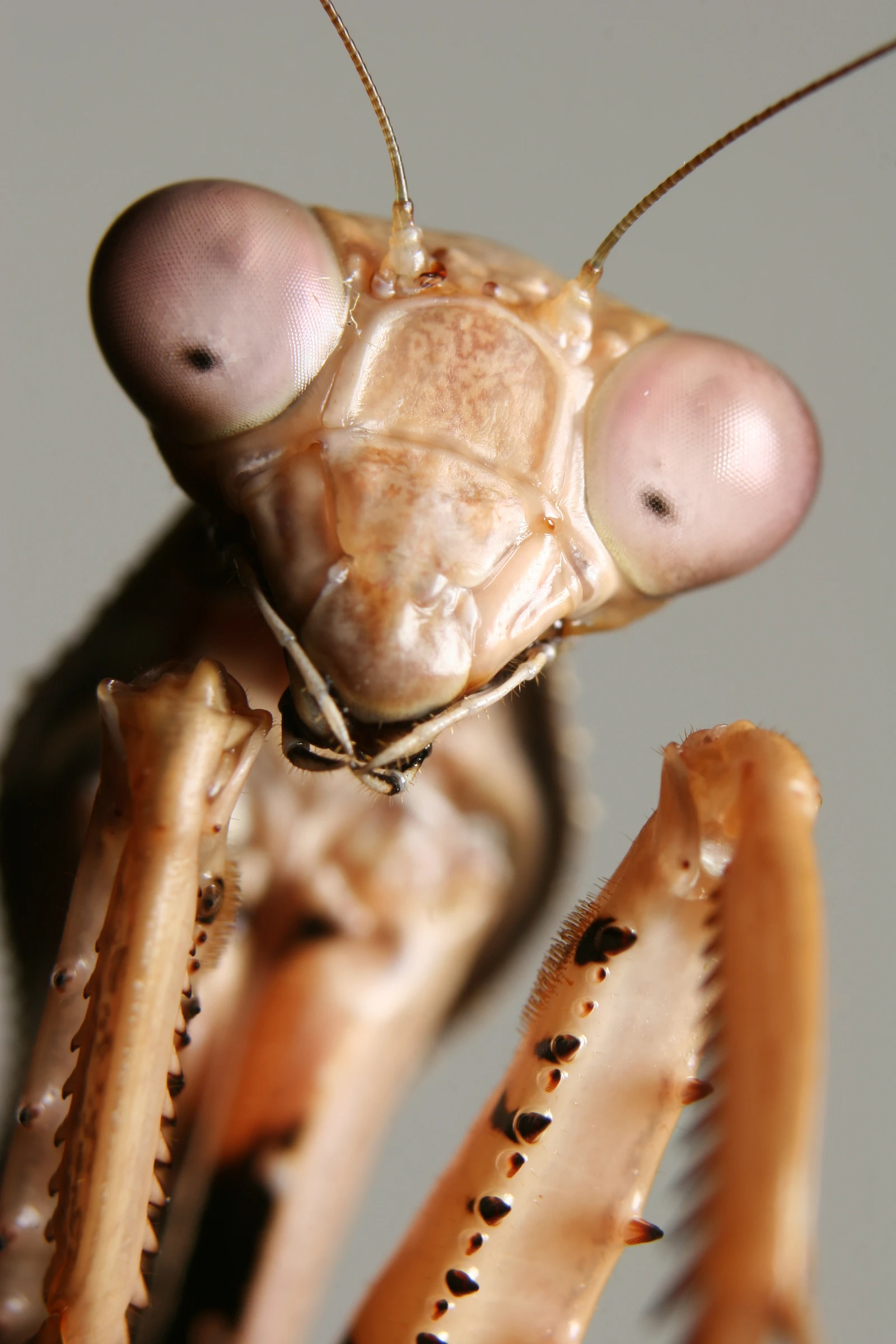
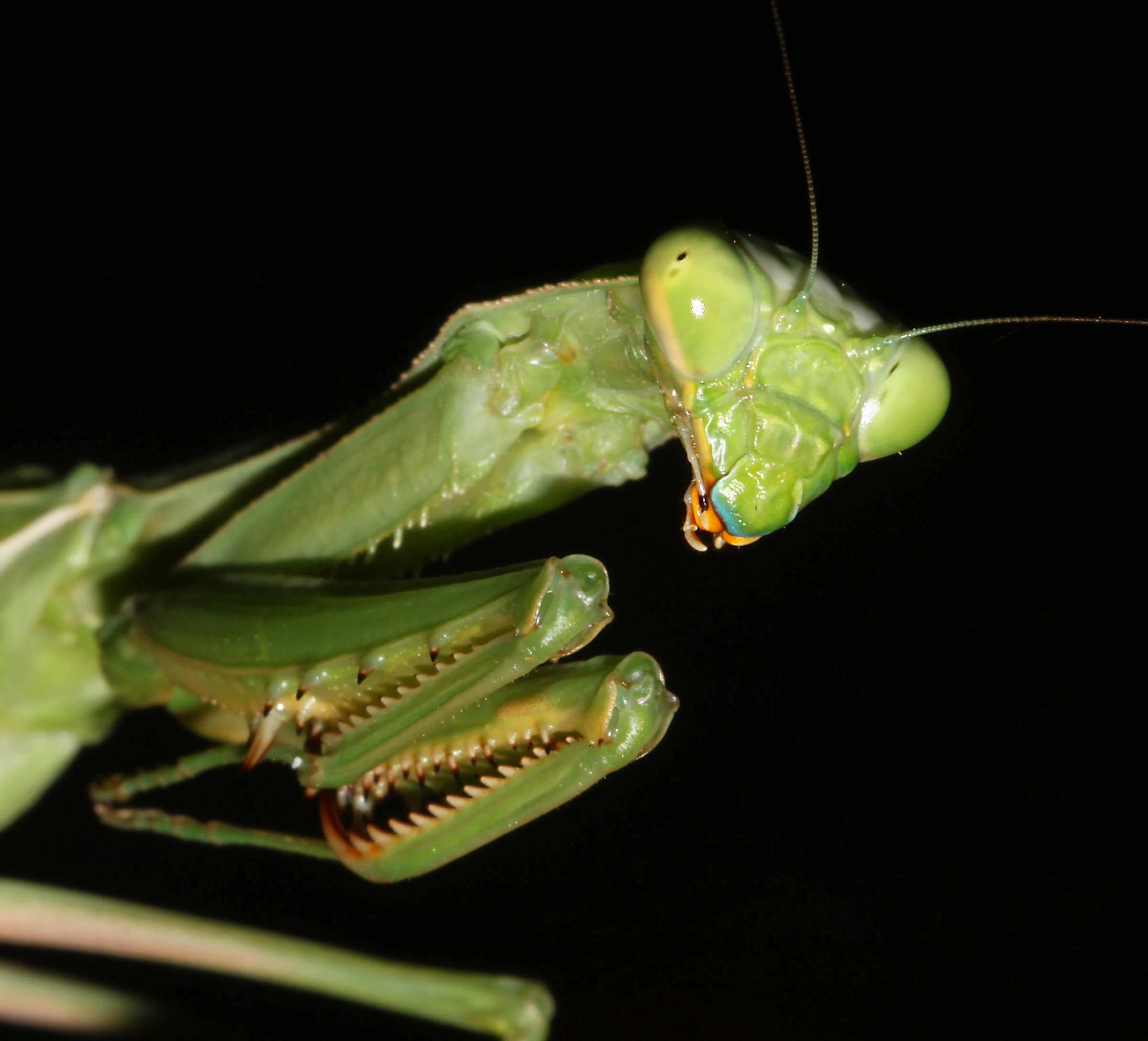
The name comes from a real animal. A praying mantis is a few inches long, with forelegs folded as if in prayer and a triangular head that some species can turn nearly 180 degrees. Each eye carries up to 10,000 facets and a small black dot that seems to follow whoever is looking. The dot is an optical effect, a pseudopupil, not an eye fixed on anyone.
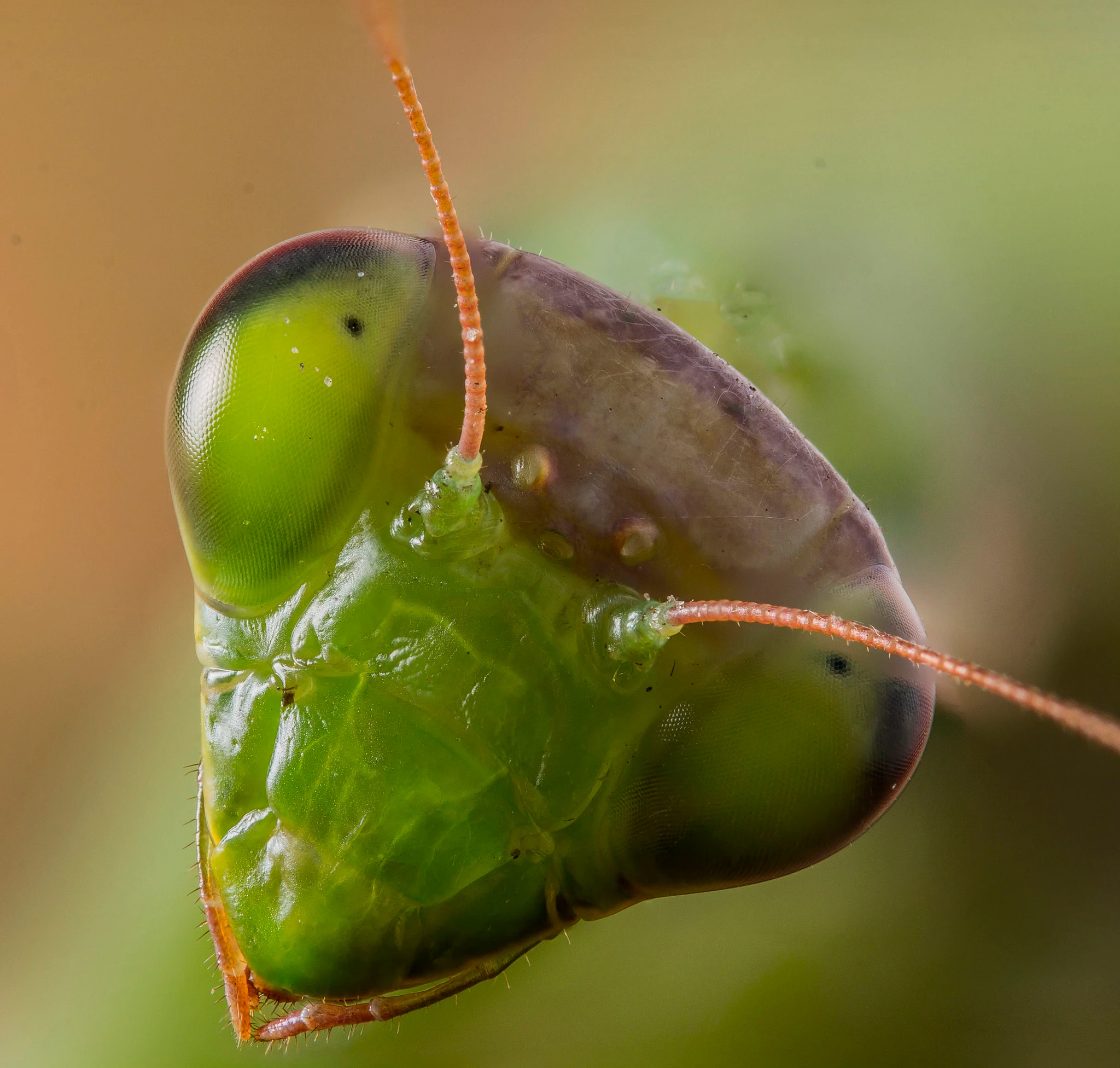
It looks back anyway.
Stretch that animal to eleven feet, the height a spirit board gave in October 1994. Put a high collar on it, the way an abduction researcher's subjects did. Set it in a hive, the way a carpenter did in a research ward in New Mexico, with DMT in his veins.
One man's memory reaches to the late 1950s. The oldest page found here does not get past the middle of the 1980s.
March 14, 1986
On March 14, 1986, the novelist Whitley Strieber went under hypnosis with the psychiatrist Donald F. Klein. A muggy evening, a vacant lot, a tent, his sister Patricia, The Ed Sullivan Show on inside. Then the sentence Martin Kottmeyer would later trace the mantis to.
"A praying mantis is what it looks like. Only it's so big."
Asked his age, he said twelve. A little later he wavered. At first it looked like a guy on a motorcycle in dark glasses. Then it almost was a mantis. Then not: a mantis has white eyes, he said, and this thing's were black. Awake, in the same book, he said why he called his visitors insectlike: the stiffness and the enormous black eyes. No feelers. No wings.
Communion appeared in 1987.
It may not have been the first page. Stanislav Grof reprinted in 1988 a writer's session: 150 milligrams of MDMA, 20 of 2C-B four hours later, and "huge, mantis-like beings." He cites Sophia Adamson, 1986. Catalogues date her Through the Gateway of the Heart to 1985. Official X read the passage only in Grof.
After Communion the figure spread. Three or four weeks after a hypnosis session in 1988, doing the dishes, Linda Porter remembered a mantis-type creature about eight feet tall. Karla Turner's son David, regressed by Barbara Bartholic, drew what he had seen, and in 1992 his mother wrote that it looked like "a tall, pale-white praying mantis." By 1994 she counted insectoid Whites in seven of the eight women in her book Taken.
In 1998 the historian David Jacobs, working from hypnosis sessions, wrote the portrait down in The Threat: very tall, something like a mantis or a giant ant, usually in a cape or long robe with a high collar.
An insect, dressed.
The Voice in Sedona
In the texts searched, the channeled column starts later and somewhere else. George Adamski's visitor of 1952 was a man. George Van Tassel's of 1953 gave a name. Five channeled books from 1977 to 1985, Ra among them, show none of the words mantis, insectoid or insectlike in the copies searched.
The first dated hit found is Sedona, Arizona, May 28, 1989, by the chapter head of a book printed in 1996. Robert Shapiro, channeling Joopah and Zoosh, took a question about insects that love humans. Cockroaches? No. A cricket? "This is much closer." The cricket, grasshopper and mantis type, the session says, resembles how the Founders look in certain dimensions, and the Founders are the source of all life.
The Prism of Lyra, by Lyssa Royal and Keith Priest, first printed in April 1990 and compiled chiefly from Royal's channeling, thanks Shapiro for material on the Zeta Reticuli. In the copies read, a footnote says that in dream symbology the Founders may become large insects such as praying mantises.
Which means the first channeled mantis found is no captain. It is a parent.
Then the voices fan out. Barbara Marciniak's Pleiadians, in 1992, add insectlike creator gods. Nancy Lieder's ZetaTalk, by Kottmeyer's report, calls the mantis form mammalian. Anna Hayes, who says she transcribed, gives tall teachers up to twelve feet, working beside the Zeta. An undated Bashar transcript in circulation calls the Mantis a higher organizing part of one mind with the Greys. And Laura Knight-Jadczyk's Cassiopaean spirit board, asked in October 1994 about a sitter's mantis, spells out a name: Minturians. From Orion. A week later, eleven feet. Asked how they reproduce: "Mechanically."
A Huge Infinite Hive
From 1990 to 1995 the psychiatrist Rick Strassman gave about 400 doses of DMT to 60 volunteers at the University of New Mexico. His book's summaries list mantises among the life-forms they met. His volunteer Rex, a 40-year-old journeyman carpenter, spoke of insect creatures all around him, and on a later day, at half the dose, of "a huge infinite hive."

The counts came later. Lawrence and colleagues read 3,778 Reddit trip reports of inhaled DMT: 1,719 entity encounters, 40 of them "insectoid, praying mantis, or arachnoid." Michael, Luke and Robinson, in 36 interviews published in 2021, found grey- or mantis-like beings in two and called alien abduction possibly the closest comparison in content.
Jacobs reads a chain of command running from the insects down to the greys. Graham Hancock, in Supernatural, sets the mantis beside Kaggen, the mantis god of the San, and calls the mantis the commonest insect form abductees see.
If the Shape Is the Fact
Set aside for a moment whether any of it is true. Ask the better question. What kind of universe are we living in if it is?
It would mean the insect is the one stable fact in the file. Mediums, hypnotists and drug researchers would all be reporting one figure, seen through three different keyholes, and the names, the home stars and the heights would be noise around it.
It would mean our family tree has a stranger at the root. On the reading Shapiro and Royal printed, the source of the human line would look, in some dimension, like the thing on the garden fence. Our oldest ancestor would have a compound eye.
It would mean our bodies are somebody's job. On Jacobs's chain of command, a tall figure in a robe directs smaller figures who handle people. Our species would be a project with a staff, and a human life would be one line in a file kept by something that does not blink.
And it would mean the door is close. If Rex's hive is a place, not a picture, then 0.2 milligrams per kilogram would be enough to reach it. Our species would have spent its whole history a few minutes from a crowded room.
Bashar's transcript says the Mantis has no leaders and no followers, that it is one mind. If so, what would we even say to it? What does a species of individuals say to a hive, and who among us would it think it was talking to?
The Word and Where It Came From
In 1999 Martin Kottmeyer, in The REALL News, went looking for a mantis in the old files and came back with nothing. Four catalogues of the 1960s and 1970s, hundreds of entities, not one, he reports. Thomas Bullard's 270 abduction cases through 1985, not one. By 1999 he could cite at least 26. He names the ground it grew from: Weird Science number 13 in 1952, John Lear's statement of 1987, and Communion itself, widely read. Strieber himself told Klein that the one thing he remembered reading was John Fuller in Look, on Betty and Barney Hill. BBC viewers had met locust-like Martians in Quatermass and the Pit in 1958.
Words moved too. Mike Shea said grasshoppers, and Patrick Huyghe's 1996 field guide files him under praying mantis. Bullard, reported by C.D.B. Bryan, had abductees likening gray faces to grasshoppers and mantises in 1992. Jacobs allows that insectoid reports may be "a matter of word choice," before going on to treat them as types.
Memory researchers add the method. In 2002 Susan Clancy's team found people with recovered abduction memories recalling more words that were never on a list than controls did. Brian Sharpless and Jacques Barber put lifetime sleep paralysis at 7.6 percent of the general population.
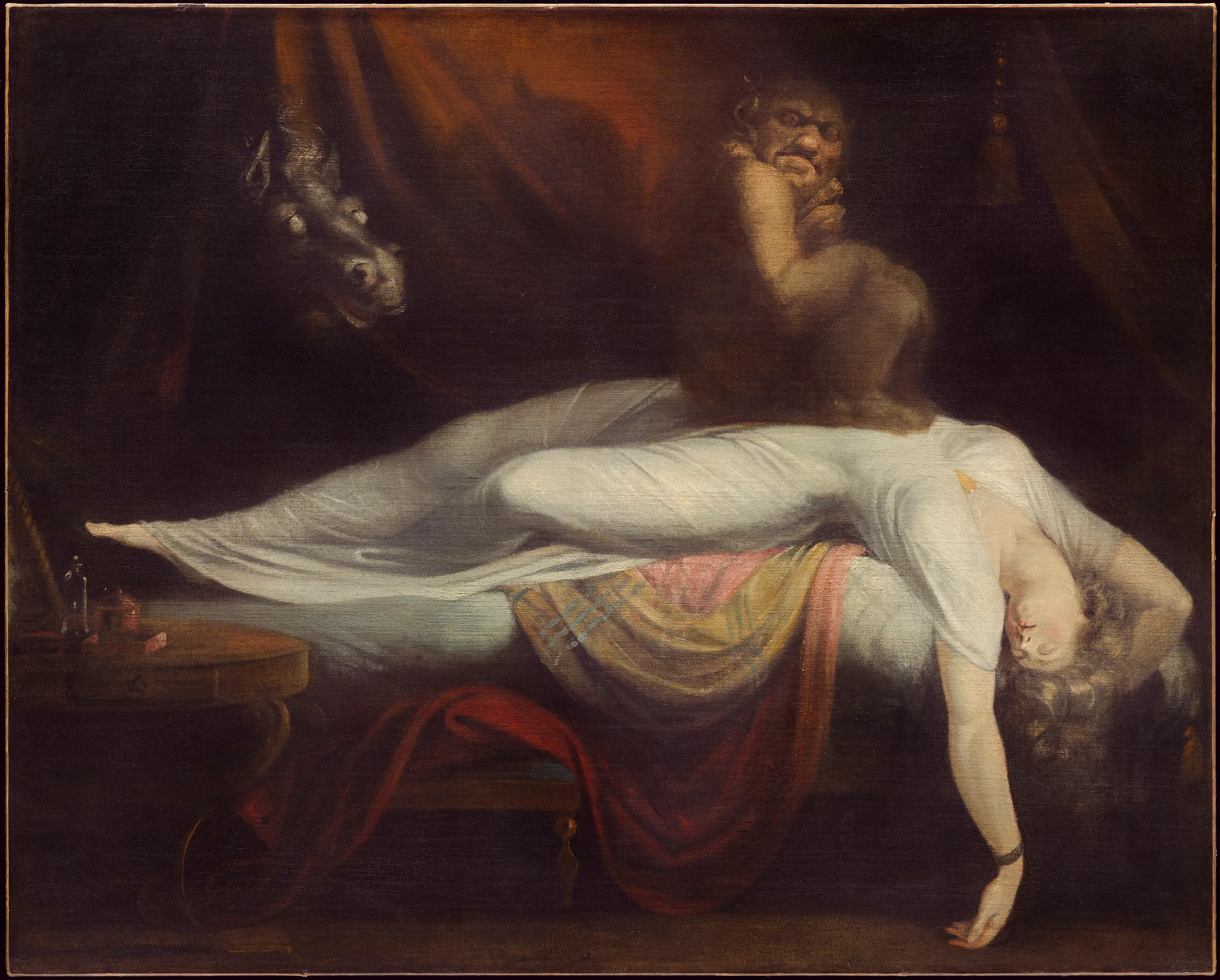
And the columns leak. The Cassiopaean sitter's mantis was later called her regression. A December 1994 question came straight from a hypnosis session, and the 2024 one cited Jacobs by name. The spirit board was answering the other record.
What the Word Does Not Explain
None of that reaches Rex. Strassman's volunteers had no hypnotist. At 7 minutes, hives rose on Rex's neck. At 10 he took off his eyeshades and spoke of insects. Strassman offered him a personal psychological meaning and says it fell on deaf ears. His notes say few volunteers knew of DMT reports of insectoid aliens, though he was asking about DMT, not about Communion.
Nor does it reach the date. Grof's 1986 and the catalogue's 1985 both put the MDMA passage before Communion, and no writer read here sets the two together.
Clancy's recovered-memory group was 11 people, and the authors say the samples are small. Nicholas Spanos and colleagues in 1993 found UFO reporters no more fantasy-prone or hypnotizable than comparison groups. Sleep paralysis puts a presence by the bed. Nothing read in those papers says why that presence should have a thorax.
Culture has its own gap. Bullard's objection, as Bryan reports it, is pointed: if Hollywood supplied the images, "where are the monsters?" Perhaps the eyes are the whole story, the grey's stare reaching for the nearest word. Strieber's own reason points that way. No study read here tests it.
Then the count. This search looked for a share of mantis reports against greys in any abduction sample. It did not find one.
Bullard's 203 cases sort into humanoid, human and nonhuman. Turner's seven of eight is eight women. Davis and colleagues surveyed 2,561 DMT users in 2020 and never offered insect as a label. The one published share found with the word mantis in it, 40 of 1,719, counts DMT reports, not abductions, and has spiders in it too.
The Mantis Speaks
In February 2026 Religion News Service found a giant inflatable blue mantis at the Conscious Life Expo in Los Angeles, beside a psychic it did not name.
The 1989 and 1994 texts speak about the mantis. In the 2020s it speaks for itself. Daniel Scranton lists for sale a recording he calls his first time connecting with the Mantis Beings. Toni Ghazi says a Praying Mantis Collective comes through him from the Antares Stargate. Michele London's Songs of the Mantis, trance transmissions, was listed for May 5, 2026.
A 2026 preprint by Andrew Gallimore and colleagues, as ScienceBlog reports it, keeps hallucination as the default and proposes tests during infusions that hold DMT steady for an hour or more. In one, a screen in a locked room flips between blue and yellow, and a volunteer tries to learn the colour from an entity. A hit would say something about information. It would not say anything about a thorax.
What is left is small. Forty reports, spiders included. Two interviews in 36. One man's second thought, partway through a hypnosis session, that the thing he had called a mantis had black eyes.
The dot in a real mantis eye is an optical effect. It has been following people around for a lot longer than anyone has been writing this down.
Questions This Leaves You With
Is there anything you actually do with this?
For your own life, nothing follows. There is no date here and no plan, and anyone selling a date is selling something. If you carry a memory like this, it is yours, and nothing here rules on it. Clancy's team writes that suggestive therapies may foster false memories, and that is worth knowing before anyone asks you leading questions. The larger question is not yours to settle alone: what a species does with a word that turns up in records this different.
Does this sit against a religious account of the world?
It cuts both ways. An insect at the root of life reads like a rival creation story. Yet a teaching that all life flows from one loving source sounds close to language many faiths already use, and a voice that speaks through a medium can be heard as a comfort or as a warning. Royal and Priest themselves say their book may be taken as literal or symbolic. This site will not tell you which way it falls.
Does this change what a human life is?
Hold the two versions up. In one, you are a line in somebody's file, and the tall thing in the robe has read it. A life gets smaller there, a specimen in a long study. In the other, the same picture makes a life rarer: a creature that can lie still, take a molecule and report on a hive, and then go home and argue about it. Which one did you feel first, and did it surprise you?
What would change your mind, in either direction?
Name it now, while nothing rests on it. In favour, you might count a mantis report dated and printed well before 1985, or volunteers screened for what they had read who still gave matching details of the same figure. Against, you might count a study showing the insect falls away when reports are collected from people with no exposure to the stories, or a first printing of Adamson that lacks the passage. Then say whether you would accept each one if it went the other way.
Why insects?
This is the open one. Clancy's subjects mostly began by waking paralysed and afraid, and Kottmeyer traces a word through comic books and paperbacks. Nothing read for this article explains why a trance or a molecule should reach for an insect at all, and not for a far more familiar animal. Lawrence's count puts feline entities below the insects and spiders, at 25. A cat sleeps on a great many beds. You have the same gap in front of you that the researchers do. No source read here fills it.
More photographs
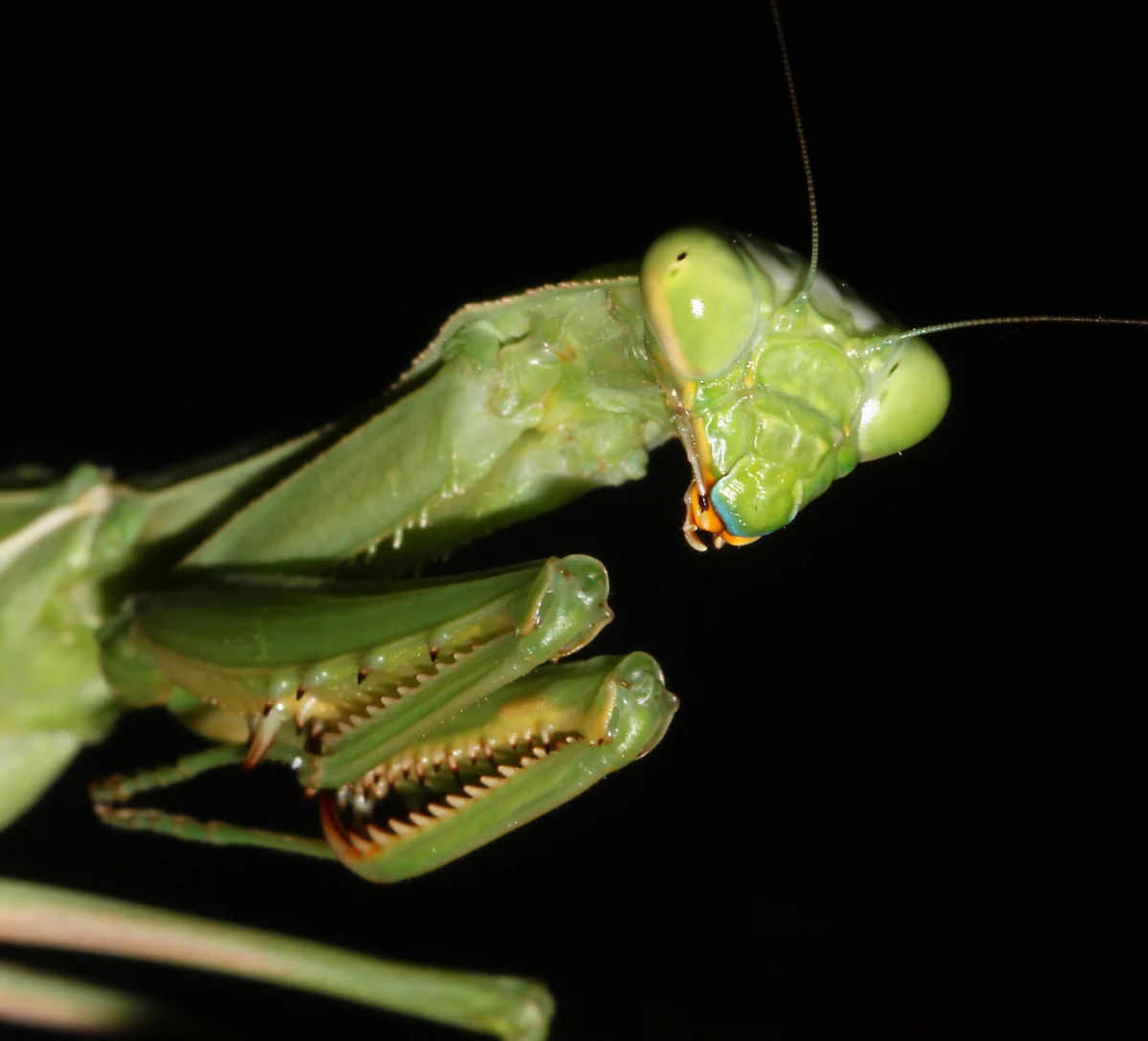
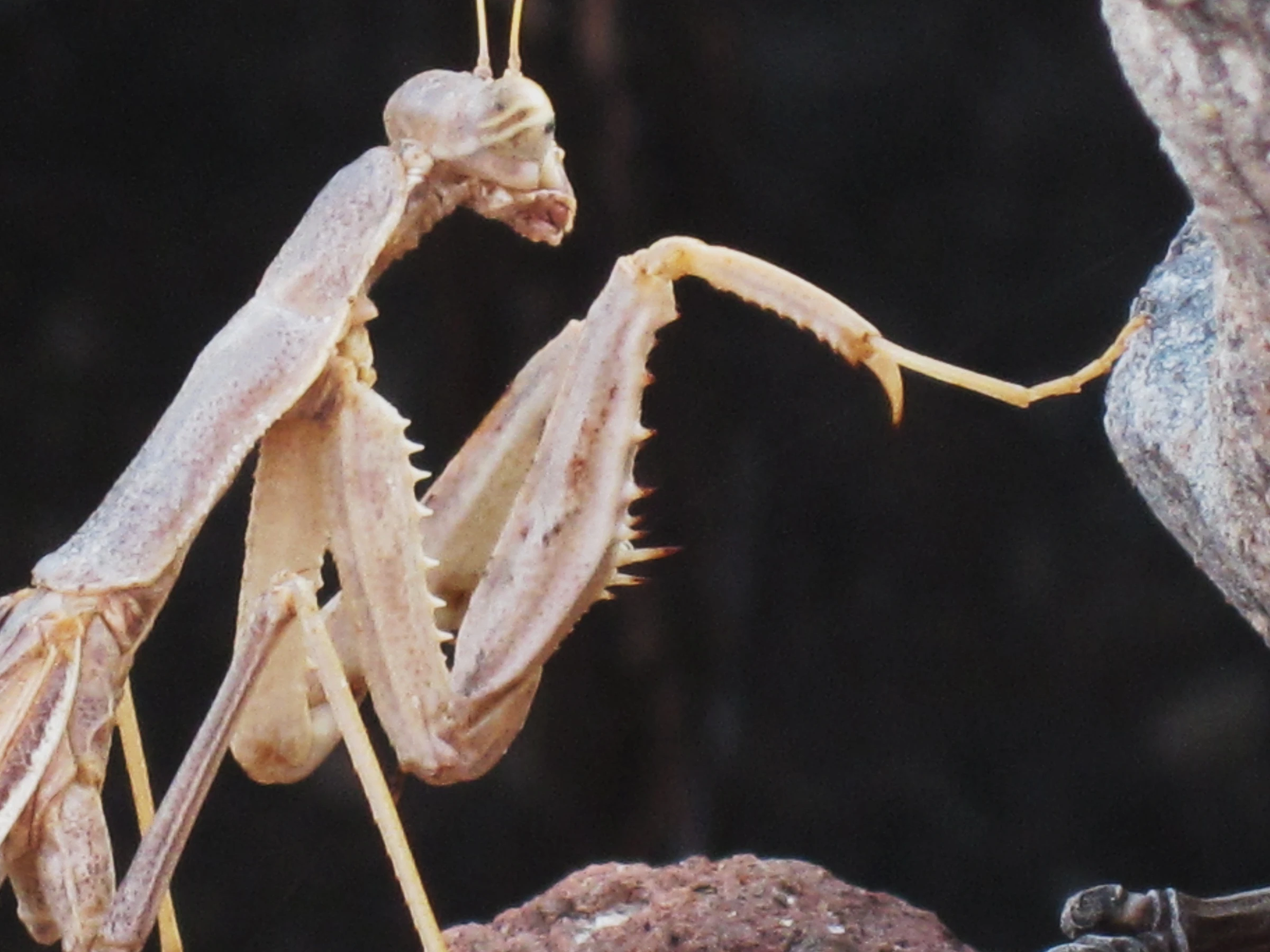
A Chinese mantis in Arizona, 2010, forelegs folded in the posture that gave the insect its name. Alan Schmierer, 2010 (CC0), via Wikimedia Commons. 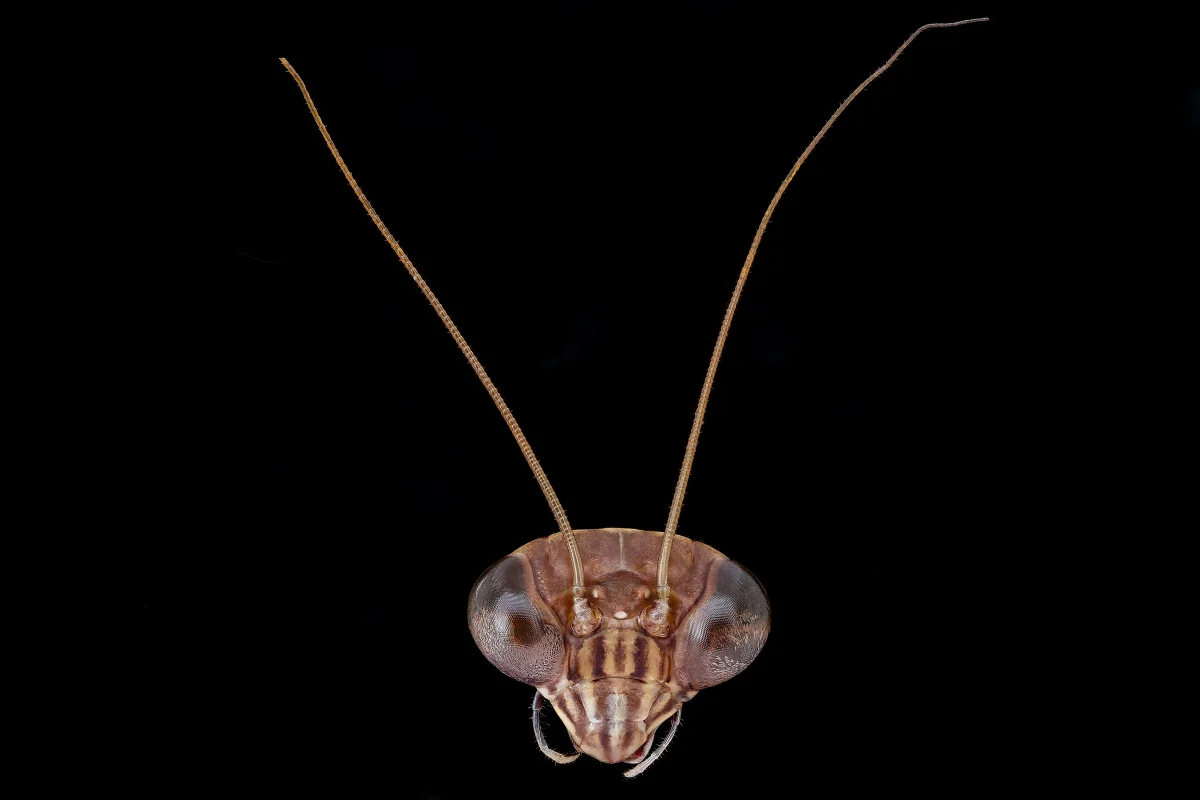
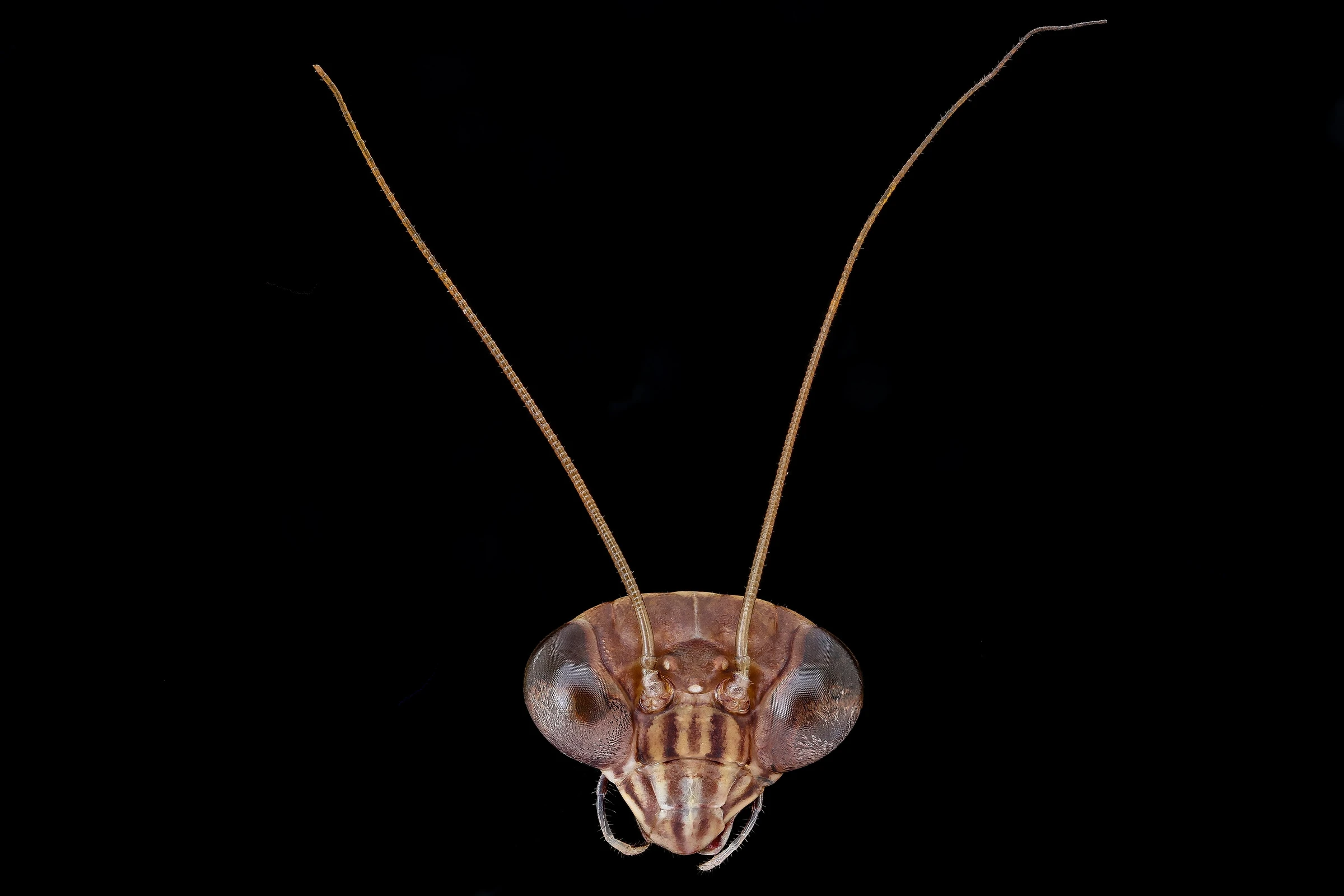
A mantis head photographed straight on by the US Geological Survey's insect lab in 2020. The file does not settle the species. USGS Bee Inventory and Monitoring Lab, 2020, public domain, via Wikimedia Commons. 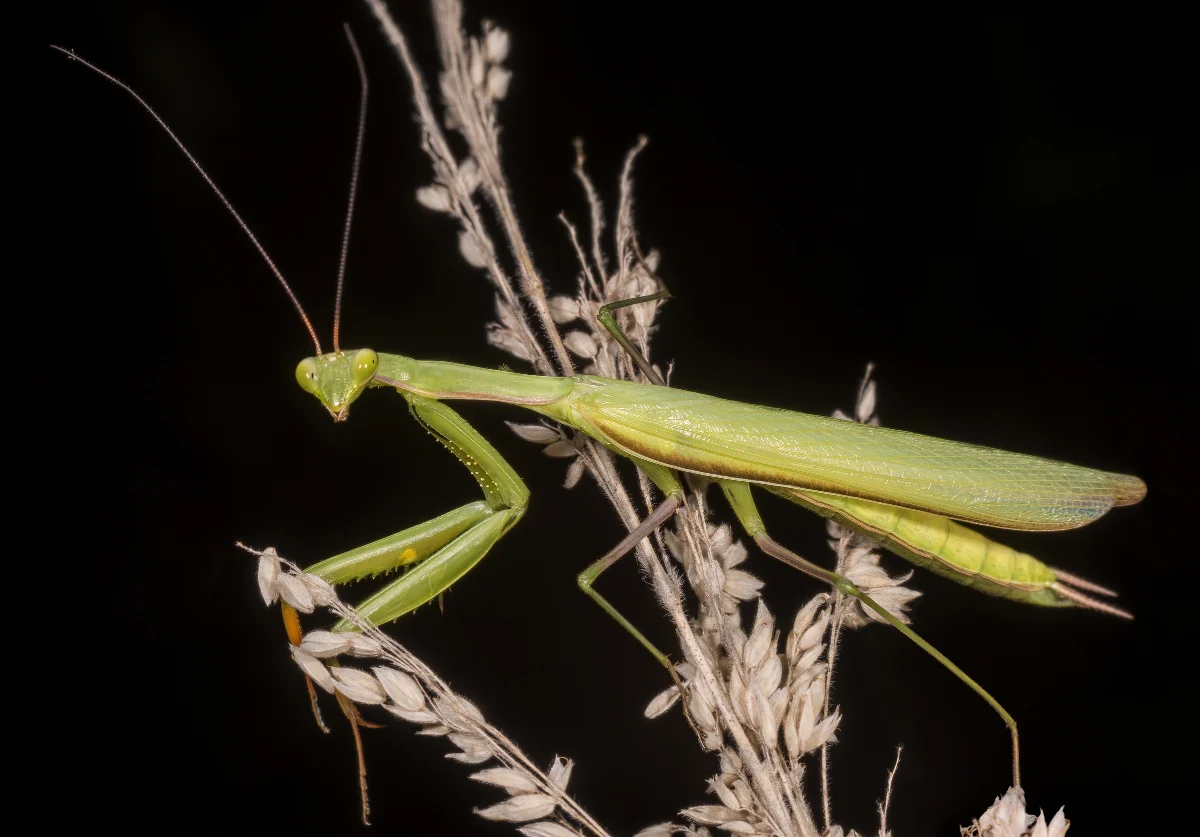
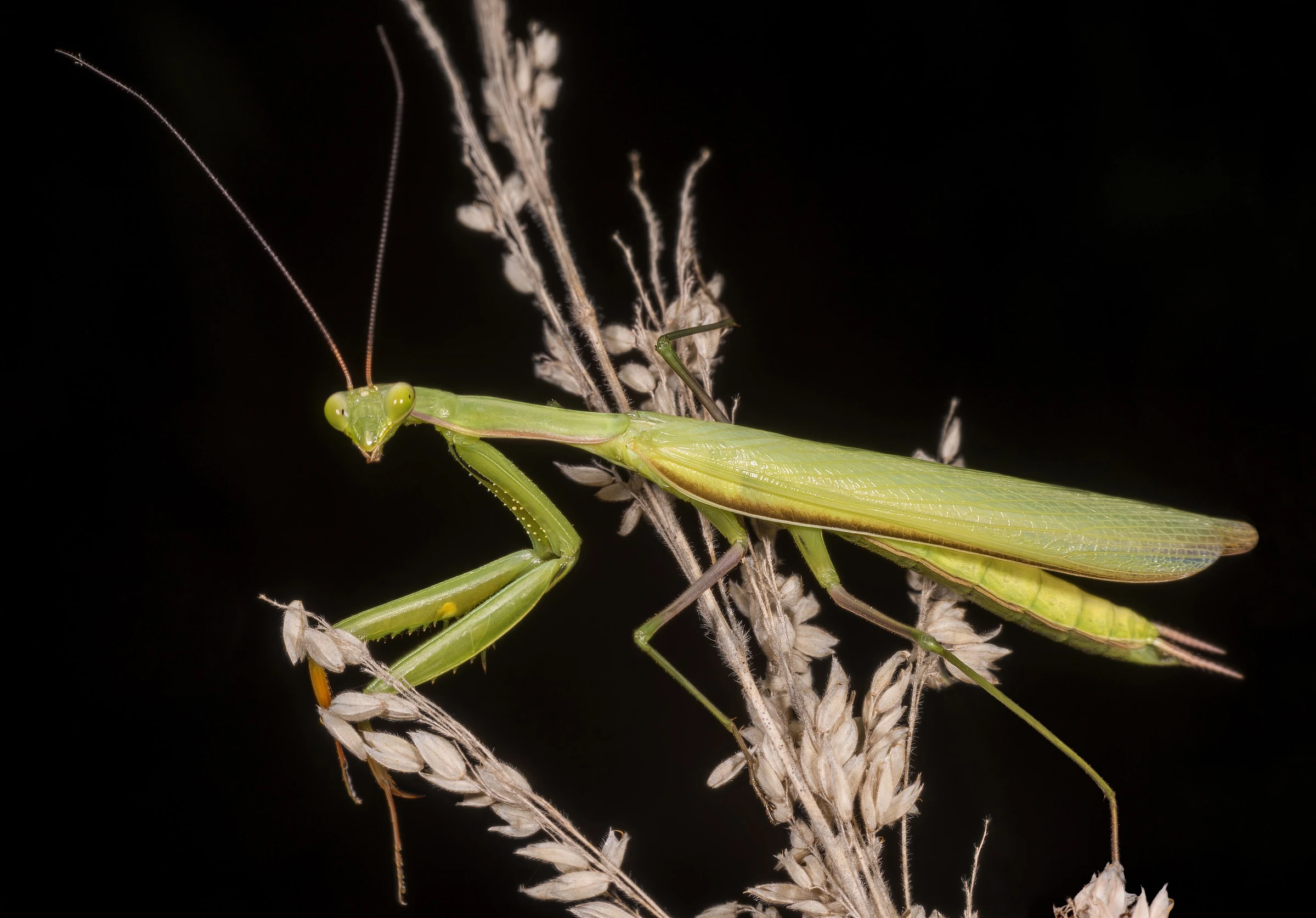
The European mantis, Mantis religiosa, on a grass stem. Photo: Didier Descouens, CC BY-SA 4.0 (creativecommons.org/licenses/by-sa/4.0), via Wikimedia Commons. Resized. 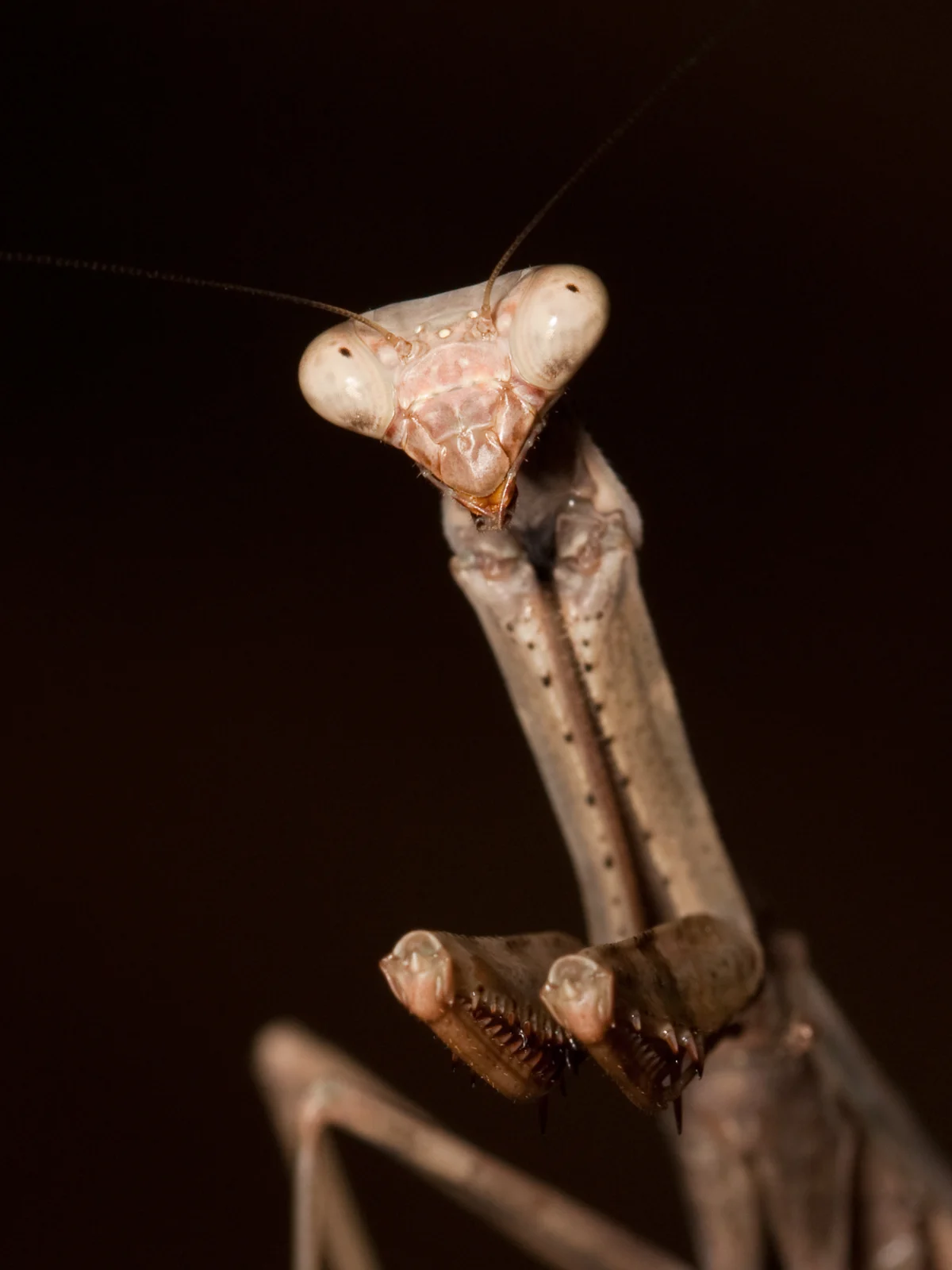
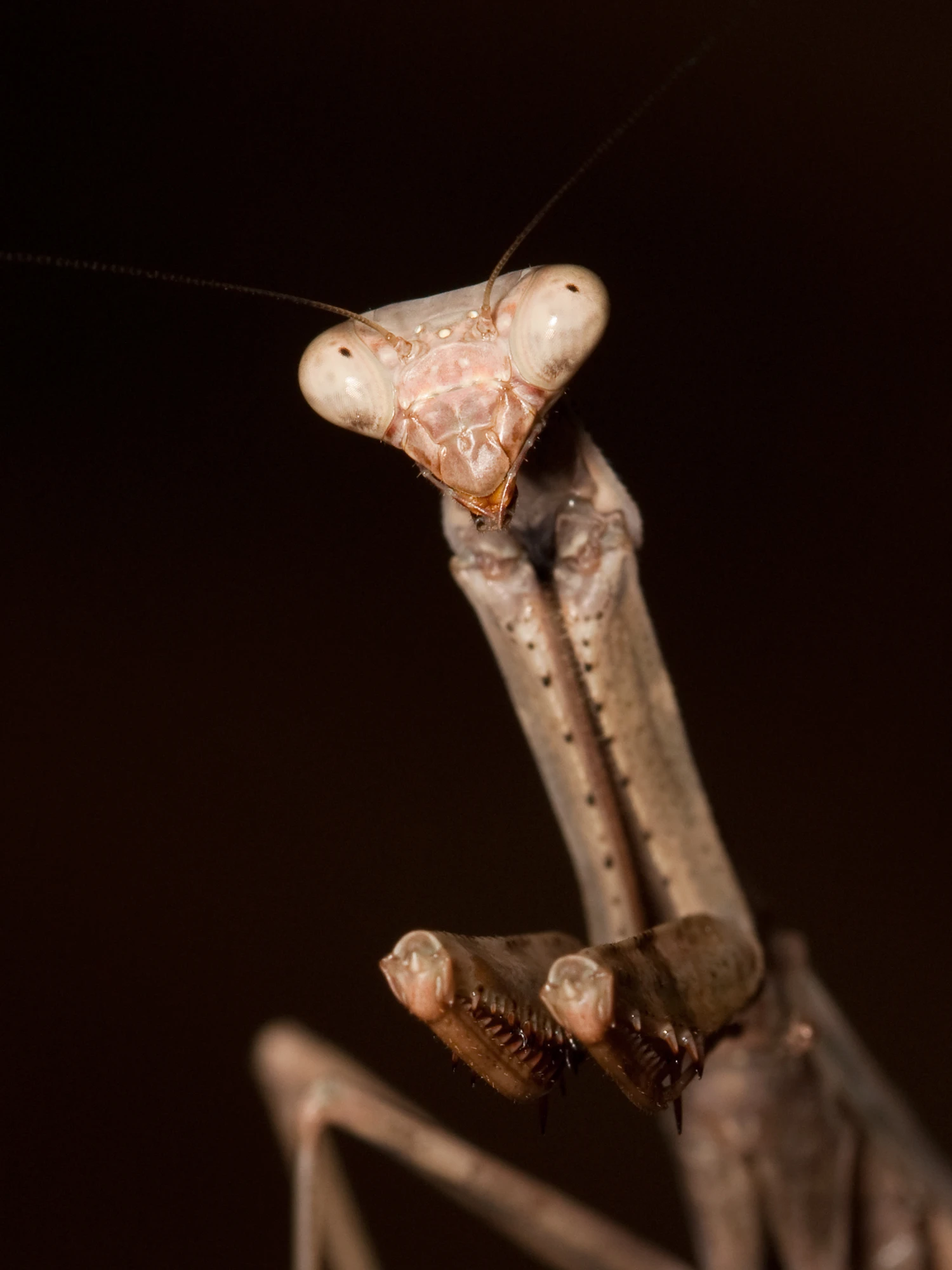
An adult female Carolina mantis, Nashville, 2009, its head turned to face the camera. Kaldari, 2009, public domain, via Wikimedia Commons. 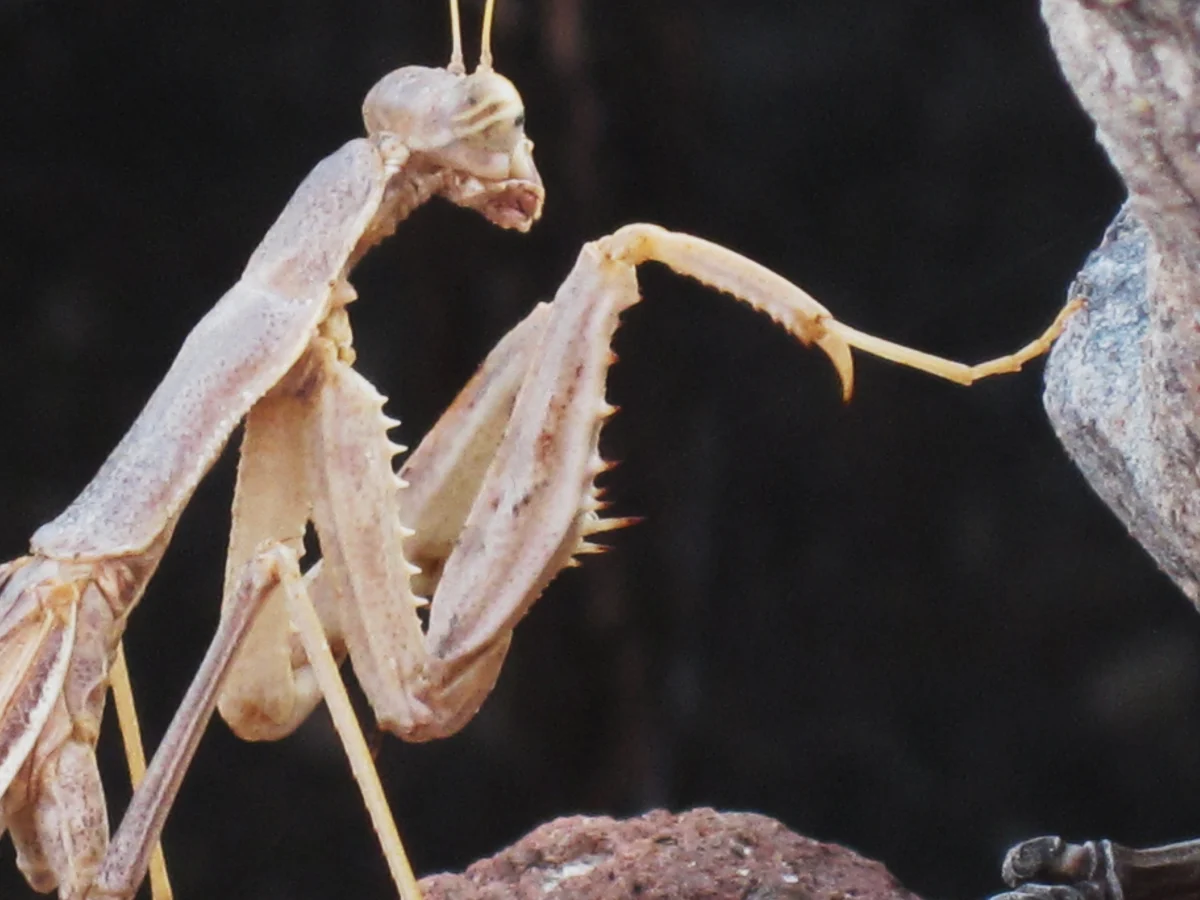
The spined front leg of Rivetina balcanica, Lesbos, 2012. Bj.schoenmakers, 2012 (CC0), via Wikimedia Commons. 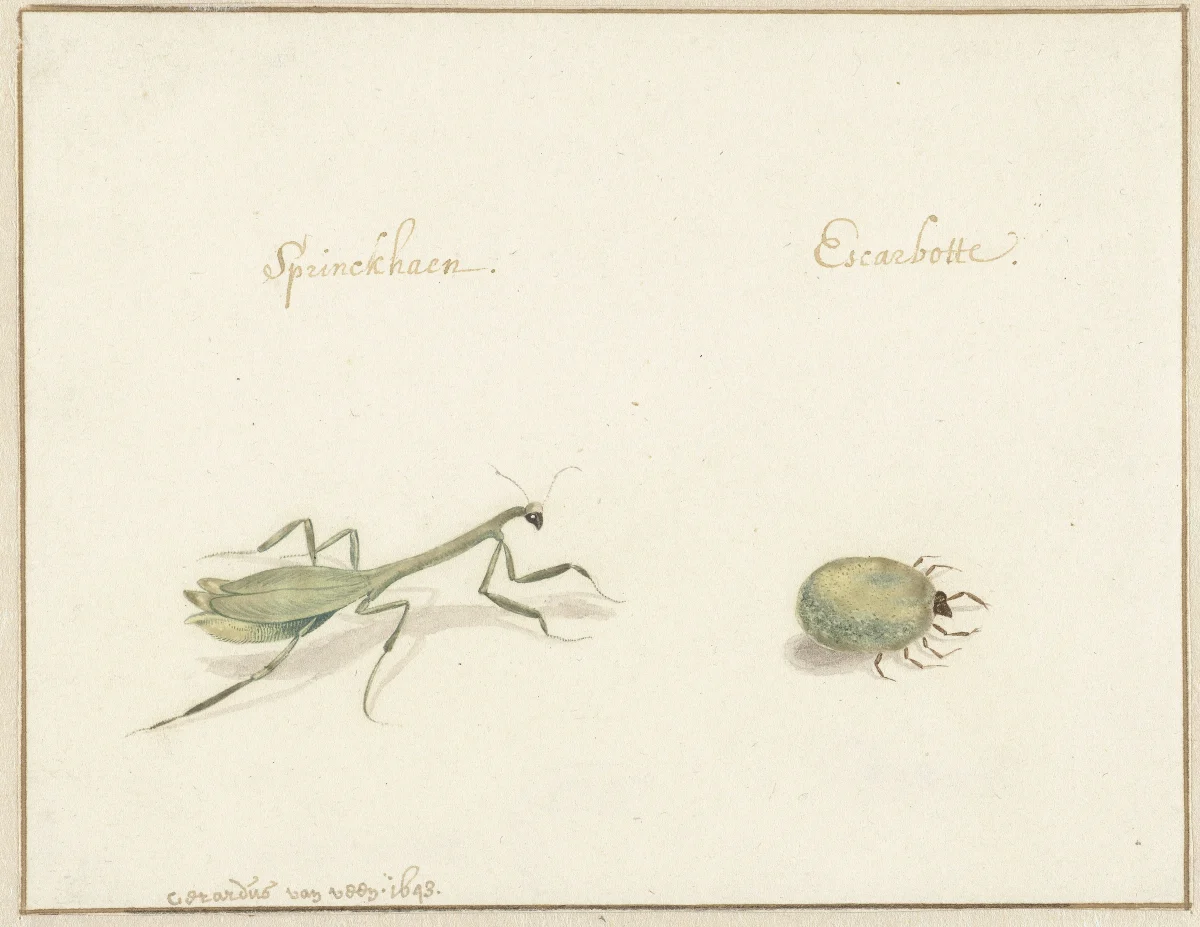
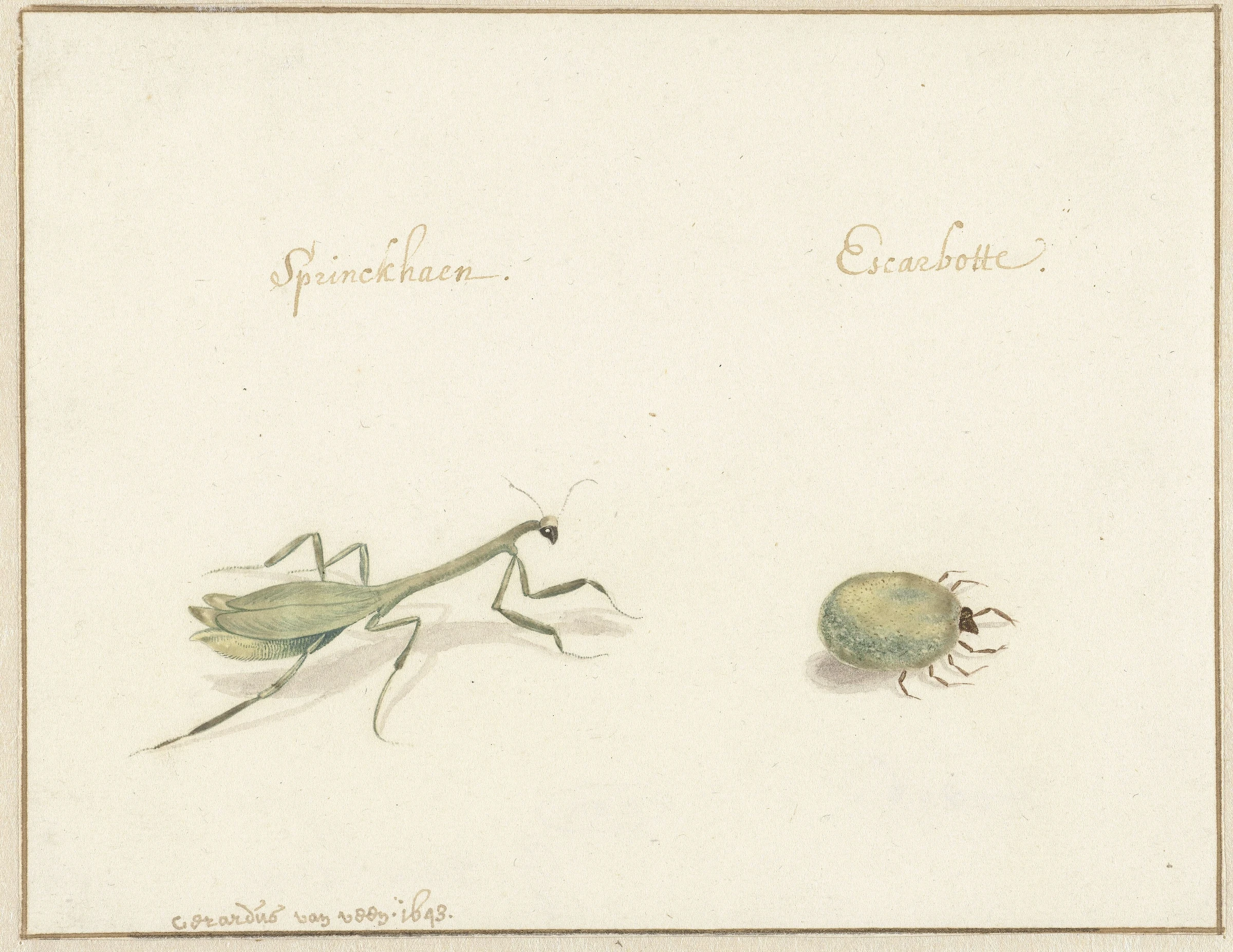
A mantis and a second insect, watercolour by Gerardus van Veen, 1643-48. Gerardus van Veen, Two Insects, 1643-48, Rijksmuseum (CC0). 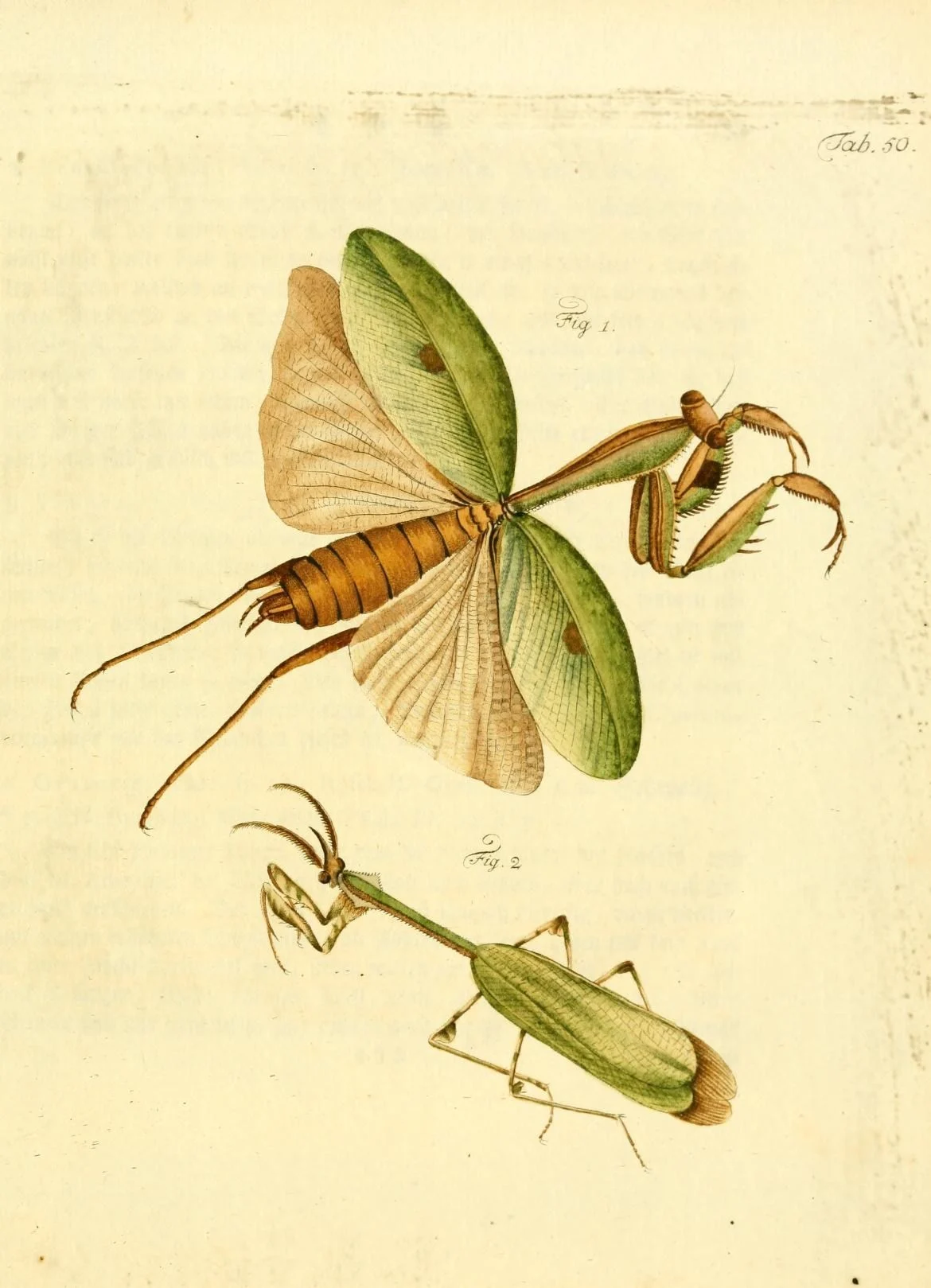
Two mantises engraved and hand-coloured in a German insect journal of the 1780s. Archiv der Insectengeschichte, plate 50, 1781-86, public domain, Biodiversity Heritage Library. 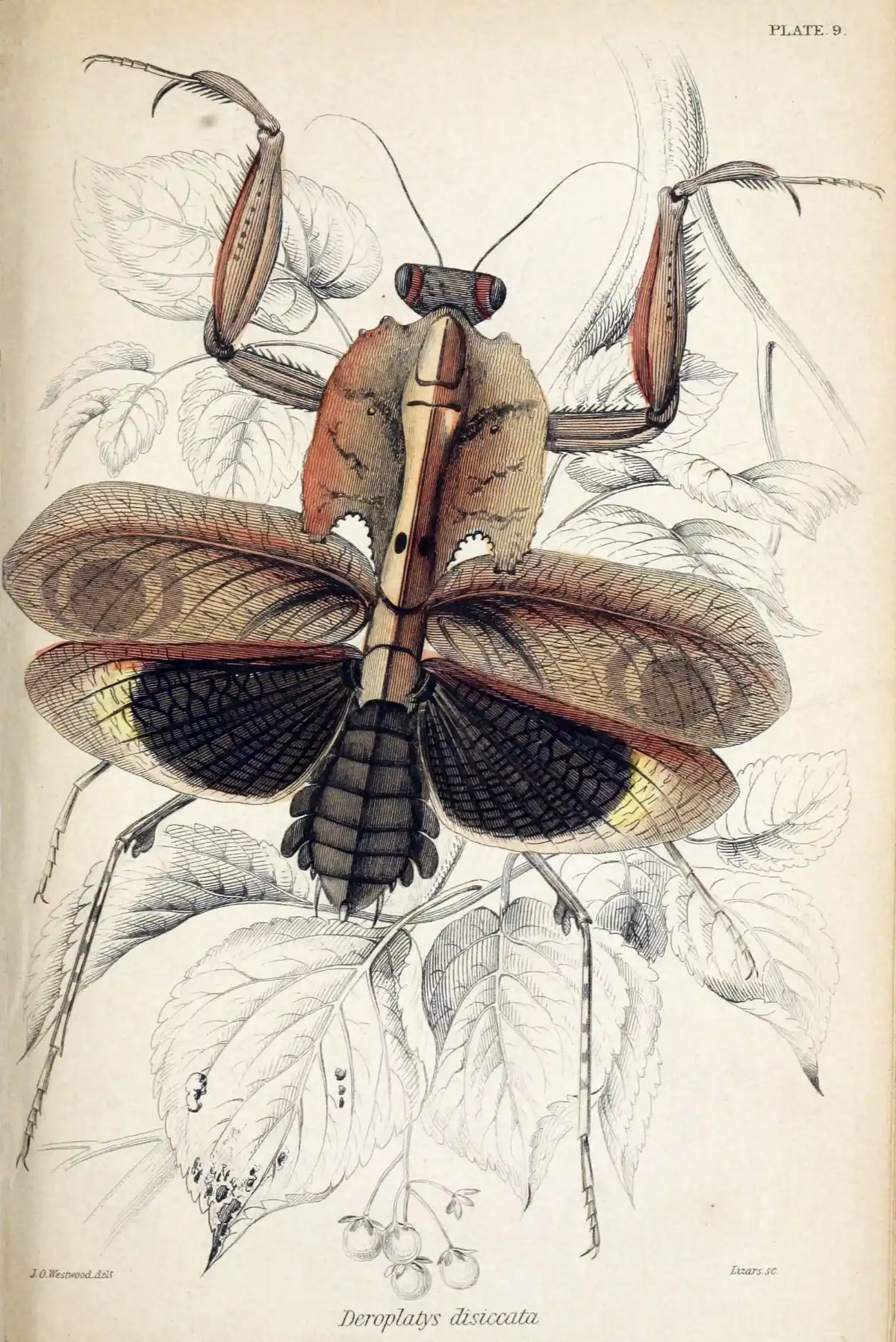
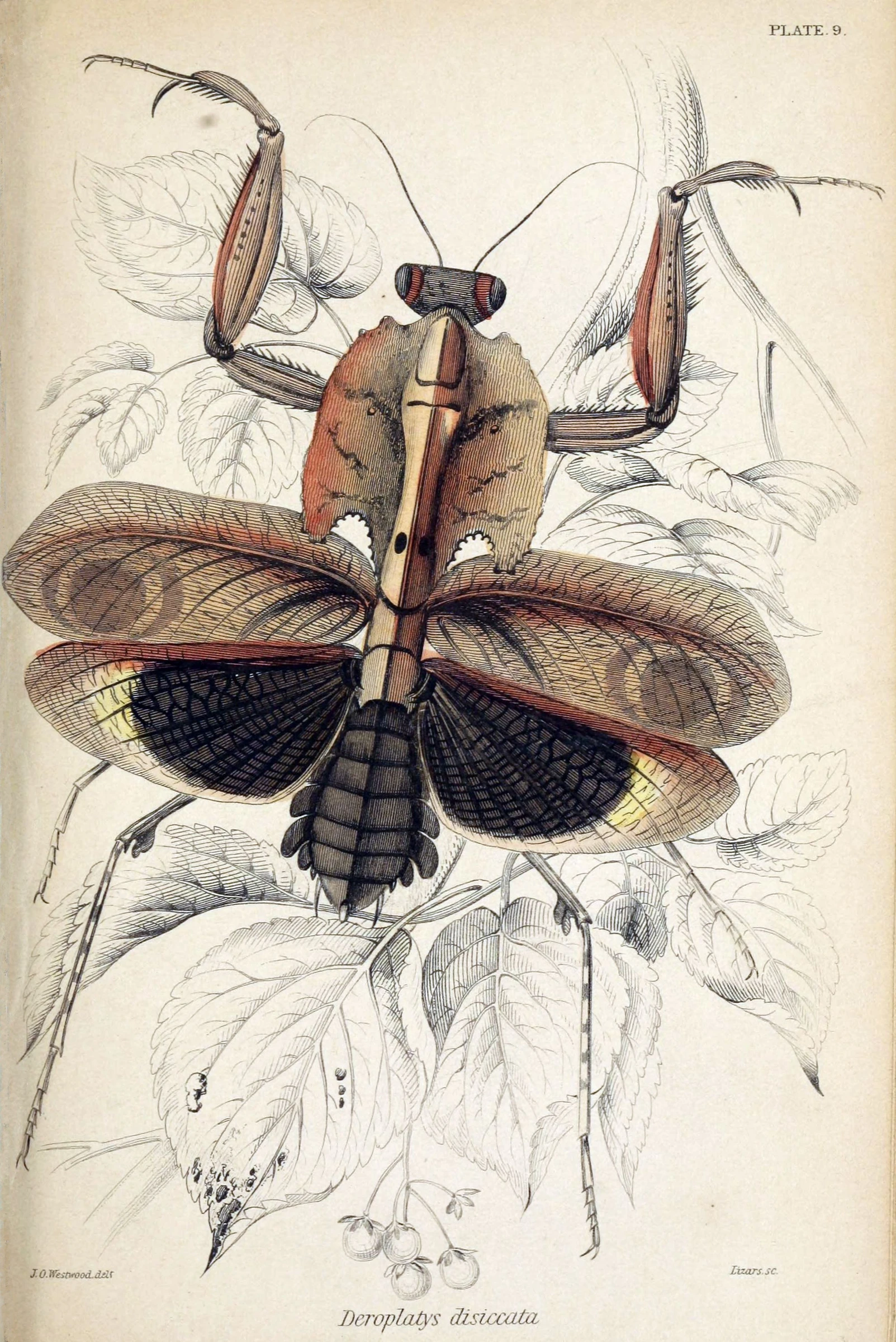
A dead-leaf mantis, Deroplatys, drawn with its wings spread for an 1840 popular natural history. The Naturalist's Library, Entomology, plate 9, 1840, public domain, via Wikimedia Commons. 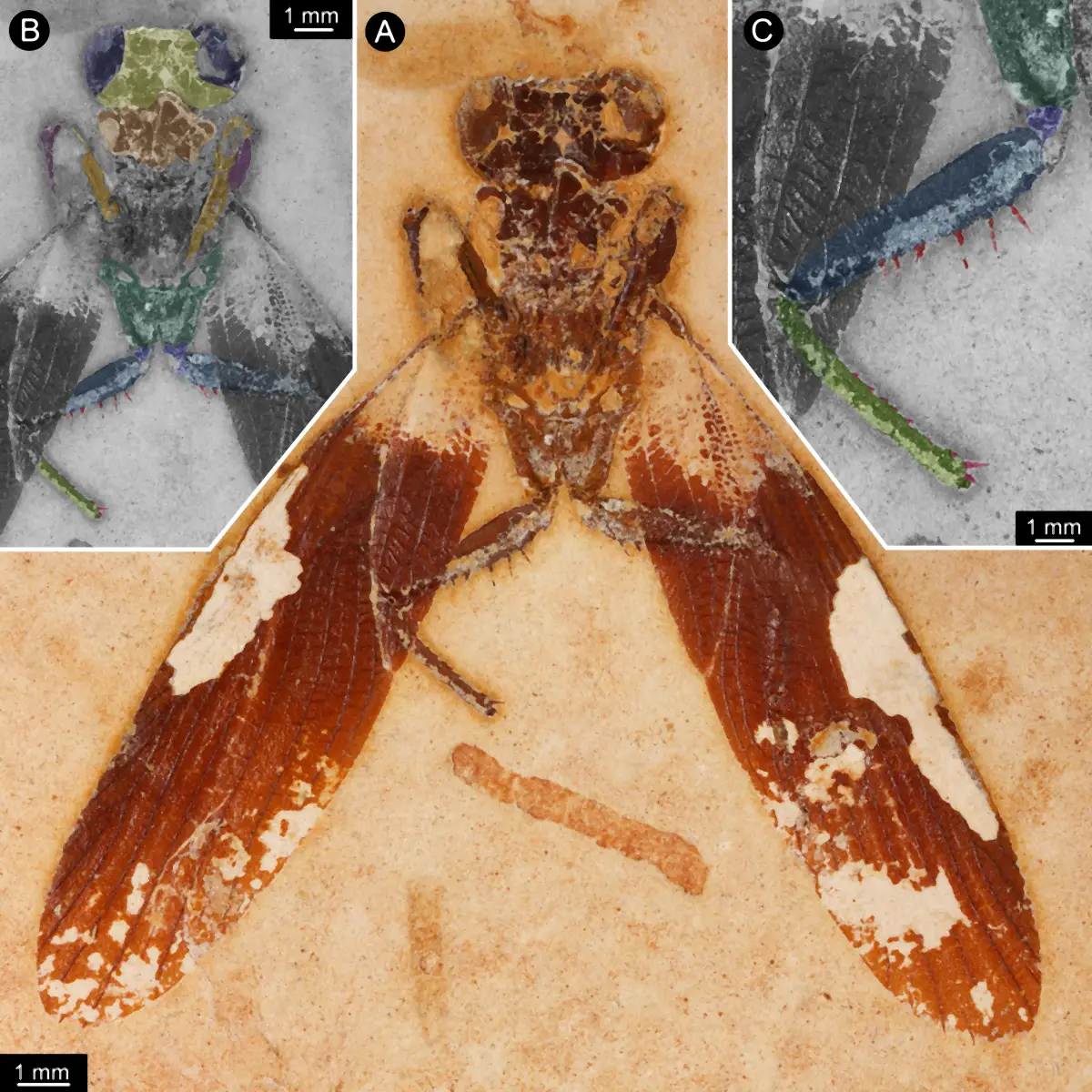
Santanmantis axelrodi, specimen MB.I.2068, a fossil mantis described in PeerJ in 2017. Marie K. Hornig, Joachim T. Haug, Carolin Haug, PeerJ 2017, CC BY 4.0 (creativecommons.org/licenses/by/4.0). Resized and smoothed. 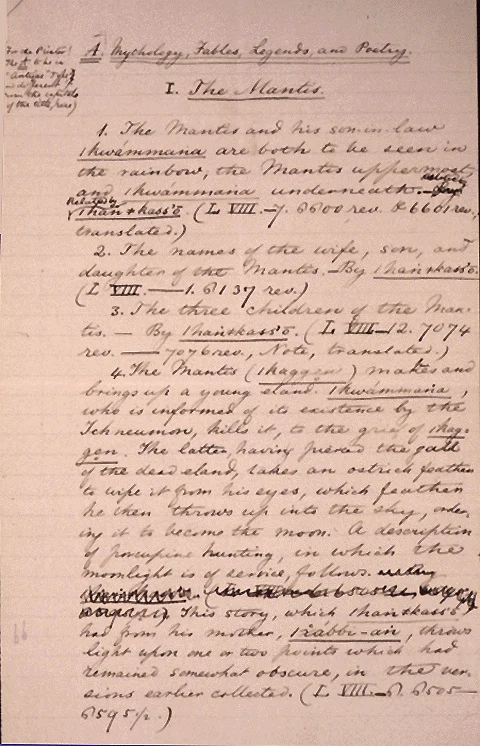
Lucy Lloyd's printer's draft, about 1908: section one is The Mantis, and its fourth entry has the San figure Kaggen making an eland. It says nothing of aliens; the comparison is Graham Hancock's. Lucy Lloyd, about 1908, public domain, via UNESCO and Wikimedia Commons. 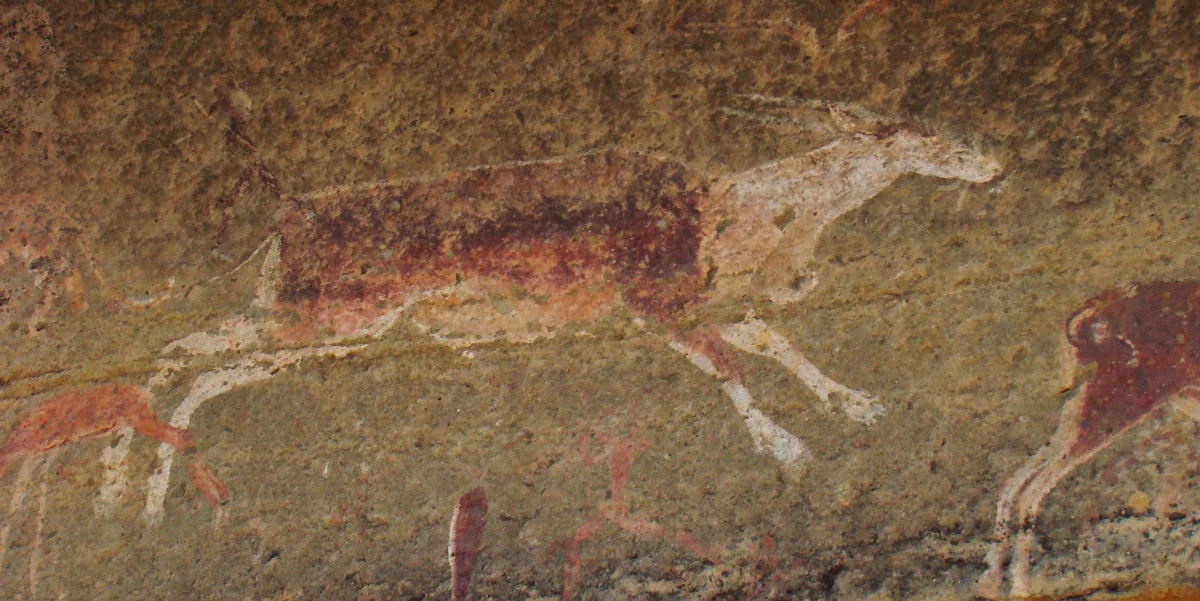
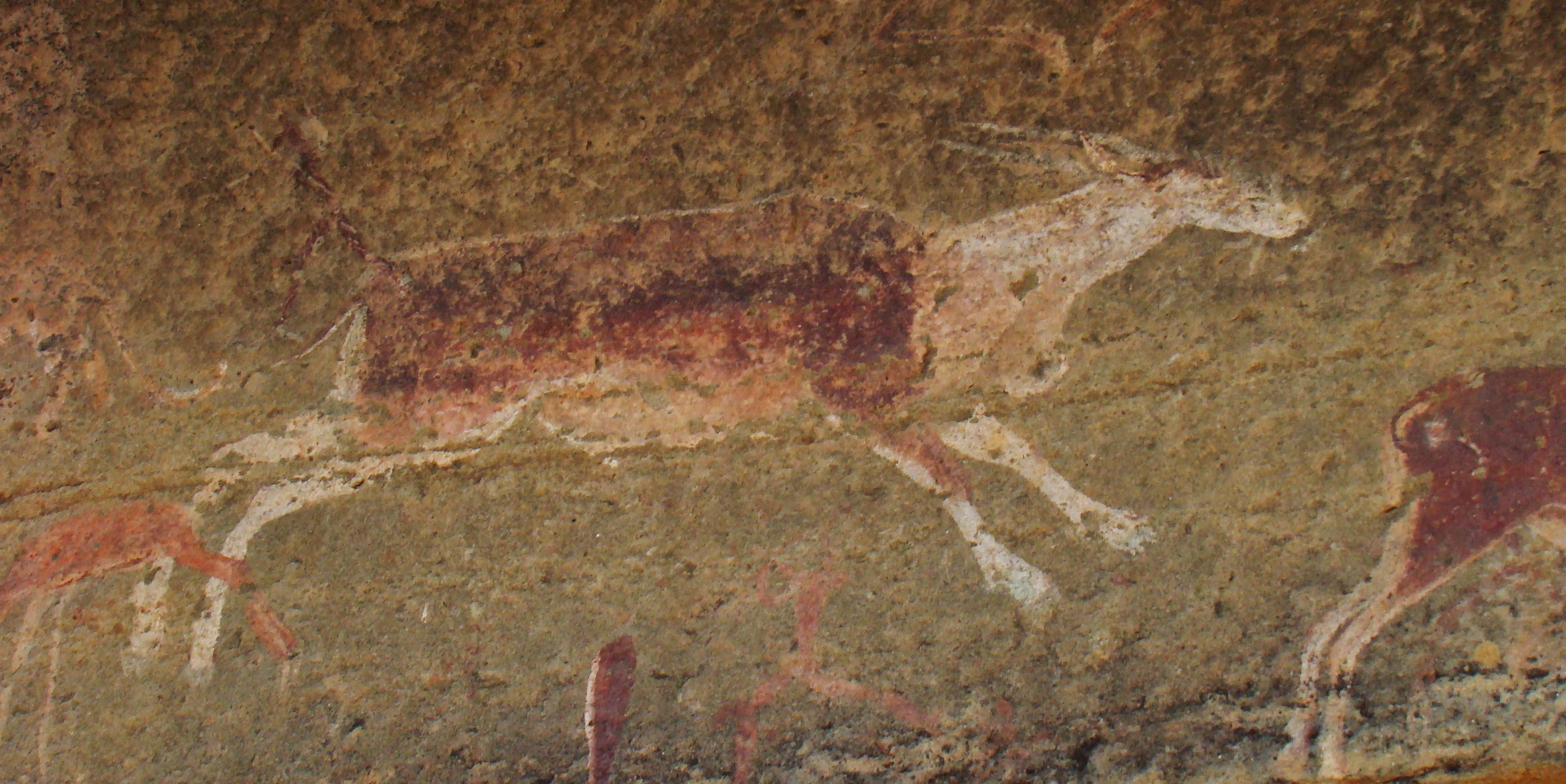
A San painting of an eland, uKhahlamba-Drakensberg, South Africa. No openly licensed San painting of a mantis was found. Photo: Lukas Kaffer, CC BY-SA 3.0 (creativecommons.org/licenses/by-sa/3.0), via Wikimedia Commons. Resized. 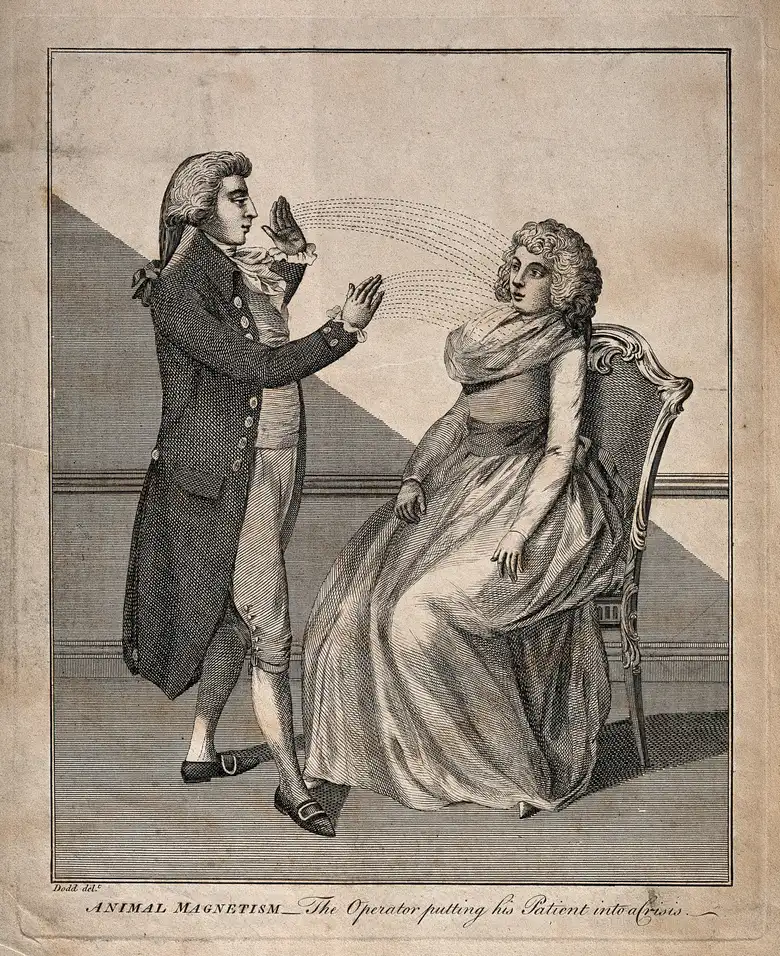
An operator and a seated patient, engraving of 1802, titled Animal Magnetism: trance as a thing one person does to another. Engraving after Daniel Dodd, 1802, Wellcome Collection, CC BY 4.0 (creativecommons.org/licenses/by/4.0). Resized and smoothed. 
Andre Brouillet's 1887 painting of Jean-Martin Charcot presenting a patient, Blanche Wittman, to colleagues at the Salpetriere in Paris. Andre Brouillet, A Clinical Lesson at the Salpetriere, 1887, Paris Cite University, public domain, via Wikimedia Commons. 
Rick Strassman, who ran the University of New Mexico DMT study. Photo: Rick Strassman, CC BY 4.0 (creativecommons.org/licenses/by/4.0), via Wikimedia Commons. 
A model of the DMT molecule: carbon black, hydrogen white, nitrogen blue. Jynto, 2015 (CC0), via Wikimedia Commons. Set on white. 
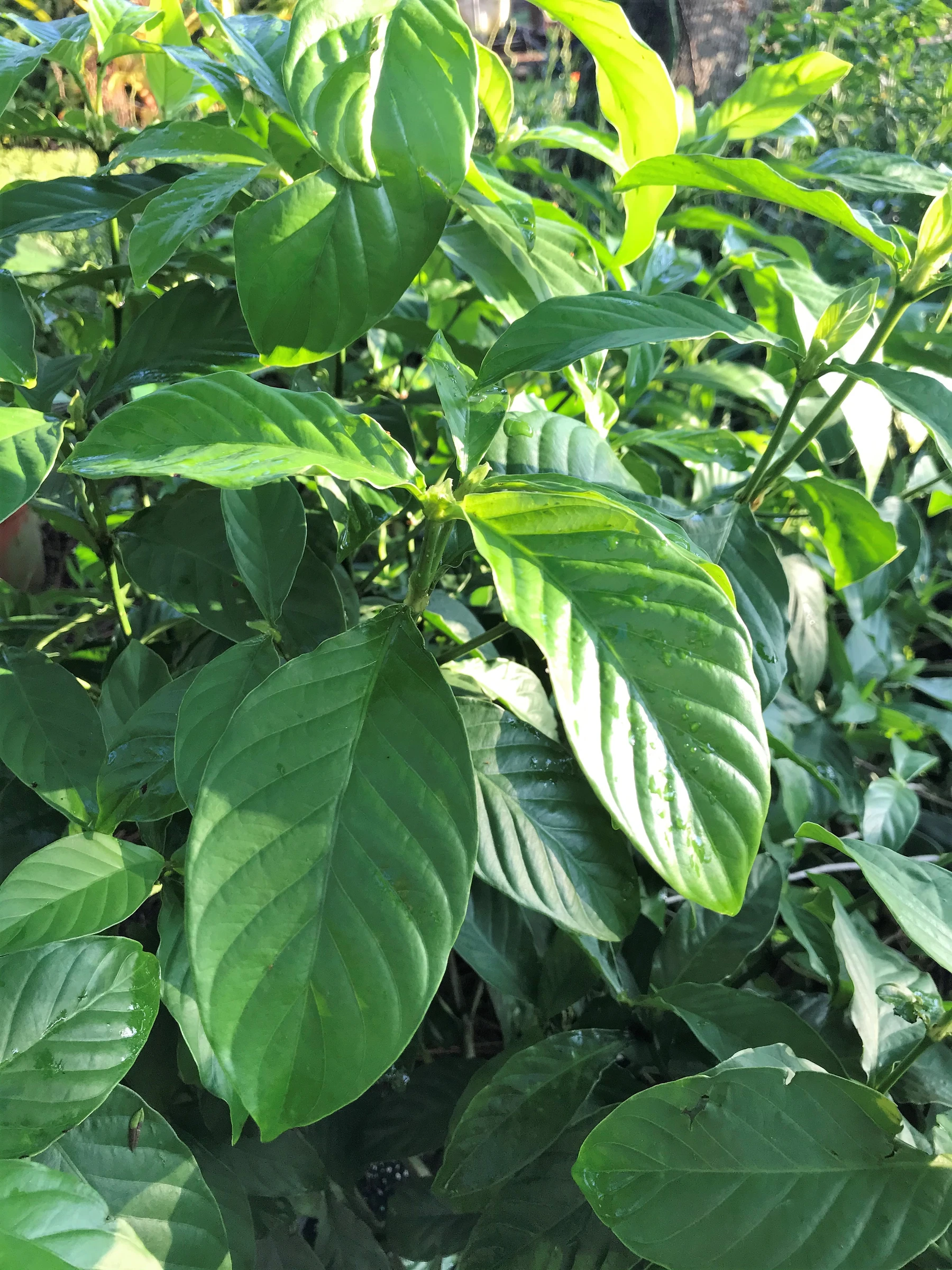
Leaves of Psychotria viridis, the DMT-bearing plant used in ayahuasca. M.Aurelius, 2020 (CC0), via Wikimedia Commons.


Select a photograph to see it full size, with its caption and credit.
Sources
- Whitley Strieber, Communion: A True Story, 1987, catalogue record Beech Tree Books / William Morrow Primary record
- Stanislav Grof, The Adventure of Self-Discovery, 1988, catalogue record State University of New York Press Study
- Sophia Adamson, Through the Gateway of the Heart, catalogued 1985 Catalogue record Primary record
- Linda Moulton Howe, Glimpses of Other Realities, Volume II, 1998, author page listing the book Gaia Study
- Karla Turner, Into the Fringe, 1992, catalogue record Berkley Primary record
- Karla Turner, Taken: Inside the Alien-Human Abduction Agenda, 1994, author record Goodreads Primary record
- David M. Jacobs, The Threat, 1998, catalogue record Simon and Schuster Primary record
- Robert Shapiro, ETs and the Explorer Race, 1996, book listing Light Technology Publishing Primary record
- Lyssa Royal and Keith Priest, The Prism of Lyra, copyright 1989, first printing April 1990, book record Royal Priest Research Press Primary record
- Anna Hayes, Voyagers: The Sleeping Abductees, book record Goodreads Primary record
- Bashar, channeled by Darryl Anka, official site Bashar Communications General reference
- Cassiopaean session, October 16, 1994 Cassiopaea forum Primary record
- Barbara Marciniak, Bringers of the Dawn, 1992, publisher listing Bear and Company Primary record
- Cassiopaean session, October 23, 1994 Cassiopaea forum Primary record
- Cassiopaean session, December 9, 1994 Cassiopaea forum Primary record
- Cassiopaean session, August 11, 1996 Cassiopaea forum Primary record
- Cassiopaean session, April 27, 2024 Cassiopaea forum Primary record
- About the Cassiopaean sessions Cassiopaea Primary record
- Rick Strassman, DMT: The Spirit Molecule, 2001, university record University of New Mexico; Park Street Press Primary record
- Lawrence, Carhart-Harris, Griffiths and Timmermann, Phenomenology and content of the inhaled N,N-DMT experience, Scientific Reports, 2022 Nature Portfolio Primary record
- Michael, Luke and Robinson, An Encounter With the Other, Frontiers in Psychology, 2021 Frontiers Primary record
- Davis and colleagues, Survey of entity encounter experiences occasioned by inhaled DMT, Journal of Psychopharmacology, 2020 SAGE Primary record
- Graham Hancock, Supernatural, 2005, publisher page Penguin Random House Study
- Martin Kottmeyer, Graying Mantis, The REALL News, May 1999, archived copy Regional Association for the Study of Unexplained Phenomena in Illinois, via the Internet Archive Study
- C.D.B. Bryan, Close Encounters of the Fourth Kind, 1995, catalogue record Knopf Study
- Patrick Huyghe, The Field Guide to Extraterrestrials, 1996, catalogue record Avon Study
- Quatermass and the Pit Wikipedia General reference
- Clancy, McNally, Schacter, Lenzenweger and Pitman, Memory distortion in people reporting abduction by aliens, Journal of Abnormal Psychology, 2002 American Psychological Association; Harvard copy Primary record
- Sharpless and Barber, Lifetime prevalence rates of sleep paralysis, Sleep Medicine Reviews, 2011 Elsevier Primary record
- Spanos, Cross, Dickson and DuBreuil, Close encounters: an examination of UFO experiences, Journal of Abnormal Psychology, 1993 American Psychological Association Primary record
- Extra-Terrestrial DNA Activation, The Mantis Beings Daniel Scranton Primary record
- Toni Ghazi on Dare to Dream with Debbi Dachinger, July 1, 2024 Spreaker Primary record
- The Antarean Heart: Channeling the Praying Mantis Collective, interview transcript Thought Change Primary record
- Michele London, Songs of the Mantis, 2026, catalogue page Sacred Dragon Publishing, via NetGalley Primary record
- Kathryn Post, Starseeds, government plots and an alien mantis, March 2, 2026 Religion News Service Study
- A New Theory Says DMT Entities Might Be Real, and Proposes How to Test It, 2026 ScienceBlog Study
- Mantis Wikipedia General reference
- Pseudopupil Wikipedia General reference
- Rigosi, Warrant and O'Carroll, A new, fluorescence-based method for visualizing the pseudopupil, Scientific Reports, 2021 Nature Portfolio Primary record
- Rick Strassman on the DMT study, Resonance Project 4, Spring 1999 The Resonance Project, reposted Primary record