
Betty Hill's star map is a drawing on a sheet of paper: dots of different sizes, some joined by lines, some heavy, some broken. She made it at home in Portsmouth, New Hampshire, in the last week of March 1964, after a psychiatrist suggested she try. It records, she said, a map shown to her aboard a craft on the night of 19-20 September 1961.
The original is in a box at the University of New Hampshire. Box 6, folder 2 of the Betty and Barney Hill Papers, listed as "Betty Hill's Star Map 1964". Beside it in the same folder is a later sheet titled "Betty's Finished Drawing with Marjorie's Pattern".
That second title is the whole story. A schoolteacher in Ohio took the dots, built the nearest stars around the Sun out of beads and thread, and found a place where the pattern seemed to stand up in three dimensions. Two Sun-like stars, side by side, 39 light-years away, in the southern constellation Reticulum. Fifteen joined dots, give or take, and a scatter of others she called background stars.
On her reading, one dot is the Sun.
A Map Drawn on a Doctor's Suggestion
At about 10:30 p.m. on 19 September 1961, Barney and Betty Hill were driving home on US Route 3 through the White Mountains, watching a light they could not explain. It had been with them since south of Lancaster. About a mile south of Indian Head in Lincoln, they said, it descended toward the car. They came back to themselves near Ashland, which John G. Fuller's 1966 book The Interrupted Journey puts thirty-five miles south, with almost no memory of the road between.

Nine years had passed since George Adamski's Desert Center testimony of 1952. Much of the Hills' account surfaced only later, under hypnosis. On 4 January 1964 the Boston psychiatrist Dr Benjamin Simon began hypnosis sessions that ran until 27 June.
On 21 March 1964 Betty said she could draw the map, if she could draw. Simon told her that if she remembered it after the session she should "try to draw the map". Fuller's note calls it a post-hypnotic suggestion, left to her choice. She drew it that week; on 28 March Barney called it "a map in dimension."
Under hypnosis she had described the original: "a lot wider than it was long", its dots "just pin points" or "as big as a nickel." The heavy lines, the man told her, were trade routes, the solid ones places visited occasionally, "the broken lines were expeditions." When she could not find Earth on it, he would not say where he was from.
Then the map went back into the wall.
Beads, Thread and Two Suns
The first fit came from Betty herself. On 13 April 1965, twelve years before the Wow! signal, the New York Times printed a map of Pegasus marking the radio source CTA-102, which "may be sending intelligent radio emissions, Russian believes." Fuller's book prints it beside her sketch: "Mrs. Hill, struck by the similarity between the Times map and her sketch, then added the corresponding names."
In 1968 an Oak Harbor, Ohio, schoolteacher and amateur astronomer read the book. Marjorie Fish took one dot to be the Sun and asked which real nearby stars, seen from somewhere else, would draw the sketch.
She answered it by hand. From August 1968 to February 1973 she built three-dimensional models of the Sun's neighbourhood, beads on thread, from the 1969 Gliese Catalogue of Nearby Stars. Her rules: a Sun-like home star within about 55 light-years of the Sun; the Sun in the pattern, joined by a line; Sun-like stars along a route visited, not skipped; base stars roughly classes F8 to K5. Colin Johnston of Armagh Observatory and Planetarium wrote in 2011 that she began from about 1,000 stars within 50 light-years of Earth and kept 46.
On 4 August 1969 she met Betty Hill, who told her the map was "three-dimensional, like looking through a window."
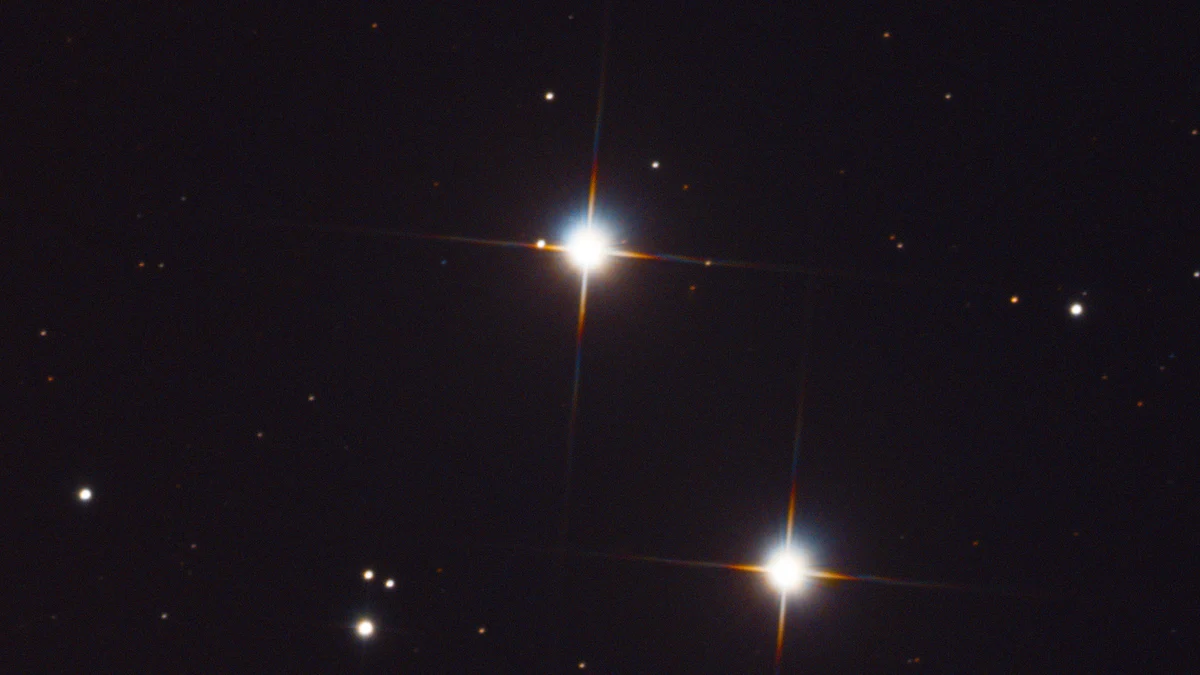
From one angle the beads fell into line. Fish's pattern, sixteen stars in the 1976 Astronomy reprint, put the two big circles at Zeta 1 and Zeta 2 Reticuli: Sun-like G stars about 39 light-years away, at least 3,750 astronomical units apart, circling each other once in 170,000 years or more. The Sun sat at the end of a route.
Walter N. Webb of NICAP passed the work to Terence Dickinson, who published it, without endorsing it, as "The Zeta Reticuli Incident" in Astronomy in December 1974. The Ohio State astronomer Walter Mitchell is quoted as "impressed by the astronomy involved in Marjorie Fish's work." David R. Saunders of the University of Chicago, a Condon study statistician, scored the fit at 11 to 16 bits of resemblance, less 4.9 bits for the choices made along the way: a net of "at least 6 to 11" bits, odds Wikipedia sums up as at least 1,000 to 1 against chance.
A Route Card for the Neighbourhood
Set aside for a moment whether Fish found the right stars. Ask what it would mean if she did.
It would mean the sketch is a document: a copy, made from memory two and a half years late, of a chart showing real stars at their real distances from a point no human being has stood at. On that reading, whoever drew the original was looking back toward us from near Zeta Reticuli.
It would mean the lines are history. Heavy lines for regular traffic between two Suns. Solid lines for places visited now and then. Broken lines for expeditions, one of them ending at a yellow star 39 light-years out. Which would put our Sun on somebody else's map as a destination before it was on any of ours as a home.
It would mean our species was reached by a route. Light that left Zeta Reticuli the month Betty drew her map arrived around 2003, the year before she died. On Fish's reading, somebody crosses that distance as routine, while we were still measuring how far away the nearest stars are.
And it would leave one consequence still in front of us. In Betty's account the man would not say where he was from, because she could not say where she was. If the map is real, that exchange is the one still open: a chart with our Sun on it, and a question put to us that went unanswered.
On her account, nobody on Earth in 1961 could have answered him.
Selection, Lines and Better Distances
The standard account holds that the method built the resemblance. Carl Sagan and Steven Soter answered in Astronomy under the title "Pattern Recognition & Zeta Reticuli". The comparison map, they wrote, "includes the sun and 14 stars selected from a list of the 46 nearest stars similar to the sun", and it is "not clear what criteria were used to select precisely these 14 stars". The drawn lines were "what a lawyer would call 'leading the witness'"; without them, the comparison "shows little similarity". Choose some points and ignore others, they argued, and a fit can always be found.
Robert Sheaffer, a programmer at NASA Goddard, set three fits side by side: Betty's Pegasus; Charles W. Atterberg's map, begun in 1966, every star "within 18.2 light-years of the sun", which he judged closer to the sketch than Fish's; and Fish's, which "reaches out 53 light-years, where our knowledge of stellar distances is much less certain."
That phrase became the test. In November 2008 Brett Holman ran Fish's own rules against the Hipparcos satellite's parallaxes for Fortean Times. On his blog he summed up the result: "six of the fifteen stars chosen by Fish must be excluded, which is no match at all." Johnston's Armagh summary names some: 54 Piscium and 107 Piscium are variables, Gliese 67 and Tau 1 Eridani are close binaries.
Simon himself, as Fuller reports his reasoning, found the abduction "too improbable", much of it "similar to dream material"; by March 1964 he was testing whether Barney had absorbed Betty's dreams.
What the Better Distances Did Not Touch
The Hipparcos test cuts both ways. It removed stars from Fish's pattern and restored one she had excluded as a binary: Epsilon Eridani, which "is not after all a binary". As Holman describes it, the test checked her pattern against her rules. It was not a test of the sketch itself.
Fish met the selection objection directly. In her reply to Sheaffer she granted that "many patterns can be found similar to the map" if any stars from any vantage point are allowed, and called Atterberg's positions "accurate". Her answer was the rules: Sun-like stars, the Sun joined by a line, none skipped. Saunders charged her 4.9 bits for that freedom and still reported a surplus, computed on the 1969 catalogue she used.
And the drawing itself is less fixed than the debate assumes. Sagan and Soter count the Sun and 14 stars; the 1976 reprint gives Fish's pattern 16. Betty later wrote that of "the 8 background stars" she did not know "if they exist and in that position". Fuller's caption says she added star names after April 1965, so the sheet has at least two states. Which dots are the March 1964 dots, only the original can say.
The map in the wall was never found.
Official X could not open the 2008 Fortean Times article, so the sixth excluded star is not named here.
The Folder in New Hampshire
The Hill papers reached the University of New Hampshire in 2006, after Betty's death in 2004, with the 1964 sketch, Fish's finished pattern, Webb's "Analysis of the Fish Model" and a star chart of beads and string. In 2011 a state marker went up on US 3 in Lincoln, after a campaign led by Mike Stevens of Farmington; it speaks of "two hours of 'lost' time".
Stanton Friedman, co-author of Captured! with Betty's niece Kathleen Marden, was described by one blogger who heard him at a 2011 MUFON symposium, quoted by Holman, as accepting that the Hipparcos data are "an order of magnitude more accurate" while still placing "the base" at Zeta 1 and 2 Reticuli.
Marjorie Fish, who lived from 1932 to 2013, went another way. Her obituary, as quoted by Armagh Observatory in June 2013, says that after newer data she found the binary stars in her pattern "too close together to support life", and "issued a statement that she now felt that the correlation was unlikely." The date and wording of that statement are unknown.
Its builder let the pattern go.
Gaia has since put Zeta 1 and Zeta 2 Reticuli at 39.28 and 39.27 light-years. Run them again on today's distances and the answer would show whether any set of Sun-like stars still draws the sketch. It could not show whether a map was ever shown to anyone.
The dots are still on the sheet. The count is still not agreed.
Questions This Leaves You With
Is there anything I can actually do with a star map like this?
Not in your own life, honestly. Nothing about Zeta Reticuli touches next week, and anyone who attaches a date or a product to it is selling something. The larger question is not personal. It is whether a drawing made from recalled memory can carry information at all, and how anyone would check. A civilization answers that kind of question with catalogues, archives and patience, not with belief. You can follow it the way the record does: by asking, each time a new star catalogue comes out, what it does to a pattern somebody wrote down rules for in advance.
Does a map of other worlds sit against my faith?
It can be read either way, and serious people have read it both ways. For some, a universe with travellers in it is a larger creation, more crowded with minds that were made. For others, it unsettles the sense that humanity has a singular place. Neither reading is forced by the map, and nothing in Betty Hill's account speaks to God at all. This site will not tell you which way it falls. That is yours to carry, and it may well land differently on different days.
Does it change how I should think about my own life?
Put your own lifetime against 39 light-years. The light reaching you tonight from Zeta Reticuli left it about 39 years ago, half a life spent crossing the gap. One reaction is that this makes a life very small: a few decades against distances that swallow them. The other is the reverse: if minds that can cross such gaps are rare, or if there are none, then a mind that can even ask is rarer still, and larger for it. You probably had one of those reactions before you finished the first sentence. Notice which.
What would change my mind about the Fish match?
Decide now, before the next argument pulls you along. In one direction: a published rerun of Fish's own rules on Gaia distances that keeps her pattern intact, or the 1964 original showing the same dots she used. In the other: a rerun in which the pattern breaks, or the original sheet showing that her key dots were added after 1965. Also worth weighing: whether a rival pattern, like Atterberg's, scores as well under the same rules. A good test treats every candidate the same way, including the one you hope wins.
Could anyone ever tell whether Betty Hill remembered a real map?
This is the empty space. The star question can be worked: catalogues improve, rules can be rerun, a fit can be scored. The memory question cannot be worked the same way. A drawing made two and a half years later, after hypnosis, by someone who began with "If I could draw", carries her memory and whatever shaped it, and there is no second copy of the original to compare it with. No method in the record opened for this article separates the two from the sheet alone. If you can think of one, it would matter far beyond this folder.
Sources
- John G. Fuller, The Interrupted Journey (introduction by Benjamin Simon, M.D.), Dial Press, 1966 Dial Press / Internet Archive scan Primary record
- Wikipedia, Barney and Betty Hill incident Wikipedia General reference
- Wikipedia, Zeta Reticuli (citing Vallenari et al. 2023, Gaia DR3) Wikipedia General reference
- Carl Sagan and Steven Soter, Pattern Recognition & Zeta Reticuli, Astronomy (transcription, UFO BBS 2705) Astronomy / UFO BBS transcription Primary record
- David R. Saunders, reply in the Astronomy Zeta Reticuli debate (transcription, UFO BBS 2707) Astronomy / UFO BBS transcription Primary record
- Robert Sheaffer, Is the Fish Interpretation Unique? (transcription, UFO BBS 2710) Astronomy / UFO BBS transcription Primary record
- Marjorie Fish, reply to Sheaffer (transcription, UFO BBS 2711) Astronomy / UFO BBS transcription Primary record
- The Zeta Reticuli Incident, Astronomy compilation, AstroMedia Corp., 1976 (transcription, UFO BBS 2713) AstroMedia / UFO BBS transcription Primary record
- Colin Johnston, Betty Hill's UFO star map: the truth, Armagh Observatory and Planetarium, 2011, updated 2013 Armagh Observatory and Planetarium Study
- Brett Holman, Goodbye, Zeta Reticuli, Airminded, 5 November 2008 (note on his Fortean Times article) Airminded Study
- Kristin Waterfield Duisberg, An Extra(terrestrial) Special Collection, UNH Magazine, Spring/Summer 2021 University of New Hampshire Study
- USNH archival analysis project, Hill Collection overview University System of New Hampshire Study
- NHPR, Marking History: The Betty And Barney Hill Incident In Lincoln, 28 March 2014 New Hampshire Public Radio Study
- Jason Colavito, NH's UFO abduction plaque, 31 July 2011 Jason Colavito blog Study
- Wikipedia, Stanton T. Friedman Wikipedia General reference
- John Margolies, Indian Head Resort, North Woodstock, New Hampshire, 1995, Library of Congress Library of Congress Primary record