If the interstellar comet 3I/ATLAS had carried a working radio transmitter, would the telescopes that listened to it in 2025 have known?
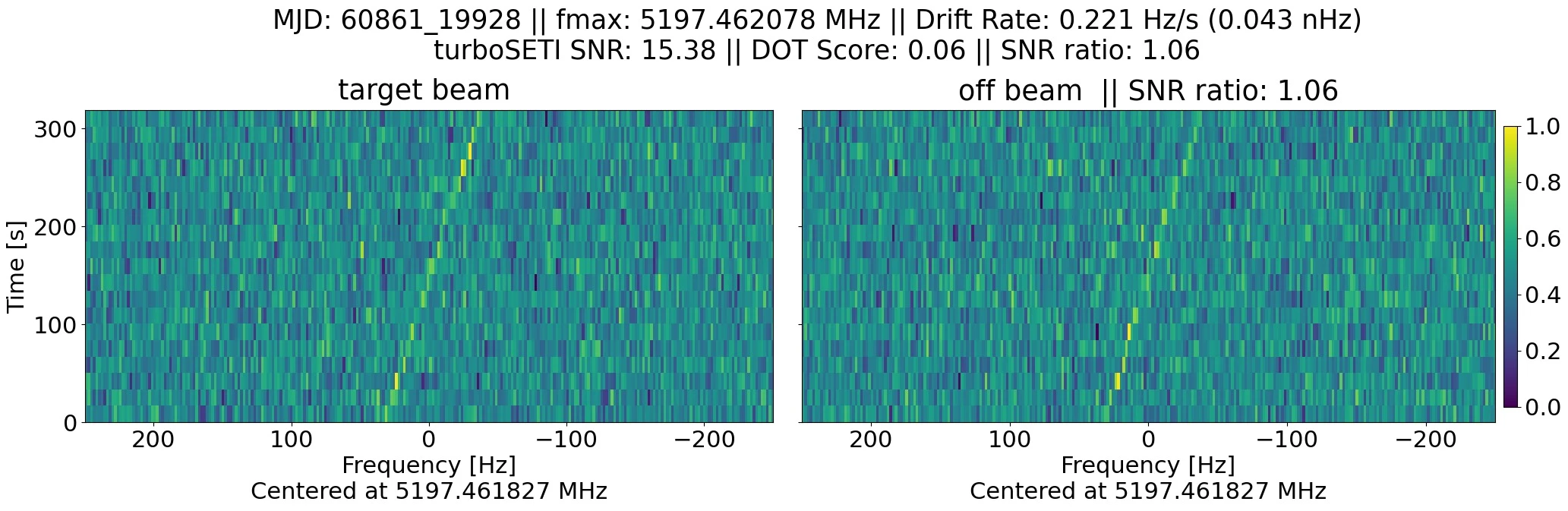
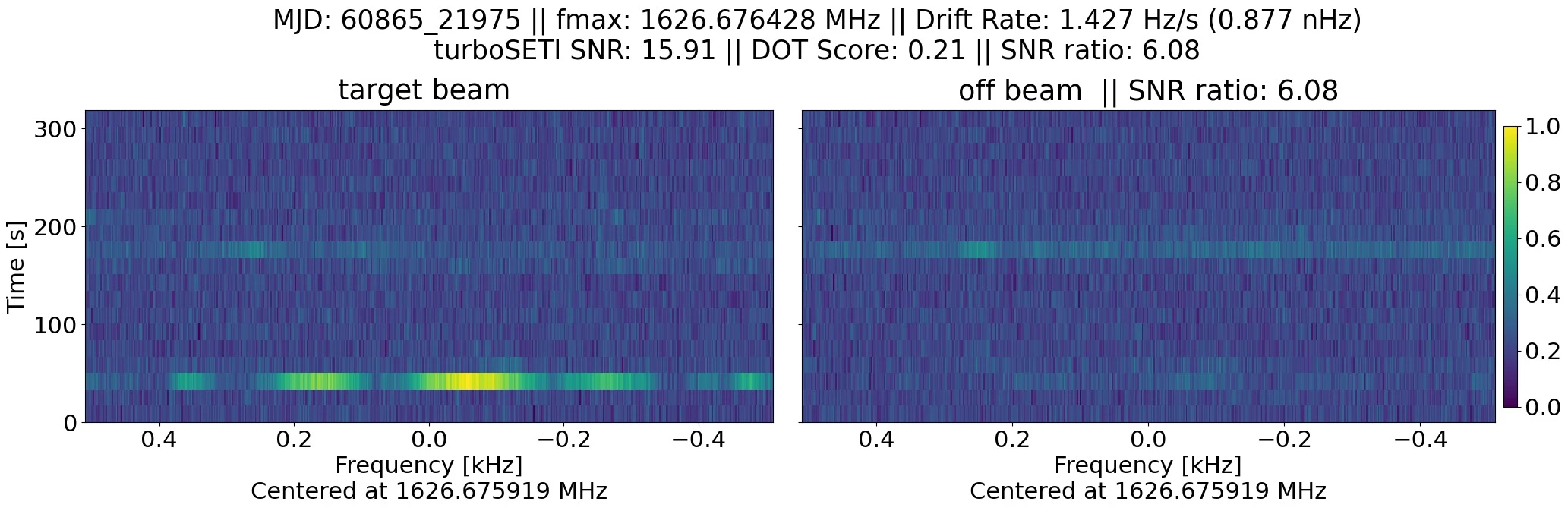
Start with two panels from the Allen Telescope Array, recorded at the same moment on 5 July 2025. The left one is a beam aimed at the comet. Find the thin diagonal streak, drifting in frequency as the minutes pass. Now the right panel, a second beam aimed just beside the comet. The same streak is there too. If all you had was the left panel, would you call it a signal from the visitor? You can make the first check yourself.
Seven hours in July
3I/ATLAS was reported on 1 July 2025 by the ATLAS survey telescope at Rio Hurtado in Chile. It was the third object ever found coming in from interstellar space, after 1I/'Oumuamua and 2I/Borisov, on an orbit so open that it will never come back.
About a day after the report, the Allen Telescope Array at Hat Creek in California began to listen, with 28 of its 42 dishes working. Between 3 and 10 July it recorded 7.25 hours on the comet, from 1 to 9 gigahertz. The comet was then about 3.35 astronomical units from Earth.
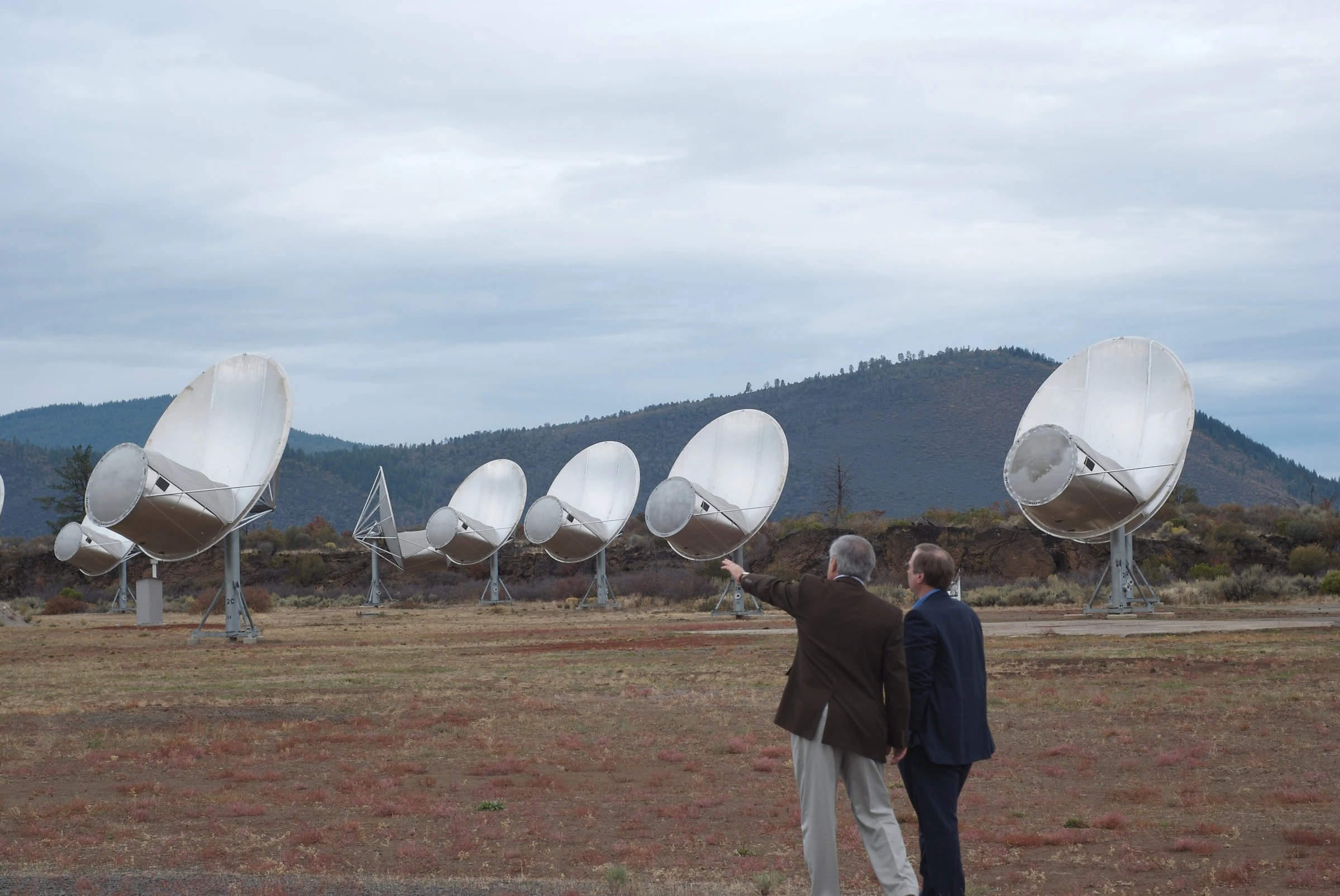
The search software, a new pipeline called bliss, logged 73,974,799 narrowband hits.
The team, led by Sofia Sheikh, cut them down. Frequency bands known to be crowded with human signals were blanked, about 16 per cent of the band. A drift-rate filter kept only signals whose frequency changed the way a transmitter riding on the comet would, between 0.05 and 1.5 hertz a second; the paper says it is "the first time that expected drift rate contributions have been used as a filter for a technosignature search of a Solar System object." What survived had to be stronger in the beam on the comet than in the beam beside it.
Eleven signals came through that test. With 200 more plotted from two sessions where nothing passed, there were 211 plots for a person to look at. "After visual inspection, all of these 211 events were easily attributable to RFI," the paper says: radio frequency interference. One, near 1626.68 megahertz, was consistent with the downlink of the Iridium satellites. The streak in the opening panels, at 5197.46 megahertz, was a local transmitter, in the band allotted to "fixed-satellite service (Earth-to-space)", the band ground stations use to reach satellites.
"We did not find any signals worthy of additional follow-up," the team wrote. In the bands, drift rates and hours it covered, any transmitter on the comet beaming equally in all directions had been weaker than 10 to 110 watts.
A visitor worth listening to
The case for listening was made in the papers that did the listening. "Similar to the NASA Voyager missions sent in 1977," Sheikh's team wrote, "science probes by extraterrestrial life ('artifact technosignatures') could be sent to explore other stellar systems like our own." For that idea, they added, "no extrapolation is needed", because humanity has already built such objects. And radio is the clearest test: narrowband emission "can only be produced by technological sources."
The stronger claim came from Avi Loeb at Harvard and two colleagues. In July 2025 Adam Hibberd and Adam Crowl of the Initiative for Interstellar Studies, with Avi Loeb, posted a paper titled "Is the Interstellar Object 3I/ATLAS Alien Technology?". They found that its path ran close to Venus, Mars and Jupiter, a coincidence they put at under 0.005 per cent, on a retrograde orbit near the plane of the planets, with its closest pass to the Sun hidden behind the Sun from Earth. On their reading, a closest pass hidden from Earth is where a craft could brake unseen, a "reverse Solar Oberth Manoeuvre" in their terms. They hypothesized "that this object could be technological, and possibly hostile as would be expected from the 'Dark Forest' resolution to the 'Fermi Paradox'": the idea that the galaxy is quiet because civilizations keep silent and treat strangers as danger. They called the paper "largely a pedagogical exercise."
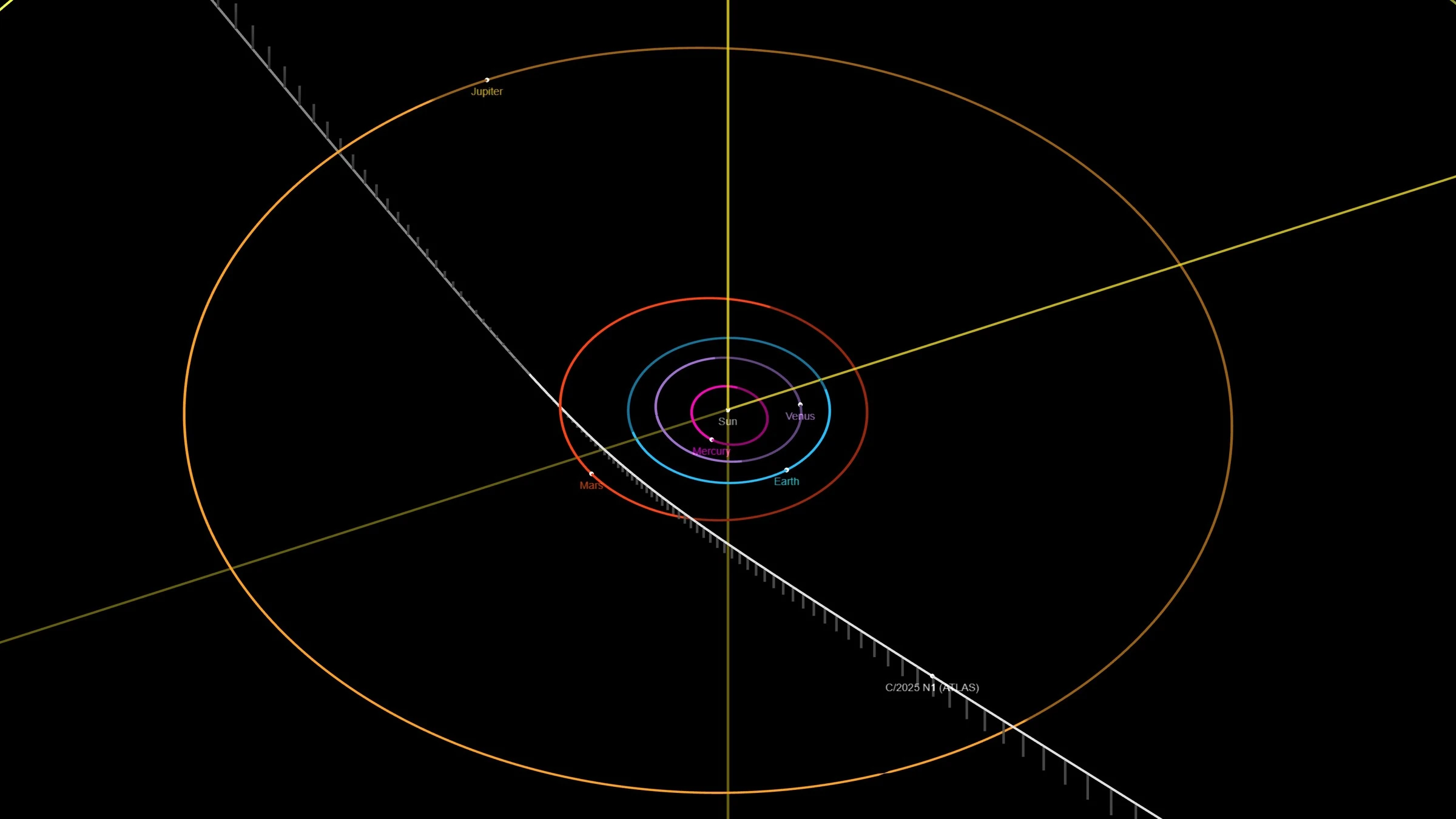
Loeb went on to point at the sky. The comet's direction, he wrote, was "separated by merely 9 degrees from those of the Wow! signal", the narrowband burst recorded in Ohio in 1977 that the Wow! Signal article on this site follows, a chance alignment he put at "about 0.6 percent." He said why he raised it: "to encourage radio observers to search for radio emission from 3I/ATLAS." And he set the test: "If it is a comet of natural origin, no radio signal is expected at 1420 megahertz."
Later in the year, near the Sun, the comet was pushed off its gravity-only path, the subject of the site's articles on the push near the Sun and what the push turned out to be.
So the question was put to the radio sky, plainly.
If it had been listening back
Set aside for a moment whether it was a comet. Ask what it would mean if it was not.
We send machines into space, and some of them talk. Voyager 1 and Voyager 2 have left the planets behind and still answer on narrow radio tones. On the probe reading, 3I/ATLAS would be the same thing from the other side: an object built somewhere else, sent across the space between stars, found in our skies on 1 July 2025.
It would mean that someone, somewhere, had done what our species has only begun to do, and done it long enough ago for the object to cross interstellar space. Which means the oldest question people ask of the night sky would have an answer that was not a message at all, but a visitor, and the visitor would have come close enough to photograph.
It would mean, on the reading Hibberd, Crowl and Loeb set out, that its path was chosen: past Venus, Mars and Jupiter, hidden behind the Sun at its turn. A path chosen is a purpose. And on the Dark Forest reading those authors raised, silence is exactly what such a visitor would keep: a purpose that hides would be a purpose we cannot read.
And it would leave us with the question that is still in front of us. If it said nothing, then the radio searches of 2025 and early 2026 would be a record of what a visitor chose not to do. The next visitor, on that reading, might choose the same. Our species would have to decide how long to listen to silence before calling it an answer.
The standard account
The standard account holds that 3I/ATLAS is a comet from another star, and that the radio searches found only human interference because there was nothing else to find.
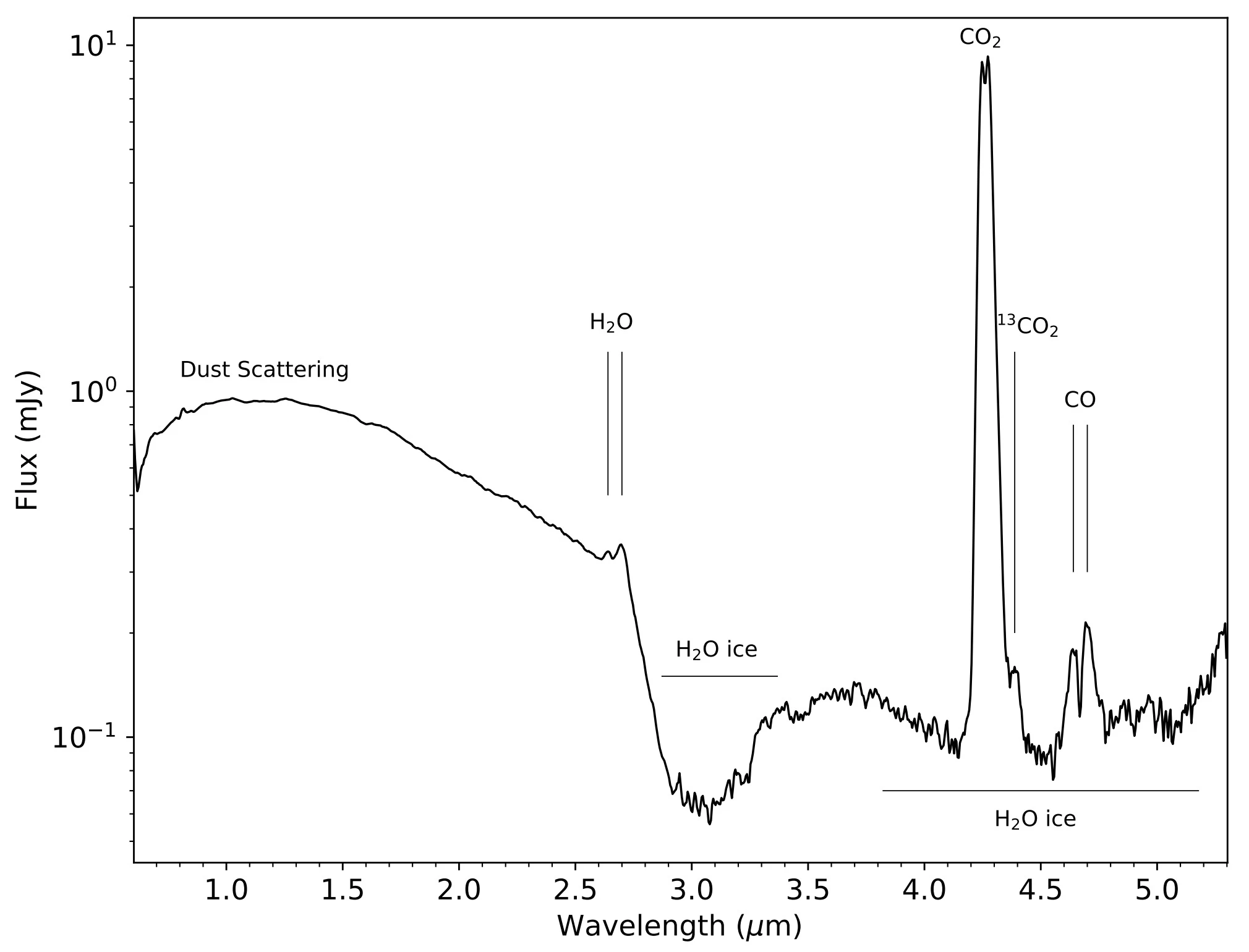
The comet behaved like one. On 6 August 2025 the James Webb Space Telescope found it wrapped in gas dominated by carbon dioxide, with water, carbon monoxide and water ice; its ratio of carbon dioxide to water, 7.6, is, in Martin Cordiner's team's words, "among the highest ever observed in a comet". NASA's Swift satellite measured water coming off it. Later observers found nickel and, with Webb in December, the first methane seen in an interstellar object.
And every radio search reported so far came back empty. MeerKAT in South Africa listened on 5 November, from 900 to 1670 megahertz, down to 0.17 watts. Breakthrough Listen used the 100 metre Green Bank Telescope in West Virginia on 18 December, the day before the comet's closest approach to Earth, at about 1.8 times the Earth's distance from the Sun. It reported "a nondetection of candidate signals down to the 100 mW level." For comparison, the paper notes, a cell phone transmits at about 1 watt. China's 500 metre FAST later set a limit of about 3 milliwatts between 1.05 and 1.45 gigahertz.
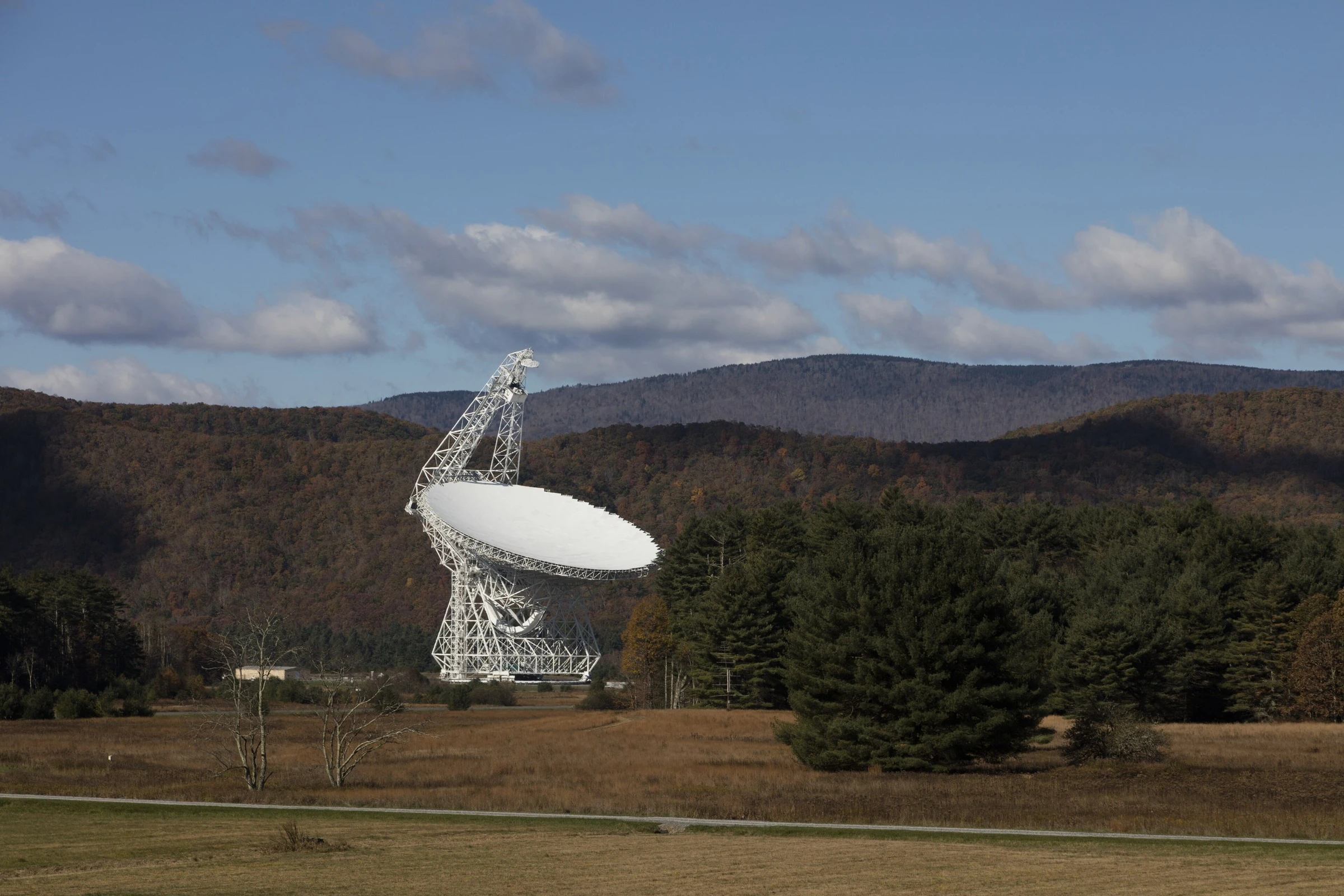
"There is currently no evidence to suggest that ISOs are anything other than natural astrophysical objects," the Green Bank team wrote. Breakthrough Listen's own summary: "3I/ATLAS continues to behave as expected from natural astrophysical processes."
What the listening could not reach
A limit is a promise with conditions, and the papers state them.
The Green Bank figure of a tenth of a watt holds for a transmitter sending one steady tone about a hertz wide, equally in every direction, switched on during the five-minute scans when the dish pointed at the comet, and drifting no faster than 4 hertz a second. Its "1 to 12 gigahertz" was four receivers, with nothing searched between 2.7 and 4.0 gigahertz. The Allen Telescope Array blanked about 16 per cent of its band, the busiest bands, where a transmitter that sounded like human satellites would hide. None of the searches reported went much below 0.9 gigahertz or above 12. The hours were hours: seven in July at the Allen Telescope Array, five on 18 December at Green Bank, two sessions on one November day at MeerKAT, four dates at FAST.
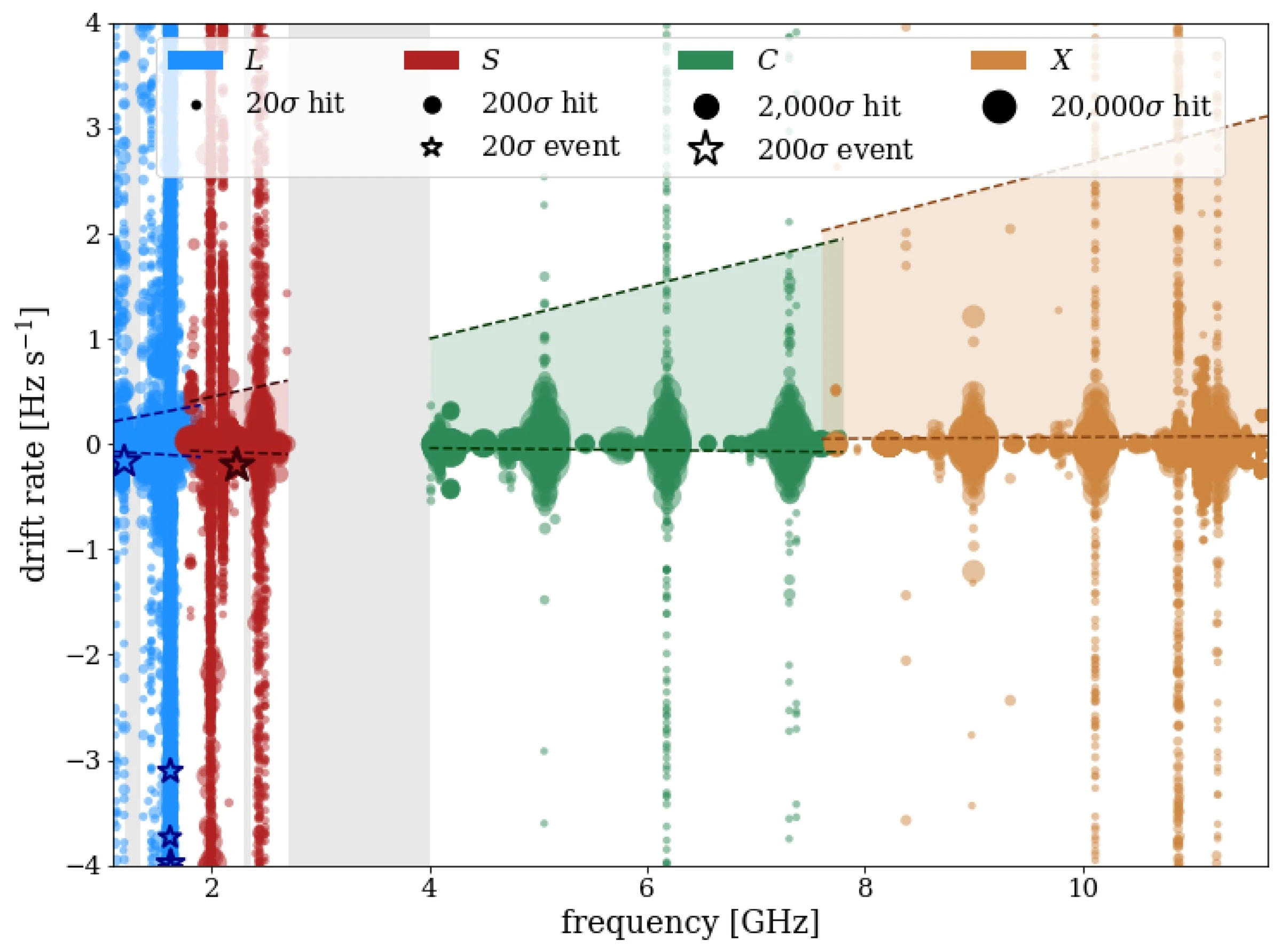
A beam pointed anywhere but Earth sets no limit at all.
Sheikh's team said so themselves. "Some technological artifacts may have no radio emission at all (e.g., Voyager in the far future)," they wrote, though "many of the potential motivations" for sending one "would benefit strongly from an artificial radio component." And: "To differentiate a natural ISO from an artificial one, we would need significant evidence of artificiality."
Parkes in Australia recorded the comet three times, on 31 July, 12 September and 5 October 2025. As of November 2026, its narrowband results, Breakthrough Listen says, "will be posted once this has been completed."
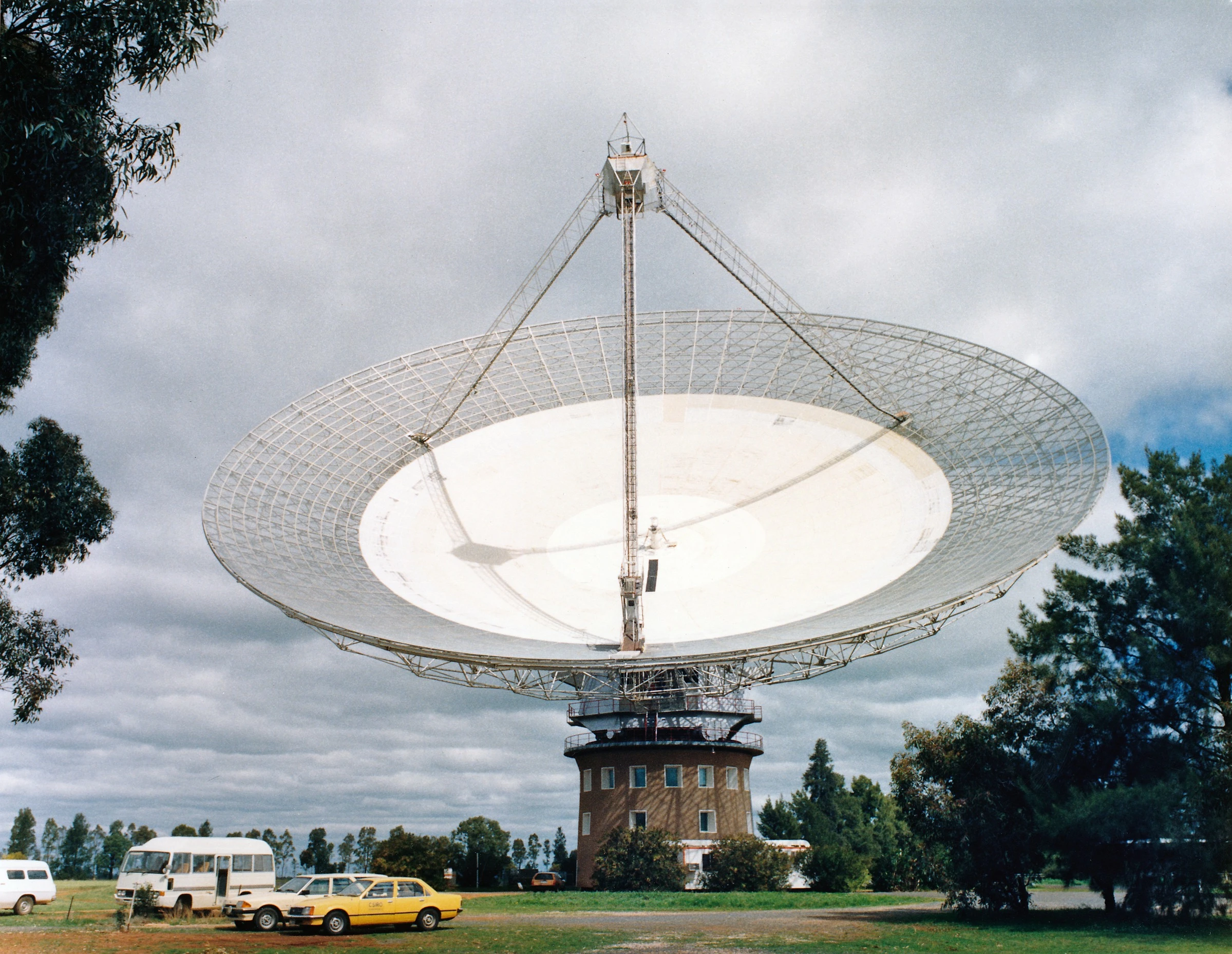
The telescopes did not hear a transmitter. They did not show there was none.
Which leaves the radio record exactly as wide as its conditions: a silence measured to a tenth of a watt in some bands, on some days, toward Earth.
Outbound
3I/ATLAS passed Jupiter on 16 March 2026 at about 0.36 times the Earth's distance from the Sun, and is on its way out.
The net widened as it went. FAST searched for signals that repeat on a fixed period as well as steady tones, and set a limit of 0.146 watts for those. The Vera C. Rubin Observatory looked in visible light for laser flashes. "No artificial emission was detected," Breakthrough Listen reported.
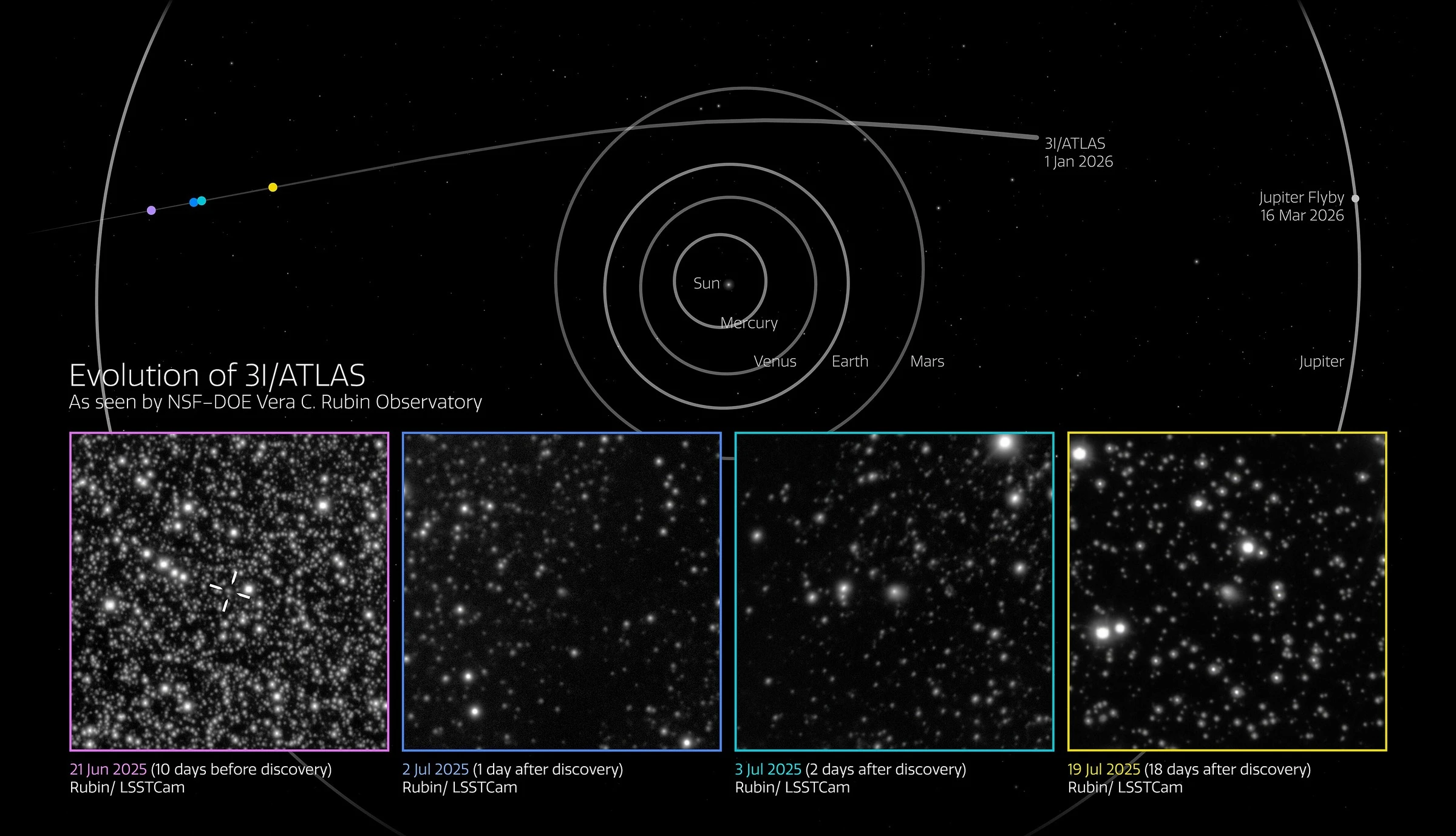
J. R. A. Davenport and colleagues have set out how future technosignature searches of interstellar objects could start at discovery and repeat, as the Rubin Observatory, which caught 3I/ATLAS ten days before anyone knew it was there, finds more.
The only radio signal reported from 3I/ATLAS was natural. MeerKAT saw hydroxyl, the molecule left when water breaks apart in sunlight, at 1665 and 1667 megahertz, the radio mark of a comet's water.
What such a search could settle is narrow and real: whether a narrowband transmitter pointed at Earth, above a stated power, was sending in the bands and hours observed. What it cannot settle is a silent object.
The comet's case rests mostly on what it did: the gas, the water, the dust. The radio record adds a number.
A tenth of a watt, from 1.8 times the distance to the Sun.
Less than a phone. On the hours and bands listened, nothing that strong was there.
Questions This Leaves You With
Is there anything a person actually does with this?
Not much in a daily sense, and it is fair to say so. 3I/ATLAS posed no threat to Earth and is leaving. What the searches offer is a way of thinking about any absence: a null result is only as wide as what was looked for. When someone tells you nothing was found, the useful questions are where, when, how faint and in what form. The larger question, how a species should listen for visitors, belongs to everyone.
Does this sit against a religious account of the world?
It can be read both ways. Some see in a visitor from another star, natural or not, a creation far larger than any one world. Others see physics, and find that enough. Hibberd, Crowl and Loeb's reading would add other makers to the picture, and people of faith have argued on both sides of that question for a long time. This site will not tell you which reading to hold. That is yours.
Does it change what a human life is?
Think of the dishes in California turning to a point of light a day after it was announced, because a few people thought it worth asking. One reaction is that it makes a life small: a visitor from another star, passing without a word. The other is that it makes it large: a species that learned to build radios a little over a century ago now turns its dishes to visitors from other stars within a day of finding them. Which did you feel first?
What would change your mind, in either direction?
Name it now. Toward a probe: a narrowband signal stronger in the beam on the object than beside it, drifting as the object's motion predicts, seen by a second telescope, and absent from every list of our own satellites. Toward a natural visitor for the next one too: the same silence at milliwatt limits, across more bands, more hours and more objects, while the gas and dust keep behaving like a comet. Either answer would need more than one visitor.
Where does the open problem actually sit?
Not in whether 3I/ATLAS was a comet. The gas, the water and the dust say it behaved like one. It sits in what silence can tell anyone. A transmitter that is off, aimed elsewhere, or sending outside the bands searched leaves no trace in any of these papers, and nobody has a way to rule out a silent machine. You are looking at a limit, not a proof.
More photographs
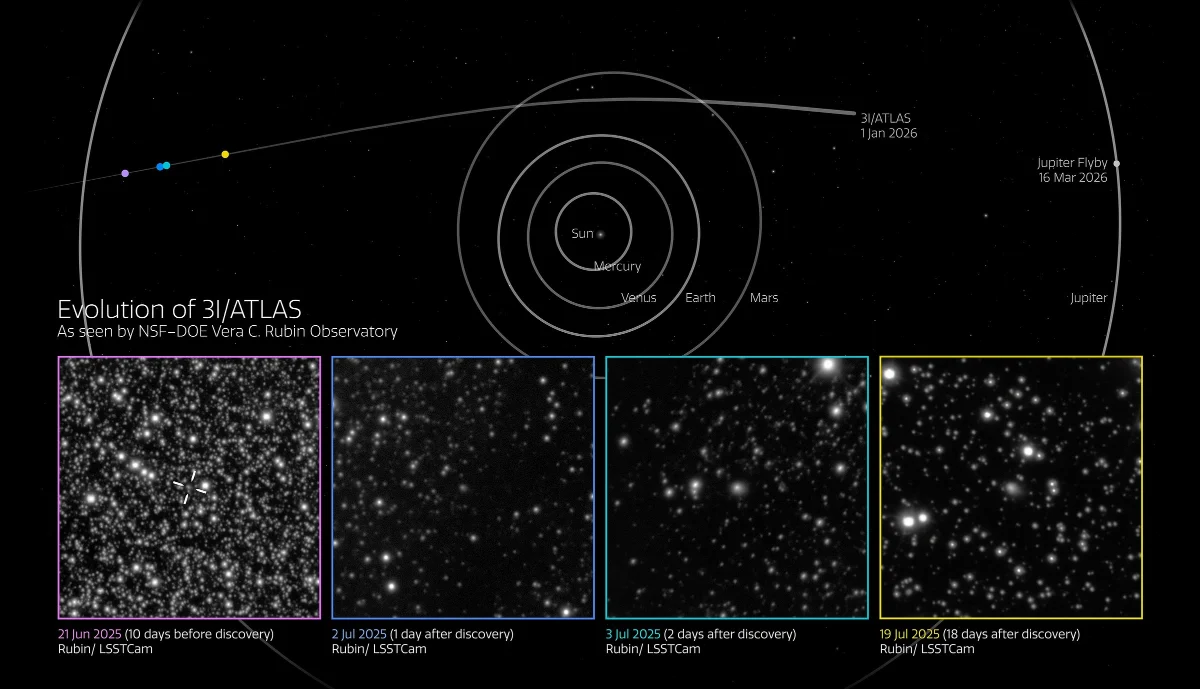
Rubin Observatory frames that caught 3I/ATLAS ten days before its discovery, with its path through the planets. Image: NSF-DOE Vera C. Rubin Observatory/NOIRLab/SLAC/AURA; processing: C. Chandler (University of Washington), M. Zamani and D. de Martin (NSF NOIRLab). CC BY 4.0 (creativecommons.org/licenses/by/4.0), via Wikimedia Commons. Resized. 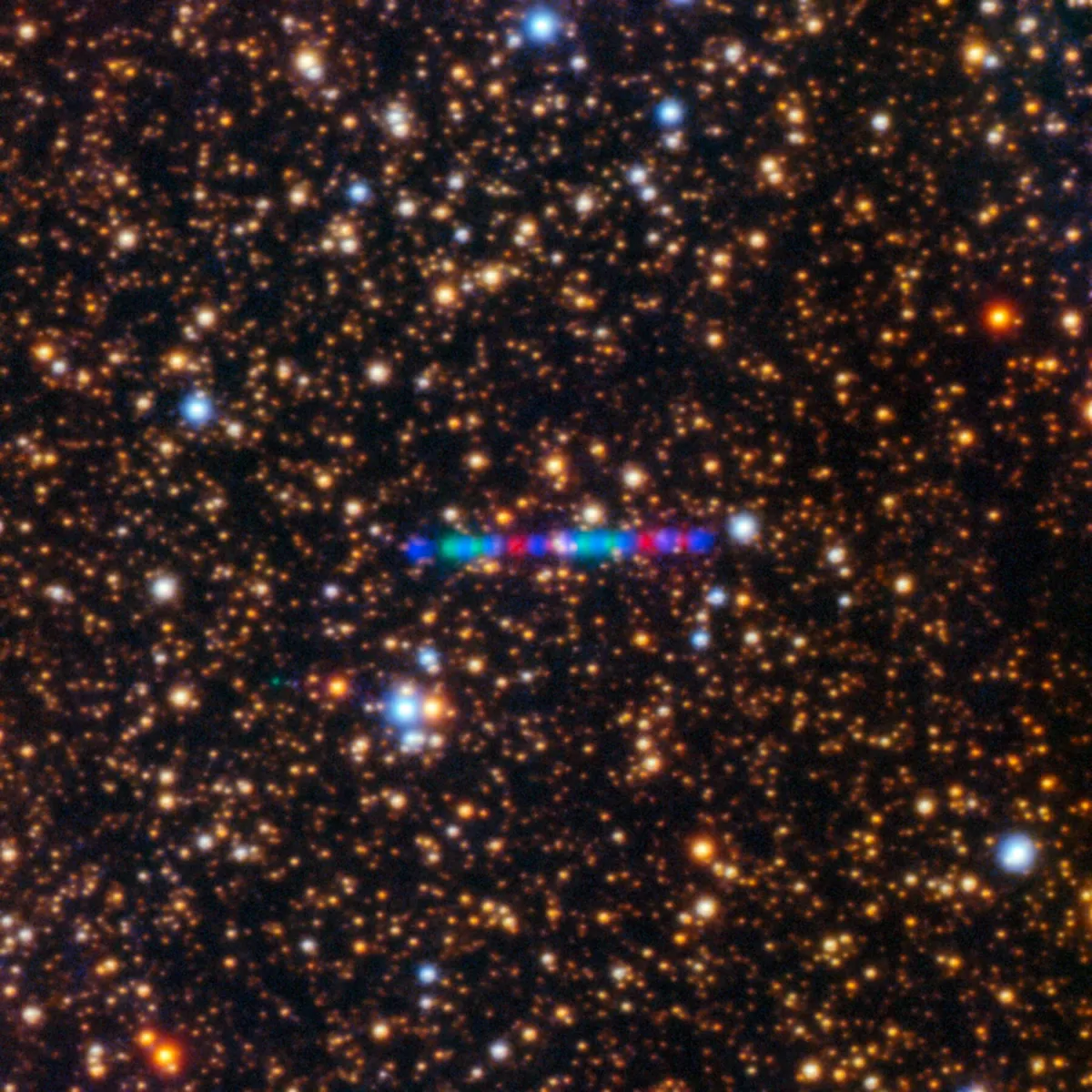
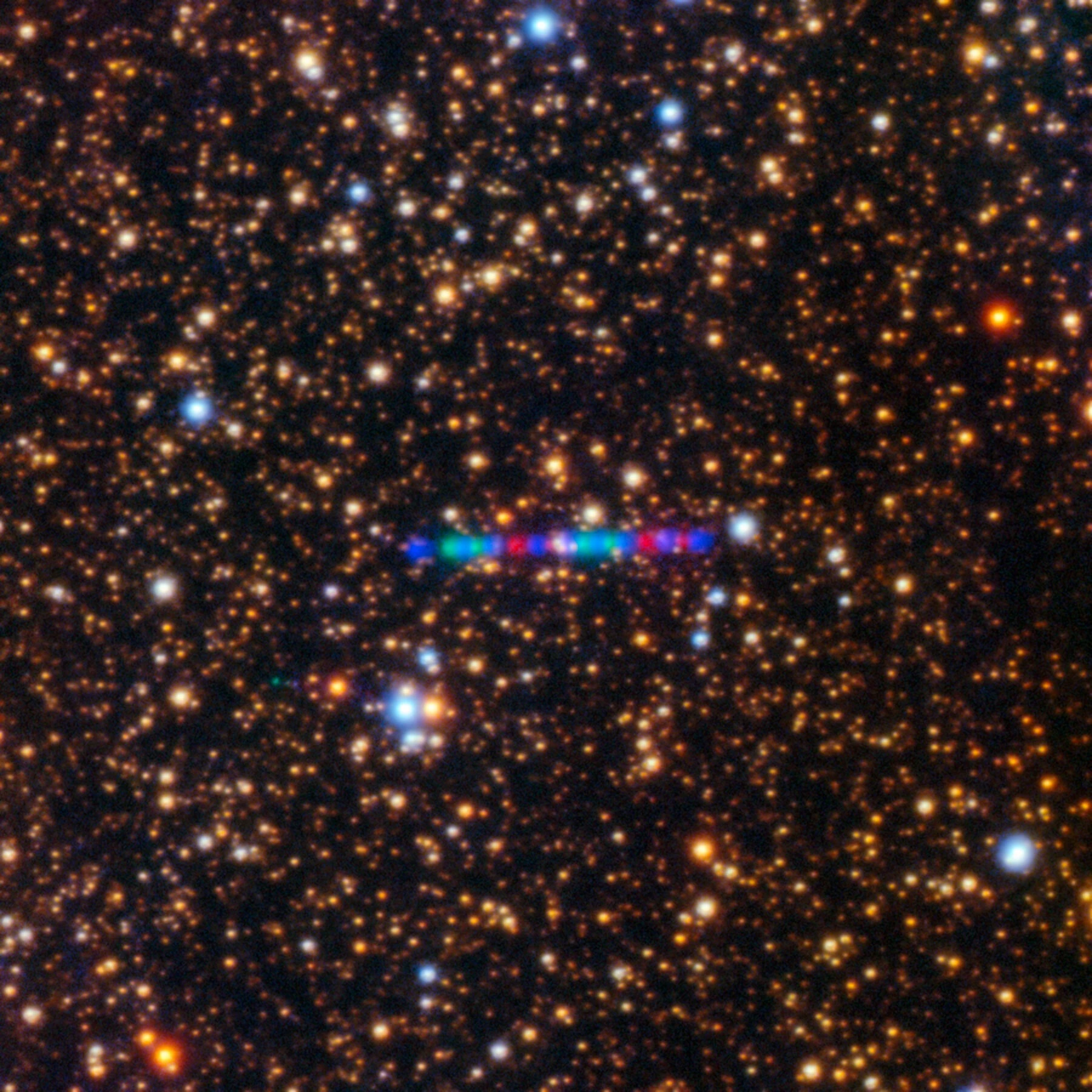
Gemini North recorded the comet's trail in three colours against a dense star field on 3 July 2025, two days after the discovery report. Image: International Gemini Observatory/NOIRLab/NSF/AURA/K. Meech (IfA/U. Hawaii); processing: Jen Miller and Mahdi Zamani (NSF NOIRLab). CC BY 4.0 (creativecommons.org/licenses/by/4.0), via Wikimedia Commons. Resized. 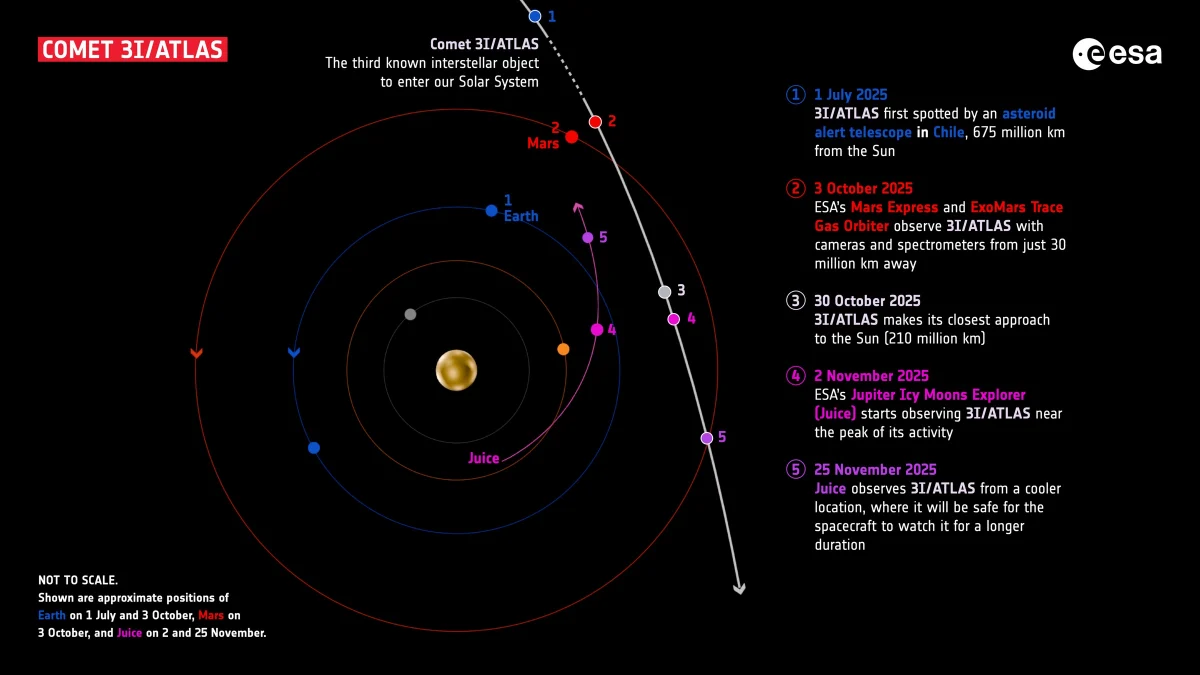
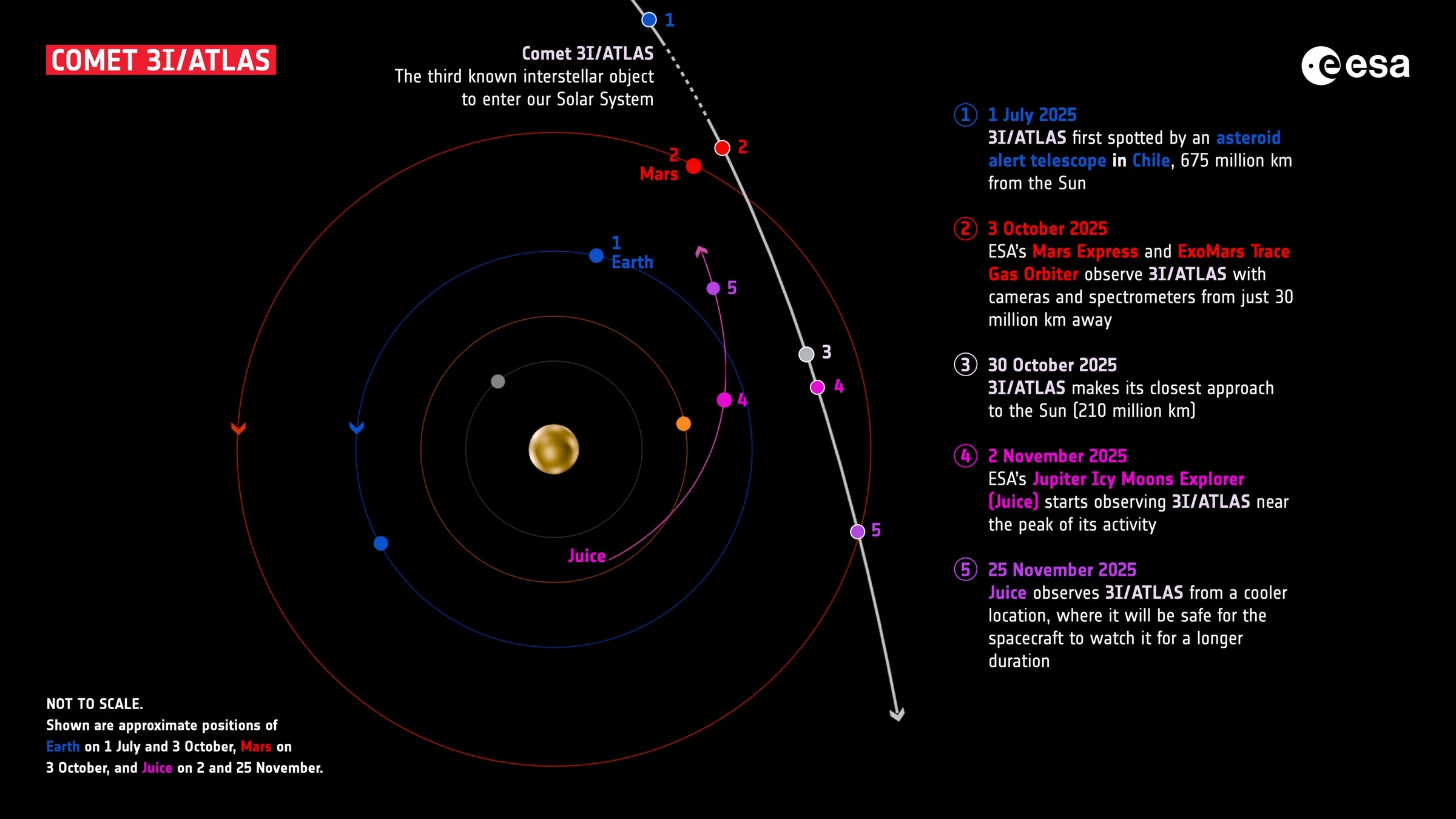
ESA's map of the comet's path past Mars, the Sun and Jupiter, with the dates its spacecraft observed it. Image: ESA, CC BY-SA 3.0 IGO (creativecommons.org/licenses/by-sa/3.0/igo), via Wikimedia Commons. Resized; this copy is shared under the same licence. 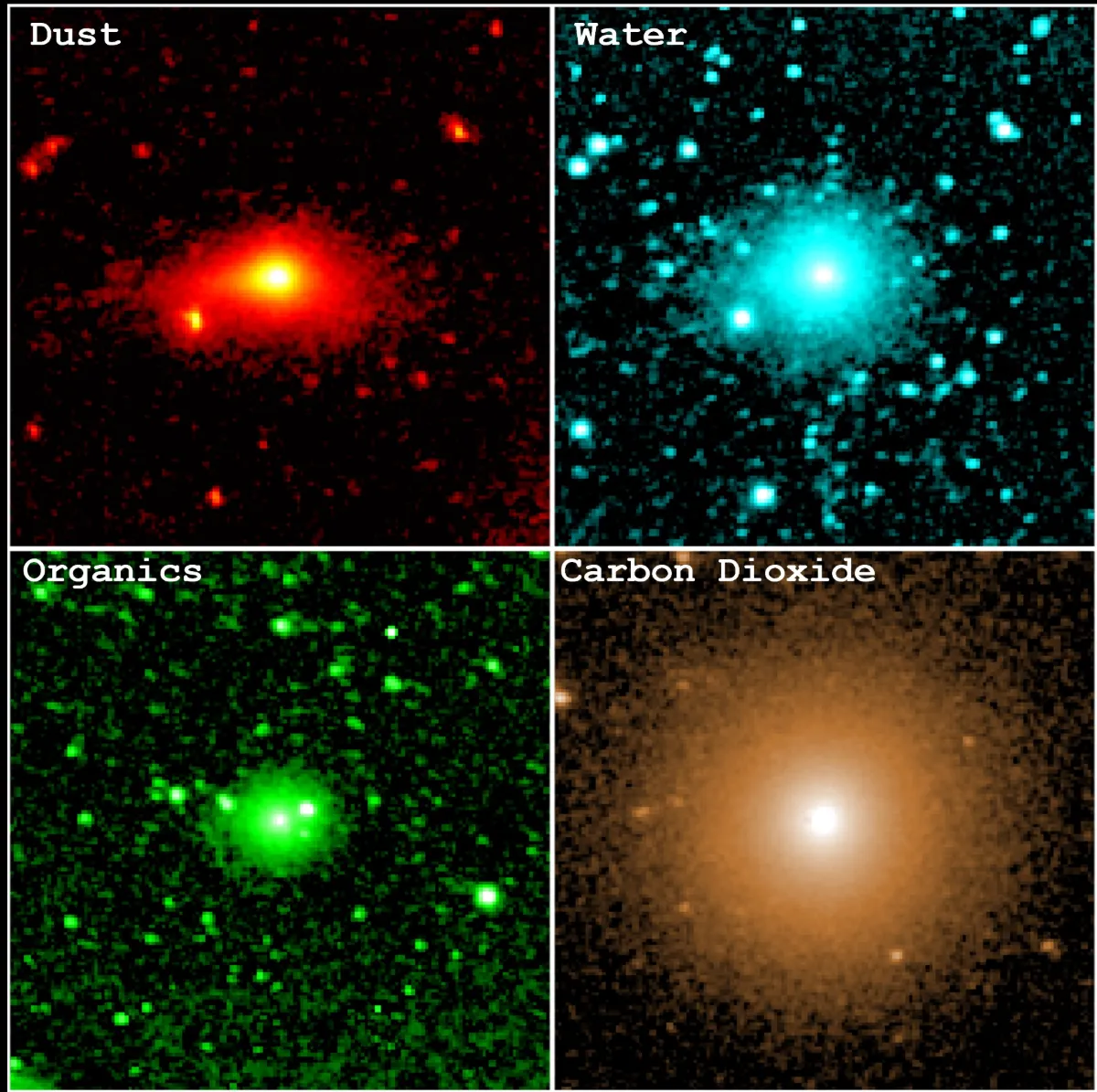
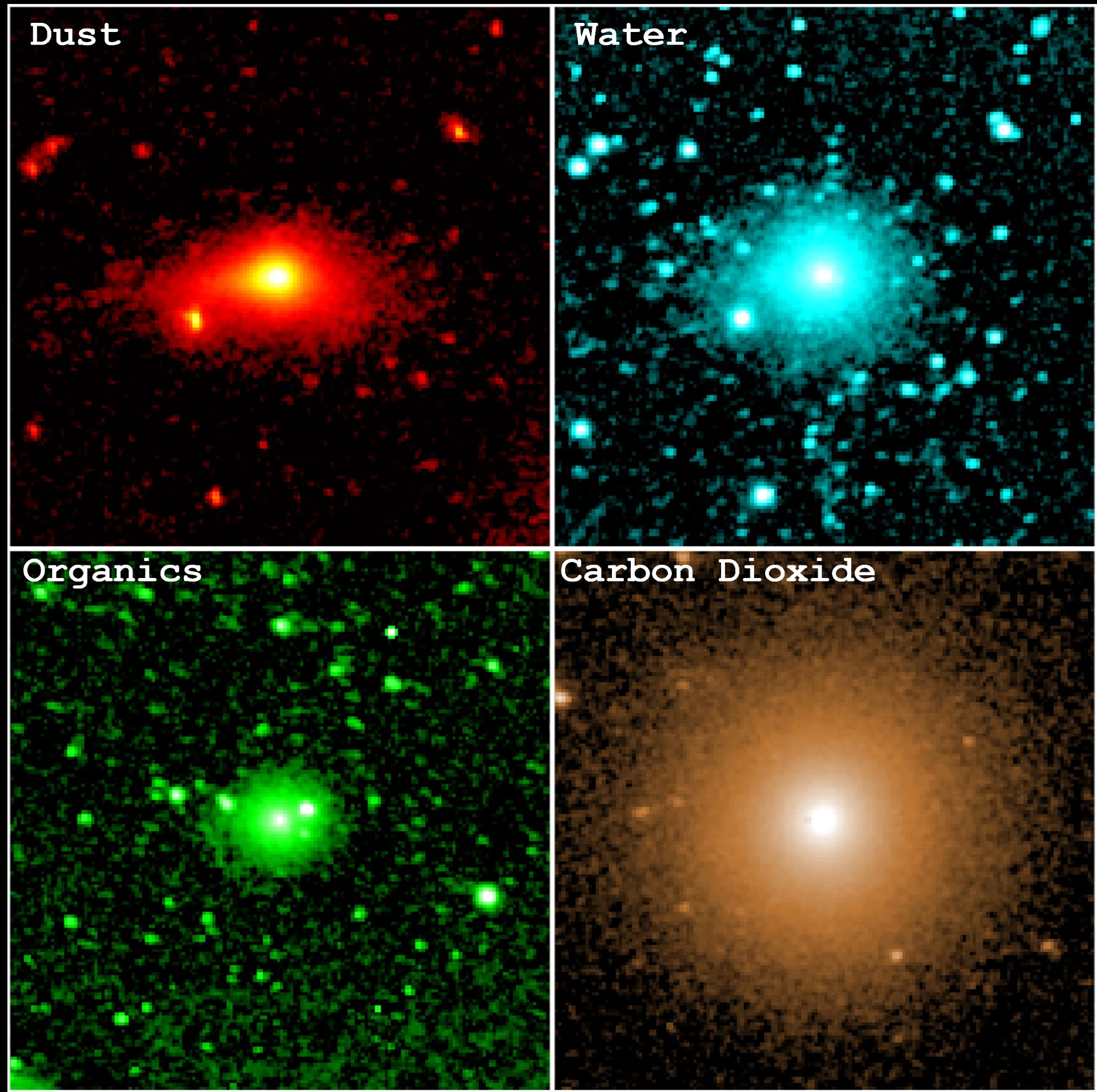
NASA's SPHEREx mapped the comet in December 2025 in the light of dust, water, organic molecules and carbon dioxide, about two months after its closest pass to the Sun. Image: NASA/JPL-Caltech (PIA26720), public domain, via Wikimedia Commons. Resized. 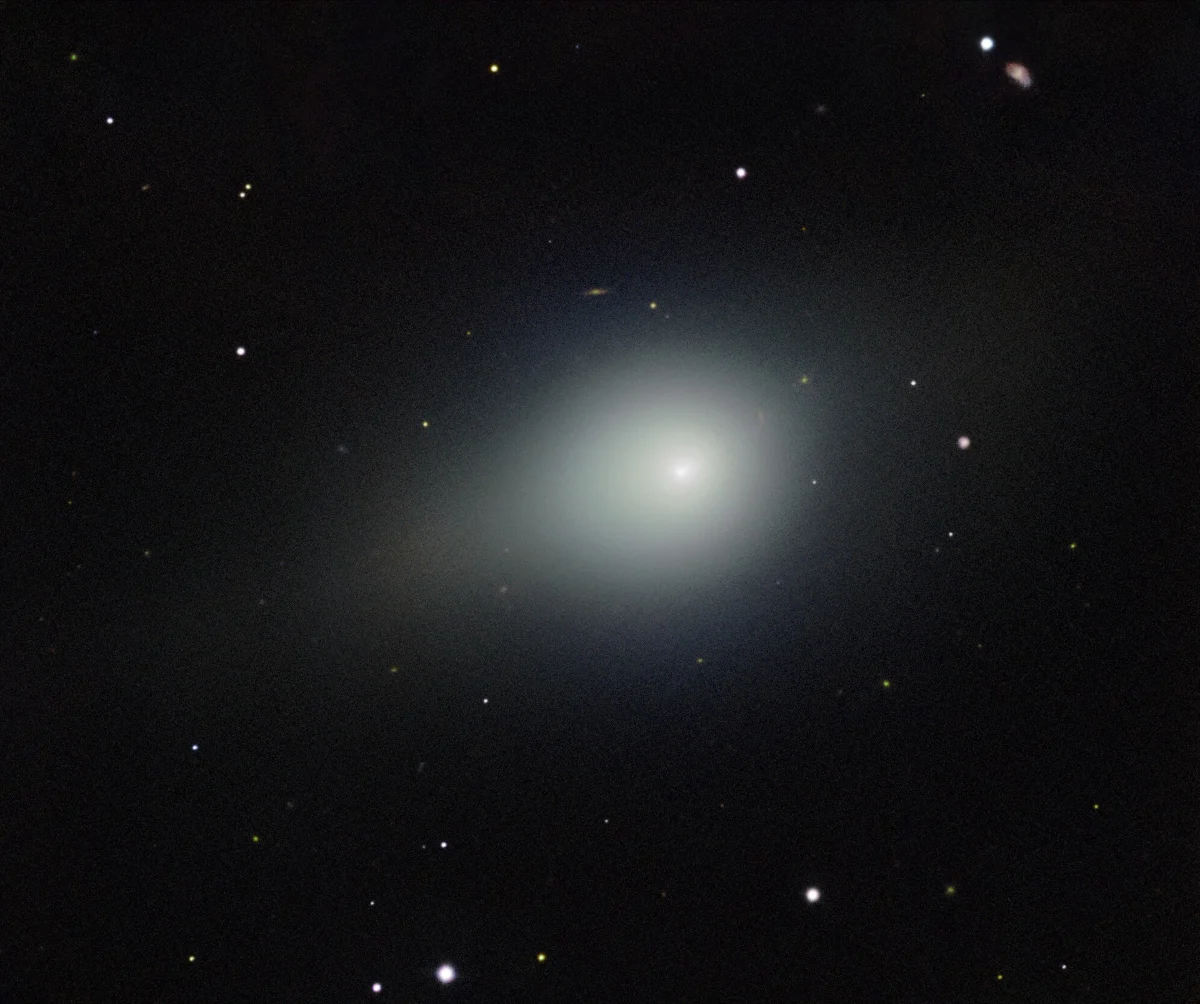
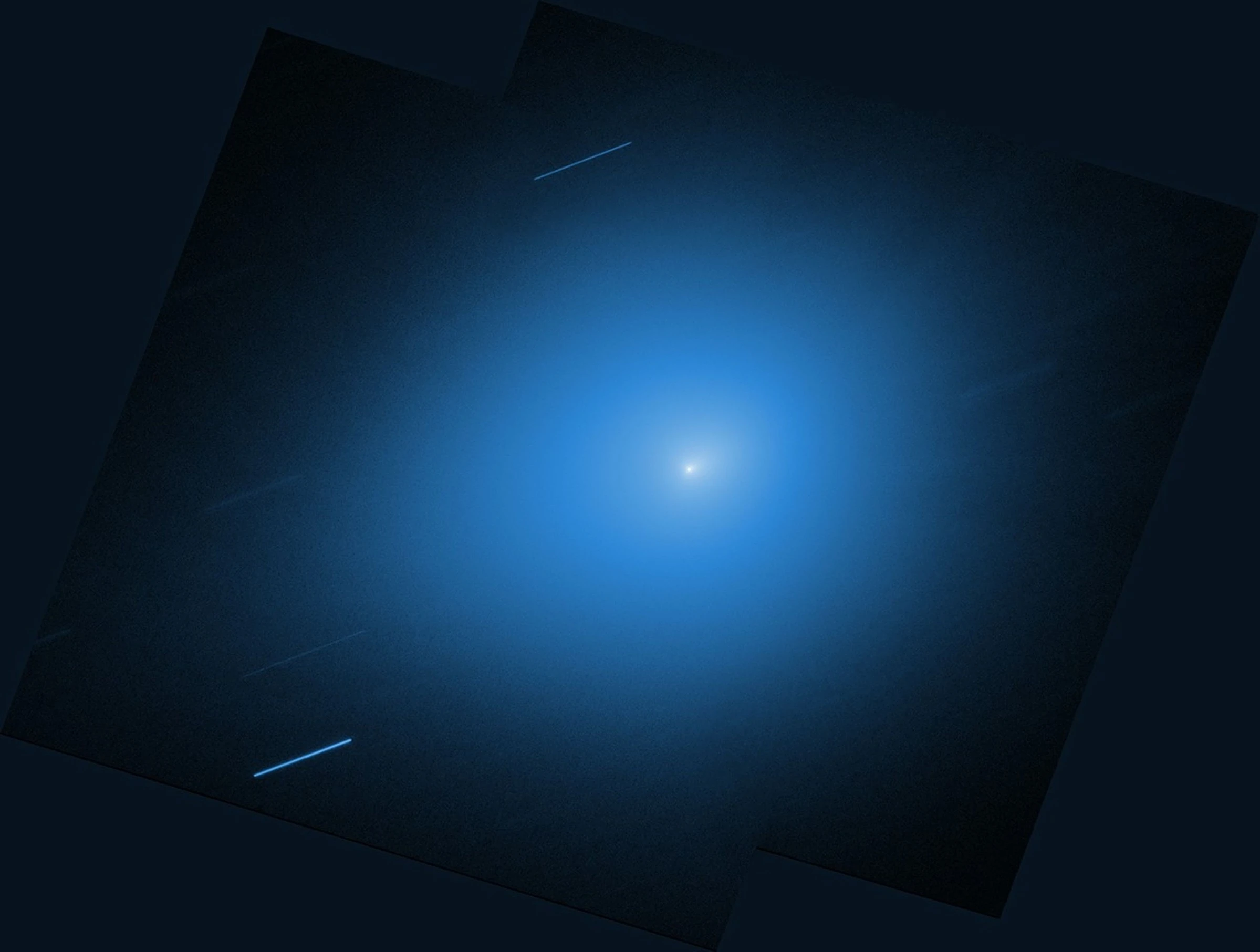
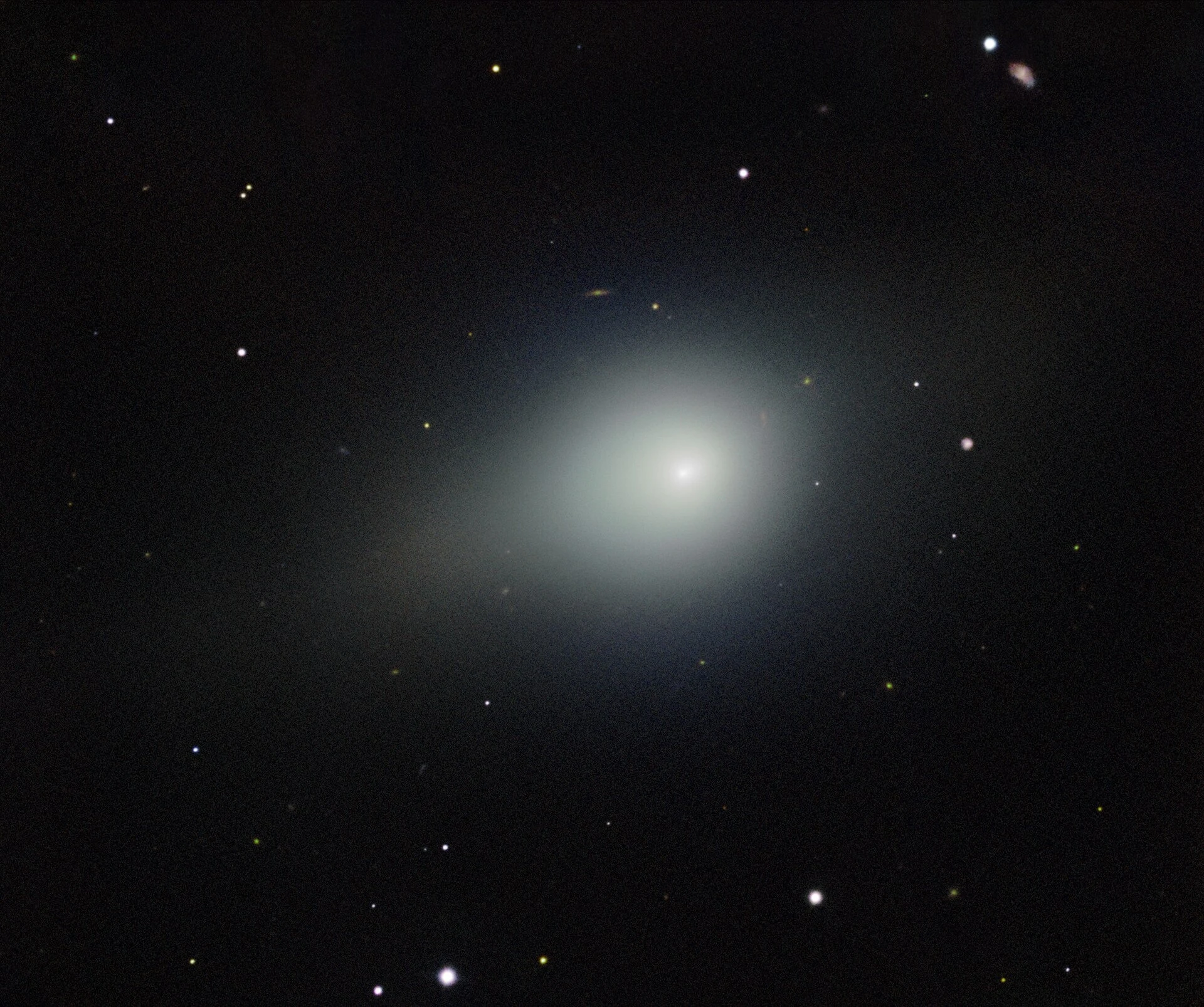
Gemini North's deep view of the comet's coma after its closest pass to the Sun, released on 12 December 2025. Image: International Gemini Observatory/NOIRLab/NSF/AURA/B. Bolin; processing: J. Miller, M. Rodriguez, T.A. Rector and M. Zamani (NSF NOIRLab). CC BY 4.0 (creativecommons.org/licenses/by/4.0), via Wikimedia Commons. 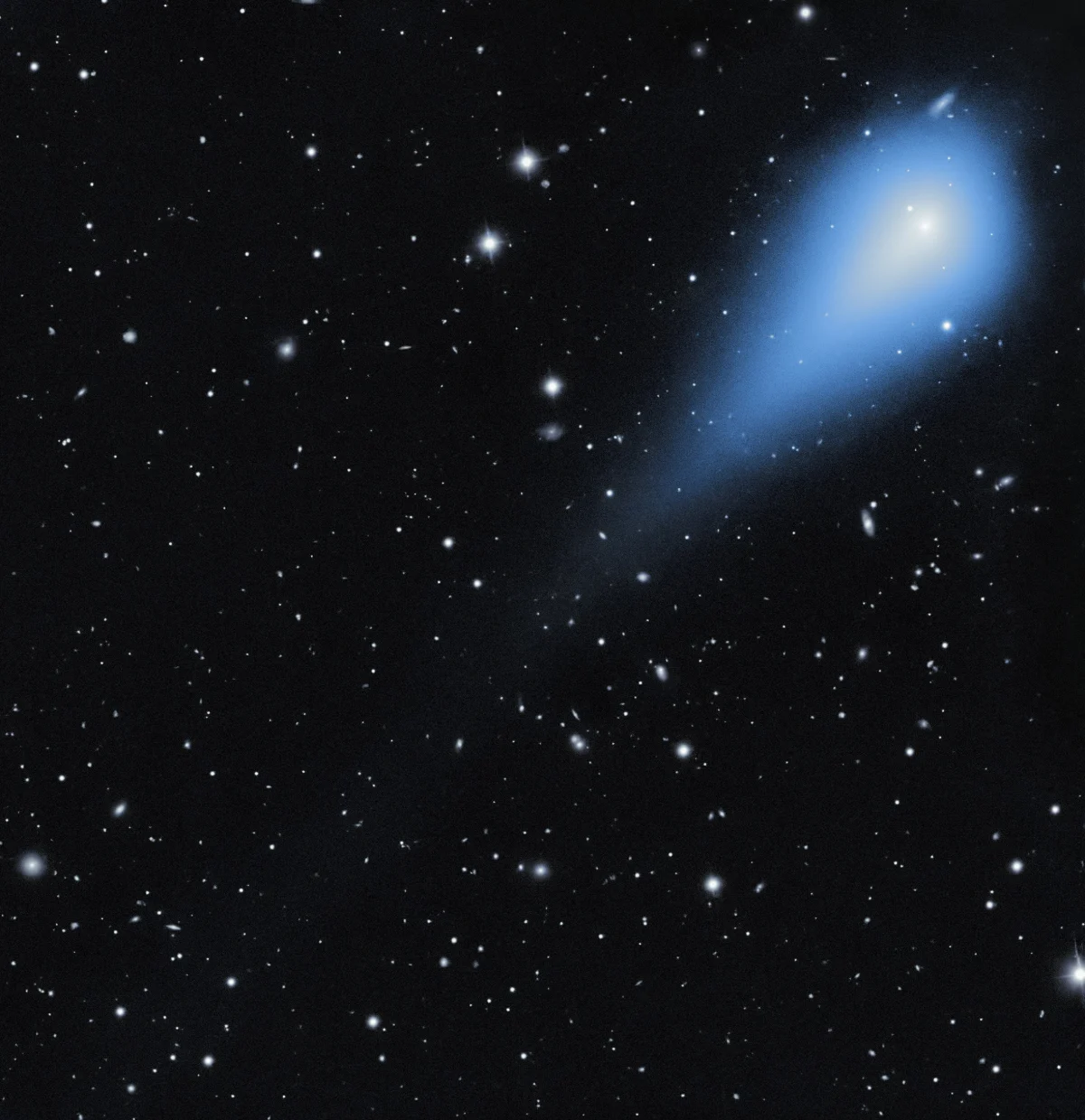
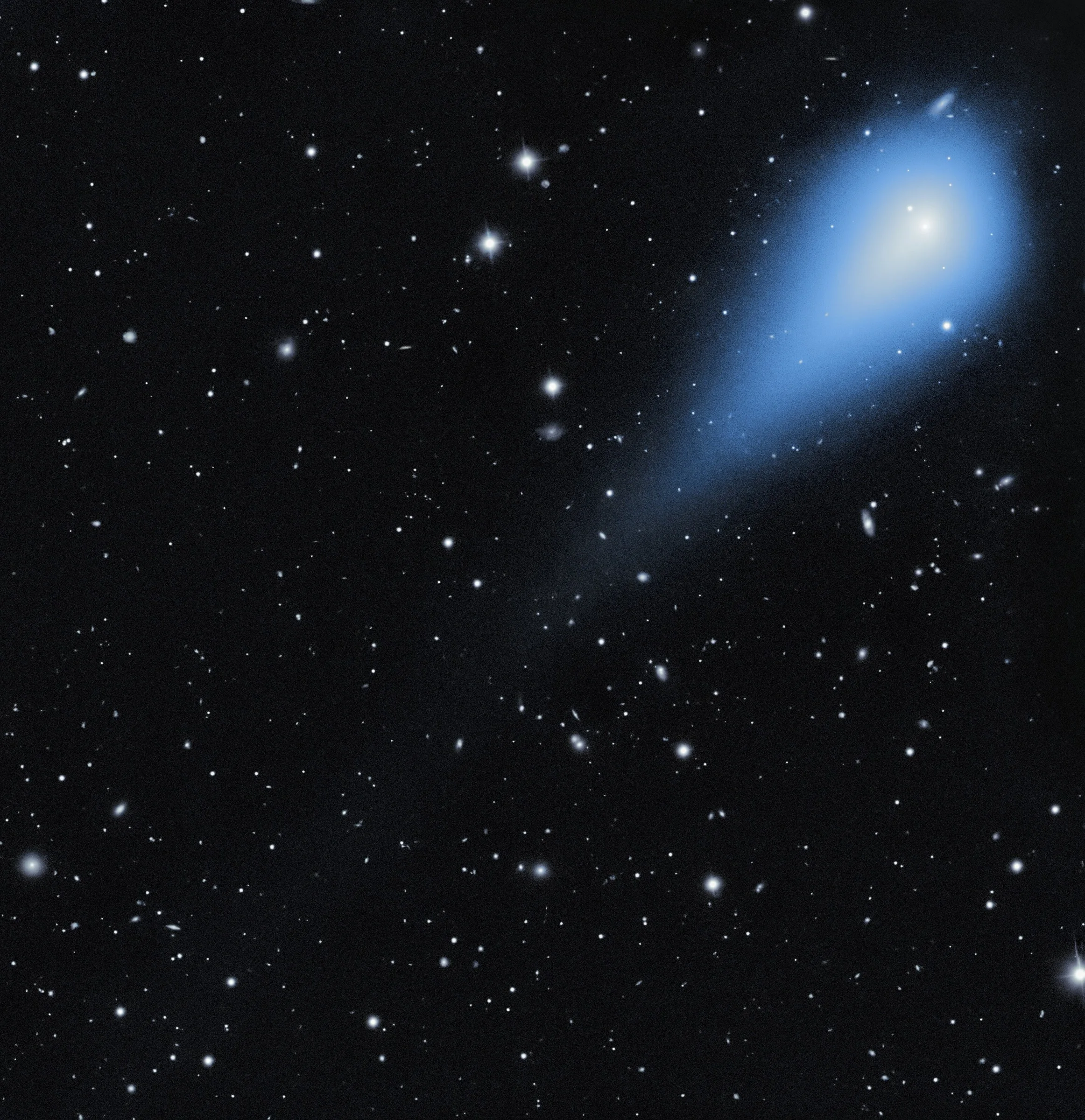
Rubin Observatory's view of the coma and tail on 19 December 2025, the day 3I/ATLAS came closest to Earth and the day after the Green Bank search. Image: NSF-DOE Vera C. Rubin Observatory/NOIRLab/SLAC/AURA; acknowledgement: C. O. Chandler (University of Washington). CC BY 4.0 (creativecommons.org/licenses/by/4.0), via Wikimedia Commons. Resized. 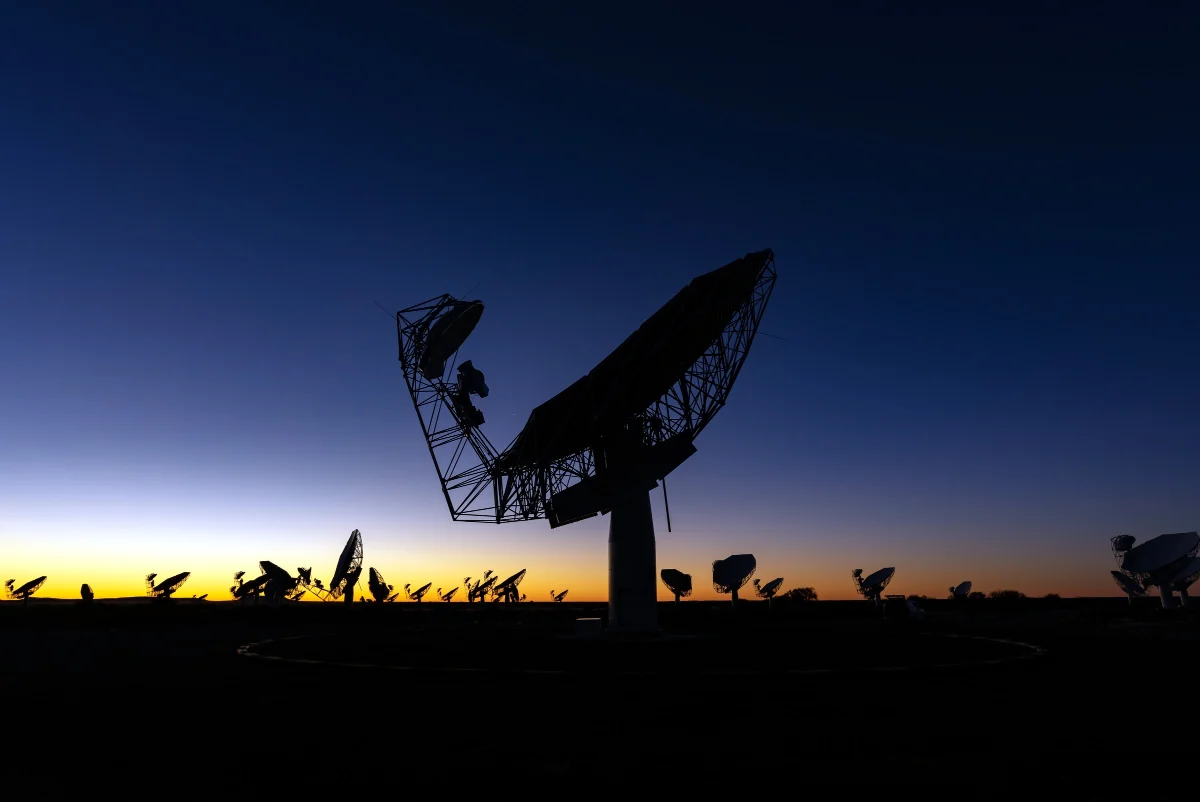
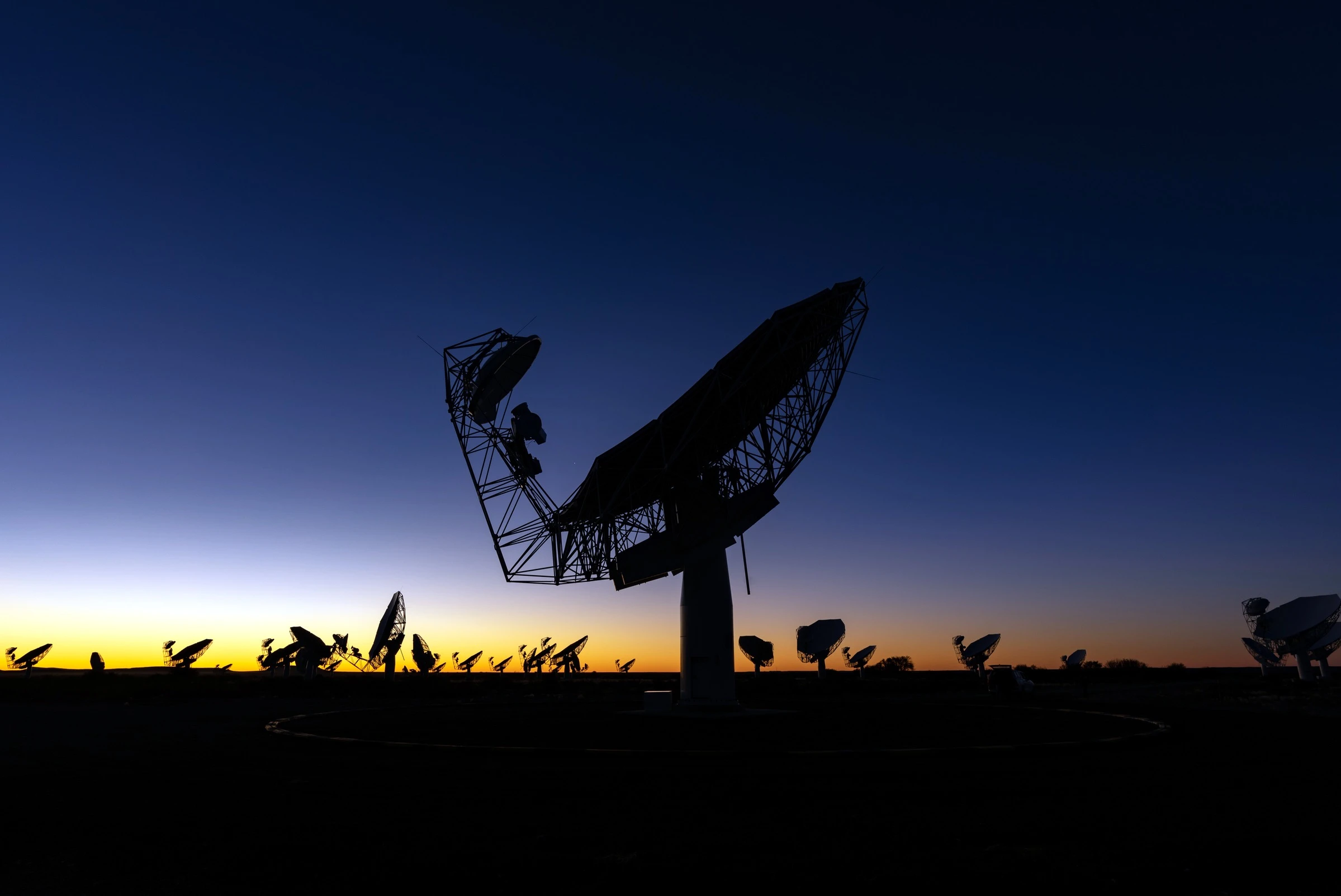
MeerKAT dishes in South Africa's Karoo at dusk. On 5 November 2025 the array searched 3I/ATLAS for transmitters down to 0.17 watts. Photo: SKAO/SARAO, CC BY 3.0 (creativecommons.org/licenses/by/3.0), via Wikimedia Commons. Resized. 
The 500 metre FAST dish in Guizhou, China, seen from orbit in October 2019. It set the tightest limit of the searches, about 3 milliwatts between 1.05 and 1.45 GHz. Image: Pierre Markuse, contains modified Copernicus Sentinel data (2019), CC BY 2.0 (creativecommons.org/licenses/by/2.0), via Wikimedia Commons. Cropped. 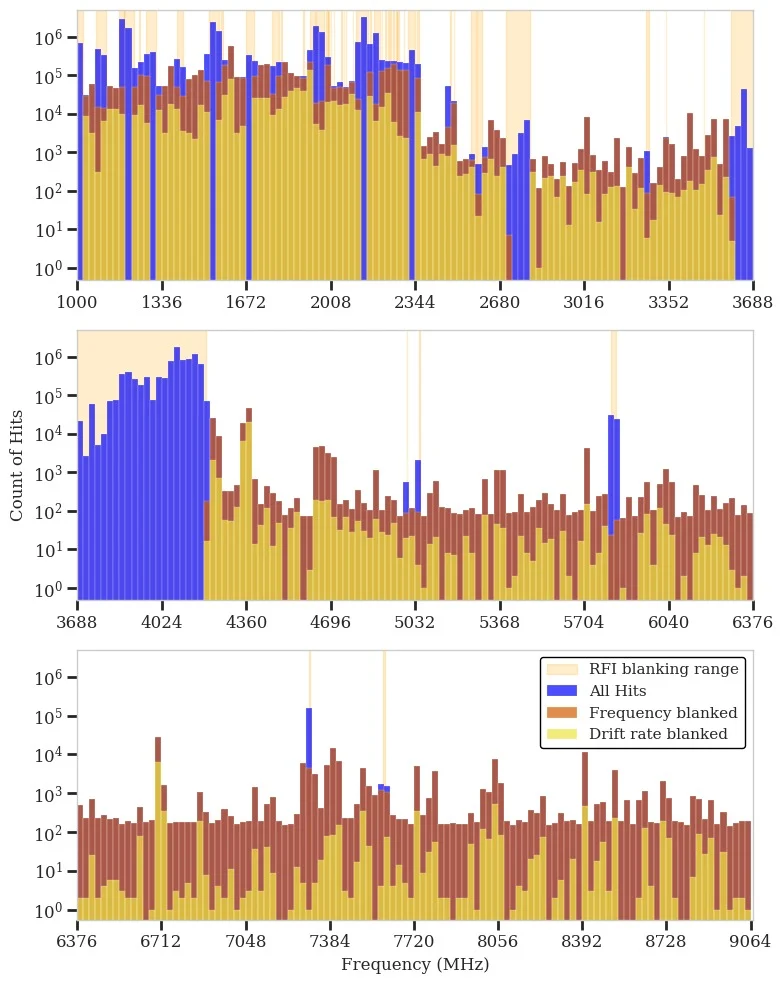
The Allen Telescope Array's 74 million hits by frequency, from 1 to 9 GHz, before and after the interference cuts; the pale bands were blanked. Figure: Sheikh et al. 2026, The Astronomical Journal 172 (arXiv:2512.18142), CC BY 4.0 (creativecommons.org/licenses/by/4.0). 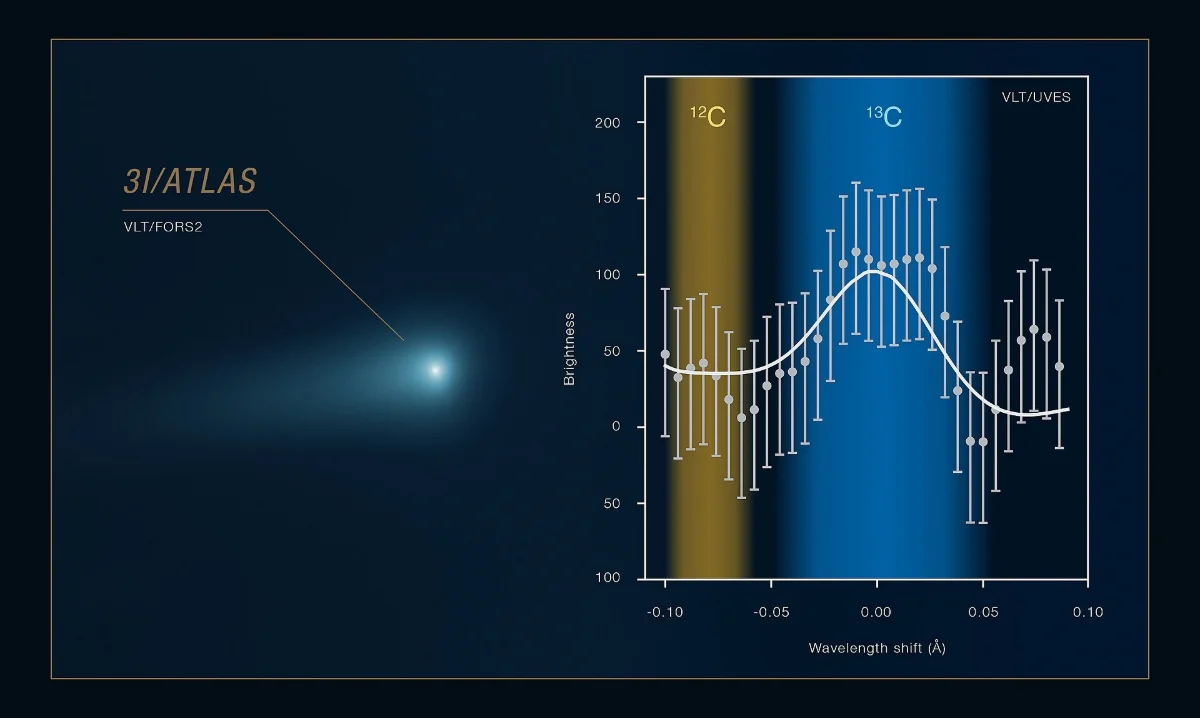
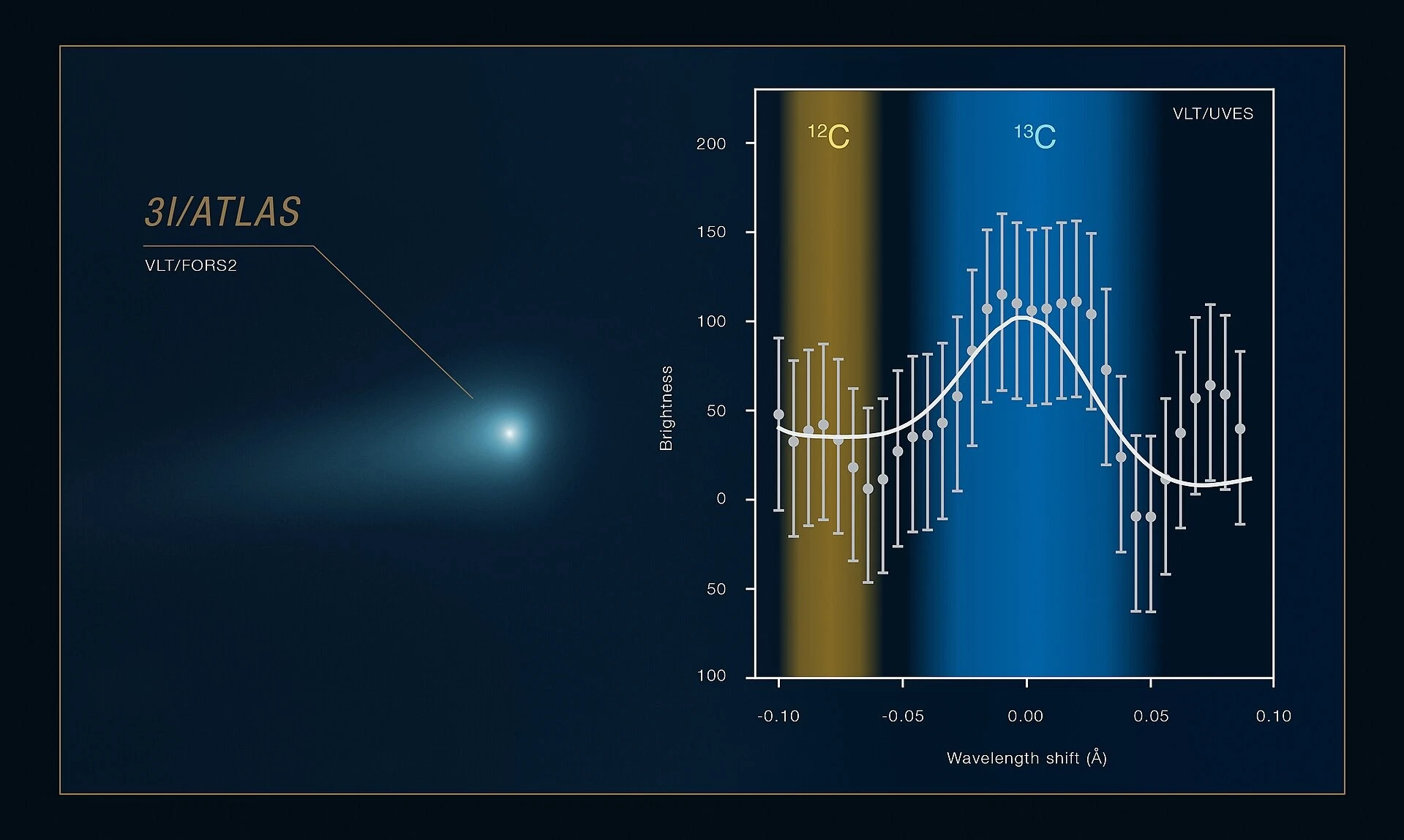
Part of the comet's spectrum from ESO's Very Large Telescope, December 2025, used to measure the carbon isotopes in its cyanide gas. Image: ESO/C. Opitom, J. Manfroid et al.; comet image: O. Hainaut. CC BY 4.0 (creativecommons.org/licenses/by/4.0), via Wikimedia Commons. Resized. 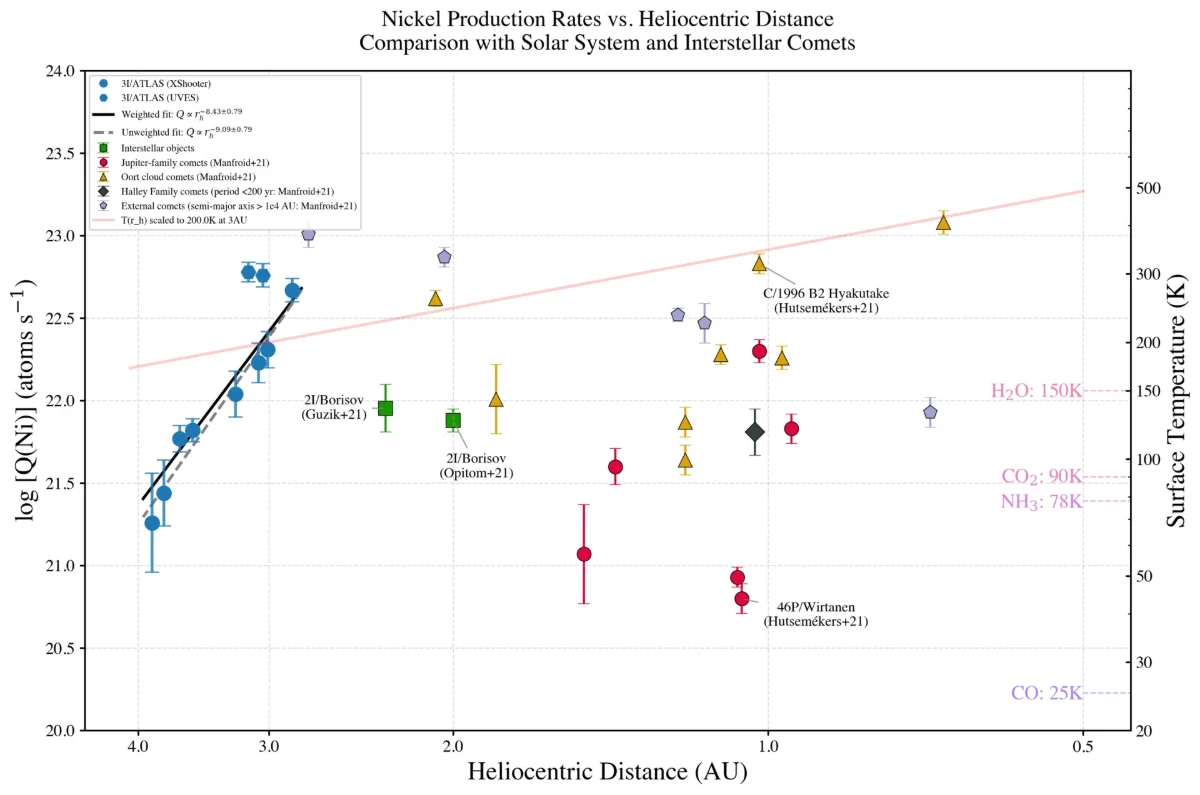
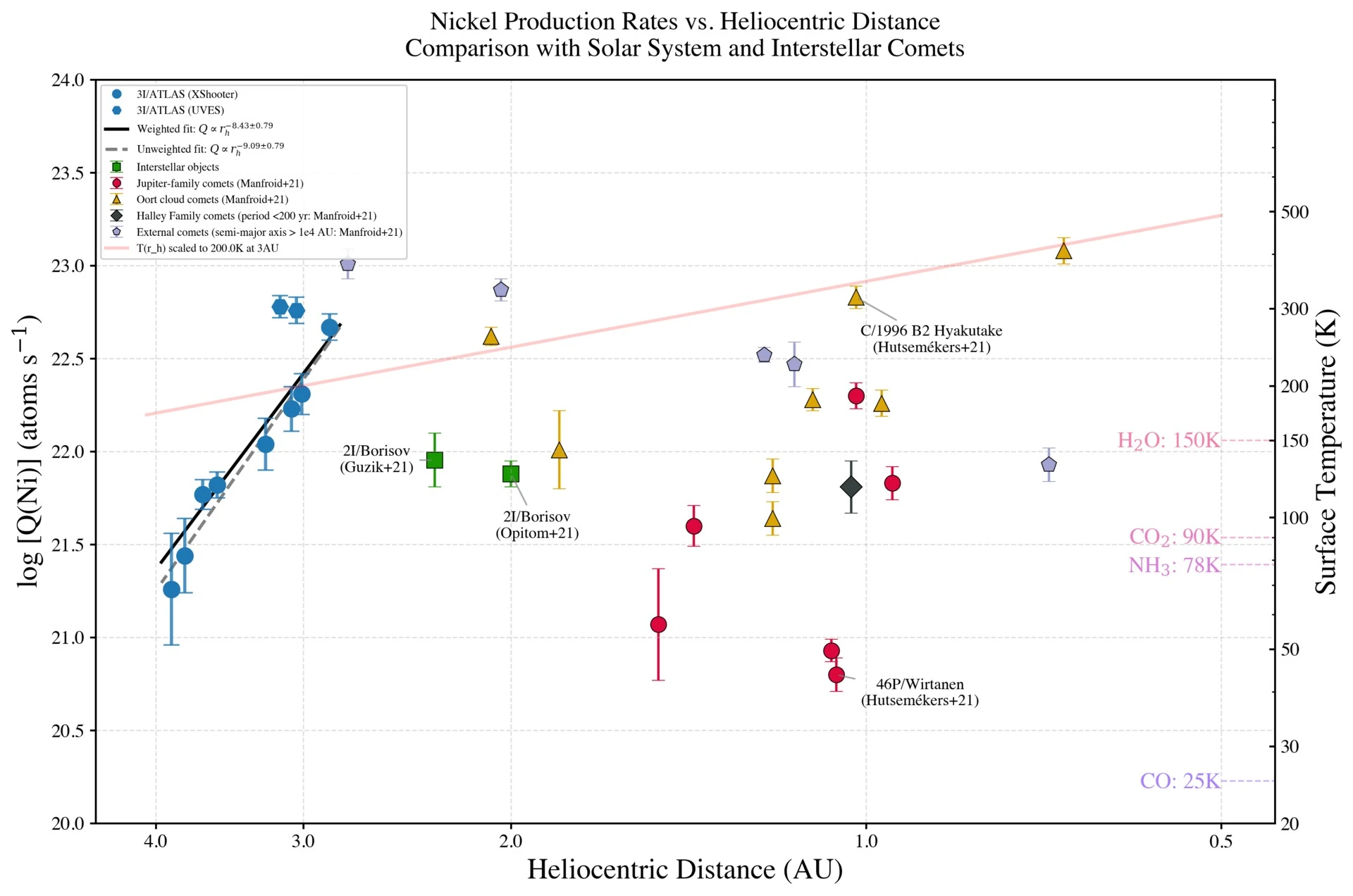
Nickel released by 3I/ATLAS (blue) rose steeply as it neared the Sun, compared here with comets of the Solar System. Figure: Rahatgaonkar et al. 2025, The Astrophysical Journal Letters 995, L34 (arXiv:2508.18382), CC BY 4.0 (creativecommons.org/licenses/by/4.0), via Wikimedia Commons. Resized.

Select a photograph to see it full size, with its caption and credit.
The record favors a natural interstellar comet. It also shows how much work it takes to say so about a single streak on a single panel.
The next visitor gives a decision to make ahead of time. Would you put the first hour into listening for a signal, or into measuring the object and the gas around it? What would you need to see twice before you called another observatory? And if a streak appeared while you were looking, could you tell it from a microwave door opening at Parkes?
Sources
- Sheikh et al., A Search for Radio Technosignatures from Interstellar Object 3I/ATLAS with the Allen Telescope Array, The Astronomical Journal 172 (2026) The Astronomical Journal, via arXiv (CC BY 4.0) Primary record
- Jacobson-Bell et al., Breakthrough Listen Observations of 3I/ATLAS with the Green Bank Telescope at 1-12 GHz, Research Notes of the AAS 9, 351 (2025) Research Notes of the AAS (CC BY 4.0) Primary record
- Breakthrough Listen observations of interstellar object 3I/ATLAS (19 December 2025) SETI Institute and Breakthrough Listen Primary record
- Pisano et al., ATel 17499 (18 November 2025) The Astronomer's Telegram Primary record
- Li, Tao and Zhang, FAST narrowband search of 3I/ATLAS, ApJ 1006, 163 (2026) The Astrophysical Journal, via arXiv Primary record
- Li et al., FAST search for periodic signals from 3I/ATLAS, AJ 172, 172 (2026) The Astronomical Journal, via arXiv Primary record
- Hibberd, Crowl and Loeb, Is the Interstellar Object 3I/ATLAS Alien Technology? (2025) arXiv Primary record
- Jordan King, Interstellar object could be mysterious 'Wow!' signal source - astronomer Newsweek Study
- Cordiner et al., JWST Detection of a Carbon Dioxide Dominated Gas Coma Surrounding Interstellar Object 3I/ATLAS, ApJ Letters 991 (2025) The Astrophysical Journal Letters (CC BY 4.0) Primary record
- Xing et al., water production of 3I/ATLAS from Swift (2025) arXiv Primary record
- Belyakov et al., JWST MIRI observations of 3I/ATLAS, ApJ Letters 1001, L11 (2026) The Astrophysical Journal Letters, via arXiv Primary record
- Comet 3I/ATLAS NASA Primary record
- Seligman et al., Discovery and Preliminary Characterization of a Third Interstellar Object: 3I/ATLAS (2025) arXiv Primary record
- JPL Small-Body Database: 3I/ATLAS NASA Jet Propulsion Laboratory Primary record
- Davenport et al., Technosignature Searches of Interstellar Objects (2025) arXiv Study
- NSF-DOE Rubin Observatory spotted comet 3I/ATLAS ten days before discovery (NOIRLab iotw2606a) NSF NOIRLab, via Wikimedia Commons Primary record
- Jerry Ehman, The Big Ear Wow! Signal: What We Know and Don't Know About It After 30 Years (2007, revised 2010) Big Ear Radio Observatory Primary record