
K2-18b is a planet about 2.6 times the width of Earth, circling a small red star in the constellation Leo, about 124 light-years away. On 17 April 2025 a Cambridge team led by Nikku Madhusudhan reported that the James Webb Space Telescope had found signs in its air of dimethyl sulfide, a gas that on Earth is made by life. The university called them the strongest hints yet of biological activity outside the solar system.
The planet passes in front of its star every 33 days.
For a few hours each time, a sliver of the starlight goes through the edge of its atmosphere on the way to us. Some colours come through dimmer than others. Each gas takes its own colours.
On 25 April 2024 the largest telescope ever put in space watched one of those passes for nearly six hours. The record is a line of points across the infrared, each with its error bar.
In that line, a team in Cambridge reported the fingerprint of a gas that on Earth comes from plankton in the sea.
A planet in the right place
K2-18b was found by NASA's Kepler spacecraft in its second mission, K2, and confirmed in a 2015 paper led by Benjamin Montet, which singled it out as "a Planet Receiving Earth-like Insolation." Its star is a red dwarf, cooler and smaller than the Sun, and the planet is close enough to it to receive about as much light as Earth does: 1,368 watts on each square metre, against Earth's 1,361, by Bjorn Benneke's 2019 figures. It weighs about 8.6 Earths. It is not a rocky Earth but a sub-Neptune, a kind of planet the solar system does not have.
In September 2019 two teams, one led by Angelos Tsiaras and one by Benneke, reported water vapour in its atmosphere from the Hubble Space Telescope.
In 2021 Madhusudhan and colleagues proposed a name for planets like it: "Hycean", from hydrogen and ocean. A Hycean world, in their model, has a deep ocean of water under an atmosphere rich in hydrogen, and could be habitable.
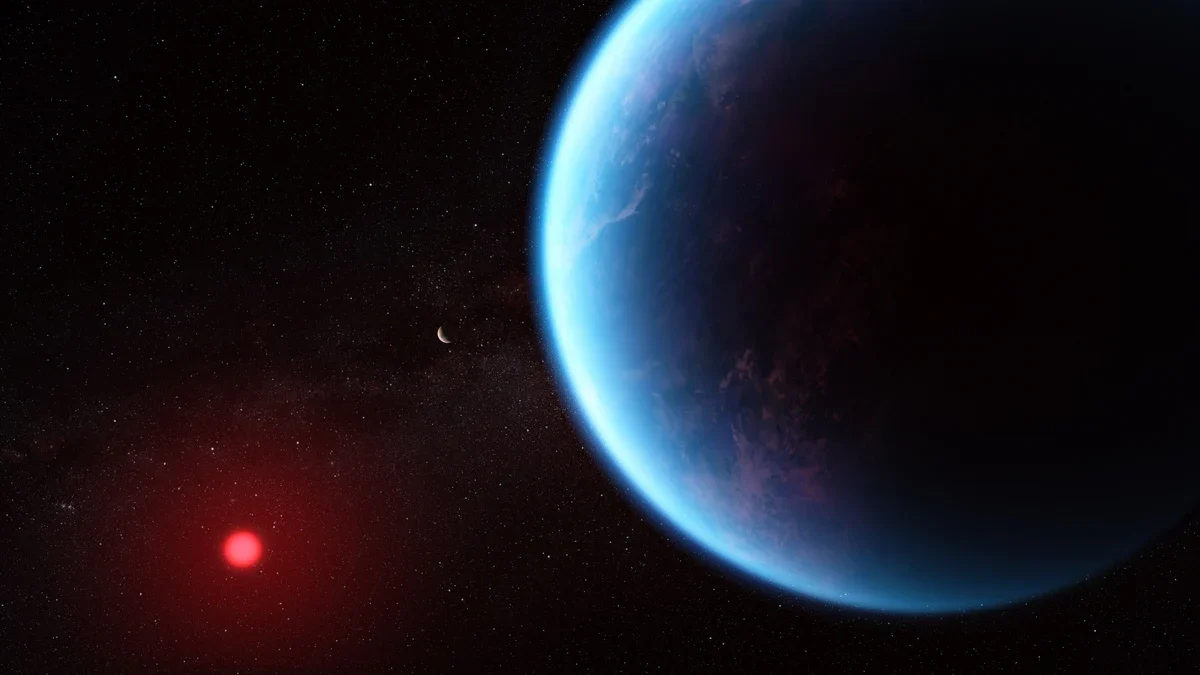
In September 2023 the Cambridge team reported Webb's first look. ESA, the European Space Agency, announced methane and carbon dioxide, and no ammonia, a mix the team read as fitting an ocean under hydrogen. There was also, the team said, a possible weak signal of dimethyl sulfide, DMS. ESA's release carried the team's aim: "Our ultimate goal is the identification of life on a habitable exoplanet."
The three-sigma signal
The 2025 paper, in The Astrophysical Journal Letters, used a different instrument on Webb, MIRI, which sees longer infrared wavelengths. It rested on that one transit of April 2024.
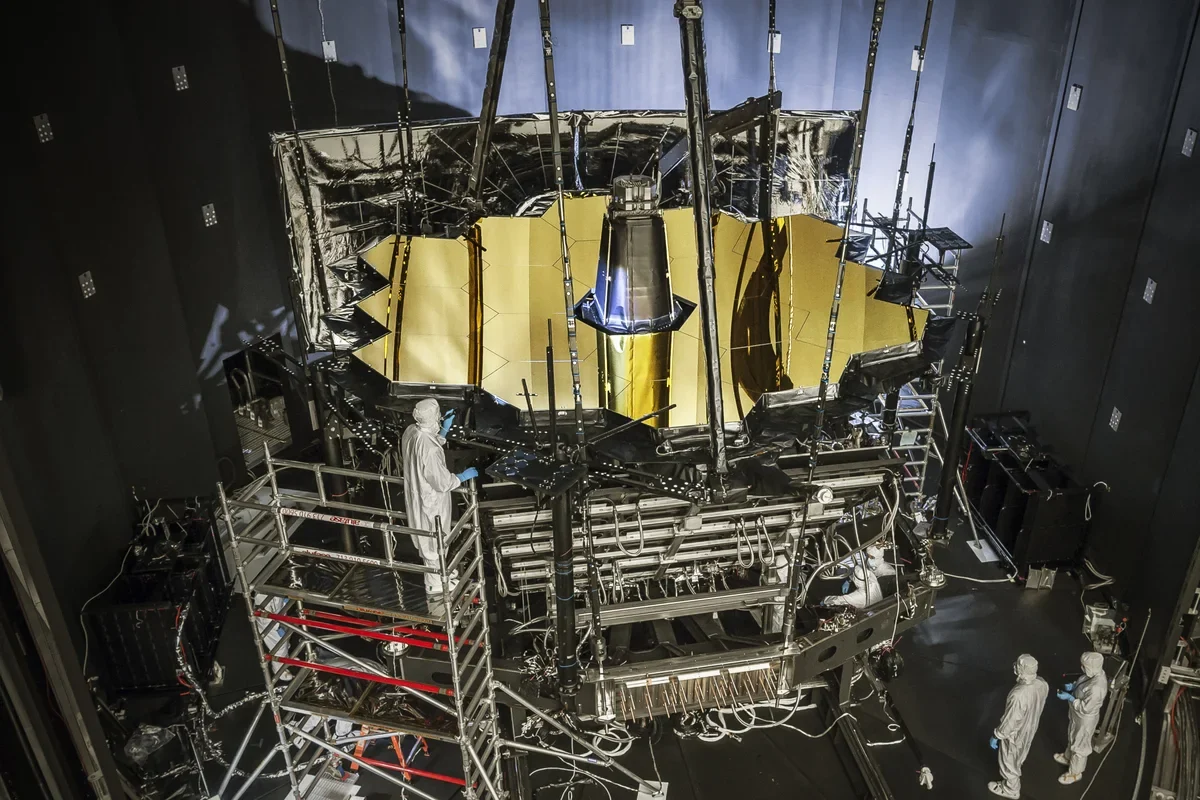
The spectrum, they said, differed from a flat line at 3.4 sigma. The authors wrote: "We report new independent evidence for DMS and/or DMDS in the atmosphere at 3-sigma significance." DMDS is dimethyl disulfide, a related molecule. The two could not be told apart in the data.
On Earth, the Cambridge release said, DMS and DMDS are made only by life, mainly microbes such as marine phytoplankton. Earth's air holds less than one part per billion. The fit for K2-18b called for more than ten parts per million, thousands of times more.
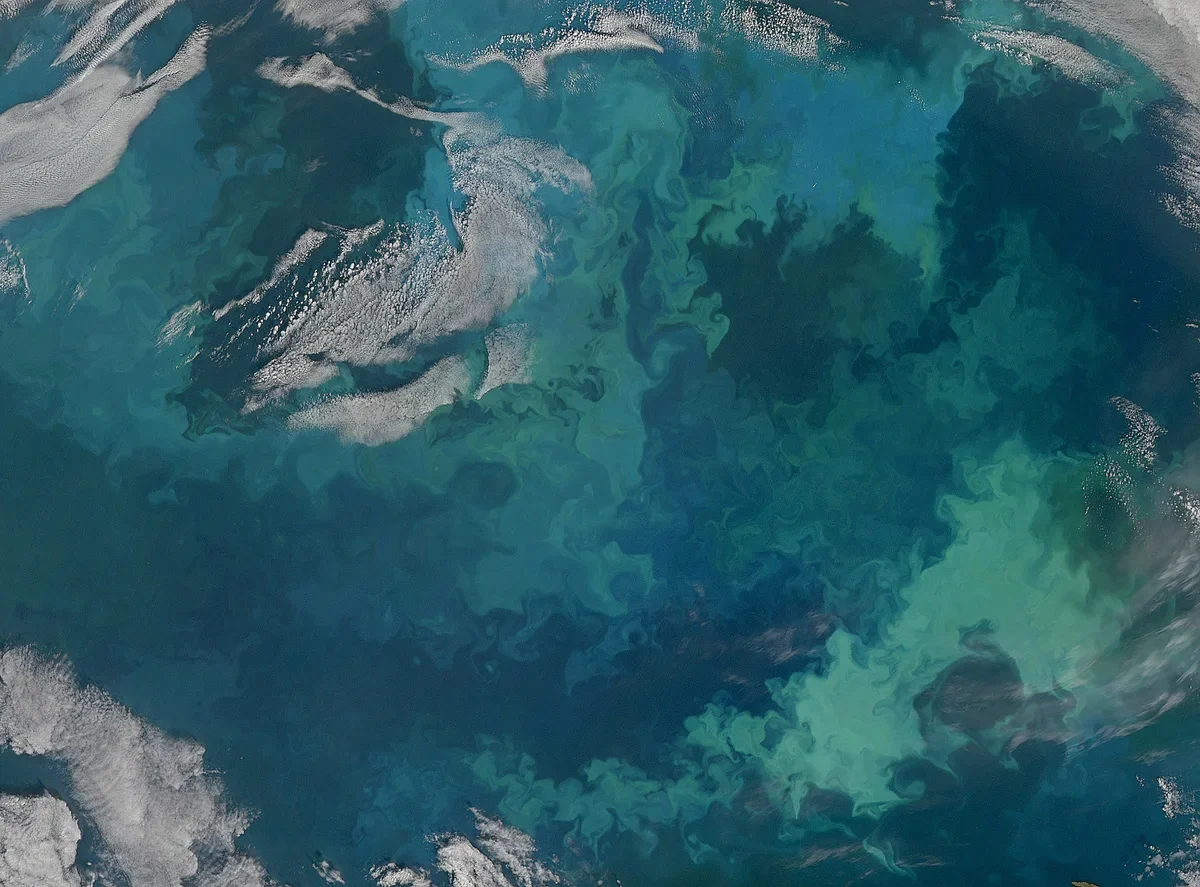
"The signal came through strong and clear," Madhusudhan said in the release. And: "a Hycean world with an ocean that is teeming with life is the scenario that best fits the data we have."
The release itself explained the caution. Three sigma means that, with no gas present, noise alone would give a result this strong about 0.3 per cent of the time; the standard for a discovery is five sigma, below 0.00006 per cent. It said 16 to 24 more hours of Webb time might get there. "It's important that we're deeply sceptical of our own results," Madhusudhan said.
In its Summary and Discussion section the paper says: "our findings continue to raise the prospects of possible biological activity on K2-18 b."
If the ocean is alive
Set aside for a moment whether it is true. Ask the next question. What kind of universe are we living in, if it is?
It would suggest, first, that life began at least twice, on two planets 124 light-years apart, unless it travelled between them, and that it may not be rare.
It would mean that life can thrive on a kind of world we do not have, a planet larger than Earth under a sky of hydrogen, and that the search for it should look far wider than the twins of Earth.
It would mean that we found it not by going but by looking, in a few hours of starlight filtered through another world's air. Every star with a planet passing in front of it would become a place to test.
And it would leave one question in front of us. A sea of microbes is not a civilisation. If the first life found beyond Earth is plankton, what does that say about how often it goes further?
What the other teams found
Within weeks and months, other astronomers ran the same public data through their own methods.
Jake Taylor of Oxford posted an analysis on 22 April 2025 testing whether the MIRI spectrum held any features at all; in five of his six tests the data preferred a flat line, and he concluded there was "no strong statistical evidence for spectral features." Luis Welbanks and colleagues, in a paper later published in Nature Astronomy, showed that the result depended on which gases the models were allowed to choose from: widen the list, and other molecules fit as well or better. A preference among models, they argued, is not the detection of a gas.
Rafael Luque and colleagues, in Astronomy and Astrophysics, combined all three of Webb's instruments and reported "insufficient evidence" for DMS and DMDS; ethane and other molecules fitted about as well. They estimated that about 25 more MIRI transits would be needed to reject a flat line in favour of DMS or DMDS at three sigma.
A team led by Kevin Stevenson, with NASA scientists among its authors, wrote in a paper titled K2-18b Does Not Meet The Standards of Evidence For Life: "there is, as yet, no statistically significant evidence for biosignatures in the atmosphere of K2-18b." The MIRI spectrum, they found, was sensitive to how the data were reduced and binned.
The near-infrared data had been questioned even before the 2025 claim. In January 2025 a team led by S. P. Schmidt, with Ryan MacDonald and Shang-Min Tsai, reanalysed the 2023 Webb spectrum and found methane but no reliable evidence for carbon dioxide or DMS; a planet with a thick gas envelope and no water surface fitted without life. Earlier, Nicholas Wogan's team in 2024 and Oliver Shorttle's had argued that a gas-rich sub-Neptune, or a magma ocean under hydrogen, could explain the same air.
And DMS is not made only by life. In 2025 Miguel Sanz-Novo and colleagues reported it in a gas cloud near the centre of the Milky Way, in proportions close to those found on a comet.
In July 2025 Renyu Hu of NASA's Jet Propulsion Laboratory led a paper, with Madhusudhan as a co-author, on four new Webb transits. Methane and carbon dioxide held up. DMS showed only "marginal signals", none exceeding three sigma in model preference and all below about two sigma.
What the critics do not settle
None of the critiques shows that DMS is absent. They show that the data do not require it, which is a different thing.
What the planet is remains open. An ocean under hydrogen, a deep gas envelope, a magma sea: each has a published model that fits. Hu's team found signs of a water-rich interior; Tsai and colleagues in 2026, in a paper on "three outstanding physical questions" for planets like it, found little evidence for one, and showed the data fit a sub-Neptune without DMS.
The non-living sources of DMS, in a comet and an interstellar cloud, show that chemistry can make it. Hu's team suggests it may form without life in hydrogen-rich atmospheres; whether that reaches ten parts per million in a temperate planet's air is one of the questions still being modelled.
And Madhusudhan's group has not withdrawn. Its search of 661 possible molecules, revised in April 2026, still found DMS the only one to reach its threshold consistently. In September 2026 its survey of ten planets' MIRI spectra reported "hints of complex molecules" in K2-18b, "likely due to molecular absorption rather than instrument systematics or noise."
Where it stands
The MIRI evidence is still one transit. Methane is confirmed by every team that reanalysed the data. Carbon dioxide was found in Webb's new observations and favoured by Stevenson's team, though one reanalysis of the 2023 spectrum did not find it reliably. DMS is a hint that its finders read one way and most other teams another.
In a survey published in Nature Astronomy in June 2026, 6.6 per cent of the astrobiologists who answered agreed that life had probably been found on K2-18b.
A radio search with two of the world's large radio arrays, reported in February 2026, listened for signals and found none that passed its filters.
Like the interstellar comet 3I/ATLAS and the fireball called IM1, claimed to be interstellar, K2-18b is a case where a few hours of data carry a very large question.
One transit. Nearly six hours. And a line of points with error bars.
Questions This Leaves You With
Is there anything a person actually does with this?
Not in a practical sense, and it is better to say so. Nothing about K2-18b touches daily life, and no date or forecast can honestly be read from it. What you can do is follow it: the papers on every side are free to read on arXiv, the Webb data are public, and the next observations, when they come, will be announced. If more Webb time is given to it, the answer may come within a few years. Few questions this large are this open to watch, and none of it needs a telescope of your own: only patience, and a willingness to read both sides before deciding.
Does this sit against a religious account of the world?
It can be read both ways. Life on another planet would say nothing directly about God; some people of faith have long expected a universe full of life as a sign of its maker's generosity, and others find in Earth's uniqueness a sign of purpose. Microbes in a distant ocean would press on both views differently than a civilisation would. Where it leaves your own faith is for you to decide. This site will not tell you.
Does this change what a human life is?
A faint dip in starlight, a few hours long, from a planet nobody will visit, and a whole argument about whether something lives there. You might find that humbling: life, if it is there, would make ours one of many. Or you might find the opposite: that a species on a small planet can read another world's air at all. Which did you feel, and does it change if the gas turns out to be chemistry alone?
What would change your mind, in either direction?
Name it now, before you are committed. Toward life: DMS confirmed at five sigma by several independent teams, from many more transits, with no non-living route able to make that much of it. Toward the critics: new transits in which the signal fades into noise, or a chemical model that makes ten parts per million of DMS in such an atmosphere without life. Each of these is an observation or a calculation someone can make in the next few years, and each would move the question more than any press release.
What is K2-18b?
This is the open problem, and it comes before the question of life. An ocean world under hydrogen, a gas-wrapped mini-Neptune, a magma sea: the same few hours of starlight fit more than one. Until the planet itself is known, a gas in its air is hard to read: the same molecule means one thing over an ocean and another over a magma sea. The first answer the telescope has to give is not whether something lives there, but what kind of place it is.
Sources
- Stellar and Planetary Properties of K2 Campaign 1 Candidates and Validation of 17 Planets, Including a Planet Receiving Earth-like Insolation (ApJ 809, 25, 2015) Benjamin T. Montet et al. Primary record
- Water Vapor and Clouds on the Habitable-Zone Sub-Neptune Exoplanet K2-18b (ApJL 887, L14, 2019) Bjorn Benneke et al. Primary record
- Water vapour in the atmosphere of the habitable-zone eight-Earth-mass planet K2-18 b (Nature Astronomy, 2019) Angelos Tsiaras et al. Primary record
- Strongest hints yet of biological activity outside the solar system (17 April 2025) University of Cambridge, Sarah Collins Study
- Habitability and Biosignatures of Hycean Worlds (ApJ, 2021) Nikku Madhusudhan, Anjali Piette, Savvas Constantinou Primary record
- Webb discovers methane, carbon dioxide in atmosphere of K2-18 b (11 September 2023) ESA/Webb Study
- New Constraints on DMS and DMDS in the Atmosphere of K2-18 b from JWST MIRI (ApJL 983, L40, 2025) Nikku Madhusudhan et al. Primary record
- Are there Spectral Features in the MIRI/LRS Transmission Spectrum of K2-18b? (arXiv, 22 April 2025) Jake Taylor Primary record
- Challenges in the detection of gases in exoplanet atmospheres (Nature Astronomy, 2025) Luis Welbanks et al. Primary record
- Insufficient evidence for DMS and DMDS in the atmosphere of K2-18 b (A&A 700, A284, 2025) Rafael Luque et al. Primary record
- K2-18b Does Not Meet The Standards of Evidence For Life (AJ, accepted, 2025) Kevin B. Stevenson et al. Primary record
- A Comprehensive Reanalysis of K2-18 b's JWST NIRISS+NIRSpec Transmission Spectrum (AJ, 2025) S. P. Schmidt, R. J. MacDonald, S.-M. Tsai et al. Primary record
- JWST observations of K2-18b can be explained by a gas-rich mini-Neptune with no habitable surface (ApJL, 2024) Nicholas F. Wogan et al. Primary record
- Distinguishing oceans of water from magma on mini-Neptune K2-18b (ApJL 962, L8, 2024) Oliver Shorttle et al. Primary record
- On the abiotic origin of dimethyl sulfide: discovery of DMS in the Interstellar Medium (ApJL 980, L37, 2025) Miguel Sanz-Novo et al. Primary record
- A water-rich interior in the temperate sub-Neptune K2-18 b revealed by JWST (arXiv, July 2025) Renyu Hu et al. (incl. Madhusudhan) Primary record
- Three outstanding physical questions for K2-18 b and other temperate sub-Neptunes (arXiv, March 2026) Shang-Min Tsai et al. Primary record
- A Systematic Search for Trace Molecules in the Atmosphere of Exoplanet K2-18 b (v2 April 2026) Pica-Ciamarra, Madhusudhan et al. Primary record
- A Homogeneous Survey of JWST MIRI Transmission Spectra of 10 Exoplanets (arXiv 2609.05264, 2026, accepted ApJL) Binet, Madhusudhan et al. Primary record
- Comparing astrobiologists' confidence in extraterrestrial life claims for K2-18 b and Cheyava Falls (Nature Astronomy, June 2026) Peter Vickers et al. Primary record
- Are there aliens broadcasting from Hycean world K2-18b? (February 2026) Phys.org / Universe Today Study
- K2-18 b (exoplanet catalogue) NASA General reference