
The Parkes radio telescope, called Murriyang, stands in the open country of Australia with its dish tipped toward the southern sky. On 29 April 2019 it was pointed at Proxima Centauri, the nearest star to the Sun, and for a little over five hours it recorded a single radio tone at 982.002 MHz. The tone has a name now: BLC1, Breakthrough Listen Candidate 1.
The tone is narrow. Less than 4 hertz wide, a sliver of a band the receiver read across more than three billion hertz.
It climbs. Slowly, a few hundredths of a hertz every second, the kind of drift a transmitter shows when it is accelerating relative to Earth.
It appears when the dish looks at the star. It goes quiet when the dish swings away to a distant quasar. It comes back when the dish looks at the star again. Half an hour on, a few minutes off, half an hour on. Five times.
A narrow, drifting tone is the exact shape Breakthrough Listen built its search to catch: the mark of an engineered signal.
The question is whose engine.
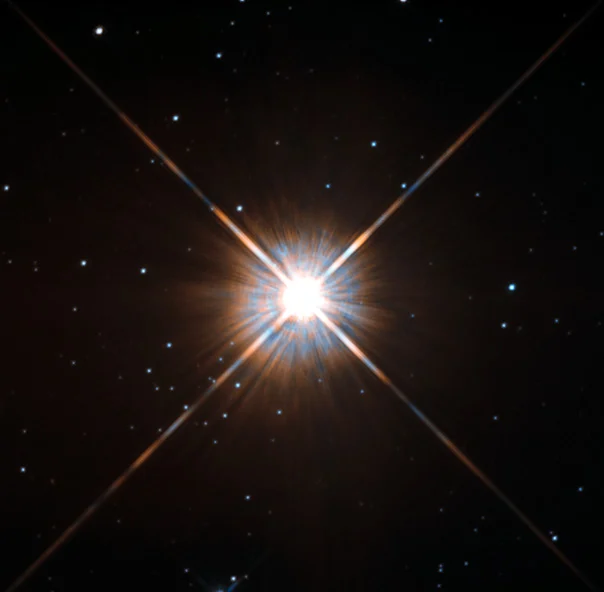
Twenty-Six Hours on the Nearest Star
The observations were not a hunt for aliens. They were part of project P1018, a campaign by Andrew Zic and colleagues to watch the small red star for flares, with ASKAP and other instruments watching alongside. From 29 April to 4 May 2019 the Parkes dish spent 26 hours and 9 minutes on the star, its new Ultra-Wideband Low receiver taking in everything from 704 MHz to 4 GHz. Breakthrough Listen, the $100 million search funded by Yuri Milner, recorded the same data for its own purpose.
The data sat for a year.
In June 2020 Shane Smith, a physics undergraduate at Hillsdale College working as an intern at the Berkeley SETI Research Center, began sifting it. He told the Hillsdale Collegian that until then he had not known "that there was actually a scientific community that was looking for aliens." The pipeline pulled 4,172,702 hits out of the recording. Filters for drift and for direction cut them to 5,160 events. Smith looked at the survivors by eye.
In late October 2020, according to Scientific American, one of them did not go away.
One candidate. Out of four million.
The team kept it quiet while it checked. On 18 December 2020 the story leaked to the Guardian, and Scientific American published the same day. Andrew Siemion of Breakthrough Listen told the magazine: "It has some particular properties that caused it to pass many of our checks, and we cannot yet explain it."
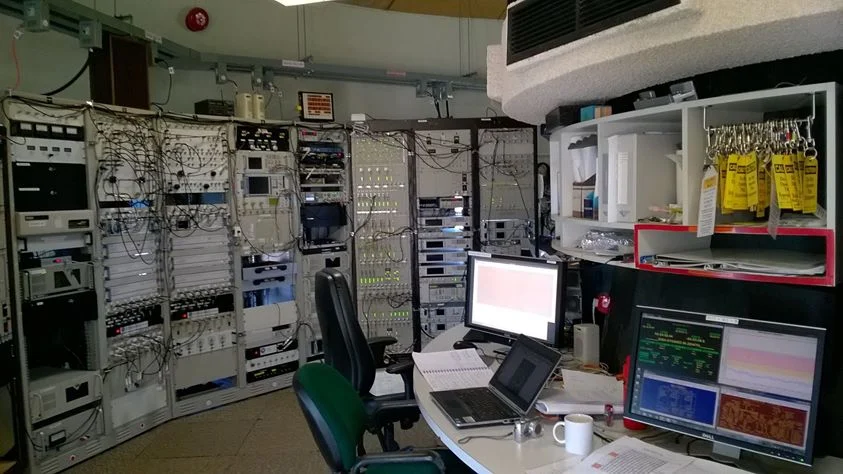
The Best Candidate the Programme Ever Had
Every radio telescope sits in a storm of human signals: phones, satellites, aircraft, its own electronics. Breakthrough Listen's defence is the cadence. The dish points at the target, then at something else, then back. A signal from the sky should follow the star. Interference, which leaks into the receiver from all around, should show up in every pointing.
At Parkes on 29 April the pattern was 30 minutes on Proxima Centauri, 5 minutes on a distant quasar, PKS 1421-490, and back again. Smith et al. report that BLC1 was there in the on-source scans and absent from the off-source ones. Sheikh et al. timed it from 13:17:35 to 18:19:26 UTC: 5.03 hours, five on-source scans, no break in the rule.
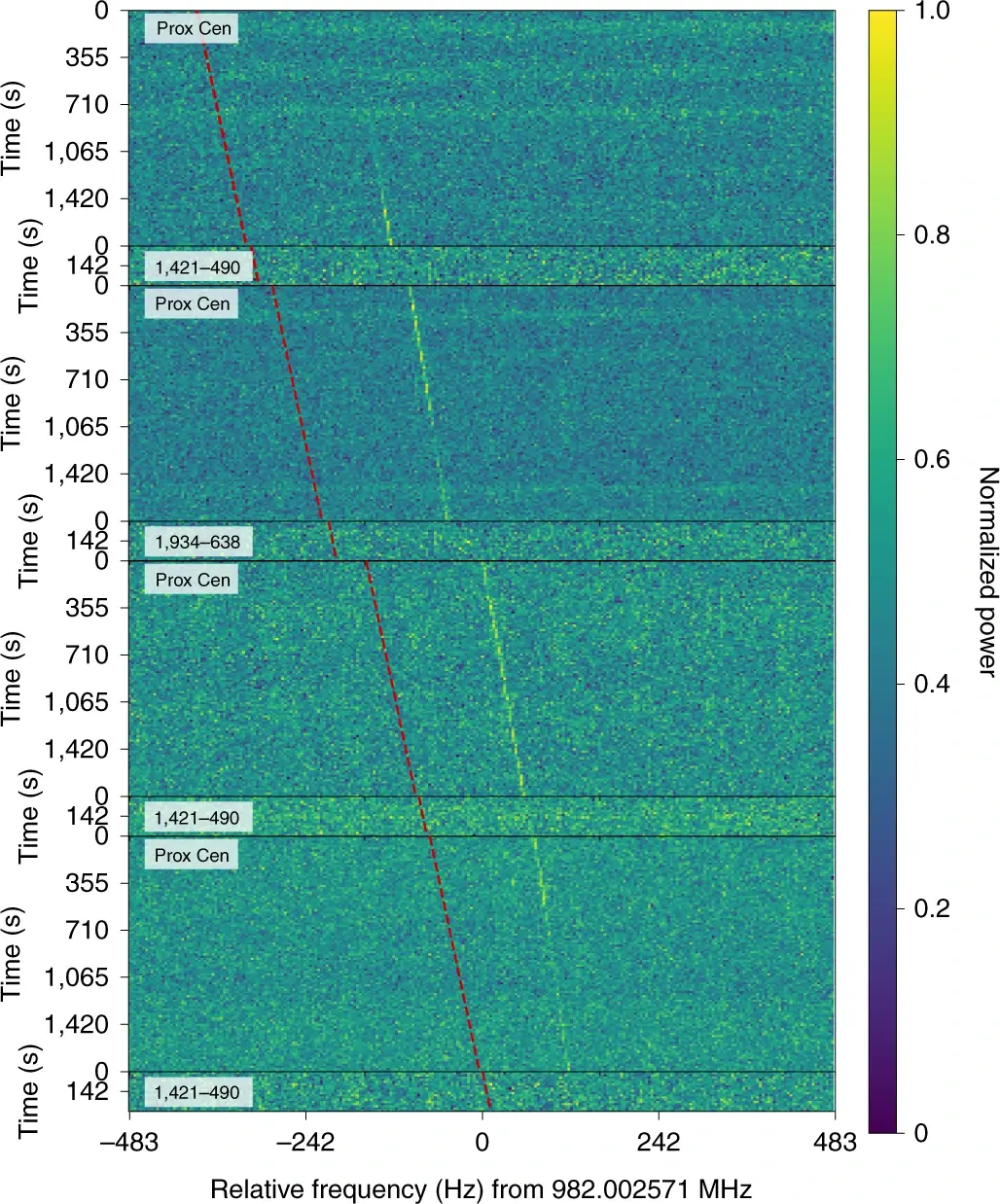
Then the drift. The tone rose at 0.038 Hz per second, the signature of a transmitter accelerating relative to the dish. And the frequency, 982.002571 MHz, sits in a band reserved for aeronautical radionavigation, yet Smith et al. found that "no transmitters that operate at the detected frequency of BLC1 are registered within 1000 km of the observatory."
Which leaves a list no earlier candidate had matched. Narrowband, so artificial. Drifting, so moving. On only when the dish faced the star. And the star was the nearest one there is, 1.301 parsecs or about 4.2 light-years away, with a planet in its habitable zone.
That planet is Proxima b, announced in August 2016 by Guillem Anglada-Escude and 30 co-authors in Nature: at least 1.3 times the mass of Earth, a year 11.2 days long, an orbit about 0.05 astronomical units from its star. ESO's release called it a planet found in the habitable zone around the nearest star.
The search that caught BLC1 was also the most sensitive ever aimed at that star. Smith et al. put the floor at 1.9 gigawatts of transmitter power, 3.6 times below the previous limit, and called it "the most sensitive search for radio technosignatures ever undertaken on a star target."
Every filter passed. The nearest star. Its one known planet, at the time.
If the Tone Came From There
Set aside for a moment whether it is true. Ask the better question. What kind of universe are we living in if a machine on Proxima b was humming at 982 MHz in April 2019?
It would mean the nearest star of all was occupied. Not a star a thousand light-years out. The closest one. Which would make technology common enough that the star next door, a small red dwarf, happened to carry it.
It would mean the signal left Proxima around the end of 2014, as light crosses that gap in a little over four years. The transmitter would have been running while the planet itself was still unannounced on Earth.
It would mean a conversation is possible. Not a message across thousands of years, like the Wow! signal of 1977, whose source would sit at an unknown and possibly vast distance. A reply sent from Earth could reach Proxima in four years and an answer could be back in eight or nine. Inside a single career. Inside a child's school years. Our species has never had a neighbour it could hear and answer within one lifetime; on that reading, we would have had one all along, eleven-day years and all, one star over.
And it would mean that the tools we already have were enough. A filter pipeline, a student intern, one quiet year in a hard drive. On that reading, contact would not need a new instrument or a new century. It would need someone to look at the data that is already sitting there.
Which is the consequence still in front of us. How much of what has already been recorded has nobody yet read?
The Lookalikes
The standard account comes from the people who found it. On 25 October 2021, Nature Astronomy published two papers together. Smith et al. described the search. Sheikh et al., led by Sofia Sheikh, then a postdoctoral researcher at Berkeley, tested BLC1 against a ten-step verification framework built for the purpose.
Their key step was to search the rest of the Proxima recording for tones shaped like BLC1. The turboSETI tool found 111 matches. Of these, 36 were "blc1 lookalikes" and 27 more were mirror images drifting downward. Every one of the lookalikes appeared in the off-source pointings as well. They were local.

The lookalikes sat at regular frequencies: integer multiples of 133.33 MHz and 15 MHz, and spacings matching a clock oscillator near 2.000004 MHz. Strong steady interferers sat at 1200, 1330 and 1400 MHz. The paper concludes that BLC1 is "an electronically-drifting intermodulation product" of local, time-varying interferers: two human signals mixing inside equipment to make a third, about a hundred times fainter than the strongest of its set. The drift, Sheikh told Scientific American, was in the wrong direction too. A transmitter on a planet of Proxima should slide down "like a trombone." BLC1 went up, "like a slide whistle."
Re-observations in November 2020, January 2021 and April 2021, 39 hours in all according to Breakthrough Listen, never heard it again. As early as December 2020, Pete Worden of the Breakthrough Initiatives had put the odds of a human cause at about 99.9 percent. The finders' verdict is plain: not extraterrestrial.
What Was Never Found
The verdict rests on a family of lookalikes and a mechanism that fits them. It does not rest on a device.
The transmitter was not identified. Not the oscillator, not the equipment, not the building. The Breakthrough Listen summary says so in as many words, and Sheikh et al. write only that "It is possible that we could untangle the origins of this interference."
The cadence itself has an asymmetry. The off-source scans were 5 minutes against 30 on the star, and they were aimed at quasars. The paper notes that this setup made the off-source scans less sensitive to a signal like BLC1. The explanation offered for why the tone switched off at exactly the right moments, five times, is that a time-varying interferer happened to line up with the schedule. The team stacked the off-source scans along the tone's drift and still found no trace of it there. What was never caught is the interferer itself, switching in step.
In the last off-source scan of 29 April there is a faint, non-drifting feature at the tone's frequency, below a signal-to-noise ratio of 5. The authors call it inconclusive. Across the band runs a comb of signals spaced about 80.1 Hz apart that the paper does not explain.
Sheikh, quoted by Paul Gilster on Centauri Dreams, put it this way: "We still can't say with 100 per cent certainty that BLC1 isn't a signal from alien technology." In the same piece she called the chance that it is alien "extraordinarily low."
Both things are in the record. The odds are long. The machine is missing.
The Tone in the Archive
The Proxima data are public. The full recording from Parkes can be downloaded, and the framework Sheikh's team built for BLC1 now stands as a checklist for the next candidate. Yuri Milner called the field "a mature, rigorous field of experimental science." Siemion still called BLC1 "undoubtedly one of the most intriguing signals we've seen to date."
Outside the team, Avi Loeb argued in Scientific American that a transmitter on Proxima b should show an 11-day modulation from the planet's orbit, and judged that BLC1 most likely came from a human-built oscillator leaking into the telescope's side lobes. The same suspicion has followed signals since Tesla's Colorado Springs disturbances of 1899.
What would settle it is not another look at Proxima. The star was watched for 39 more hours and stayed silent. What would settle it is the interferer: a specific piece of equipment, at or near Parkes, that makes a 2 MHz clock and drifts upward at 0.038 Hz per second when it warms.
Find that device, switch it on, and BLC1 returns on demand.
Until then the tone is a fingerprint without a hand. Four million hits, one survivor, five clean pointings at the nearest star, and a transmitter that has been traced in every way except the one that would close the case.
Questions This Leaves You With
If it was interference all along, was there any point in taking it seriously?
You might think a false alarm is wasted time. The team treated it the other way. BLC1 forced Sheikh's group to write a ten-step framework for checking a candidate, and that framework is now the procedure the next one will face, from the instrument check to a second telescope. Nothing in your own life changes because of a tone at 982 MHz, and anyone selling you a date for first contact is selling something. The question that stays open is a civilizational one: whether a search this careful is the kind that would recognise a real signal when it came.
Does a signal like this sit against a religious account of the world?
It cuts both ways, and serious people have argued each. Some find that other minds in the universe would make creation larger and stranger; others find that it unsettles the idea that this world is the centre of the story. A tone from Proxima would not answer that question by itself, and an interference verdict does not settle it either. Official X will not tell you which way it falls. That belongs to you, and it is worth noticing which reading you reached for first when you heard "the nearest star."
Would it change how you see your own life if the nearest star were inhabited?
Picture the scale from the middle of the article: a reply in four years, an answer in eight or nine, inside one ordinary stretch of a human life. For some people that makes a life feel smaller, one voice among neighbours. For others it makes a life rarer, because the first exchange between two worlds would fall in someone's lifetime, maybe yours. Neither reaction is the right one. You probably had one of them before you finished the sentence.
What would change your mind, in either direction?
Decide now, before the next headline arrives. In one direction: someone at or near Parkes finds the device, switches it on, and the same tone drifts upward again in the receiver. That would close it. In the other: a second telescope, with different electronics on a different continent, picks up a narrow tone from Proxima drifting downward the way a transmitter on that planet should, and changing on a schedule tied to the planet's 11.2-day year. Either one would count. A louder version of the same leak would not.
Why can't a machine that made five perfect appearances be found?
The analysis found dozens of relatives of BLC1 and the clock frequencies behind them, and still no specific transmitter. A time-varying interferer that switched off for five 5-minute windows and on for five 30-minute ones is the explanation offered; the stacked off-source scans showed no tone, but no interferer was ever caught switching in step. You are entitled to ask what it would take to identify it now, years later, with the equipment around the site changed. The honest answer may be that nobody can say whether that trail is still warm. And if it has gone cold, you are left holding a verdict that rests on relatives of the signal rather than on the signal's own source.
Sources
- Shane Smith et al., A radio technosignature search towards Proxima Centauri resulting in a signal of interest, Nature Astronomy 5, 1148-1152, 2021 (arXiv:2111.08007) Nature Astronomy / arXiv Primary record
- Sofia Z. Sheikh et al., Analysis of the Breakthrough Listen signal of interest blc1 with a technosignature verification framework, Nature Astronomy 5, 1153-1162, 2021 (arXiv:2111.06350) Nature Astronomy / arXiv Primary record
- Berkeley SETI Research Center, BLC1 (Breakthrough Listen Candidate 1), n.d. Berkeley SETI Research Center Primary record
- Breakthrough Initiatives, Breakthrough Listen Releases Analysis of Previously Detected Signal, 25 October 2021 Breakthrough Initiatives Primary record
- Jonathan O'Callaghan and Lee Billings, Alien Hunters Discover Mysterious Signal from Proxima Centauri, Scientific American, 18 December 2020 Scientific American Study
- Avi Loeb, Did We Receive a Message from a Planet Orbiting the Nearest Star?, Scientific American, 2020 Scientific American Study
- Aubrey Gulick, Hillsdale student assists on ET research project, Hillsdale Collegian, 28 January 2021 Hillsdale Collegian Study
- Paul Gilster, BLC1: The Proxima Signal and What We Learned, Centauri Dreams, 27 October 2021 Centauri Dreams Study
- Guillem Anglada-Escude et al., A terrestrial planet candidate in a temperate orbit around Proxima Centauri, Nature 536, 437-440, 2016 Nature / arXiv Primary record
- ESO, Planet Found in Habitable Zone Around Nearest Star, eso1629, 24 August 2016 European Southern Observatory Primary record