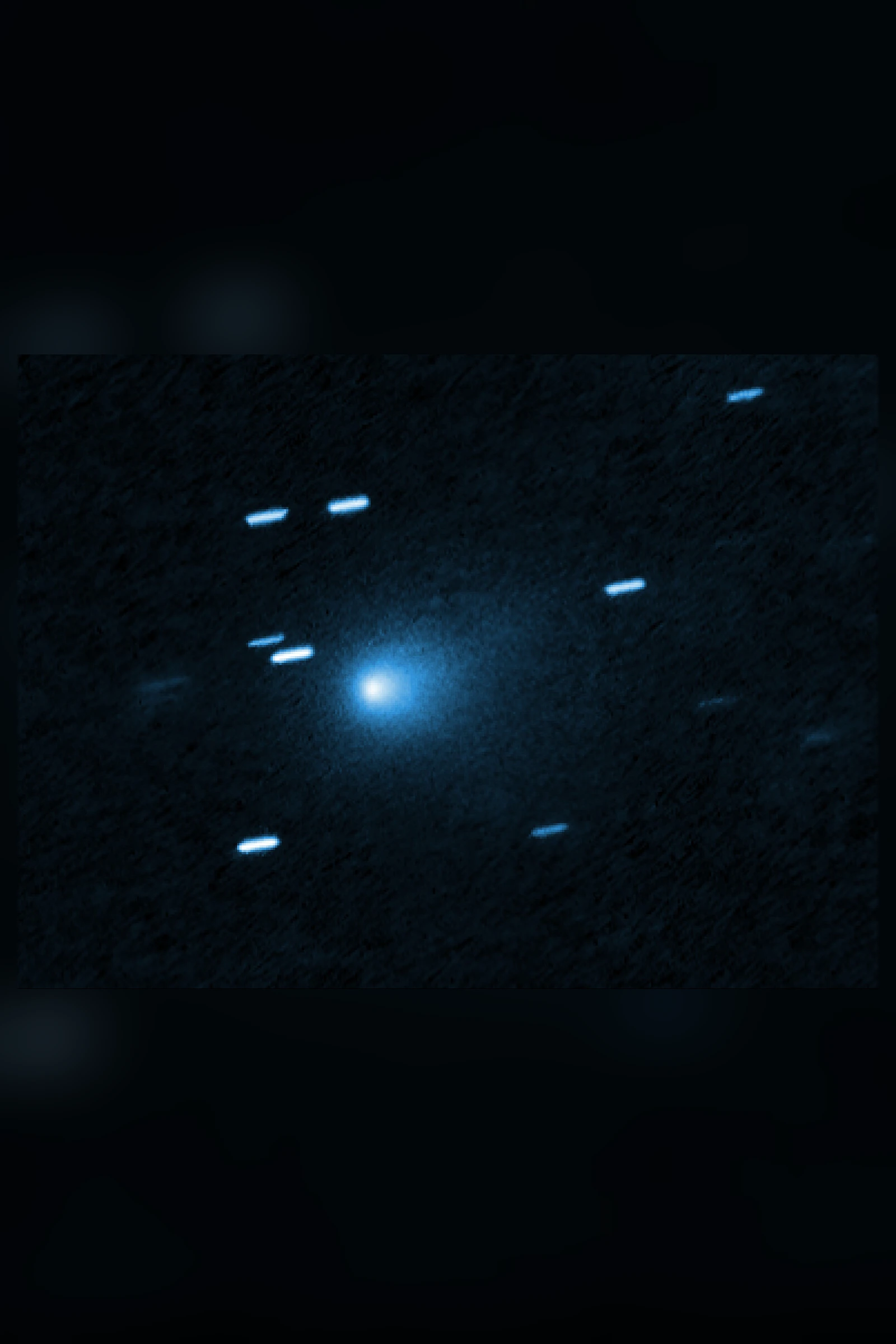
3I/ATLAS is a comet from another star. It was found on 1 July 2025 by a small survey telescope in the hills of Rio Hurtado, Chile, and it is only the third object ever seen passing through the solar system from interstellar space.
It came in at about 58 kilometres a second, far too fast for the Sun's gravity to hold. Its path is a hyperbola, open at both ends: it fell past the Sun once, on 29 October 2025, and it is leaving, never to return. Around a nucleus a few hundred metres to a few kilometres across, it wrapped itself in a cloud of gas and dust, thick with carbon dioxide.
One team's model, working from its speed, puts its age at more than 7.6 billion years, older than the Earth. Everything humans have ever written down fits inside the last thin sliver of that journey.
Perhaps older than the Sun.
And on its way past the Sun, something pushed it.
Four frames from Chile
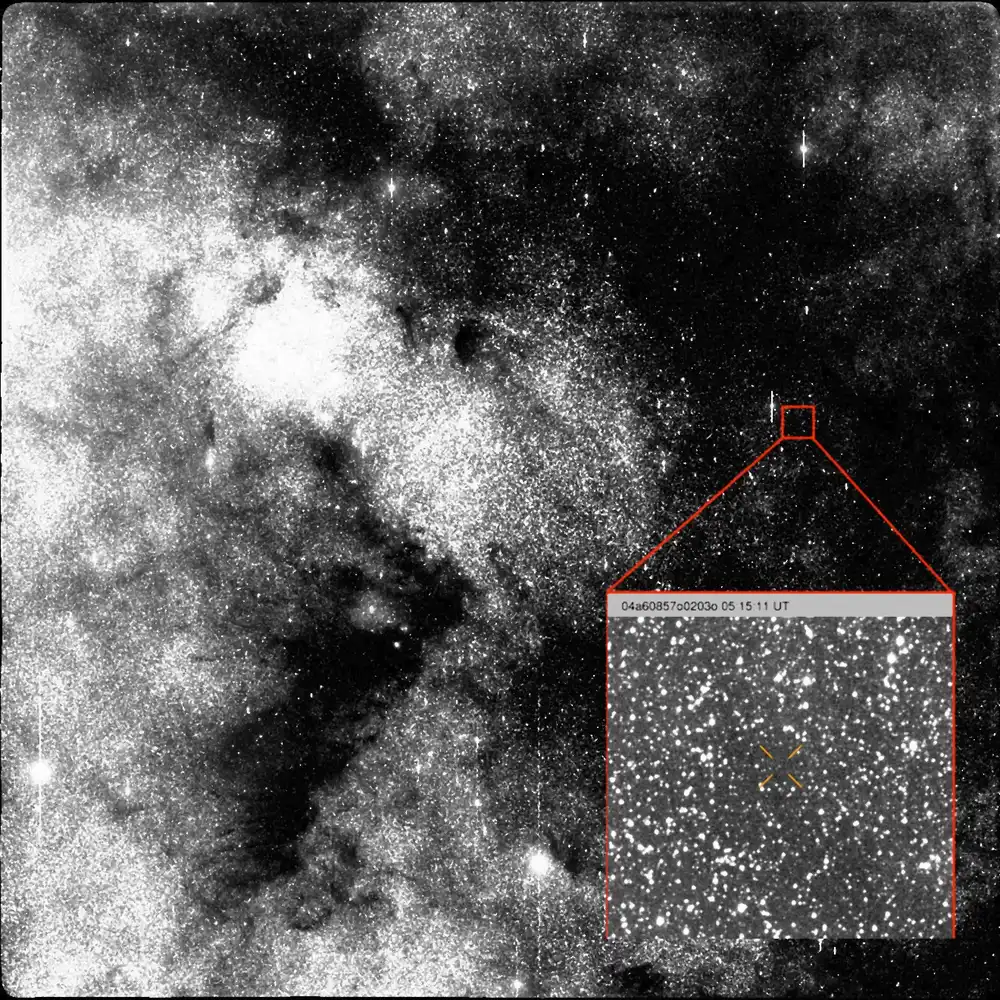
The Asteroid Terrestrial-impact Last Alert System, ATLAS, is a NASA-funded network of telescopes built to watch for rocks headed toward Earth. Its Chilean station at Rio Hurtado has a half-metre telescope that sweeps the sky every night in short exposures.
On 1 July 2025 four of those exposures showed a faint point moving against the stars. The object went to the Minor Planet Center as A11pl3Z. Astronomers at other observatories found it in older images, from ATLAS units, from the Zwicky Transient Facility at Palomar and from the Rubin Observatory, which had caught it on 21 June. By the evening of 2 July the orbit was in: an eccentricity of more than six, where anything above one means the object is not bound to the Sun. It was designated 3I/ATLAS, the third interstellar object, after Oumuamua in 2017 and the comet 2I/Borisov.
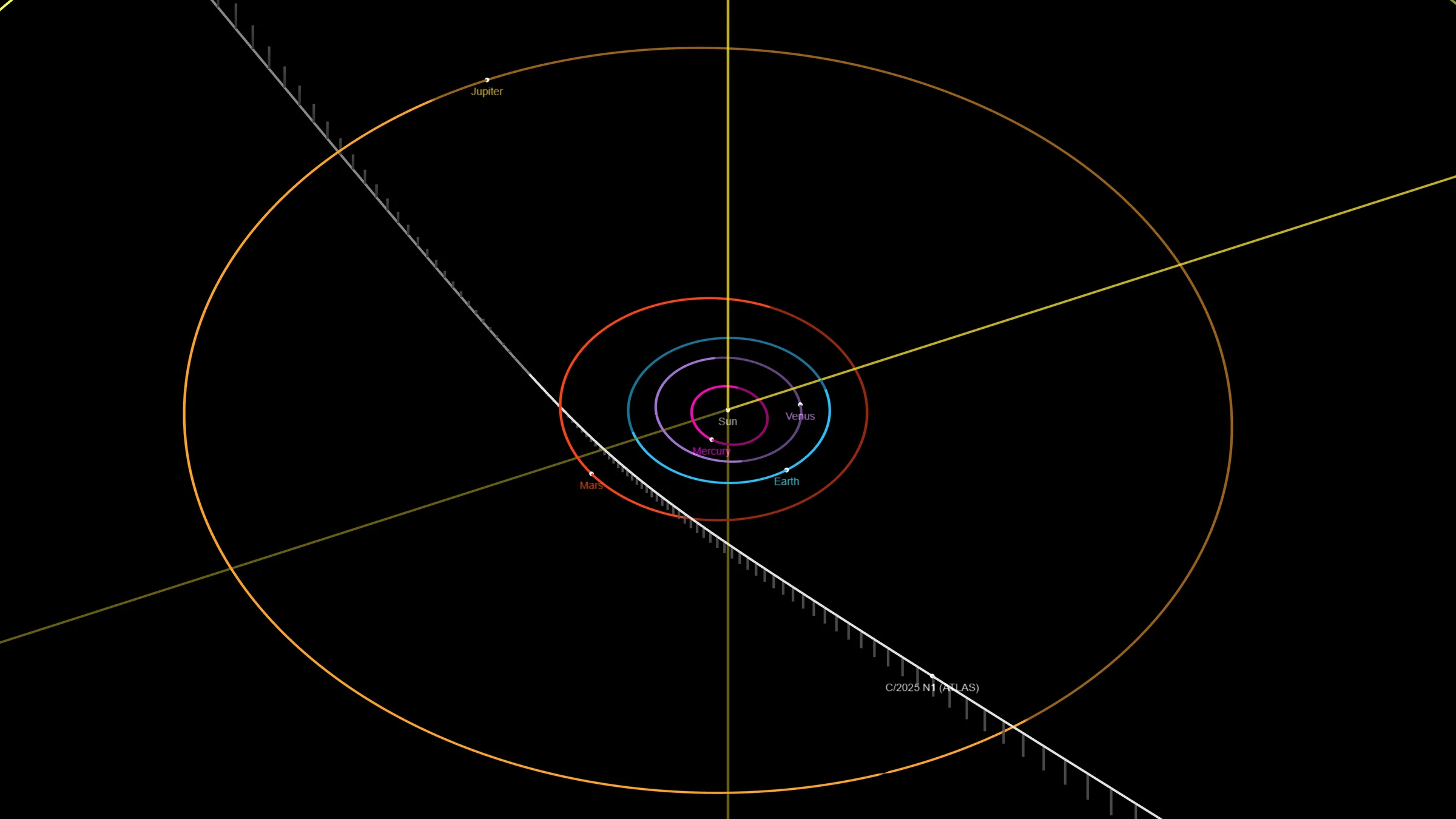
The path had a shape that caught the eye at once. 3I/ATLAS moves almost exactly in the plane where the planets travel, tilted only about five degrees from it, but backwards, against their direction. Its route would carry it past Mars on 3 October 2025, around the Sun on 29 October, behind the Sun as seen from Earth at its closest, and past Jupiter on 16 March 2026.
The great telescopes turned to it. Hubble measured its cloud of dust in July 2025. The James Webb Space Telescope found its gas dominated by carbon dioxide, about eight times as much as water, well above the run of comets born around the Sun. Spacecraft at Mars photographed it as it passed.
The paper from Harvard
On 16 July 2025, two weeks after the discovery, the Harvard astronomer Avi Loeb and two colleagues, Adam Hibberd and Adam Crowl, posted a paper with a direct title: "Is the Interstellar Object 3I/ATLAS Alien Technology?"
They worked through the path as an engineer would. An orbit lying so close to the plane of the planets, they calculated, had about a 0.2 percent chance of happening at random. Passing as close as it does to Venus, Mars and Jupiter together, at most about 0.005 percent. Reaching its nearest point to the Sun while hidden behind it from Earth, about seven percent. They noted what such a path could offer an intelligence: access to the inner planets, and a perihelion out of sight, where a spacecraft could fire its engines to brake, a manoeuvre they called a reverse Solar Oberth burn, and stay.
Then the push. If the object accelerated by about 5.9 x 10^-5 astronomical units per day per day, measured at the distance of the Earth from the Sun, they wrote, that "would indicate an intent to intercept the planet Jupiter." That is a little over a thousandth of a metre per second, every second, from no visible engine.
Small. And, on their reading, steering. They modelled what could deliver it: a light sail with a radius of about ten kilometres, pushed by sunlight.
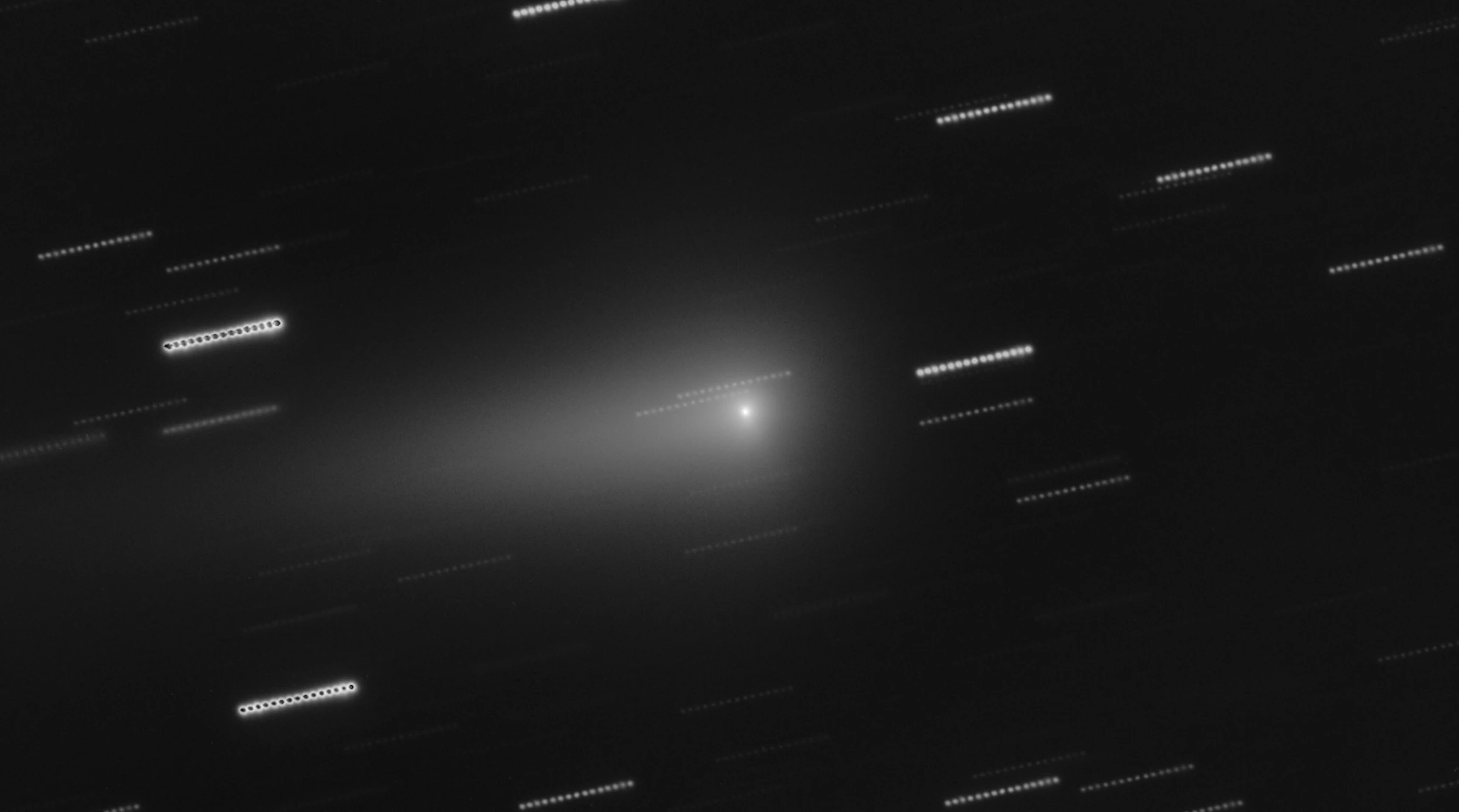
The paper raised a darker possibility, the "Dark Forest" answer to the question of why the sky is silent: that civilisations stay hidden because contact is dangerous. And it was frank about its own status. It called itself "largely a pedagogical exercise" and said the most likely outcome was "a completely natural interstellar object, probably a comet."
The idea did not stay in a preprint. Loeb kept writing about 3I/ATLAS, on his blog and in a dozen further papers with colleagues, ranked it on his own scale of how likely an object is to be technological, and as of October 2026 still places it at level 4 on that scale. NASA was asked about it at a news briefing on 19 November 2025. The associate administrator for science, Nicky Fox, answered, as NBC News reported: "We certainly haven't seen any techno signatures or anything from it."
If it was steering
Set aside for a moment whether it is true. Ask the better question. What would it mean if it was?
It would mean the first visitor anyone could watch at length was not a rock. Not ice. Not dust. A made thing. A craft, built somewhere older than the Sun, came in along the plane of the planets and adjusted its course where nobody on Earth could see it do so.
It would mean the timing was chosen. A path that passes three planets and hides its turn behind the Sun is not an accident of physics on that reading; it is a plan. Which means somebody, long ago, aimed it at this system, or at least at a system like this one.
It would mean the sail in the July paper was real: a sheet with a radius of ten kilometres, riding sunlight, far larger than any sail humans have launched, built by someone else and sent here first.
It would mean the sky has been less empty than it looks. Our species has listened with radio dishes for sixty years and heard almost nothing, a few unexplained seconds like the Wow! signal of 1977. A visitor that sends no signal and arrives anyway would make that silence a choice.
And it would leave one question in front of us that no telescope can answer by itself: if something came this close and chose to say nothing, what are we supposed to do with that?
The comet's own engine
The standard account holds that 3I/ATLAS is a comet, and that its push is the push every active comet feels, gas jetting from its sunlit side like a weak rocket. It rests on measurements made since July 2025.
The first was Loeb's own. In September 2025, with Richard Cloete and Peter Veres, he fitted the positions measured from May to late September and found any non-gravitational acceleration before perihelion smaller than about 3 x 10^-10 astronomical units per day per day, around two hundred thousand times smaller than the light-sail figure.
After perihelion the push showed clearly, and it was small. The Jet Propulsion Laboratory's current solution, computed by Davide Farnocchia on 21 October 2026 from observations through mid-October 2026, gives a radial acceleration of about 4.6 x 10^-8 at the same reference distance: more than a thousand times smaller than the figure in the July paper, about a millionth of a metre per second, every second. Romina Spada, Malgorzata Krolikowska and Luke Dones, in a paper accepted by Astronomy and Astrophysics, found clear evidence that the push is real and that the full data agree well with JPL.
The comet's chemistry fits a natural engine. Webb found a coma of carbon dioxide. In March 2026 Loeb himself, with Thoss and Burkert, turned the measured push into a size, treating it as outgassing: a nucleus about 0.42 kilometres in radius if carbon dioxide drives it. Hubble's images after perihelion give a radius of about 1.3 kilometres.
NASA's associate administrator Amit Kshatriya put it plainly in November 2025: "It looks and behaves like a comet. And all evidence points to it being a comet."
What the comet account does not reach
The comet account reaches the size of the push. It has not settled its timing or its shape.
Spada, Krolikowska and Dones found that when the orbit is fitted on the data from before perihelion and after it separately, the two give acceleration values that do not agree with each other. They offer two readings: small errors in the measured positions, or the limits of simple outgassing models with fixed parameters. They also found that models with a delayed or lopsided push fit better than a symmetric one. Neither reading is a measurement of anything unusual. Neither is a closed explanation either.
When the push peaked is also open. JPL's solution puts the strongest push about 28 days after perihelion, give or take nine days; the delayed-peak fit of Spada's team puts it about a week after. A third analysis, by Eubanks and colleagues using positions measured from spacecraft at Mars and from NASA's Psyche, gave a peak before perihelion, a result Spada's team found hard to reconcile with ice turning to gas.
The size is open. The push, read as comet outgassing, gives a radius of about 0.42 kilometres if carbon dioxide drives it, or 0.74 to 1.15 kilometres in water models that the same authors find harder to square with the push. Hubble's light gives about 1.3 kilometres, for a surface as dark as a typical comet's. Those numbers have not yet been brought into agreement.
And the claim side has moved too. In September 2025 Loeb's own team set a lower limit of five kilometres on the nucleus's diameter; by March 2026 his paper with Thoss and Burkert gave a radius of 0.42 kilometres. The record was corrected in public, by the people who first raised the question.
NASA's words in November 2025 were careful: no technosignatures seen. In the papers this article draws on, no measurement shows a burn, a sail or a change of course that gas could not make.
They did not find one.
What the record leaves is a comet with a push smaller than the July paper needed, whose timing the simplest models do not capture.
Where it stands
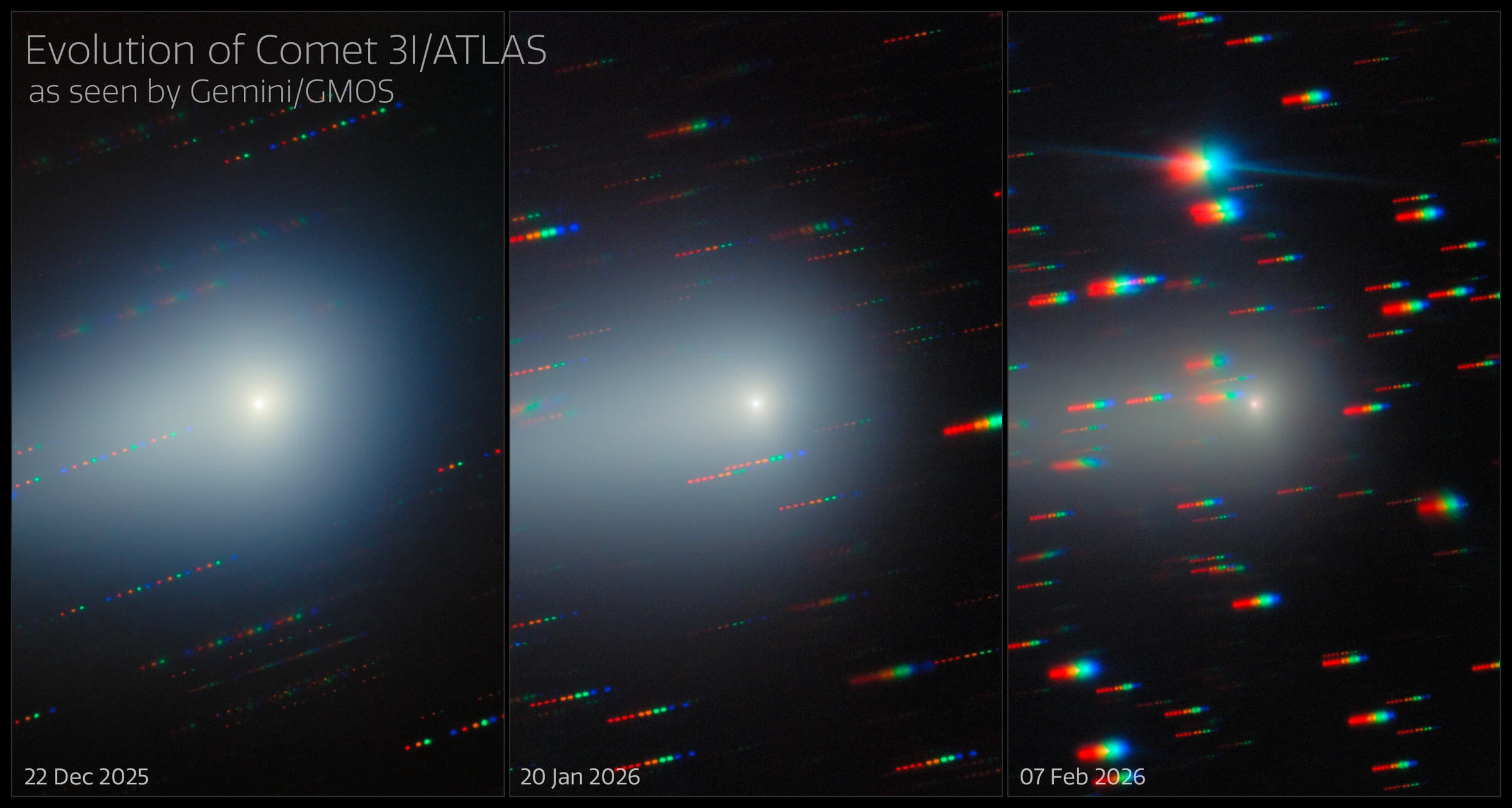
What the record shows is not in doubt. A comet from another star, perhaps more than twice the age of the Sun, crossed the solar system in 2025 and 2026 along a path close to the plane of the planets. It was watched by telescopes on the ground and in space, and by spacecraft at Mars. Its push was real and was measured.
The record clearly favours a comet. The push is about a thousand times smaller than the light sail needed, it appeared when a comet's would, and the coma is made of the gas that would drive it. Loeb's own later papers explain its size and its sunward glow in natural terms.
What is still open is narrower. Why the fits from before and after perihelion disagree. When the push was strongest. Why the push and the light give two different sizes for the same nucleus. Those questions will be worked on for years from data already in hand, by the same teams that measured it, Loeb's among them.
3I/ATLAS is past Jupiter now, fading on its way out. Every week it is harder to see; JPL's latest orbit includes positions measured as late as 16 October 2026.
Its orbit, fitted from those positions, is the only record left of how it moved. It will not come back to be measured again.
Questions This Leaves You With
Is there anything a person actually does with this?
Not with the object itself. It is leaving, it was never a danger to Earth, and anyone who sells a date for its return, or a message it carried, is selling something. What you can do is follow how the record was made. Every measurement of its push came from positions anyone can download, fitted by people who published their methods. You can watch, in real time, how a strange question about the sky gets answered: in public, by competing teams, with numbers. Even the paper that asked whether it was a craft published its arithmetic, so others could check it, and they did.
Does this sit against a religious account of the world?
It cuts both ways. Some readers see a sky full of old worlds, older than the Sun, as a larger creation than they were taught, and others see intelligent life elsewhere as a question their faith already leaves open. Others find that an empty, silent universe sharpens the sense that life here is precious. Neither reading follows from a comet. This site will not tell you which way it falls for you.
Does this change what a human life is?
Put your own life beside this object. It formed, by one estimate, before the Sun existed, travelled for billions of years and crossed our neighbourhood in a few months. Whether it was a comet or a craft, it is a piece of another star's history that drifted close enough for us to taste its chemistry. Some people find that makes a human life smaller. Others find it makes the moment of being here to see it rarer, and so larger.
What would change your mind, in either direction?
Name it now, before you are committed. The way astronomers test a push like this is simple in principle: they fit the positions with and without the extra force, and ask which fit is better and whether the force follows the comet's gas output. Toward technology: a change in course that does not track the comet's activity, or any signal at all. Toward a comet: a single outgassing model that fits both legs of the orbit, before and after perihelion. Ask which of those you would accept before you see the result.
Why do the two halves of the orbit disagree?
That is the empty space in this story. Spada, Krolikowska and Dones found that the push measured on the way in and the push measured on the way out do not match each other within their uncertainties. It may be the quality of the positions, or the limits of models that hold the comet's behaviour fixed. Spada's team found that letting the push lag behind perihelion, or fall unevenly, improves the fit. Whatever the reason, the answer is in the data already taken, and the object itself is gone. The next interstellar visitor, found earlier and watched longer, may be the one that settles what this one left open.
Sources
- MPEC 2025-N12: 3I/ATLAS = C/2025 N1 (ATLAS), 2 July 2025 Minor Planet Center
- CBET 5578: Comet C/2025 N1 (ATLAS) = 3I/ATLAS, 2 July 2025 IAU Central Bureau for Astronomical Telegrams
- Comet 3I/ATLAS NASA Science
- Chandler et al., 3I/ATLAS in Rubin Observatory images, arXiv:2507.13409, 2025 arXiv
- Seligman et al., Discovery and Preliminary Characterization of a Third Interstellar Object: 3I/ATLAS, ApJL 2025 arXiv / The Astrophysical Journal Letters
- Comet 3I/ATLAS frequently asked questions European Space Agency
- JPL close-approach data for 3I/ATLAS NASA/JPL
- Hopkins et al., From a Different Star: 3I/ATLAS in the context of the Otautahi-Oxford model, ApJL 990 L30, 2025 arXiv / ApJL
- Older than the Sun: new clues to the origin of interstellar comet 3I/ATLAS, ESO release eso2608, July 2026 European Southern Observatory
- Jewitt et al., Hubble Space Telescope Observations of the Interstellar Interloper 3I/ATLAS, 2025 arXiv
- Cordiner et al., JWST detection of a carbon dioxide dominated gas coma surrounding 3I/ATLAS, ApJL 2025 arXiv / ApJL
- View Interstellar Comet 3I/ATLAS Through NASA's Multiple Lenses, 19 November 2025 NASA Science
- Hibberd, Crowl and Loeb, Is the Interstellar Object 3I/ATLAS Alien Technology?, arXiv:2507.12213, July 2025 arXiv
- arXiv listing of Loeb's papers on 3I/ATLAS arXiv
- Avi Loeb, Extending the Loeb Scale to SETAI, Medium, 17 October 2026 Medium
- Denise Chow, NASA photos of interstellar comet 3I/ATLAS, NBC News, 19 November 2025 NBC News
- 3I/ATLAS is a comet, not aliens, NASA says, Times of Oman (DW), 20 November 2025 Times of Oman / Deutsche Welle
- Cloete, Loeb and Veres, Upper Limit on the Non-Gravitational Acceleration of 3I/ATLAS, September 2025 arXiv
- JPL Small-Body Database solution for C/2025 N1 (ATLAS), 21 October 2026 NASA/JPL
- Spada, Krolikowska and Dones, Systematic and Statistical Uncertainties in the Non-Gravitational Acceleration of 3I/ATLAS, 2026 arXiv (accepted, Astronomy and Astrophysics)
- Thoss, Loeb and Burkert, Inferring the mass and size of 3I/ATLAS from its non-gravitational acceleration, March 2026 arXiv
- Hui et al., Nucleus and Postperihelion Activity of 3I/ATLAS Observed by Hubble, 2026 arXiv / ApJL
- Eubanks et al., Research Notes of the AAS 9, 329, December 2025 American Astronomical Society
- Keto and Loeb, The Physics of Cometary Anti-tails as Observed in 3I/ATLAS, 2025 arXiv