
2I/Borisov is the second object ever found coming into the solar system from another star. It was discovered on 30 August 2019, Greenwich time, by Gennadiy Borisov, an amateur astronomer working at his own observatory at Nauchnij in Crimea, with a 0.65-metre telescope he had built. On his frame it was a faint, fuzzy point, moving in a slightly different direction from the asteroids around it.
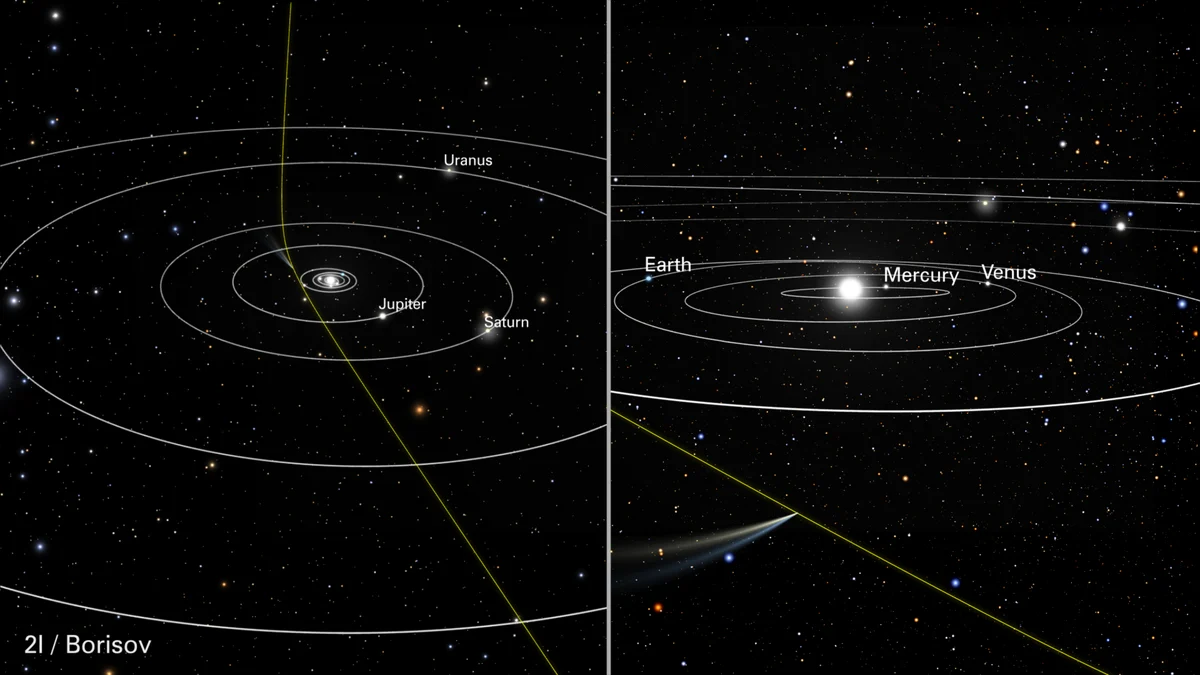
It was moving at about 32 kilometres a second on a path that no gravity of the Sun could close. It would pass once and leave.
And it had a tail.
That was what set it apart from the only visitor before it. In October 2017 'Oumuamua had crossed the solar system as a bare, tumbling, elongated thing, with no coma and no tail, and an unexplained push. Borisov looked like a comet.
Ordinary. From another star.
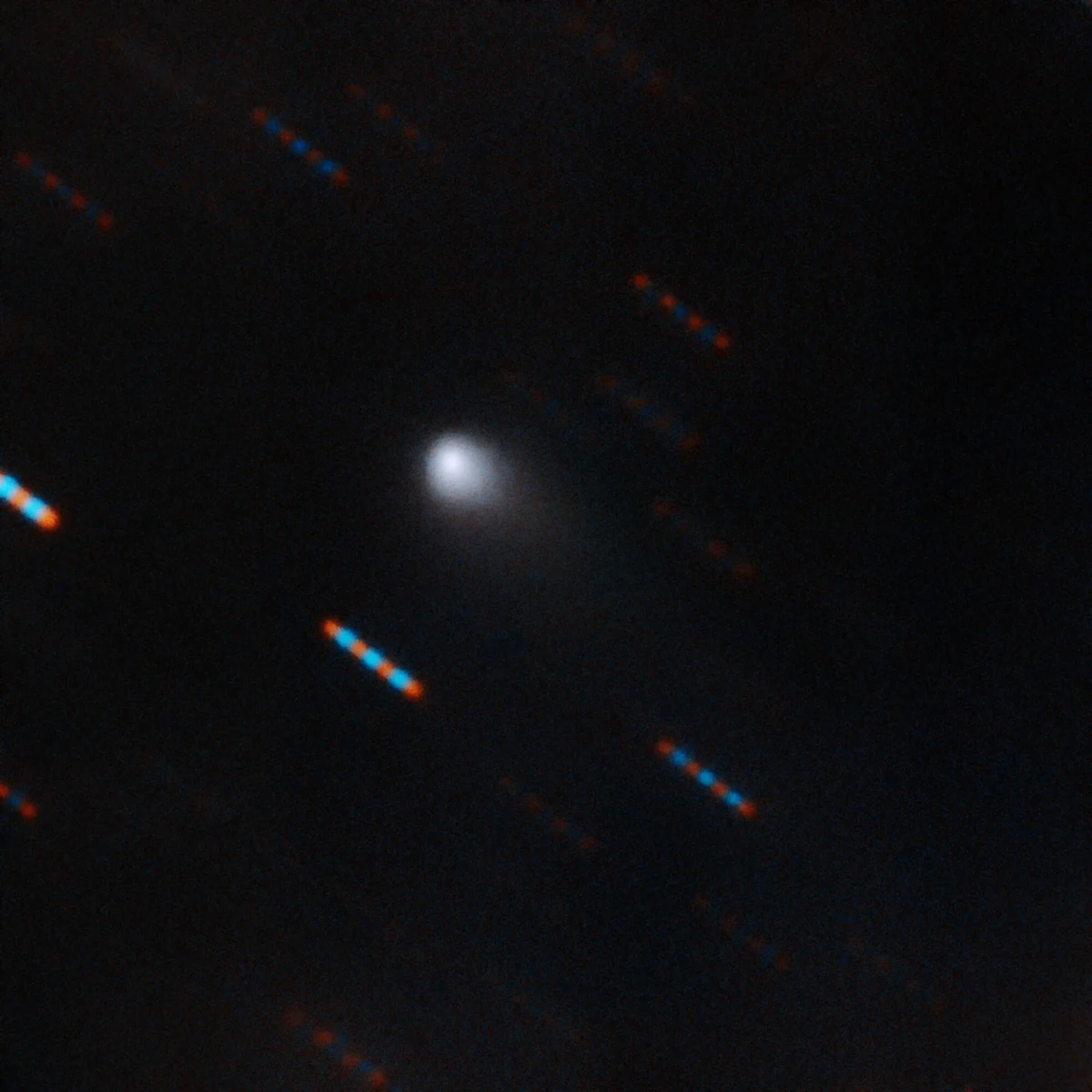
A diffuse object
Borisov told the Russian news agency RIA Novosti how he saw it. "I observed it on 29 August, but by Greenwich it was 30 August," he said, in translation. "In the frame I saw a moving object." It was moving "in a slightly different direction from the main asteroids". He reported, he said, that "the object was diffuse and that it was not an asteroid but a comet."
He had built the telescope himself, as he had built others. "I make fast, wide-field telescopes," he told the Russian news site Fontanka. "You can't get rich on comets. They reward you only with fame."
The orbit computers took it from there. On 11 September 2019 the Minor Planet Center issued a circular naming it C/2019 Q4 (Borisov). Its orbit had "converged to the hyperbolic elements", the circular said, "which would indicate an interstellar origin." Davide Farnocchia at JPL and others had reached the same answer. On 24 September the Center gave it the permanent designation 2I: the second interstellar object. "The IAU Working Group for Small Body Nomenclature has decided to retain the name Borisov."
Then the telescopes turned. On 9 and 10 September the Gemini North telescope in Hawaii took a colour image showing, for the first time on an interstellar visitor, a clear tail. Piotr Guzik, Michal Drahus and colleagues, writing in Nature Astronomy in October, found it reddish, with a coma, and concluded: "2I/Borisov appears indistinguishable from the native Solar System comets."
"It's kind of relieving that finally we have something that meets our expectations," Drahus told Science News.
The odd one out
Then the second half of Drahus's thought. "Now we really can be absolutely sure that 'Oumuamua was one weird object."
That is the case Borisov's discovery makes, put by the people who studied it. A second interstellar object was found, and it behaved exactly as theory said such things should: an icy body flung out of another planetary system, warming as it neared our Sun, venting gas and dust. Which leaves the first one, by contrast, standing alone.
David Jewitt of UCLA, who led the Hubble observations of Borisov, put it plainly in October 2019: "Whereas 'Oumuamua appeared to be a rock, Borisov is really active, more like a normal comet. It's a puzzle why these two are so different."
A puzzle. On the reading Avi Loeb has held since 2018, it is more than that. In October 2018 he and Shmuel Bialy proposed that 'Oumuamua's push, measured with no sign of the gas a comet gives off, could be sunlight pressing on a thin, flat object, perhaps a light sail. In a Boston Globe question-and-answer in 2021, on whether a comet-like second visitor changed his view of 'Oumuamua, he answered with a story: "Well, when I met my wife on our first date, I thought she was special." Meeting other people later, he went on, did not change his opinion of the first. Borisov, he said, looked and behaved like a comet from the start. The contrast, on that view, is the point: here is what an ordinary interstellar comet looks like, and 'Oumuamua did not look like it.
One visitor that looked like a comet. One that did not.
And even the familiar one was not quite familiar.
If one of them was different
Set aside, for a moment, whether it is true. Ask the larger question. What kind of galaxy is it, if the two visitors were not the same kind of thing?
It would mean that the first object ever seen arriving from another star was the odd one: that the galaxy's ordinary traffic is comets like Borisov, and that 'Oumuamua was drawn from some rarer population, natural or not.
It would mean that the sky is being sampled. Each visitor is a piece of another star's system, delivered free, and if the first one was not a comet, the other systems send out more than ice.
It would mean something about us. A species that had waited all of history for a single object from another star got two in two years, and the second was there to tell it how strange the first had been.
And it would leave one question in front of us. A third arrived in 2025, 3I/ATLAS, and it, too, looked like a comet. Every new one changes what 'normal' means, and therefore what the first one was.
Just a comet, with a past
The standard account is that both visitors are natural, and that Borisov is simply the clearer case.
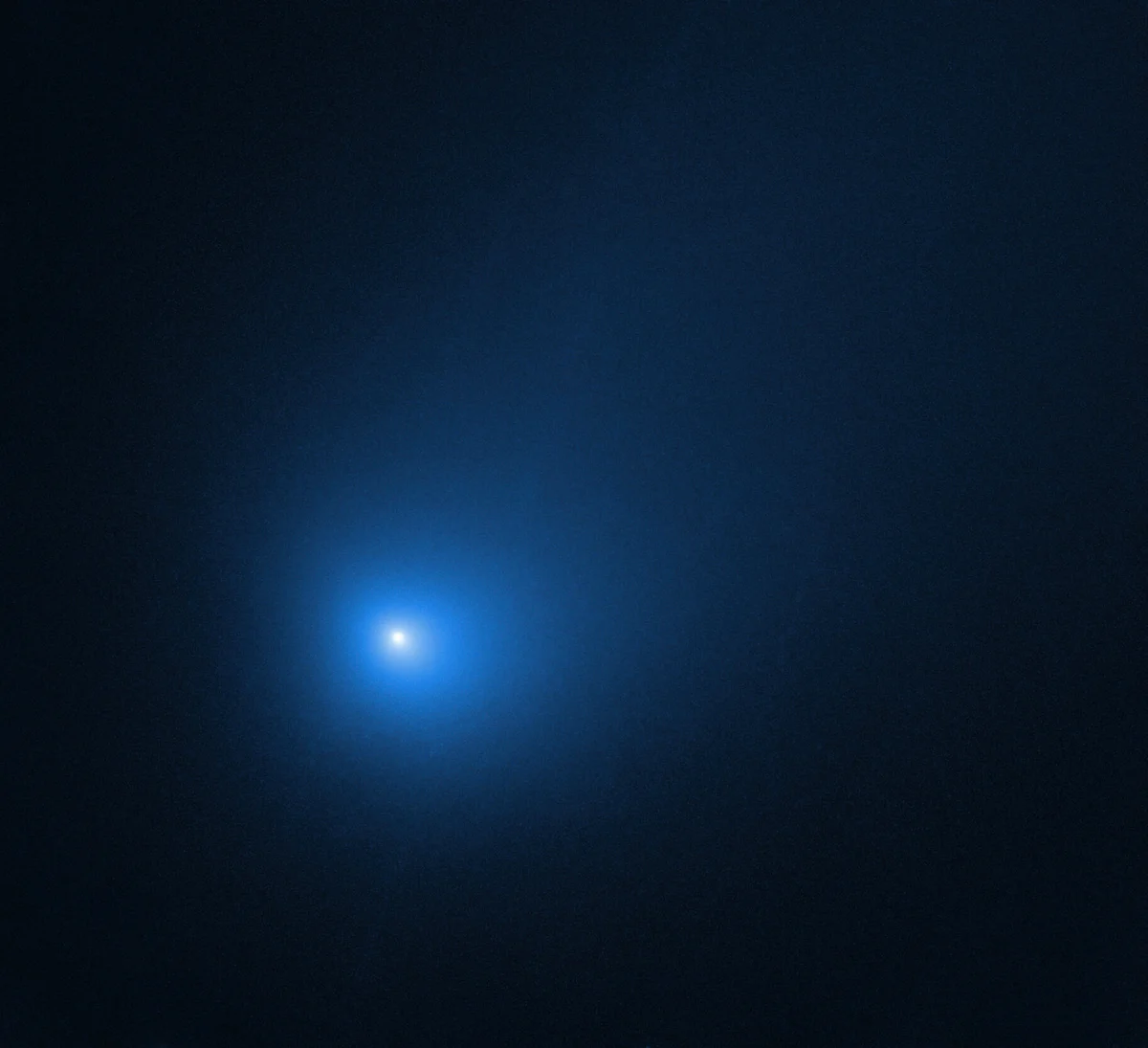
The Hubble Space Telescope watched it through its closest approach to the Sun on 8 December 2019, at about 2 AU, and Jewitt found its nucleus small: "The radius is smaller than half a kilometre." Its chemistry was where it differed. Dennis Bodewits and colleagues, using Hubble's ultraviolet spectrograph, and Martin Cordiner and colleagues, using the ALMA radio telescope in Chile, reported in April 2020 that Borisov carried more carbon monoxide relative to its water than any comet measured so close to the Sun: by ALMA's measure, nine to 26 times the average comet. "This is the first time we've ever looked inside a comet from outside our solar system," Cordiner said. The ALMA team read it as a comet that formed in the cold outer reaches of another star's disc.
In March 2020 it flared twice, and Hubble saw a piece break away; Jewitt and colleagues judged these "minor events" that it would survive. In 2021 polarisation measurements at the Very Large Telescope suggested it had never before passed close to a star. "2I/Borisov could represent the first truly pristine comet ever observed," said Stefano Bagnulo, who led the study.
Different chemistry, different history, the same physics. On that account, 'Oumuamua was a natural object too, of a kind not yet seen twice, as the first Official X article on it sets out.
What the comet does not explain
Borisov looked and acted like a comet; that much is settled.
What it does not do is explain 'Oumuamua. It could not. A comet behaving as expected says what expected looks like; it says nothing about why a different object did something else. The natural explanations for 'Oumuamua's push are argued on their own evidence: Jackson and Desch proposed in 2021 a fragment of nitrogen ice, chipped off a Pluto-like world; Bergner and Seligman proposed in Nature in 2023 that hydrogen, made by cosmic rays in water ice and released as it warmed, did the pushing. Borisov does not add to either.
And here is the strange part. Even the familiar visitor was not entirely familiar. Its carbon monoxide was, in Bodewits's words, "not a property of most solar system comets". In the polarisation study it resembled only one comet ever measured, Hale-Bopp. "The main result," said Olivier Hainaut of ESO, "that 2I/Borisov is not like any other comet except Hale-Bopp, is very strong."
Its size is known only as a limit: a radius under half a kilometre in Jewitt's Hubble work, about 975 metres across on NASA's own page. And nobody knows which star it came from: no proposed parent system has been confirmed, and the trail goes cold among the stars.
Three, and counting
Where it stands now: there are three known interstellar objects. 'Oumuamua in 2017, Borisov in 2019, 3I/ATLAS in 2025. Most astronomers classify two of the three as comets; Loeb has argued that 3I/ATLAS deserves formal consideration as something more. 'Oumuamua is still argued over.
Borisov changed what astronomers expect of the next one. "2I/Borisov gave us the first glimpse into the chemistry that shaped another planetary system," said Milam, a co-author of the ALMA study, and on NASA's page: "Whatever the answer is, 2I/Borisov opens up a whole new can of worms for cometary science."
Borisov is gone, outbound into the galaxy, last measured by the orbit computers in September 2020.
"Borisov is the first known interstellar comet," Jewitt said in 2019, "and we would like to know how many others there are." The Vera C. Rubin Observatory began its ten-year survey of the sky at the end of June 2026.
What is left is the comparison, now with three points instead of two. Every new visitor that looks like a comet makes the ordinary clearer. Whether it makes the first one more ordinary or less is the question 'Oumuamua still asks.
Questions This Leaves You With
Is there anything a person actually does with this?
Nothing for your own life: Borisov is gone and will never return. But it is a reminder of who finds these things. The second interstellar object was found by one man, in his own observatory, with a telescope he built,. As he put it, comets reward you only with fame. The designation he earned is permanent: 2I, the second in a sequence 'Oumuamua opened. Amateurs still find comets, and the next visitor from another star could, in principle, be found the same way, by someone patient with a telescope of their own. Nobody knows when or where the next one will appear.
Does this sit against a religious account of the world?
It can be read either way, and thoughtful people have. One reading sees a galaxy where other stars build comets as ours did, a shared physics that some find to be a sign of order. Another hears in the oddness of 'Oumuamua the old question of whether we are alone, which faiths have answered in many ways. Borisov itself settles none of it. What it does show is that another star's leftovers are made of the same atoms and ices as ours, in different proportions, which some readers find humbling and others find homely. This site will not tell you which way it falls.
Does this change what a human life is?
For all of human history no one had seen an object from another star. Then, within two years, two arrived, and since then a third. A life lived before 2017 never saw one; a life lived now has seen three. On one reading that makes us latecomers to a traffic that has always been passing. On another it makes us lucky, the first generation able to notice it. Which did you feel?
What would change your mind, in either direction?
Name it now. Toward 'Oumuamua being natural: more interstellar objects found by Rubin, with a few that are inactive and elongated like it, so that it stops being alone. Toward something stranger: a long run of comet-like visitors with none like 'Oumuamua, leaving it truly singular, or a specific property of 'Oumuamua that no natural body in the growing sample shares. The comparison only works with numbers, and the numbers are coming.
What would it take to show that 'Oumuamua was made?
This is the open problem, and it is narrower than it sounds. 'Oumuamua is gone; nothing new can be measured on it. An artificial reading would need a second object like it, caught early enough to be studied closely: its shape, its spectrum, whether gas leaves it, whether its push follows sunlight or something else. A natural reading needs the same thing. Three objects are too few for a statistic, and only one of them was strange. Nobody has yet seen its twin.
Sources
- MPEC 2019-R106, Comet C/2019 Q4 (Borisov) (11 September 2019) Minor Planet Center Primary record
- MPEC 2019-S72, 2I/Borisov = C/2019 Q4 (Borisov) (24 September 2019) Minor Planet Center Primary record
- Krymskii astronom zayavil, chto otkrytaya im kometa izmenit nazvanie (RIA Novosti, 16 September 2019) RIA Novosti Primary record
- Nikolai Nelyubin, interview with Gennadiy Borisov (Fontanka, 13 September 2019) Fontanka Primary record
- P. Guzik, M. Drahus et al., Initial characterization of interstellar comet 2I/Borisov (Nature Astronomy, October 2019) arXiv / Nature Astronomy Primary record
- Gemini Observatory Captures Multicolor Image of First-ever Interstellar Comet (noirlab1907a, September 2019) NOIRLab via Wikimedia Commons Primary record
- Maria Temming, How the second known interstellar visitor makes 'Oumuamua seem even odder (Science News, 14 October 2019) Science News Study
- Hubble Observes First Confirmed Interstellar Comet (16 October 2019) NASA Primary record
- Steve Nadis, Q&A: Was that a weird rock or an alien spacecraft? (Boston Globe, January 2021) The Boston Globe Primary record
- Hubble Watches Interstellar Comet Borisov Speed Past the Sun (heic1922, 12 December 2019) ESA/Hubble Primary record
- C/2019 Q4 (Borisov), JPL Small-Body Database NASA Jet Propulsion Laboratory Primary record
- D. Bodewits et al., The carbon monoxide-rich interstellar comet 2I/Borisov (Nature Astronomy 4, 867, 2020) arXiv / Nature Astronomy Primary record
- Hubble Probes Alien Comet's Chemical Makeup (20 April 2020) NASA Primary record
- ALMA Reveals Unusual Composition of Interstellar Comet 2I/Borisov (20 April 2020) ALMA Observatory Primary record
- Jewitt et al., Interstellar Object 2I/Borisov Double (ATel 13611, 2 April 2020) The Astronomer's Telegram Primary record
- Drahus, Guzik et al., Multiple Outbursts of Interstellar Comet 2I/Borisov (ATel 13549, 12 March 2020) The Astronomer's Telegram Primary record
- D. Jewitt et al., Outburst and Splitting of Interstellar Comet 2I/Borisov (ApJL 896, L39, 2020) arXiv / ApJL Primary record
- First interstellar comet may be the most pristine ever found (eso2106, 30 March 2021) European Southern Observatory Primary record
- Vera C. Rubin Observatory Begins Its Long-Awaited All-Sky Survey (Sky and Telescope, 30 June 2026) Sky and Telescope Study
- 2I/Borisov (updated 3 November 2024) NASA Science Primary record
- Interstellar Comet Borisov Reveals Its Chemistry and Possible Origins (20 April 2020) NASA Primary record
- S. Bialy and A. Loeb, Could Solar Radiation Pressure Explain 'Oumuamua's Peculiar Acceleration? (2018) arXiv / ApJL Primary record
- A. Jackson and S. Desch, 1I/'Oumuamua as an N2 ice fragment of an exo-Pluto surface: I (2021) arXiv / JGR Planets Primary record
- J. Bergner and D. Seligman, Acceleration of 1I/'Oumuamua from radiolytically produced H2 in H2O ice (Nature, 2023) Nature Primary record
- Avi Loeb, Medium posts (feed), including Extending the Loeb Scale (17 October 2026) Avi Loeb, Medium Primary record