
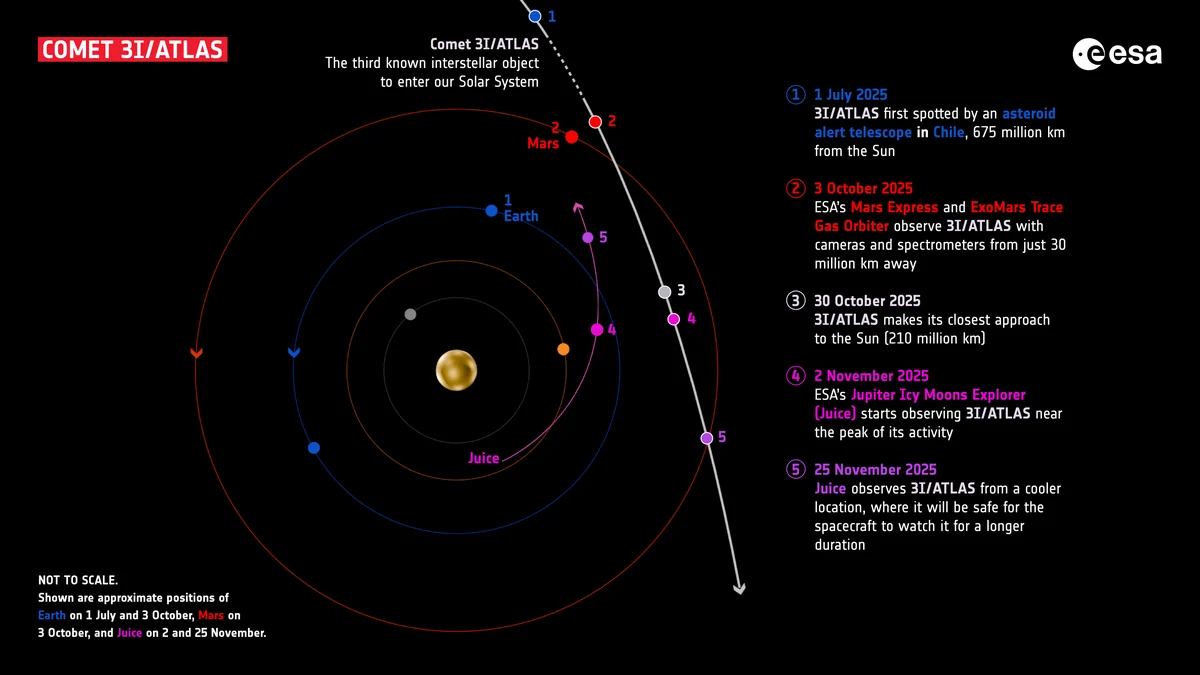
3I/ATLAS is the third object ever found passing through the solar system from another star. It was discovered on 1 July 2025 by the ATLAS survey telescope at Rio Hurtado in Chile, moving too fast to be bound to the Sun, and it swung closest to the Sun on 29 October 2025 (Universal Time), at about 1.35 times the Earth's distance, before heading back out for good.
The first Official X article on it followed the question that made it famous: whether it was being pushed by something other than gravity. This one follows the year after perihelion, when the push stopped being a question and became a measurement.
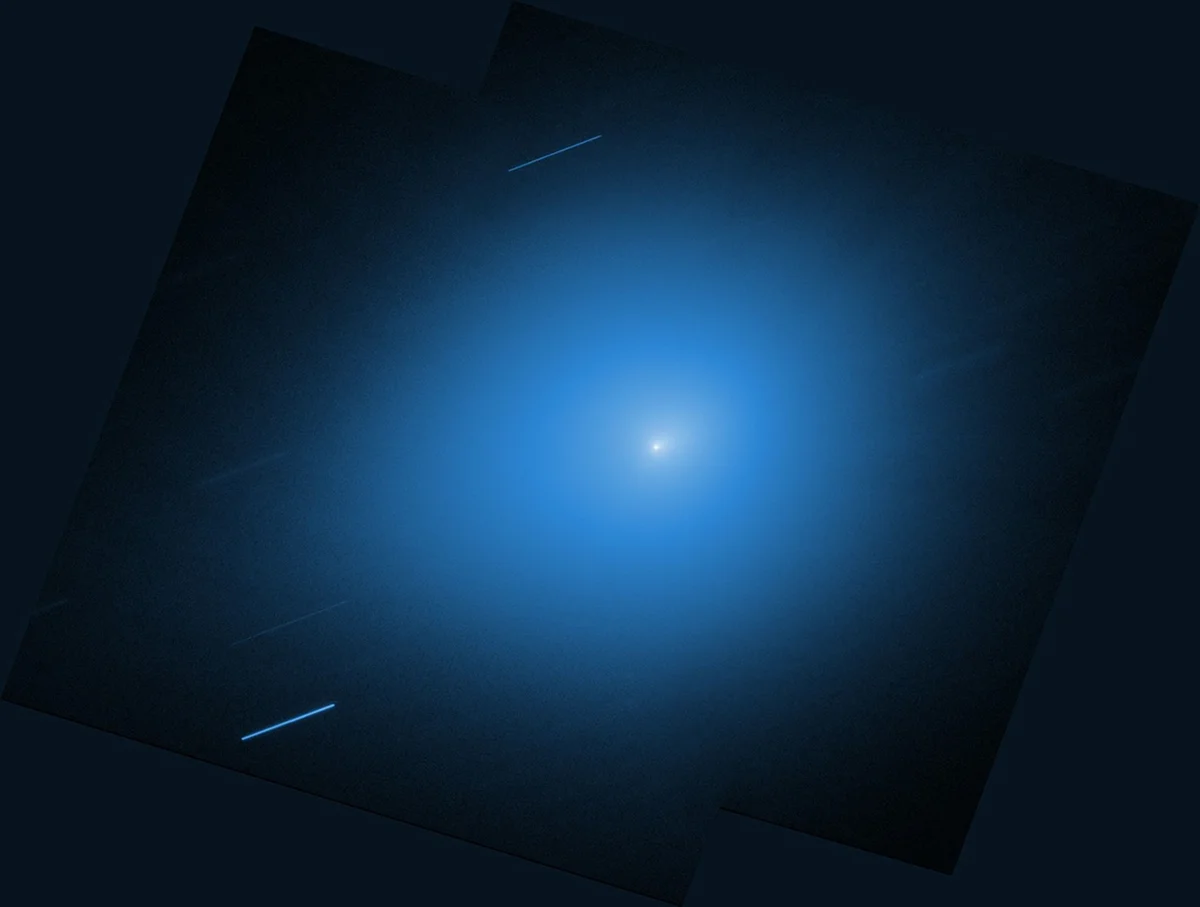
It was watched from Mars, from near the Sun, from a spacecraft bound for Jupiter and from the Earth; the HiRISE camera on the Mars Reconnaissance Orbiter caught it at about 30 million kilometres on 2 October 2025. A year on, the push has been measured, most researchers put it down to the comet's own outgassing, and a few numbers still do not fit.
Before perihelion, the push was too small to see. After it, it was there in every orbit fit.
The question became what was doing the pushing.
The number that moved
In September 2025, a month before perihelion, Cloete, Loeb and Veres went through every position reported to the Minor Planet Center from 15 May to 23 September and found no measurable push at all: any acceleration beyond gravity had to be smaller than about 3 x 10^-10 astronomical units per day per day.
Then the comet rounded the Sun. Values from JPL's Horizons system for the weeks around perihelion, quoted by Neukart, were far larger, around 10^-6, and Neukart found them consistent with ordinary sublimation of carbon monoxide ice. Whether those figures used the same model of how the push varies with distance from the Sun as later ones is not stated in the sources opened for this article, and figures from different models cannot be set side by side.
The figure settled as observations piled up. A JPL solution of 8 January 2026, quoted by Ahuja and Ganesh, put the main radial term, A1, at about 4.5 x 10^-8. The newest, solution 55, computed by Davide Farnocchia at JPL on 21 October 2026 from 117 observations made after 3 October 2025, gives 4.618 x 10^-8, with the push peaking about 28 days after perihelion. The second term, the push along the orbit, was positive in January and is negative in October.
Not zero. Small, and real.
And never had an interstellar object been watched by so many instruments. NASA lists Psyche, Lucy, MAVEN, STEREO, PUNCH, the Mars Reconnaissance Orbiter, the Perseverance rover, SOHO, Parker Solar Probe, Europa Clipper, Hubble, SPHEREx and TESS among them. Europe's Juice spacecraft, on its way to Jupiter, turned five instruments on it through November 2025, passing within about 0.4 AU on 4 November. "When ATLAS came, we knew there was not a lot of time," said Angela Dietz, its spacecraft operations manager. On 19 December 2025 the comet passed closest to the Earth, about 270 million kilometres away.
The case Loeb kept open
Read as the astronomer Avi Loeb reads it, 3I/ATLAS was never a closed file, and the year after perihelion gave him reasons to keep it open.
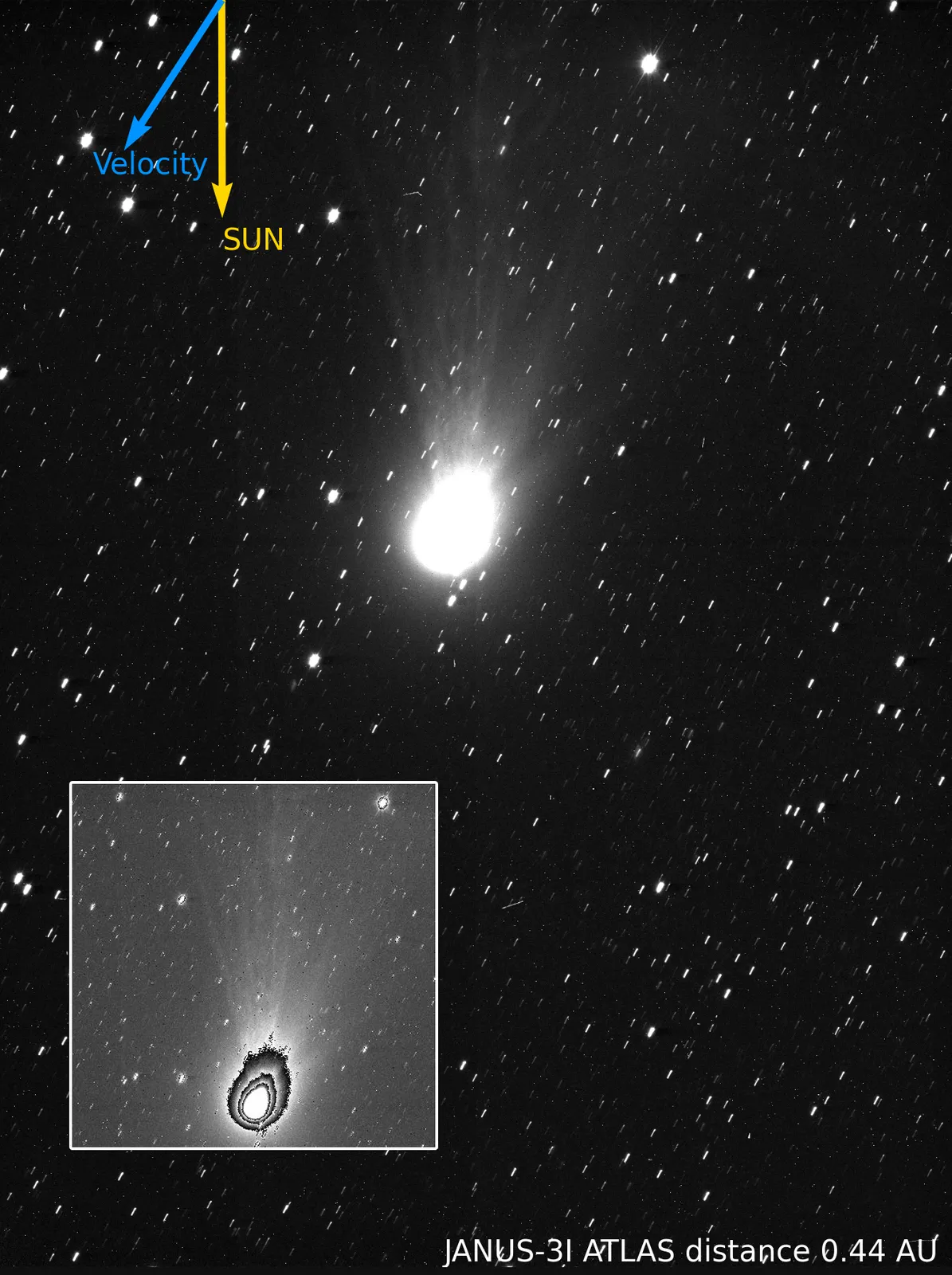
The push appeared only after the closest pass to the Sun, where none could be found before. The gas coming off it was odd. Before perihelion the Very Large Telescope saw nickel streaming from it with no iron at all. After perihelion, Hutsemekers and colleagues reported in May 2026, its metal output stayed "at least an order of magnitude larger" than in ordinary comets. Its ice may be ancient: Webb's measurements of its deuterium and the Very Large Telescope's carbon and nitrogen isotopes point, on those teams' estimates, to an origin more than twice the Sun's age. In March 2026 Roth and colleagues measured the deuterium in its methane at 14 times the level in comet 67P. Even NASA's Tom Statler called it "a window into the deep past and so deep in the past that it predates even the formation of our Earth and our sun."
Then the jets. In February 2026 Scarmato and Loeb reported that its dominant jet wobbled with a period of 7.20 hours, and that its rotation axis pointed toward the Sun to within about 20 degrees.
On his own scale for rating possible technology, Loeb has kept 3I/ATLAS at Level 4 through October 2026, a level that "marks formal consideration of techno-signature criteria". Together, on his reading, they are an object older than the Sun, rich in metal, spinning on an axis pointed at the Sun, and pushed only after it rounded it.
Formal consideration. Not a verdict.
If it were made
Set aside, for a moment, whether it is true. Ask the larger question. What kind of galaxy is it, if 3I/ATLAS was made?
It would mean an object built by someone else crossed the solar system in 2025 and rounded our Sun, watched by more than a dozen spacecraft that recorded it as a comet. Its jets and its metals would be part of its design.
It would mean that the material older than the Sun is old craft, not old ice. A thing assembled before the Earth formed would have been crossing the galaxy for billions of years before it reached us, and whoever built it would have lived around a star that was old when ours was born. Intelligence, on that reading, would be older than the Earth.
It would mean something about us. We would have been visited, measured the visit to many decimal places, and recorded it, in good faith, as a comet.
And it would leave one question in front of us. The visitor is gone. Whatever it was, the data already taken, and whatever Webb's last look adds, is what there will be, and the answer would have to come out of that archive.
A comet's own jets
The standard account is that the push is the reaction of the gas leaving the nucleus. Water and carbon dioxide boiling off the sunlit side push the comet the other way, as with every active comet, and the timing fits.
In the days before perihelion Zhang and Battams watched it brighten steeply in solar observatory images, "distinctly bluer than the Sun", the colour of glowing gas. On 6 November, about a week after perihelion, the first measurement in Combi and colleagues' series from the SOHO spacecraft found water leaving it at 3.17 x 10^29 molecules a second, falling steeply after that. JPL's orbit puts the peak of the push after perihelion too. In January 2026 Shinnaka's team at the Subaru telescope found that "the CO2/H2O ratio decreased substantially across perihelion", and Webb made "the first direct detection of methane in an interstellar object." After perihelion, Keck found iron alongside the nickel, at a ratio that "matches Solar System comets well".
Forbes and Butler found the push and the gas "consistent when the nucleus of 3I/ATLAS is around 1 km in diameter". Hubble found its fading after perihelion "not unusual" for comets. On 18 December the Breakthrough Listen team searched it from 1 to 12 gigahertz with the Green Bank Telescope and, in a short research note, reported no signal down to 100 milliwatts.
"This object is a comet," NASA's Amit Kshatriya said at the briefing of 19 November 2025. "It looks and behaves like a comet. And all evidence points to it being a comet."
What the explanation leaves open
No signal was found, and the gases it gave off are the gases comets give off.
What the comet account does not yet settle is the detail. Spada, Krolikowska and Dones found, in a paper accepted by Astronomy and Astrophysics, that the orbits fitted before and after perihelion disagree, and that delayed or lopsided activity fits better than symmetric; the JPL fit's sideways term has flipped sign. The size does not settle either. Forbes and Butler's push-and-gas fit points to a nucleus about a kilometre across; Hubble's measurement, assuming a dark surface, gave a radius of about 1.3 kilometres, more than twice that across; Thoss, Loeb and Burkert put it as small as 0.42 kilometres if carbon dioxide drives the push. Webb found water coming partly from icy grains in the coma, not only the nucleus, which changes the size the push implies. And the metals ran ten times high for reasons still being argued.
And here is the strange part. The astronomer who most kept the question open has also recorded what was not seen. In October 2026 Loeb gave a new grade, C0, to 3I/ATLAS and to Oumuamua, "because neither has shown contingent behavior": nothing either did responded to anything around it.
A comet by every test applied. A file, on one scale, still open.
Gone, with the data
Where it stands now: 3I/ATLAS is on its way out of the solar system and will not return. It passed Jupiter in March 2026; no record turned up for this article of a Jupiter spacecraft observing it then. JPL's latest orbit, its comment field says, was computed to support a further Webb observing programme.
What is left is the archive: Juice's 126 science files, Webb's spectra, Hubble's fading curve, more than a year of positions. The papers have not stopped. Through 2026 they have added methane, an age, a deuterium ratio, a jet period, each from data taken in a few months of 2025, and each read differently by different teams.
And a short list of open numbers. How big the nucleus is. Where the water came from. Why the metals ran high. Why the fits before and after perihelion will not agree.
The push turned out to be a comet's. Exactly what kind of comet is still being worked out.
Questions This Leaves You With
Is there anything a person actually does with this?
Nothing for your own life: 3I/ATLAS is leaving and will never come back. What it leaves is a template. The next interstellar object will be met by a plan built on this one: which spacecraft can turn to look, which spectra settle what, how to tell a jet from something stranger. Anyone selling a date is selling something; the next visitor will not announce itself in advance.
Does this sit against a religious account of the world?
It can be read either way, and thoughtful people have. One reading sees a universe generous with its building blocks, sending ice older than the Sun into our sky from another star. Another hears in the search for technosignatures a hope, or a worry, about not being alone, which faiths have answered in different ways for a long time. The comet does not decide it. This site will not tell you which way it falls.
Does this change what a human life is?
The ice that boiled off 3I/ATLAS in November 2025 may have formed before the Earth existed, around another star, and drifted for billions of years to pass us once. A human life is a blink against that, and so is the whole of recorded history. On one reading that makes us small, bystanders to an object that did not notice us. On another it makes us rare: the first people ever able to catch such a visitor, weigh its push and read its gas. Which did you feel?
What would change your mind, in either direction?
Name it now. Toward something more than a comet: a change in its motion no outgassing law can fit, a narrowband signal from its direction found in archived data, or behaviour that responds to something, which is exactly what Loeb's C0 grade says has not been seen. Toward an ordinary comet: a single outgassing model that fits the whole orbit, before and after perihelion, and an agreed nucleus size. Both tests can be run on data already taken.
Why will the fits not agree?
This is the open problem. The push is real and comet-like, but no simple law of outgassing yet fits the orbit before and after perihelion together, and the sideways part of the push changed sign between solutions. It may be lopsided jets, delayed activity, water from grains rather than the nucleus, or hidden errors in the positions. Spada and colleagues and others have proposed delayed or lopsided activity; no single model has yet been shown to fit every measurement. A model that did would also say how big the nucleus is, where its jets were, and how much of the push was water and how much carbon dioxide.
Sources
- 3I/ATLAS Facts and FAQs (updated 28 May 2026) NASA Science Primary record
- C/2025 N1 (ATLAS), JPL Small-Body Database, orbit solution 55 (21 October 2026, D. Farnocchia) NASA Jet Propulsion Laboratory Primary record
- Cloete, Loeb and Veres, upper limit on the non-gravitational acceleration of 3I/ATLAS (arXiv, September 2025) arXiv Primary record
- Neukart, non-gravitational acceleration of 3I/ATLAS (arXiv 2511.07450v3, Icarus) arXiv Primary record
- Ahuja and Ganesh (arXiv 2601.17083, January 2026) arXiv Study
- View Interstellar Comet 3I/ATLAS Through NASA's Multiple Lenses (2025, updated 2026) NASA Science Primary record
- A rare encounter: How Juice came to observe 3I/ATLAS (23 March 2026) ESA Primary record
- Hutsemekers et al., metals in 3I/ATLAS after perihelion (arXiv 2605.07652, May 2026) arXiv Primary record
- Rahatgaonkar et al., VLT X-shooter spectra of 3I/ATLAS (ApJL 995, L34, 2025) arXiv / ApJL Primary record
- Webb finds clues to ancient, distant origin of Comet 3I/ATLAS (weic2613, 22 June 2026) ESA/Webb Primary record
- Older than the Sun (eso2608, 6 July 2026) European Southern Observatory Primary record
- Scarmato and Loeb, jet wobble of 3I/ATLAS after perihelion (arXiv 2602.18512, 2026) arXiv Primary record
- Avi Loeb, Extending the Loeb Scale to the Search for Extraterrestrial Artificial Intelligence (SETAI) (17 October 2026) (read through his Medium feed, medium.com/feed/@avi-loeb) Avi Loeb, Medium Primary record
- Zhang and Battams, Rapid Brightening of 3I/ATLAS Ahead of Perihelion (PASP 138, 014403, 2026) arXiv / PASP Primary record
- Combi et al., SOHO/SWAN water production of 3I/ATLAS (arXiv 2512.22354) arXiv Primary record
- Shinnaka et al., Subaru HDS [O I] observations of 3I/ATLAS (arXiv 2603.25002, 2026) arXiv Primary record
- Belyakov et al., The Volatile Inventory of 3I/ATLAS as seen with JWST/MIRI (ApJL 1001, L11, 2026) arXiv / ApJL Primary record
- Hoogendam et al., Keck KCWI after perihelion (arXiv 2601.16983, 2026) arXiv Primary record
- Forbes and Butler (arXiv 2512.18341, December 2025) arXiv Primary record
- Hui, Jewitt et al., Hubble observations of 3I/ATLAS after perihelion (arXiv 2601.21569, accepted ApJL) arXiv / ApJL Primary record
- Jacobson-Bell et al., Breakthrough Listen GBT observations of 3I/ATLAS (arXiv 2512.19763, 2025) arXiv Primary record
- 3I/ATLAS is a comet, not aliens, NASA says (DW via Times of Oman, 20 November 2025) Times of Oman / DW Study
- Spada, Krolikowska and Dones (arXiv 2603.00782, accepted A&A) arXiv / A&A Primary record
- Thoss, Loeb and Burkert (arXiv 2603.15735, 2026) arXiv Primary record
- NASA's Mars Spacecraft Capture Images of Comet 3I/ATLAS (19 November 2025) NASA/JPL Primary record
- Roth et al., An Enriched Methane D/H Ratio in the Interstellar Object 3I/ATLAS (arXiv 2603.20445, 2026) arXiv Primary record
- Comet 3I/ATLAS Image Gallery (updated 28 May 2026) NASA Science Primary record