
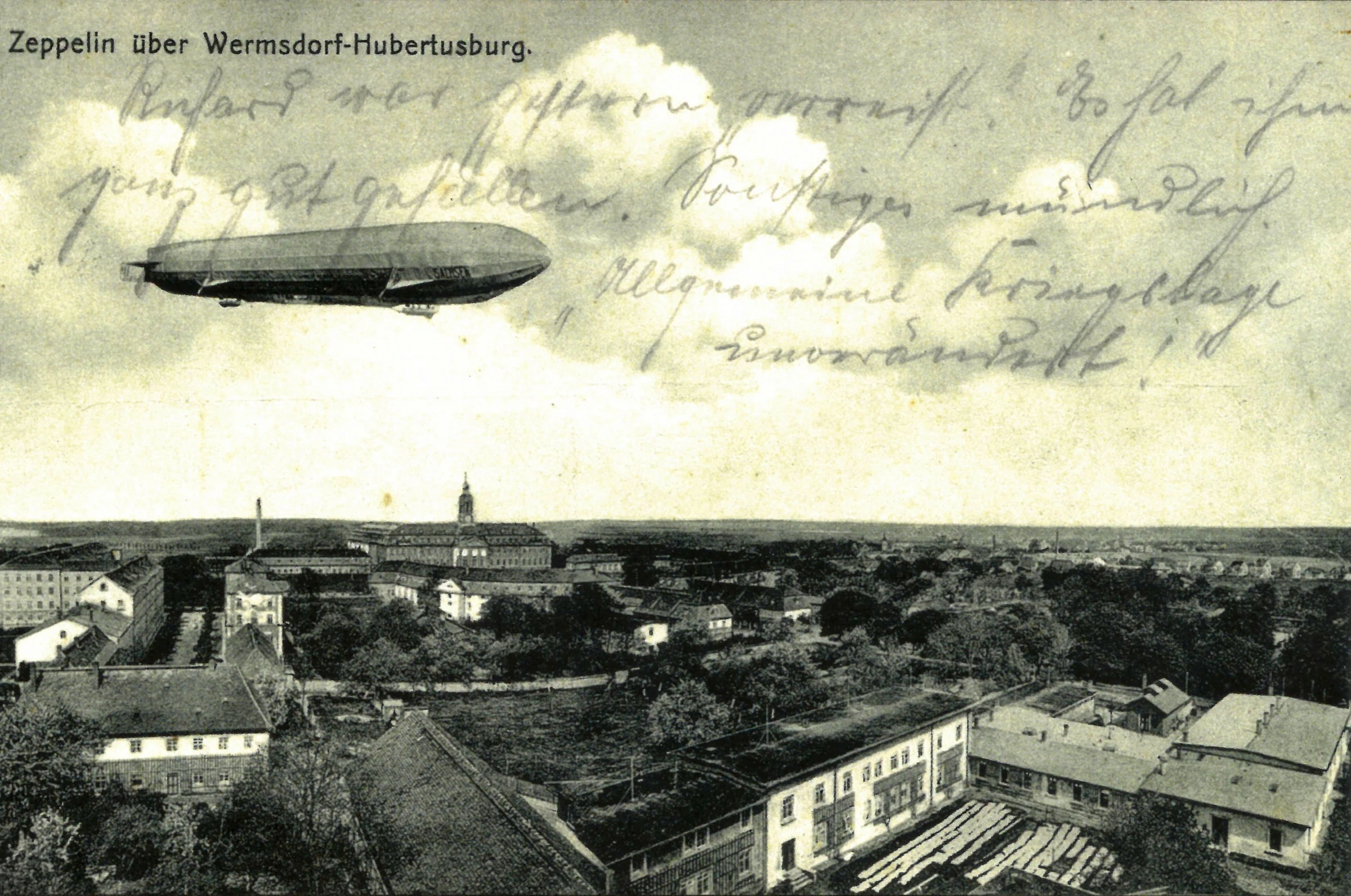
A German postcard of Wermsdorf, in Saxony, shows an airship as wide as the card itself, parked in a blank white sky above the roofs and the tower of Hubertusburg palace. Along its hull runs a lettered panel: Linie Friedrichshafen-Wermsdorf-Hubertusburg-Memel. A scheduled service, from the town that built Zeppelins to what was then the northernmost city in Germany, with a stop at a small Saxon town.
Two wicker baskets hang under it. II Klasse has its luggage slung beneath. IV Klasse is so crammed that a passenger has gone over the side and dangles below the basket. A man rides the hull with a telescope. A birdcage swings from one end.
It is a joke, and it hangs over a real place. Under the cartoon lies a photograph: slate roofs, one thin chimney, dark trees, the palace on its rise, a flat horizon going off into grey.
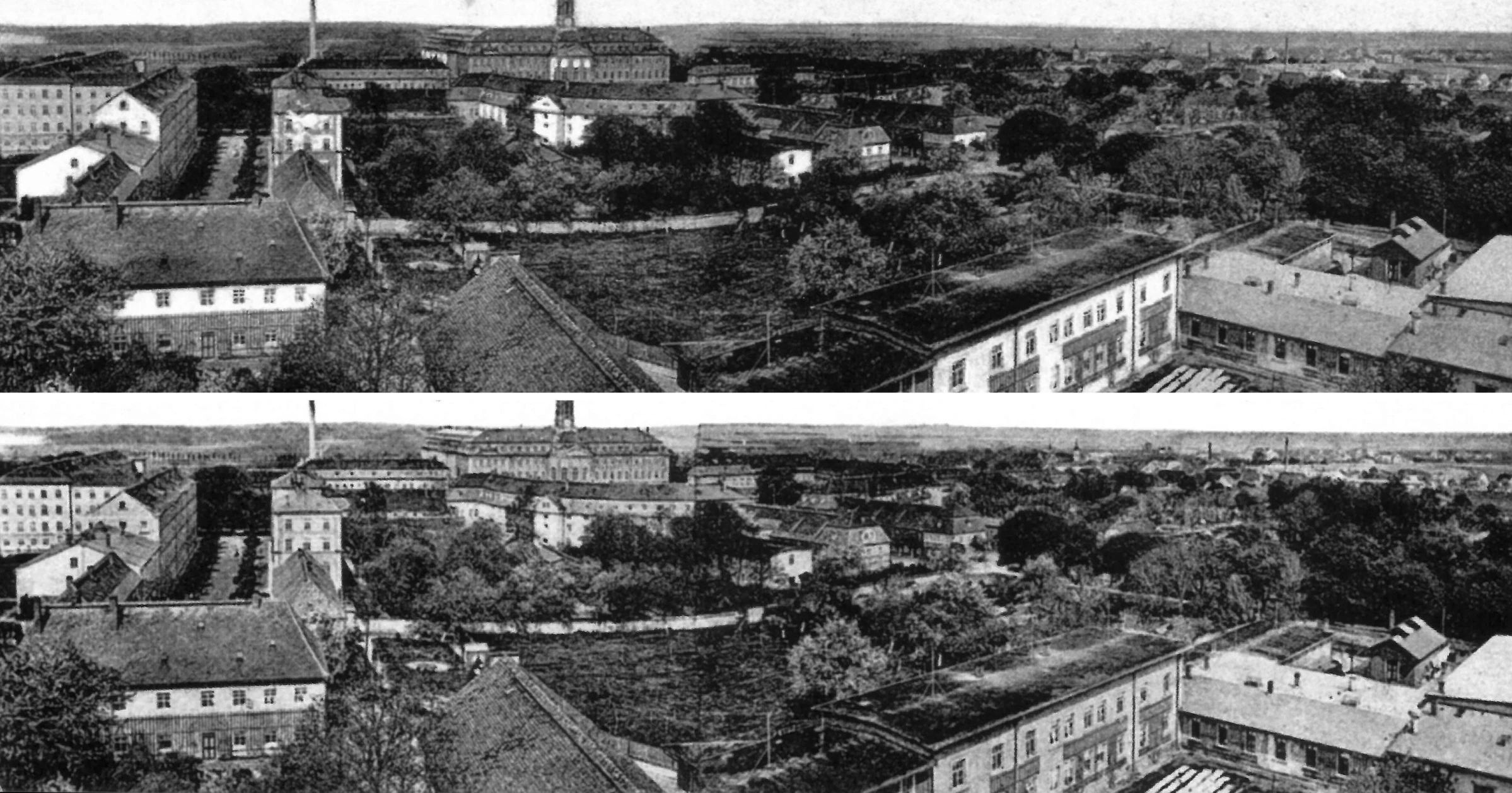
A second card of the same place has no joke in it. Heaped clouds, a plain Zeppelin, a line of somebody's handwriting running across the sky, and below them the roofs again.
Same chimney. Another sky.
A File of Plain Sentences
A search in English and German found no general study of airships added to old cards, as the article on the Leipzig card found before it. What it found is smaller: lines in catalogue records.
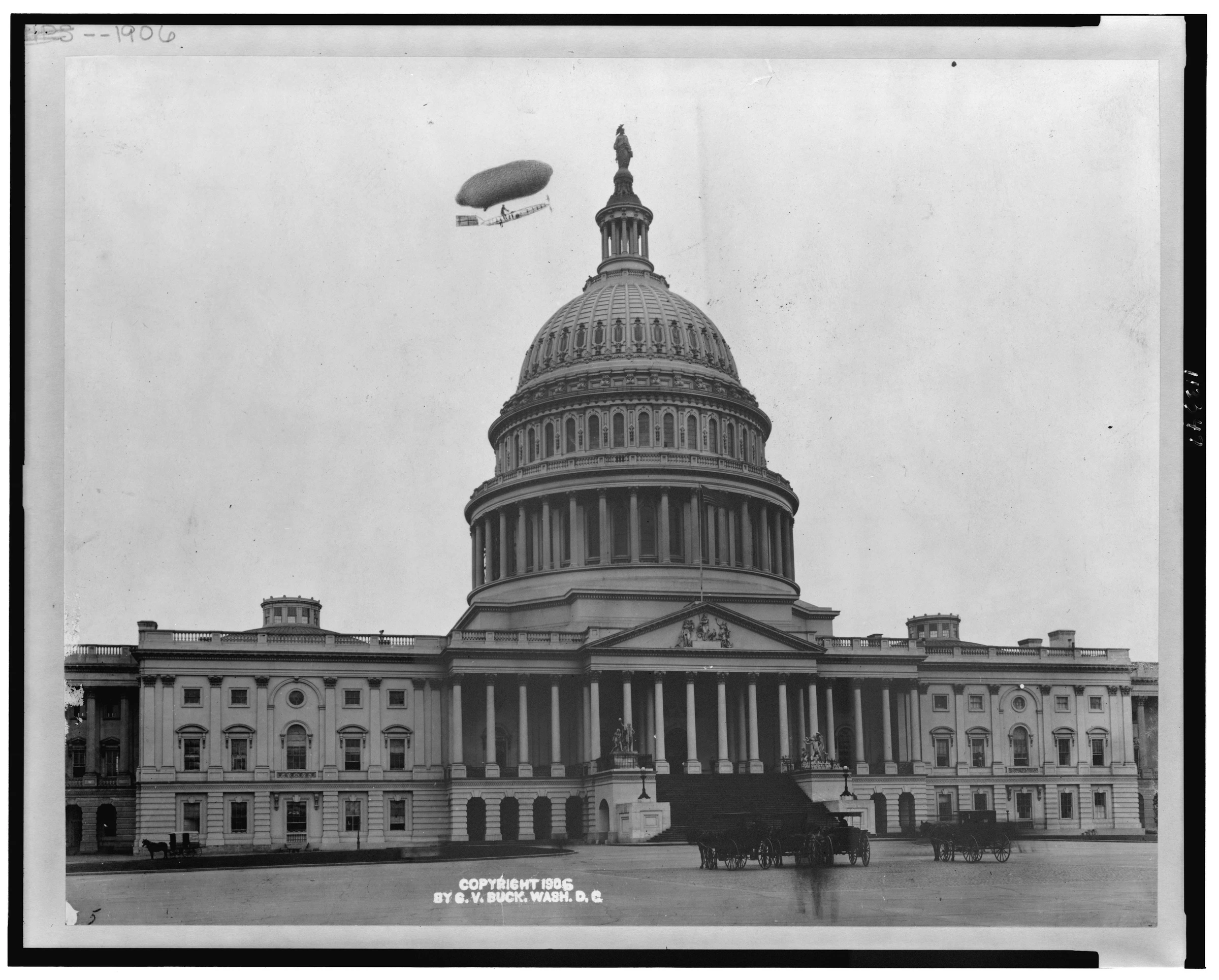
Six holders speak of an airship. The Detroit Historical Society holds Detroit The Airship City, a Pesha Photo card postmarked 26 July 1910, and records that a biplane and an airship are superimposed on the sky. Museum Schloss Neuenbuerg says the airship on a Gebrueder Metz card of about 1910 was probably put in afterwards; its technique field reads Fotomontage, with a question mark. The Karrasburg Museum in Coswig records a drawn Zeppelin, probably issued for a flight of 18 September 1912. The Library of Congress files G. V. Buck's Capitol of 1906 under a title that asks: airship (drawn?). Historic England says of R101 over St Paul's: "Probably a composite photo montage." And a City of Toronto Archives print of R100 of 1930 is titled a composite, as the title is carried on Wikimedia Commons.
Three of the six hedge. Beside them sit two other kinds of line. Barnet's archive titles a 1910 Hendon card a fake, but of an aeroplane: cameras were too slow, it says, so an enlarger put one in. The other is a forum post, below.
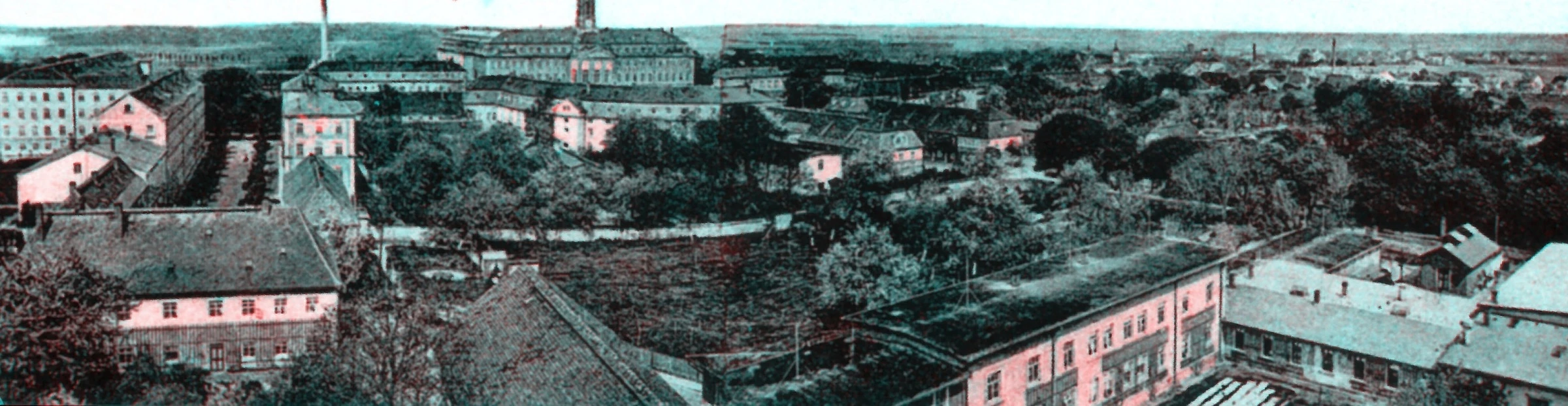
Neither Wermsdorf card is in the file: both are scans of exhibition reprints on Wikimedia Commons, and no holder of the originals is known. So Official X compared them with a feature-matching script, on the full files, 3,440 px wide. Some 2,269 matching points fit one geometry with a median miss of 1.3 px. Detail across 207 patches of roof and tree correlates at 0.71, near the 0.73 and 0.76 the same script gives on drawings visibly printed from one block; patches pushed 40 px out of line give 0.00, which rules out misalignment and nothing more. Read that way the town looks like one photograph under two skies, though reprints cannot exclude a second exposure from the same tower in the same light.
Brushed Skies
The Tartaria version of this story is about what lifted the buildings. Tartaria Vault's film of January 2026 says airships set them in place. It speaks of hundreds of pictures and of archive prints with their rigging scratched out, names no archive, and in its own footer calls the material imaginative speculation that should not be considered factual.
The question of the sky came up earlier, on the forum Stolen History, in March 2021. The poster KorbenDallas proposed that victory columns were mooring masts. The pictures include Graf Zeppelin at the Berlin column and the Los Angeles at the Capitol, named ships of the 1920s, which puts a flight in the frame and no mooring.
Then a member called Right Arm offered what he called just an observation: pictures with airships keep their skies, while "most historic pics without them have brushed skies." KorbenDallas answered: "those brushed skies could be hiding a lot of interesting things including airships." To illustrate the point Right Arm ran a paint-bucket tool over two skies, which shows that a sky is flat, not what it once held.
The thread stops at could be. This article takes the next step for the sake of the question: if a brush could hide a thing, a whole class of object could leave the record one print at a time, and no negative need burn.
In January 2024 a poster called Restitutor_Orbis_214 put 48 pictures on r/Tartaria in three parts, Airship Photos, without a word of text.
If the comparison holds, a Wermsdorf sky was changed on at least one card. It cannot say which card, or which way.
What a Rewritten Sky Would Mean
Set aside for a moment whether any sky was brushed to hide a craft. Ask the better question. What kind of past are we looking at if one was?
It would mean, first, that the sky is the least trustworthy part of every old view of every town. Not the street, with its trams and its shopfronts, which we check. The part above it, which we never look at. Every card sold before 1914 would be a page edited in the one place nobody reads.
It would mean that the history of flight has been written from a sorted pile. On that reading what was in the air between the 1880s and 1914 would be what a print shop chose to leave in, and the museum gondolas and the dated flights would be the part that was allowed to stay.
It would mean that we do not hold our great-grandparents' world. We hold a product. A town's picture of the greatest day it ever had would be the work of somebody at a bench, far away, who may never have looked up. Our family albums, our local histories and the framed view in the town hall would all descend from that bench. The memory would feel like ours, and it would be theirs.
And it would leave one question in front of us, the one that matters most. Ours is the first age in which anybody can put anything into any sky, or take it out, in seconds and for nothing. If a brush and an enlarger could rearrange the heavens without one person writing it down, what will anyone be able to say, a hundred years from now, about the sky over us?
Ready-Made Ships
The standard account holds that the ship went in, not out, and that the reasons were commercial. Barnet's caption gives one: the cameras of 1910 could not hold a fast machine. John Higgs, in a 2013 talk to a Fairford history society, described makers keeping a supply of clouds to drop into plain skies. The Panecki postcard collection's history says retouchers filled blank skies and that "even zeppelins" came as ready-made decals, though its dated example is a card of the late 1940s.
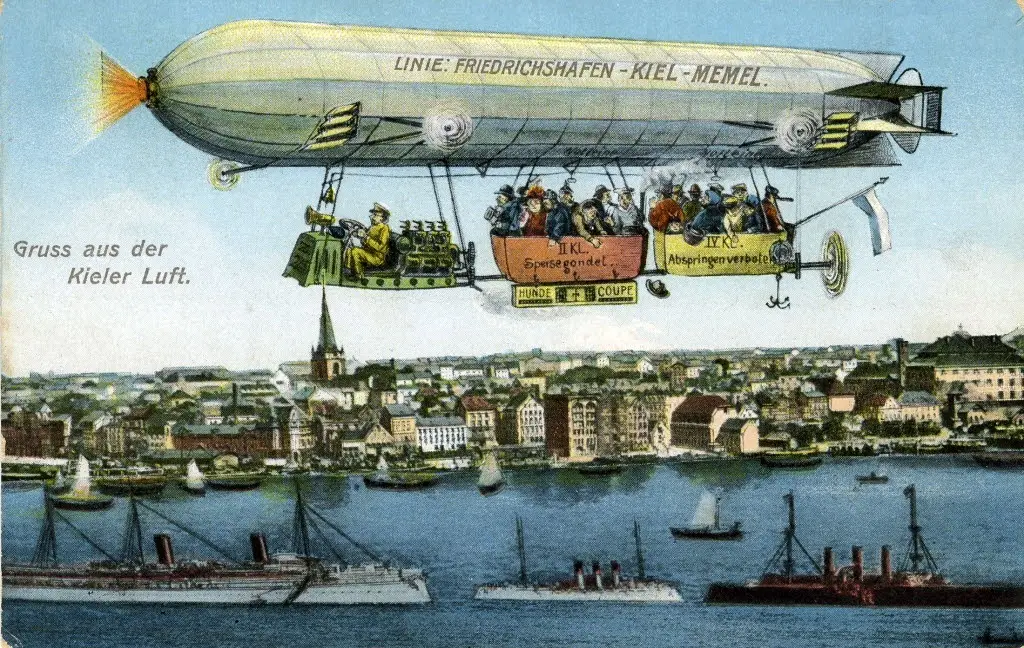
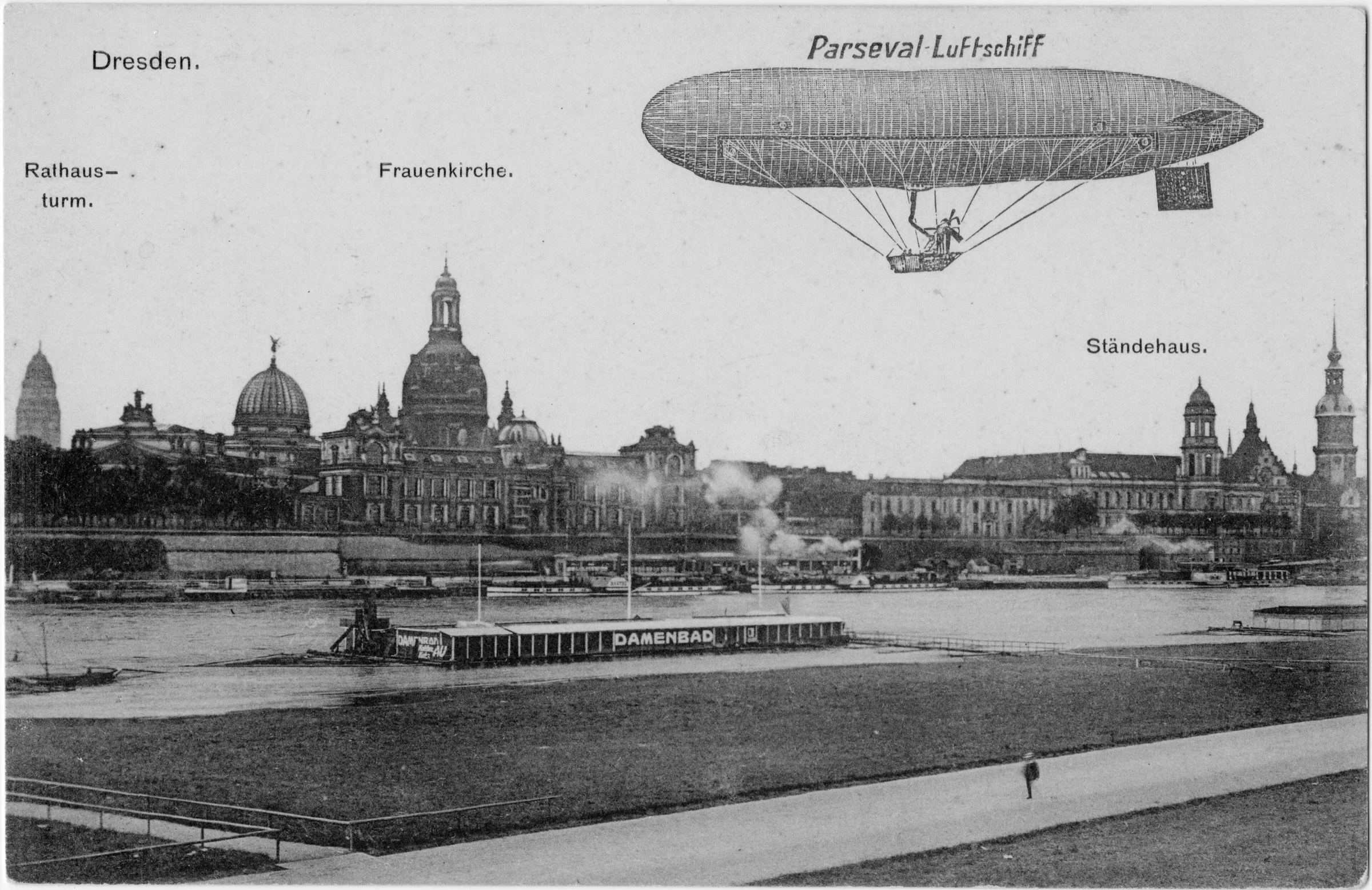
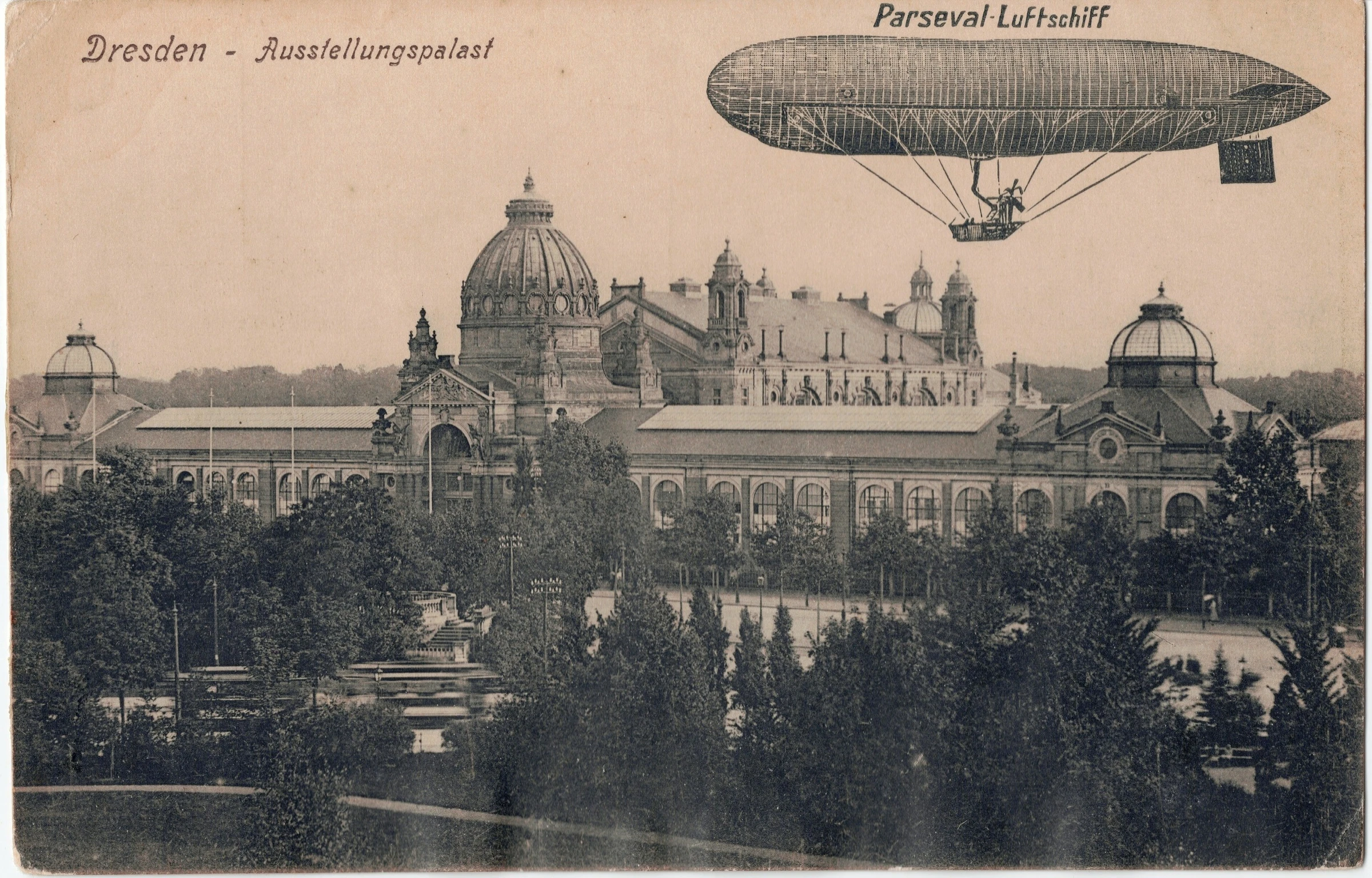
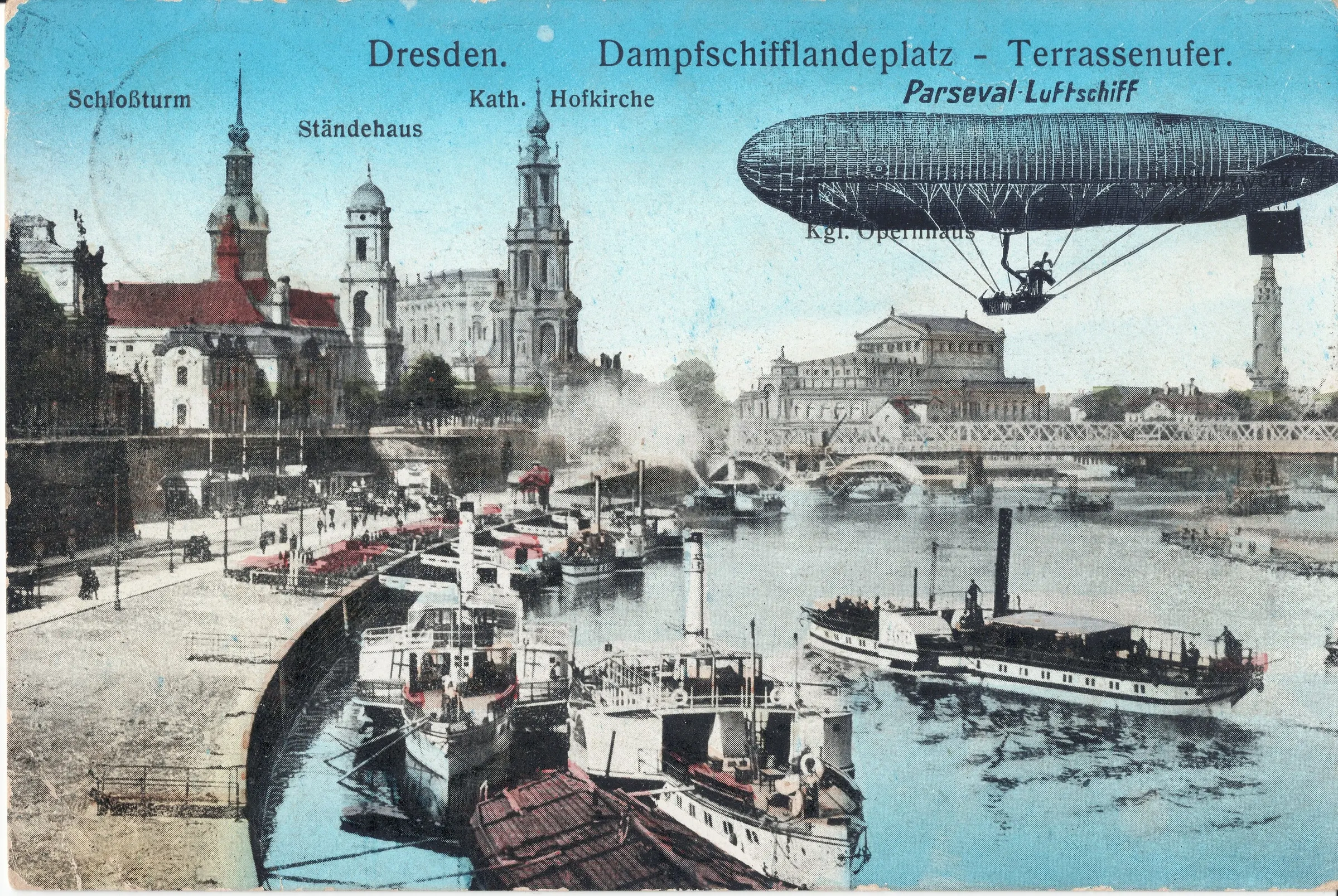
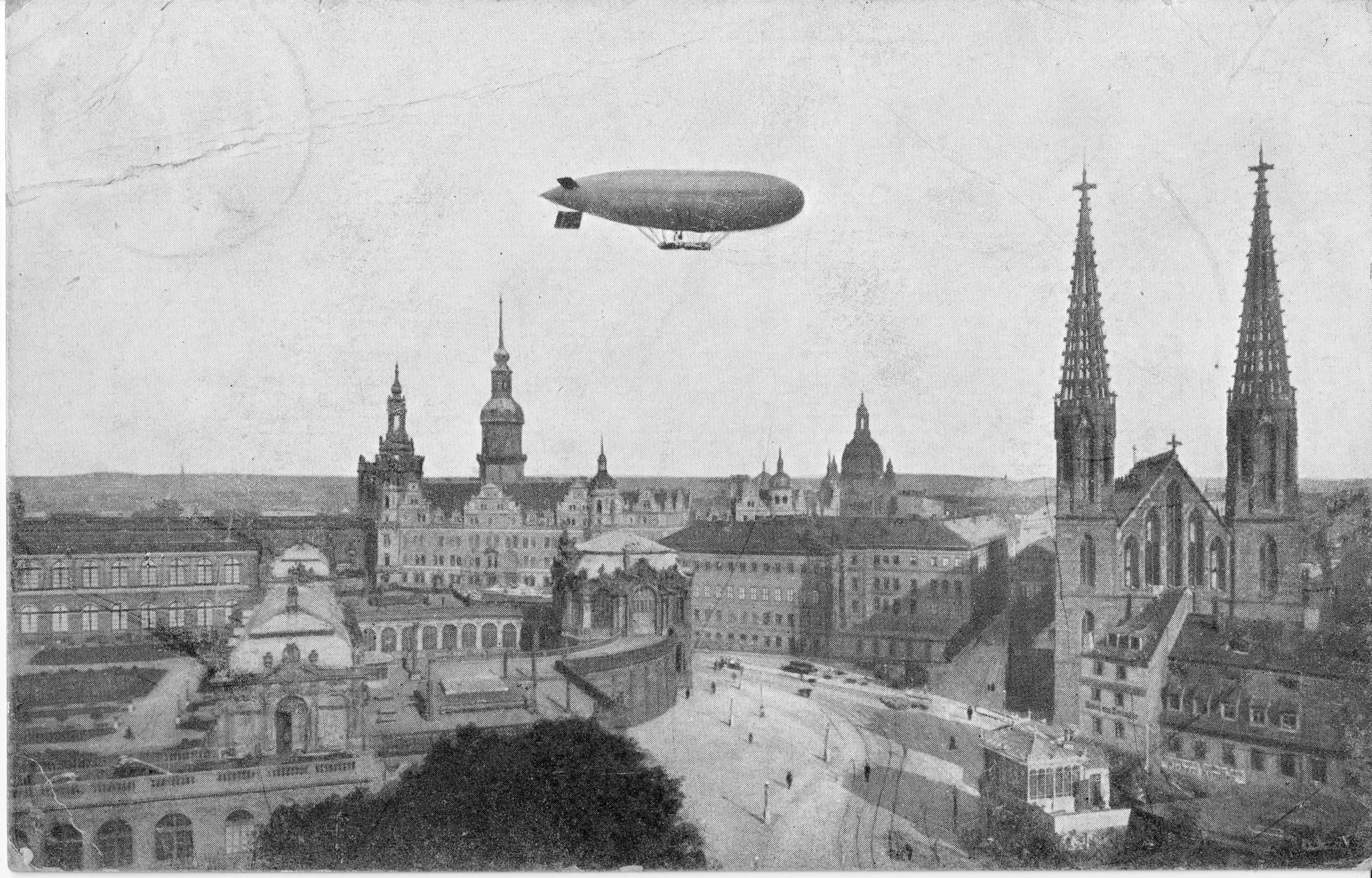
The same script points that way. Set against the Coswig card at 1,400 px wide, the Wermsdorf cartoon gives 882 points and a median miss of 0.6 px, down to the falling passenger and the birdcage, which reads as one drawing with the town's name changed on the hull. A Kiel card from Ottmar Zieher of Munich runs the same joke line with another drawing. Three Dresden cards carry what looks like one line-drawn Parseval, at 320, 160 and 94 points, where other pairs among six Dresden cards share 17 at most.
Buck's Capitol, on the Library's 4,096 px master, shows a craft hatched in strokes, with no rigging from the envelope to the frame below. His White House, the next copyright number, shows a speck.
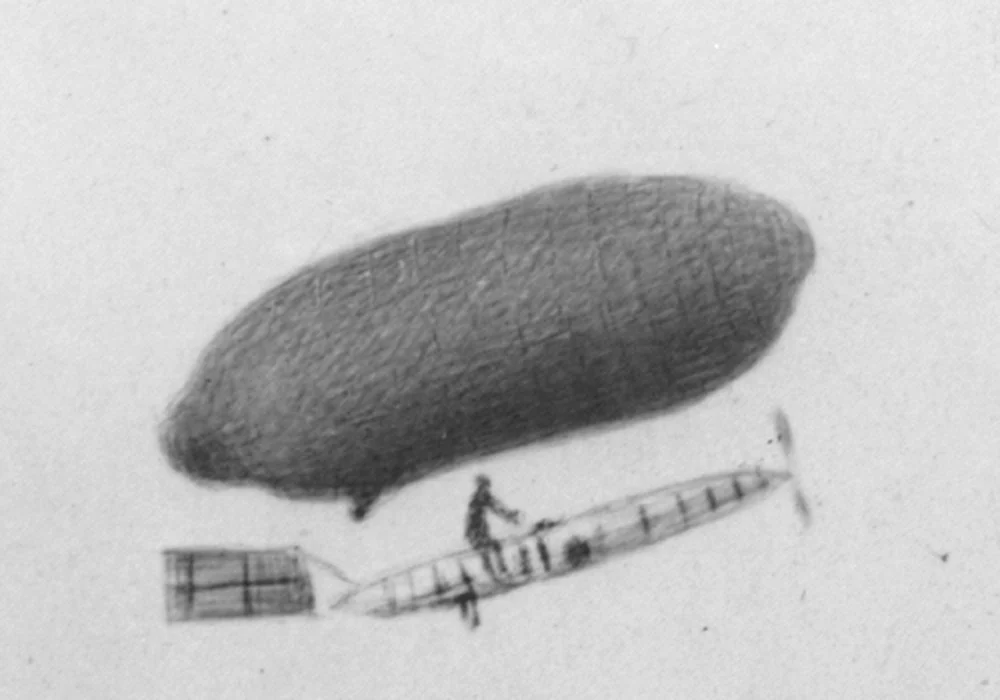
As for the album, 15 of the 48 pictures could be tied to a printed caption or to a holder's record, matched by script and checked by eye. The dated airships among them run from 1905 to 1933. Read at contact-sheet size, none of the 48 shows a stone, a beam or a cargo on a line, which is what the film's claim would want. The nearest thing is a small aeroplane on an airship's hook.
What the Paste Does Not Reach
Those lines say how a ship got onto a card. They do not say the ship was never there.
The hull on the plain Wermsdorf card seems to read Sachsen, at the limit of the scan. A ship of that name first flew on 3 May 1913, which leaves the upload's date of about 1911 in trouble, and German Wikipedia records a stone at Wermsdorf for its landing there on 12 July 1914. Coswig's museum ties its cartoon to a flight. R100 crossed Toronto on 11 August 1930. Which means a ship added to a card can still be a picture of something that happened.
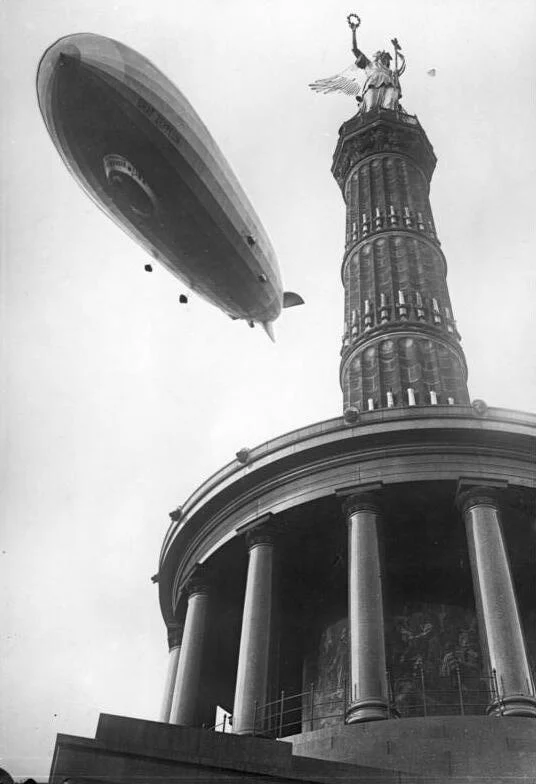
Berlin is harder. The Bundesarchiv holds Graf Zeppelin over the Brandenburg Gate and over the Reichstag, Bild 102-06616 and 102-06617, in the Pahl agency series, dated October 1928, captioned as flights. The Badischer Beobachter of 4 October has the ship over Berlin at 9.02 the morning before, in clear weather. Getty lists another view of the Gate, credited to Alfred Gross in Zeitbilder 41/1928: a street-level crowd and a far smaller craft. It is a different picture.
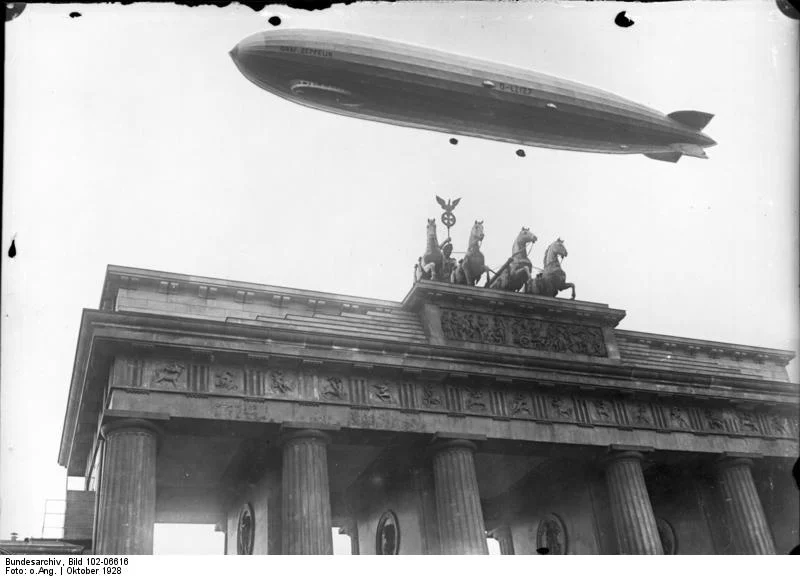
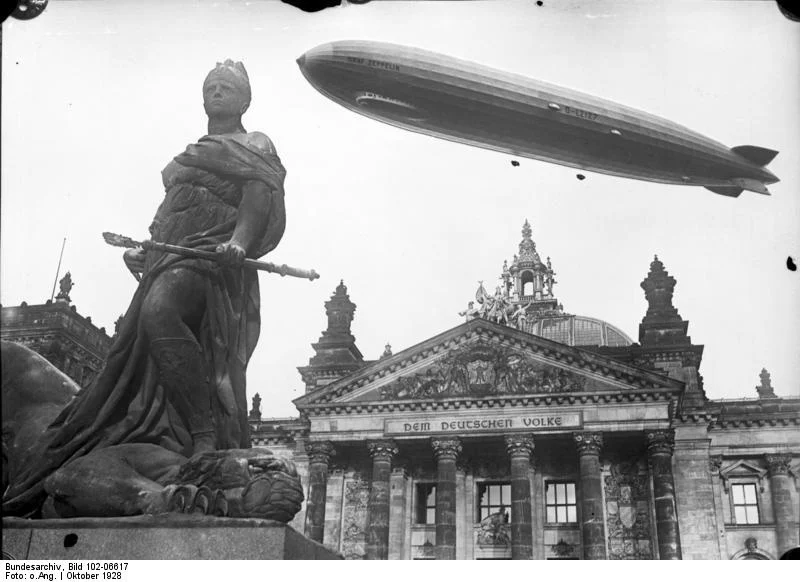
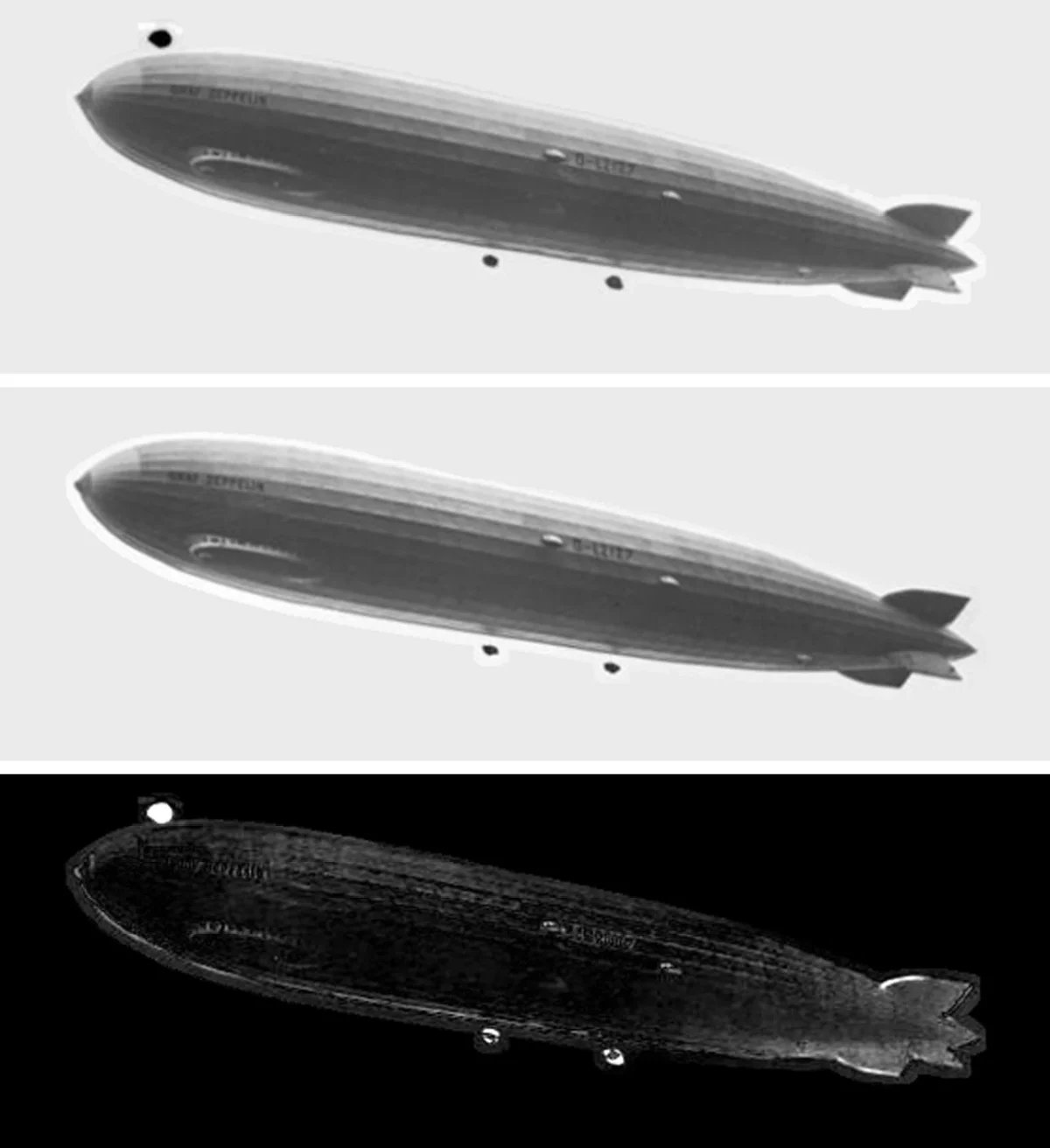
Official X ran the same kind of comparison here, on the 800 px files, the largest copies found. On that comparison the two hulls resemble each other closely. Lines and lettering correlate at 0.83, and 12 of 15 pod-sized patches with clear detail land on themselves. A clean copy of one picture scores 0.99 and lands them all, but copies softened by 1 px of blur score 0.77 to 0.90 and land only 9 to 12, so the hull figures alone cannot separate the cases. The two engine pods, which hang clear of the hull and are best placed to show a change of viewpoint, do not land. They sit 1.2 and 2.0 px off, and stand 18 and 28 percent shorter in the Reichstag picture. In 68 test copies of one image, blurred, sharpened, toned, resampled or compressed, the worst case was 0.9 px and 17 percent, at 1.8 px of blur, about four times the blur that separates the two files' sharpness.

That reading counts against one image reused unchanged. It does not prove two exposures: the pods are about 8 px wide, and a retoucher could have touched them. Two exposures from one angle are untested, because no picture of the ship at that angle was found. On this measurement Berlin is a resemblance, unresolved.
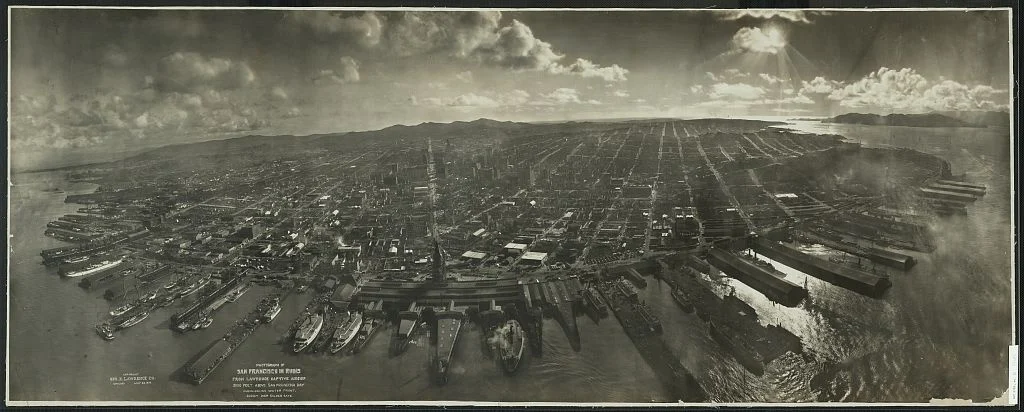
The forum's own check is the cleanest in the file. In June 2021 KorbenDallas set an online San Francisco of 1906, airship included, beside the Library of Congress scans and wrote "there is no airship on these." The title there says Captive Airship, which was a camera on kites. Many took that picture for a composite in its day. Who added the ship is unknown.
One more search was made: for a print with an airship painted out, the Wermsdorf pair run backwards. It covered what is online in English and German.
It did not find one.
Two Pictures at 800 Pixels
The Rijksmuseum's show FAKE!, curated by Hans Rooseboom and closed in May 2026, set more than 50 images from 1860 to 1940 in its Photo Gallery, though its press text names no airship. The file here is still small and much of it says probably. In The Airship Record, most old postcards are marked Not stated, because they carry no word on how the airship got there. The Wermsdorf originals, if they survive, could settle the town.
It narrows to two pictures, seen here at 800 px and at no other size. Most of the Bundesarchiv's picture collections are at Koblenz, though its page does not place Bild 102, and whether it holds negatives or prints for these two was not established. That matters, because a paste-up could show its edges on a print and lose them on a negative made from it. Full-size scans could help in three ways. A shared speck or scratch on the plate or print, inside the hull, would point to one source for the ship. Pods that keep their difference on a sharp scan would make one reused image hard to hold. Pods that lose it would bring that reading back. Different grain would not settle it, because two paste-ups from one print, each photographed again, would differ too, and neither answer would say who made either picture or how.
None of it would reach the 1880s. A shared source in 1928 would show a press agency at work, and nothing about what lifted a building.
Two captions say the ship flies over. What the measurement can add, so far, is a hull that mostly lines up and two small pods that do not.
Questions This Leaves You With
Is there anything a person actually does with this?
Nothing in your own life follows from it, and anyone selling you a date or a secret is selling something. But there is one small habit you could keep. When an old picture of a craft reaches you, look for the holder before the caption, and look at the sky's edge where it meets the roofs. The larger question belongs to everyone: what a culture should keep alongside a picture so that the people after it can tell what was done to it.
Does this sit against a religious account of the world?
Hardly at all, and it cuts both ways. Some readers will hear an old warning here, that people see what they are shown and call it the heavens. Others will hear something close to the reverse, that a thing can be true and witnessed even when its only surviving picture was made by a stranger who was not there. Plenty of faiths have thought hard about testimony at second hand. This site will not tell you which way this one falls for you.
Does this change what a human life is?
Think of someone on a Berlin roof that October morning, looking up at the largest thing they had ever seen move. Their picture of it might be a shop's paste-up. If so, a life can look smaller, its best day handed down in another person's version. Or look at it the other way: the day itself needed no picture, and what they saw was theirs whatever the card did afterwards. You may already know which of those you felt first.
What would change your mind, in either direction?
Name it now, before you are committed. Towards a painted-out airship: one print and its negative where a craft on the plate is missing from the print, or a retoucher's job book that records removing one. Against it: a large run of old view cards scanned from their negatives, with the skies compared, and every change found to be an addition or a cloud. For Berlin: the two pictures at full size, whichever way the pods fall. Each of these can be looked for. Which would you accept?
Who drew the line from Friedrichshafen to Memel?
Somebody did. A hand drew a crammed basket, a falling passenger and a birdcage, and left a panel on the hull for a town's name, or changed it for each order. Neither the Wermsdorf card nor the Coswig record names a maker, and nobody has counted how many towns bought that ship. A card with a printer's mark, or a publisher's sample book, would give the drawing an author. The hull has a blank where the name goes. So, for now, does the record.
More photographs
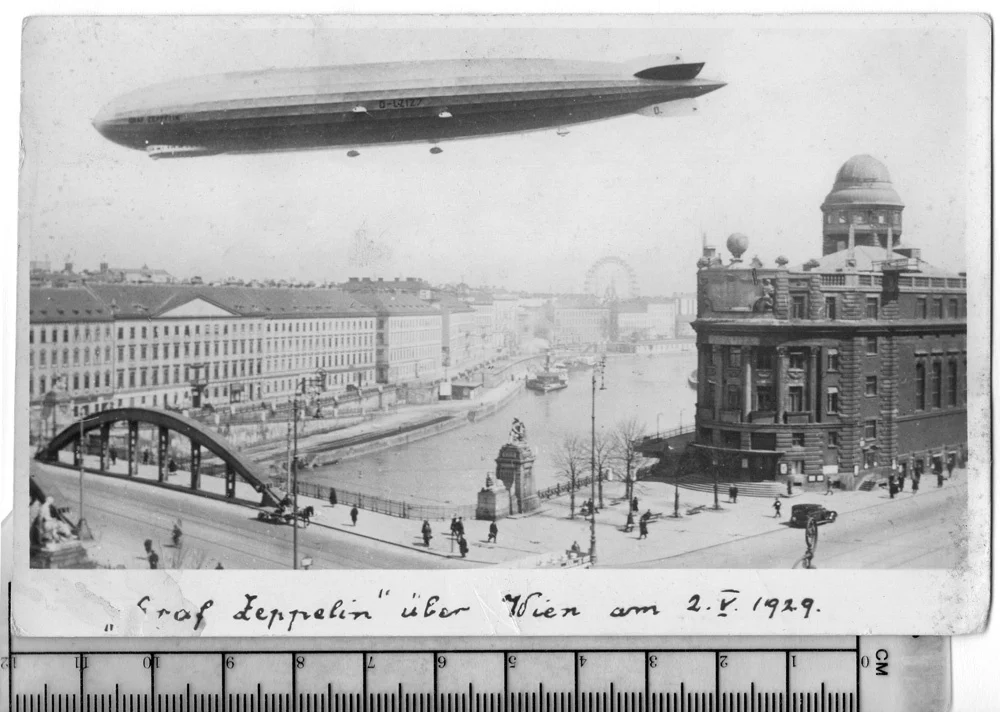
Graf Zeppelin over the Vienna Urania, 2 May 1929. The Commons contributor thinks it a montage, citing newspaper reports of cloud and rain that day. Unknown maker, 1929, card from Antiquariat Klabund, Vienna, scan WWWeb.pix, CC BY-SA 4.0, via Wikimedia Commons. 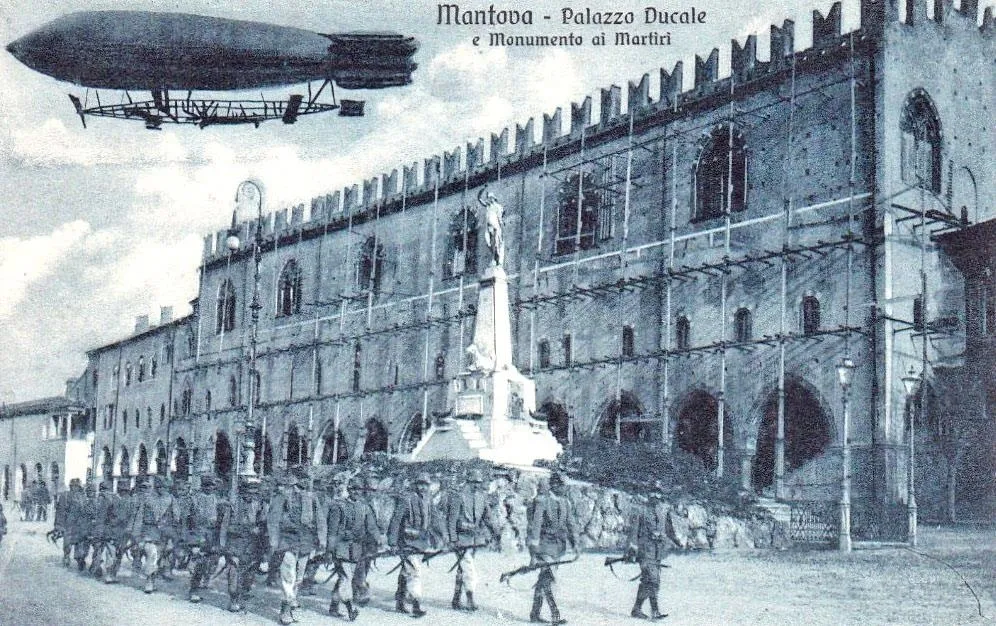
Mantua, 1913: an airship and marching soldiers before the Palazzo Ducale. The word fotomontaggio is the uploader's. Unknown maker, 1913, Mantova Vecchiotta, public domain as tagged, via Wikimedia Commons. 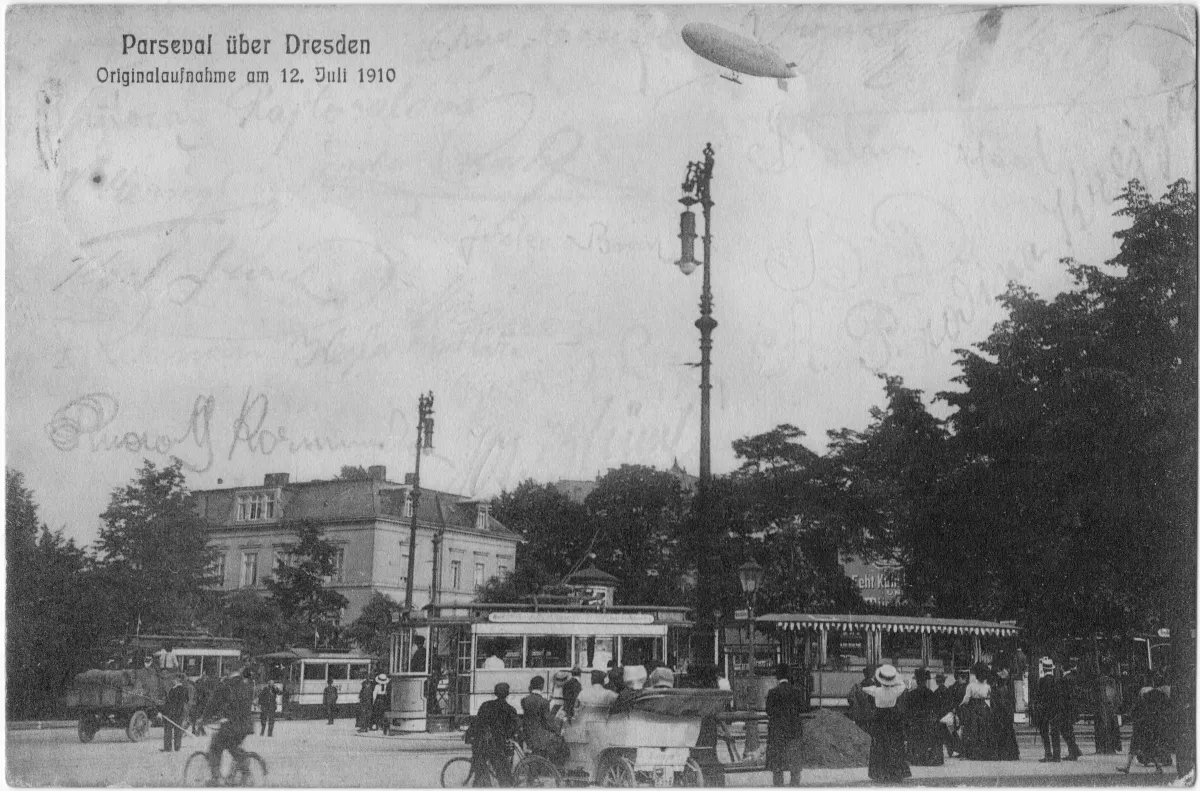
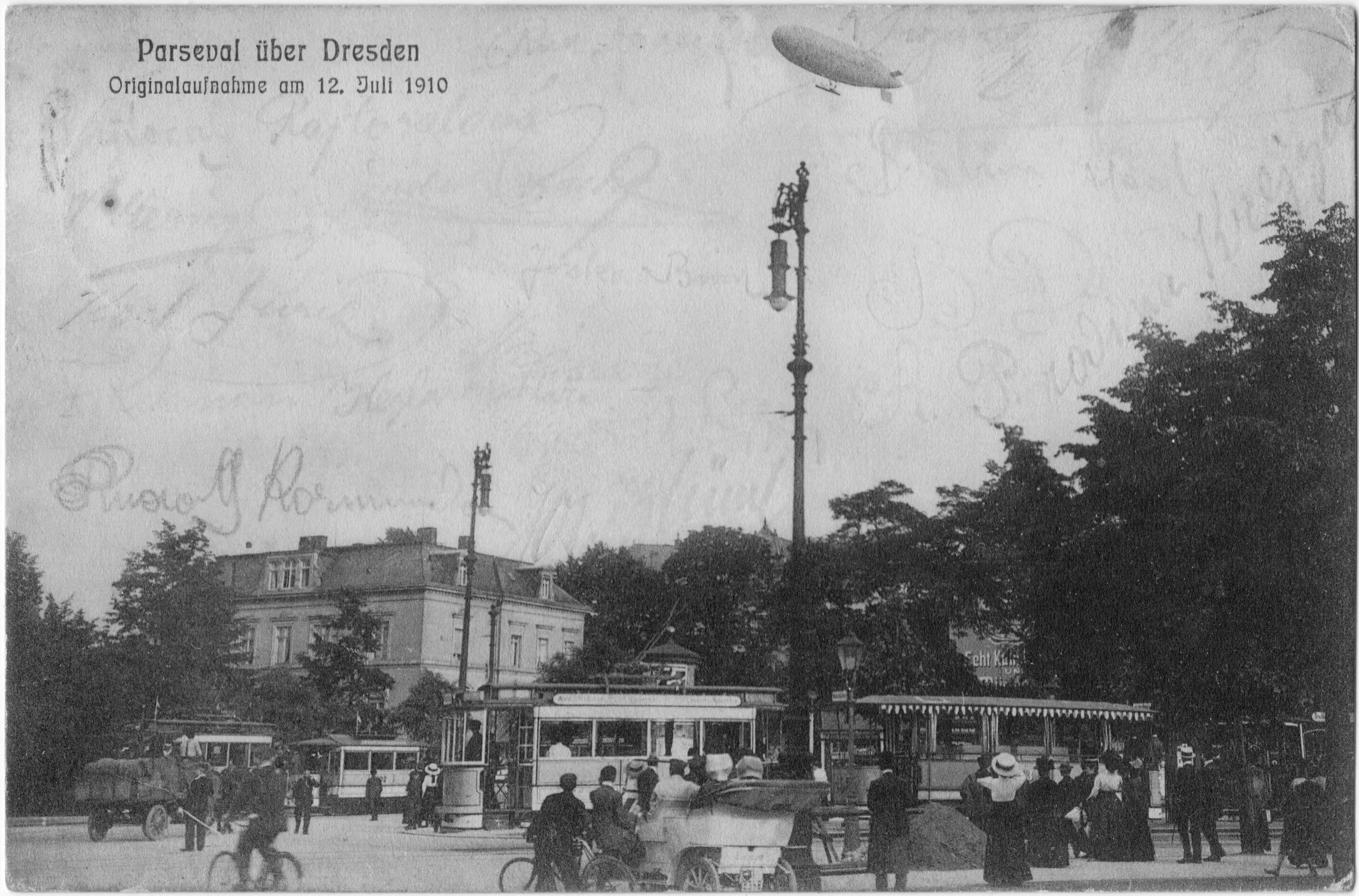
Dresden, a Max Koehler card captioned an original exposure of 12 July 1910: a street with trams and a very small airship. A caption is not a statement of how a picture was made. Kunstverlag Max Koehler, 1910, postcard collection of Holger Naumann, Dresden, Public Domain Mark, via Wikimedia Commons. 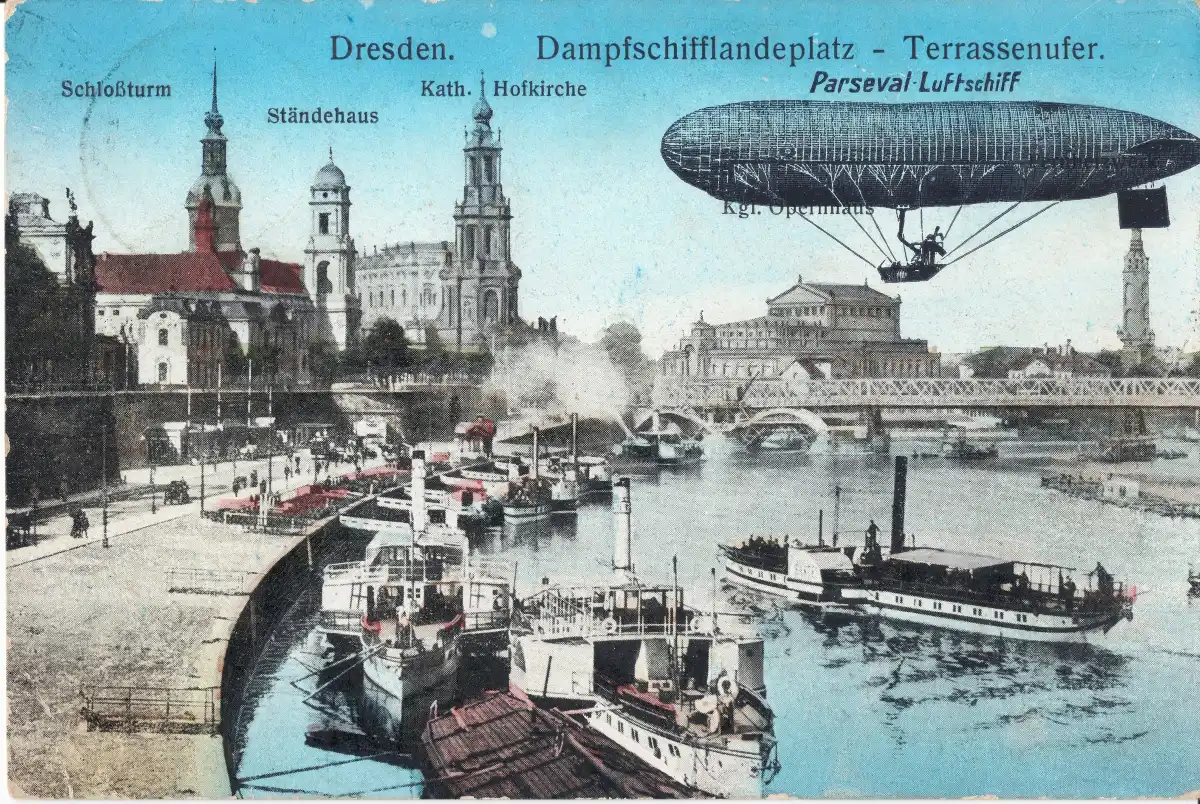
The steamer landing at Dresden, posted by 23 July 1910, with what looks like the same drawn craft, recoloured. Carl Doege (Commons category), by 23 July 1910, postcard collection of Holger Naumann, Dresden, Public Domain Mark, via Wikimedia Commons. 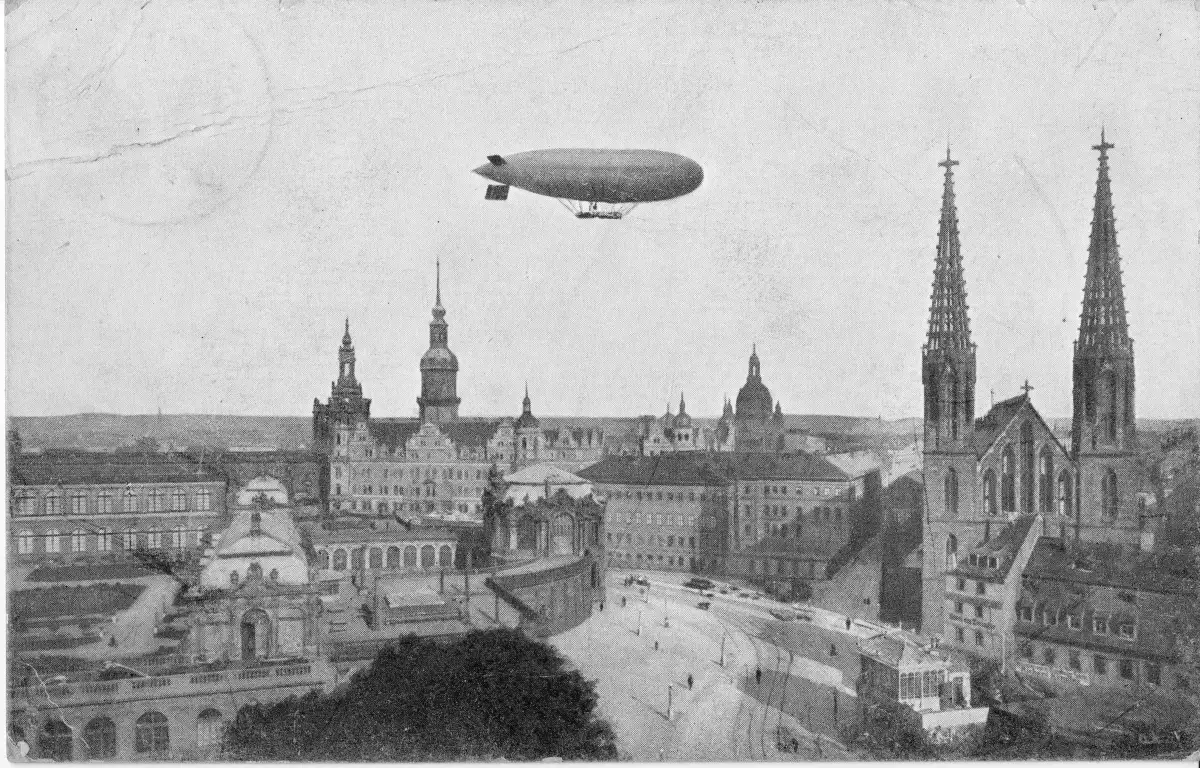
Parseval in Dresden, 12 July 1910, manoeuvring over the city: a small soft ship above the spires, posted the next day. Stengel & Co. (Commons category), 1910, postcard collection of Holger Naumann, Dresden, Public Domain Mark, via Wikimedia Commons. 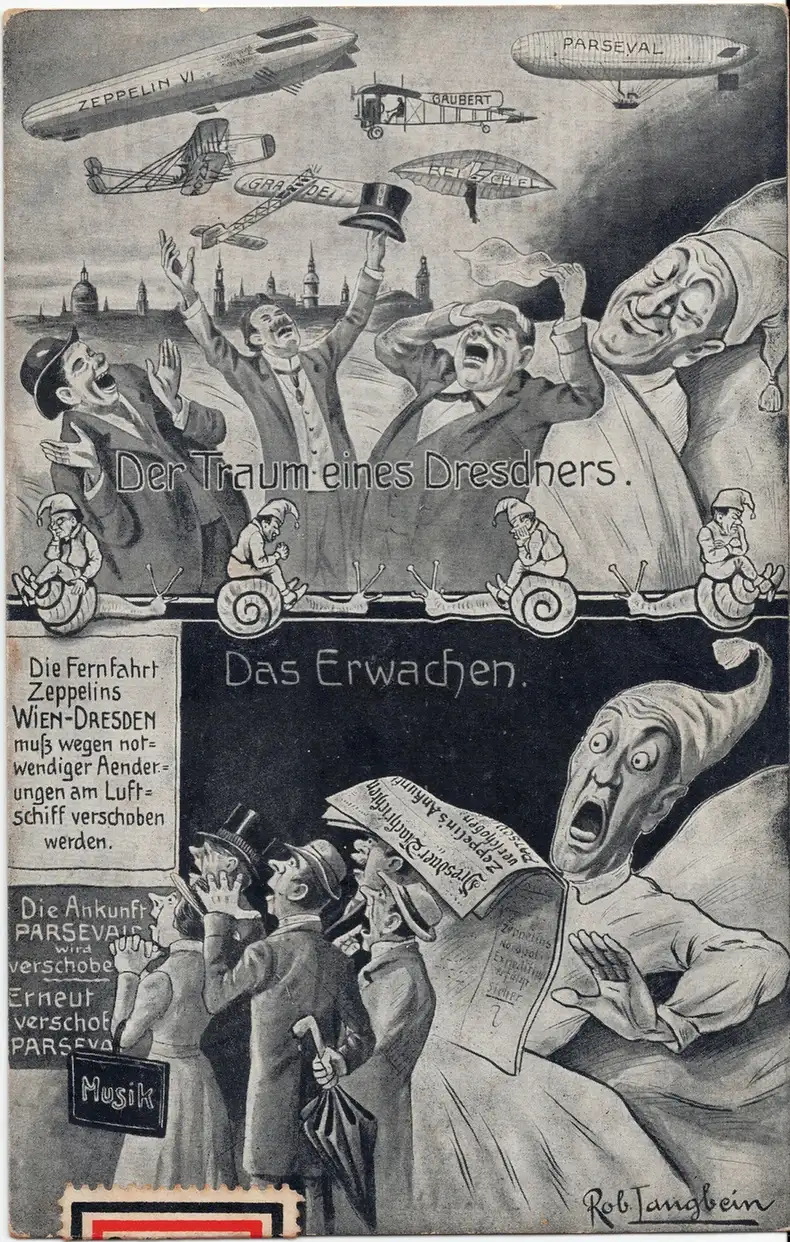
Robert Langbein's The Dream of a Dresdener, by 1912: crowds dream of airships and wake to news that the visit is off. Robert Langbein, postcard collection of Holger Naumann, Dresden, public domain, via Wikimedia Commons. 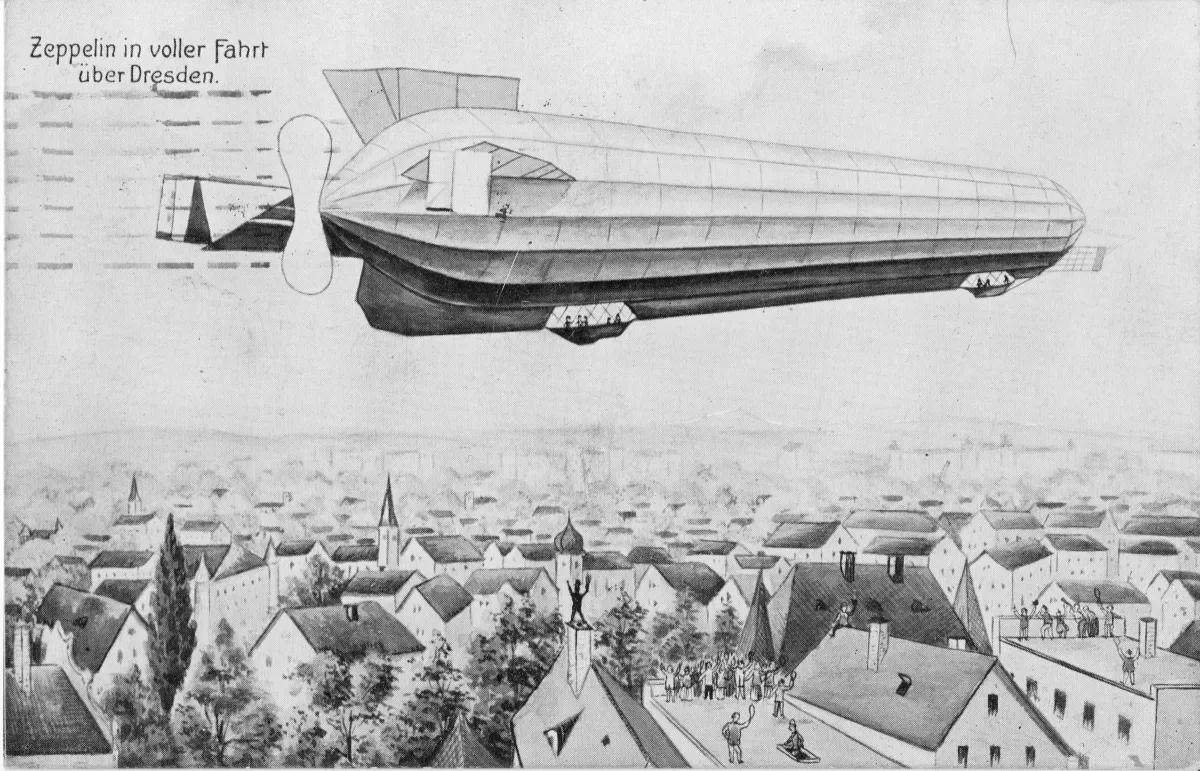
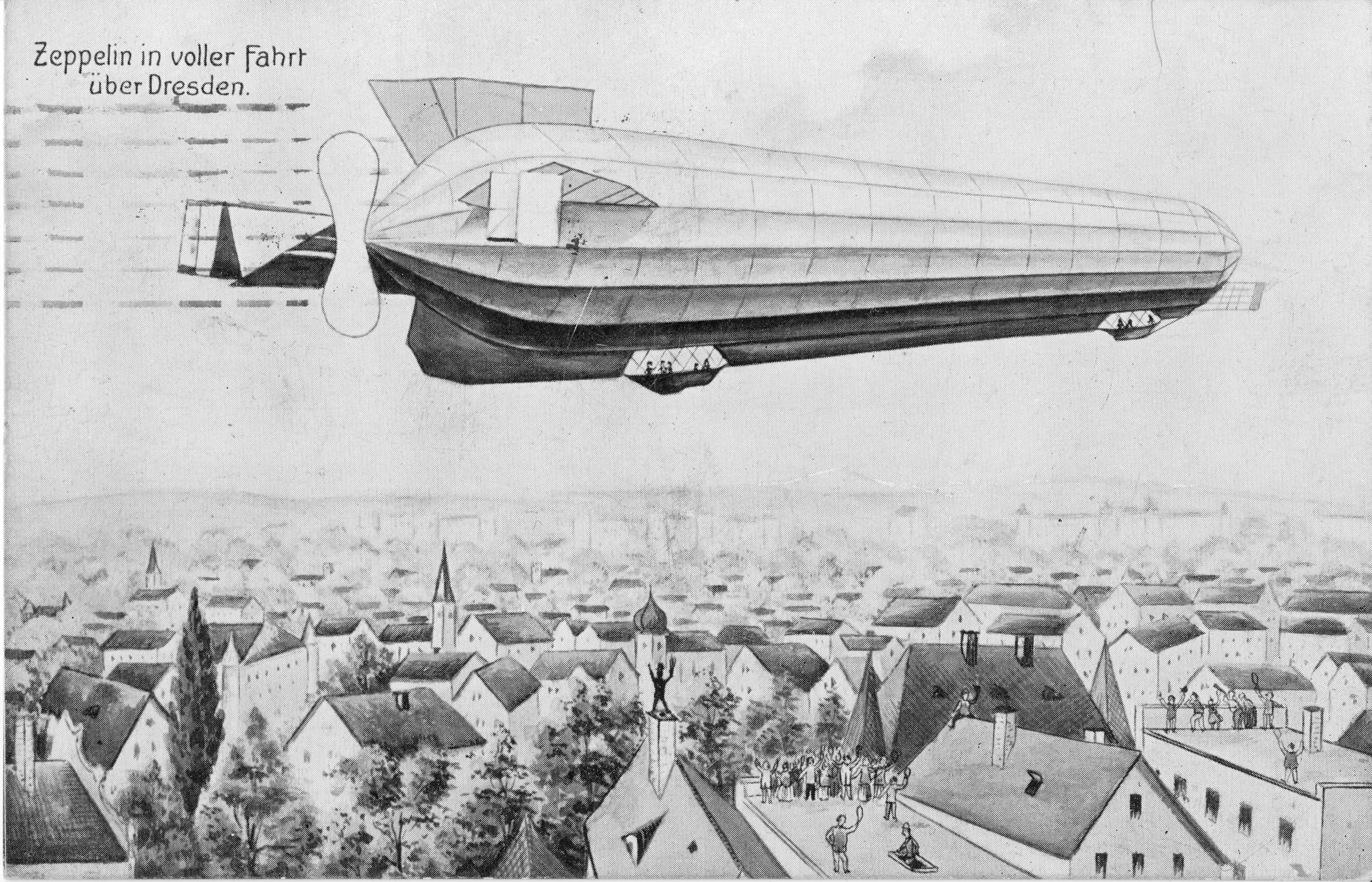
Zeppelin at full speed over Dresden, a Friedrich Knauthe card posted by 5 April 1914: a huge drawn-looking ship over faint roofs. Verlag Friedrich Knauthe, postcard collection of Holger Naumann, Dresden, public domain, via Wikimedia Commons. 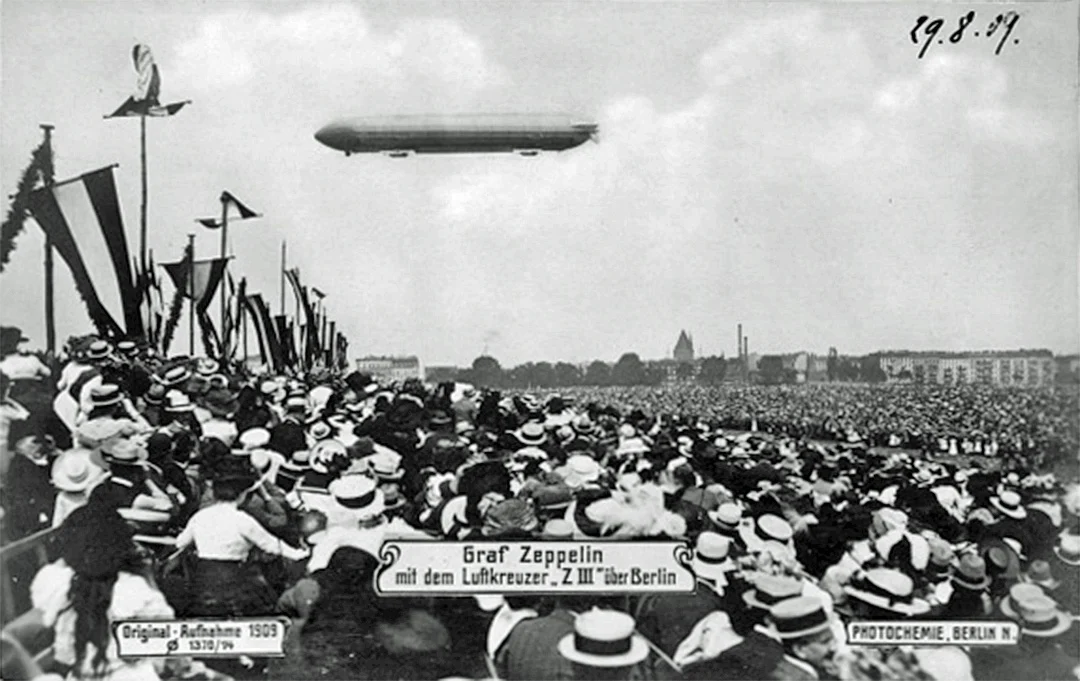
Z III over a packed Berlin crowd, 29 August 1909, a card marked as an original exposure. It was not tested for this article. Photochemie Berlin, 1909, public domain as tagged, via Wikimedia Commons. 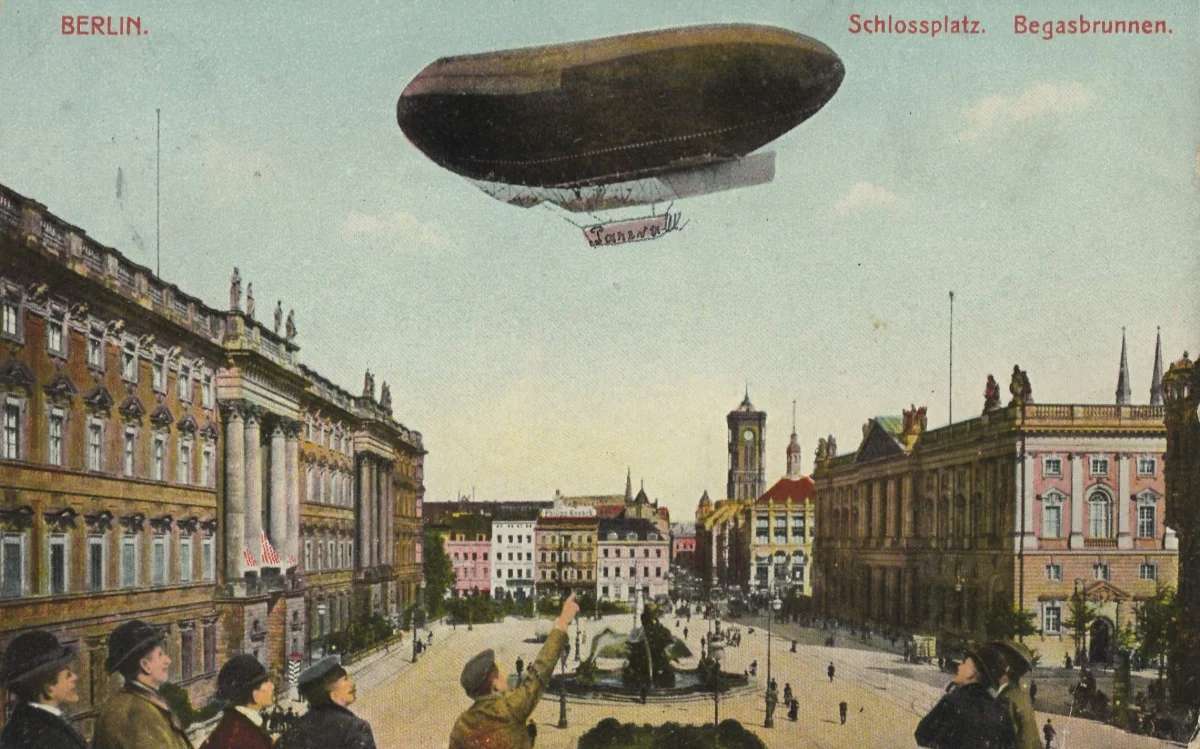
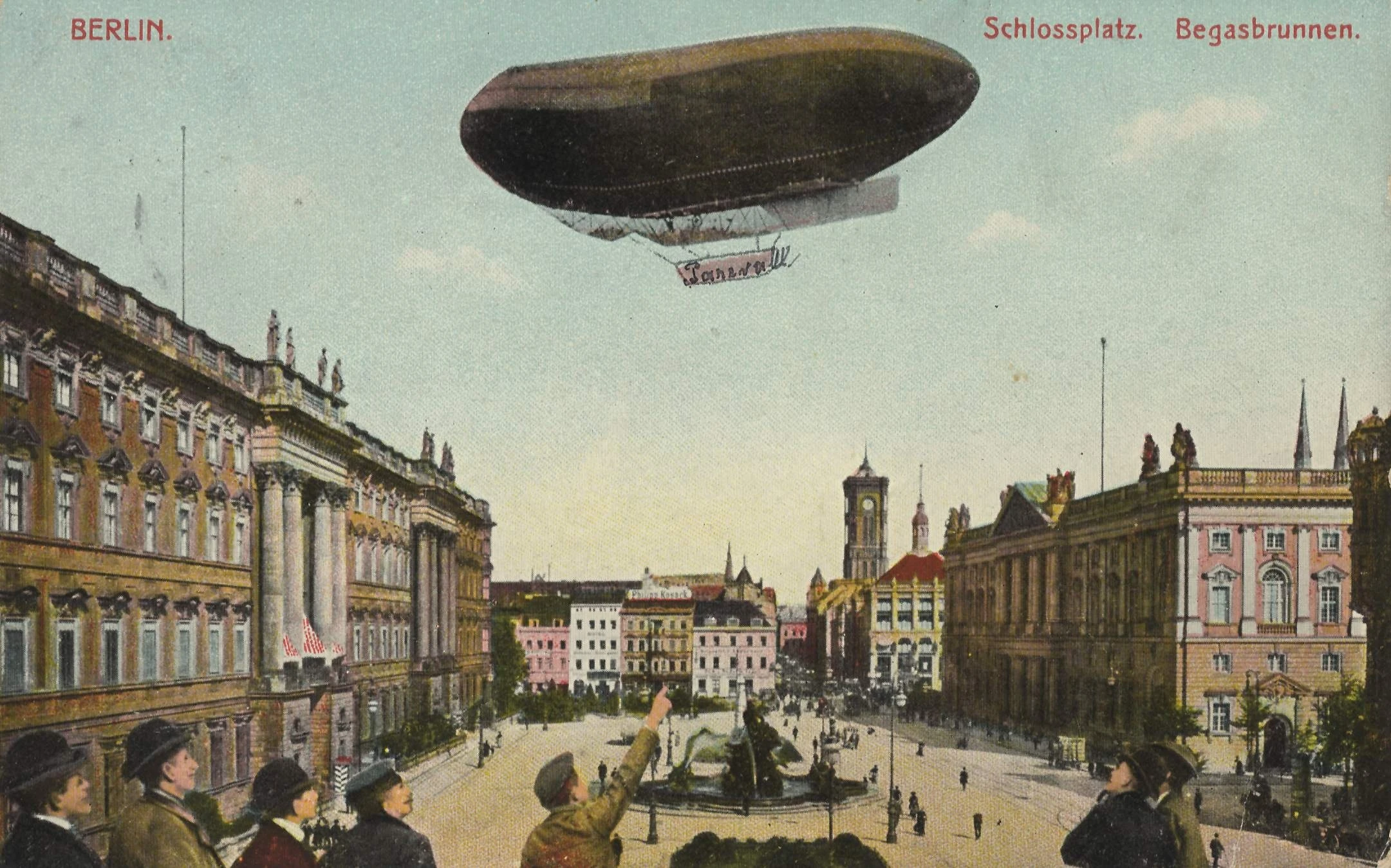
The Berlin Schlossplatz on a coloured card with a large dark airship over the square. The file page says 1909. Not tested for this article. Maker unknown, about 1909, public domain, Zeno.org Ansichtskarten via Wikimedia Commons. 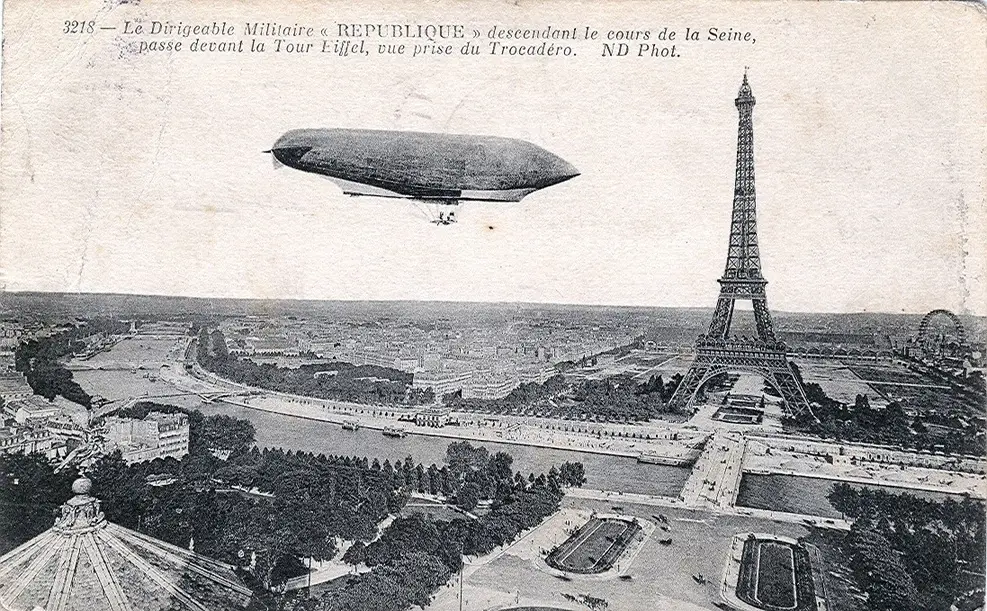
The military dirigible Republique passing the Eiffel Tower, an ND Phot. card posted in 1913. A close relation of a picture in the album. Neurdein (ND Phot.), public domain as tagged, via Wikimedia Commons. 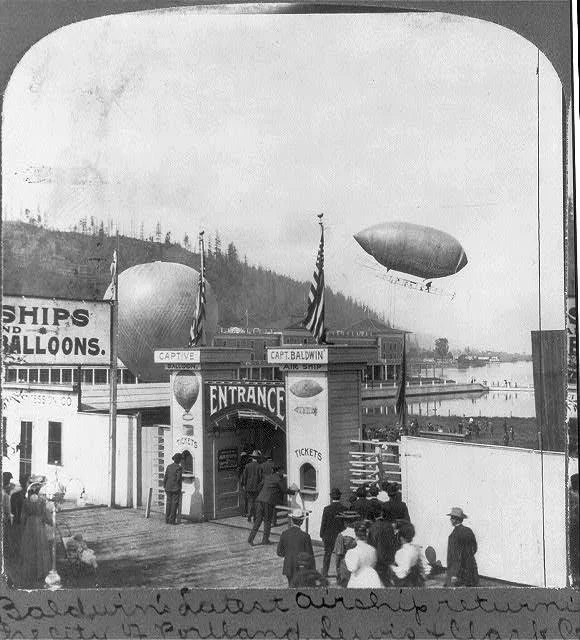
Traced from the album: Baldwin's airship over the entrance of his concession at the Lewis and Clark Exposition, Portland, 1905. Library of Congress, Prints and Photographs Division, 2002722167. No known restrictions on publication. 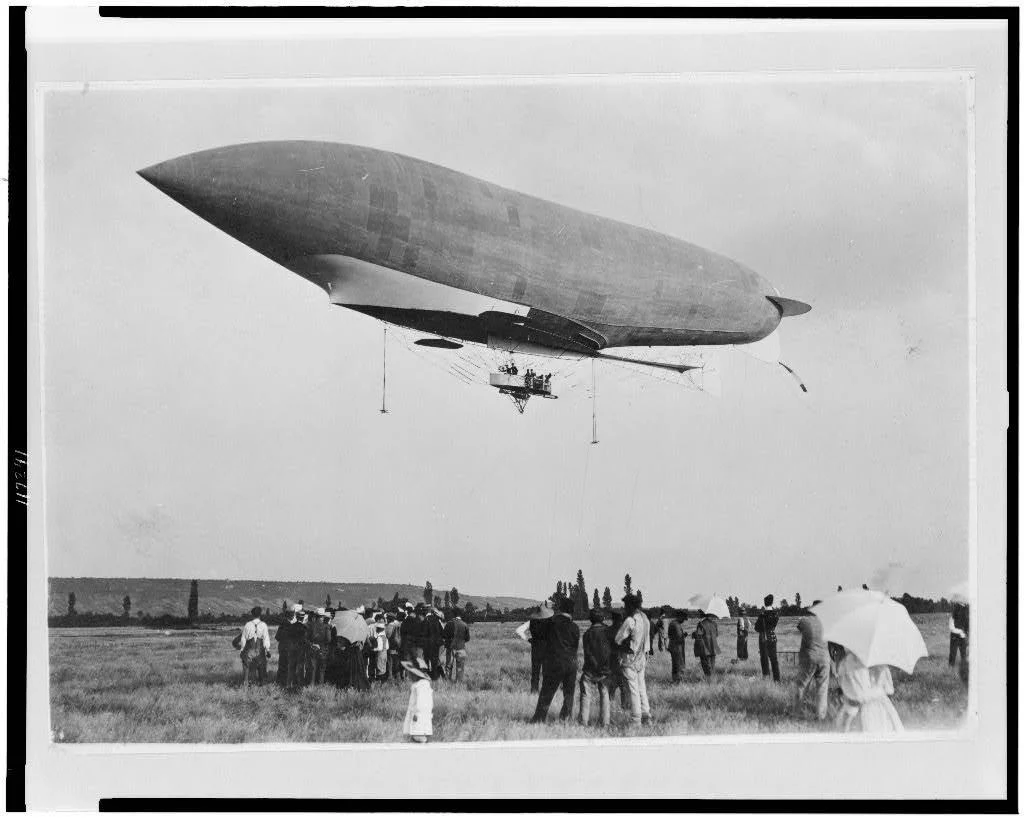
Traced from the album: the Republique leaving Moisson, 1907, watched by people with parasols. Library of Congress, Prints and Photographs Division, 96521020. No known restrictions on publication. 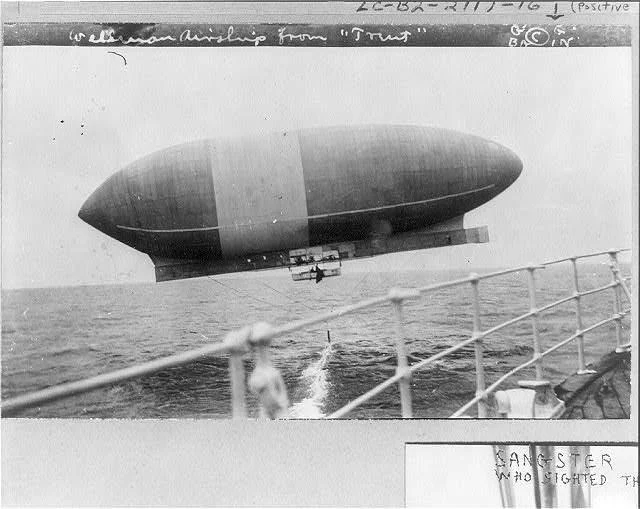
Traced from the album: Wellman's America seen from the rail of the RMS Trent, October 1910. Library of Congress, Prints and Photographs Division, 2002722166. No known restrictions on publication. 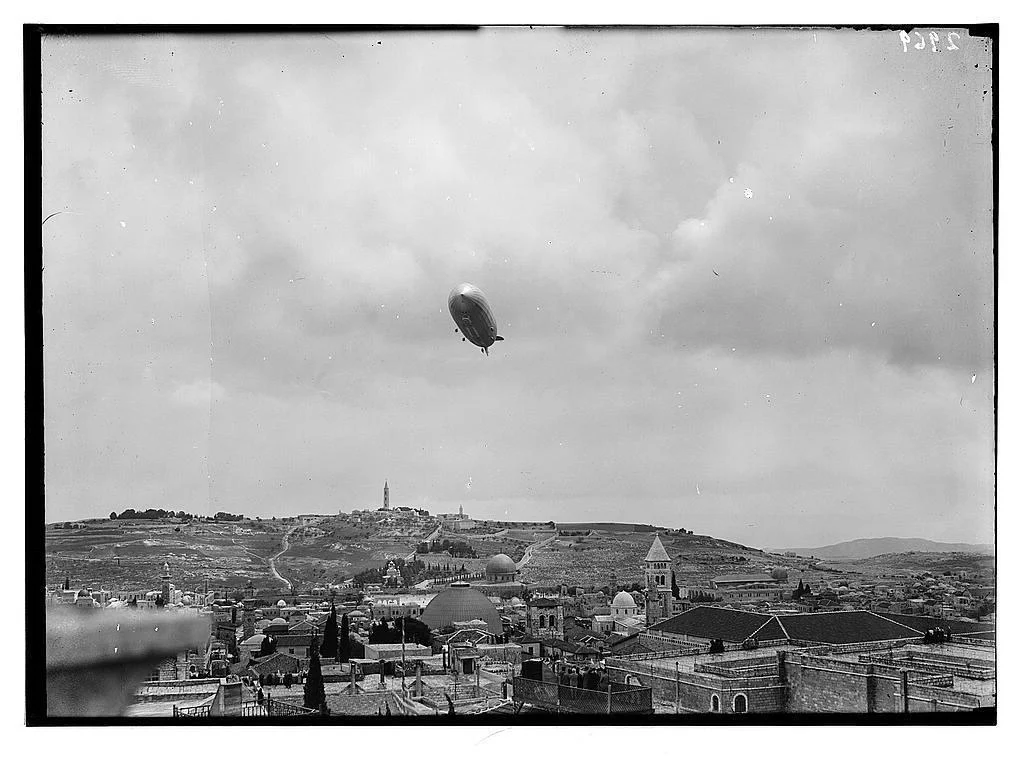
Traced from the album: Graf Zeppelin head-on over Jerusalem, 11 April 1931, the Mount of Olives behind. G. Eric and Edith Matson Photograph Collection, Library of Congress, 2019696219. No known restrictions on publication. 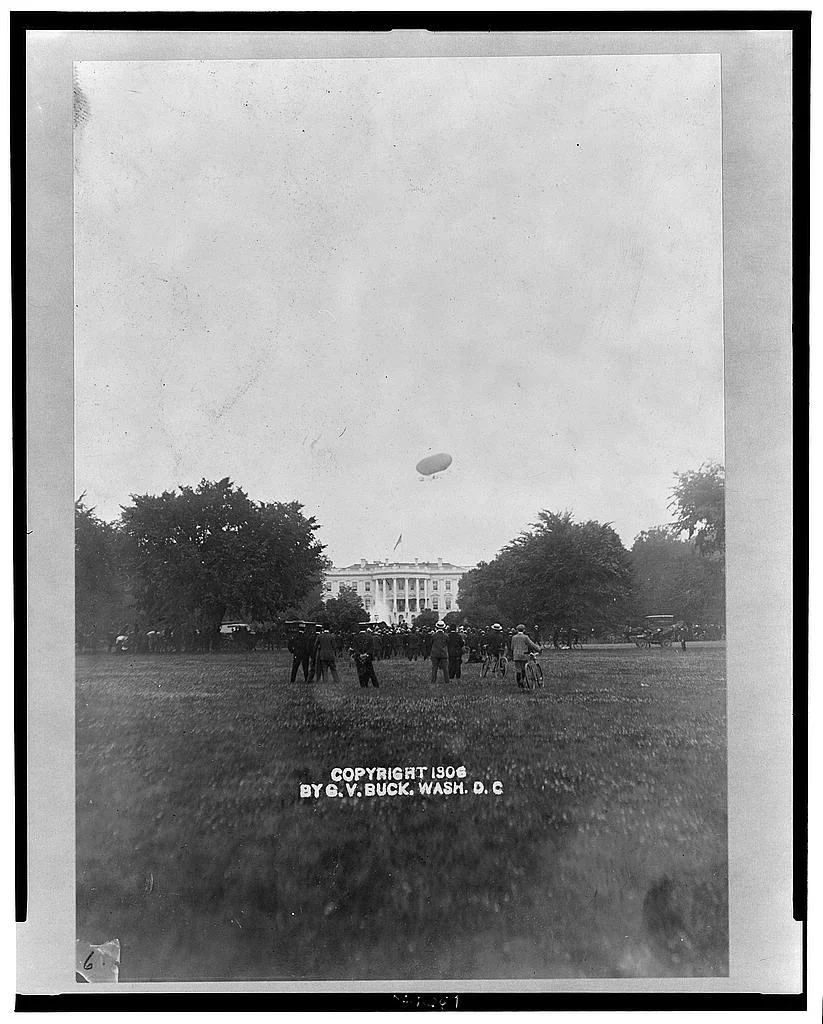
Traced from the album: Buck's View of air ship above the White House, the next copyright number after his Capitol. The ship here is a speck. G. V. Buck, about 1906, Library of Congress, Prints and Photographs Division, LC-USZ62-130946. No known restrictions on publication.
Select a photograph to see it full size, with its caption and credit.
Sources
- Postcard - Detroit The Airship City, 2012.046.702 Detroit Historical Society Primary record
- Postcard - Woodward Ave. Detroit The Airship City, 2012.020.692 Detroit Historical Society Primary record
- Postkarte mit dem Luftschiff Schwaben ueber Neuenbuerg, ca. 1910/1911, III L 1 Museum Schloss Neuenbuerg, museum-digital Primary record
- Postkarte: Coswig - Ereignisse - Zeppelin, 0790PK/08 Karrasburg Museum Coswig, museum-digital Primary record
- [East front of the U.S. Capitol, with airship (drawn?) above], c1906 Library of Congress Primary record
- View of air ship above the White House, ca. 1906 Library of Congress Primary record
- Hendon Aerodrome Fake, 1910, The Jack Richardson Collection Barnet Local Studies and Archives Primary record
- The R101 flying over St Pauls Cathedral, 1929-1930, AFL03_aerofilms_c16455 Historic England, Aerofilms Collection Primary record
- Composite image of HM Airship R100 flying over Toronto, 1930, Fonds 1244, Item 10045 City of Toronto Archives; Wikimedia Commons Primary record
- Airship over destroyed 1906 San Francisco, 8 June 2021 Stolen History Primary record
- Victory Columns were airship mooring masts, 16 March 2021 Stolen History Primary record
- Airship Photos (and Parts 2 and 3), 7 January 2024 r/Tartaria Primary record
- Tartaria's Airships and the Zeppelin Over the Leipzig Monument, 2026 Official X Study
- Photograph of San Francisco in ruins from Lawrence Captive Airship, c1906 Library of Congress Primary record
- Christopher Turner, George R. Lawrence, Aeronaut Photographer, Cabinet 32, Winter 2008-2009 Cabinet Study
- San Francisco ruins 1906 US Geological Survey Study
- AGM 2013: Early postcards, a local history resource? 20 June 2013 Fairford History Society Study
- How Were Vintage Postcards Made? 2015 Russell P. Panecki Collection blog Study
- Zeppelin, a type of rigid airship, over the Brandenburg Gate, Alfred Gross, Zeitbilder 41/1928, ullstein bild 548797145 Getty Images Study
- LZ 127 Graf Zeppelin Wikipedia General reference
- Pictures and posters Bundesarchiv Study
- Bild 102-06616, Berlin, Graf Zeppelin ueber Brandenburger Tor, October 1928 Bundesarchiv; Wikimedia Commons Primary record
- Bild 102-06617, Berlin, Luftschiff Graf Zeppelin ueber Reichstag, October 1928 Bundesarchiv; Wikimedia Commons Primary record
- Bild 102-06615, Berlin, Graf Zeppelin ueber der Siegessaeule, October 1928 Bundesarchiv; Wikimedia Commons Primary record
- Badischer Beobachter, no. 274, 4 October 1928 Badische Landesbibliothek Karlsruhe Primary record
- Zeppelin ueber Wermsdorf-Hubertusburg, um 1911, reprint Wikimedia Commons, uploader Derbrauni Primary record
- Zeppelin ueber Wermsdorf-Hubertusburg, um 1914, reprint Wikimedia Commons, uploader Derbrauni Primary record
- Gruss aus der Kieler Luft, 48.863 Stadtarchiv Kiel; Wikimedia Commons Primary record
- Dresden, Parseval-Luftschiff, PKSHN 10441 Postcard collection of Holger Naumann, Wikimedia Commons Primary record
- LZ 17 Wikipedia (German) General reference
- Zeppelinstein, section LZ 17 - Sachsen Wikipedia (German) General reference
- Klaipeda Wikipedia General reference
- Chris Bateman, That time a giant airship darkened Toronto's skies, 4 May 2013 blogTO Study
- FAKE! Early Photo Collages and Photomontages, press release, 17 December 2025 Rijksmuseum Study
- Flugversuch der Brueder Renner mit dem Lenkballon Estaric im Prater bei der Rotunde, 1909, 34017/5 Wien Museum Primary record
- Fotokarte Graf Zeppelin LZ 127, Urania Wien, 1929 Wikimedia Commons, WWWeb.pix Primary record