
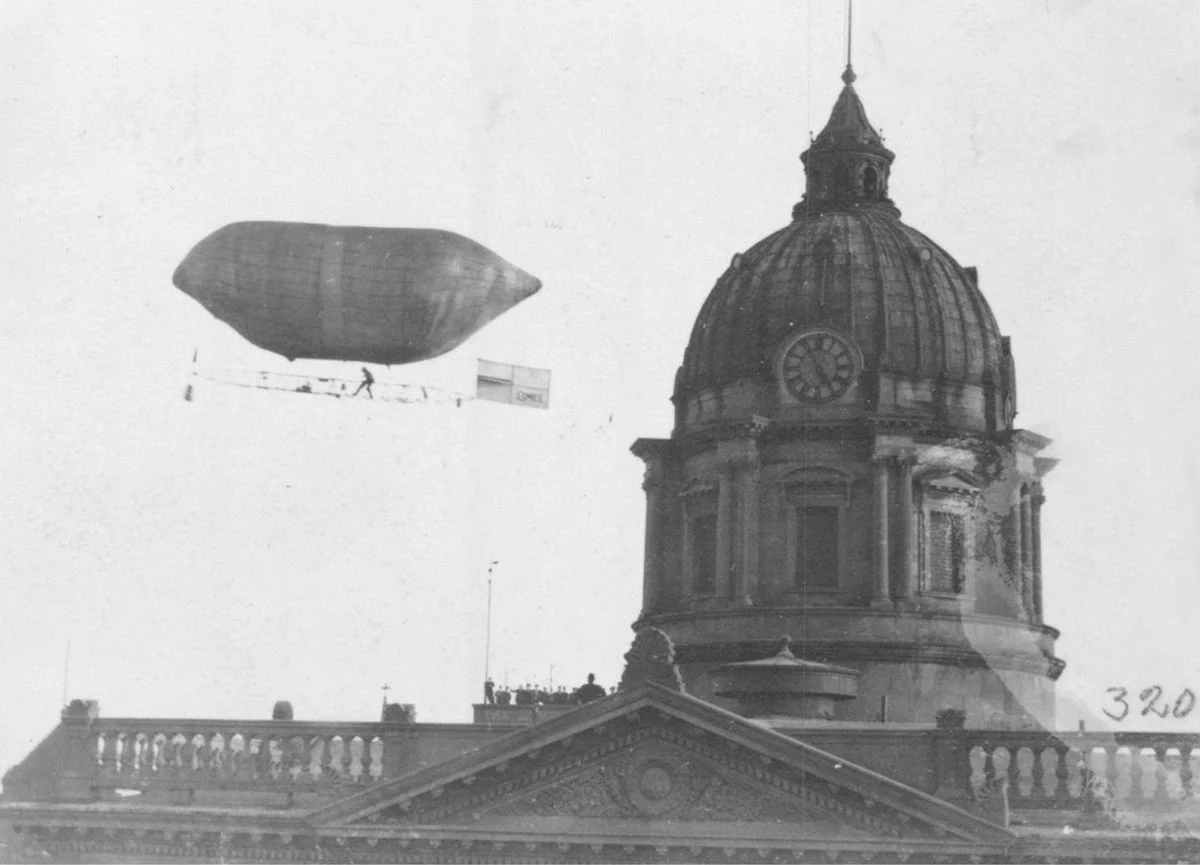
On the gravel roof of C.W. Klemm's department store in Bloomington, Illinois, in the middle of September 1910, sits an airship. Not over the roof. On it. The picture was sold as a card, number 319, and the white lettering along its foot reads: Capt. Yager's Air Ship The Comet making a landing on buildings North of Court House.
The bag fills the frame from edge to edge: 75 feet of varnished Japanese silk holding 10,080 cubic feet of hydrogen. Under it a woman in a white apron stands on a low kerb of brick. At the right a man in a waistcoat waits beside the flat rudder with COMET painted across it.
The streets below were full, and the office windows were full of faces. The Comet stayed half an hour, then lifted off and circled the courthouse dome.
This is the picture the Tartaria stories need: an airship at rest on top of a building. Here it is, with a pilot, a store and a newspaper behind it.
And it was not the first.
Seven Roofs and a Flag Pole
The list exists because Bill Welker of Colorado Springs kept looking. His Then and Now pages count seven landings on buildings and three crashes. Toledo, Portland, Cleveland, Akron and Washington can be read in papers of the day. Bloomington and Red Oak come down through a museum article and a speech. One of his seven was no landing, and one he does not have.
Toledo comes first. A. L. Spitzer had offered $500, by Welker's account, to the first aeronaut to land on his office building. On 30 June 1905 Roy Knabenshue, 28, flew Toledo No. 1 from the fairgrounds and at 10 o'clock, The Sun of New York reported, came down on the ten-storey Spitzer Building. Then he flew home.
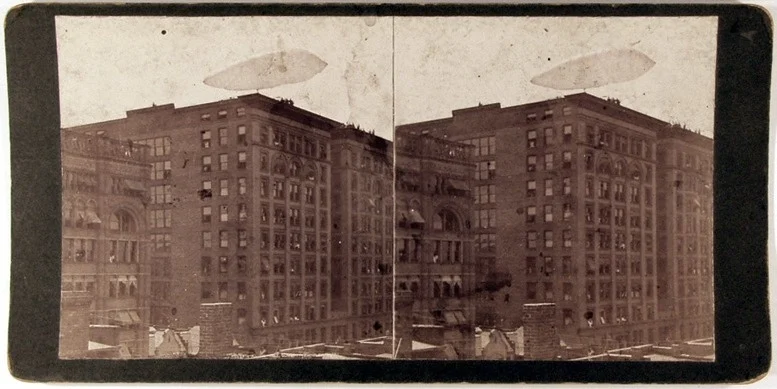
Portland is the roof the list misses. On 26 September 1905 Lincoln Beachey, 18, took the City of Portland up from the Lewis and Clark fair and stopped on top of the Chamber of Commerce building to deliver a letter.
Twenty-four days later a man called Burke was throwing circulars from the airship Man Angel in Los Angeles, moored, the Herald said, to a flag pole on the roof of the Fifth Street store. A policeman ran up five flights to arrest him. The airship had cast off. Welker counts this as a landing. The Herald does not: the plan to alight on the store was dropped, the patched bag "too weak to undergo the manipulations of landing", and the ship was "hauled to the starting point". Which point, it leaves unclear.
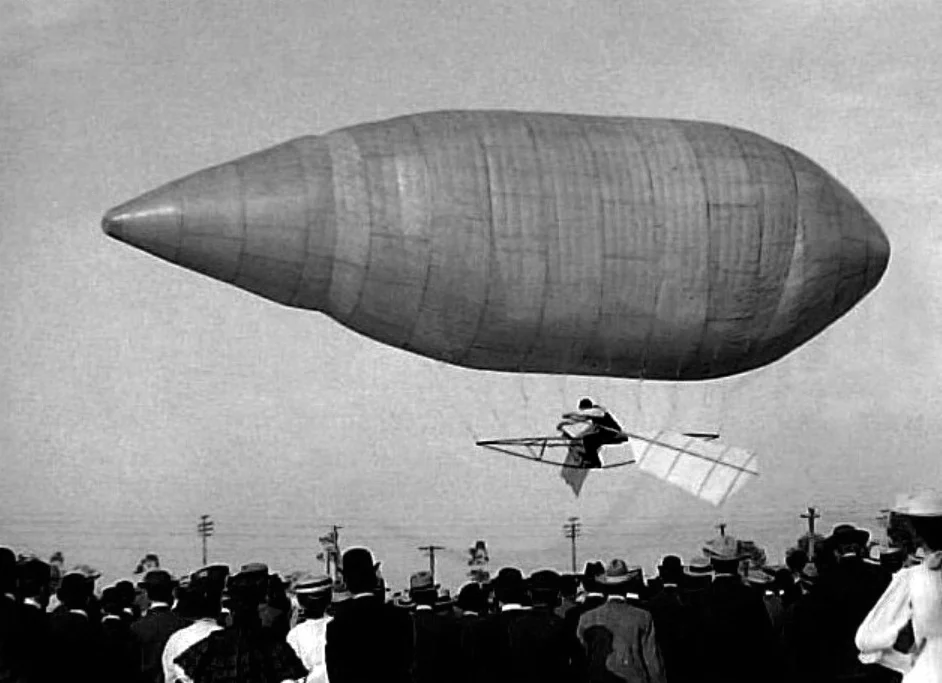
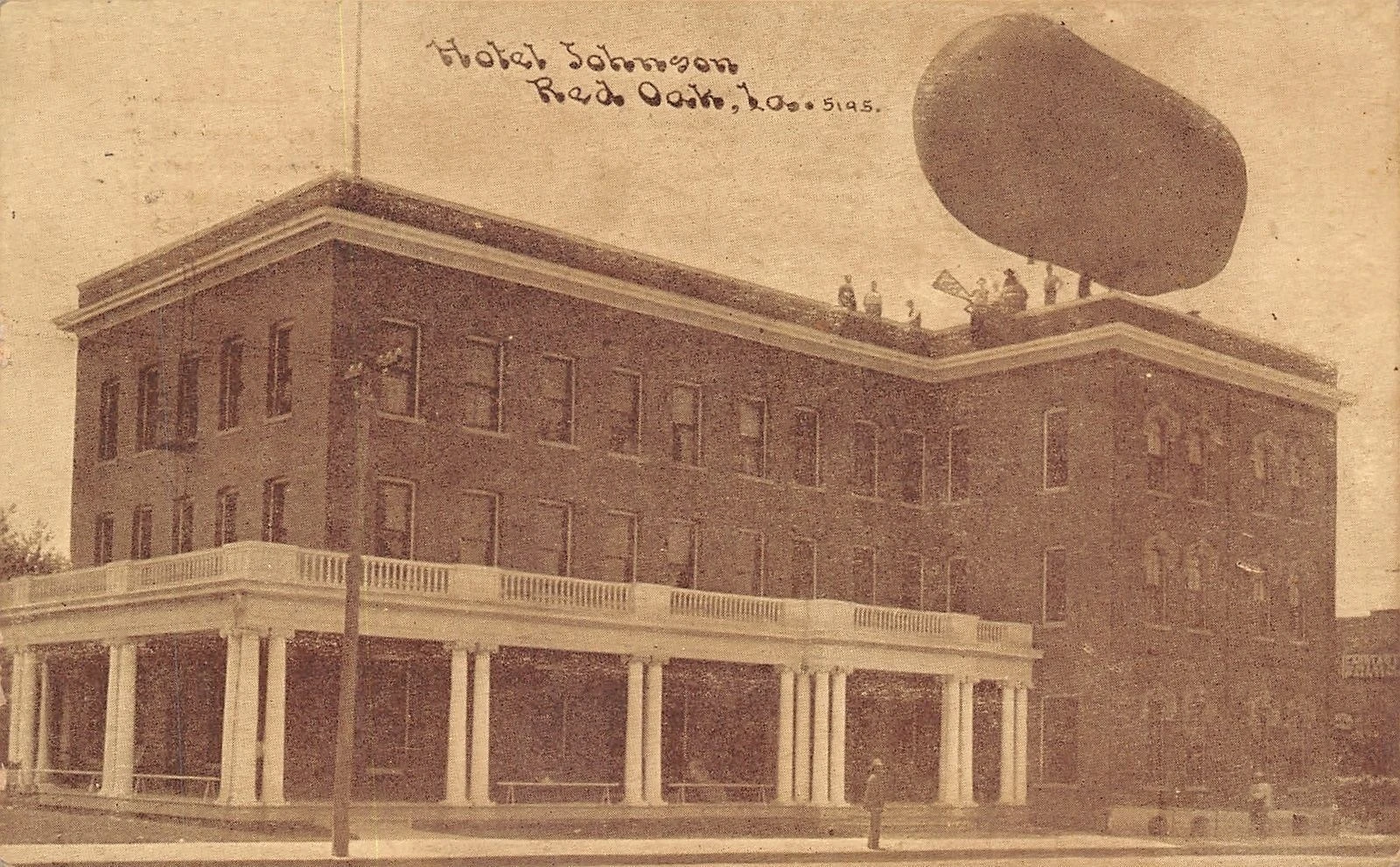
The Comet's aeronaut at Bloomington was Horace Wild. In 1917, in the words Welker quotes from Hotel World, Wild said the proprietor of the Hotel Johnson in Red Oak, Iowa, offered to pay the crew's bill if they landed on a building. Next morning the ship was on the Johnson. The bill came to $250.
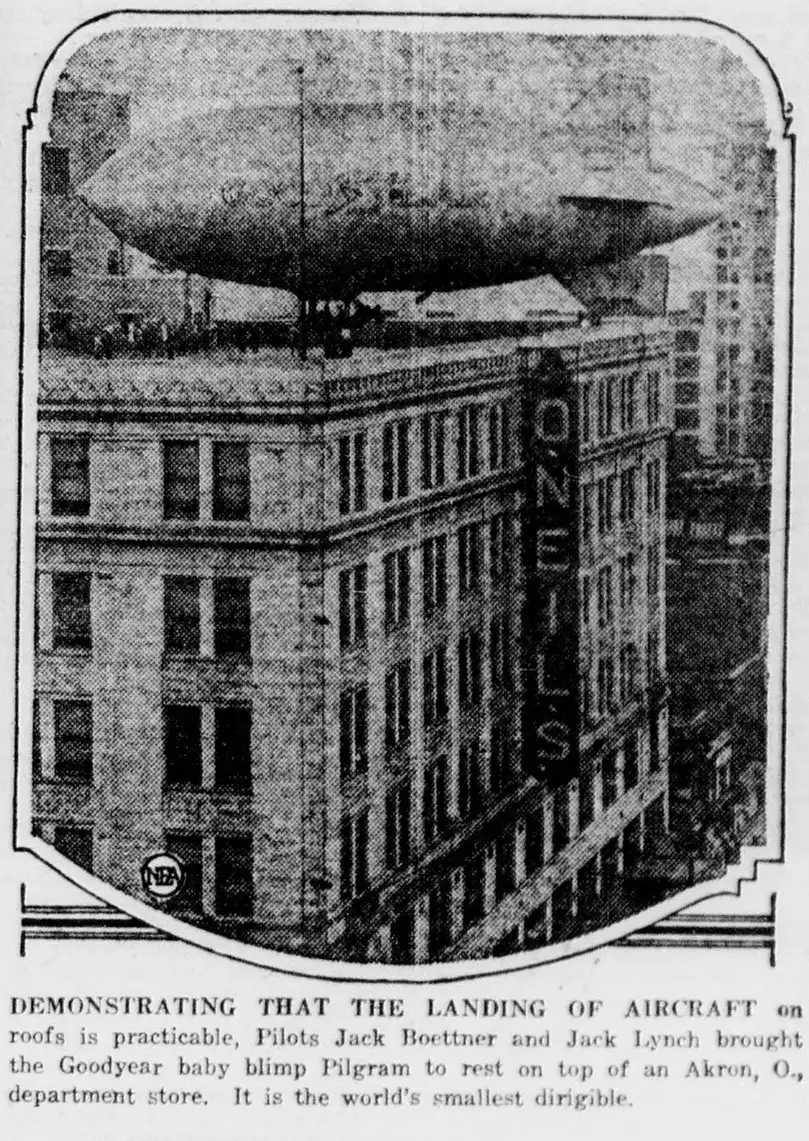
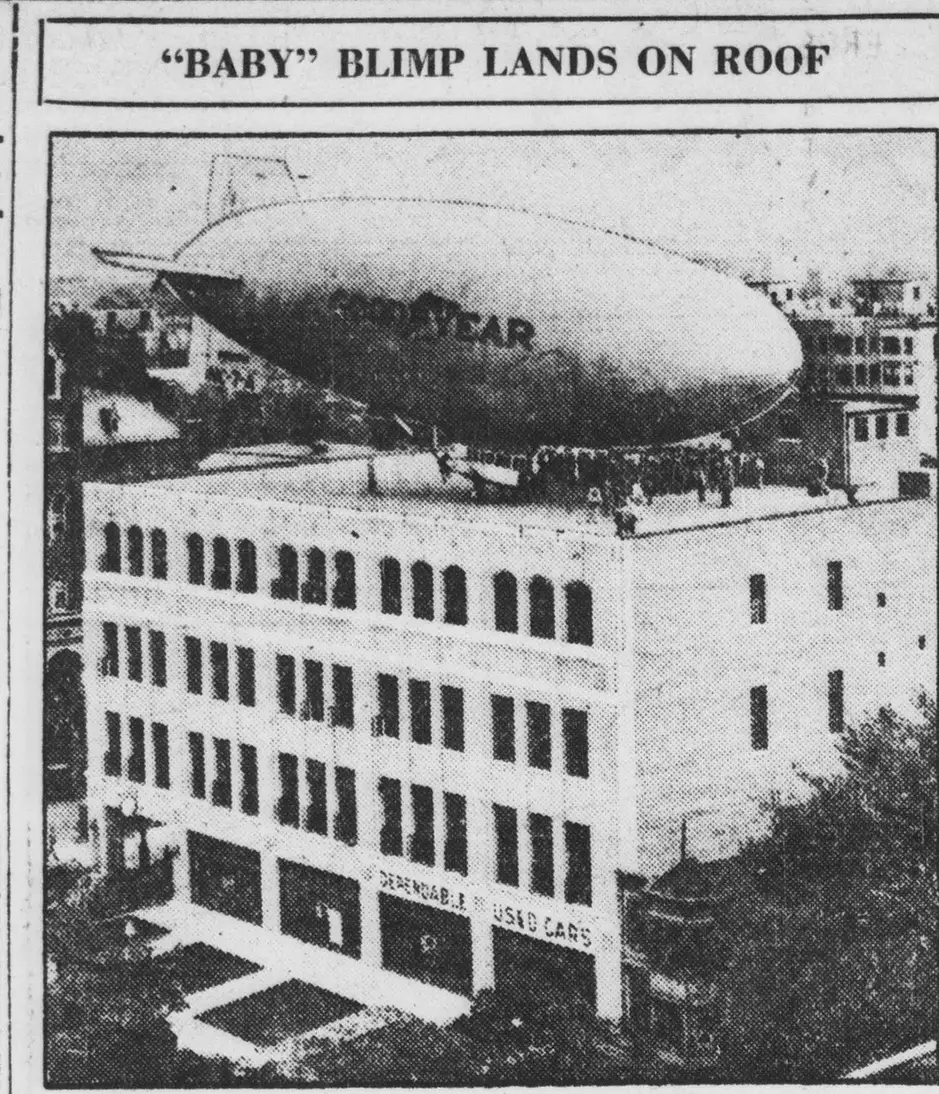
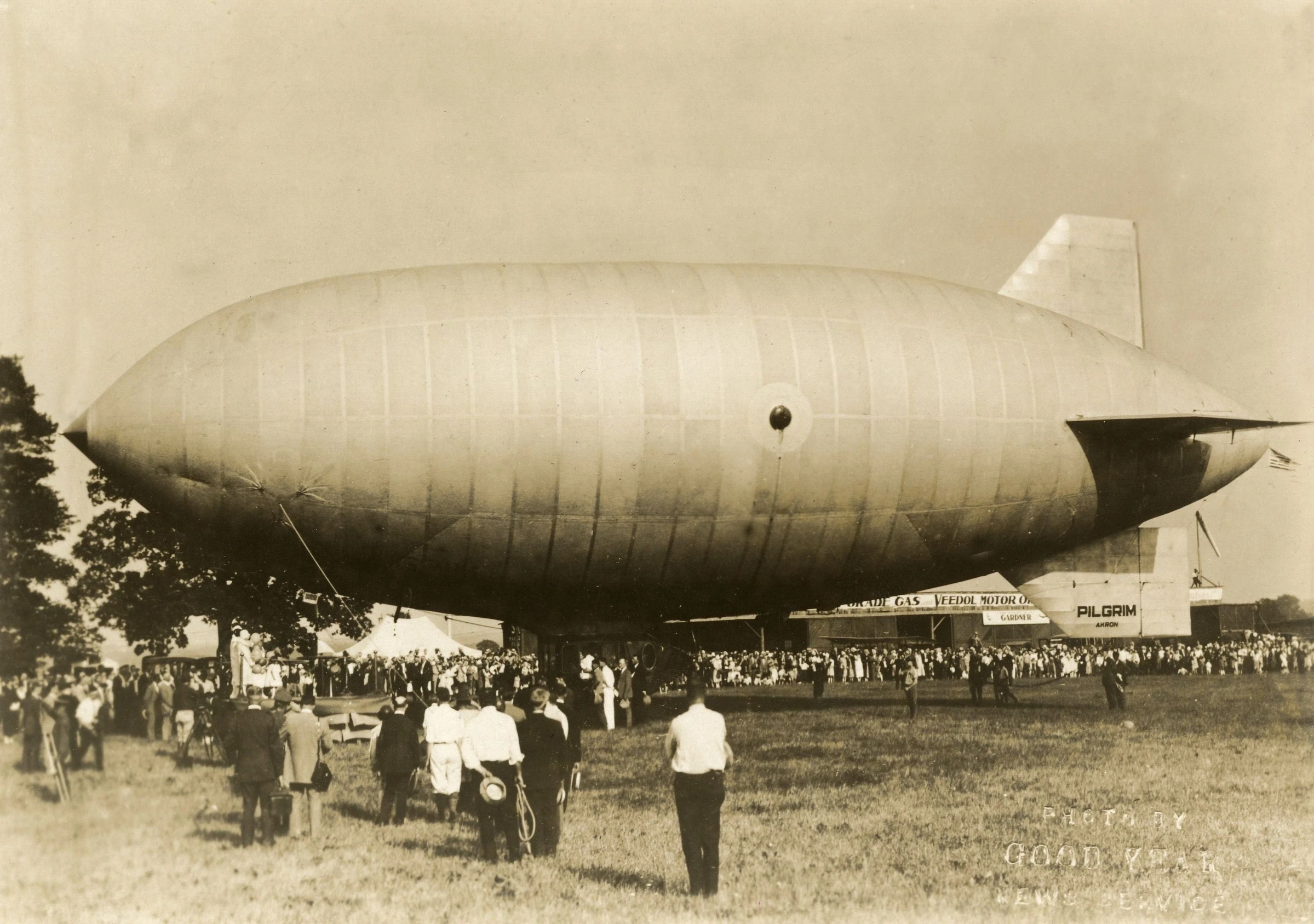
In June 1928 the blimp Pilgrim took O'Neil's department store in Akron. On 5 October the Puritan took the four-storey Emerson and Orme building at 17th and M Streets in Washington. William Emerson stepped off, went down to his desk and told the Daily News the ship had found parking faster than his own car.
Doors at the Top
Tartaria Britannica put the idea in print on 8 January 2023, in a post called "How Do You Board an Airship?" Many city landmarks, it says, carried ornate entrances at the top where people went aboard. The films of January 2026 put the craft over the great domes themselves. Read that way, the crowns of the old city are what is left of a port, in a world the old maps called Tartary, that came and went by the top floor.
And here is the strange part. The old newspapers run ahead of the posts.
In May 1919 a platform 30 feet square was built on the roof of the Hotel Statler in Cleveland. The Army's A-4, 160 feet long, with James Shade at the wheel, flew in from Wingfoot Lake, put two passengers off for an engineers' dinner and went home. The press called it the first dirigible in America to dock at a landing platform on the roof of a skyscraper.
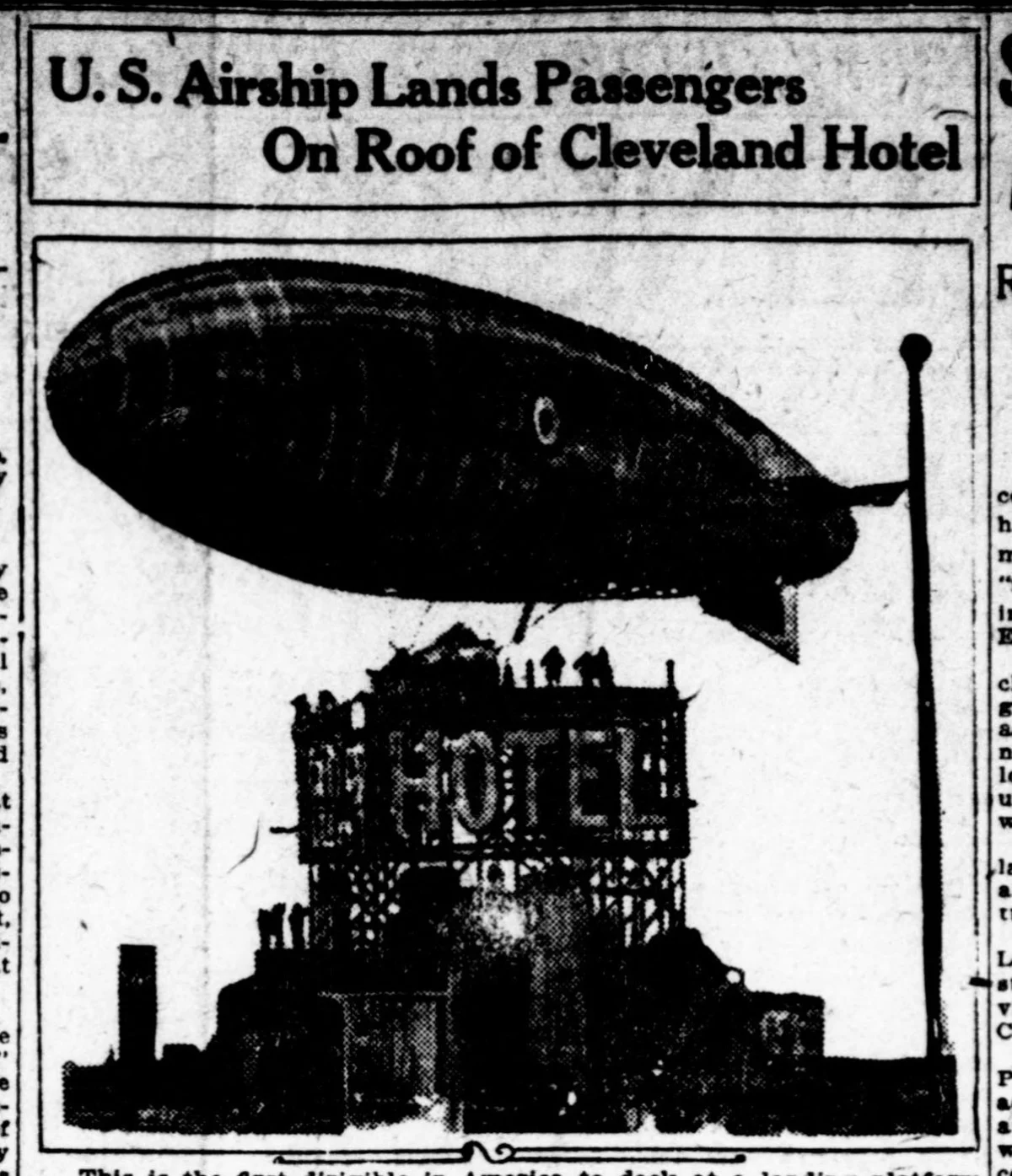
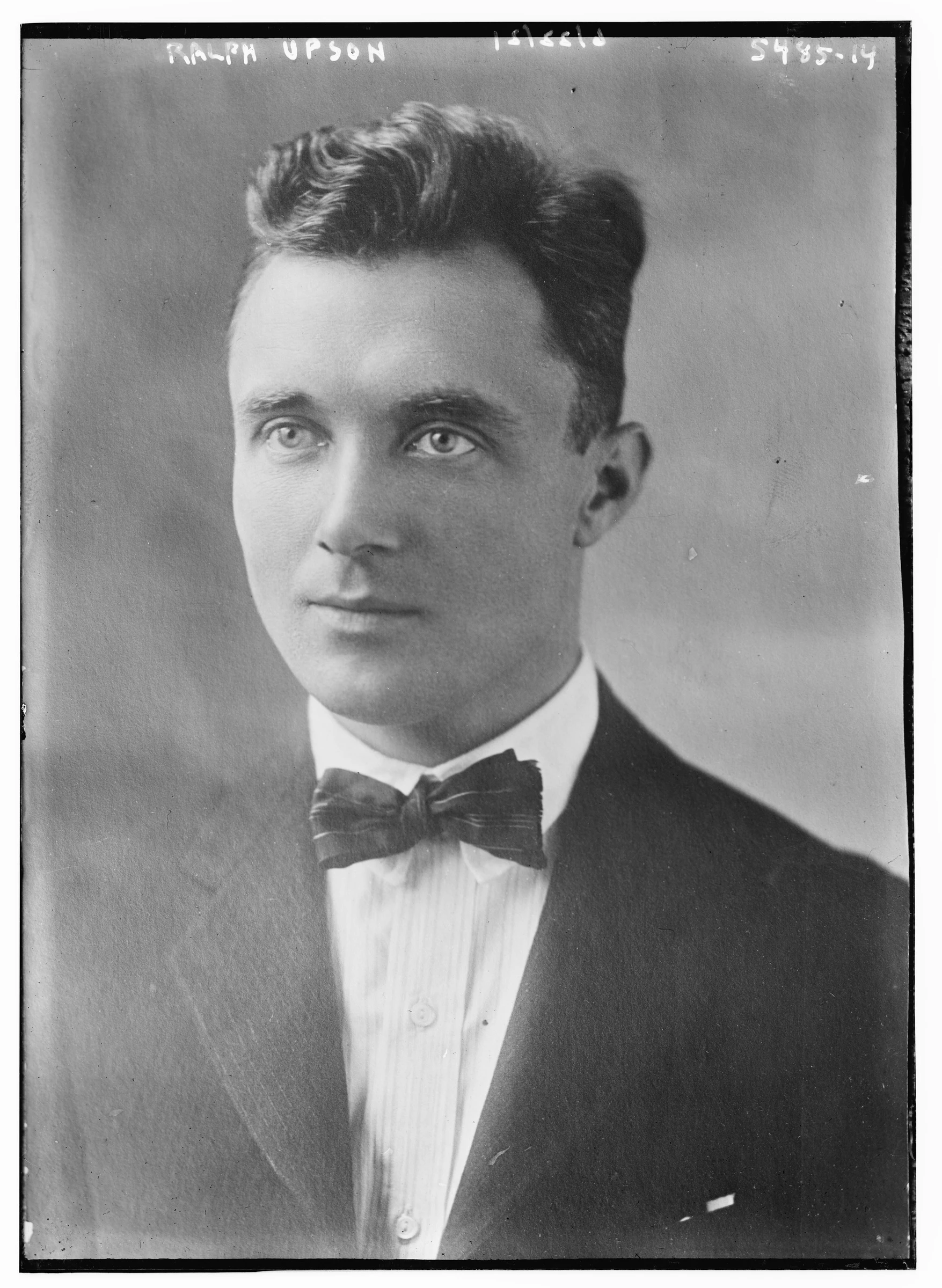
Days later the wire carried what it was for. Ralph Upson and W. C. Young, with Goodyear's backing, would run passenger dirigibles out of Akron to New York, Chicago and the Pacific, landing "probably on the roofs of the tallest hotels." Which puts a hotel roof, in June 1919, on a business plan. "These are not dreams," the story said.
Ten years on, the Thomas Jefferson Hotel in Birmingham, Alabama, went up with a tower billed as a mooring mast, and Alfred E. Smith added 200 feet of mast to the Empire State Building, where airships would, he said, "swing in the breeze and the passengers go down a gangplank."
A City Entered From Above
Set aside for a moment whether any of it ever joined up. Ask the better question. What kind of past are we standing on if it did?
It would mean, first, that seven landings were never seven stunts. Spitzer's $500 and the car dealer on M Street would have been paying to stay on a line. Each card would be a torn page from a timetable, and a store roof in Bloomington a stop whose neighbours we have lost.
It would mean that we have been reading our cities from the wrong end. The street door, with its brass and its doorman, would be the back way in. The real front door would be the top, and every crown on every old bank and hotel a porch that none of us has ever looked at as a porch.
It would mean that our bodies once knew something they have lost: how to step off a basket on to gravel high above a street, with no more thought than stepping off a tram, and go down to the desk. A whole habit of getting about, taken out of the muscles of a species inside two generations.
And it would leave one question in front of us. The roofs of our own cities are covered with masts, dishes and landing pads that a stranger could not read. If the purpose of a building can be lost while the building still stands, what are we walking under now, and who will be left to say what it was for?
What the Roofs Could Bear
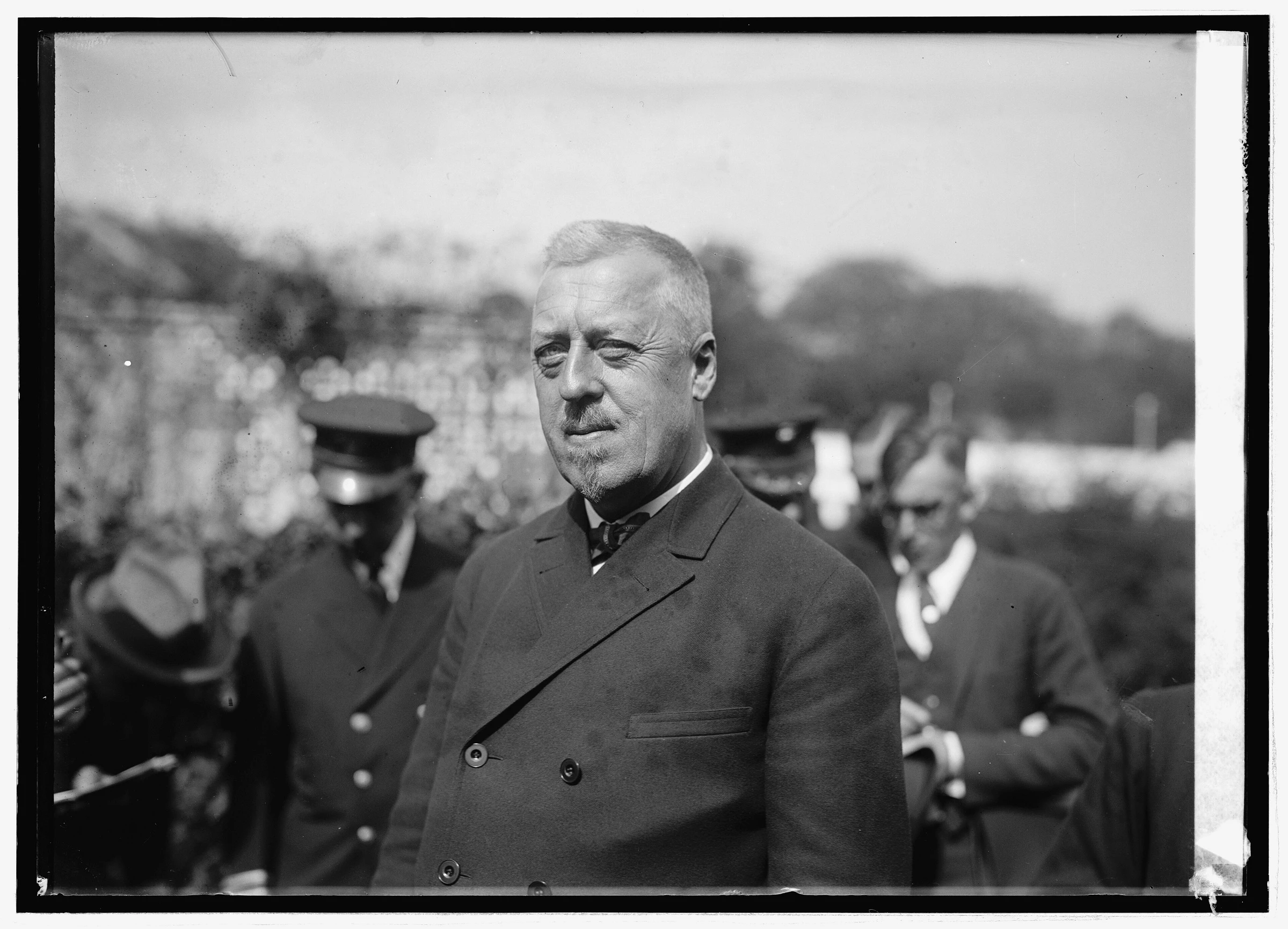
The standard account begins with size. Dan Grossman, the airship historian, told WBEZ in 2016 that no airship ever moored to the roof of any building in the country. He calls those towers publicity stunts; the Birmingham one has no ladder to its own roof. The Comet's gas gives about 700 pounds of lift at the usual hydrogen figure, ship and pilot included; the sum is this article's. The Puritan, 128 feet long, took 16 men to haul down. Hugo Eckener of the Graf Zeppelin called the mast impractical.
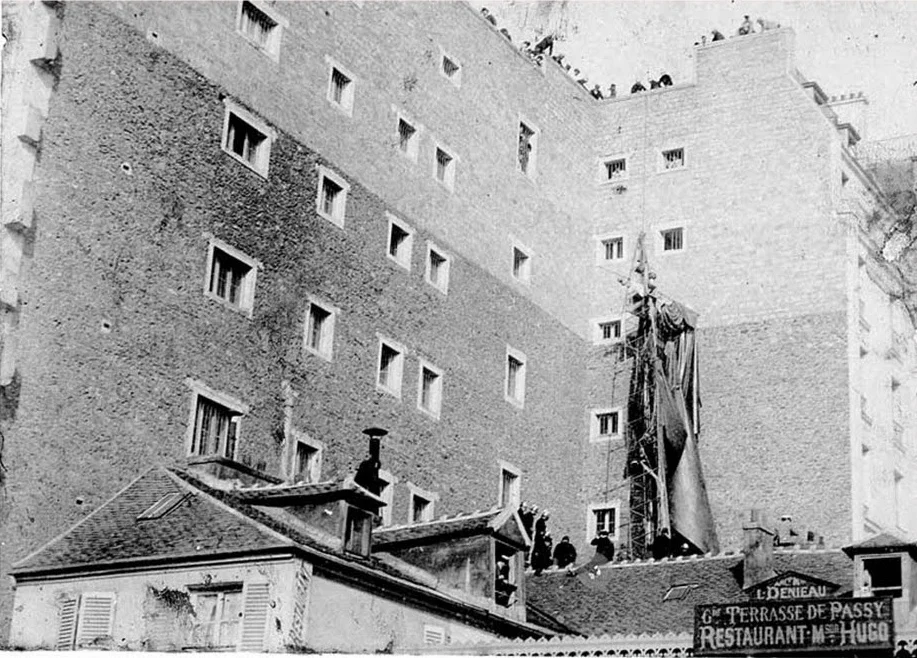
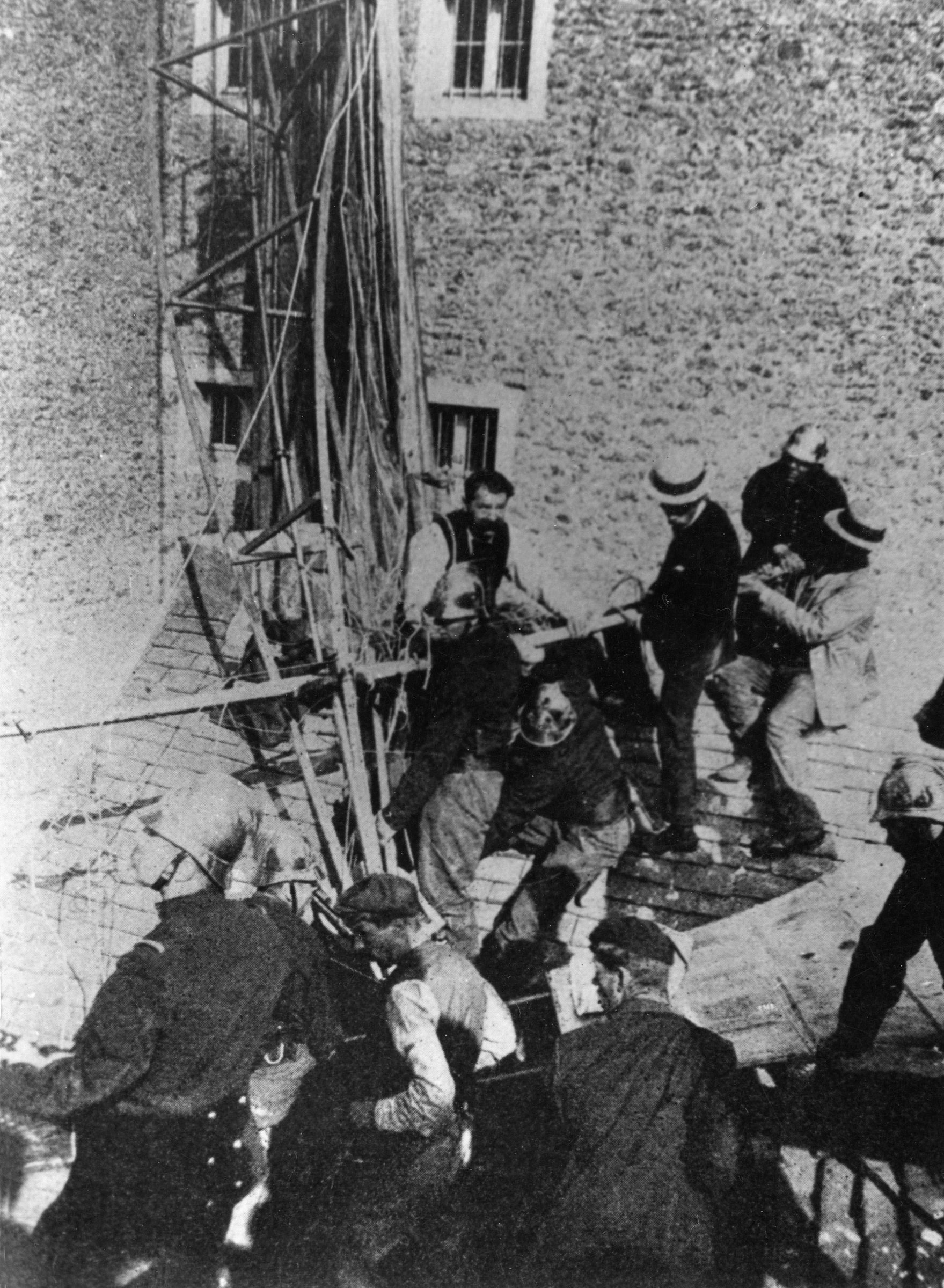
Every roof had a sponsor: a landlord, a fair, a car dealer, a tyre company. And the idea had its price. On 8 August 1901 Alberto Santos-Dumont lost gas in his No. 5, burst on the roof of the Trocadero hotels in Paris and hung in his basket in the courtyard until firemen lowered a rope.
On 21 July 1919, seven weeks after the hotel-roof story, Goodyear's Wingfoot Air Express caught fire over Chicago and fell through the skylight of the Illinois Trust and Savings Bank. Thirteen were dead within three days, most of them bank staff. The pilot jumped and lived. His name was John A. Boettner.
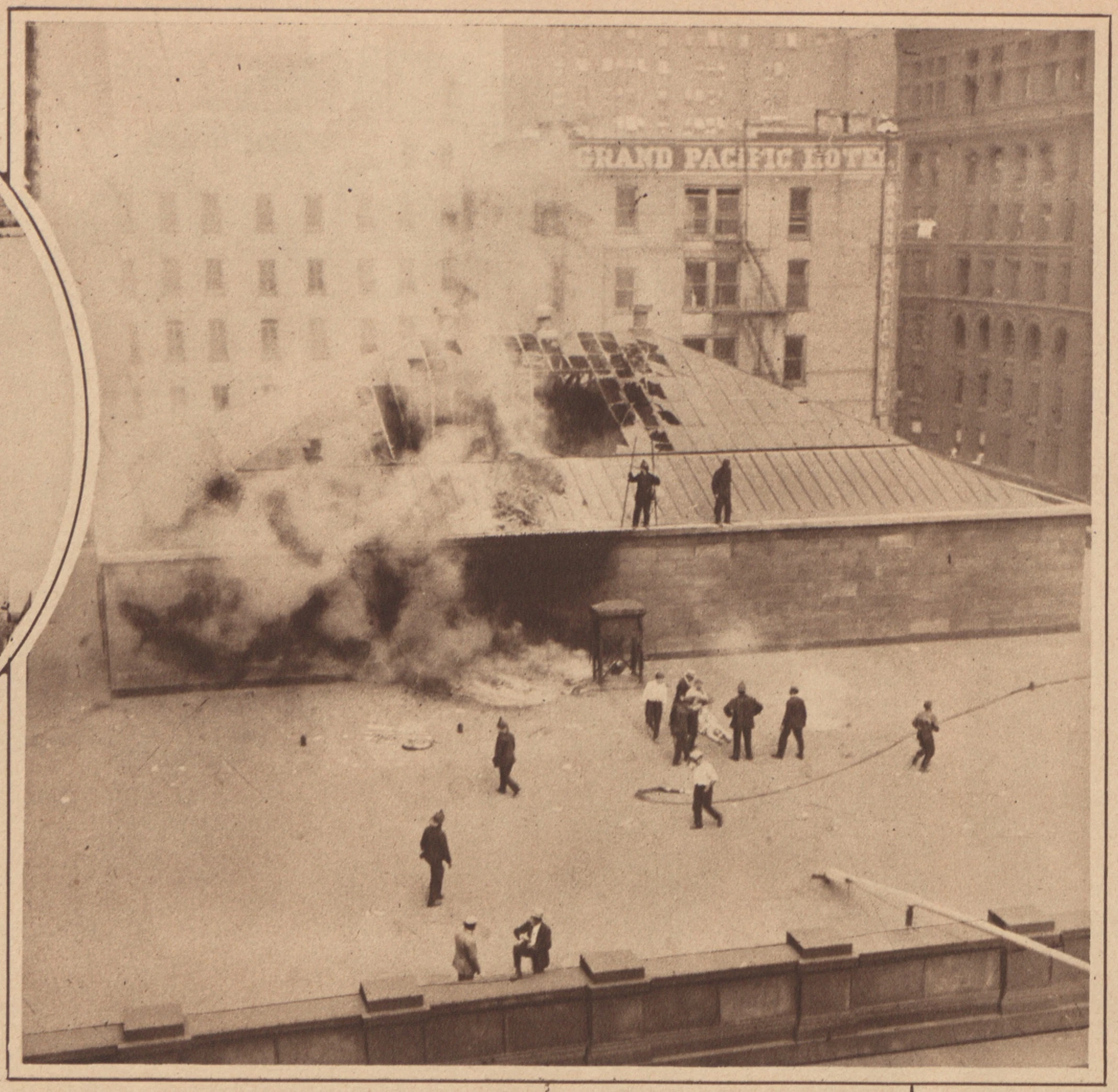
Nine years later he was at the wheel over O'Neil's and over M Street.
What One Word Does Not Reach
Those numbers answer a claim about great ships. They do not settle the word. The Herald had the Man Angel moored to a flag pole in 1905. The Evening Star had the Puritan moored to the roof top for about five minutes. In 1931 a headline read Tiny Blimp Moored Atop Empire State. Which means Grossman's sentence holds for a ship riding at a mast and not for the word on the page. A flag pole on a Los Angeles store, on one reporter's account, is the oldest mooring to a building found here.
The hard test is the hotel. Hotels were the plan, and hotels carried towers sold as masts. The search behind this article ran through the Library of Congress's digitised American newspapers for 1906 to 1935. The Statler took the A-4 for as long as two passengers needed to step out. WBEZ found no evidence that Drome Station No. 1, planned in 1910 for the roof of the Blackstone Hotel in Chicago, was ever built.
No airship on any record opened for this article rode at moorings on a hotel. The search did not find one.
That search has edges: it read 4 to 6 pages from lists of up to 268 hits, some queries failed, and the Cleveland, Akron and Red Oak papers went unread, as did every European hotel archive. Red Oak rests on a speech, and to this site's eye the Johnson card looks worked over; no holder has said so.
Bloomington's day is unsettled: 14 September in the Early Birds' note of 1950, the 15th by the museum's sequence. In January 1950, at 72, he was in the Pantagraph under the headline Old Pilot Seeks Date He Landed on Klemm's Store.
And the list is not closed. The Star wrote that the Puritan had landed on buildings in other cities, and that roofs were Boettner's specialty. Which ones, no list opened here says. The wider run of pictures, with each craft and building named where the record names them, is in The Airship Record.
A Rope at 1,250 Feet
The thing most worth finding is the Statler platform: how long it stood, and whether a second ship ever touched it. The Cleveland papers and the hotel's own file could say. They could show one hotel fitted for one dinner, or the first stop of a line. They could not show a fleet.
One platform, 30 feet square.
On 15 September 1931 a commercial blimp came over the Empire State Building in a stiff breeze. The print at the Library of Congress names her: the semi-rigid Enna Jettick, just before it made fast for a moment. The United Press had men clinging to the mast for about 15 minutes, fishing for the line. They got it. The rope parted. Accounts of how long she held run from a moment to three minutes.
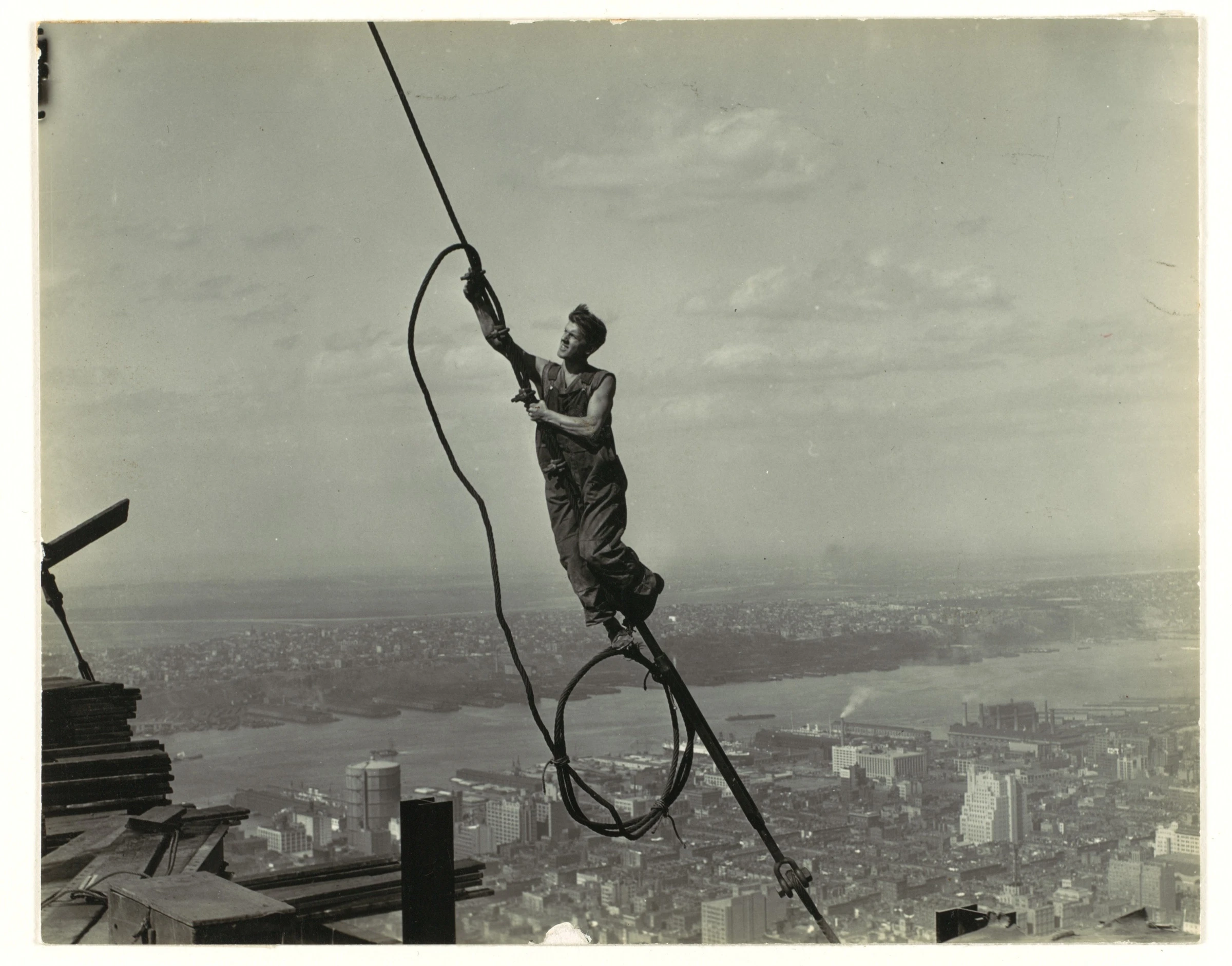
On 30 September the Goodyear-Zeppelin Columbia came to lift two bags of mail off the mast for the liner President Harding. The caption tells the rest. A dozen passes. Once the rope came within reach of Andrew Kelly, a mere spot on the rim of the mast. It tore out of his grasp. After the blimp left, a movie cameraman carried a rope to the top, the bags were hooked on and the cameras ground while it was pulled up.
"It ought to be impressive on the screen," the caption said.
The tallest building in the world held a blimp for a moment. A car dealer's roof held the Puritan for about five minutes. A store in Bloomington held the Comet for half an hour. The caption does not say whether the mail caught the boat.
Questions This Leaves You With
Is there anything a person actually does with this?
Nothing in your own life follows from it, and anyone selling you a date is selling something. What you can do is small. Goodyear's little ships toured the country, so a store or a school near you may hold a roof that nobody has listed, and a week of a local paper from 1928 takes an afternoon to read. Welker's best picture of the Johnson came to him from a reader. The larger question is not yours alone: how a town keeps hold of what its own buildings once did.
Does this sit against a religious account of the world?
Hardly at all, and it cuts both ways. A city that wanted to be entered from the sky can read as pride, a tower reaching further than it could hold, with a rope that parted at the top. It can also read as hope, people who would not agree to stay on the ground and who went out on a roof to prove it. No teaching that this site can point to turns on whether a blimp touched a hotel. Which way it falls for you is yours to decide, and this site will not tell you.
Does this change what a human life is?
Set your own life beside George Yager's. One day in 1910 a town stood in the street to look up at his airship. Forty years later he sold wicker and had to ask a newspaper what day that had been. Read one way, that makes a life small: the best morning you ever had, gone from your own memory. Read another way it makes a life larger, because the card survives, and a woman in a white apron is still standing on that roof. You may already know which of those you felt first.
What would change your mind, in either direction?
Name it now, while it is easy. Towards a real rooftop service: a hotel ledger with a ship kept overnight; a second landing on the Statler platform; a printed fare or timetable naming a building; a door at the top of an old block with a gangway photographed in use. Against it: the building plans, which historians of architecture read first, showing those crowns as tanks, lift rooms and signs; Goodyear's flight logs showing every roof as a one-day booking. Each of these can be looked for. Which would you accept?
How many roofs did Jack Boettner land on?
This is the open problem, and it is smaller than it sounds. He flew the ship that fell on a Chicago bank, and nine years later he was putting blimps on stores for a living. The Star says other cities, and office buildings, schools and stores. It names none of them. A tour like that left a trail once, in local papers and in the company's own files, and no list opened here sets it out. There may be a hotel on it. That line of the record is empty, and it can only be filled from a local paper.
More photographs
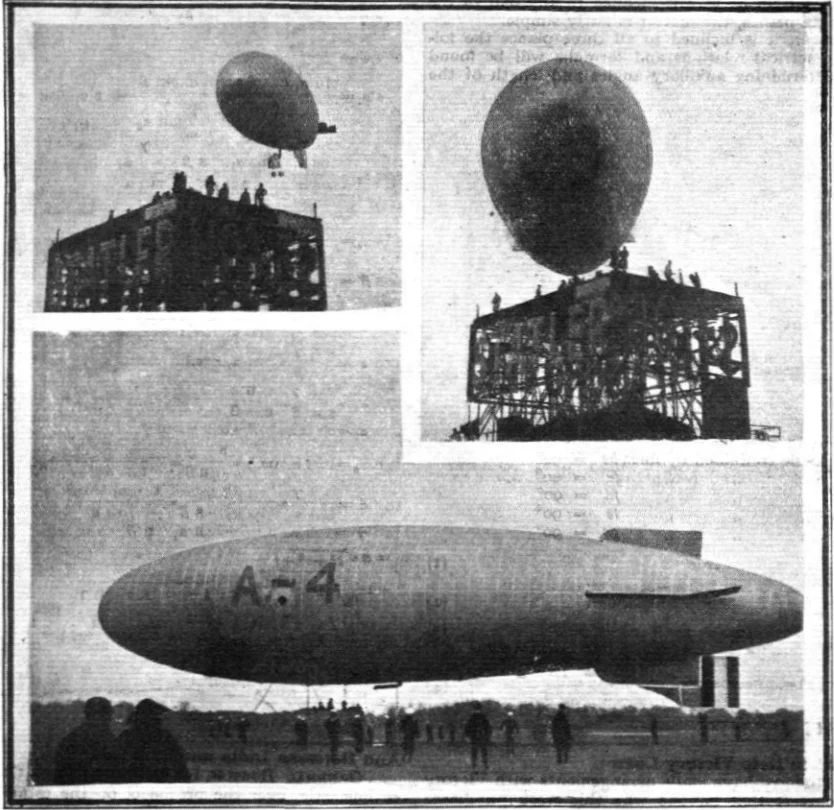
The page from Flight of 10 July 1919: the A-4 over the rooftop sign and platform at Cleveland, twice, and on the field below. Flight's text was read only as Welker quotes it. Flight, 10 July 1919, public domain by age, copy on welweb.org, Then and Now. 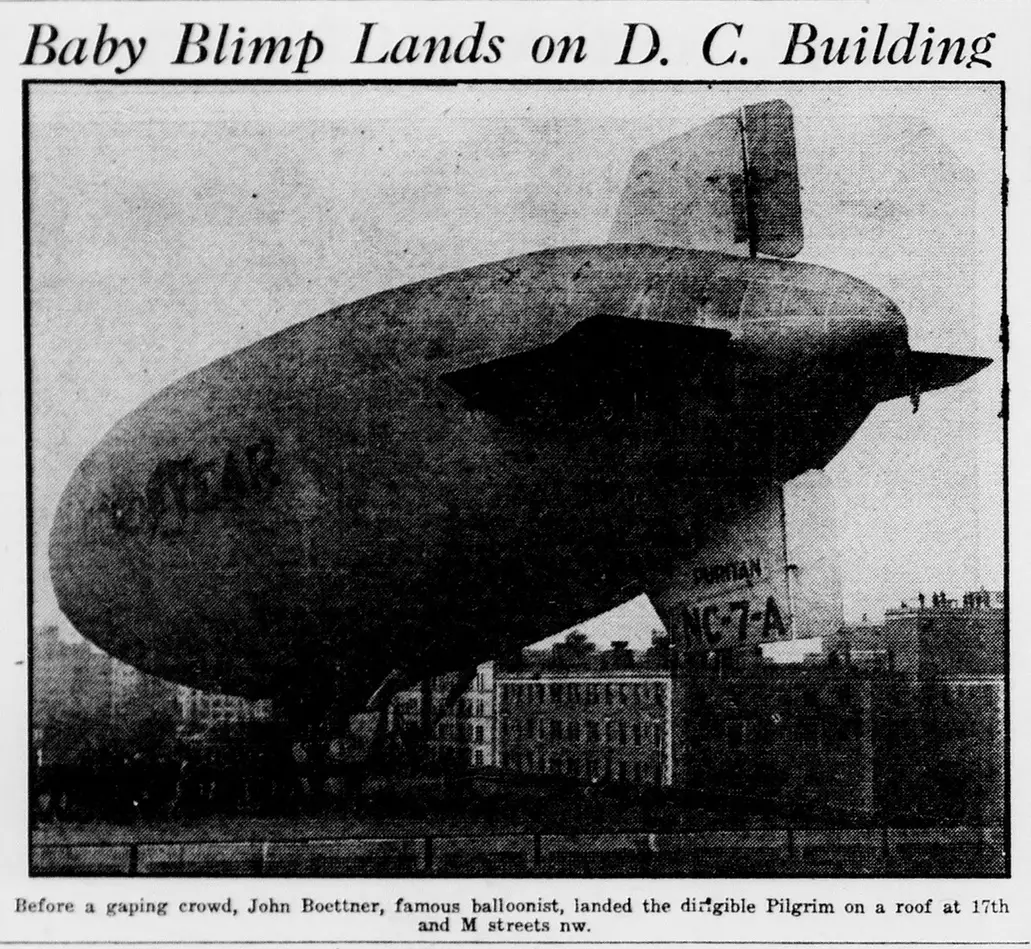
The Daily News picture of the same landing. Its caption calls the ship Pilgrim. The tail in the picture reads Puritan, NC-7-A. The Washington Daily News, 5 October 1928, p. 4, Library of Congress, Chronicling America, public domain. Cropped. 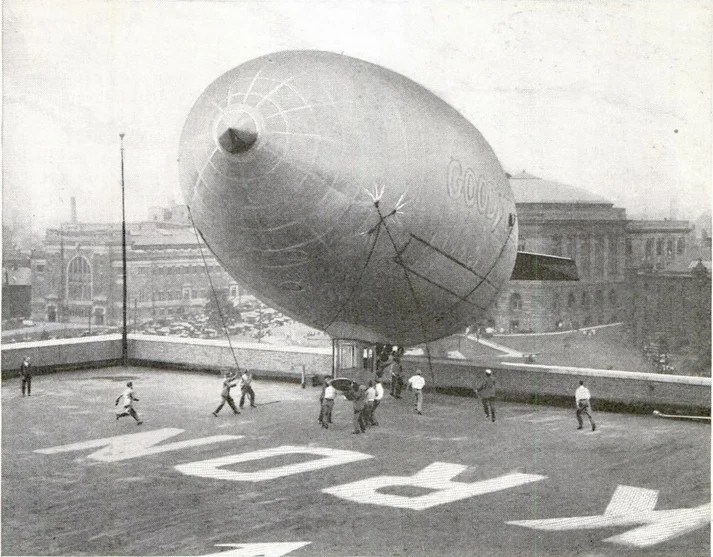
Men run with the lines as a Goodyear blimp sets down on a flat roof with AKRON painted across it. Welker ties this to the Pilgrim at O'Neil's; the magazine page itself was not opened. Popular Mechanics, July 1929, p. 31, as cited by Welker, public domain by age, copy on welweb.org, Then and Now. 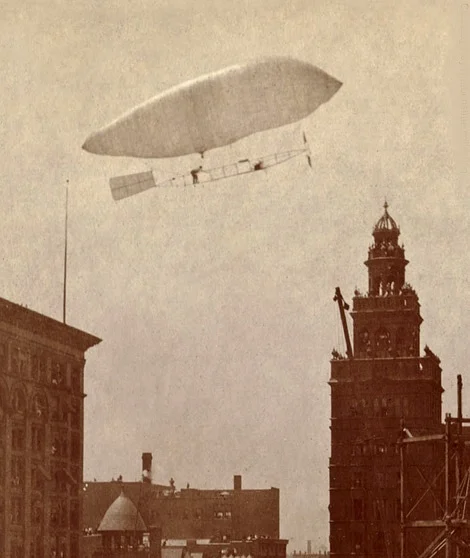
Knabenshue leaving the Spitzer Building on his return trip, 30 June 1905, by the card's own description. Card of 1905, cropped and enhanced by the Commons uploader marcric, public domain, via Wikimedia Commons. 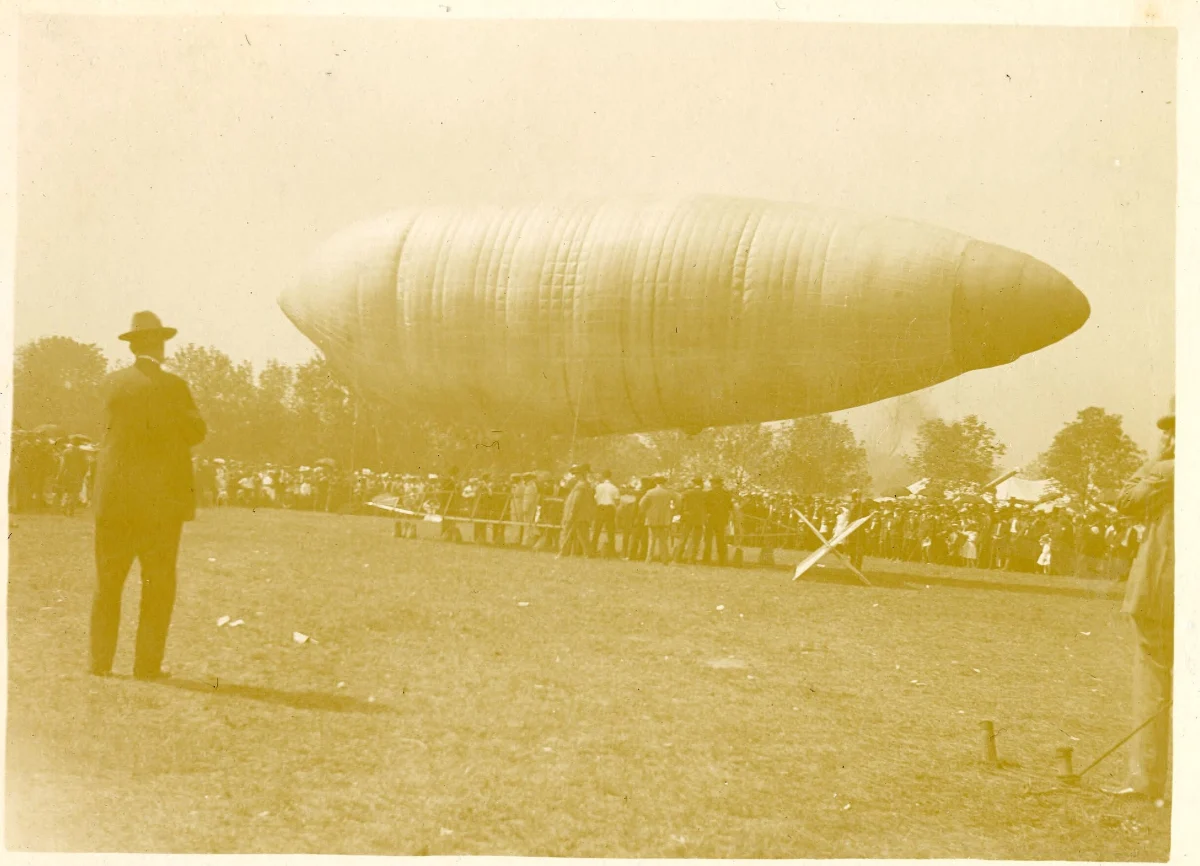
Knabenshue with Toledo I at the Ohio State Fair, 1905, by the record: the size of the thing against a man on the grass. Photographer unknown, 1905, no restrictions, DPLA via Wikimedia Commons. Cropped. 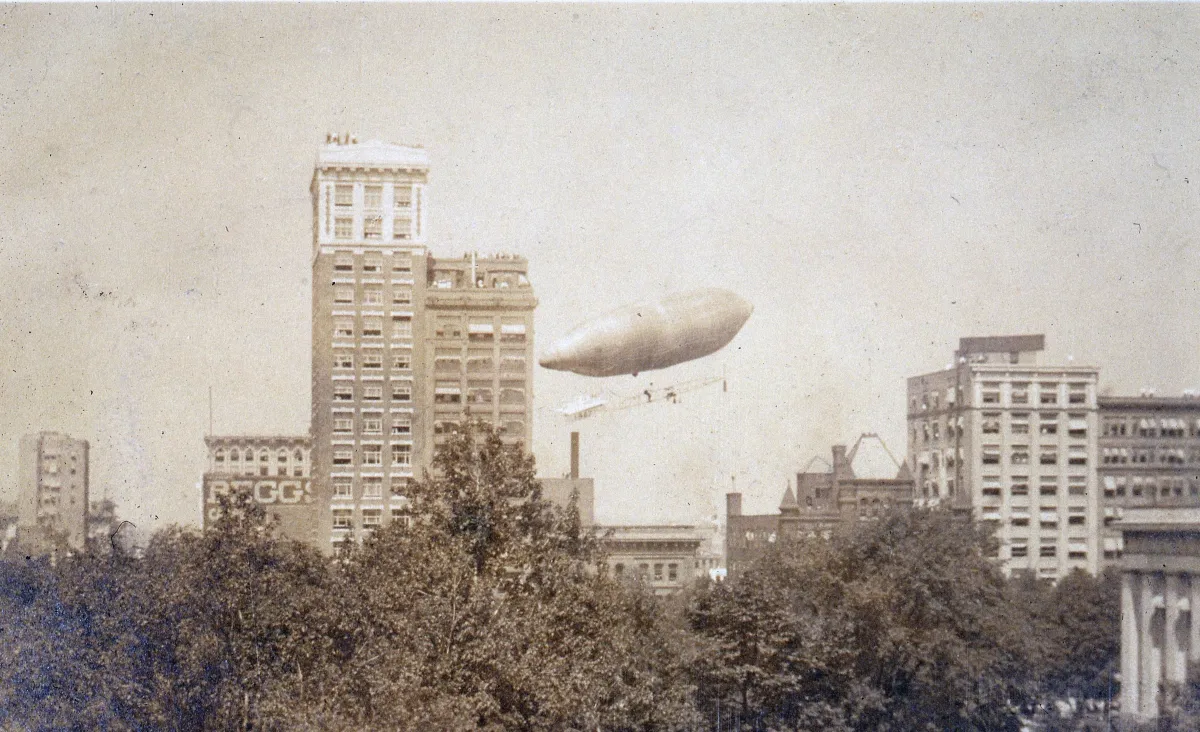
Knabenshue in Toledo II over downtown Columbus, Ohio, on 7 September 1906, by the record, on his way from the State Fair to the Statehouse grounds. A lawn, this time, not a roof. Photographer unknown, 1906, public domain, DPLA via Wikimedia Commons. 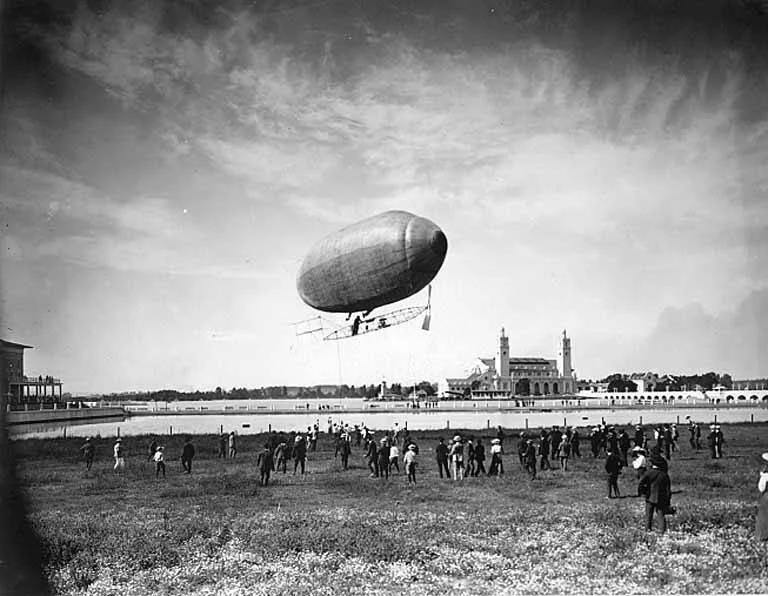
Lincoln Beachey over the Aeronautic Concourse at the Lewis and Clark fair, Portland, 1905. No free picture of the Chamber of Commerce landing was found; the Oregon Historical Society holds one, OrHi 47256. Photographer unknown, 1905, public domain, via Wikimedia Commons. 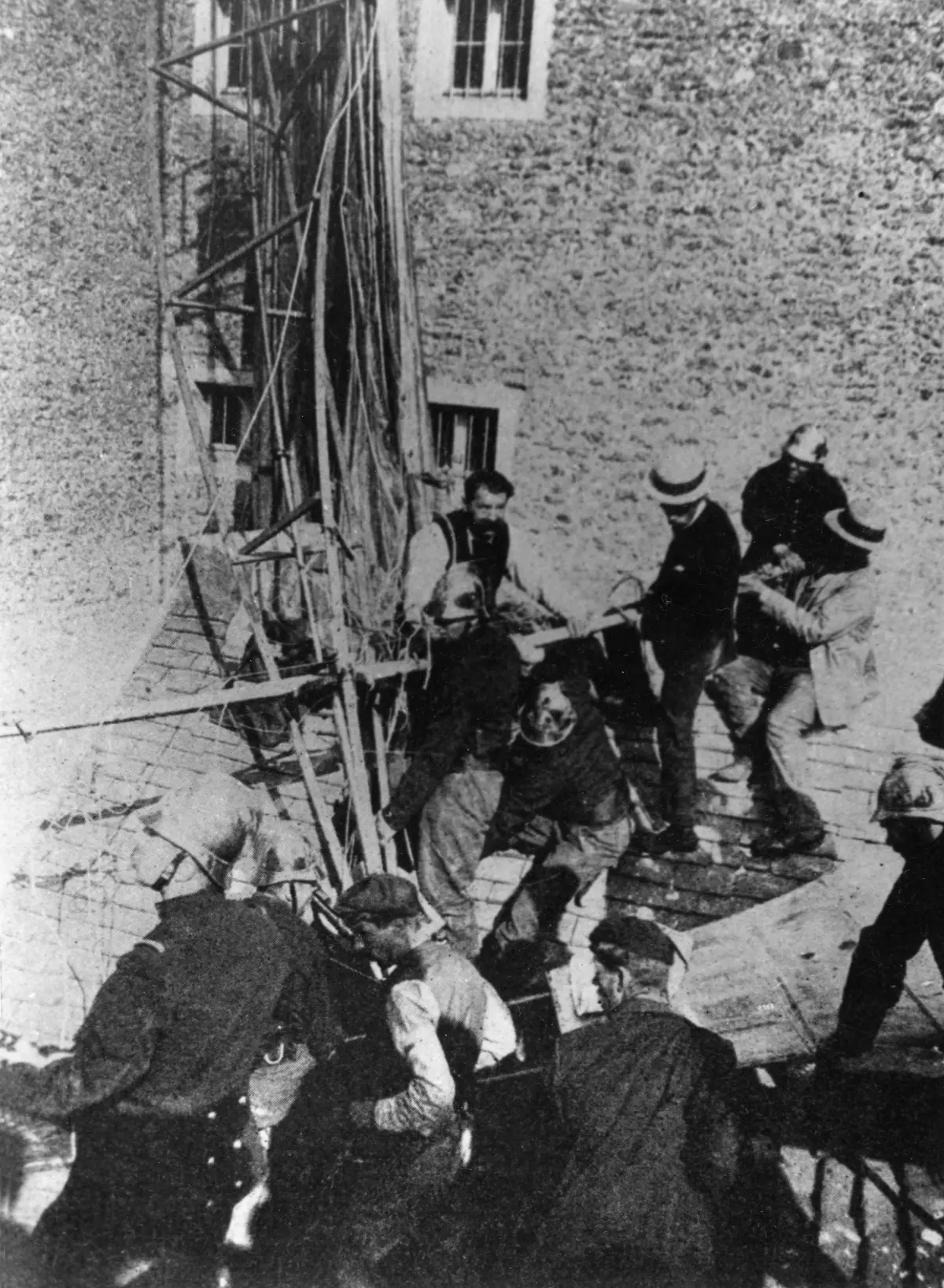
Paris firemen working Santos-Dumont free of the wreck at the Trocadero hotels, 1901. The Dutch caption says the piano wire of his cables held him. Spaarnestad Photo, 1901, public domain, via Wikimedia Commons. 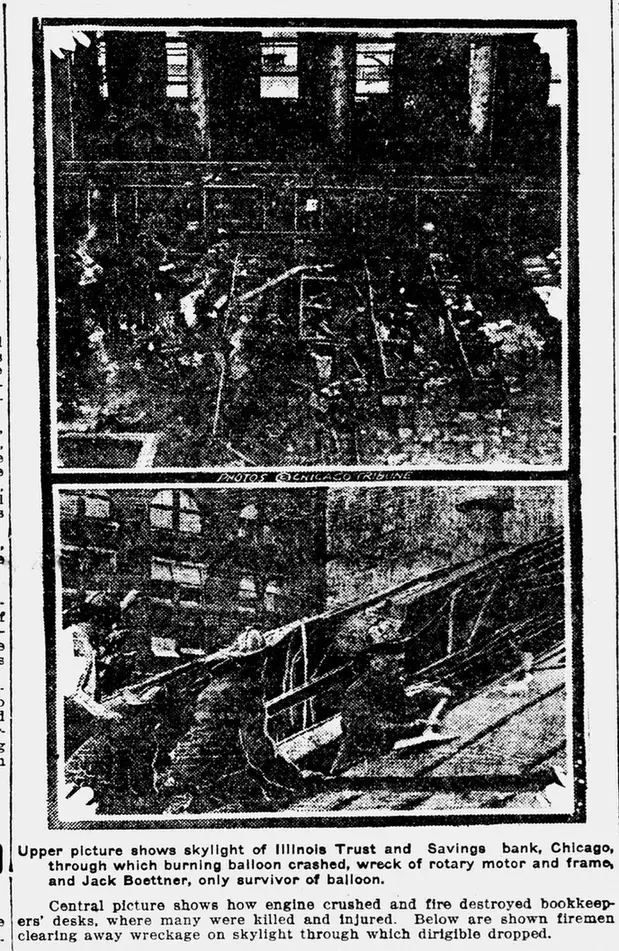
Inside the Illinois Trust and Savings Bank after the crash, from a newspaper of 24 July 1919. Its caption calls Jack Boettner the only survivor of the balloon; another crewman, Harry Wacker, also lived. The Richmond Palladium and Sun-Telegram, 24 July 1919, public domain, via Wikimedia Commons. 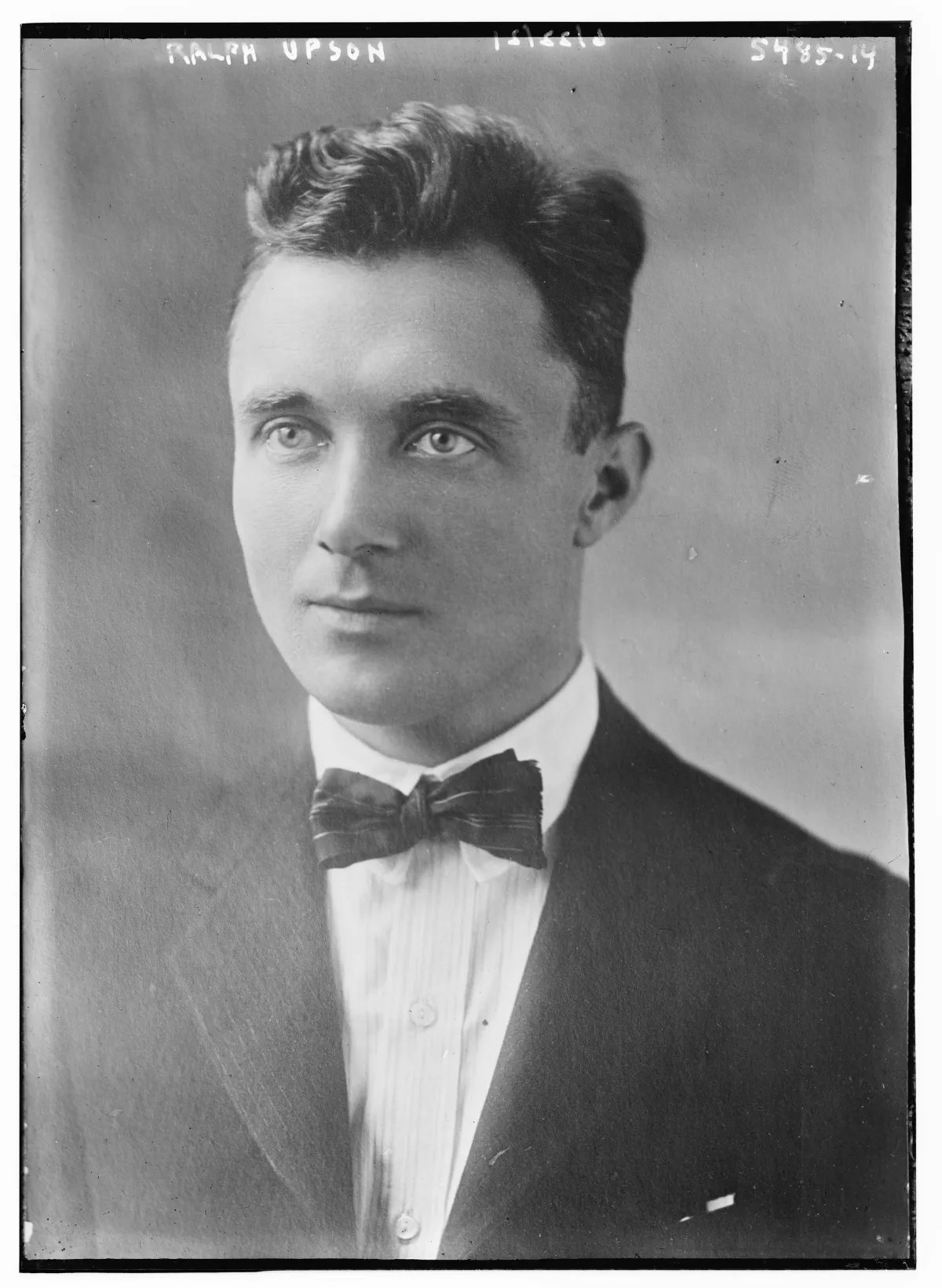
Ralph Upson, the Goodyear engineer behind the Statler flight and the plan for the roofs of the tallest hotels. The portrait is undated. Bain News Service, Library of Congress, LCCN 2014712742, public domain, via Wikimedia Commons. 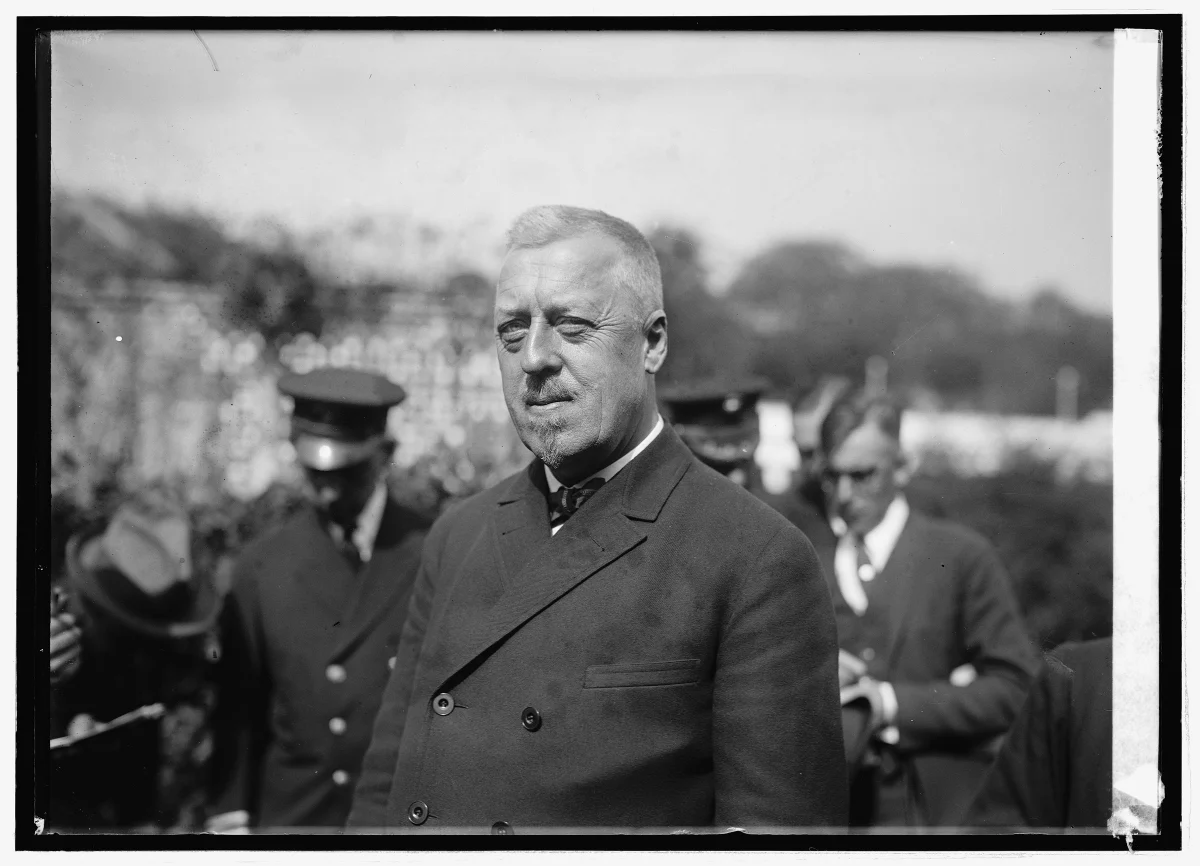
Hugo Eckener on 16 October 1924, the date on the negative. He called the Empire State mast impractical: landings took scores of ground crew. National Photo Company, 16 October 1924, Library of Congress, LCCN 2016849665, public domain, via Wikimedia Commons. 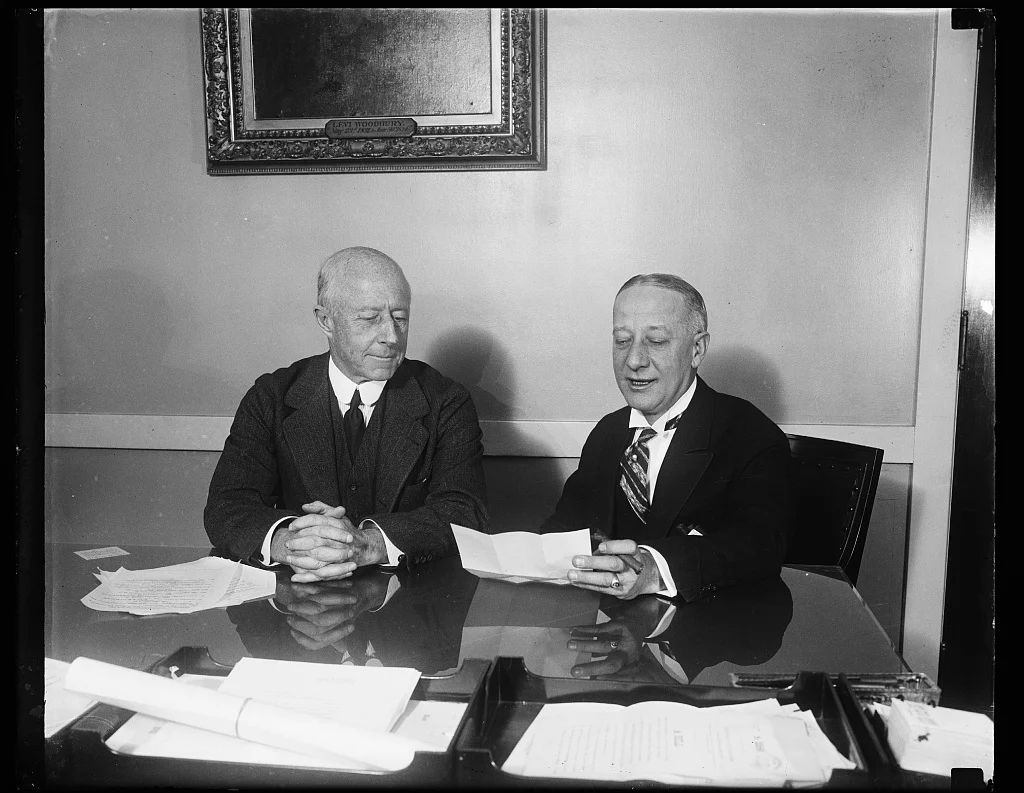
Alfred E. Smith with the Secretary of the Navy, Charles Francis Adams, in December 1929, asking for Navy engineers for the mast. Harris and Ewing, December 1929, Library of Congress, LC-DIG-hec-35633, no known restrictions. 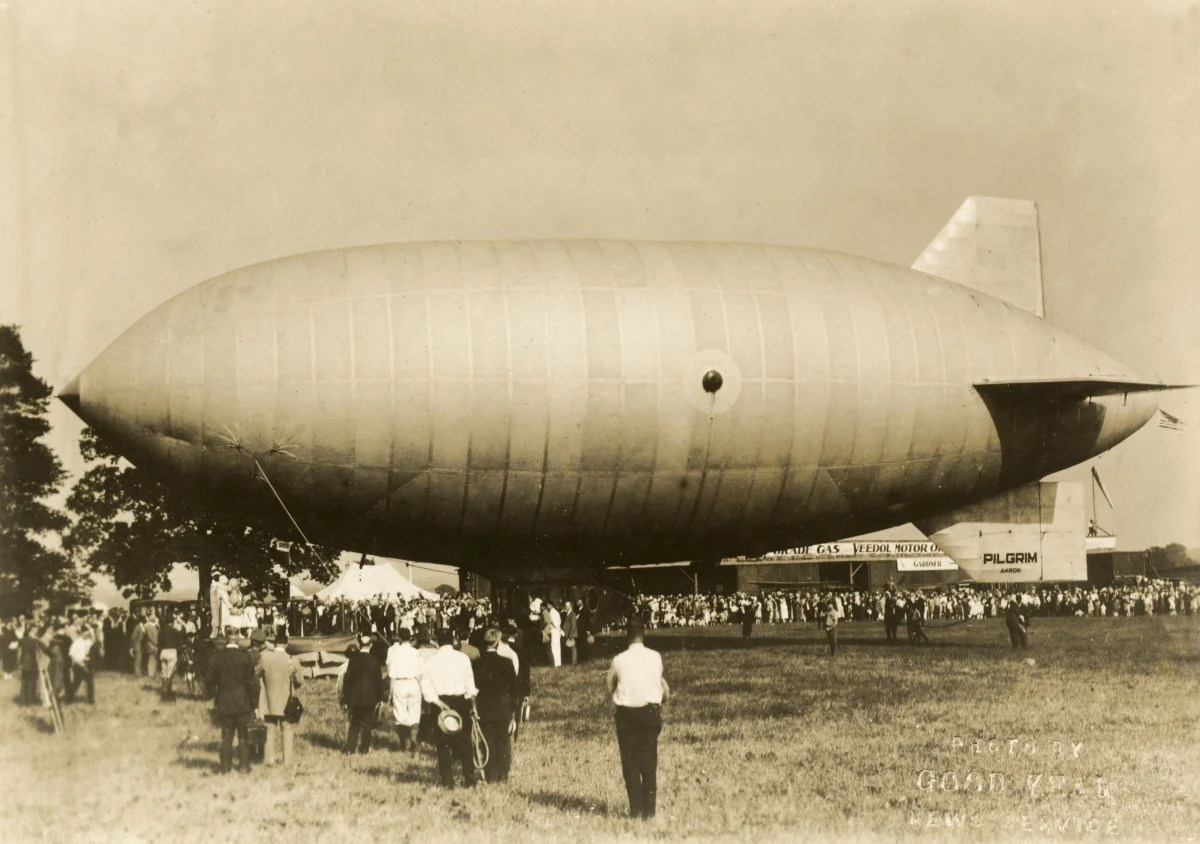
The Pilgrim on a field in the 1920s, with a crowd and the small car under the bag. Spaarnestad Photo, 1920s, public domain, via Wikimedia Commons. 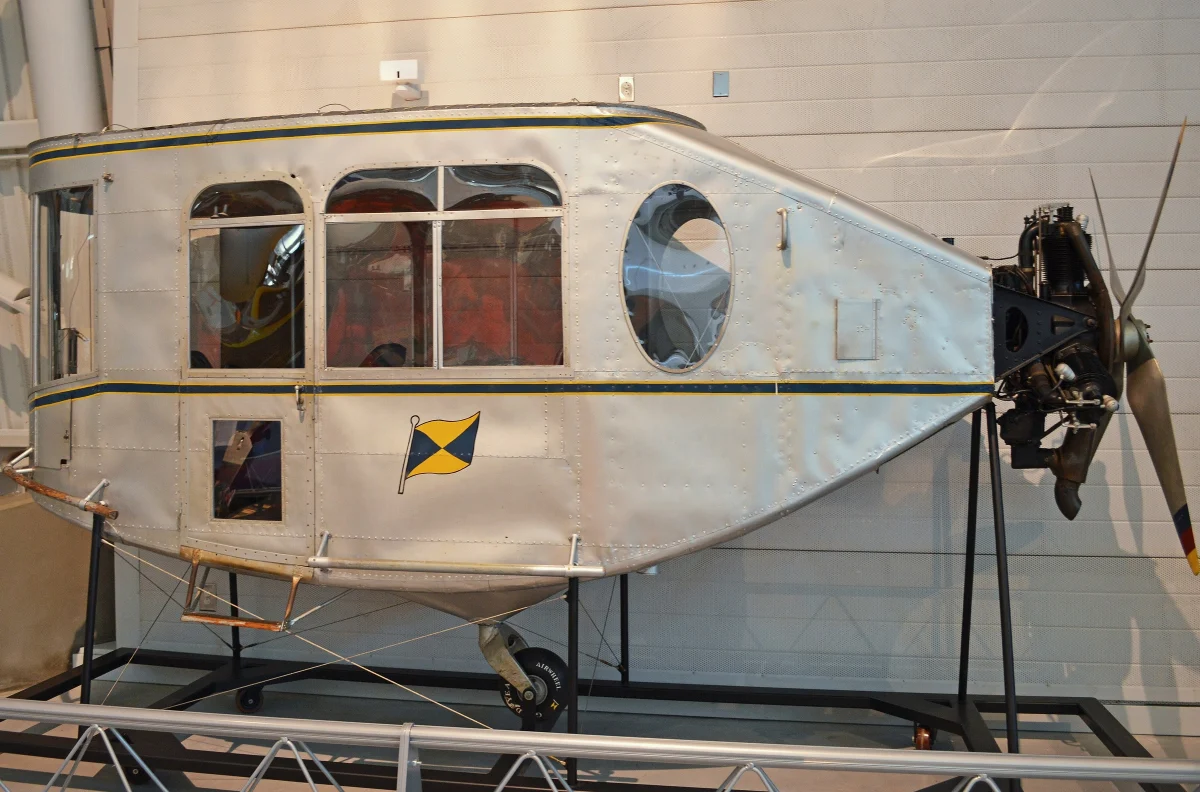
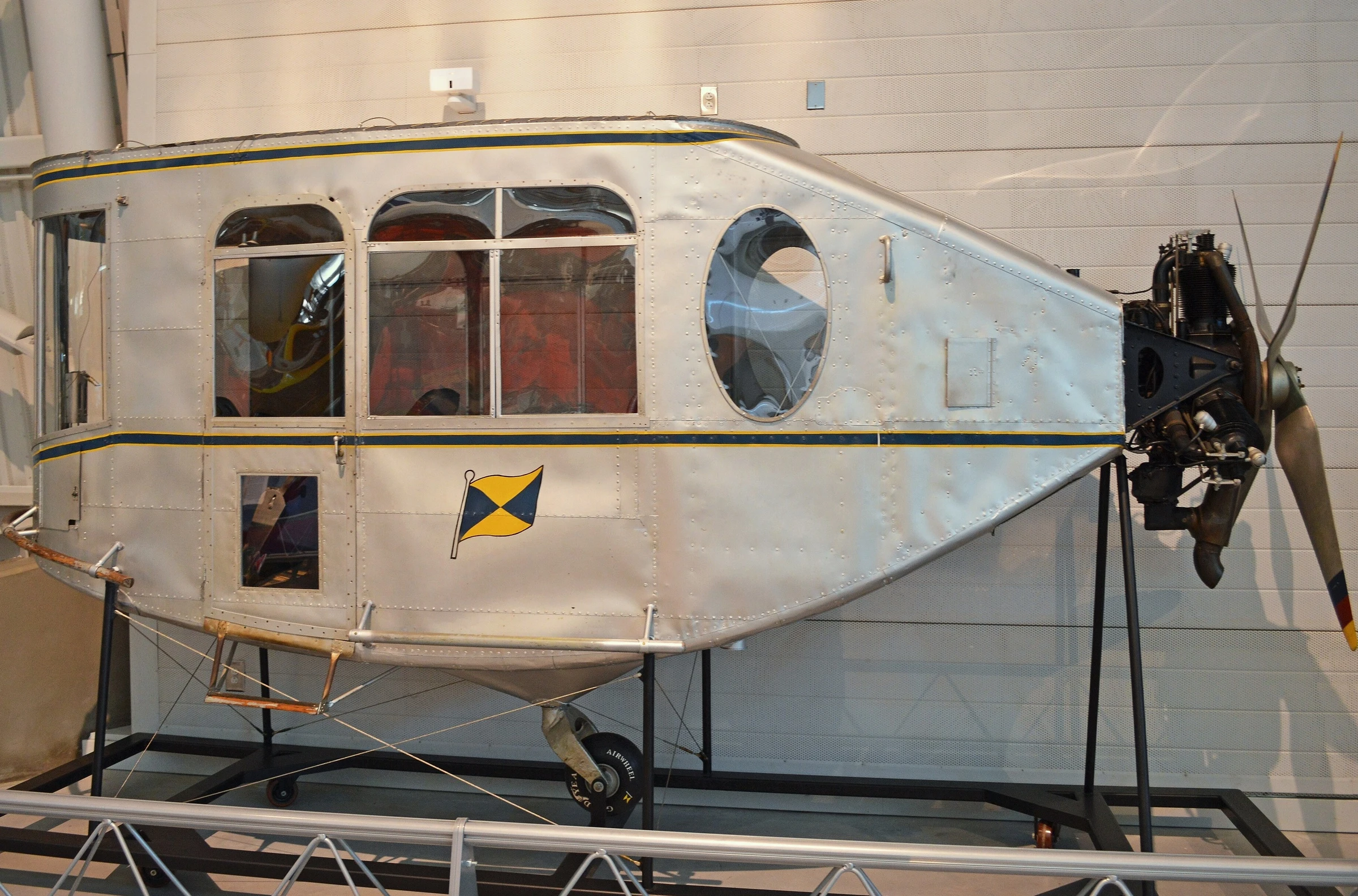
The Pilgrim's gondola as it survives, photographed on display in 2015: the cabin that sat on O'Neil's roof. Photo: Alan Wilson, CC BY-SA 2.0 (creativecommons.org/licenses/by-sa/2.0), via Wikimedia Commons. Cropped. 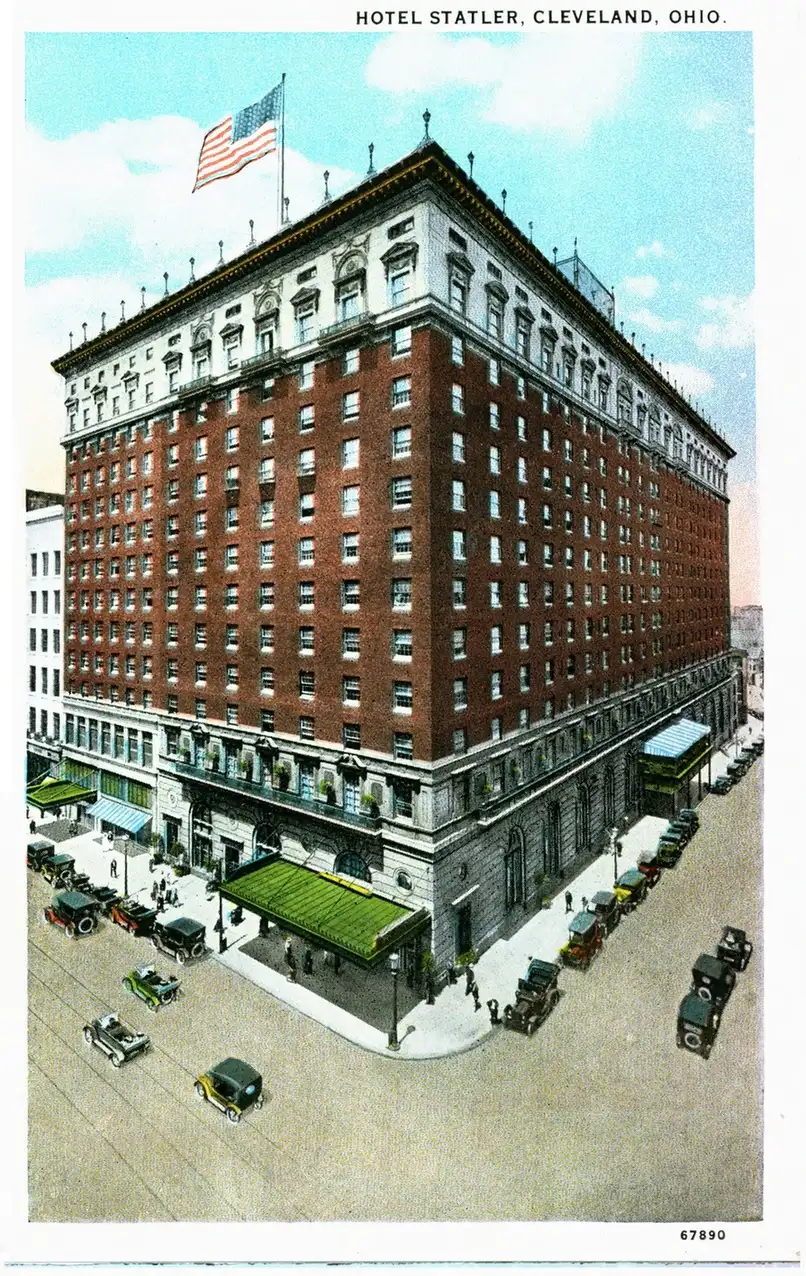
The Hotel Statler, Cleveland, on a postcard. No record found says how long the 1919 platform stayed on its roof. Postcard, undated, no restrictions, DPLA via Wikimedia Commons. 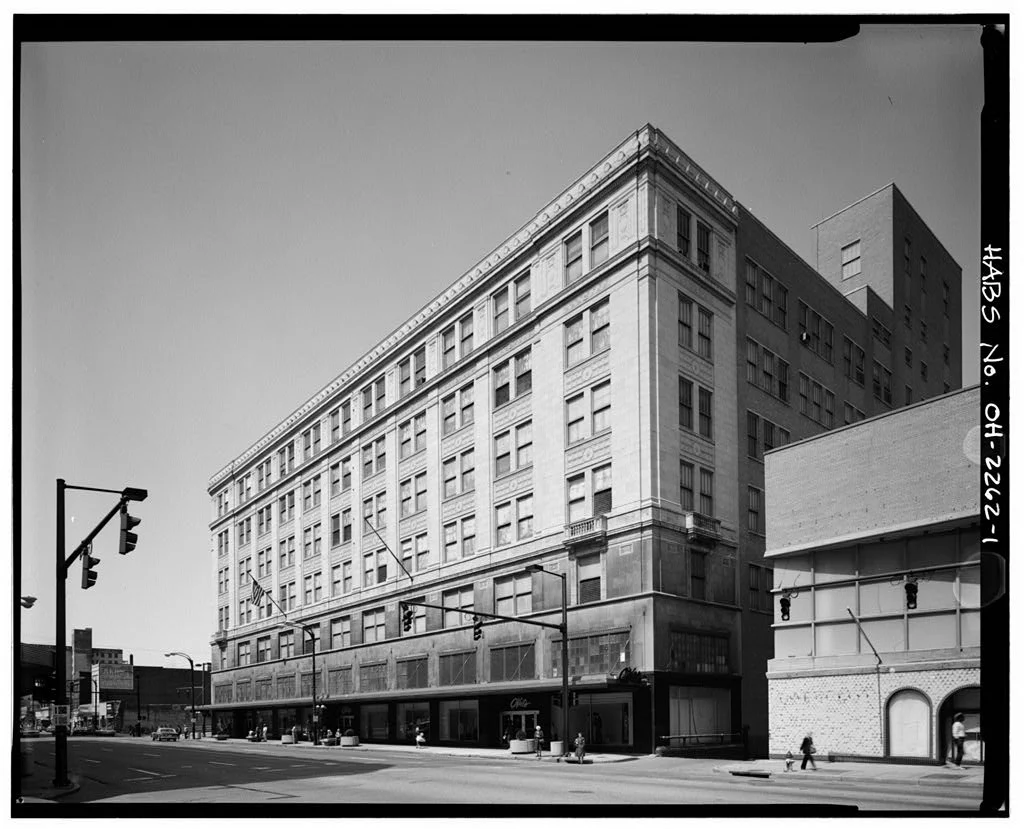
The M. O'Neil Company building at 226 South Main Street, Akron, in the Historic American Buildings Survey. Historic American Buildings Survey, Library of Congress, public domain, via Wikimedia Commons.
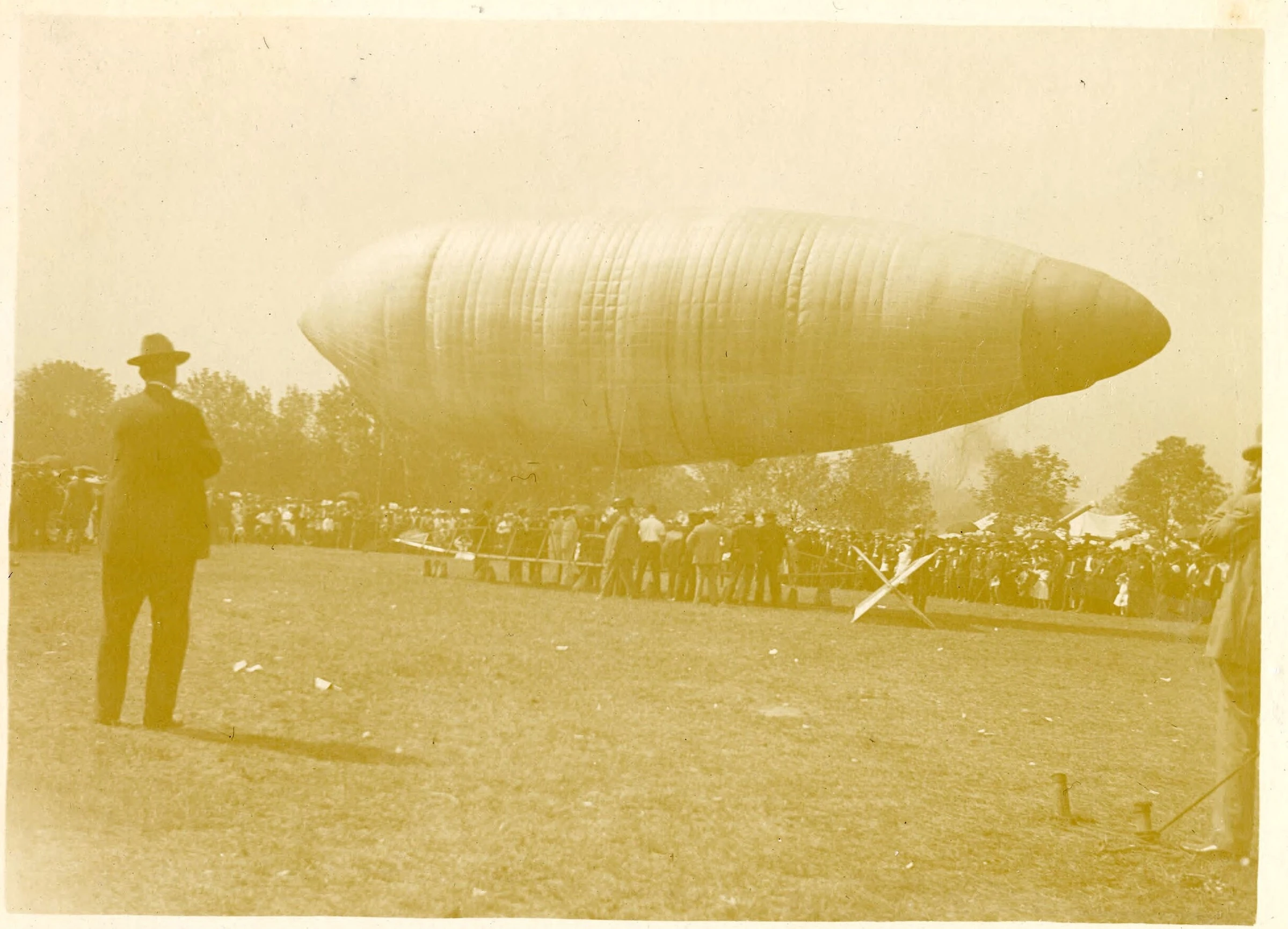
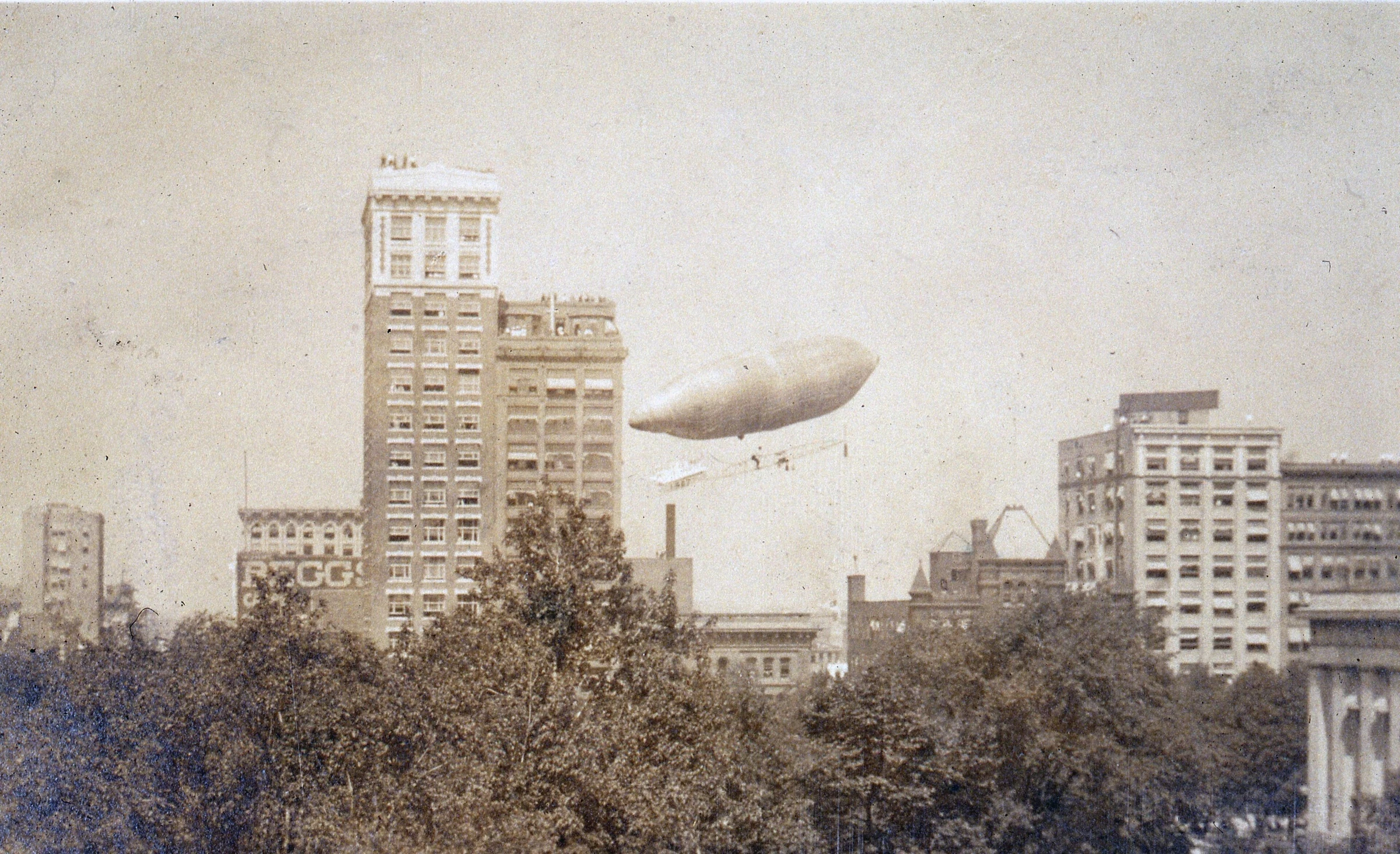
Select a photograph to see it full size, with its caption and credit.
Sources
- Bill Welker, Airship Landings on Buildings, Then and Now welweb.org Study
- Bill Welker, Army A-4, Then and Now welweb.org Study
- Bill Welker, Knabenshue Toledo No. 1, Then and Now welweb.org Study
- welweb.org home page Bill Welker Study
- The Sun (New York), 1 July 1905, third edition, p. 3 Library of Congress, Chronicling America Primary record
- The Washington Times, 1 July 1905, p. 7 Library of Congress, Chronicling America Primary record
- Nathan Havenner, A. Roy Knabenshue's Toledo No. 1 Takes Flight, Ohio Magazine, June 2023 Ohio Magazine Study
- The San Francisco Call, 27 September 1905, p. 3 Library of Congress, Chronicling America Primary record
- Los Angeles Herald, 27 September 1905, p. 1 Library of Congress, Chronicling America Primary record
- Dirigible Lands on Chamber of Commerce Bldg., 1905, OrHi 47256 Oregon History Project, Oregon Historical Society Study
- Los Angeles Herald, 21 October 1905, p. 14: Sails Away From Police in Airship Man Angel Library of Congress, Chronicling America Primary record
- Bill Kemp, Airship pays visit to downtown Bloomington in 1910 McLean County Museum of History Study
- Klemm's Department Store Collection, finding aid McLean County Museum of History Primary record
- George E. Yager, with Chirp of 1 April 1950 Early Aviators, reproducing the Early Birds' Chirp Study
- The Washington Daily News, 22 June 1928, p. 13 Library of Congress, Chronicling America Primary record
- South Bend News-Times, 23 June 1928 Library of Congress, Chronicling America Primary record
- Evening Star (Washington), 5 October 1928, p. 2: Little Dirigible Lands Atop Roof Library of Congress, Chronicling America Primary record
- The Washington Daily News, 5 October 1928, p. 4: School Dismissed to Watch Blimp Land on Roof Library of Congress, Chronicling America Primary record
- Evening Star, 14 October 1928 Library of Congress, Chronicling America Primary record
- Evening Star, 27 September 1928 Library of Congress, Chronicling America Primary record
- How Do You Board an Airship?, 8 January 2023 Tartaria Britannica Primary record
- The Goodyear Blimp and the Future of the Past, 11 July 2026 Tartaria Britannica Primary record
- Zeppelin Poseurs: Why Chicago's Airship Dreams Never Took Off, 2016 WBEZ Curious City Study
- The Washington Times, 14 June 1919, p. 3 Library of Congress, Chronicling America Primary record
- The Washington Herald, 4 June 1919, p. 2 Library of Congress, Chronicling America Primary record
- New Britain Herald, 30 May 1919, p. 10 Library of Congress, Chronicling America Primary record
- Perth Amboy Evening News, 4 June 1919, p. 7 Library of Congress, Chronicling America Primary record
- Dan Grossman, Alabama pretends it had a dirigible mooring mast on a hotel Airships.net Study
- Christopher Gray, Not Just a Perch for King Kong, New York Times, 23 September 2010, excerpt Buffalo Architecture and History Study
- Alberto Santos-Dumont, My Airships: The Story of My Life, 1904, free full text Project Gutenberg Primary record
- Wingfoot Air Express crash Wikipedia General reference
- Evening Star, 24 August 1930, p. 2 of the section Library of Congress, Chronicling America Primary record
- John A. (Jack) Boettner Ravenna Schools Study
- Daily Capital Journal (Salem, Oregon), 24 July 1919, p. 1 Library of Congress, Chronicling America Primary record
- The semi-rigid blimp Enna Jettick, just before it made fast for a moment to the Empire State Building mooring mast, 15 September 1931, LC-DIG-ppmsca-51844 Library of Congress, New York World-Telegram and Sun collection Primary record
- Blimp takes mail from Empire State Building - almost, 30 September 1931, LC-DIG-ppmsca-56252 Library of Congress, New York World-Telegram and Sun collection Primary record
- The Washington Daily News, 15 September 1931, p. 7 Library of Congress, Chronicling America Primary record
- The Washington Times, 16 September 1931, p. 5 Library of Congress, Chronicling America Primary record
- Springfield Weekly Republican, 17 September 1931, p. 5 Library of Congress, Chronicling America Primary record
- Rebecca Maksel, Docking on the Empire State Building, Air and Space, 1 April 2013 Smithsonian Study
- Empire State Building Mooring Mast, Ten Tops The Skyscraper Museum Study