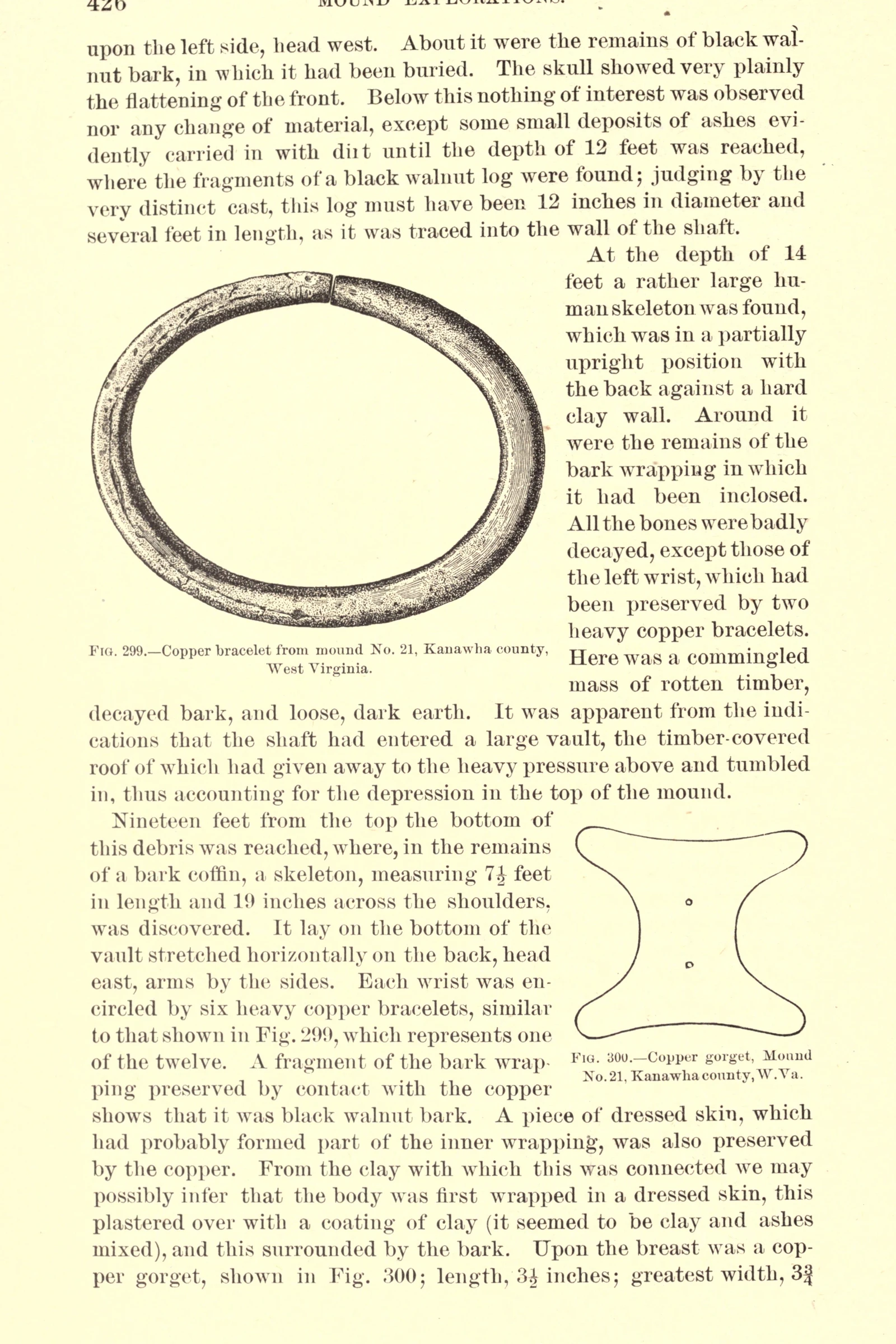
Deep in a government report printed in Washington in 1894, between a drawing of a mound and a list of finds, there is a sentence the argument over ancient giants in America keeps coming back to. The report is Cyrus Thomas's Report on the Mound Explorations of the Bureau of Ethnology, published by the Smithsonian Institution. The sentence is on page 426.
It describes a burial mound in the Kanawha Valley of West Virginia, a cone of earth 35 feet high. Nineteen feet down, in the remains of a bark coffin, lay "a skeleton, measuring 7 1/2 feet in length and 19 inches across the shoulders." It lay on its back, arms by its sides. Six heavy copper bracelets circled each wrist.
On the next page, in a list of what lay beside it, the report calls it "this giant frame."
A passing phrase. But the Smithsonian's own.
A survey built to answer one question
The Smithsonian set up its Division of Mound Studies in 1882, and Cyrus Thomas wrote its great report. The question he put at the head of his report was blunt: "Were the mounds built by the Indians?" For decades writers had credited the great earthworks of the Ohio and Mississippi valleys to a vanished race, and Thomas wrote that settling the question would see "the thousand and one wild theories and romances" disposed of.
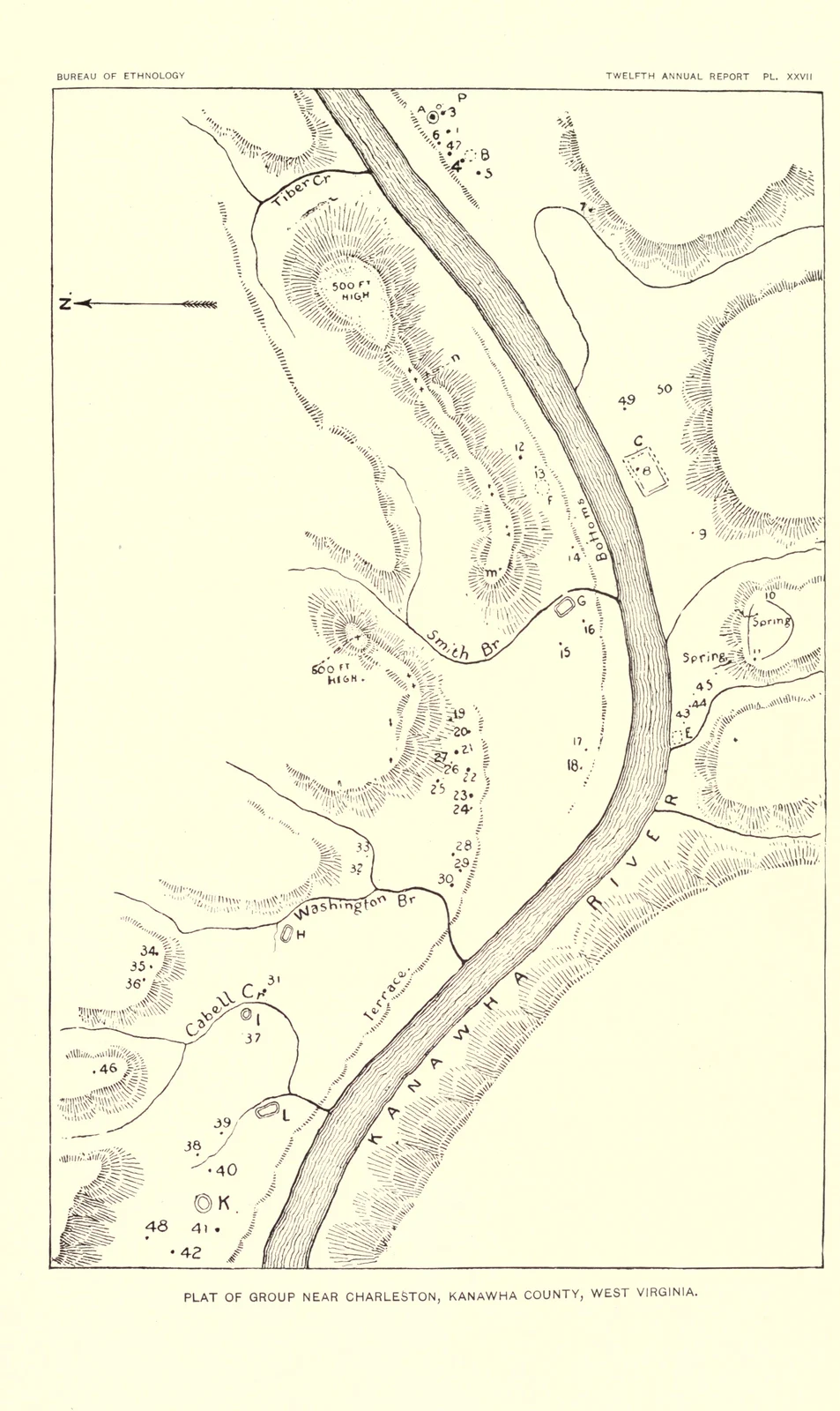
His field men dug across the eastern United States. In the Kanawha Valley, near Charleston, Col. P. W. Norris of the Smithsonian began work in November 1883. The report lists the mounds of that group by number on a plat.
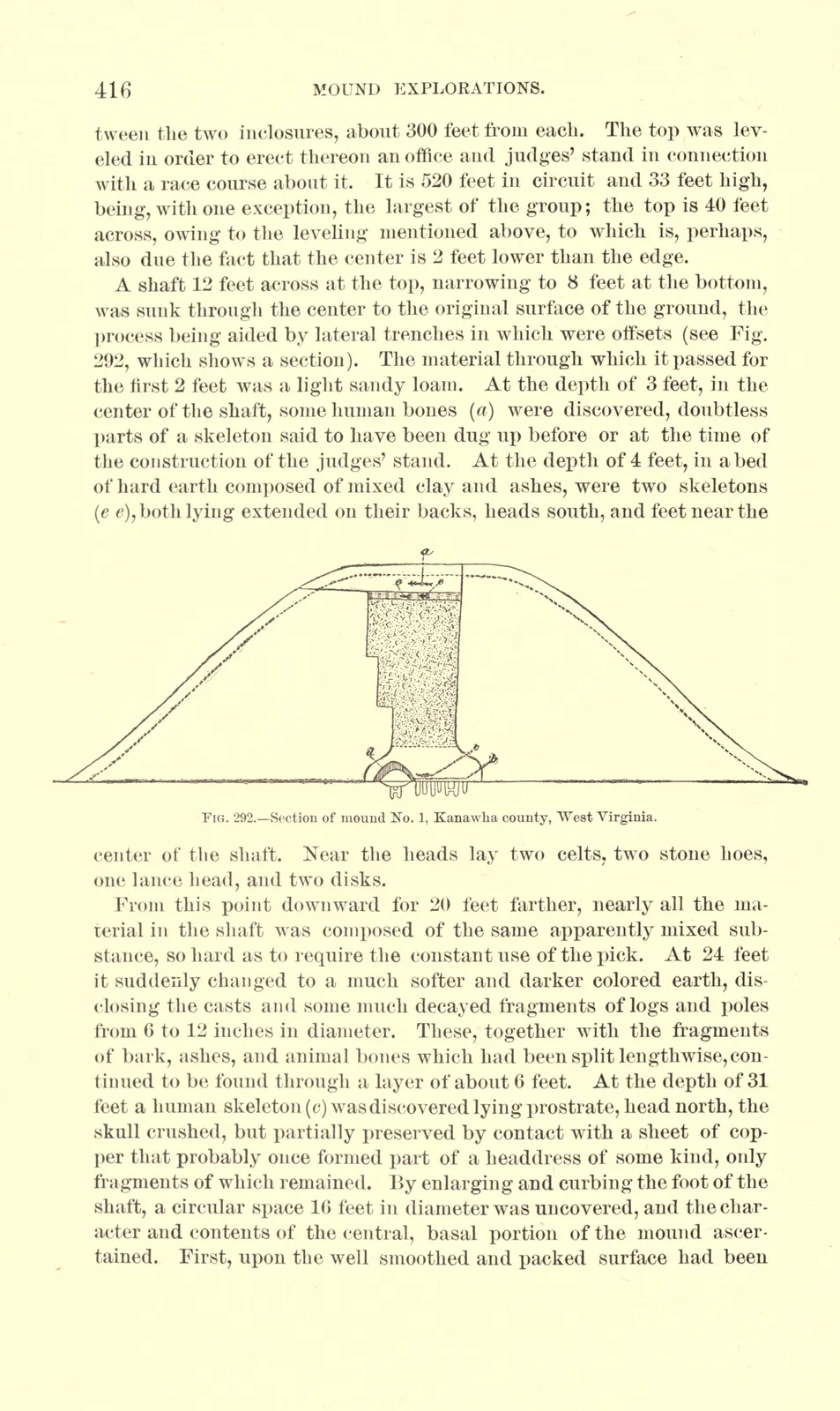
Mound 21, the one the report calls the Great Smith Mound, was "a somewhat regular cone 175 feet in diameter at the base and 35 feet high," raised in two stages. At 14 feet down the diggers found "a rather large human skeleton" sitting upright against a clay wall. At 19 feet they reached a vault 13 feet long and 12 wide, and in it the bark coffin. Four other adults lay in the vault's corners, "of medium size." By each hand of the tall burial were three unused black flint lance heads. Nearby lay a copper gorget, a hematite celt, about a hundred perforated sea shells and three sheets of mica.
Whoever this was, they were buried as someone who mattered.
More than one
The Great Smith skeleton is not alone in the report. In Roane County, Tennessee, on Long Island, a mound held "a very large skeleton, lying horizontally at full length." The diggers measured it in the ground before lifting it: "The length from the base of the skull to the bones of the toes was found to be 7 feet 3 inches. It is probable, therefore, that this individual when living was fully 7 1/2 feet high."
In Pike County, Illinois, a mound packed with burials held one skeleton "rather more than 7 feet long"; the others, the report says, "appeared to be of medium size." In Kanawha Mound 31, "two very large skeletons in a sitting position, facing each other, with their extended legs interlocking to the knees." In the Couch mounds of Mason County, skeletons "many of them very large."
Older reports carry more. The writer Jason Colavito, who doubts the giant case, has collected Smithsonian and Bureau entries of the 1870s and 1880s that describe skeletons "quite 7 feet" and "between 7 and 8 feet."
The giants of Genesis
For many readers these entries are not curiosities. They are confirmation. Genesis says it in one verse: "There were giants in the earth in those days; and also after that, when the sons of God came in unto the daughters of men, and they bare children to them, the same became mighty men which were of old, men of renown." The Hebrew word behind "giants" is Nephilim. In Numbers the spies sent into Canaan come back shaken: "we were in our own sight as grasshoppers, and so we were in their sight." The Book of Enoch gives the giants a history and, in one translation, a stature of "three hundred cubits." A few verses after the giants, Genesis brings the flood, the story older tablets tell too, among them the Flood Tablet George Smith read in 1872.
The modern case gathers the record. Richard Dewhurst's The Ancient Giants Who Ruled America (2013) collected nineteenth-century newspaper reports of giant skeletons and accused the Smithsonian of suppressing the evidence. Jim Vieira and Hugh Newman published Giants on Record in 2015, and in 2014 the History channel ran a six-part series, Search for the Lost Giants, with Jim Vieira and his brother Bill. Gregory Little, in Path of Souls (2014), put the case in numbers: "There were a lot of these tall people, far more than would be expected by chance."
And the record they all come back to is a government report, written by a man whose purpose was the opposite.
If they were giants
Set aside for a moment whether it is true. Ask the better question. What kind of past are we living in if it is?
It would mean that the burial mounds of the Ohio Valley hold the bones of a people of great stature, honoured in copper and mica, and that the government's own survey wrote some of them down.
Which would mean Genesis is reporting, not poetry. The mighty men of old, the people beside whom the spies felt like grasshoppers, would be a fact of the human past, as real as the long-lived kings before the flood in the Sumerian King List are to those who read that list as history.
If they were a people and not a few tall individuals, it would mean our species once had a branch, or a neighbour, that stood a head and more above the rest, and that it was buried here, on this continent, with honour.
And it would mean the question is still answerable. Bones were taken from these mounds. If any of them survive, they can be measured again.
What the report concluded
The standard account, held by the archaeologists of the Bureau and those who came after, is that the mounds were built by the ancestors of Native American peoples, and that the tall burials in the report are tall people, not a separate race.
That was Thomas's conclusion and the Bureau's. Its director, John Wesley Powell, summed it up: the mound-builders "comprised a number of tribes bearing about the same relations and having about the same culture-status as the Indian tribes" Europeans met. Thomas wrote that the supposition of a lost race "aids but little."
In more than 700 pages the very large skeletons are a handful of sentences. In the Criel Mound, the best-known of the Kanawha group, the report says the bones of the ten burials around the central one were too crushed and decayed "to decide positively as to the size," and "It is believed that all were adults of medium size." Popular accounts, among them Legends of America, place a 7 1/2-foot giant in the Criel Mound; in the report that figure belongs to the Great Smith Mound. Tall individuals are found in every population, and the report's figures are field measurements, taken in the 1880s on bones in the ground. As a baseline for the related Hopewell culture of Ohio, a man excavated in 2005 at 5 feet 6 inches sits "near the center of the distribution of documented Hopewell individuals."
One story is separate from the books named above. A viral claim since 2014 that the Smithsonian admitted destroying thousands of giant skeletons was traced by PolitiFact to a website "that publishes fiction and satire." Asked in 2022, a Smithsonian representative told the fact-checker Lead Stories: "Yeah, definitely not."
What the account does not reach
The Great Smith skeleton was recorded with two measurements, its length and the width of its shoulders, 19 inches, lying stretched out on the floor of its vault. The general caution about field measurement applies to it, but no one has shown an error in this case. The Tennessee skeleton was not measured carelessly by the report's own account; the bones were "sufficiently distinct to allow of a careful measurement before attempting to remove them."
Little's argument, that there are more tall burials than chance allows, would be tested by a height distribution for the Adena people of the Kanawha mounds; Official X found none published. Such a study could show how many tall burials there were, not why. Little himself has granted that mound burials may be a selected group, a status class. That is a reason for caution on both sides.
And the bones themselves are out of sight. According to the West Virginia Encyclopedia, all burials and artifacts from the Criel Mound went to the Smithsonian, "where they remain today." A re-measurement of those would not settle the Great Smith question, which concerns a different mound.
No later published measurement of the Great Smith skeleton turned up in this investigation.
Where the mounds stand
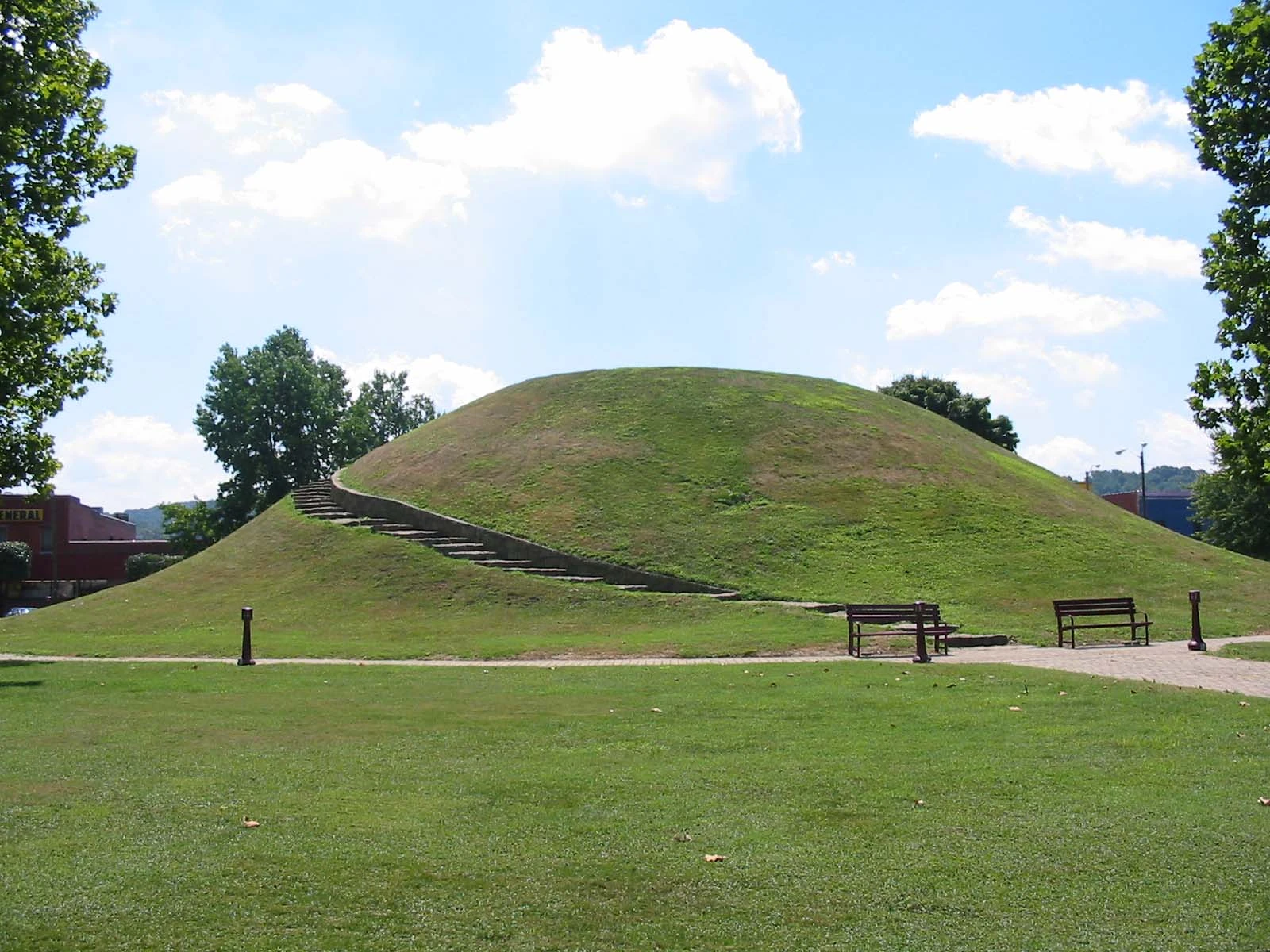
The mounds are still there. The Criel Mound, about 33 feet high, stands in a park in South Charleston, built by the Adena people, who lived along the Ohio and the Kanawha between about 1000 and 200 BC. Up the Ohio, the Grave Creek Mound at Moundsville rises 62 feet, built by the Adena between 250 and 150 BC; in 1838 the Tomlinson family and Thomas Briggs dug into its centre and found a central chamber with two skeletons and a large amount of jewellery.
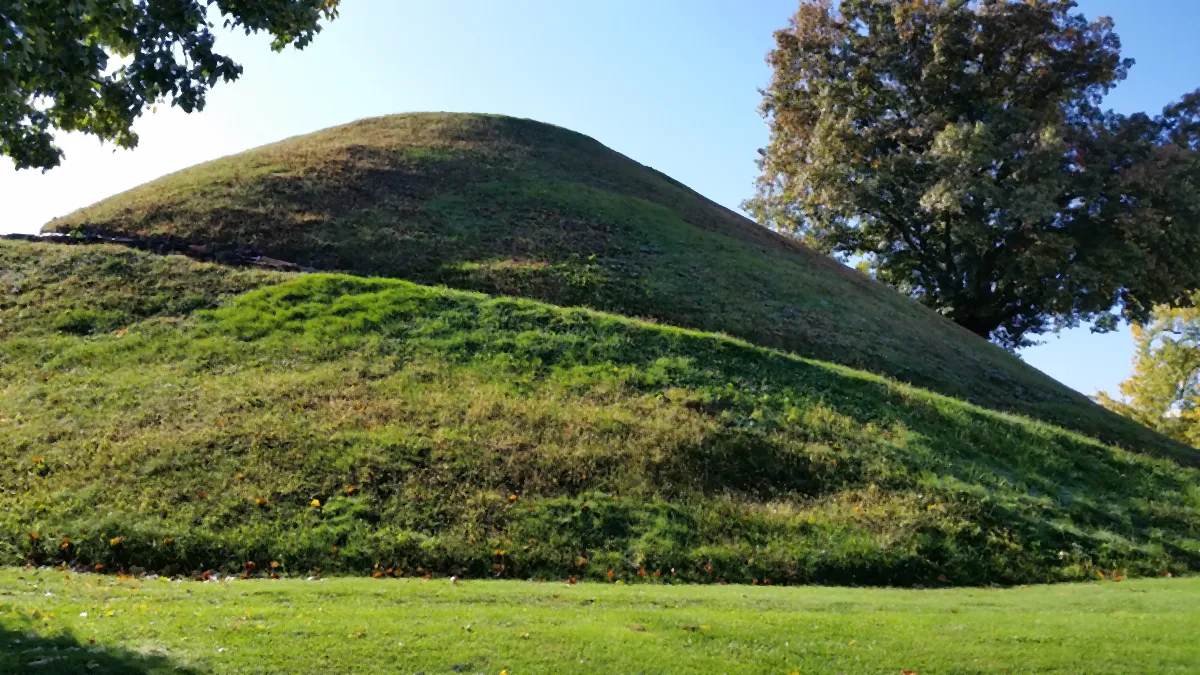
The giants of the newspapers came and went. The one on page 426 has stayed, in a report that set out to close the question of who built the mounds and wrote down, in the same pages, the line the giant case has been quoting ever since.
A bark coffin. Six copper bracelets on each wrist. Seven and a half feet.
The bones went somewhere. The sentence stayed where it was.
Questions This Leaves You With
Is there anything a person actually does with this?
The mounds are open to visit, and the 1894 report is free to read online, page 426 included. Nothing in this asks you to do anything more than look. If you live near the Ohio or Kanawha valleys, the Criel and Grave Creek mounds are public places. Anyone selling a certainty about what lay inside them, in either direction, is selling something. The record is there to be read in its own words, and it is a stranger and richer document than any summary of it.
Does this sit against a religious account of the world?
It cuts both ways, and serious people have argued each. For some readers the tall burials are a confirmation of Genesis 6:4 and the Nephilim; for others, including many people of faith, the giants of scripture are a matter of meaning, not measurement, and need no skeleton. This site will not tell you which way it falls for you. The verses and the report are both short, and both are worth reading slowly, side by side, before deciding what either one says about the other.
Does this change what a human life is?
Hold the Great Smith burial up against your own life. Someone, long ago, was laid in a bark coffin with copper on both wrists and three unused spear points by each hand, in a mound that people, over time and in two stages, raised 35 feet high. Read one way, that is a life reduced to a measurement in a government report. Read the other way, it is a life still being argued over, which few lives are. Which did you feel?
What would change your mind, in either direction?
Name it now, before you are committed. Toward giants: a surviving long bone from one of these burials, measured by an independent laboratory, giving a living height well above seven feet; or a population study of Adena burials showing far more tall individuals than any modern population. Against: the same bones located and measured at an ordinary height, or the field notes behind page 426 showing how the figure was taken and where it went wrong.
Where are the bones from Mound 21?
The report records them. The West Virginia Encyclopedia says the Criel finds, from the same group of mounds, went to the Smithsonian and remain there. Whether the Great Smith skeleton was catalogued, where, and in what state, is not in any source this investigation could find. Repatriation law may now govern what can be done with such remains, and rightly so for the peoples whose ancestors they are. It is a real gap, and a specific one: one catalogue entry, if it exists, would close it.
Sources
- Cyrus Thomas, Report on the Mound Explorations of the Bureau of Ethnology, Twelfth Annual Report of the Bureau of Ethnology (1894) Smithsonian Institution, Bureau of Ethnology (Internet Archive)
- Thomas 1894, page 426 Internet Archive
- Patrick D. Trader, Mound Builders e-WV, The West Virginia Encyclopedia
- Lora Lamarre, South Charleston Mound e-WV, The West Virginia Encyclopedia
- Genesis 6:4 and Numbers 13:33, King James Version Bible Gateway
- 1 Enoch (Wikisource translation) Wikisource
- Jason Colavito on Richard Dewhurst's The Ancient Giants Who Ruled America (2014) Jason Colavito
- Search for the Lost Giants, episode guide (2014) Jason Colavito
- Smithsonian giant reports Jason Colavito
- Andrew White, Gregory Little's book Path of Souls: some preliminary thoughts (2015) Andy White Anthropology
- Giants in West Virginia Legends of America
- Pacheco, Burks and Wymer, Brown's Bottom #1 (2005) Ohio Archaeological Council
- Smithsonian didn't admit to destroying giant human skeletons (3 November 2022) PolitiFact
- Fact check: Smithsonian did not destroy giant skeletons (3 August 2022) Lead Stories
- Mounds and Mound Builders West Virginia Archives and History