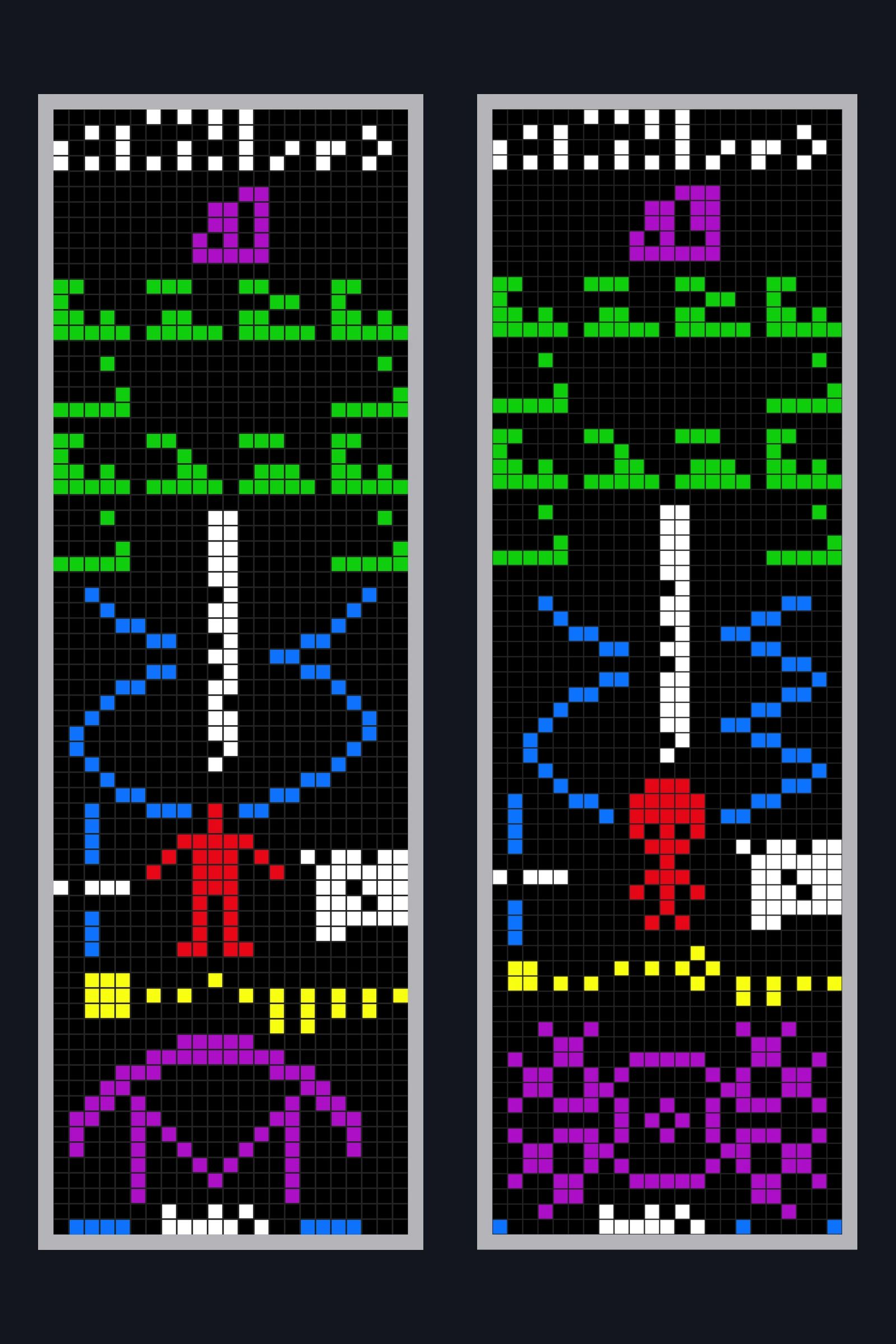
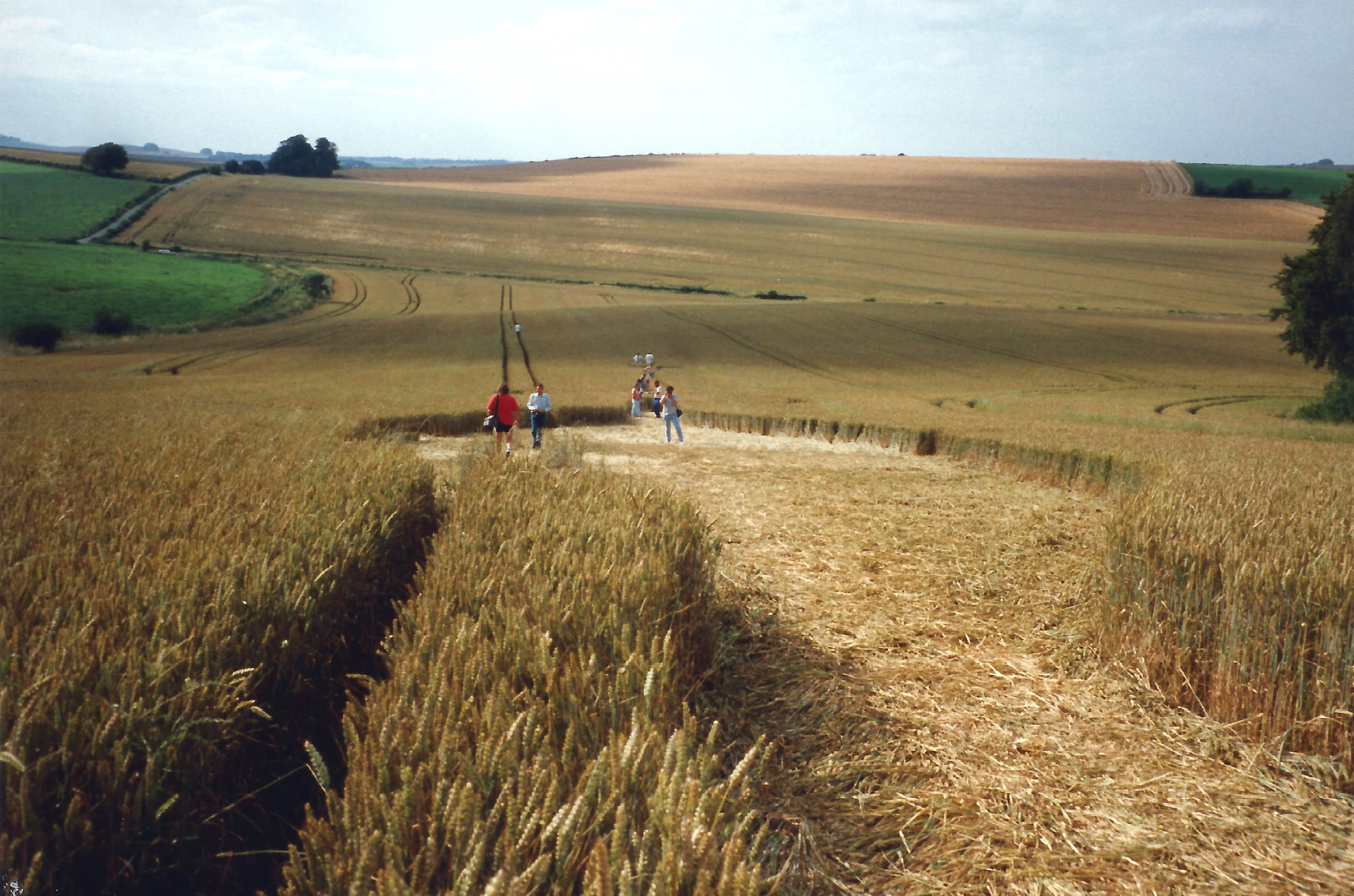
The Chilbolton formation is a rectangle of flattened wheat that appeared in August 2001 in a field beside the Chilbolton Observatory, a radio telescope in the chalk country of Hampshire, in southern England. It is a picture made of squares, and it is a picture of a message.
At the field's edge there is almost nothing to see. Stalks bent flat in some places, standing in others, a pattern too large to read from the ground. From the air it resolves, and the shape is unmistakable: a long panel of blocks laid out in rows and columns, like a page of print enlarged until each square is about two feet across.
Beside the farmland, a dish 25 metres wide points at the sky. It has stood there since 1967, and it is used now for atmospheric radar and space research.
The pattern in the wheat was laid out like the message humanity sent to the stars in 1974, line for line, square for square.
Not the same message.
A different one.
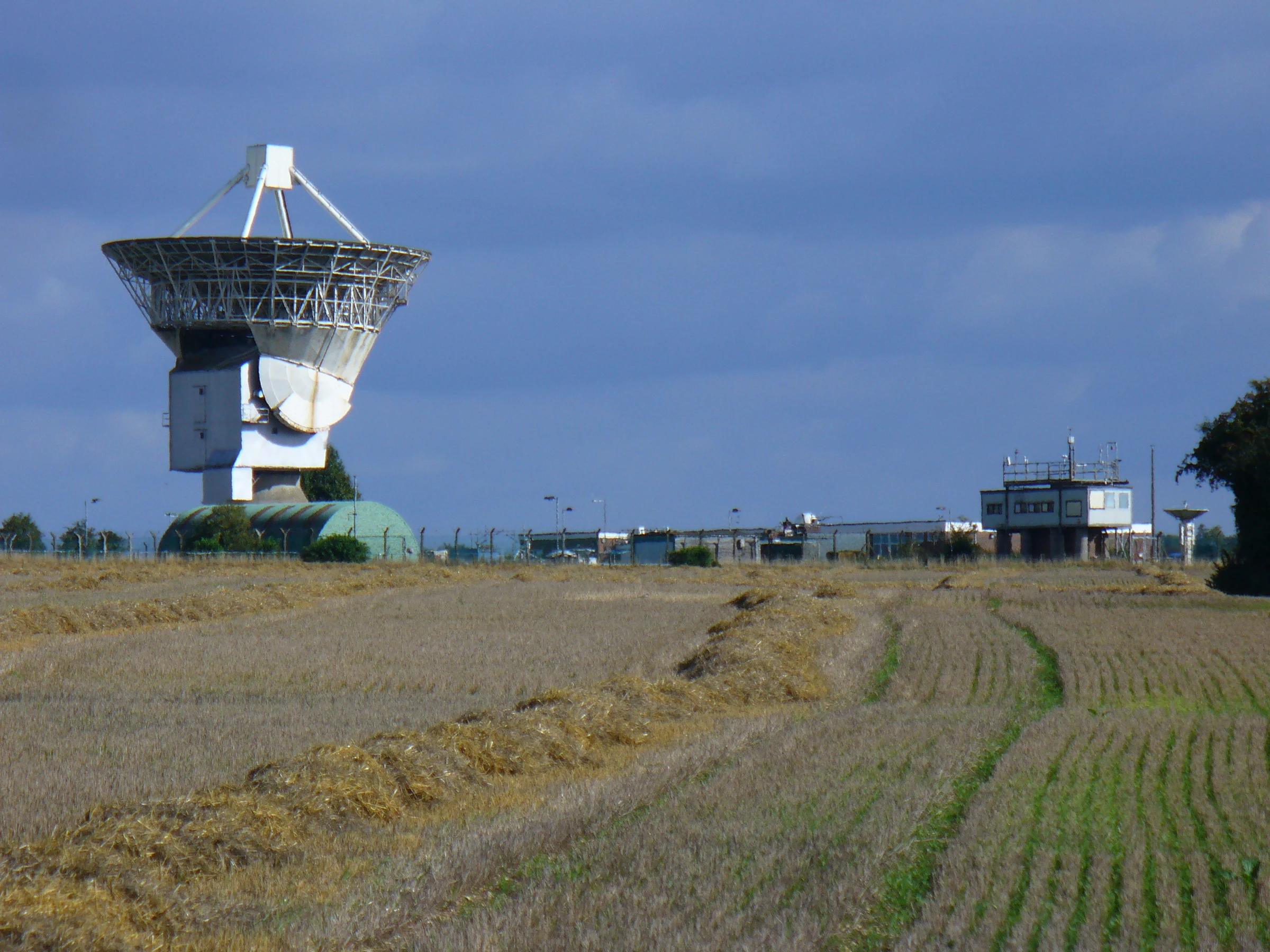
A grid in a Hampshire field
The first shape appeared in the same week, on or about 14 August 2001: a face, built of dots of standing wheat like a newspaper photograph seen through a magnifying glass. Then, on 19 or 20 August, the rectangle. Reports were going out by 21 August. Accounts of its size vary, from about 120 feet long to about 200.
The man who read the rectangle was Paul Vigay, a Hampshire crop formation researcher. He is credited with being the first to recognise the layout, and he wrote up his decoding after visiting the field. The panel was 23 squares wide and 73 long. In the log the makers' group Circlemakers kept that month, Vigay is quoted on why those two numbers matter: "1679 is the unique product of two prime numbers; 23 and 73."
Which means the grid could be laid out only one way. And that number, 1,679, was the length of a message Earth had already sent.
On the afternoon of 16 November 1974, at a ceremony to mark the upgrade of the great radio telescope at Arecibo in Puerto Rico, the astronomer Frank Drake and his colleagues, with help from Carl Sagan, beamed 1,679 binary bits at the frequency of 2380 megahertz toward the star cluster M13, about 25,000 light-years away. Laid out as 23 columns by 73 rows, the bits made a picture: the numbers one to ten, the atomic numbers of the elements in DNA, the double helix, a human figure with its height and the population of the Earth, the Sun and its planets, and the dish that sent it.
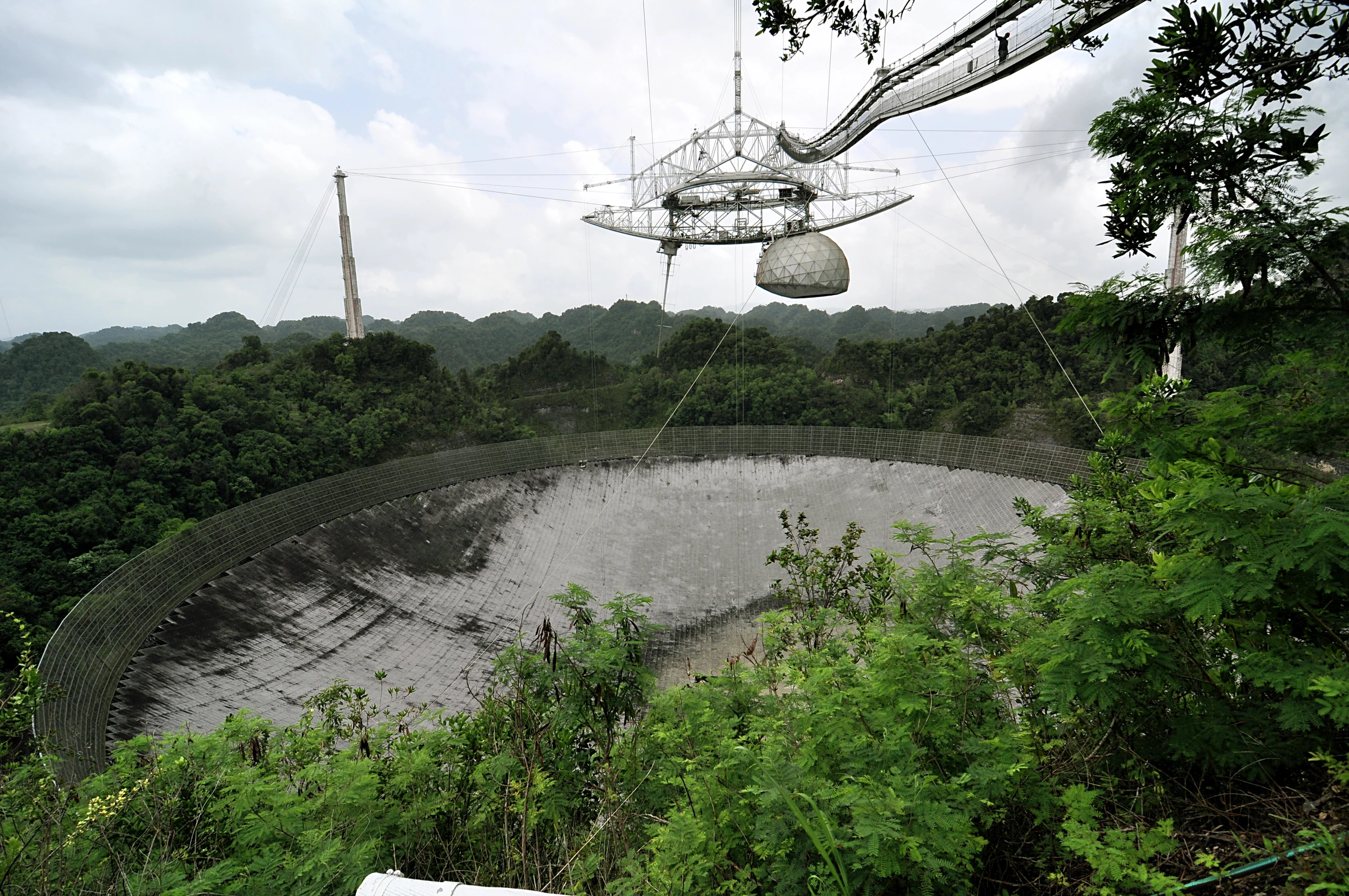
Vigay set the Chilbolton rectangle beside it, row by row. The numbers were the same.
The rest had been rewritten.
Nine corrections
On Vigay's reading, the wheat answered the 1974 message line for line. To the five elements of the original, it added a sixth: silicon. The helix of DNA was redrawn, with a strand changed on one side. The human figure was gone; in its place stood a smaller figure with a large, rounded head. The marks giving its height were fewer. In the row of planets, where the 1974 message raises the third planet, Earth, toward the figure, the Chilbolton pattern raises three: the third, the fourth and the fifth, the fifth drawn as a small cross of dots. And at the foot, where Drake's team drew the Arecibo dish, the wheat drew a different shape: the outline of a formation that had appeared in the same field in August 2000.
Doug Rogers of Newtown, Connecticut, the US network coordinator of the Centre for Crop Circle Studies, counted nine corrections and read the figure's height as 3 feet 4 inches and the population line as 12.3 billion. He told the Newtown Bee in October 2001 that it was "a genuine design, not put together by pranksters."
The story spread at speed. Reuters carried Vigay's analysis; it went out on American radio and television. Art Bell's overnight radio show in the United States came back to it night after night that August, with Richard Hoagland presenting research from Colin Andrews, Vigay and himself, and Bell, as the Circlemakers' log recorded his words, called it "the biggest story this year in the paranormal community." Andrews, who had written Circular Evidence with Pat Delgado in 1989, said of that season: "There's never been a better one, this is by far the pinnacle of the last 20 years."
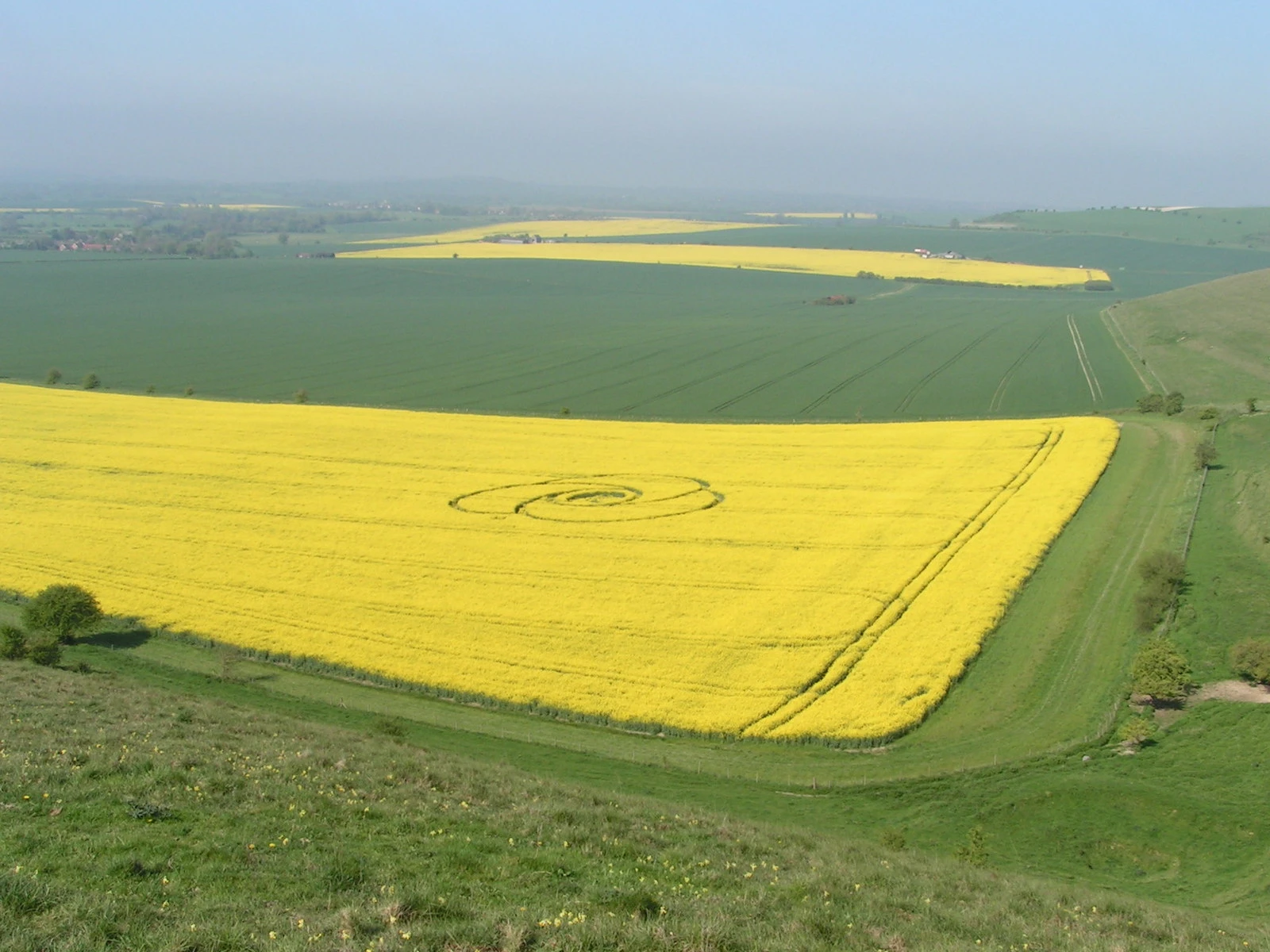
Behind the reply reading stood a body of work on the plants themselves. In 1994 the biophysicist W. C. Levengood published in the journal Physiologia Plantarum a study of stalks from inside formations, reporting stretched growth nodes and other changes he did not find in plants outside them; in 1999 he and Nancy Talbott of the BLT Research Team published a second paper in the same journal. On that work, something happens to the wheat in a formation that a plank and a rope do not explain.
And Vigay drew attention to what any visitor could see: the design could not be read from the ground.
If it was an answer
Set aside for a moment whether it is true. Ask the better question. What kind of universe would it be if it is?
It would mean the message of 1974 was heard, by someone close enough to answer in 27 years. Not by a civilisation in M13, but by someone, somewhere, who knew its format well enough to edit it, and who chose to reply not by radio but in a field beside a radio dish, in a language of squares that only an aircraft could read.
It would mean we are not the only makers of pictures for strangers. The 1974 message was a portrait of our species, sent with no expectation of an answer. A reply that changes the figure, adds silicon and redraws the helix would be a portrait of someone else: shorter, built on a different chemistry, from a world where three planets matter instead of one.
It would mean the long silence that the Wow! signal of 1977 seemed for 72 seconds to break was never silence at all, only listening on the wrong channel. Our species has spent half a century pointing dishes at the sky and waiting for a narrow tone at a single frequency. On this reading the answer came in the most ordinary medium on Earth, a ripening field.
It would mean the strangeness on the radio dial was never the whole story. Radio has carried odd returns before, like the echoes that came back seconds late to listeners in 1928. A reply drawn in a field would make the sky and the ground two halves of one conversation.
And it would leave one question in front of us: if a reply can come in a form nobody was watching for, what else in the record of our own planet was meant to be read?
The plank, the rope and the light
The standard account holds that the Chilbolton formation, like the others, was made by people, and it rests on specific evidence.
On 9 September 1991 the British newspaper Today reported that two men from Hampshire, Doug Bower and Dave Chorley, had been making circles since the late 1970s, by most accounts from 1978, with a plank, a length of rope and a sight made from a loop of wire on a cap. They said they had made more than 200. They made one in front of a Today journalist. Pat Delgado had declared one of their circles genuine before the story broke.
The makers who followed them became an art movement. Circlemakers, founded by John Lundberg and Rod Dickinson, made formations as artwork and on commission through the 1990s, with designs of growing complexity. When a listener suggested on air that Bell get students to reproduce the Chilbolton pattern at night, Bell replied that he did not think they could. The Circlemakers' log, on 30 August, answered: "I know we can."
The plant work was answered in print. In 2005 three researchers of the Italian group CICAP, Grassi, Cocheo and Russo, writing in the Journal of Scientific Exploration, re-examined the Levengood and Talbott results and found only "a mere difference in the stem elongation between the flattened plants" and those standing outside, "as one should expect when whatever kind of mechanical force flattens the plants."
And the physics sets limits on a reply. The 1974 message travels at the speed of light; by August 2001 it had covered about 27 light-years of the 25,000 to M13, about a thousandth of the way. An answer arriving in 2001 would need a listener within about 13 light-years of Earth, replying at once, and the message itself had been published in books and newspapers for anyone on Earth to copy. Seth Shostak of the SETI Institute put the general case in 2011: "Proof of their existence requires more than bent stalks."
What the makers' account does not reach
The makers' account explains how a formation can be made. At Chilbolton it has not explained who made this one.
In twenty-five years, through a season of radio shows, newspaper pages and books, no name has been attached to it.
The searchers did not find the makers.
No maker is on record. The British magazine The Skeptic, in a 2023 article arguing the human case, says so plainly: "Nobody has ever come forward to claim ownership for producing the image in the wheat." Circlemakers, the best-known team in the country, said they could make it and did not say they had.
The design is not trivial either. To lay it out, someone had to know the 1974 message bit for bit, choose which bits to change, and carry a grid of 1,679 cells into a field at night without a single row slipping. On Vigay's and Rogers's readings the changes are not random noise. They hang together: a smaller figure, a different population, a different chemistry, a different home planet, a different transmitter. The design is a deliberate edit of a published message, made with care.
The face is its own puzzle. Circlemakers described it as built from a halftone dot screen, like a printed photograph, not a grid of pixels, and pointed to an earlier halftone formation at All Cannings in Wiltshire that June as its forerunner. The technique had been seen in a field before. That does not say who used it at Chilbolton.
And the record from the observatory is quiet. In its research for this article, Official X found no public statement from the observatory or its operators about the formations. The farmer cut the formation out within a week.
Where it stands
What the record shows is clear enough. In August 2001, in a wheat field beside the Chilbolton dish, two formations appeared within a week: a halftone face, and a 23-by-73 grid that copies the layout of the 1974 Arecibo message and changes its content in a consistent way, the changes first decoded by Paul Vigay.
How it is explained is documented too. People have made formations with planks and rope since the late 1970s, teams have made complex ones as art, the plant studies have been challenged in print, and a radio message cannot have reached M13 and returned. On the weight of that record, the field favours human makers.
What is still open is narrower. Who laid out that grid, and why there, beside that dish, a year after a formation in the same field. The case for a reply now lives in radio archives, newspaper cuttings, the Circlemakers' log and the researchers' books. The pattern survives in photographs and in redrawings like the one at the head of this page.
A maker's sketch, a plan of the grid on paper, a name: any one would go a long way toward closing the question at Chilbolton. An independent study of plants taken from the formation, if any were kept, could say something about how it was flattened, though not who flattened it. None of these is on the public record a quarter of a century later.
The field was cut and sown again. The question was not.
Questions This Leaves You With
Is there anything a person actually does with this?
Not in the sense of a change to your own life. Nobody is waiting for you to answer the field, and nothing about it calls for preparing. But it does hand you a way of looking at evidence. A formation is a message that does not come with its sender attached. Whatever you decide about Chilbolton, you are deciding how much a design can tell you about its designer, and how much it cannot, which is the same question astronomers face with every strange signal, and the same one the 1974 message posed to whoever might receive it.
Does this sit against a religious account of the world?
It has been read both ways. Some see a reply from elsewhere as one more sign that creation is larger and more populated than any one tradition described. Others read the same pattern as a human artwork about longing, a very old impulse to make signs for something greater. Neither reading needs the other to be false. This site will not tell you which way it falls for you, and the wheat does not say.
Does this change what you think a message is?
It might. The 1974 message was a picture of us, made by people who knew it might never be read. The Chilbolton grid, whoever made it, is a picture of someone answering. If it was made by humans, it is a striking piece of art about what an answer would look like: smaller, stranger, built on silicon. If it was not, it would be one of the most important documents ever found. Which of those felt more surprising may tell you where you started, and that is worth knowing before you read anything more about the field.
What would change your mind, in either direction?
Name it now, before you are committed. Toward human makers: a plan of the grid dated before August 2001, a maker who can show how it was laid out, a team reproducing it at the same scale in one night. Toward a reply: an independent laboratory, working blind, finding plant changes in samples from the formation that no flattening produces, or a second reply arriving by a channel that cannot be made by hand, a radio signal in the 1974 format. It also helps to know how such a test works. A blind plant study means the laboratory does not know which samples came from inside the formation and which from the standing crop around it, so the result cannot be steered by expectation.
Why there, and why then?
That is the empty space in this story. Of all the fields in England, this one sits beside a working radio dish, and the rectangle used as its transmitter the shape of a formation that had appeared in that same field a year before. Whoever made it chose the place for what it meant. The field holds the design and not the motive. One reading sees a tribute or a joke aimed at the scientists next door; another sees a reply placed where a radio astronomer could not miss it. The 2000 formation in the same field is part of the puzzle too, because whoever laid out the 2001 grid knew it was there. Nobody on the record has explained the choice.
Sources
- Top of the crops 2001, news log, August-September 2001 Circlemakers
- Linda Moulton Howe (Earthfiles), Chilbolton formations and interview with Paul Vigay, Russian translation Tallinn University of Technology course reading
- Arecibo message (section Chilbolton crop circle) Wikipedia
- Jan Howard, Is Someone Talking Back To Planet Earth?, Newtown Bee, 26 October 2001 The Newtown Bee
- Richard Goodwin, Paul Vigay radio star, The Icon Bar, 28 August 2001 The Icon Bar
- Bill Steele, It's the 25th anniversary of Earth's first attempt to phone E.T., Cornell News, 1999 Cornell University
- Nadia Drake, 40 years ago, Earth beamed its first postcard to the stars, National Geographic, 2014 National Geographic
- Chilbolton Observatory Wikipedia
- Chilbolton Observatory facility page UKRI / STFC
- Alex Boese, This Day in the History of Hoaxes: September 9 Museum of Hoaxes
- Crop circle Wikipedia
- Crop Circles, Psi Encyclopedia Society for Psychical Research
- W. C. Levengood, Anatomical anomalies in crop formation plants, Physiologia Plantarum 92(2), 1994 FAO AGRIS record
- BLT Research Team BLT Research Team Inc.
- CICAP press release on Grassi, Cocheo and Russo, Journal of Scientific Exploration 19(2), 2005 CICAP
- Nick Garratt, The Arecibo Reply, The Skeptic, 22 November 2023 The Skeptic (UK)
- Seth Shostak, Signs, SETI Institute, 2011 SETI Institute