Every story of Atlantis, every map, every search of the sea floor, goes back to one source: two dialogues written by the Athenian philosopher Plato, the Timaeus and the Critias. No earlier text that survives names it. In them a speaker describes an island in the Atlantic, beyond the straits the Greeks called the Pillars of Heracles, "larger than Libya and Asia put together," the seat of a sea empire that tried to conquer the Mediterranean world.
Its capital stood on a hill ringed by water. Two rings of land and three of sea, cut round it "as with a lathe," crossed by bridges and a canal. Walls coated in brass and tin, and the inner wall flashing "with the red light of orichalcum," a metal the speaker says was then more precious than anything but gold.
Then, "in a single day and night of misfortune," the island "disappeared in the depths of the sea."
Plato's speaker says it is true. He says it more than once.
A boy of ten and an old man of ninety
The speaker is Critias, and he tells the story as family history. He heard it as a boy. "Critias, at the time of telling it, was, as he said, nearly ninety years of age, and I was about ten," he says of his grandfather, at the festival of the Apaturia. The grandfather had it from Solon, the Athenian lawgiver, "the wisest of the seven sages."
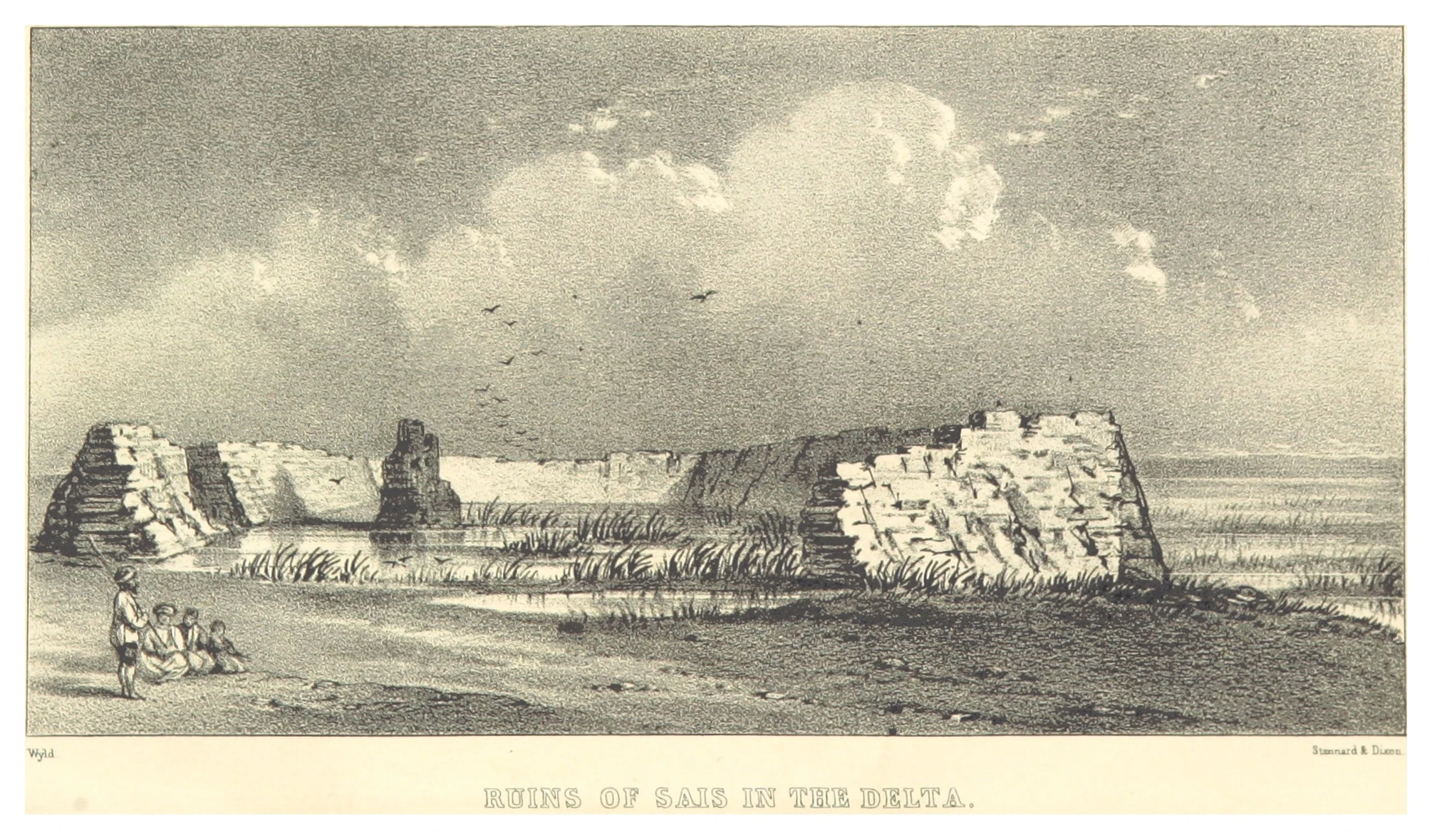
Solon had it from Egypt. In the Nile Delta, Critias says, lies "the district of Sais," whose goddess, Neith, the Egyptians held to be the same as the Greeks' Athene. There an old priest told Solon: "O Solon, Solon, you Hellenes are never anything but children, and there is not an old man among you." Floods and fires, the priest said, keep wiping out Greek memory, but in Egypt everything "has been written down by us of old, and is preserved in our temples."
The priest gave numbers. The constitution of Sais was "recorded in our sacred registers to be 8000 years old." The Athens that fought Atlantis was older still: "your citizens of 9000 years ago."
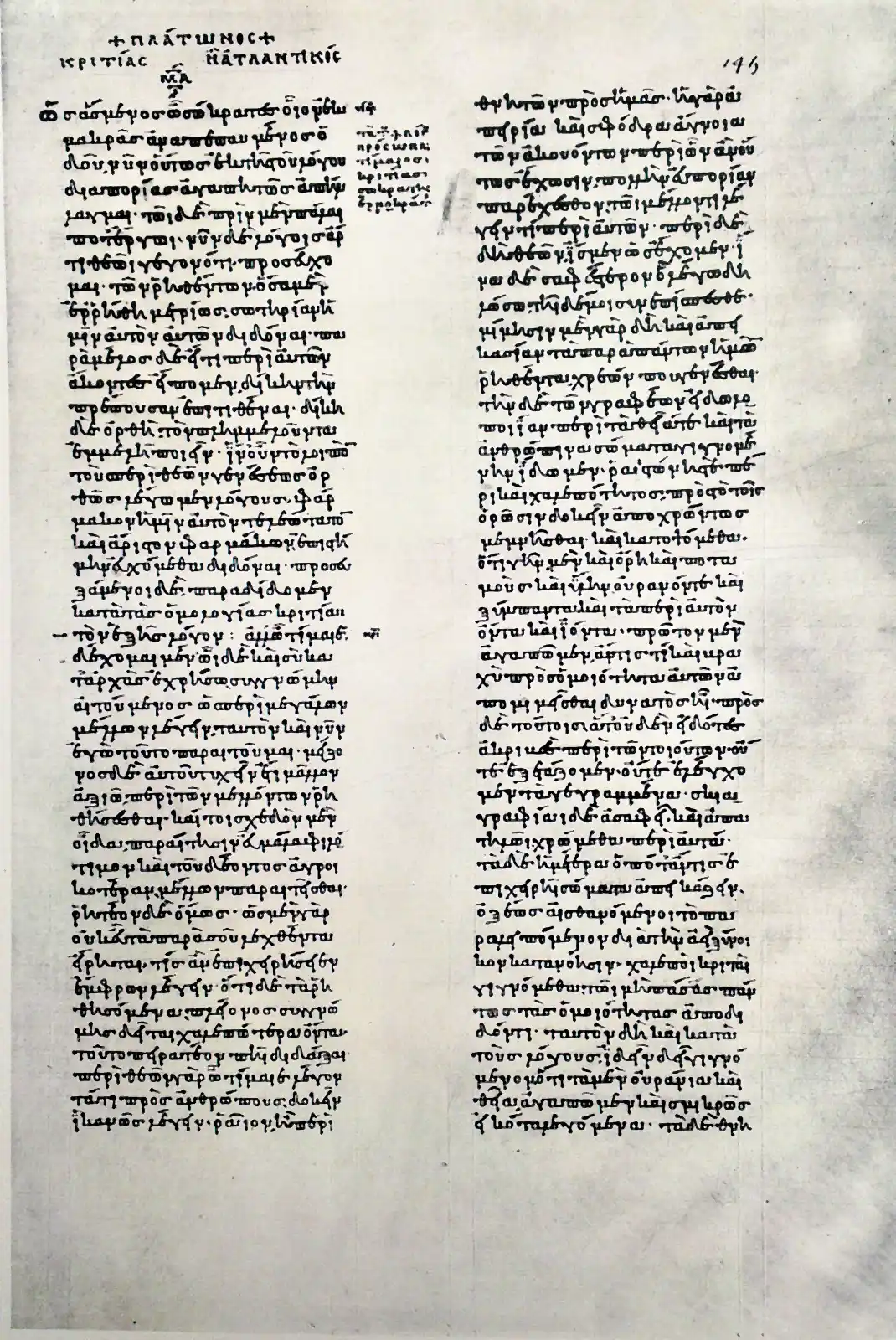
And there was a document. Solon, intending to make a poem of it, had worked out the meaning of the names the Egyptians had written down. "My great-grandfather, Dropides, had the original writing," Critias says, "which is still in my possession, and was carefully studied by me when I was a child."
The story in Plato's words
What the priest told Solon was a war. The power "came forth out of the Atlantic Ocean, for in those days the Atlantic was navigable." From the island beyond the straits, larger than Libya and Asia, "you might pass to the whole of the opposite continent." Its kings ruled Libya as far as Egypt and Europe as far as Tyrrhenia, and tried "to subdue at a blow our country and yours." Athens, standing alone at the end, "defeated and triumphed over the invaders."
"But afterwards there occurred violent earthquakes and floods; and in a single day and night of misfortune all your warlike men in a body sank into the earth, and the island of Atlantis in like manner disappeared in the depths of the sea."
The Critias fills in the island. Poseidon, in love with a mortal woman, Cleito, ringed her hill with "alternate zones of sea and land." Their five pairs of twin sons were its first kings, the eldest named Atlas, "and after him the whole island and the ocean were called Atlantic." A canal three hundred feet wide and fifty stadia long ran to the sea. The laws were cut "on a column of orichalcum in the temple of Poseidon," and the ten kings hunted bulls "without weapons, but with staves and nooses" and sacrificed them so that "the blood fell upon the sacred inscription."
Socrates, listening, names what the story has over a philosopher's invented city: "the very great advantage of being a fact and not a fiction."
The readers who took it as history
The first commentator on the Timaeus, Crantor, writing a generation or two after Plato, called the story, in Thomas Taylor's translation of the later report by Proclus, "a mere history." Crantor added that "the prophets of the Egyptians" asserted its particulars "are written on pillars which are still preserved." The geographer Posidonius, Strabo reports, did well to cite Plato's own remark that it is "possible that the story about the island of Atlantis is not a fiction."
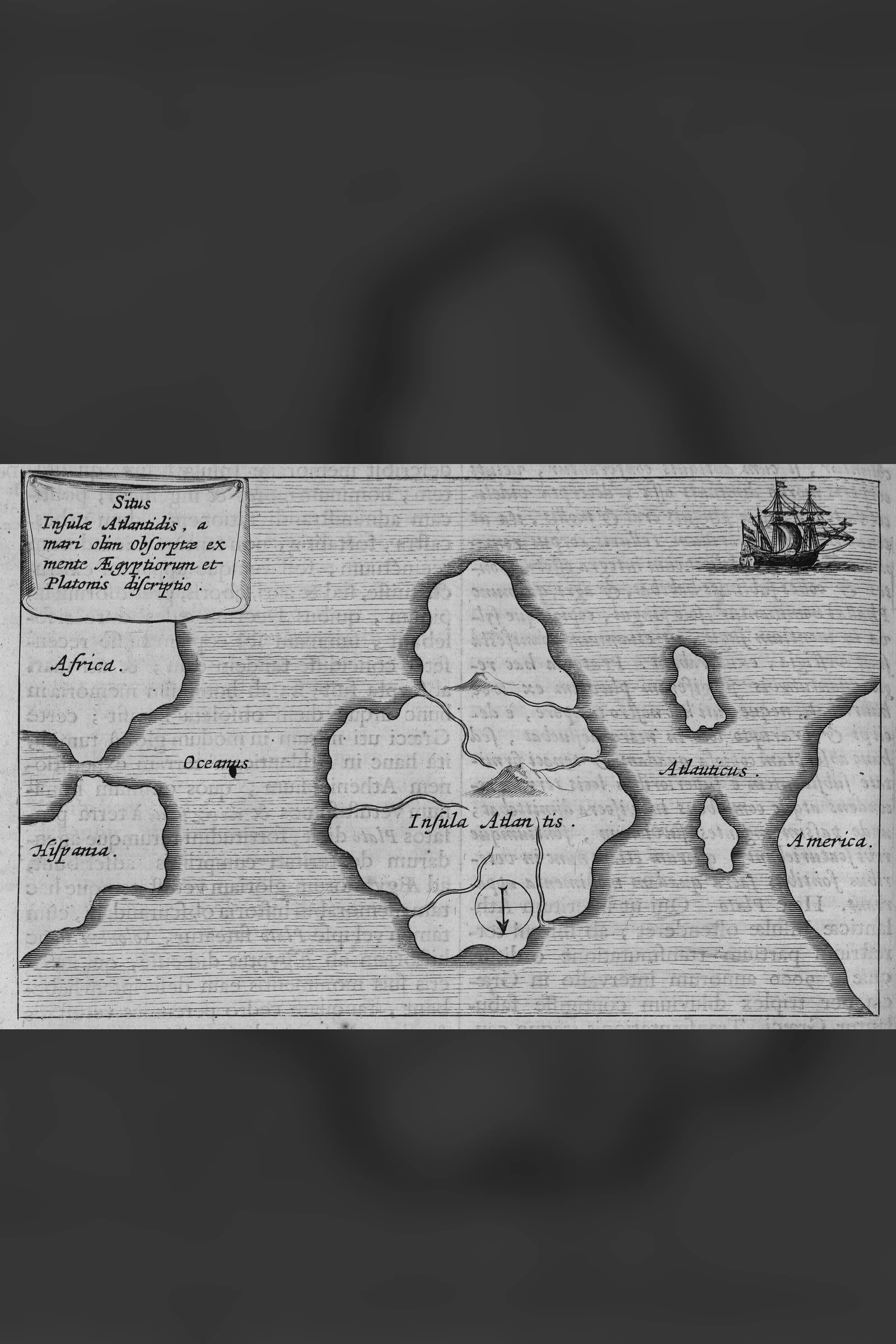
In 1664 the Jesuit scholar Athanasius Kircher printed a map of the island in his Mundus Subterraneus, its title saying it was drawn "ex mente Aegyptiorum et Platonis," according to the Egyptians and Plato: a great island between Spain and Africa on one side and America on the other, drawn with south at the top.
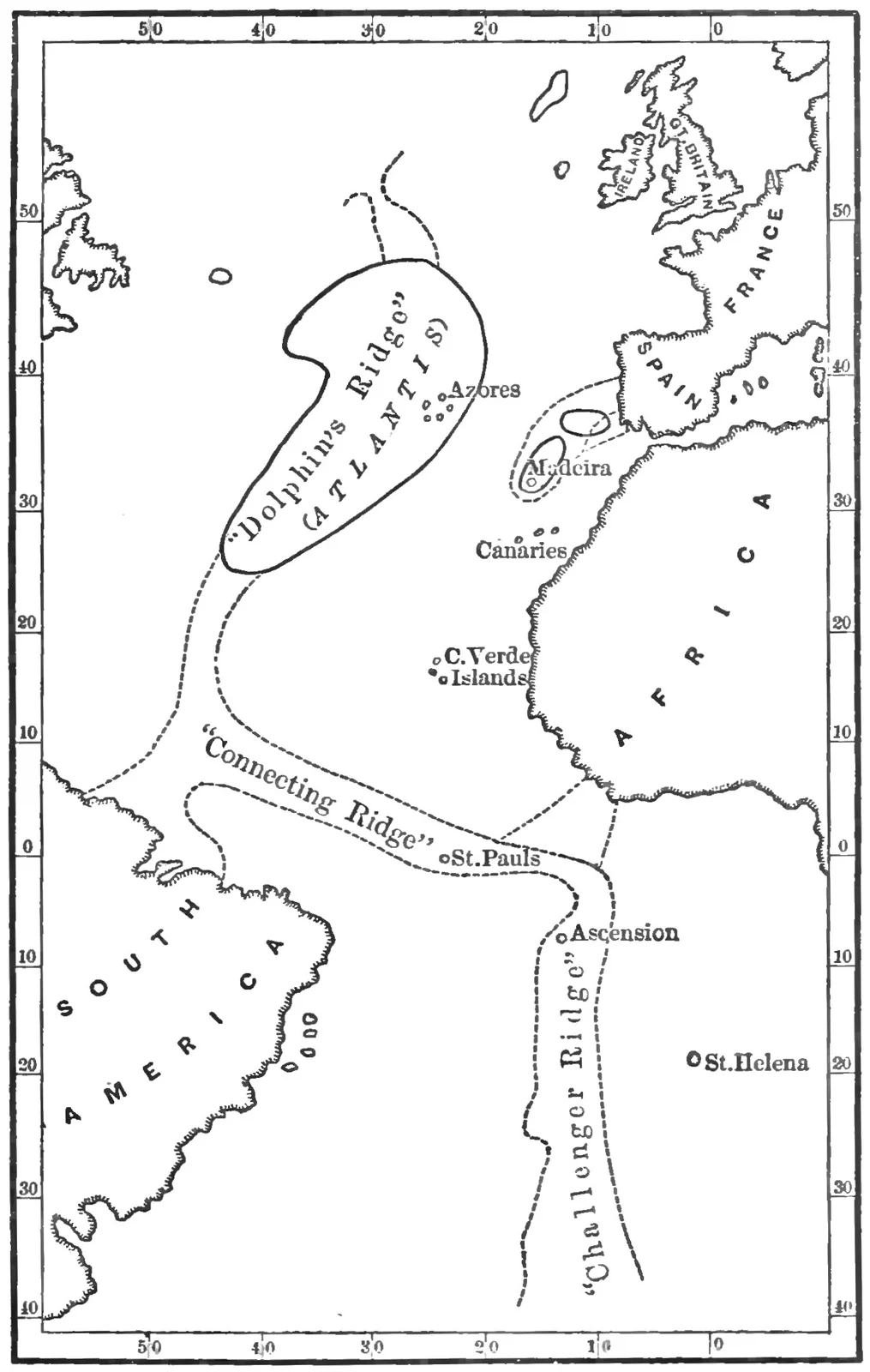
In 1882 the American writer Ignatius Donnelly made it a programme. Atlantis: The Antediluvian World opened with thirteen propositions, the second "That the description of this island given by Plato is not, as has been long supposed, fable, but veritable history." He read the island onto a ridge in the Atlantic sea floor charted by deep-sea soundings, among them the Challenger's, with the Azores as "the surviving fragments of Atlantis," and the world's flood stories as its memory.
And in 1909 the scholar K. T. Frost proposed in The Times that the story remembered Minoan Crete, a sea power whose fall he read as sudden. The bull hunt "without weapons but with staves and nooses," he wrote in 1913, "cannot be anything but a description of the Bull-ring at Cnossus." In 1939 Spyridon Marinatos argued that the eruption of the volcanic island of Thera brought down Minoan Crete, and in 1967 he began digging a town buried in its ash at Akrotiri, a find the classicist J. V. Luce wrote was linked worldwide "with the magic word Atlantis."
If the priests were right
Set aside for a moment whether it is true. Ask the better question. What kind of past are we living in if it is?
It would mean a civilisation with canals, harbours, metalwork and written law stood in the Atlantic some nine thousand years before Solon, thousands of years before the first cities anyone has dug up.
Which would mean history is far older than its records, and that whole ages of it can drown without trace. The priest's warning to Solon would be literal: the Greeks were children, and so, on that reading, are we, a species that has forgotten its own past more than once.
It would mean the temples of Egypt kept a memory older than any surviving writing, and that a Greek lawgiver, as the story says, once held a copy of it.
And it would leave a question in front of us that no one has closed. The sea keeps what it takes. If an island that size went down, something of it is still out there, under water or under ash, waiting for someone who knows where to look.
How the scholars read it
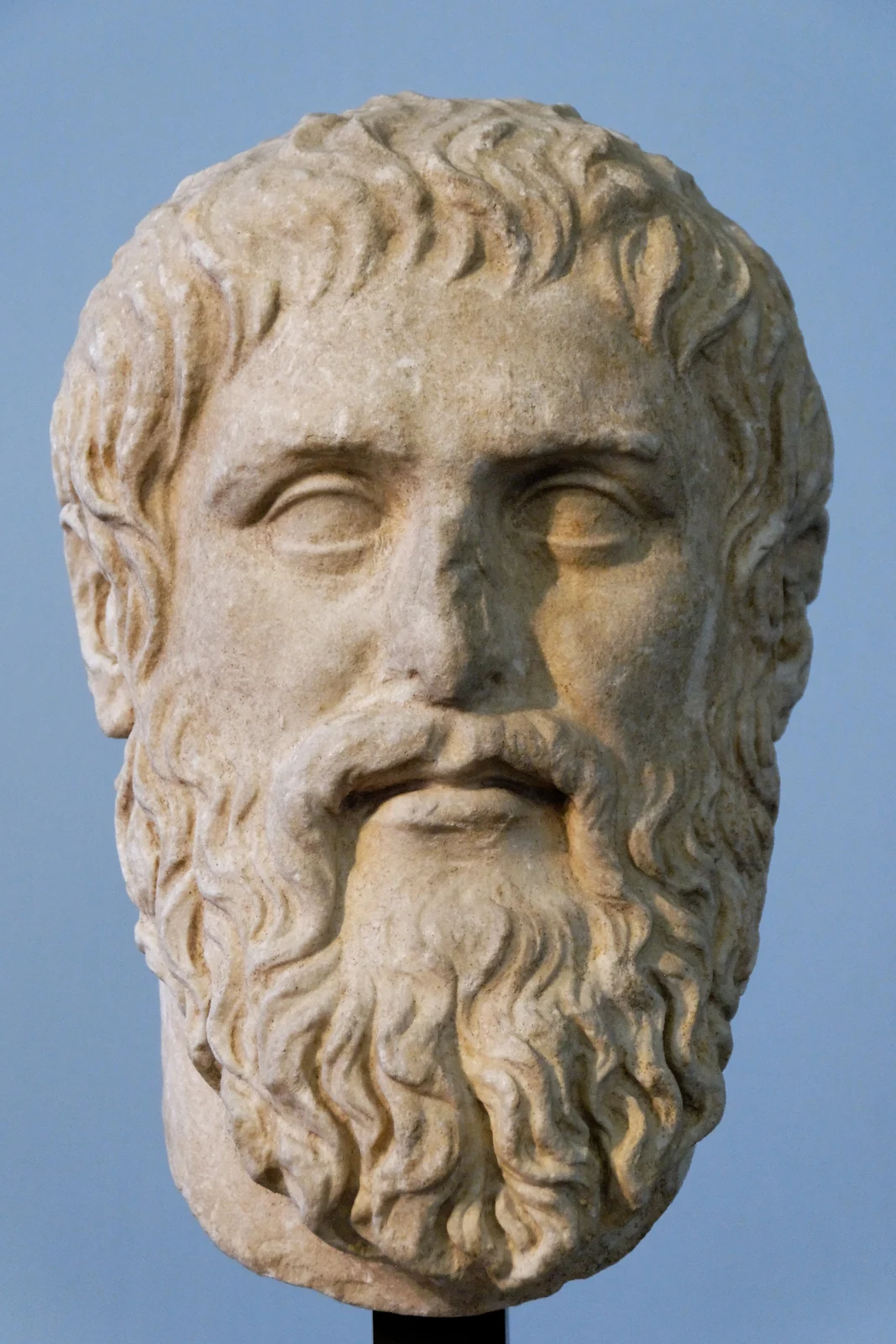
The standard account, held by most classical scholars, is that Plato invented Atlantis, as a philosophical story, and that the dialogue says so in its own frame.
The Timaeus begins the day after Socrates has described an ideal city, the city of the Republic. Critias offers to bring it to life: "The city and citizens, which you yesterday described to us in fiction, we will now transfer to the world of reality." Atlantis, on this reading, is the overreaching sea power that the ideal Athens defeats, a story built to show the good city in action.
Benjamin Jowett, who translated the dialogues in the nineteenth century, wrote that there is "no such legend in any writer previous to Plato; neither in Homer, nor in Pindar, nor in Herodotus," that no Egyptian monument then known showed any link between Greece and Egypt older than the eighth or ninth century BC, and that the story is "far more likely to have been invented by Plato than to have been brought by Solon from Egypt," a "mosaic work of small touches" made to win the reader's trust. Pierre Vidal-Naquet, from 1964, read Atlantis and ancient Athens as two faces of Plato's own Athens, the sea empire and the land city. Christopher Gill wrote in 1979 of Plato's Atlantis story and "the birth of fiction"; Kathryn Morgan in 1998 called it "designer history." Alan Cameron, in 1983, judged Plato's invention "virtually demonstrable," and every later witness, Crantor included, to depend on Plato's text.
Where the chain still holds
The invention reading explains the frame. It does not explain everything in the chain.
Crantor's pillars are the oldest report that could point outside Plato's text. Crantor did not say he saw them; he reported the Egyptian priests' word. Scholars divide on the grammar of that sentence, Cameron on one side, H.-G. Nesselrath and Harold Tarrant on the other, and on what Crantor meant by calling it history; in 2023 Kilian Fleischer argued that he took it as true. No surviving record identifies the pillars.
The Minoan echoes are specific. Frost and Marinatos pointed to features Bronze Age Crete and Thera share with the tale: a sea power, bulls caught without weapons, a volcanic island buried in ash. They are resemblances, and the tale's 9,000 years and Atlantic setting do not fit them. Whether they are memory, coincidence or Plato's own invention, the record does not settle.
The narrator himself marks the strain. Of a great ditch around the plain, a stadium wide and ten thousand stadia long, he says: it "could never have been artificial. Nevertheless I must say what I was told." The narrator, in the middle of the story, stops to doubt a detail and keeps it anyway, because, he says, it is what he was told.
And the Critias does not end. Zeus calls the gods together to judge Atlantis, "And when he had called them together, he spake as follows," and there the text stops. Whether the rest was lost or never written, nobody knows.
Still being searched
The search has never stopped. The readings of Edgar Cayce placed one of its mountaintops at Bimini. Other strange records on this site show both ways a story can travel: an island that stayed on maps for a century, the Zeno chart's Frisland, and a flood story with older tellings than anyone expected, the Flood Tablet George Smith read in 1872. Neither shows which way Atlantis went.
Which leaves the one link in the chain that cannot be checked.
In the story, Solon in Sais, listening to a priest, writing down names he would translate back into Greek. A poem he never finished. A writing Critias said was still in his house.
None of it survives. The story does.
Questions This Leaves You With
Is there anything a person actually does with this?
Read the two dialogues. They are short and free, and reading them in order gives you the whole chain in Plato's own words. You will find the 9,000 years, the rings of water, the bull hunt, and the narrator's own doubt about the ditch, in his words. Nothing here asks you to dive or dig, and anyone selling a certainty about where Atlantis lies, or that it never was, is selling something. The text is the evidence, and it is in your hands.
Does this sit against a religious account of the world?
It cuts both ways, and serious people have argued each. Donnelly read Atlantis as the Garden of Eden and the source of the world's flood stories; others see in the sinking of a proud island a moral story Plato told for its own sake, with no history behind it at all. Some readers find a lost civilisation a challenge to scripture, others a confirmation of an ancient memory of judgment. This site will not tell you which way it falls for you.
Does this change what a human life is?
Nine thousand years is three hundred generations. Read one way, that makes a life very small: whole civilisations can rise and drown and leave nothing but a story told to a boy at a festival. Read the other way, it makes a single life enormous, because a story told by one old man to one child has outlived most of the empires since. Both readings are honest, and they can sit in the same mind. Which of those did you feel when you read the stakes?
What would change your mind, in either direction?
Name it now, before you are committed. Toward history: an Egyptian text older than Plato that names an island power in the west and its fall, or the pillars Crantor heard of, found and read. Toward invention: an early draft or note of Plato's showing the story being built, or a fourth-century source naming it as his fiction. Physical finds would test a site, not the story: a city found under the sea would need a date that fits the text.
Was the Critias ever finished?
The dialogue breaks off in the middle of a sentence, as Zeus is about to speak. Was the end of the Critias lost, or did Plato put down his pen? If he abandoned it, why stop exactly where the judgment on Atlantis begins? The text gives no answer. Readers who take the story as history and readers who take it as Plato's invention both have a stake in the missing ending, and neither can point to it. Nobody has found the rest, and nobody knows whether there was a rest to find.
Sources
- Plato, Timaeus, translated by Benjamin Jowett (1871, 3rd ed. 1892), with Jowett's introduction Project Gutenberg
- Plato, Critias, translated by Benjamin Jowett Project Gutenberg
- Plato, Timaeus 25d, translated by W. R. M. Lamb (Loeb, 1925) Perseus Digital Library, Tufts University
- Jason Colavito, The First Believer? (2011), quoting Thomas Taylor's 1820 translation of Proclus Jason Colavito
- J. M. Zamora Calvo, Proclus on the Atlantis Story, Rupkatha Journal 10.3 (2018) Rupkatha Journal
- Strabo, Geography 2.3.6, translated by H. L. Jones (Loeb, 1917) LacusCurtius, University of Chicago
- Athanasius Kircher, Situs Insulae Atlantidis, Mundus Subterraneus (Amsterdam, 1664), Universidad de Sevilla copy Wikimedia Commons / Biblioteca de la Universidad de Sevilla
- Ignatius Donnelly, Atlantis: The Antediluvian World (1882) Harper and Brothers (Internet Archive)
- K. T. Frost, The Critias and Minoan Crete, Journal of Hellenic Studies 33 (1913) Zenodo
- Spyridon Marinatos, The Volcanic Destruction of Minoan Crete, Antiquity 13 (1939) Cambridge University Press
- J. V. Luce, More thoughts about Thera, Greece and Rome 19 (1972) Cambridge University Press
- Atlantis Edgar Cayce Foundation
- Alan Cameron, Crantor and Posidonius on Atlantis, Classical Quarterly 33 (1983) Cambridge University Press
- Summary of Kilian Fleischer, Crantor of Soli as an Early Witness (2023) Atlantis-Scout
- Pierre Vidal-Naquet, Athenes et l'Atlantide, Revue des Etudes Grecques 77 (1964) Persee
- Kathryn A. Morgan, Designer History: Plato's Atlantis Story and Fourth-Century Ideology, JHS 118 (1998) Cambridge University Press
