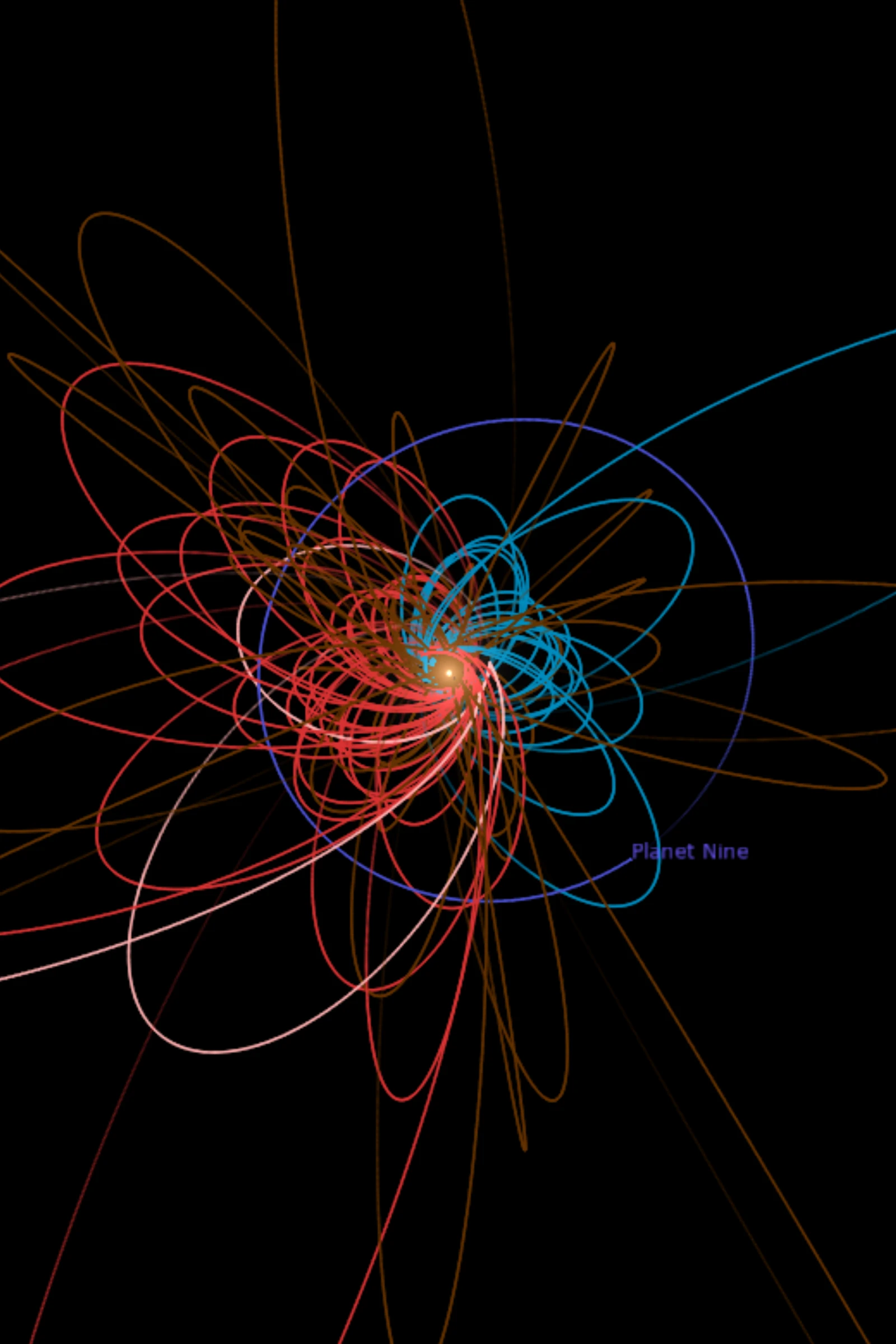
Out past Neptune, past Pluto, past the crowded ring of icy bodies called the Kuiper belt, a handful of small worlds swing on orbits so long that one trip around the Sun outlasts recorded history. In January 2016 two astronomers at Caltech, Konstantin Batygin and Michael Brown, published a paper about six of them, and the planet it proposed has been called Planet Nine ever since.
Sedna, the best known, never comes closer to the Sun than about 76 times the Earth's distance, and swings out to hundreds more. Sunlight there is a bright star, not a day.
What Batygin and Brown noticed was not any one of these worlds. It was the six of them together. Their long, stretched orbits do not point every which way, the way scattered things should. They lean the same way, and they tilt the same way.
Six orbits.
One direction.

A planet hunter and a broken pattern
Michael Brown had found these places before. In 2004, with Chad Trujillo and David Rabinowitz, he announced Sedna, at the time "the most distant object ever seen in the solar system." In January 2005 the same team found Eris, and NASA's own summary is blunt about what followed: "the discovery of Eris led to the demotion of Pluto from planet to dwarf planet," in the International Astronomical Union's vote of August 2006.
The thread Batygin and Brown pulled came from two other astronomers. In March 2014 Chad Trujillo and Scott Sheppard reported in Nature a second Sedna-like body, 2012 VP113, which never comes closer than 80 times the Earth's distance. They noted that the most distant objects shared a quirk in the angle at which they reach their closest point, and they showed that a body of about five Earth masses at 210 times the Earth's distance could cause it.
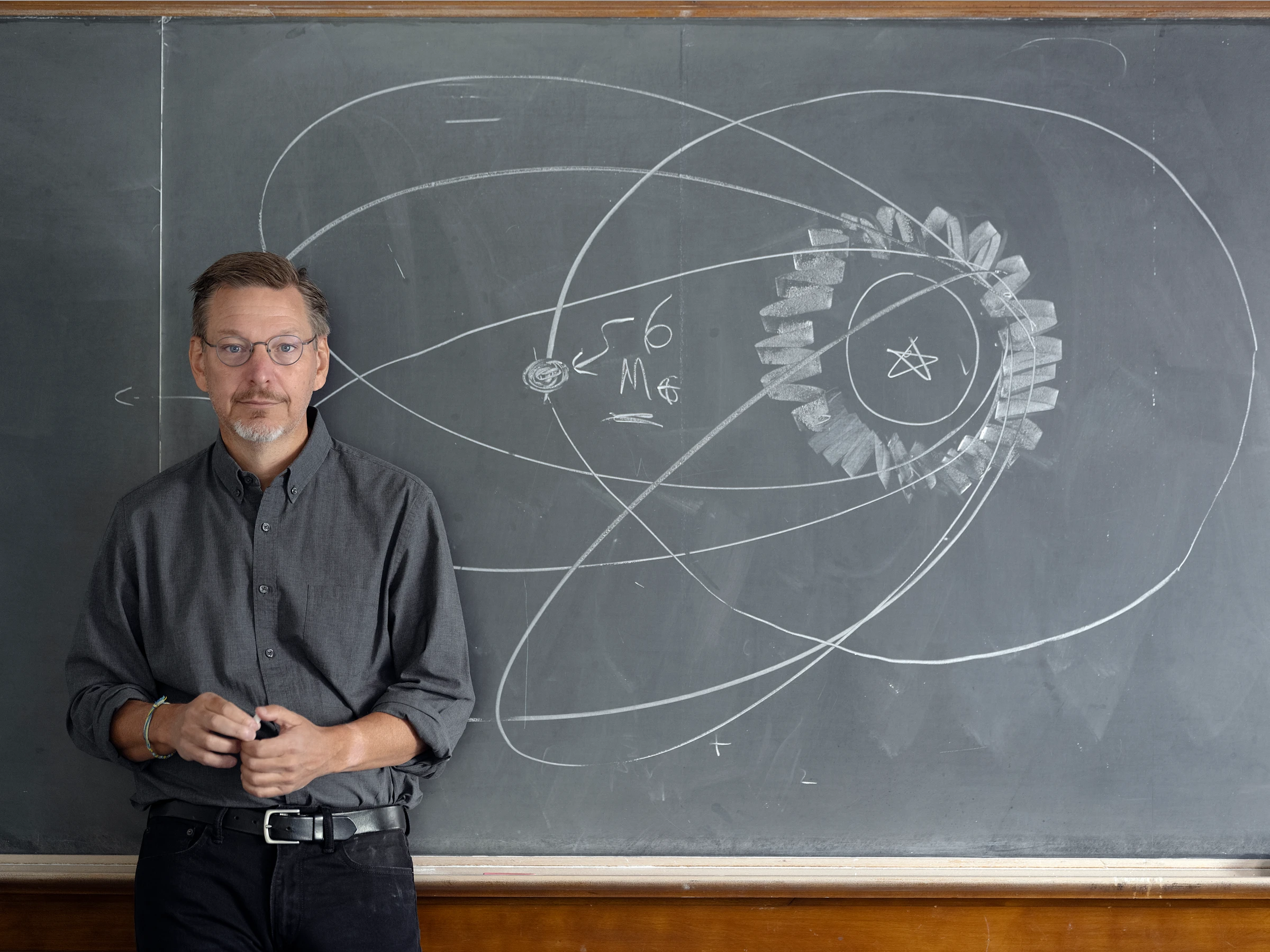
Batygin and Brown started from that. Brown described the pattern in Caltech's announcement as "almost like having six hands on a clock all moving at different rates," and all pointing the same way.
What the 2016 paper showed
The paper appeared in The Astronomical Journal on 20 January 2016 under a modest title, "Evidence for a Distant Giant Planet in the Solar System." The six objects with orbits stretching beyond 250 times the Earth's distance "all come to perihelion below the ecliptic and at longitudes between 20 deg and 130 deg." Their closest points were bunched in one part of the sky. And the planes of their orbits were tilted together too.
They put numbers on it. "Orbits as tightly clustered in perihelion position as the 6 observed KBOs occur only 0.7% of the time." A cluster of orbit poles as tight as the one seen, "only 1% of the time." Together: "only 0.007%." With six objects, about 3.8 sigma. They answered the obvious objection at once: "each of our 6 clustered objects was discovered in a separate survey with, presumably, uncorrelated biases."
The alignment, they argued, is physical, not only a matter of angles, and the known planets should have smeared it out over billions of years. Something has to hold it. Their answer was a planet of at least about ten Earth masses, on an orbit averaging some 700 times the Earth's distance, its far point swung to the opposite side of the sky from theirs. The same planet, the paper said, would also explain Sedna's detached orbit and a set of objects tipped steeply against the rest of the solar system, and it predicted more of those. Caltech's release said five known objects on steeply tilted orbits already fit.
The paper itself never uses the words Planet Nine. It speaks of "the perturber." Brown, in Caltech's announcement, said it plainly: "This would be a real ninth planet."
Ten years of adding to it
The case did not stand still. In 2019 Brown and Batygin, with more objects, put the chance that the clustering is an artefact of where telescopes looked at "only 0.2%." A 2019 review in Physics Reports, with Adams and Becker, gave a planet of about five to ten Earth masses at 400 to 800 times the Earth's distance. In 2021 they narrowed it again: about 6.2 Earth masses at about 380, and "closer and brighter than initially expected."
A second line of evidence came in 2024. Batygin, Morbidelli, Brown and Nesvorny looked not at the clustered objects but at a different group, small bodies crossing Neptune's orbit on nearly flat paths. A model with the planet matched them; the model without it, they wrote, "is statistically rejected," at about five sigma.
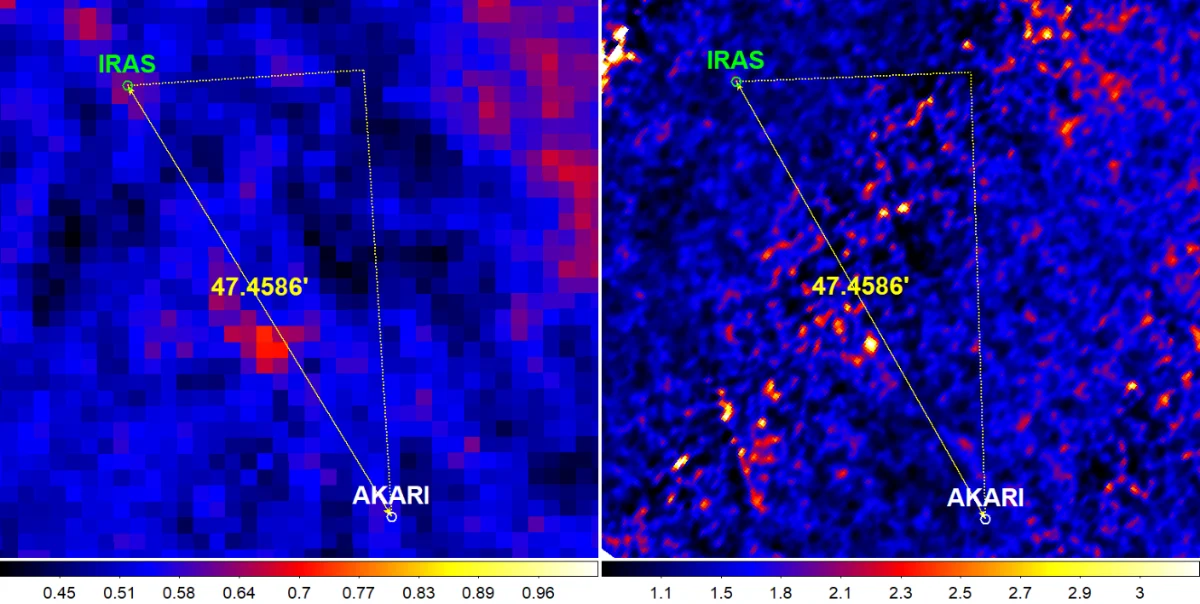
In 2025 a Princeton group, Siraj, Chyba and Tremaine, working independently, also found that a planet-mass body fits the distant objects, though on a different orbit: about 4.4 Earth masses at about 290 times the Earth's distance. The same year a team led by Terry Long Phan searched two infrared sky surveys taken 23 years apart, IRAS in 1983 and AKARI in 2006, for something that had moved the way a planet out there would. They looked for a body of 7 to 17 Earth masses at 500 to 700 times the Earth's distance. Of 13 candidate pairs that passed their cuts, one looked good on inspection.
If there is a ninth planet
Set aside for a moment whether it is true. Ask the better question. What kind of solar system are we living in if it is?
It would mean the census of planets, the list every child learns, is wrong by one, and the missing world is not small. Five Earths, perhaps ten, sliding through the dark on an orbit that takes, by Caltech's estimate, ten to twenty thousand years.
Which would mean that, on the paper's reading, the planet has been shaping the outer solar system for billions of years without anyone seeing it, and the alignment of those six orbits is the mark it left on the far belt.
It would mean our own neighbourhood was never fully mapped: that a body more massive than the Earth, so far out that its reflected sunlight is fainter than most surveys reach, could sit inside the Sun's family through all of human astronomy. What else would that say about how much of the sky we have actually looked at?
And it would mean the moment is still ahead. A planet that has never been seen could be seen, photographed, measured, given a proper name. Every planet in the textbooks was found by someone. This one, if it is there, has not been found yet.
The survey-bias account
The standard account, held by the teams who ran the largest unbiased surveys, is that the clustering comes from where and when telescopes looked, not from a planet.
A survey finds distant objects only where it points and when it can observe. In 2017 the Outer Solar System Origins Survey, OSSOS, reported in a paper led by Shankman that its own distant finds were "consistent with being detected from a uniform underlying angular distribution," once its "striking and non-intuitive biases" were modelled. In 2021 a team led by Napier modelled the pointing, depth and tracking of three surveys, the Dark Energy Survey, OSSOS and Sheppard and Trujillo's, and found that their 14 extreme objects provide "no evidence for angular clustering."
Other explanations keep a real effect without a planet. Sefilian and Touma showed in 2019 that a massive, moderately eccentric disk of small bodies could hold orbits in place. Scholtz and Unwin asked in 2020 whether the perturber could be a primordial black hole of about five Earth masses.
The searches have also narrowed the sky. Brown and Batygin's own search of the Zwicky Transient Facility archive ruled out 56 percent of their predicted range in 2022, and with Pan-STARRS and the Dark Energy Survey added, 78 percent by 2024. And in 2025 a newly reported Sedna-like object, 2023 KQ14, turned out not to share the alignment; the Subaru Telescope's release said this "lowers the likelihood of the Planet Nine hypothesis," and that if the planet exists, "its orbit should lie even farther out than previously predicted."
What the bias studies do not settle
The bias studies are careful, and they are also limited to surveys whose pointings are fully published. Napier's team, to keep its sample independent of the 2016 paper, left two of the original six, 2013 RF98 and 2012 VP113, out of its main analysis. Its finding is that 14 objects are consistent with a uniform spread, at levels from 17 to 94 percent. That is a statement about what those objects can show. It is not a measurement that no planet exists.
The bias papers address the clustering of angles. They do not address the 2024 test, which used a different group of objects altogether.
And the searches that ruled out 78 percent of the predicted range did not rule out the rest. Much of what is left, Brown, Holman and Batygin wrote, is fainter than the surveys reached, where the northern Milky Way crosses the planets' path and a faint moving dot is hardest to pick out of the stars.
None of the searches found it. None of them reached all of the places it could be.
A telescope built for this
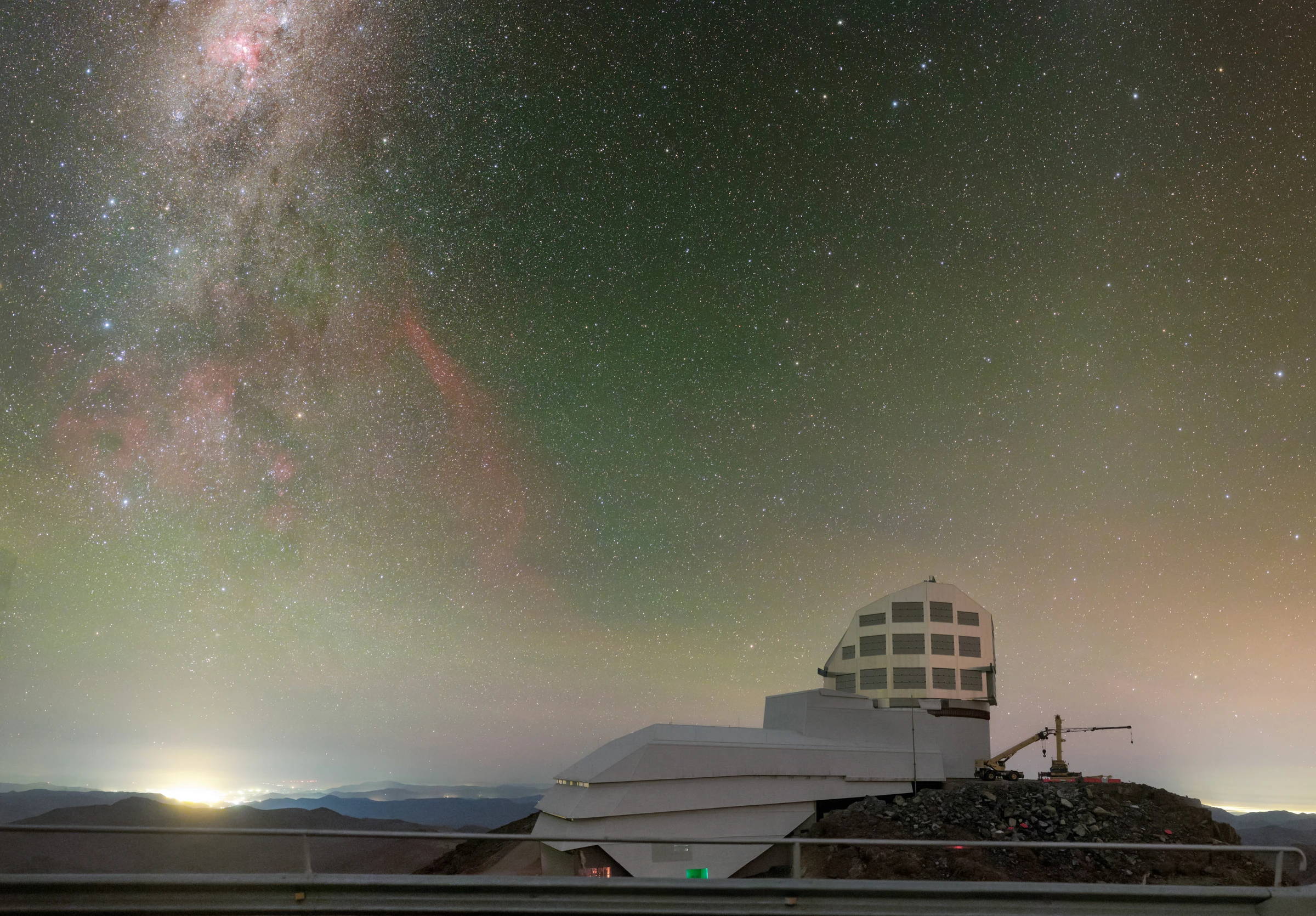
In June 2026 the Vera C. Rubin Observatory in Chile began its ten-year survey of the southern sky. Its early data, released in April 2026 before the survey formally began, already held about 380 new candidates beyond Neptune, two of them reaching roughly a thousand times the Earth's distance from the Sun. In 2024, before it opened, the astronomer Pedro Bernardinelli told National Geographic: "Probably within the first year we're going to see if there's something there or not." On 27 October 2026 the University of Washington announced Rubin's first dwarf planet candidate, 2026 ED138. No result on Planet Nine has been reported. A detection would settle it. A long survey that finds nothing where the models point would narrow the planet's possible orbits again; it would not, by itself, prove there is none farther out.
Which leaves one pair of points.
In the IRAS sky of 1983, a faint source in the far southern sky. In the AKARI sky of 2006, another, a little under a degree away. Phan's team called it "a good candidate" and wrote that the two detections "are not enough to determine the full orbit." A new image of that patch of sky could show whether something there is moving the way a distant planet would. It could settle that pair. It could not, alone, settle Planet Nine.
The site's account of the 1983 infrared survey that became Planet X follows an older reading of the same IRAS data, and Nancy Lieder's account of a planet from Orion is a very different one. Ten years after the paper, the six orbits still point the same way, and the question has a telescope on it.
Questions This Leaves You With
Is there anything a person actually does with this?
Start with the timescale. On Caltech's estimate the planet would take ten to twenty thousand years to go around the Sun once, so nothing about it touches a human life directly: no approach, no date, and anyone selling a date is selling something. What it does touch is larger. It asks whether our own solar system has been fully counted. That question belongs to everyone, and the answer may come within a few years, from a telescope already running.
Does this sit against a religious account of the world?
It cuts both ways, and serious people have argued each. Some readers find in a vast, still-unmapped solar system a reason for humility before creation; others read every new planet as one more sign that the heavens are ordinary physics all the way out. Planet Nine says nothing about either on its own. This site will not tell you which way it falls for you, and it would be overstepping to try. The question of what a sky full of unseen worlds means is older than telescopes, and it is yours.
Does this change what a human life is?
Hold a human life against an orbit of ten to twenty thousand years and it is a moment: the whole of written history fits inside one trip. Read that way, a life is small. Read the other way, it is extraordinary: your life might be the one in which a planet nobody has ever seen is seen for the first time. Both readings are honest, and neither asks anything of you. Which one did you have when you read the stakes?
What would change your mind, in either direction?
Name it now, before you are committed. Toward the planet: a moving point found by Rubin where the models predict, a follow-up image showing the IRAS and AKARI pair moving as a distant planet would, or Rubin's new distant objects showing the same alignment in a survey whose biases are fully known. Against it: Rubin's large, carefully modelled sample turning out evenly spread, or its survey covering the remaining predicted range and finding nothing bright enough to be there.
Is the pattern in the sky, or in the telescopes?
That is the question nobody has settled. The same few dozen objects are read by one team as a fingerprint and by another as the shadow of where telescopes happened to point. Both sides model the biases, and they model them differently. Even the teams who think a planet is there disagree about its orbit, 380 times the Earth's distance in one fit, 290 in another. The objects are real. Whether their alignment is real is the empty space, and it will take more objects, found without bias, to fill it.
Sources
- Batygin and Brown, Evidence for a Distant Giant Planet in the Solar System, The Astronomical Journal 151:22 (2016) arXiv / American Astronomical Society
- Evidence for a Distant Giant Planet in the Solar System, journal page (2016) The Astronomical Journal (IOP)
- Caltech Researchers Find Evidence of a Real Ninth Planet (20 January 2016) Caltech News
- Brown, Trujillo and Rabinowitz, Discovery of a candidate inner Oort cloud planetoid, ApJ 617 (2004) arXiv / The Astrophysical Journal
- Eris NASA Science
- Trujillo and Sheppard, A Sedna-like body with a perihelion of 80 astronomical units, Nature 507 (2014) Northern Arizona University research record
- Batygin and Brown 2016, full text PDF arXiv
- Brown and Batygin, Orbital clustering in the distant solar system, AJ 157:62 (2019) arXiv
- Batygin, Adams, Brown and Becker, The Planet Nine Hypothesis, Physics Reports (2019) arXiv
- Brown and Batygin, The orbit of Planet Nine, AJ (2021) arXiv
- Batygin, Morbidelli, Brown and Nesvorny, Generation of Low-Inclination, Neptune-Crossing TNOs by Planet Nine (2024) arXiv / ApJ Letters
- Siraj, Chyba and Tremaine, Orbit of a Possible Planet X, ApJ (2025) arXiv
- Phan et al., A Search for Planet Nine with IRAS and AKARI Data, PASA 42 e064 (2025) arXiv / Publications of the Astronomical Society of Australia
- Shankman et al., OSSOS VI. Striking Biases in the detection of large semimajor axis TNOs (2017) arXiv / The Astronomical Journal
- Napier et al., No Evidence for Orbital Clustering in the Extreme Trans-Neptunian Objects (2021) arXiv / Planetary Science Journal
- Sefilian and Touma, Shepherding in a Self-Gravitating Disk of Trans-Neptunian Objects (2019) arXiv / The Astronomical Journal
- Scholtz and Unwin, What if Planet 9 is a Primordial Black Hole? (2020) arXiv / Physical Review Letters
- Brown and Batygin, A search for Planet Nine using the Zwicky Transient Facility public archive (2022) arXiv
- Brown, Holman and Batygin, A Pan-STARRS1 Search for Planet Nine (2024) arXiv
- Subaru Telescope release on 2023 KQ14 (14 July 2025) NAOJ Subaru Telescope
- Is there a Planet Nine? We may find out (2024) National Geographic
- Early data from Rubin Observatory reveals over 11,000 new asteroids (April 2026) NSF-DOE Rubin Observatory via Newswise
- Rubin Observatory reveals its first dwarf planet candidate (27 October 2026) University of Washington News