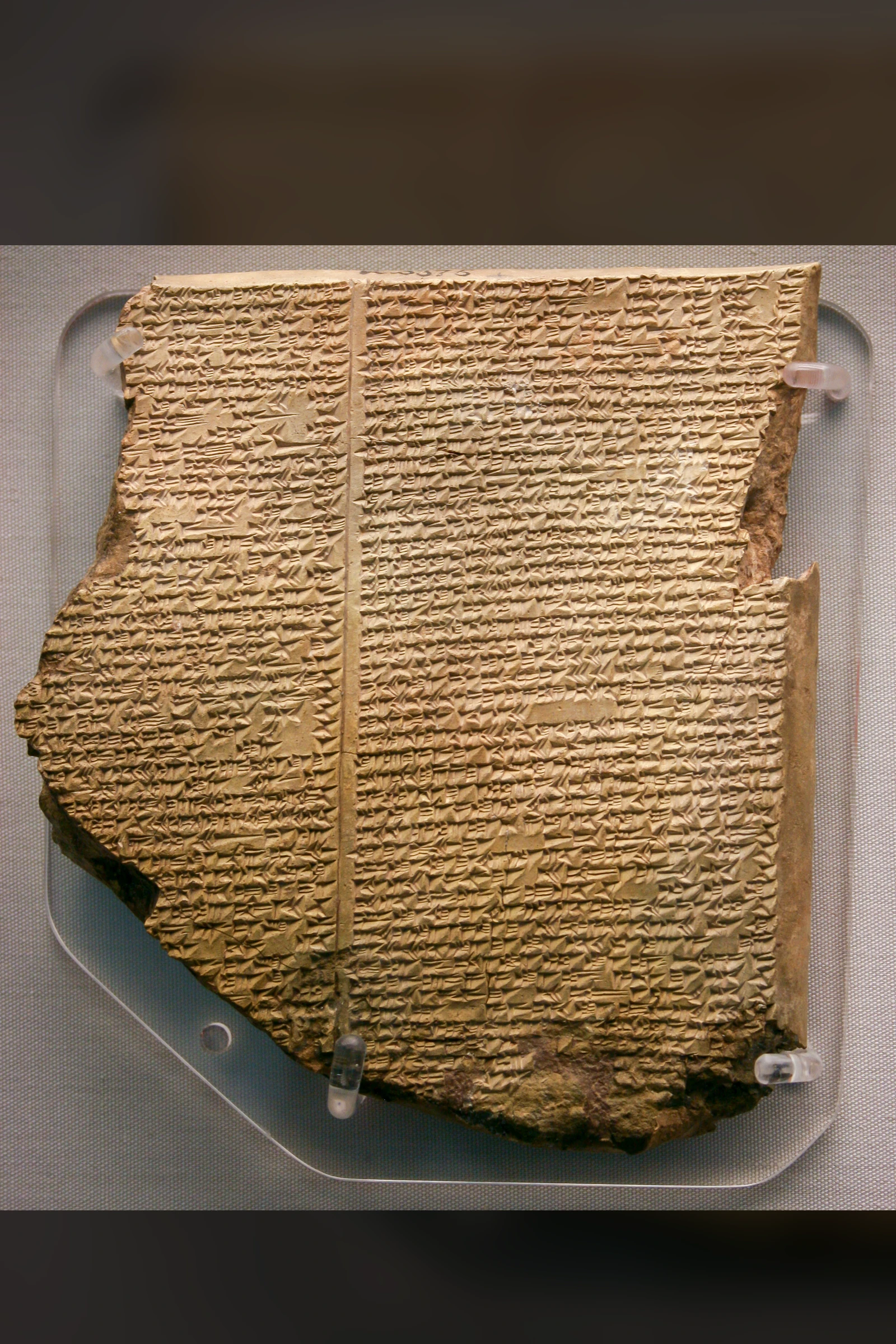
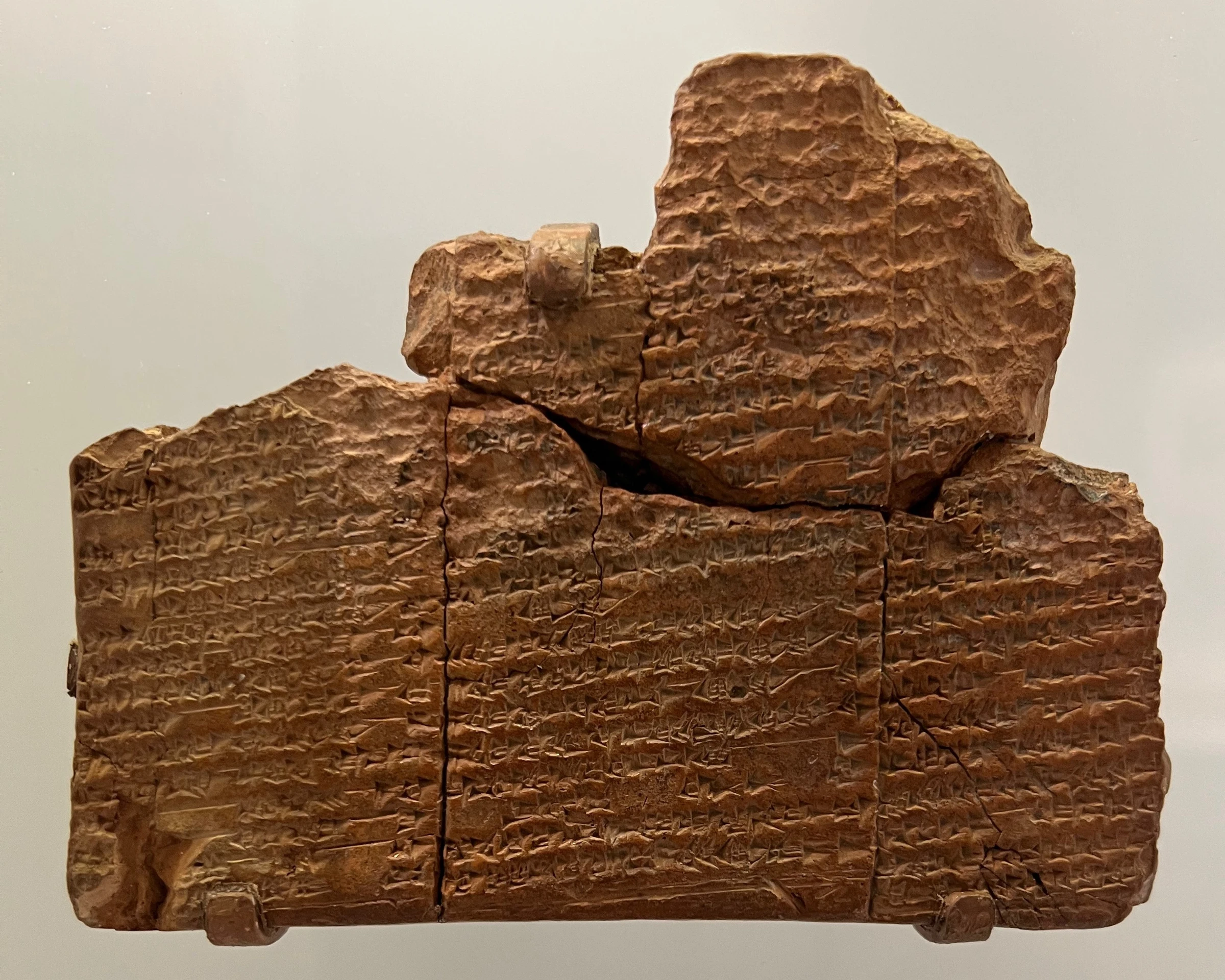
In a case in the British Museum lies a piece of baked clay about fifteen centimetres high, broken across its corners and packed edge to edge with wedge-shaped writing. Its catalogue number is K.3375. It is called the Flood Tablet: the eleventh tablet of the Epic of Gilgamesh, from the library of the Assyrian king Ashurbanipal at Nineveh, written in the seventh century BC.
The signs are tiny, pressed into wet clay with a cut reed and baked hard. Line after line, they tell of a man warned that the waters are coming, a ship built and sealed, a storm that drowns the land, a mountain where the ship comes to rest, and birds sent out to look for dry ground.
A dove. A swallow. A raven.
On 3 December 1872 a man named George Smith stood up in London and read it aloud.
The assistant who read the third column
Henry Rawlinson, impressed by his work, had brought George Smith into the British Museum, where by 1872 he was sorting the museum's clay inscriptions from Nineveh into groups. One of the six divisions he made was the mythological one, and he was going through it piece by piece.
His own account of the moment was published in 1876: "On looking down the third column, my eye caught the statement that the ship rested on the mountains of Nizir, followed by the account of the sending forth of the dove, and its finding no resting-place and returning. I saw at once that I had here discovered a portion at least of the Chaldean account of the Deluge."
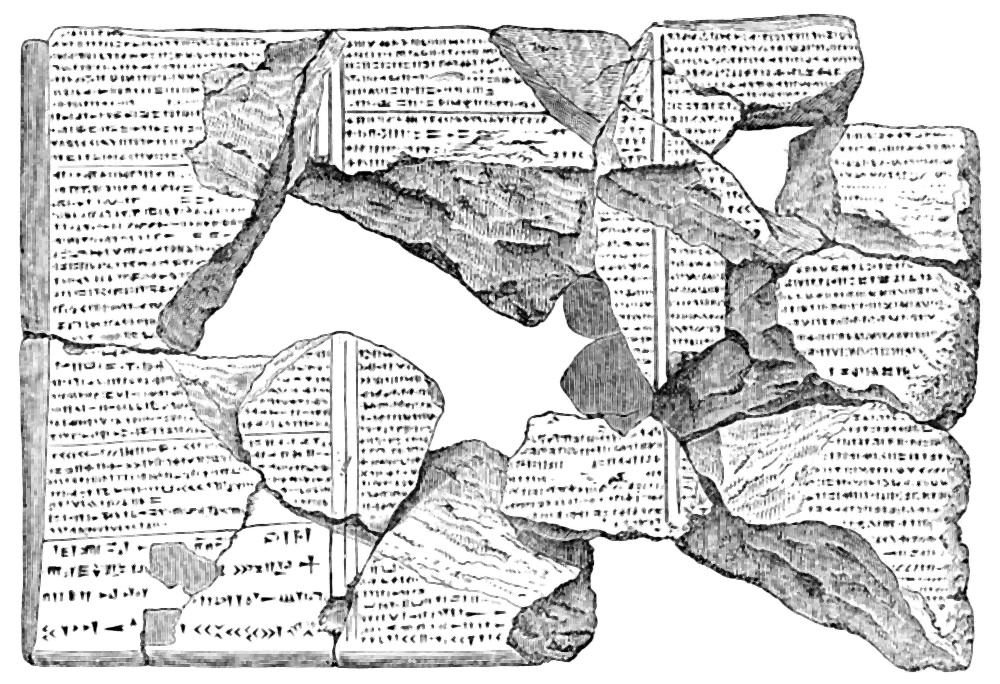
He hunted for more copies, pieced them together, and on 3 December 1872 read his translation to the Society of Biblical Archaeology. Immediately after the lecture, he wrote, Edwin Arnold of the Daily Telegraph came to him with an offer: the paper's proprietors would put up "one thousand guineas" for fresh digging at Nineveh, if Smith led it and sent them reports.
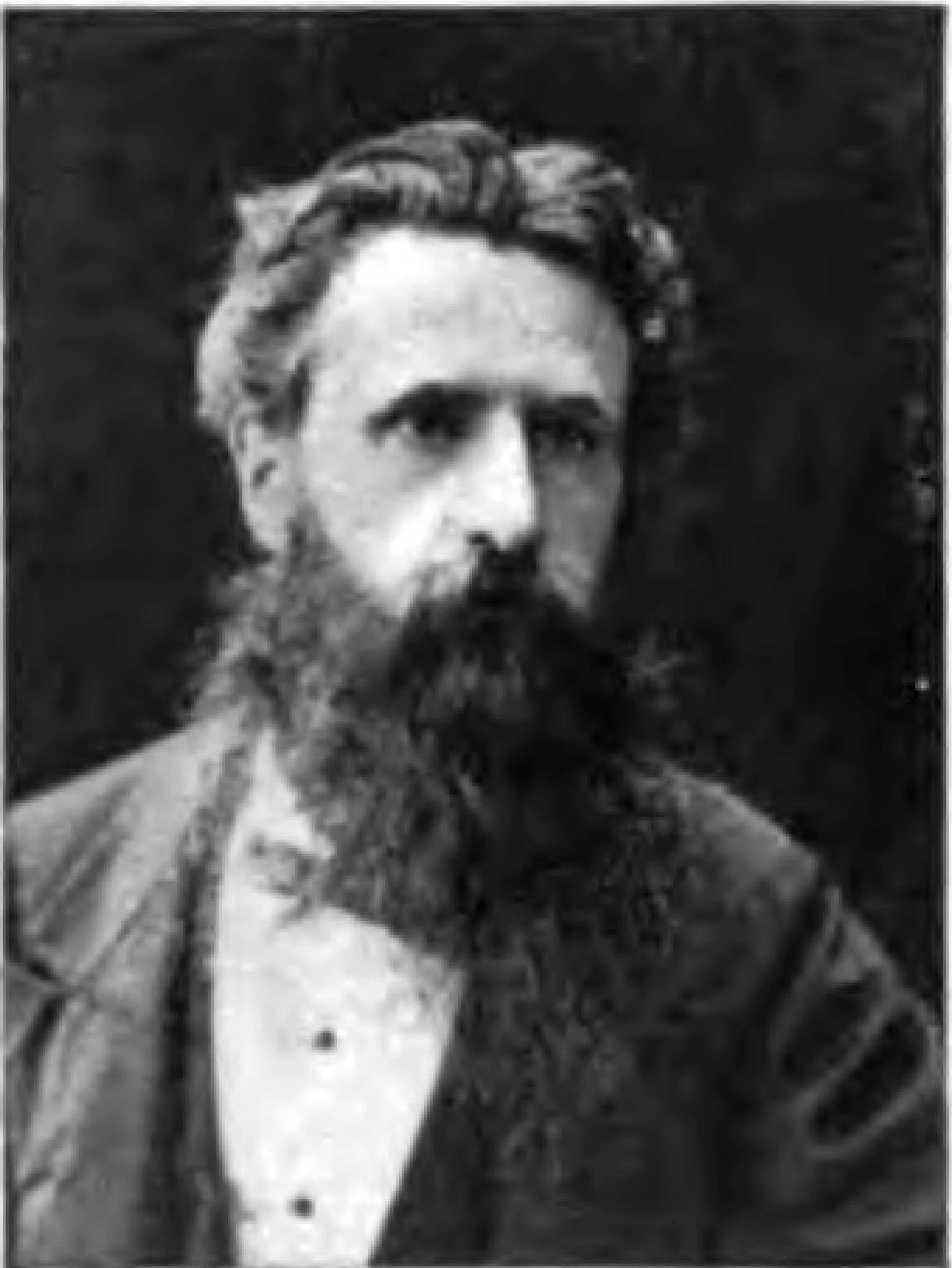
He went. The story still had a hole in it, a gap near the start where, he guessed, "about fifteen lines" were missing. On 14 May 1873, at Nineveh, he sat down with the fragments from the day's digging. Cleaning one, he found "the greater portion of seventeen lines" that fitted, in his words, "the only place where there was a serious blank in the story." The Telegraph printed his telegram on 21 May. Then, Smith wrote, the paper decided the find "accomplished the object they had in view" and declined to pay for more.
Less than four years later, on 19 August 1876, he died while on a further expedition to the region. He was 36.
Sumerian and Akkadian, one flood
Smith had found one copy of a story the region told for well over a thousand years.
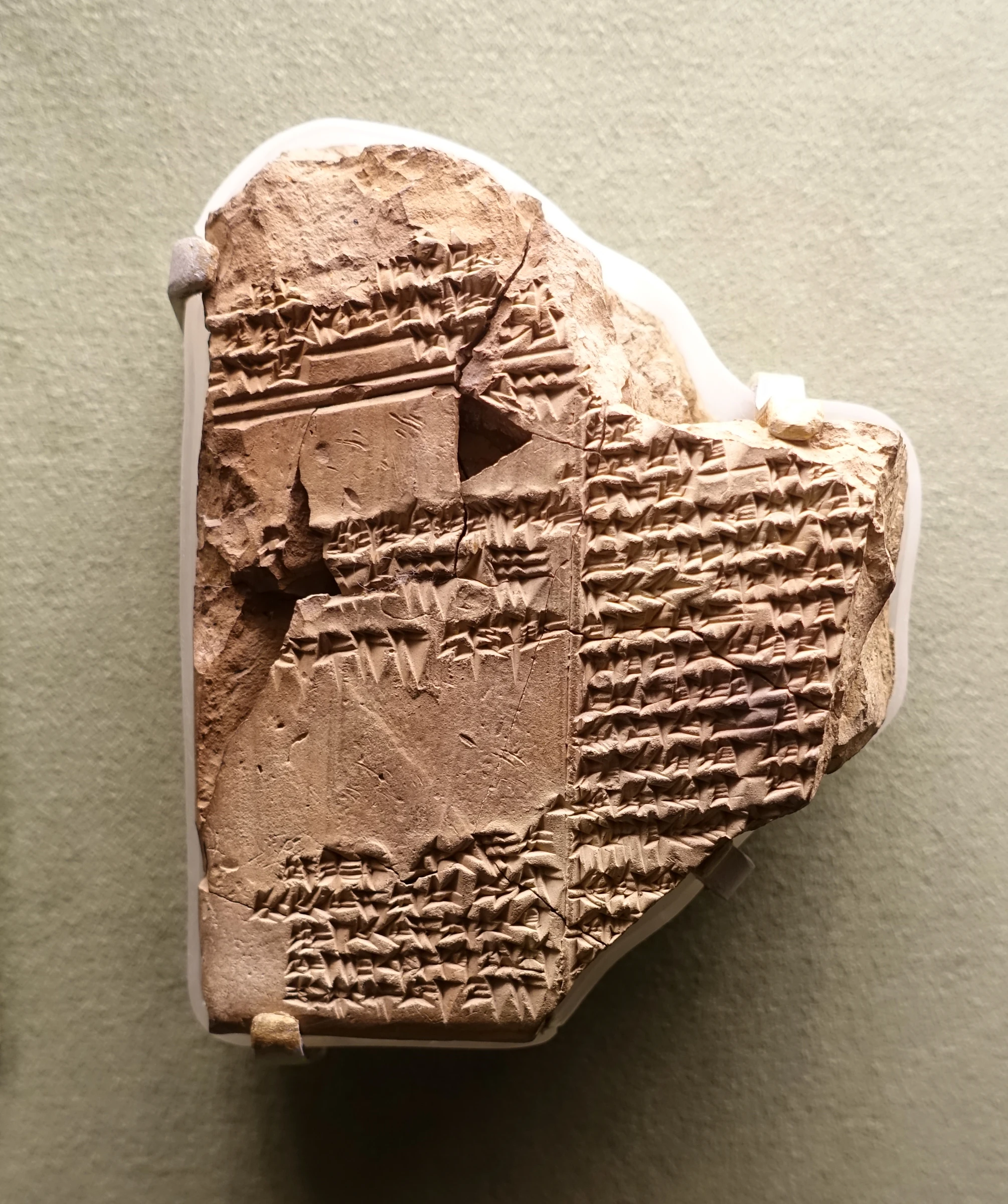
The oldest surviving telling in Sumerian is a tablet from Nippur, now in the Penn Museum as CBS 10673, joined with a second fragment and first published by Arno Poebel in 1914. It tells of a king named Ziusudra who rode out the flood in a huge boat. In the University of Oxford's translation, "waves and windstorms had rocked the huge boat for seven days and seven nights," before the sun god came out and lit heaven and earth. At the end the gods set Ziusudra in Dilmun, "where the sun rises."
Then the Babylonian epic of Atrahasis. Its best-preserved copy was written in the reign of King Ammi-saduqa, in the seventeenth century BC, by a junior scribe whose name W. G. Lambert and A. R. Millard read as Ku-Aya; their edition of 1969 put the pieces in order. It begins before people existed: "When the gods were man." The junior gods dig the watercourses, tire of it, and "set fire to their tools." So the gods make a worker. In the translation adapted by Livius from Benjamin Foster, the birth goddess mixes clay with a slain god's "flesh and blood." People multiply. Their noise keeps the gods awake. And the gods decide on the flood. The god Enki sends Atrahasis a dream, and a message: "Flee the house, build a boat."
Gilgamesh, a thousand years later, carries the same flood in its eleventh tablet, the one Smith read. In his 1876 translation: "I sent forth a dove and it left. The dove went and turned, and a resting-place it did not find, and it returned."
The ground under the story
The ground has been asked too. In 1929 C. L. Woolley, digging deep at Ur in southern Iraq, came on a deep bank of clay laid down by water, with a whole older civilisation below it. "8 feet of sediment imply a very great depth of water," he wrote, "and the flood which deposited it must have been of a magnitude unparalleled in local history." For Woolley there could be "no doubt" it was "the Flood on which is based the story of Noah." At Shuruppak, the city of the flood hero in the tablets, Erich Schmidt, writing in the Penn Museum's journal, found in 1931 an alluvial layer four to five metres down, and wrote that the flood story "seems to be based on a very real event or a series of such."
And in 1976 Zecharia Sitchin read Atrahasis as history in a different sense. In The 12th Planet and the books after it, the gods of the tablets are the Anunnaki, who came, in his words on his own site, "to Earth some 450,000 years ago from the planet Nibiru" in "need of gold." The junior gods' revolt is a labour strike. Their chief scientist Enki proposed making "Primitive Workers," and with Ninharsag "embarked on a process of genetic engineering." The clay mixed with a god's flesh and blood, on Sitchin's reading, is the record of that work, and the flood is the moment the makers let their workers drown. The site's account of Sitchin and the twelfth planet follows the rest of his reading.
If the tablets are a record
Set aside for a moment whether it is true. Ask the better question. What kind of past are we living in if it is?
It would mean the oldest flood story on Earth is not a legend at all but a memory, written down by people who had heard it from people who had lived through it. The seven days, the boat, the birds: details carried down the generations because they happened.
Which would mean the earliest literature is history in disguise, and the lists of kings and gods that read like legend are the closest thing to an eyewitness account of the deep past that survives.
On Sitchin's reading it goes further. It would mean our species was made, on purpose, by others, to do their digging, and that the oldest account of human origins says so in plain words that were taken for poetry.
And it would leave a question still in front of us. If the tablets told the truth about the beginning and about the flood, what else in the libraries of clay, much of it still unread, is a record waiting to be taken at its word?
What the Assyriologists read in the tablets
The standard account, held by the scholars who edit and date the tablets, is that the flood stories are one literary tradition copied and reshaped over many centuries, rooted in the floods of the rivers.
The tablets themselves show the copying. The Sumerian, Babylonian and Assyrian versions share their hero, boat, seven days and birds, and the Gilgamesh flood follows Atrahasis closely; the scribes signed their copies, and the best Atrahasis tablet is fixed to Ammi-saduqa's reign. Lower Mesopotamia flooded again and again, as Woolley himself noted: "Inundations are of normal occurrence." Woolley later withdrew his identification of the Ur clay as the Flood, the layer being too old for it.
On Sitchin, the answer most often given is Michael Heiser's, on his site SitchinIsWrong.com: no cuneiform text, he argues, describes Nibiru as a planet that passes through the solar system every 3,600 years. And in the Atrahasis text itself, the making of people is told as a rite, clay, a god's flesh and blood, the birth goddess, not as a laboratory.
What copying does not explain
Copying explains why the stories match. It does not explain where the first telling came from. Schmidt, who dug the flood hero's own city, wrote in his preliminary report that the story "seems to be based on a very real event or a series of such."
The ground has not settled it either way. Woolley's clay turned out too old for the story he hoped it proved. No flood layer in the record has been tied to the tablets by a date. They did not find the flood. They did not rule it out.
And Smith's own story shows how much the record still depends on what comes out of the ground. He guessed that about fifteen lines were missing, went to Nineveh, and dug up seventeen that fitted, because the scribes of Ashurbanipal's library copied carefully. How closely their copies kept to the earliest telling can only be judged where older tablets survive, and the older versions differ.
Still being read
The tablets keep arriving. In 2014 Irving Finkel of the British Museum published a privately owned Babylonian tablet, dated to around 1700 BC, with building instructions for the ark: not a long ship but "a huge circular coracle," waterproofed with bitumen inside and out. He called it "one of the most important human documents ever discovered." The animals, it says, went in two by two.
The flood runs through the literature of ancient Mesopotamia, in the king lists as well, where it divides the kings before from the kings after.
Which leaves one thing on the table that has not changed since 1872.
A piece of clay fifteen centimetres high, broken at the corners, in which a man sends out a dove, and the dove comes back because there is nowhere to land.
Who first told that, and what they saw, is not written on it.
Questions This Leaves You With
Is there anything a person actually does with this?
The flood in these tablets, whatever it was, lies thousands of years behind us, and nothing in them asks anything of your life now. What it hands you is a question you can actually look at: the Flood Tablet is on display in London, and translations of all three versions are free to read. Anyone selling a date for the next great flood, or a certainty about the first, is selling something. The tablets are the evidence, and they are open to anyone who wants to read them.
Does this sit against a religious account of the world?
It cuts both ways, and serious people have argued each. Read one way, the tablets challenge the uniqueness of Genesis; read the other, they show the flood remembered far beyond Israel. Sitchin's reading adds a third possibility, that the gods of the tablets were makers of flesh and blood, which some readers of scripture reject and others hold beside it. This site will not tell you which way it falls for you. The tablets and the scripture are both there to be read in full.
Does this change what a human life is?
On the Atrahasis story, people were made to do the gods' work and nearly wiped out for being too loud. Read one way, that makes a human life small, a labourer in someone else's world. Read the other way, it is the story of a species that survived its makers' decision, saved by one god who broke ranks and one man who listened. Both readings sit in the same lines. Which did you hear when you read the stakes?
What would change your mind, in either direction?
Name it now, before you are committed. Toward a real, remembered flood: a widespread flood layer across southern Mesopotamia dated to a single event, or an older tablet whose details match a datable catastrophe. Toward literature: a clear chain of copies showing each detail entering the story at a known point, with nothing left that needs an event behind it. On Sitchin's reading: a cuneiform text that describes a planet on a 3,600-year path, in words specialists of any school accept, would show the Babylonians wrote of such a planet; it would not, by itself, show that anyone came from it.
Where did the first teller get the story?
Every flood tablet found so far appears to be a copy or a reworking of something older. The Sumerian tablet from Nippur is the earliest telling known, and it is already a polished story with a named king, a boat and a sun god. Behind it there is nothing written. Was there a first teller who saw the water, or a first poet who gathered many floods into one? The tablets stop exactly where that question starts, and no excavation yet has found the place where the story began.
Sources
- The Flood Tablet, K.3375 (British Museum record) British Museum via Google Arts and Culture
- George Smith, The Chaldean Account of Genesis (1876) Sampson Low, London (Internet Archive)
- George Smith, Assyrian Discoveries (1875) S. Low, Marston, Low and Searle (Internet Archive)
- Scientist of the Day: George Smith Linda Hall Library
- George Smith's Other Find: The Babylonian Flood Tablet Biblical Archaeology Society Library
- The Flood story (t.1.7.4), translation Electronic Text Corpus of Sumerian Literature, University of Oxford
- CBS 10673 + CBS 10867, Nippur Cuneiform Digital Library Initiative
- James R. Battenfield, Atra-hasis: A Survey, Grace Theological Journal 12.2 (1971) Grace Theological Journal
- The Epic of Atrahasis (adapted from B. R. Foster) Livius.org
- C. L. Woolley, Ur of the Chaldees (1929) Ernest Benn (Internet Archive)
- Erich Schmidt, Excavations at Fara, 1931 The Museum Journal, Penn Museum
- M. D. Meinhardt, The Ur Flood: Uncovering the Deluge Biblical Archaeology Society Library
- Zecharia Sitchin, The 12th Planet (Stein and Day, 1976), library record Internet Archive
- Zecharia Sitchin, The Case of Adam's Alien Genes (2001) sitchin.com
- Michael S. Heiser, Nibiru SitchinIsWrong.com
- How to build Noah's Ark (28 January 2014) Archaeology Wiki
- Noah's Ark: Was it really round? (25 January 2014) Christian Science Monitor