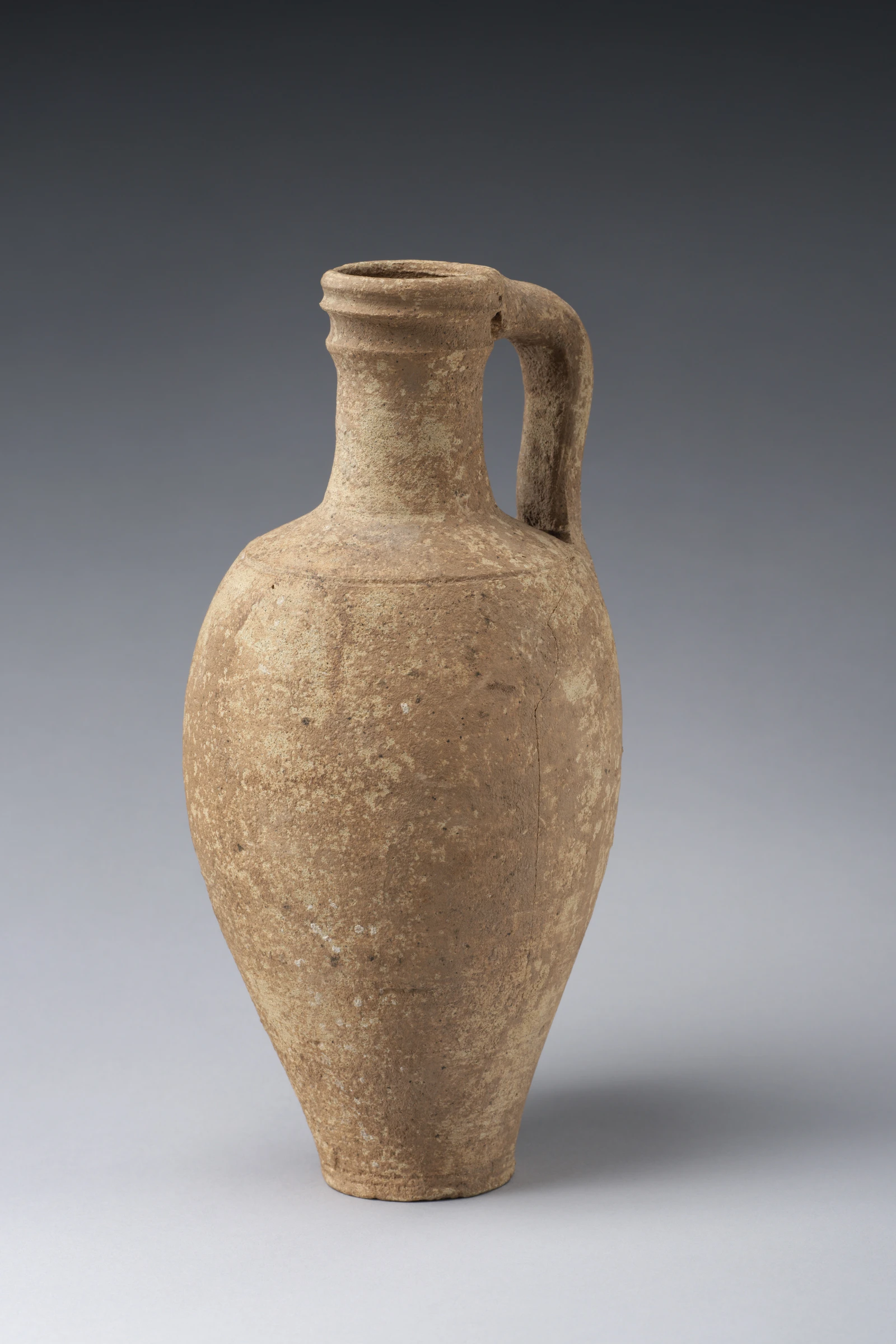
The Baghdad jar is a small clay pot from Khujut Rabu'a, a low hill a few miles south-east of Baghdad, and it holds three things that should not need explaining. A tube of sheet copper. A plug of asphalt. A rod of iron.
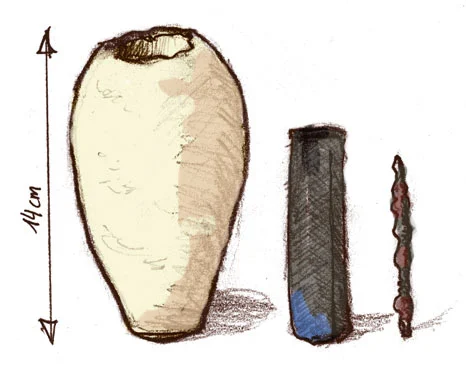
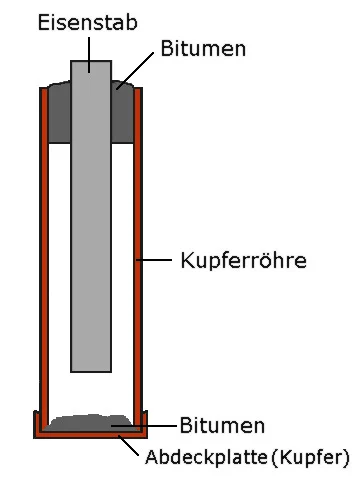
The pot is pale yellow clay, about a hand high, its neck broken away. Inside it the copper tube stands upright, about 26 millimetres across and nine or ten centimetres long, its bottom closed with a disc of the same copper. Black asphalt lines the floor of the tube and rings the mouth of the pot. Down the middle of the tube, held in place by a stopper of asphalt, runs the iron rod, eaten by rust to a point at its lower end.
The whole thing would sit in one palm. Its excavators dated the layers it came from to the Parthian kings, about two thousand years ago, and it has been argued over since 1938.
Copper around iron, sealed in a jar. Put anything sour in that tube and the two metals do what two different metals in an acid always do.
They make a current.
Fill earth from a flooded river
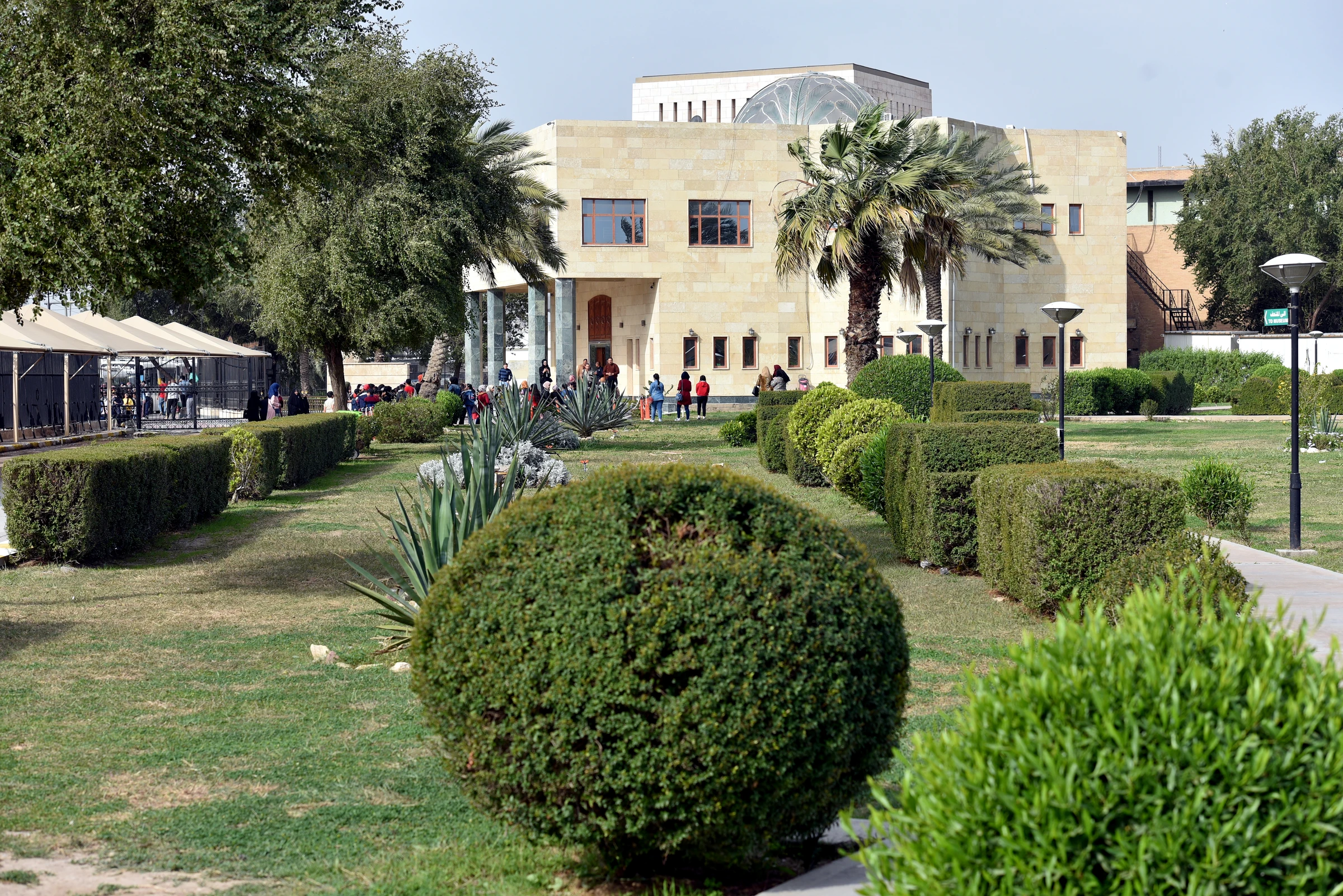
The jar came out of the ground by accident. After the Tigris flooded in 1936, workmen dug fill earth from the hill at Khujut Rabu'a and struck the walls of old buildings. The Iraq Museum and the government stepped in, and the digging, in the words of the science writer Willy Ley, "turned into scientific excavations." The excavators dated the layers to the Parthian period, the centuries either side of the birth of Christ.
The man who looked hardest at the jar was not an archaeologist. Wilhelm Koenig was a German painter working at the Iraq Museum in Baghdad, by some accounts as its director in the 1930s. In January 1938 he described the object in print, and in the same year in the German scientific weekly Forschungen und Fortschritte, under a title that ended in a question mark: a galvanic element from the Parthian period?
In the English translation that the chemist Gerhard Eggert later quoted, it reads: "In a vase-like container of bright yellow clay, the neck of which had been removed, a copper cylinder was stuck, held in place by asphalt." The vase was about 15 centimetres high. The tube had a closed bottom, a diameter of 26 millimetres and a height of 9 centimetres. Inside it was "a completely oxidized rod of iron."
Then the sentence that gave the object its name: "From its parts and their arrangement one might think that it must be a kind of 'galvanic' element or battery."
Koenig had a reason to look in that direction. In Baghdad he had watched silversmiths gild small objects by a method that ran on electricity, and he wondered aloud, in his memoir of his years in Iraq, whether the method was older than anyone thought.
A cell two thousand years before Volta
Willy Ley carried the jar into English. In the March 1939 issue of Astounding Science-Fiction he set out Koenig's measurements and drew the conclusion Koenig had only asked about: "An assembly of this kind cannot very well have any other purpose than that of generating a weak electric current." He admitted that "one naturally feels very reluctant to accept such an explanation, but there is really no alternative."
Ley widened the picture. At Seleucia on the Tigris, an expedition had found four similar vases, and beside them thin rods of bronze and iron that Ley called wire-like and thought might have served as conductors. From Ctesiphon, across the river, came a set held in a Berlin museum: one clay vessel holding ten copper cylinders, a second holding ten iron rods, a third holding ten asphalt plugs. Ley dated the Ctesiphon set to the later Sasanian period.
Ten of each.
Parts, on Ley's reading, waiting to be assembled.
The experiment followed at once. Willard Gray, an engineer at General Electric in Pittsfield, Massachusetts, built a copy after reading Ley's first article, filled it with copper sulphate and reported that it "worked quite well for a short time." The replica went on show at the Berkshire Museum. By 1954 Ley was certain: "Nobody who knows all the facts doubts that they did have 'galvanic' batteries in Baghdad at about the time of Christ."
The idea had a biography after that. For the 1978 exhibition of treasures from the Iraq Museum, the Roemer- und Pelizaeus-Museum in Hildesheim showed journalists a gilding experiment run from an open reconstruction of the cell, and its catalogue said the Parthians had known an electric cell some 1,800 years before Galvani. In 1993 the scholar Paul Keyser argued in the Journal of Near Eastern Studies that such cells were used for something gentler than plating, a faint electric numbing, a treatment for pain. In 2005 the television programme MythBusters wired ten replicas filled with lemon juice and read about 4.5 volts.
And in January 2026 the researcher Alexander Bazes published, in Sino-Platonic Papers, a reading nobody had tried: two cells in one jar. The iron in the copper is one, at about a third of a volt. The solder on the outside of the tube, a caustic liquid in the porous clay and the air make a second. Together, he reported, more than 1.4 volts, enough to etch a copper plate overnight. Bazes called it "the strongest evidence to date" for a working knowledge of electrochemistry in the Near East "nearly two millennia before Alessandro Volta's experiments."
If the current was meant
Set aside for a moment whether it is true. Ask the better question. What would it mean if the jar was built to make a current?
It would mean a discovery made and kept in one valley. Electricity, on that reading, was found by craftsmen with clay, copper and vinegar, and it was used, perhaps for gilding, perhaps for healing, without one surviving line of writing about it. The recipe lived in hands, not in books.
It would mean the jar on the museum shelf is not alone. The Dendera crypt reliefs, carved in Egypt in roughly the same centuries, have been read by engineers as lamps; one sealed cell in Mesopotamia would make every such reading harder to set aside.
It would mean the history of science has a gap where a whole branch should be. Our species learned to store current in a column of metal discs in 1800, when Volta announced his pile, and the century that followed built the telegraph, the electric light and every machine since on that one step. If the step was taken once before and lost, then the line from the first spark to the modern world was not a single climb. It was a climb, a fall and a second climb.
It would mean that what we know depends on what happened to survive. A craft can die with the people who practise it, as the formula for Greek fire did.
And it would leave the largest question standing in front of us: how much of what humanity once knew sits in museum stores right now, labelled as something else, waiting for someone to put the parts together the right way?
The scroll holders
The standard account holds that the jar was a container for something written, not a source of power, and it rests on specific finds.
The parallels are its first evidence. The Seleucia cylinders, Ley himself reported in 1954, were "full of plant fibers", which their excavator took to be decayed writing material, and they were found in a house with bowls the experts called magic equipment. Eggert, a chemist and conservator at the Rheinisches Landesmuseum in Bonn, noted in 1996 that most of the parallels are rolled bronze sheets with open seams that "cannot hold any liquid." The archaeologist Emerich Paszthory argued in 1989 that such objects held blessings or incantations on organic material. Eggert agreed: the magical container, he wrote, is "much more probable than the 'power source' claim."
The second is what has not turned up beside the jars. Ley's thin rods are straight pieces of metal, not a connected circuit, and "We don't find wires," the archaeologist William Hafford of the Penn Museum has said. As of 1996, Eggert found no ancient Near Eastern object shown by analysis to be electroplated, and no text describing the work. The Baghdad gilding Koenig saw matched, Eggert found, a method invented in Birmingham by John Wright in 1839.
The third is the seal. A copper tube soldered shut and stoppered with asphalt lets in almost no air, and Eggert's account of the chemistry is that the current from such a cell falls to almost nothing once the oxygen inside is used up.
The last is the date. The closest parallels, the Ctesiphon set and the Seleucia vases, are dated to the Sasanian period, and St John Simpson of the British Museum has said of the jar itself, in a 2014 report in the Pakistani newspaper Dawn: "The pot itself is Sassanian," which would place it after AD 224 and beside the finds the scroll reading rests on. Eggert's conclusion covers every replica: "successful experiments alone can show only a supposed ancient technique to be possible, but never its application."
What the scroll reading does not reach
The scroll reading has its own soft ground, and it begins with the jar itself.
Koenig's description of the Khujut Rabu'a jar lists clay, copper, asphalt and iron. It mentions no fibre. The plant matter belongs to the Seleucia cylinders, which were closed at both ends, a different build. The explanation for one set of objects is being carried across to another.
Then the dig. William Hafford, in a comment on the linguists' blog Language Log in January 2026, said that as far as he knows the 1936 excavation was never published, that a photograph Koenig took shows the object already in pieces, and that the famous drawing shows how Koenig thought the parts fitted. Koenig and Ley reported the tube found inside the jar, held by asphalt. No published plan shows how the parts lay in the ground.
And the jar is gone. It was reported lost when the Iraq Museum was looted in 2003. Bazes, replying on the same blog, said its loss ruled out the X-ray analysis of its metal that might have shown what, if anything, once stood in the tube.
There is one more gap, and it cuts against both sides. A scroll holder needs a scroll, and a battery needs a circuit. In the Khujut Rabu'a jar the record shows neither, only the four materials Koenig listed and the order he put them in.
The search for the circuit has been made in the metalwork of the region: archaeometry, in Eggert's 1996 summary, "could not prove any ancient Near Eastern object to be electrogilded."
The analysts did not find it.
No fibre is reported from the Khujut Rabu'a tube either. Neither absence can now be checked on the original.
Where it stands
What the record shows is not in doubt. A clay jar from a hill near Baghdad, a copper tube about 26 millimetres across, an iron rod rusted to a point, asphalt at both ends. The replicas reported since 1939 have given a current, from a fraction of a volt to the 1.4 volts Bazes reports for his two-cell reading.
How the specialists explain it is documented too: storage for sacred writing, on the evidence of the Seleucia finds, the magic bowls and the missing wires. On the weight of what has been found, the record favours that reading.
What is still open is narrower. Whether the Khujut Rabu'a tube ever held a liquid. How the parts lay when they were found. Whether the jar is Parthian, as its excavators thought, or Sasanian, as Simpson holds. The people still on it work from copies. Bazes built his two cells from Koenig's measurements and, on Language Log, said he hoped chemists would repeat the work. Hafford and the archaeologists answer from the parallels and the bowls. A bronze machine from a Roman-era wreck shows what one surviving object can do to a settled history, once it is measured with instruments its finders never had.
A published account of the 1936 dig would help most with how the parts lay; the original jar recovered and tested would say more about what they did than another replica could. A replica can show what the parts are able to do. Only the jar can show what they did.
Koenig gave his first account a title that ended in a question mark. The record still does.
Questions This Leaves You With
Is there anything a person actually does with this?
Not with the jar itself: the original is reported lost, and nothing about it changes how anyone lives. But the question underneath it is worth carrying. Most of what you know about the past comes from what was written down. A craft that lived only in workshops, passed hand to hand, leaves objects and no instructions. If you want to do something with the Baghdad jar, it is this: notice how often "nobody knew how" really means "nobody wrote it down," and how hard the two are to tell apart from two thousand years away.
Does this sit against a religious account of the world?
It cuts both ways, and both have been argued. On the standard reading the jar is itself religious: a holder for blessings or incantations, buried in a house with magic bowls, a piece of devotion. On the battery reading it is a craftsman's tool, used for gilding or, on Keyser's reading, for easing pain. Neither reading needs or excludes faith. This site will not tell you which way it falls for you, and the jar does not say.
Does this change what you think ancient people could do?
It depends which jar you are holding. If it was a battery, then people with clay and vinegar found something the modern world thought it found in 1800, and lost it again, which makes knowledge both easier to win and easier to lose than it looks. If it was a scroll holder, then you are looking at a careful, sealed, precisely made object built for words, and the people who made it were investing their best metalwork in protecting language. Notice which of those you felt as the bigger loss.
What would change your mind, in either direction?
Name it now, before you are committed. Toward a battery: an object from the same period with a gold or silver layer that analysis shows was laid down electrically; a jar found with traces of acid or salt inside the tube; anything resembling a wire or a connected set. Toward the scroll holder: fibre or writing found in a tube like the Khujut Rabu'a one; the 1936 dig records turning up with the jar and its contents described as found. Either would move the question further than any replica can.
Why was the 1936 dig never published?
That is the empty space at the centre of this story. A flood, a hill of fill earth, a rescue excavation by the Iraq Museum, and then, as far as the specialists who have looked can tell, no report: no plan of the building, no list of what lay beside the jar, no photograph of it in the ground. The parallels from Seleucia and Ctesiphon were published by their excavators; the jar that started it all was not. Hafford thinks Koenig probably kept field notes. A record of where the jar stood, what lay beside it and what was in it would not settle what it was for, but every argument about it would start from firmer ground. If those notes survive, nobody has published them yet.
Sources
- Willy Ley, An Electric Battery 2,000 Years Ago, Astounding Science-Fiction, March 1939 Street and Smith (Internet Archive scan)
- Willy Ley, The Elements of Khujut Rabu'a and Ctesiphon, Galaxy Science Fiction, December 1954 Galaxy Publishing (Internet Archive scan)
- Gerhard Eggert, The Enigmatic Battery of Baghdad, Skeptical Inquirer 20(3), 1996 Center for Inquiry
- Alexander Bazes, The Baghdad Battery, Sino-Platonic Papers 377, January 2026 University of Pennsylvania, Sino-Platonic Papers
- Victor Mair, Volts before Volta, Language Log, 3 January 2026 (with comments by William Hafford) Language Log, University of Pennsylvania
- Tom Metcalfe, Was the Baghdad battery really two cells?, Chemistry World, January 2026 Royal Society of Chemistry
- Baghdad Battery, History.com, 2026 A+E Networks
- Myths and mysteries: The Baghdad Battery mystery, Dawn, 10 May 2014 Dawn
- Brian Dunning, Draining the Baghdad Battery, Skeptoid 640, 2018 Skeptoid Media
- Jar, Ctesiphon, Sasanian, The Metropolitan Museum of Art 32.150.94 The Metropolitan Museum of Art
- Voltaic pile, Wikipedia Wikipedia