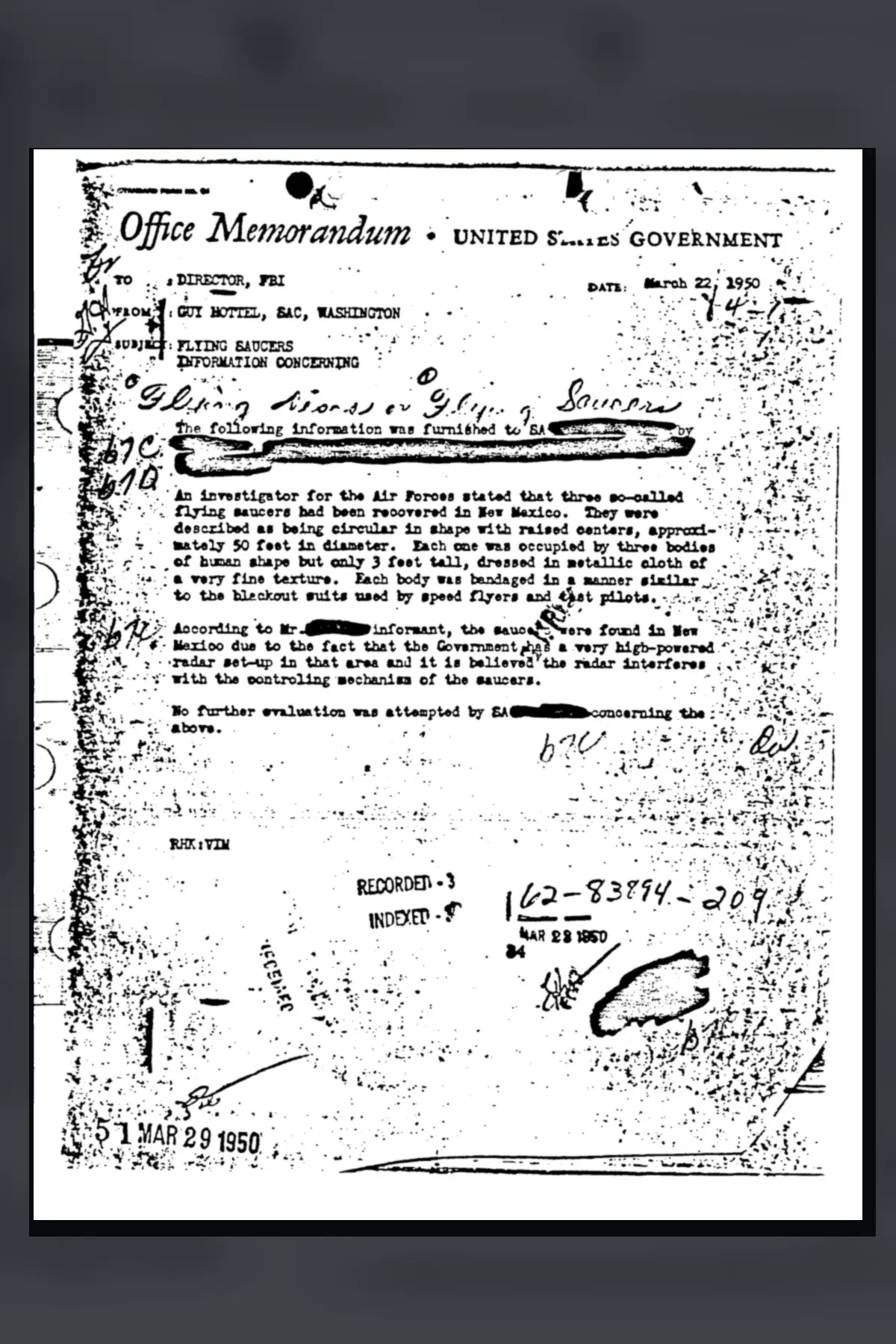
On 22 March 1950 Guy Hottel, the special agent in charge of the FBI's Washington field office, sent J. Edgar Hoover a memo one page long. Its subject line reads "FLYING SAUCERS / INFORMATION CONCERNING". It is filed in the Bureau's flying disc file as 62-83894-209, and after the FBI put it online in its Vault reading room it became, by the Bureau's own count in 2013, the most viewed document there.
The page is a printed government form, "Office Memorandum", typed on a manual machine. Someone has written across it in a quick, looping hand: "Flying Discs or Flying Saucers". Four short typed blocks. Ink stamps along the bottom, RECORDED, INDEXED, MAR 28 1950. Black bars where the Bureau later removed names.
What the paragraphs say is this. An investigator for the Air Forces stated that three flying saucers had been recovered in New Mexico. Each was round, with a raised centre, about 50 feet across. Each held three bodies of human shape, only 3 feet tall, dressed in metallic cloth of a very fine texture and bandaged "in a manner similar to the blackout suits used by speed flyers and test pilots". The saucers were found in New Mexico, an informant said, because the government had a very high-powered radar set-up in that area, and "it is believed" the radar interfered with their controlling mechanism.
Three craft. Nine bodies. One radar.
Then the last typed line, flat as a receipt: "No further evaluation was attempted by SA [name blacked out] concerning the above."
The page in the Vault
Hottel was a Washington man. Born around 1902, he had been a star football player at George Washington University, joined the FBI as a special agent in 1934, and ran the Washington field office from 1937 to 1941 and again from 1943 to 1951, according to the biography the FBI published in 2013. His memo went to Hoover, as every field office memo did, and was recorded and indexed. Then it sat in the file.
It did not stay secret. The FBI says the memo was first released publicly in the late 1970s. The physicist and UFO researcher Bruce Maccabee obtained it in 1977, among some 1,600 documents of FBI flying disc records released under the Freedom of Information Act, as the Huffington Post reported in 2013.
In April 2011 the FBI moved its online reading room into a new site, the Vault. Within days the Hottel memo was a headline. The Sun told its readers that "the amazing UFO find at Roswell, New Mexico, was detailed by FBI agent Guy Hottel."
The traffic did not stop. On 25 March 2013 the FBI published a story about its own file. "It's the most popular file in the FBI Vault," it began. "Over the past two years, this file has been viewed nearly a million times."
A single page. Nearly a million readings.
Three saucers, nine bodies
Read as its strongest readers read it, the memo is the closest thing on public record to a written confirmation of a crash retrieval. Not a rumour in a newspaper. A typed memorandum from the head of an FBI field office to the Director, entered in the Bureau's own saucer file, citing a military source.
That is how the 2011 headlines took it, and how it had been taken earlier. In 1998, according to a 2011 report in the International Business Times, the documentary filmmaker Linda Moulton Howe presented this memo as proof that a ship had landed at Roswell in 1947. Wikipedia's summary puts it plainly: the memo is "claimed by some ufologists to substantiate the Aztec crash."
Aztec is the other half of the story. In September 1950, six months after the memo, Henry Holt published Frank Scully's Behind the Flying Saucers. Scully, who wrote for the show business paper Variety, told how a craft had landed northeast of Aztec, New Mexico, and that the men who reached it counted sixteen bodies of little men inside. His source was a scientist he called "Dr. Gee". The book sold some 60,000 copies. In 1986 William Steinman and Wendelle Stevens revived the case in UFO Crash at Aztec, and in 2012 Scott and Suzanne Ramsey and Frank Thayer made the case for a real crash in The Aztec Incident. Contact stories followed within a few years: in November 1952 George Adamski said he met a visitor in the desert near Desert Center, California.
On that reading the memo is the government's side of the same event, written down before Scully's book existed. The details are specific in the way a real report is specific: raised centres, a 50-foot span, bodies of human shape, cloth of very fine texture, bandaging like the blackout suits of speed flyers and test pilots. Even the place is explained. Not chance. Radar.
And the memo names its route, even with the names blacked out: an investigator for the Air Forces, an informant, the man the informant told, an FBI special agent, the special agent in charge, the Director. Its readers argue that a report which travelled that far up the chain was not idle talk.
If the memo is right
Set aside, for a moment, whether it is true. Ask the larger question. What follows if it is?
It would mean that the most viewed page in the FBI's public archive has been, all along, exactly what the headlines of 2011 said: a field office recording, in plain bureau prose, that three craft and nine crew had been recovered in New Mexico, at a date the memo does not give, and that the record then went quiet. Which means the silence after it would be the story, not the memo.
It would mean that by 1950 the United States held bodies of human shape that were not human beings. Three feet tall, dressed for flight. Our species would have stopped being alone some time before most people now living were born, and the knowledge would have been held by a handful of officials in the first years of the Cold War, filed under a heading in a cabinet in Washington.
It would mean something stranger about us, too. On the memo's own account the craft were not shot down. The informant tied them to a powerful radar believed to interfere with their controls. If that radar brought them down, the machines that crossed whatever distance they crossed would have been undone by an ordinary piece of 1940s electronics. Whatever we are, on that reading, we were already loud enough to knock visitors out of the sky without meaning to.
And it would leave one question in front of us. The FBI's flying disc file is still being released. In May 2026 the Department of War published fuller copies of FBI file 62-HQ-83894 from the National Archives. If the memo records a real retrieval, the pages around it, and the Air Force's own records, are where the next step would be.
The story from Denver
The standard account starts with a man who was not in New Mexico at all.
Silas Newton was a Denver oil man. On 8 March 1950 he stood in front of a University of Denver elementary science class as an anonymous guest lecturer, brought there by George T. Koehler, a salesman for the Denver radio station KMYR, and told the students about saucers held by the government. The journalist J. P. Cahn named him in True magazine in September 1952, and named Scully's "Dr. Gee" as Newton's associate Leo GeBauer.
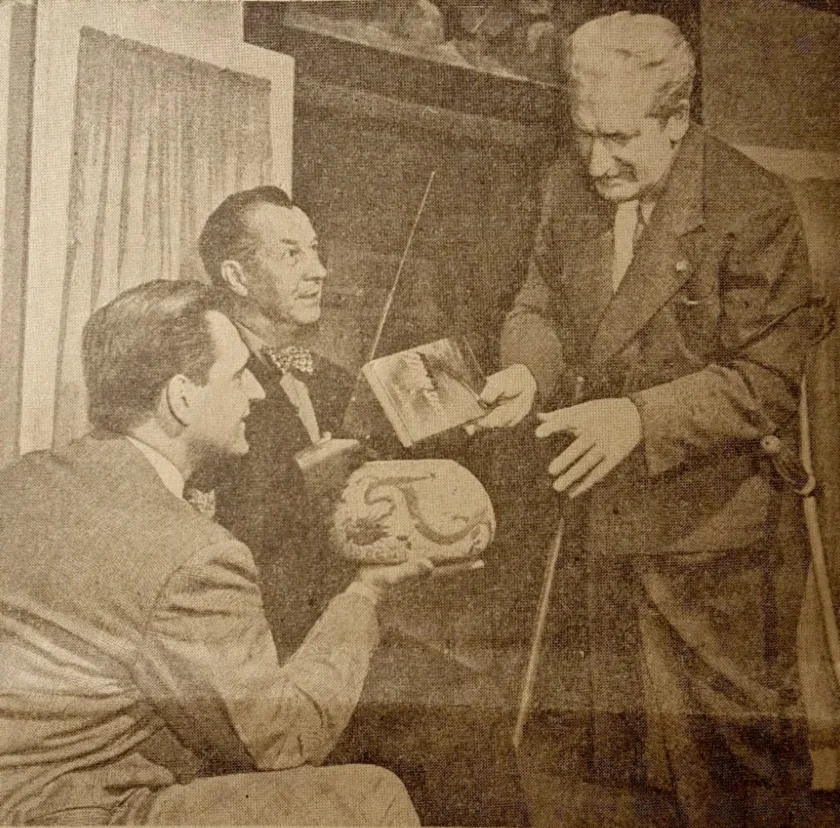
Newton's story was already moving. In January a Kansas City, Kansas paper, the Wyandotte Echo, had printed it as an engineer it called Coulter had told it to a Kansas City Ford dealer; Air Force investigators later identified Coulter as Koehler. It had saucers down near a radar station close to the New Mexico and Arizona border, crews 3 feet tall, bodies "taped", radar that might "interfere with their control systems". That chain rests on transcriptions of Air Force intelligence files published on the research site Saturday Night Uforia. On 10 March, twelve days before Hottel wrote, Washington's Evening Star carried the Associated Press account of the Denver lecture, naming Koehler: "Midget pilots recently flew three flying discs to earth from Venus." And on 31 March the FBI's New Orleans office told Hoover that a Denver oil man named Silas Newton was describing a disc found intact in the Mojave Desert, with eighteen three-foot occupants. That memo is filed four serials after Hottel's.
Cahn finished the story. The metal Newton had shown as saucer metal was, he reported, "plain old aluminum, 99.5 percent pure". In November 1953 Newton and GeBauer were tried in Denver for conducting a confidence game, and the jury found both men guilty. Even the ufologist Jerome Clark, reviewing The Aztec Incident in 2012, called Newton a "lifelong swindler".
The FBI's own 2013 verdict is short. The memo is "a second- or third-hand claim that we never investigated."
What the Denver story does not reach
In August 2022 the FBI released the memo again, this time to the researcher John Greenewald Jr. of The Black Vault, with the names restored. The chain it shows is longer, and stranger, than the redacted copy let anyone see. "The following information was furnished to SA R. H. KURTZMAN by KARL HOWE, Special Investigator, Sex Squad, Metropolitan Police Department."
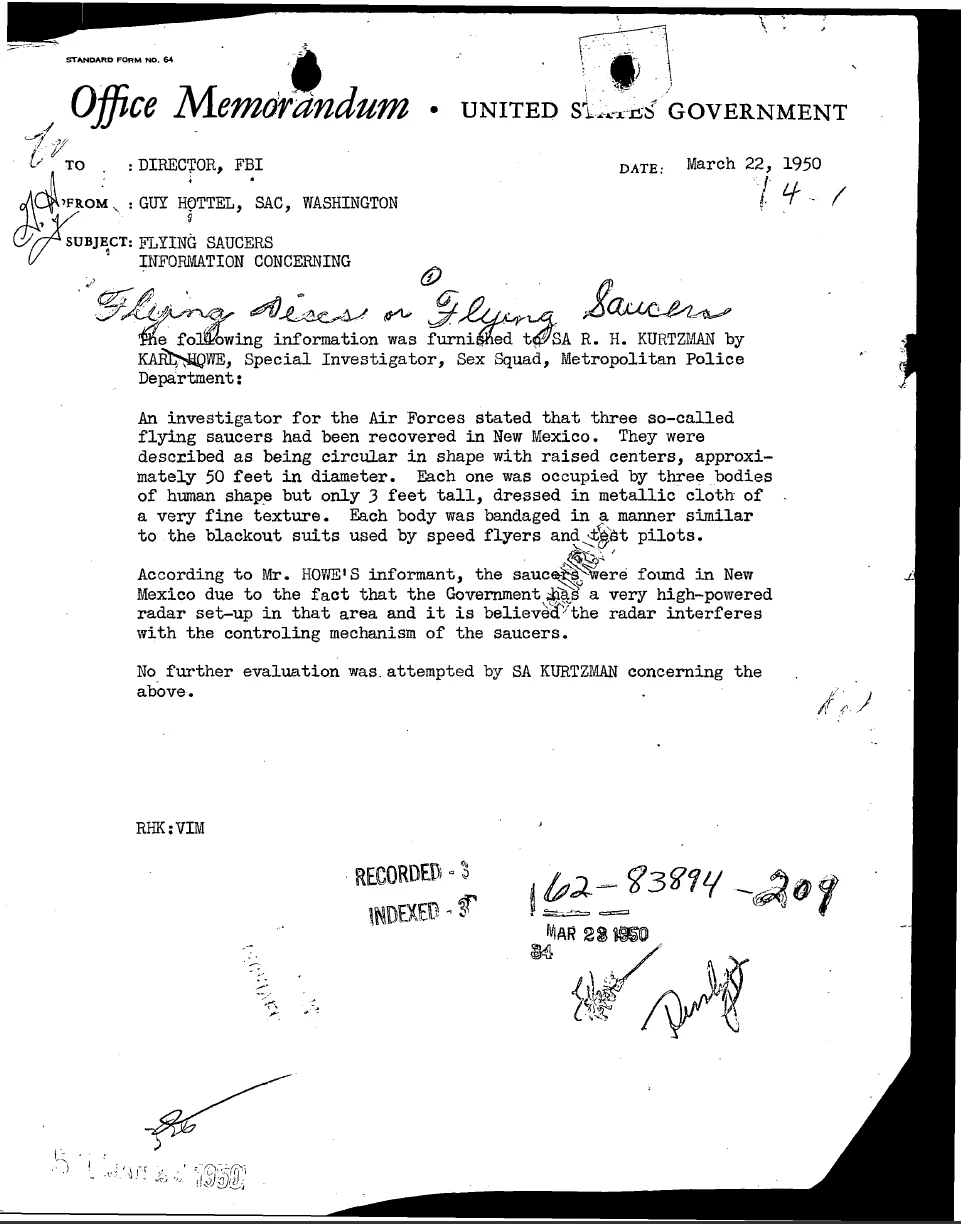
A vice-squad detective in Washington, D.C. The informant in the radar paragraph is "Mr. HOWE'S informant". Whether that informant was the Air Force investigator himself or a go-between, the memo does not say. Either way the story passed from the investigator to Howe to Kurtzman to Hottel before it reached Hoover, and the Bureau's own phrase, "second- or third-hand", counts short.
And here is the strange part. Nothing in any released record connects Karl Howe or Agent Kurtzman to Newton, Koehler, the Wyandotte Echo or the Denver lecture. The match is in the content and the timing, nothing more. The Echo version had two craft with crews of two and an 18-foot ring (13 feet in an Air Force summary); the memo has three craft, three bodies each, and 50 feet. The air investigator has never been named. Several researchers call him an agent of the Air Force Office of Special Investigations, which, according to the same transcriptions, had reported the Echo story to its Washington headquarters in January; no document says so. Greenewald, who obtained the unredacted copy, wrote that the source was "another law enforcement agency" and that where the police department received the information "remains a mystery." The writer Jason Colavito proposed in 2022 that the investigator was more likely an Air Force investigator of homosexual conduct, and that the story reached Howe through a vice case; he called that "most likely", and it remains his inference.
Neither the informant nor the investigator has been named.
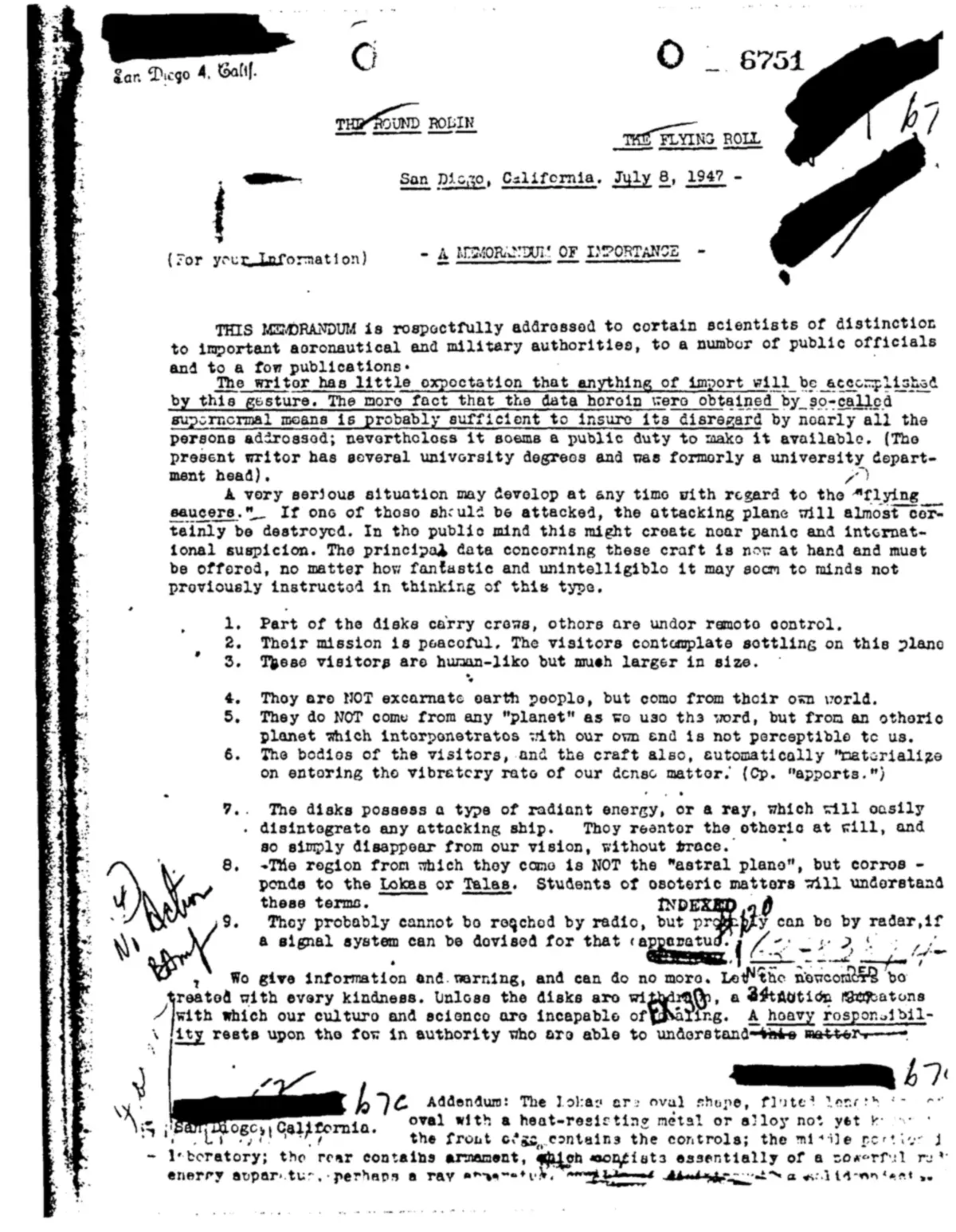
The flying disc file also shows what kind of mail the Bureau kept. Page 22 of its first released part is a mimeographed circular from San Diego dated 8 July 1947, headed "The Round Robin", the name of the newsletter the San Diego psychic researcher Meade Layne had published since 1945, and "The Flying Roll". Who mailed this copy to the Bureau is not recorded on the page. Its writer says the data "were obtained by so-called supernormal means", and its nine numbered points place the discs' home in "an etheric planet" corresponding "to the Lokas or Talas". Its visitors are "much larger in size". Someone at the Bureau wrote "No Action" in the margin, and the page was indexed into the same file as Hottel's memo. Material was sent to the FBI; being in the file was never a finding.
One paragraph, still open
Where it stands now: the FBI says it never followed the story up, and that its practice of checking saucer reports for the Air Force ended in July 1950. The Pentagon's All-domain Anomaly Resolution Office, in the first volume of its historical report in 2024, noted that claims of recovered craft "date back to the 1940s and 1950s" and did not mention the memo. That volume was the government's answer to the claims of retrieved craft made to Congress in 2023, among them David Grusch's testimony. Which section of the fuller National Archives copies published in May 2026 holds serial 209 had not been established when this article was written.
What remains is small and specific. A detective of the Metropolitan Police had an informant, and the story began with an investigator for the Air Forces, who may have been that informant or may have told him. Nobody has put a name to either, and nobody has found the conversation in which the story reached Howe.
That conversation, or the Air Force's own record of its investigator, could settle the memo in either direction. If Howe's informant had read the Kansas City paper or heard Koehler, the memo is Newton's story arriving in Washington by a side door. If the investigator was real, and was talking about something he had seen, it is something else.
"No further evaluation was attempted", by the agent who took the report. Seventy-six years later, it is still the one line on the page that everyone agrees on.
Questions This Leaves You With
Is there anything a person actually does with this?
Honestly, very little follows for your own life. The memo describes events reported in 1950, and whatever was or was not recovered, it asks nothing of you now. Anyone selling you a date, a disclosure deadline or a kit is selling something. The larger question does belong to everyone, though: what a government owes its public about records like this, and how a society decides when a story told to one agent becomes something worth checking. That question is unanswered, and it is not yours alone to answer.
Does this sit against a religious account of the world?
It can be read either way, and serious people have read it both ways. Some find that other minds in the universe make creation larger and stranger; others find the idea unsettling for what it says about humanity's place. The memo itself says nothing about souls, gods or origins: it describes size, clothing and radar. Official X will not tell you which way it falls for you, and nothing in a one-page FBI file can decide it.
Does this change what a human life is?
If the bodies in New Mexico were real, a human life sits in a crowded universe, and one ordinary radar set was enough to make contact by accident. That can make a life feel smaller, one species among several. It can also make it feel rarer: a short life lived at the exact moment when the question first became askable. Which of those two did you feel when you read the paragraph about the three-foot crews?
What would change your mind, in either direction?
It helps to decide now, before you lean further. Toward a real event: a named Air Force investigator with a record placing him in New Mexico in early 1950; a contemporary report of three craft from a source with no line back to Newton, Koehler or the Echo; anything physical with a documented chain of custody. Toward Newton's story: a record showing what Howe's informant had read or heard, or an Air Force file that traces the investigator's account to the Kansas City paper. Either would move the memo a long way. Neither has turned up.
Who told Karl Howe?
This is the open problem, and it is a real gap, not a rhetorical one. The 2022 release named the detective and the FBI agent, and stopped there. Howe's informant and the investigator for the Air Forces, whether one man or two, are still blank, and how the story reached Howe is not in any file released so far. The fuller National Archives copies of the FBI's flying disc file are public now, and no one has yet reported finding the informant's name in them.
Sources
- FBI Vault: Guy Hottel, memo of 22 March 1950 (file 62-83894-209) Federal Bureau of Investigation Primary record
- UFOs and the Guy Hottel Memo (25 March 2013) Federal Bureau of Investigation Primary record
- The Guy Hottel Memo and the Crashed Flying Saucers of New Mexico (updated 8 August 2022) John Greenewald Jr., The Black Vault Primary record
- FBI Vault: Silas M. Newton Part 06, SAC New Orleans to Director, 31 March 1950 (62-83894-213) Federal Bureau of Investigation Primary record
- FBI Vault: UFO Part 01, page 22, The Round Robin / The Flying Roll, San Diego, 8 July 1947 Federal Bureau of Investigation Primary record
- J. P. Cahn, The Flying Saucers and the Mysterious Little Men, True, September 1952 True magazine (scan, Southern Methodist University) Primary record
- J. P. Cahn, Flying Saucer Swindlers, True, August 1956 True magazine (scan, Southern Methodist University) Primary record
- Evening Star (Washington), 10 March 1950, p. 23: 'Saucers' Now Equipped With Midget Pilots (AP) Library of Congress, Chronicling America Primary record
- Anatomy of a Hoax, Part One (2013, transcriptions of Air Force files) Saturday Night Uforia Study
- Lee Speigel, FBI UFO document (27 March 2013) HuffPost Study
- Benjamin Radford, Roswell FBI memo: Baloney or hogwash? (11 April 2011) Christian Science Monitor / LiveScience Study
- Jesse Emspak, IBTimes (11 April 2011) International Business Times Study
- Jerome Clark, review of The Aztec Incident (2012) Journal of Scientific Exploration, reposted by Kevin Randle Study
- Jason Colavito, Why Did a Vice Cop Report Crashed Saucers and Dead Aliens to the FBI in 1950? (8 August 2022) Jason Colavito Study
- Robert Todd Carroll, Aztec (New Mexico) UFO case (updated 2015) The Skeptic's Dictionary General reference
- AARO, Report on the Historical Record of U.S. Government Involvement with UAP, Volume I (2024) All-domain Anomaly Resolution Office (copy at The Black Vault) Primary record
- Department of War UFO declassifications, May 2026 (FBI file 62-HQ-83894 sections) Internet Archive mirror of war.gov/UFO Primary record
- Aztec, New Mexico UFO case (Wikipedia) Wikipedia General reference
- Meade Layne (Wikipedia) Wikipedia General reference
- Chris Root, Of Flying Saucers and Fraud: The Silas M. Newton Story (16 July 2021) Denver Public Library Study
- Koehler, Newton and Scully, Denver Post photograph, October 1950 Wikimedia Commons (public domain) Primary record