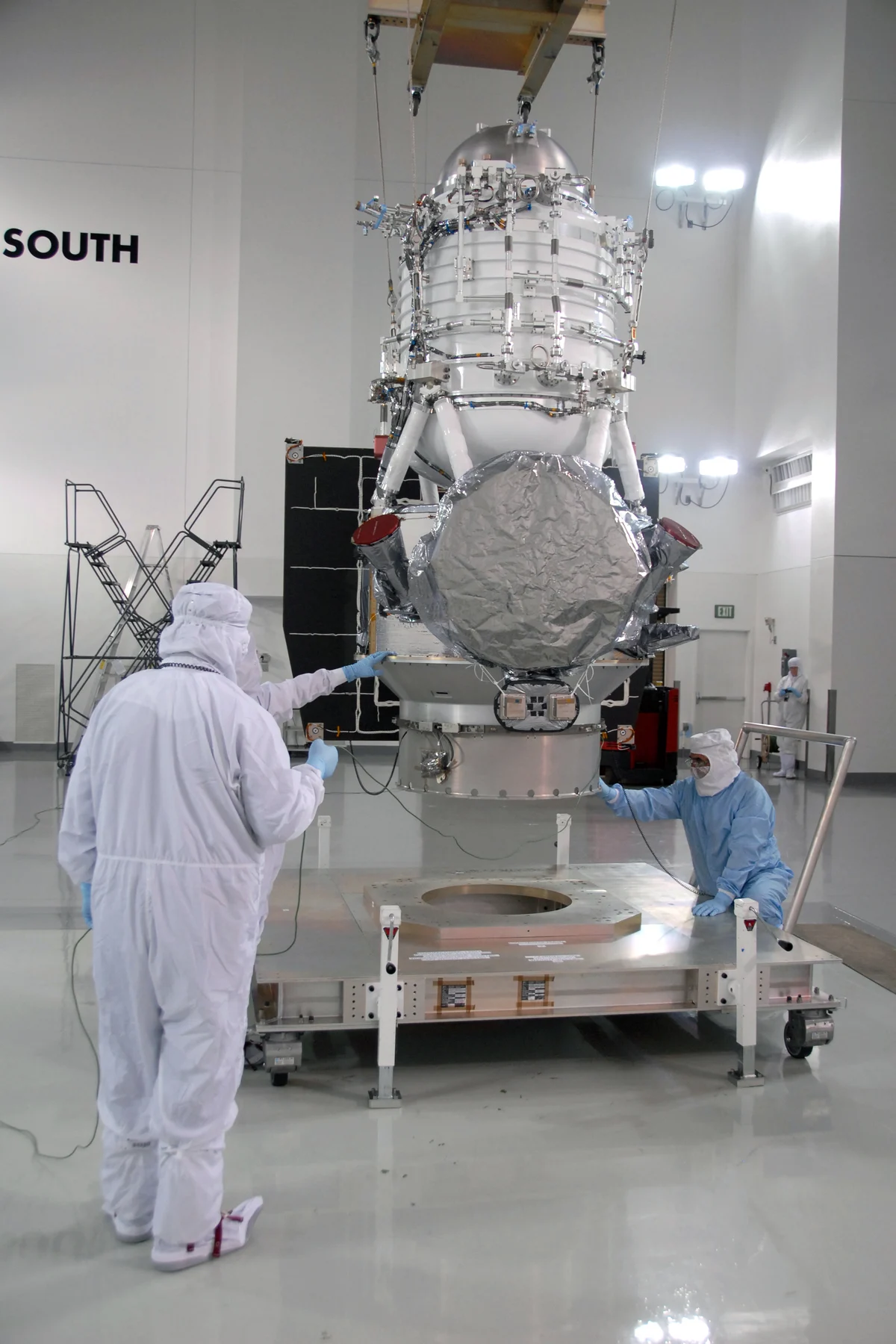
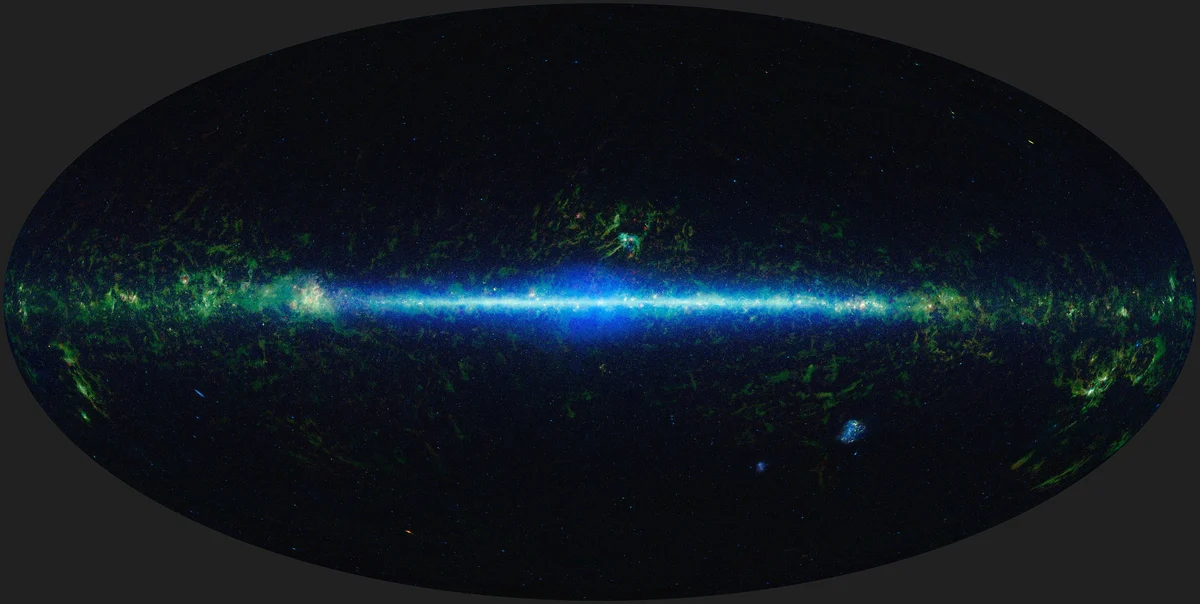
WISE, the Wide-field Infrared Survey Explorer, was a NASA telescope 40 centimetres across, sealed inside a tank of frozen hydrogen and launched from Vandenberg Air Force Base, California, on 14 December 2009. From an orbit 540 kilometres up it photographed the entire sky in four colours of infrared light, the light of things too cold to shine.
Cold is the point. A star burns. A brown dwarf, a failed star, glows faintly, and a planet the size of Jupiter far from the Sun gives off almost nothing but the heat it was born with. Visible light will not find them in the dark beyond the planets. Infrared will.
Between January and July 2010 WISE covered the whole sky once, and kept going until its hydrogen ran out in September. Each position in the sky was photographed two or three times, about six months apart.
Twice is enough to see something move.
And for thirty years there had been a thing, out in that dark, that some astronomers wanted very much to see move.
Twenty-six million years
The thing had a name before it had a position. In February 1984 the palaeontologists David Raup and Jack Sepkoski reported in the Proceedings of the National Academy of Sciences that mass extinctions over the past 250 million years seemed to come at a mean interval of 26 million years. Two months later two teams in Nature offered a cause, one of them Marc Davis, Piet Hut and Richard Muller: a companion of the Sun on a long orbit, swinging in every 26 million years to shake comets loose from the cloud at the edge of the solar system. It came to be called Nemesis, after the Greek goddess of doom, as the earlier Official X article on the extinction clock tells.
By 2010 the companion had a second candidate. The physicists John Matese and Daniel Whitmire had found what they read as a pattern in the orbits of comets falling in from the outer Oort cloud, and in a paper published in Icarus in 2011 they argued for "a companion of mass ~ 1-4 M_Jup", one to four times the mass of Jupiter, orbiting in the innermost region of the outer Oort cloud. It was nicknamed Tyche, after Nemesis's kinder sister in Greek myth. And they wrote, in so many words, that it "could be easily detected by the recently launched Wide-field Infrared Survey Explorer."
The man who went looking was Kevin Luhman, an astronomer at Penn State. His method was the oldest in astronomy, parallax: a nearby object shifts against the distant background as the Earth moves around the Sun. WISE had photographed the sky about six months apart, from opposite sides of the Earth's orbit. A companion of the Sun would jump between the two pictures.
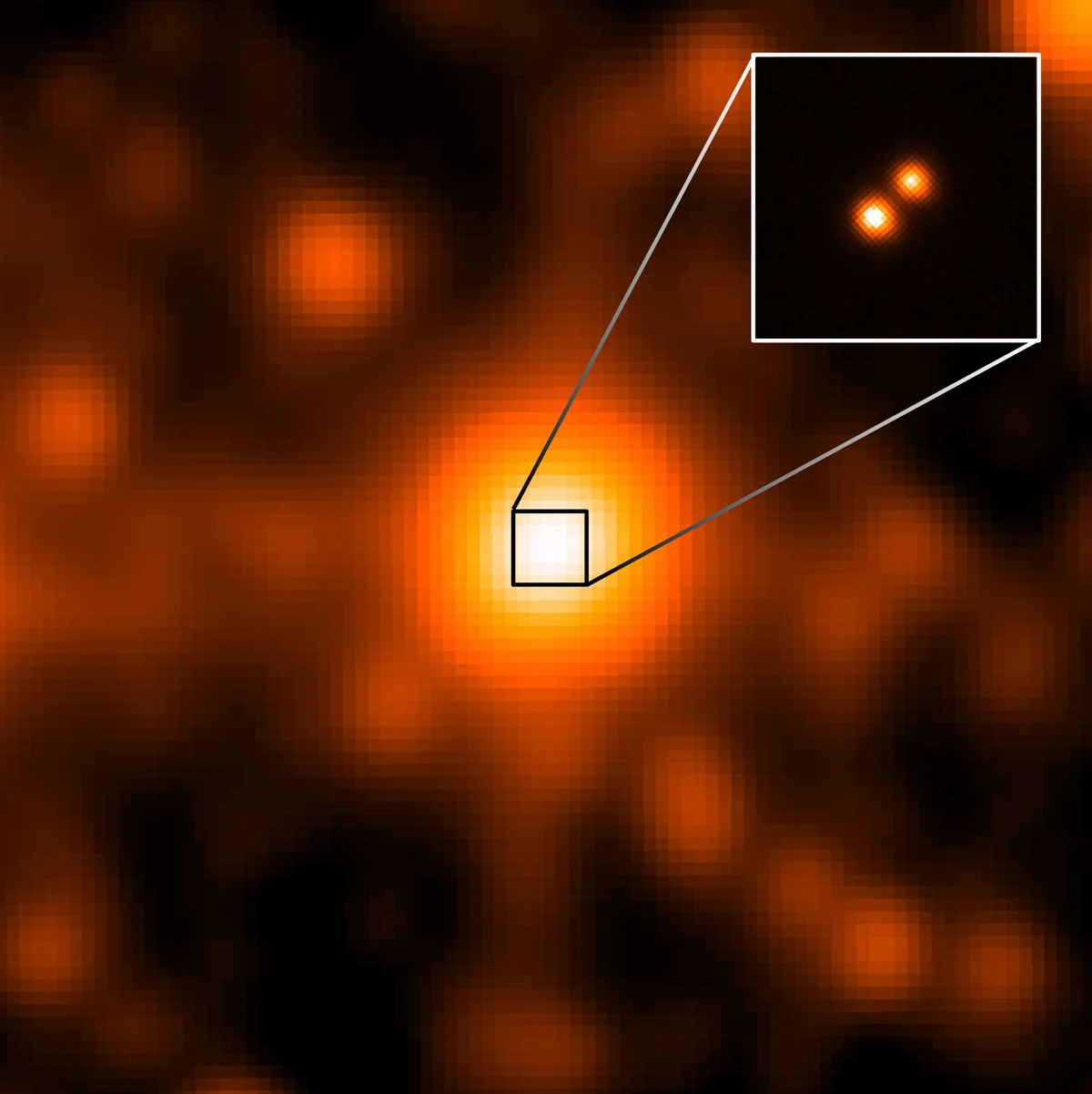
In March 2013, before the companion search was finished, the method found something else. Luhman reported a pair of brown dwarfs only 6.5 light-years away, "the third closest system to the Sun", in his words. A neighbour that close, missed until then.
The companion, read whole
The case for a hidden companion is not one argument but three, and each was made by working scientists in leading journals.
The first is the extinctions. Raup and Sepkoski's 26 million years came out of their own catalogue of the fossil record, and if the rhythm is real, something keeps time. A companion star on a long orbit is a clock with a mechanism: each pass through the Oort cloud would send a shower of comets toward the inner planets, and some would hit.
The second is the comets. Matese and Whitmire did not start from the fossils. They started from the directions comets come from, and found, they argued, more arriving from certain parts of the sky than chance would allow, as if something massive were stirring that region of the cloud. They titled their paper "Persistent Evidence of a Jovian Mass Solar Companion in the Oort Cloud". Persistent. They had been making the case since 1999.
The third is the sky's own record of misses. The brown dwarf pair WISE turned up in 2013, 6.5 light-years away, had been overlooked by every survey before it; Penn State called it the closest system discovered in nearly a century. If a neighbour that close could hide, a dim partner of the Sun could hide too.
Which is why WISE mattered so much to both camps. Here, for the first time, was an instrument built to see exactly this kind of object, everywhere at once. Matese and Whitmire said so themselves. Whatever WISE saw, the question would be far narrower afterwards.
If the Sun has a partner
Set aside, for a moment, whether it is true. Ask the larger question. What kind of solar system is it, if it is?
It would mean the Sun is not alone. The star at the centre of everything every human culture has worshipped or measured would be one of a pair, its partner too dim to see, circling a sky away. Every diagram of the solar system ever printed would be missing its second-largest member, drawn nowhere because it was seen nowhere.
It would mean the history of life has a pulse. The great dyings in the rocks would not be accidents scattered at random through time but beats of a clock, each one set off when the companion came round. The end of the dinosaurs would be one tick.
It would mean something about us. Our species has existed for a few hundred thousand years, a sliver of one orbit. On the Nemesis reading we were born in the quiet stretch between two beats, and everything we have built has happened in the calm of a long swing outward.
And it would leave one question in front of us. A clock has a next. If the companion is real, the next pass is somewhere on its orbit right now, and the only way to know where would be to find it.
What the survey ruled out
Luhman's paper appeared in The Astrophysical Journal in January 2014. He had gone through the WISE catalogues for anything faint and red that moved between the visits, looked again at every candidate in earlier sky surveys, and checked the motions. "I have not found an object of this kind," he wrote, down to the faintest brightness he could use. Only the small regions within a few degrees of the ecliptic poles, about 0.05 percent of the sky, were left out.
What that rules out depends on how bright a cold body is, and so on models. On the planet models he used, a Saturn-like body would have been caught out to 28,000 astronomical units, a Jupiter-like one to 82,000. On the brown dwarf models, a body of one Jupiter mass would have been caught out to 26,000. An astronomical unit is the distance from the Earth to the Sun; Pluto orbits at about 40. His results, he wrote, "exclude most combinations of mass and separation at which a solar companion has been suggested to exist."
NASA's announcement of 7 March 2014 put it in rounder numbers: "no object the size of Saturn or larger exists out to a distance of 10,000 astronomical units". Its headline: "NASA's WISE Survey Finds Thousands of New Stars, But No 'Planet X'". Luhman's line in the release was plain. "The outer solar system probably does not contain a large gas giant planet, or a small, companion star."
The neighbours, meanwhile, kept coming. A second team, led by Davy Kirkpatrick at Caltech, found 3,525 stars and brown dwarfs within 500 light-years that earlier surveys had missed. In April 2014 Luhman reported a brown dwarf about 7 light-years away with a temperature of 225 to 260 kelvin, well below the freezing point of water. The method worked. It found what was there.
What the search could not reach
The companion was not found. That is the result.
But the search had edges, and the paper names them. Every limit rests on how bright a cold body is assumed to be at an age of 5 billion years, the age the paper uses; the gap between 26,000 and 82,000 AU for a Jupiter mass is the gap between two sets of models. Anything fainter than the limit, smaller than Saturn or farther out than the numbers, was below the survey's reach. A small dim companion on a very wide orbit is not excluded by WISE. It is outside it.
And here is the strange part. The Nemesis of 1984 was never a gas giant at a few thousand AU. To keep a 26-million-year period it would orbit at roughly 100,000 AU, the figure Luhman's own paper gives. His limits for a Jupiter-mass body stop short of that. A heavier brown dwarf or a small star would be far brighter and is among the combinations his results exclude; a small, cold body at that distance is not.
The comet pattern Matese and Whitmire read is a separate question, and WISE tested only its proposed cause. Luhman's paper summarises their companion as one to four Jupiter masses at roughly 10,000 to 30,000 AU; his limits for a single Jupiter mass, 26,000 to 82,000 AU depending on the model, cover most of that range, and a heavier body would be brighter still. It was not found. Whether the comets really arrive in the pattern they described is a question about comets, and WISE did not answer it.
The search that kept going
Where it stands now: WISE was put to sleep in 2011, woke in 2013 as NEOWISE to hunt asteroids, and kept photographing the sky until July 2024. It burned up in the atmosphere on 1 November 2024. Its data did not stop. Coadding years of images, Aaron Meisner and colleagues searched part of the sky for Planet Nine in 2017 and found nothing to their limit. The CatWISE2020 catalogue lists 1,890,715,640 sources over the entire sky.
And since 2017 the sifting has been done partly by hand. In the citizen-science project Backyard Worlds: Planet 9, led by Marc Kuchner of NASA Goddard, volunteers flick through WISE images looking for anything that moves. In May 2026 NASA reported that they had found more than 3,000 brown dwarfs, doubling the known population, with more than two billion sources still to review.
The fossil side of the question has moved too. In 2011 Science News, revisiting its own 1984 story, reported that most people no longer think mass extinctions are periodic; if the rhythm is not there, a companion has nothing to keep time for. The record has leaned that way since. It has not closed.
What is left is narrow and specific: a body small enough, cold enough and far enough to fall below a line drawn in 2014. The line has a number on it. Whether anything sits just past it, nobody has seen.
Questions This Leaves You With
Is there anything a person actually does with this?
On any human timescale, nothing. Even on the 1984 reading, the companion's period was 26 million years. Nothing in this story touches next year or the next century. The larger question is about how a civilisation learns its own surroundings: the WISE data found neighbours 6.5 and about 7 light-years away that nobody had seen in a century of looking. Anyone selling a date is selling something.
Does this sit against a religious account of the world?
It can be read either way, and both have been argued by thoughtful people. A Sun with a hidden partner can be read as a universe more ordered than it looks, keeping time on a scale beyond human sight; or as one more sign that the sky is a place of accidents, where whole kingdoms of life end when something swings by. The search itself takes no side: it reports what was seen and where it looked. Some religious writers have welcomed each new survey as a deeper look at an ordered creation; others hear in an empty result only that the heavens keep their own counsel. Both responses are older than WISE. Which way it falls for you is not something this site will tell you.
Does this change what a human life is?
Hold a life of eighty years against an orbit of 26 million. A single orbit would be three hundred thousand lifetimes, longer than our species has existed. On one reading that makes a life invisible, a moment inside a swing of a clock. On another it makes it rare: the one stretch in which a species could build a telescope, freeze it in hydrogen and look. Which did you feel?
What would change your mind, in either direction?
Name it now. Toward a companion: a faint object moving with the right parallax in WISE, NEOWISE or Rubin data; a confirmed periodicity in a new, larger fossil database; a comet anomaly that survives with more comets. Away: a deeper survey, with better models, that closes the gap below Luhman's limits; or extinction records that show no rhythm at any period. Each of those is a measurement someone could make. Some are being made now.
What is below the line?
This is the open problem. The 2014 search excluded most companions that had been proposed, but its limits depend on models of how bright a cold body is, and on how far away it sits. Below those limits the sky is not empty; it is unknown. Backyard Worlds has found thousands of brown dwarfs nobody had catalogued. Whether one of the faint movers in the remaining two billion sources is bound to the Sun, nobody can say yet. A companion would show itself not by brightness but by motion: a yearly shift matching the Earth's own orbit, and very little drift of its own across the sky. That is a test the data can still run. It is not a test anyone has completed for every faint source.
Sources
- Edward L. Wright et al., The Wide-field Infrared Survey Explorer (WISE): Mission Description and Initial On-orbit Performance (The Astronomical Journal 140, 1868, 2010) arXiv / AAS Primary record
- NEOWISE mission page NASA Primary record
- D. M. Raup and J. J. Sepkoski Jr., Periodicity of extinctions in the geologic past (PNAS 81, 801, February 1984), Europe PMC record Europe PMC Primary record
- Nemesis: Searching for the sun's deadly companion star (Science News, 1984, updated 2011) Science News Study
- John J. Matese and Daniel P. Whitmire, Persistent Evidence of a Jovian Mass Solar Companion in the Oort Cloud (Icarus 211, 926, 2011) arXiv / Icarus Primary record
- Can WISE find the hypothetical 'Tyche' planet at edge of our solar system? (NASA/JPL, 21 February 2011) ScienceDaily Study
- K. L. Luhman, Discovery of a Binary Brown Dwarf at 2 Parsecs from the Sun (ApJ Letters 767, L1, 2013) arXiv / AAS Primary record
- WISE Satellite Finds No Evidence for Planet X in Survey of the Sky (6 March 2014) Penn State Eberly College of Science Study
- K. L. Luhman, A Search for a Distant Companion to the Sun with the Wide-field Infrared Survey Explorer (ApJ 781, 4, 2014) The Astrophysical Journal Primary record
- NASA's WISE Survey Finds Thousands of New Stars, But No 'Planet X' (7 March 2014) NASA/JPL Primary record
- K. L. Luhman, Discovery of a ~250 K Brown Dwarf at 2 pc from the Sun (ApJ Letters 786, L18, 2014) arXiv / AAS Primary record
- Aaron Meisner et al., Searching for Planet Nine with Coadded WISE and NEOWISE-Reactivation Images (AJ 153, 65, 2017) arXiv / AAS Primary record
- F. Marocco et al., The CatWISE2020 Catalog (ApJS, 2021) arXiv / AAS Primary record
- NASA volunteers double known population of brown dwarfs (5 May 2026) NASA Primary record
- Backyard Worlds: Planet 9 launch (15 February 2017) ASU News Study
- Marc Davis, Piet Hut and Richard A. Muller, Extinction of species by periodic comet showers (Nature 308, 715, 1984) Nature Primary record