
The Wow! signal is 72 seconds of radio emission that the Big Ear telescope near Delaware, Ohio, recorded around 11:16 at night on 15 August 1977. In 2024 and 2025 a team led by Abel Mendez at the University of Puerto Rico at Arecibo posted two papers, the Arecibo Wow! series, that give it a detailed natural explanation: a small, cold cloud of hydrogen in the Milky Way, made to blaze for a moment by a flare from somewhere behind it.
The night itself, and the red ink in the margin, are told in the story of the printout and Jerry Ehman's note. This is the story of what happened to that page forty-seven years later.
The page is a computer printout, perforated down both edges, its columns of digits and letters recording the strength of the radio sky channel by channel. Down channel 2, six characters run in a vertical line, circled: 6, E, Q, U, J, 5. The printout survives at the Ohio History Connection.
Both new papers are preprints on arXiv. Neither has yet appeared in a journal.
The column has not changed. What it is said to record has.
Four Faint Lines in the Arecibo Archive
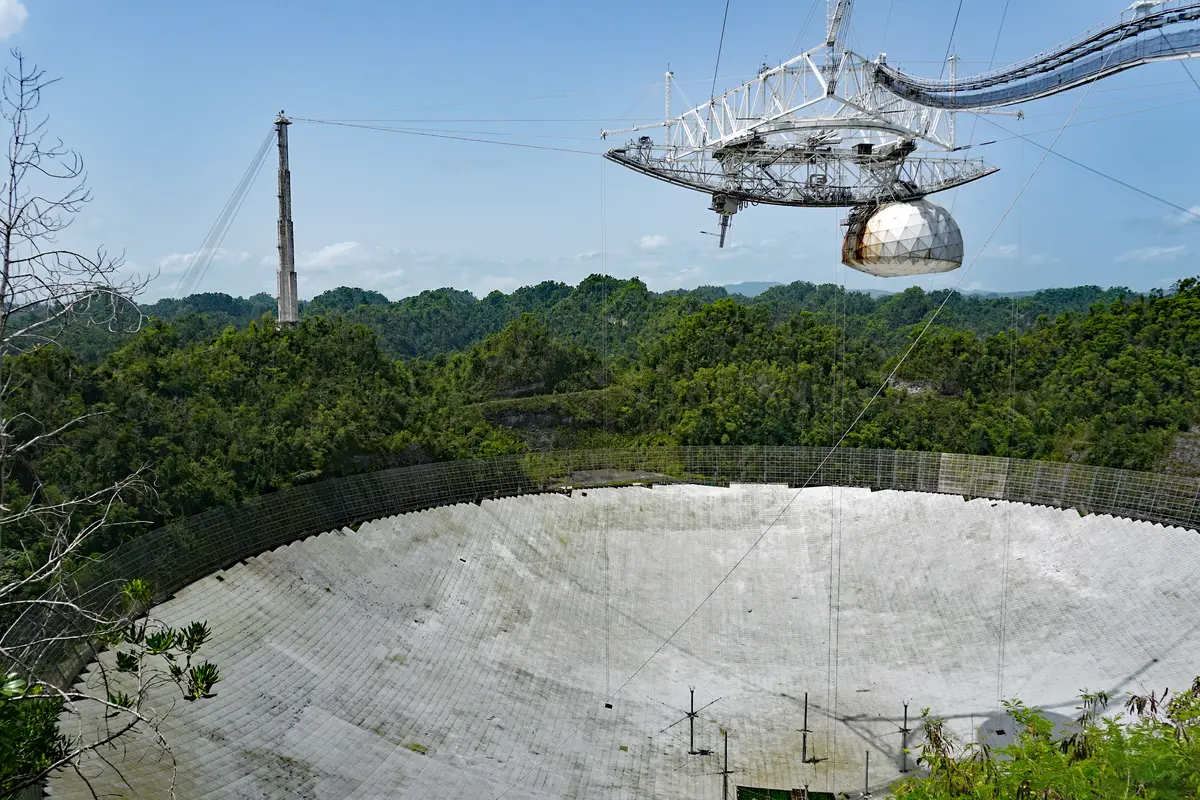
The new reading began with a different telescope. Between February and May 2020, the 305-metre Arecibo dish in Puerto Rico ran drift scans under project A3123: the telescope held still and let the sky slide through its beam, while the Mock Spectrometer cut the band from 1419.5 to 1421.0 MHz into 10 kHz channels, the same width as Big Ear's channel 2.
The fields were nearby stars, Teegarden's Star among them, the magnetar SGR 1935+2154, calibration sources and an empty patch of sky logged as the Void.
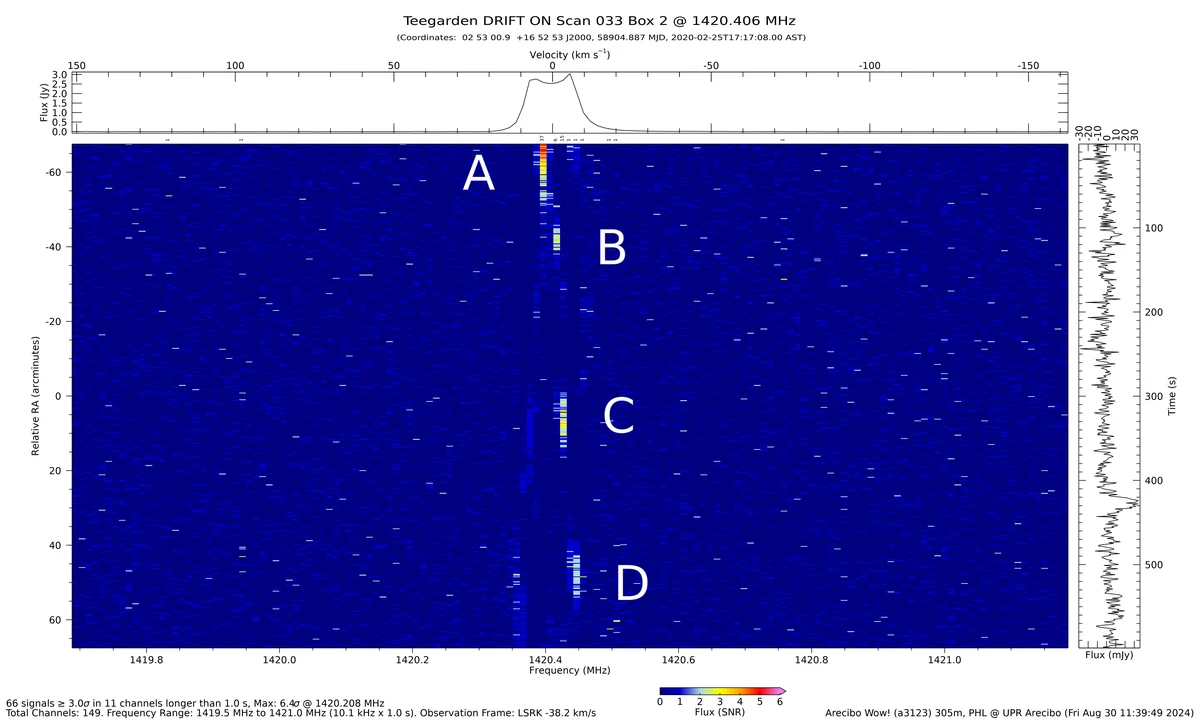
In the scan of Teegarden's Star, four narrow features rose out of the hydrogen background, labelled A to D. Similar features turned up in other fields. Each was about 10 kHz wide. Each measured about half a jansky.
Which put them a hundred times fainter than the Wow!.
Mendez, Kevin Ortiz Ceballos and Jorge Zuluaga read them as small clouds of cold interstellar hydrogen. On 16 August 2024 they posted "An Astrophysical Explanation for the Wow! Signal" to arXiv, 22 pages, marked "submitted to ApJ". The abstract puts the idea in one line: "We hypothesize that the Wow! Signal was caused by a sudden brightening of the hydrogen line in these clouds".
The Column as Ehman Read It
Each character is the signal's strength divided by the channel's noise, cut to a whole number; the letters run from A for 10 to Z for 35. The readings climb, 6, E, Q, U, and fall, J, 5. U means 30 to just under 31 times the noise. Ehman called it "the largest value ever seen".
The case for a transmitter was made first by the man who found it, in the properties he listed in his thirtieth-anniversary report. The signal was "less than 10,000 Hz wide (in one channel only)". Its rise and fall over six readings, 12 seconds apart, "matched almost perfectly the pattern expected from a small-angular-diameter (point) radio source": a source fixed among the stars, carried through the beam by the turning Earth. Big Ear listened through two feed horns, minutes apart on the same strip of sky. The signal appeared in only one. Whatever sent it had stopped within about three minutes.
And the frequency. Ehman put it at 1420.4556 MHz, 50 kHz above the hydrogen line, the line of the most abundant element there is, and the place where, in his words, "an intelligent civilization within our Milky Way galaxy desirous of attracting attention to itself" might broadcast.
Narrow. Strong. Fixed in the sky. At the one frequency a searcher would watch.
Ehman went no further than the record allowed: "an ETI (ExtraTerrestrial Intelligence) might have sent the signal that we received as the Wow! source". In 2007 he told NBC News: "It's still an open question what the source of the signal was".
Big Ear stayed on that strip of sky for close to two months. Robert Gray went back with Marvel on the Very Large Array in 1995 and 1996, at more than a hundred times the original sensitivity, and with Ellingsen from Hobart in 1998 and 1999, tracking the field for nearly 14 hours at a stretch. Nothing came back. On the beacon reading, that silence is the signature of a transmitter that swept past once.
The Wow! sits in a short line of signals read as messages, beside the counting Tesla heard at Colorado Springs and the long-delayed echoes of 1928.
It is the one with a printout.
If a Hand Was on the Switch
Set aside, for a moment, whether it was a transmission. Ask the larger question. What kind of galaxy would we be living in if it was?
It would mean that on one summer night in 1977, a narrow beam of radio crossed the Earth from a point in Sagittarius, on a frequency picked for the reason Ehman gave: that any mind which had studied the sky would know it. Which would mean the choice of the hydrogen line was never ours alone. Somebody else would have reasoned their way to the same number.
It would mean that the first contact our species ever had was not a conversation. It was a glance. A beam that came round, touched one telescope in Ohio for the length of a long breath, and moved on, and the 72 seconds Big Ear wrote down would be the only moment in our history that we were standing in its way.
It would mean that the sky we have been searching since then is not empty but timed. Every null result in that direction since 1977 would read differently: not as absence, but as the beam pointed somewhere else.
And it would leave a question still in front of us. A transmitter that swept past once might sweep past again. On that reading, the beam is still out there, turning, on a schedule nobody has measured, and the next pass would find a world with far more ears than one telescope in a field. Whether we would be listening on the right night, on the right channel, in the right direction, is a question no search has yet answered.
The Arecibo Explanation
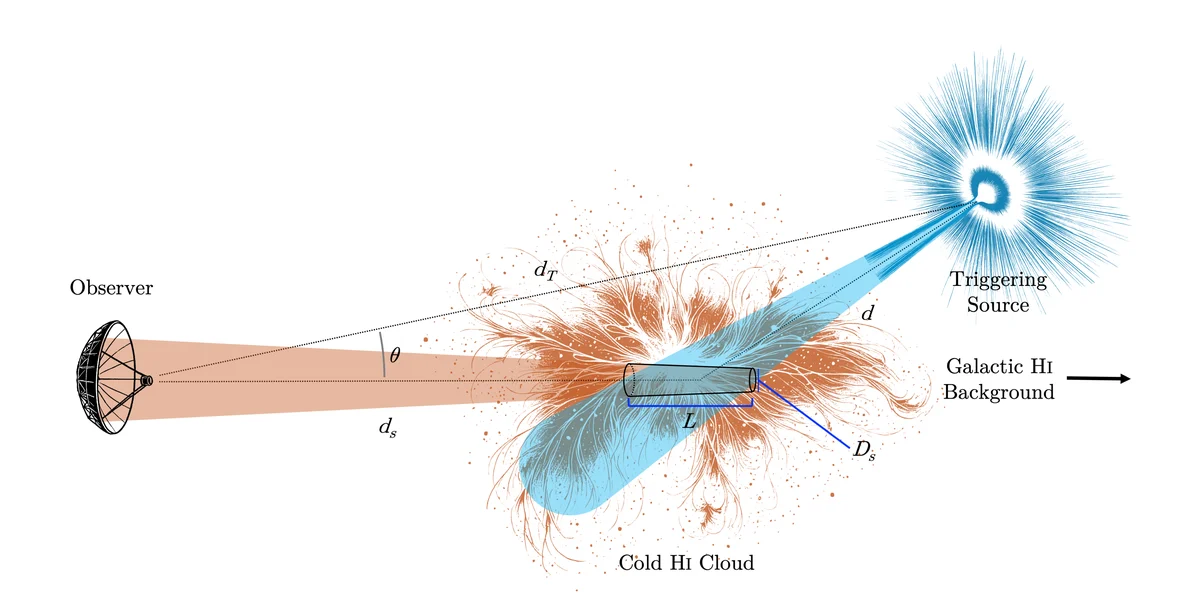
Mendez and his co-authors hold that a cloud did it. In the 2024 paper the source is a small, cold cloud of neutral hydrogen, no warmer than about 97 kelvin so its line stays inside 10 kHz, probably 0.5 to 1.2 kiloparsecs away. Behind or near it, a strong transient, such as a magnetar flare or a soft gamma repeater, floods the cloud and triggers stimulated emission in the hydrogen line: maser action, or Dicke superradiance, scaled from a 2016 model by Rajabi and Houde, with a characteristic superradiance time of about 5 seconds and an event lasting minutes to hours. Why only once: "Flaring events from magnetars are infrequent and must be directly aligned towards Earth for detection."
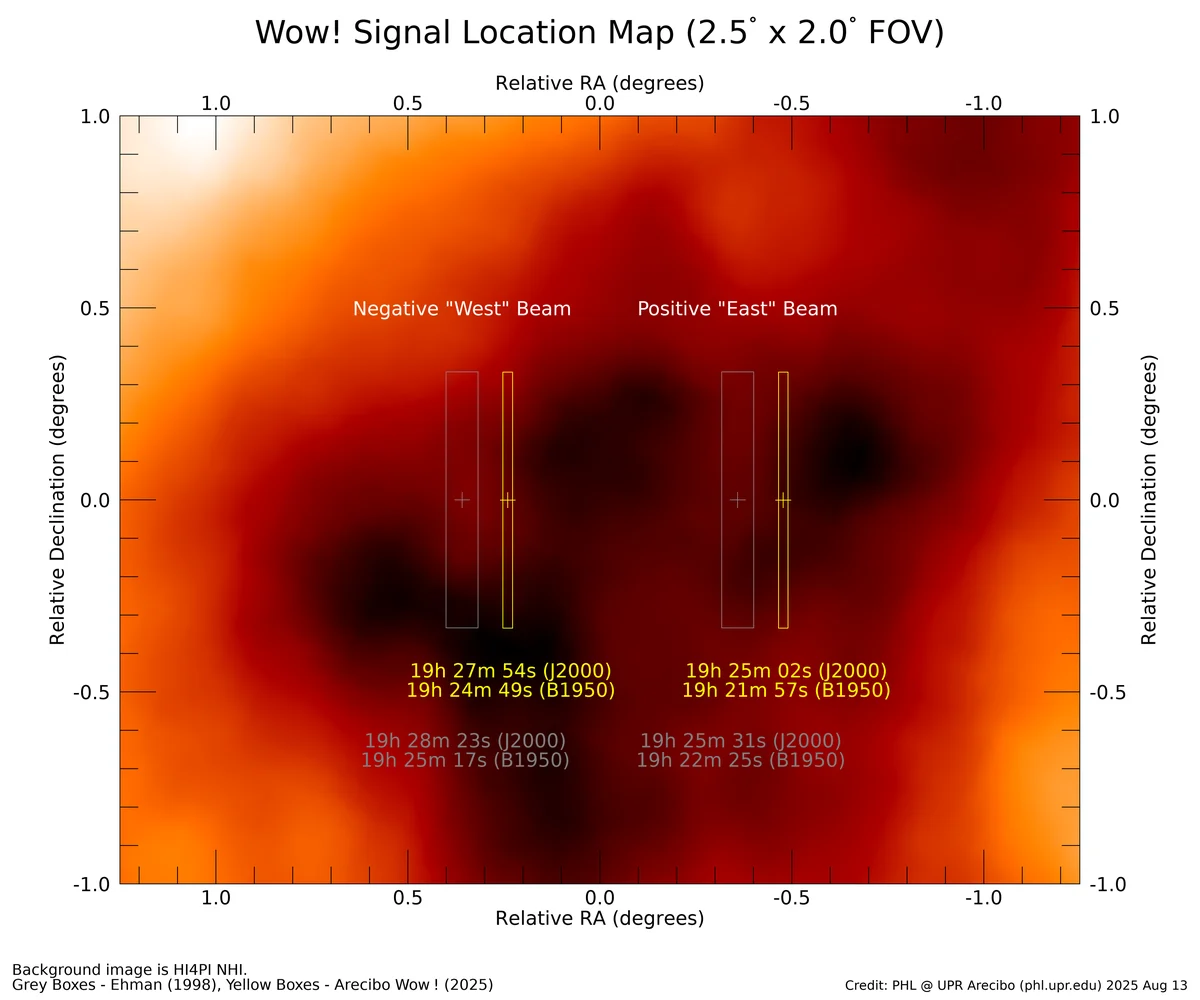
Arecibo Wow! II, posted on 14 August 2025 by Mendez and ten co-authors, went back to the Ohio data: more than 75,000 printout pages photographed between 2006 and 2017. Transcribing 13 to 17 August 1977, the team found "an inversion in channel ordering within the Ohio SETI filter bank, where the frequency decreased with the channel number rather than increased". Corrected, the frequency is 1420.726 +/- 0.005 MHz. The position narrows to two fields, at 19h25m02s or 19h27m55s, +/- 3 seconds. The peak rises to at least 256 +/- 63 janskys. In January 1978 data the team found two much weaker narrowband signals, Wow2 and Wow3, and read both as cold clouds.
What the Cloud Has Not Yet Done
The proposal explains how a cloud could make the column. It has not shown that one did.
The mechanism needs a magnetar or soft gamma repeater to flare in the right direction on the right night, and the 2024 paper leaves the trigger unidentified.
Nobody has found the flare.
The clouds that were observed are the faint ones: about half a jansky at Arecibo, against a Wow! peak above 250. The jump between them, a cloud brightening hundreds of times for a minute and going dark, is modelled, not seen. The maser route needs gas about a thousand times denser than typical diffuse clouds; the superradiance route rests on parameters scaled from another model. No flare of this kind has been recorded anywhere in the sky. Wow2 and Wow3 show that cold clouds left marks in Big Ear's own data, much weaker than the Wow!.
The revised numbers are a corrected reading of the 1977 page, not a new detection. The frequency has now had three values: 1420.356 MHz from John Kraus, Big Ear's designer, in a 1990 private communication cited by Gray and Marvel; 1420.4556 MHz from Ehman; 1420.726 MHz in 2025, about 320 kHz above the hydrogen line, which for a cloud means a motion of about 84 km/s toward the Sun, a speed the 2025 paper itself calls "generally inconsistent with the motion of a source with the galactic rotation"; its authors point to intermediate-velocity clouds and stars in the field that move as fast.
The authors grant it: the work "does not conclusively rule out the possibility that the signal may have originated from alternative sources". Seth Shostak of the SETI Institute told National Geographic the oldest problem stands: a result that cannot be replicated. And both papers are still preprints. The 2025 one carries the note "To be submitted to ApJ after incorporating feedback".
A Cloud With an Address
National Geographic reported in June 2026 that the team has found about 45,000 unpublished detections in Big Ear's archive, and plans to revisit 37 Project META signals from 1986 to 1991. Mendez set the limit himself: "But we always have to bring in a certain amount of doubt."
The 2024 paper named its own tests. Point the Very Large Array or the FAST telescope at the two fields and look for a cold cloud no wider than 10 kHz, shifted by about 10 km/s, smaller than 8 arcminutes; the authors favour the field near 19h25m, where the hydrogen column density is higher. Search the Arecibo archive for another flare. Find the trigger. "Since these Hi clouds are easy to recognize, it may be possible to determine the exact location".
A cloud found there would give the explanation an address. It would not show that the cloud flared on 15 August 1977. Only a flare caught as it happens would show that clouds do this at all.
Until then the record is what it was in 1977. One channel. Six characters. A beam that passed through one horn and not the other.
The page has now been read three ways and given three frequencies. The sky has not yet read it back once.
Questions This Leaves You With
Does any of this change anything for me?
Probably not in your own life, and that is worth saying plainly. Whether the Wow! was a cloud or a transmitter, it happened in 1977, and nothing about it asks you to do anything. The larger question belongs to the species: what kind of listening a civilization keeps up, and for how long, when the most famous result in fifty years came once and never again. Anyone selling a date for the next signal is selling something. What is real is an old archive, now being read with new tools, and the slow work of checking it.
Does a natural explanation take something away from a religious view of the universe, or add to it?
It can be argued both ways, and serious people have argued both. One reading holds that a universe empty of other minds makes our own more singular; another holds that a universe full of them shows a creation larger than any single world. A cloud lit by a magnetar's flare can sit in either picture, and so can a beam from another civilization. This site will not tell you which way it falls for you. That part is yours, and it was yours before the 2024 paper was posted.
If it was a cloud, is the story smaller?
Put it beside the scale. A small cloud of hydrogen below 100 kelvin, struck by a flare from a magnetar and made to shine for about a minute in exactly the direction of one telescope in Ohio. Some readers find that a letdown: no one was calling. Others find it rarer than a message, an accident aimed at us by nothing at all, caught on the one night someone was writing the sky down. Which one did you feel when you read the mechanism? The answer may say more about you than about the sky.
What would change your mind?
Decide now, before the next result arrives. A cold hydrogen cloud found by the VLA or FAST inside one of the two 2025 fields, at the right velocity, would strengthen the natural reading, and a hydrogen flare caught in the act anywhere in the sky would strengthen it far more. A magnetar flare found in an old record for that direction on that night would come close to closing it. On the other side, a second narrowband signal from that spot near 1420.726 MHz, with no cloud there to explain it, would put the beacon reading back in front.
Where did the flare come from?
This is the empty space at the centre of the 2024 proposal. The mechanism needs a trigger, a magnetar or something like it, behind or near a cloud in Sagittarius, pointed at Earth in August 1977. The paper names no such object, and no record of such a flare has been put forward. Without it, the cloud is a stage with no light switched on. Is there an instrument record from that summer that covered that patch of sky? If there is, someone still has to look.
Sources
- Abel Mendez, Kevin Ortiz Ceballos, Jorge I. Zuluaga, Arecibo Wow! I: An Astrophysical Explanation for the Wow! Signal, arXiv:2408.08513 (preprint, v1 16 Aug 2024, v2 11 Sep 2024) arXiv Primary record
- Abel Mendez and 10 co-authors, Arecibo Wow! II: Revised Properties of the Wow! Signal from Archival Ohio SETI Data, arXiv:2508.10657 (preprint, 14 Aug 2025) arXiv Primary record
- Jerry R. Ehman, Wow! Signal - 30th Anniversary Report, 2007, revised 2010 Big Ear Radio Observatory / NAAPO Primary record
- Jerry R. Ehman, Explanation of the Code 6EQUJ5 on the Wow! Computer Printout, 2008 Big Ear Radio Observatory / NAAPO Primary record
- Robert H. Gray and Marvel, A VLA Search for the Ohio State 'Wow', Astrophysical Journal 546:1171-1177, 2001 The Astrophysical Journal Primary record
- Robert H. Gray and Ellingsen, A Search for Periodic Emissions at the Wow Locale, Astrophysical Journal 578:967-971, 2002 The Astrophysical Journal Primary record
- Alan Boyle, Wow mystery turns 30, NBC News Cosmic Log, 15 Aug 2007 NBC News Study
- Paola Rosa-Aquino, article on the Wow! signal reanalysis, National Geographic, 30 June 2026 National Geographic Study