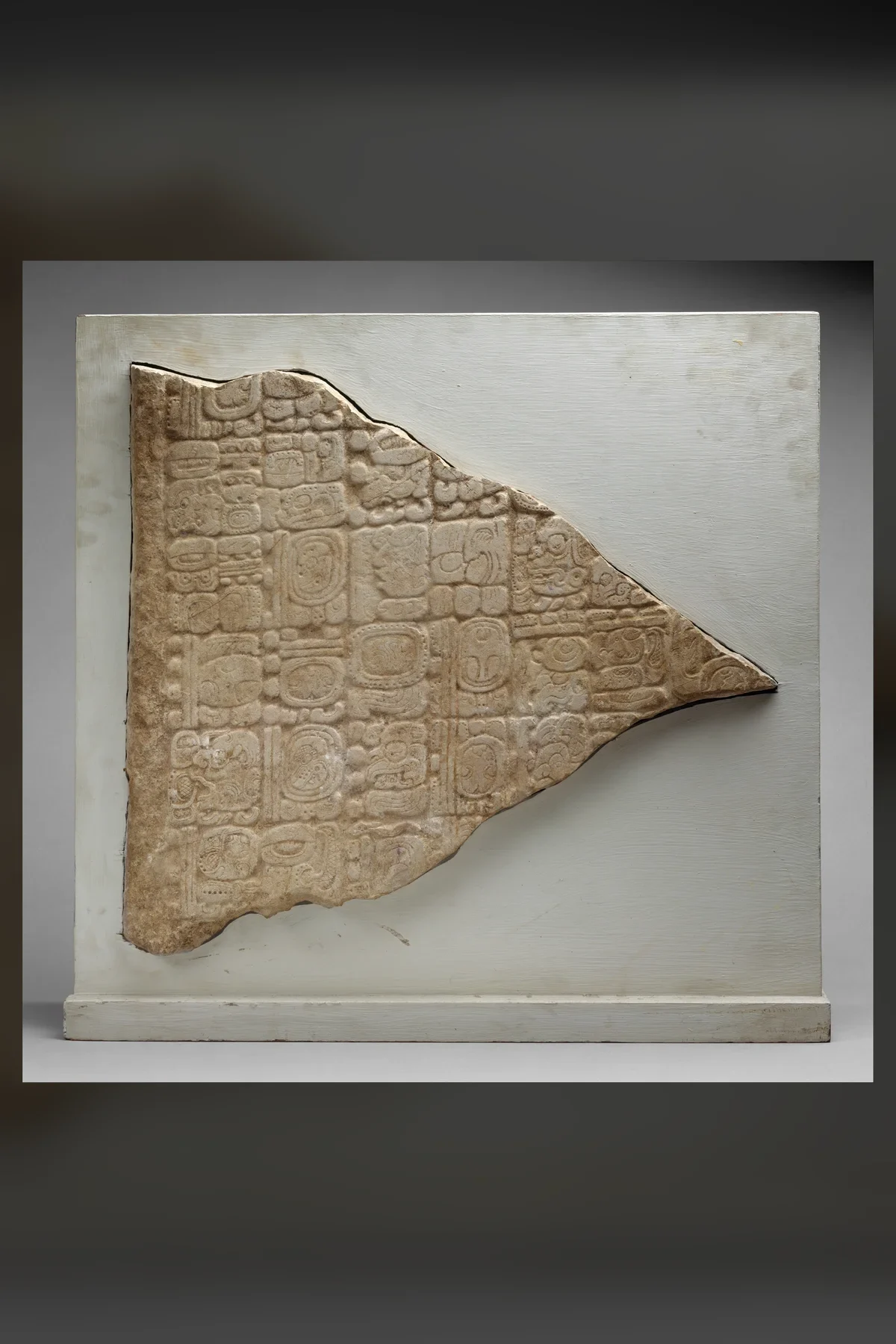
Tortuguero Monument 6 is a carved stone tablet from the Maya city of Tortuguero, in what is now the state of Tabasco, Mexico. It was made for a king named Bahlam Ajaw in the seventh century, and it is broken into pieces held in Mexico and the United States. One of them is in the collection of The Metropolitan Museum of Art in New York: a wedge of pale stone, its edge snapped to a point, carved in rows of square glyph blocks.
Somewhere in its text, on another fragment, is a date. Written in the Maya Long Count it is 13.0.0.0.0 4 Ajaw 3 K'ank'in. On the calendar most of the world uses, it is 21 December 2012.
The text was carved more than thirteen centuries before that day. It counts forward to it, from a building dedicated in January 669, across 490,862 days. Then it says something happens.
What happens is the problem. The line that tells it is damaged, and the people who read Maya glyphs for a living still translate its verb three different ways.
In the 2000s a planet was hung on that date.
A stone covering a tomb
The monument came to light at Tortuguero, in the municipality of Macuspana, in 1958, reportedly covering a tomb. By 1978, when the epigrapher Berthold Riese published its whole inscription in the journal Estudios de Cultura Maya, it was already scattered. Three fragments were in the Museo de Tabasco in Villahermosa. One had gone to the Museum of Primitive Art in New York. Two were in a private collection in Boston.
The text is a king's record. It gives Bahlam Ajaw's accession in 644, and a war against a ruler of Comalcalco in 649, with an ocean of blood and skulls piled like mountains, in the Smithsonian's published translation.
The count behind its dates is the Long Count, the Maya reckoning of days from a fixed zero. That zero is written 13.0.0.0.0 4 Ajaw 8 Kumk'u, the start of the present creation, which falls on 11 August 3114 BC. One b'ak'tun is 144,000 days. Thirteen of them, 1,872,000 days, about 5,125 years, bring the count back to 13.0.0.0.0. The 2010 study of the monument by the epigraphers Sven Gronemeyer and Barbara MacLeod gives the arrival on 21 December 2012 under the standard correlation of the Maya and European calendars.
On Monument 6, the count runs from the dedication of a house, 9.11.16.8.18, in January 669, straight to the end of the thirteenth b'ak'tun. The distance number on the stone is 3.8.3.9.2. As read, it lands exactly on 13.0.0.0.0.
The Met's own piece holds an earlier part of the story: a "star war" in 644, an accession to rulership in 647, and the dedication of a building called the Six-Stone House in 667, according to the museum's curator James Doyle. The 2012 line is elsewhere.
And in 1996 the epigraphers Stephen Houston and David Stuart read the verb that follows it as "descend". A god, the stone seemed to say, would come down.
The day the count turns over
Read as Houston and Stuart first read it in 1996, and as the 2012 movement took it up, the stone records a Maya king setting down, thirteen centuries in advance, a day on which something would come to the world, and naming who.
The god is Bolon Yokte' K'uh, a deity Gronemeyer and MacLeod read as one "of both war and transition". The Smithsonian's translation of the line runs: "the thirteenth b'aak'tuun will have finished; on the day(?) 4 Ajaw 3 K'ank'iin [21 December, 2012 CE] it will have happened; then ... it is the coming down of [god] B'alun Ookte'". Gronemeyer and MacLeod read the verb differently, as a display or an investiture, and still concluded: "we consider this to be a genuinely prophetic statement". On their reading Bahlam Ajaw's lineage was to "orchestrate the future welcoming of Bolon Yokte' K'uh - perhaps with this very building serving as the stage for the event."
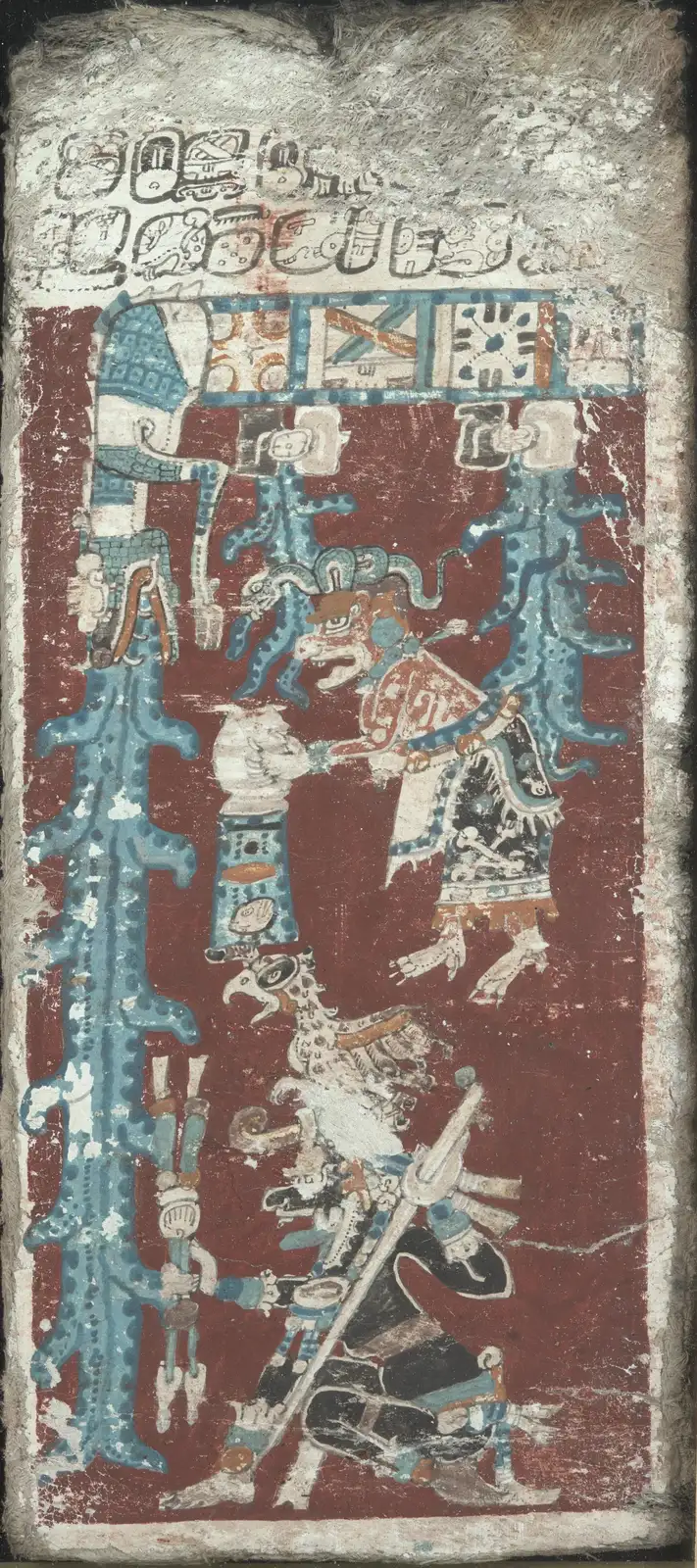
The idea of 2012 is older than the reading of that stone. The archaeologist John Hoopes, writing its history for the International Astronomical Union in 2011, traced it to the scholars first. Ernst Forstemann in 1906 said of the last page of the Dresden Codex, a Maya book of astronomy and ritual, that it "can denote nothing but the end of the world". Michael Coe, in his 1966 survey The Maya, was "the first to publish the correlation of a future Long Count date and associate it with 'Armageddon'", Hoopes wrote. In 1975 Frank Waters, the brothers Dennis and Terence McKenna and Jose Arguelles each published books that took up the end of the Maya count. In 1987 Arguelles's The Mayan Factor described a beam from the centre of the galaxy arriving on 21 December 2012.
The planet came last. The NASA scientist David Morrison set down the order in 2009. Nancy Lieder, who said she channelled beings from the star Zeta Reticuli, had warned that Earth was in danger from Planet X or Nibiru. "This catastrophe was initially predicted for May 2003, but when nothing happened, the doomsday date was moved forward to December 2012," Morrison wrote. "Only recently have these two fables been linked to the end of the Mayan calendar long-count."
A stone and a planet. One date.
If the stone was right
Set aside, for a moment, whether it is true. Ask the larger question. What kind of world is it, if it is?
It would mean the Maya calendar was not only a way of counting but a way of seeing. A king in the seventh century would have fixed a day thirteen centuries out, and the day would have been meant to carry weight, not merely to arrive. The count would be a prophecy in the form of arithmetic.
It would mean the Maya held a knowledge of time that the rest of the world lost. A civilisation that wrote dates in millions of days, and turned its long cycles like a wheel, would have marked one turning as the threshold of something, and that mark would have survived the jungle, the Conquest and the scattering of its stones to arrive, intact, in our century.
It would mean something about us. If the stone named the day, then the generation alive in 2012 was the audience a Maya scribe was writing for. Our calendars, our almanacs, our countdown clocks on the evening news would have been answering a question put to us by a king of Tortuguero.
And it would leave one question in front of us. The thing that was to come down on that day: if the stone is a prophecy, the prophecy names a god, not a planet, and nobody has said what his coming would look like.
Count-forward, not countdown
The standard account comes from the people who read the glyphs, and it starts with the stone's grammar.
Stephen Houston, writing in 2008, read Monument 6 as a count forward from the building, a device Maya scribes used on other monuments too, on Naranjo Altar 1 and La Corona Panel 2. "Whatever Monument 6 has to tell us pertains to the dedication of the building associated with the sculpture," he wrote. In June 2012 a new carved block from La Corona in Guatemala turned out to name the same b'ak'tun ending. Stuart, who read it, found that its main subject was a visit by the Calakmul king Yuknoom Yich'aak K'ahk' in AD 696. "There is no prediction involved; it is simply a literary device," he wrote.
Classic texts count far past thirteen b'ak'tuns; a stela at Coba writes a creation date with twenty 13s above the b'ak'tun place. In May 2012 William Saturno's team published astronomical tables painted on the wall of a room at Xultun in the ninth century, running some 7,000 years ahead.
As for the doomsday, Hoopes called it "an unanticipated and unintentional consequence of early speculation by credentialed academic experts." Hoopes notes that the date was already in Joseph Goodman's tables of 1897, with no catastrophe attached.
On the planet, the astronomers' answer is short. A planet that close, Morrison told the Washington Post in 2017, "would be bright. It would be easily visible to the naked eye."
The verb on the broken line
21 December 2012 came, and went. No planet was seen.
That is as flat as anything in this story. But the counter, for all it settles about Nibiru and the doomsday books, does not settle the stone.
It does not settle the verb. Houston and Stuart in 1996 read "descend". The Smithsonian's translation, by the epigrapher Erik Velasquez, keeps "coming down". Gronemeyer and MacLeod read a display, an investiture. The block is damaged. Three readings, in print, by specialists.
It does not settle what Tortuguero expected. Houston's count-forward reading explains why the date is there; it does not say why a scribe would carry a building's story more than 1,340 years into the future, and Gronemeyer and MacLeod's reply is that the scribe meant it: a statement about the future, made in earnest, of a rite for a god of war and transition. Not a catastrophe. Not nothing, either.
And here is the strange part. The day the stone points to is written exactly as the day the world began: 13.0.0.0.0. The Maya wrote their creation that way, and the stone names the moment the count returns to it. Whether that symmetry was meant to carry weight, or is only the way the numbers fall, nobody can now ask the person who carved it.
The planet is not in the text. As the line is read, the god's name is.
The fragments still apart
Where it stands now: the date has passed, and no planet appeared, then or since. The infrared source of 1983 that was read as Planet X and the planet Zecharia Sitchin read into Sumerian tablets still have their readers. The Maya question is the one the scholars are still working.
Monument 6 is still in pieces. In 2011 The Met, Mexico's National Institute of Anthropology and History and Harvard's Corpus of Maya Hieroglyphic Inscriptions scanned the New York fragment in three dimensions, and a reproduction of it was reunited with two fragments in the Museo Regional de Antropologia Carlos Pellicer Camara in Villahermosa. Two pieces were in a private collection in Boston in 1978; where they are now is not in any source Official X could open.
The line that matters is on a damaged part of the monument. Its verb, and the god's name beside it, are the whole of what the stone says about 2012. Everything else in the story, the books, the beam from the galaxy, the planet, was added later by other hands.
A better photograph of those blocks could narrow the readings. It could not tell anyone what a king of Tortuguero thought would happen when the thirteenth b'ak'tun closed, or whether he thought anyone would still be counting.
Somebody still is.
Questions This Leaves You With
Is there anything a person actually does with this?
On the timescale, nothing: the day came and went in 2012, and the next b'ak'tun ending, 14.0.0.0.0, falls in March 2407. What remains is a question about civilisations rather than about you. A people who counted in units of 144,000 days thought on a scale most societies never attempt, and that is a habit worth noticing, whether or not it was a prophecy. Anyone selling a date is selling something. The Maya were counting one, and the count is still there to be read, glyph by glyph, by anyone who learns the system: the number of days since a creation, written so precisely that a modern calculator lands on the same day.
Does this sit against a religious account of the world?
It can be read either way, and both have been argued seriously. One reading says the stone is a sacred text in its own right, a promise of a god's arrival, and deserves to be heard on its own terms rather than as a forecast someone failed. Another treats the 2012 phenomenon as a modern spiritual movement that borrowed a Maya date and gave it meanings the Maya never wrote. What any living tradition holds about it is for that tradition to say. This site will not tell you which way it falls.
Does this change what a human life is?
Set a lifetime of eighty years against a b'ak'tun of about 394 years, and against the 5,125 years of the thirteen. Most people who ever lived saw no b'ak'tun ending at all; the generation alive in 2012 saw one. That can make a life feel small, a few decades against a wheel that turns in millennia. Or it can make a life feel rare, one of the few that happened to stand at a turning. Which one did you feel?
What would change your mind, in either direction?
Name it before you lean further. A clearer image of the damaged blocks could settle the verb, but even "descend" would not settle whether the scribe meant a cosmic arrival or a rite in one building. A second Classic text speaking of the god's coming in 2012 would make an expectation more likely; more texts like La Corona's, using far-future dates only to anchor local events, would make a dating device more likely. Neither would read a seventh-century mind. On Nibiru the test is simpler: a planet near enough to matter would be found by its light and its pull.
What did the scribe of Tortuguero expect on 13.0.0.0.0?
This is the open problem, and it is a real one. The stone names a day and, on most readings, a god. It does not say what the god's coming would look like, whether the king's descendants were to stage it, or whether it was a cosmic event or a ceremony in a single building. The specialists who have read it most closely do not agree, and the line is broken where it matters. Nobody living knows.
Sources
- Sven Gronemeyer and Barbara MacLeod, What Could Happen in 2012: A Re-Analysis of the 13-Bak'tun Prophecy on Tortuguero Monument 6 (Wayeb Notes 34, 2010) Wayeb Primary record
- Berthold Riese, La inscripcion del Monumento 6 de Tortuguero (Estudios de Cultura Maya XI, 1978) UNAM Primary record
- Monument 6 of Tortuguero, Tabasco, Mexico, glyphs deciphered by Erik Velasquez Smithsonian National Museum of the American Indian Primary record
- Stephen Houston, What Will Not Happen in 2012 (20 December 2008) Maya Decipherment Primary record
- David Stuart, Notes on a New Text from La Corona (30 June 2012) Maya Decipherment Primary record
- Oldest Maya astronomical tables found at Xultun (National Geographic Society release, 10 May 2012) ScienceDaily Study
- John W. Hoopes, A critical history of 2012 mythology (Proceedings IAU Symposium 278, 2011) Cambridge University Press / IAU Primary record
- Mark Van Stone and John Hoopes, 4 Ahaw 3 K'ank'in Questions and Comments FAMSI Study
- David Morrison, Doomsday 2012, the Planet Nibiru, and Cosmophobia (Astronomy Beat 32, 2009) Astronomical Society of the Pacific Primary record
- Kristine Phillips, Washington Post, September 2017 (syndicated copy) The Washington Post via The Gazette Study
- Stela Fragment with Glyphs (Tortuguero Monument 6 fragment), The Metropolitan Museum of Art 1978.412.75 The Metropolitan Museum of Art via Wikimedia Commons Primary record
- Codex Dresdensis, page 74 (Mscr.Dresd.R.310) SLUB Dresden Primary record
- James Doyle, The Blood Was Pooled, the Skulls Were Piled: Maya Star Wars and a Misconstrued Doomsday (2015) The Metropolitan Museum of Art Primary record