
Fourteen numbers: 8, 11, 15, 8, 13, 3, 8, 8, 8, 12, 15, 13, 8, 8. Each is a count of seconds, the time a short-wave signal took to come back as an echo during a run of tests in October 1928. In April 1973 a Scottish astronomer and writer, Duncan Lunan, published a reading of those seconds as a star map: the constellation Bootes, the Herdsman, with one star set apart to mark the double star Epsilon Bootis, also called Izar. On his reading, the map was the first line of a message from a machine parked in the orbit of the Moon.
Two different things sit inside that sentence. The echoes are a measurement. Radio men in Oslo and Eindhoven heard signals return after three to fifteen seconds, timed them, and printed the delays.
The star map is a reading. It exists only after the seconds become dots, the dots are given axes, and the axes are chosen so a figure appears.
Fourteen dots. One constellation.
A Picture Asked For in 1960
The idea came first. On 28 May 1960 Ronald N. Bracewell of the Radioscience Laboratory at Stanford University published two pages in Nature, "Communications from Superior Galactic Communities". A probe, he argued, could wait near a likely star, listen, and answer. "Such a probe may be here now, in our solar system, trying to make its presence known to us."
He went further. The probe, he wrote, "could first listen for our signals and then repeat them back. To us, its signals would have the appearance of echoes having delays of seconds or minutes such as were reported thirty years ago by Stormer and van der Pol and never explained." And then one more sentence, the one that would matter in Scotland: "Should we be surprised if the beginning of its message were a television image of a constellation?"
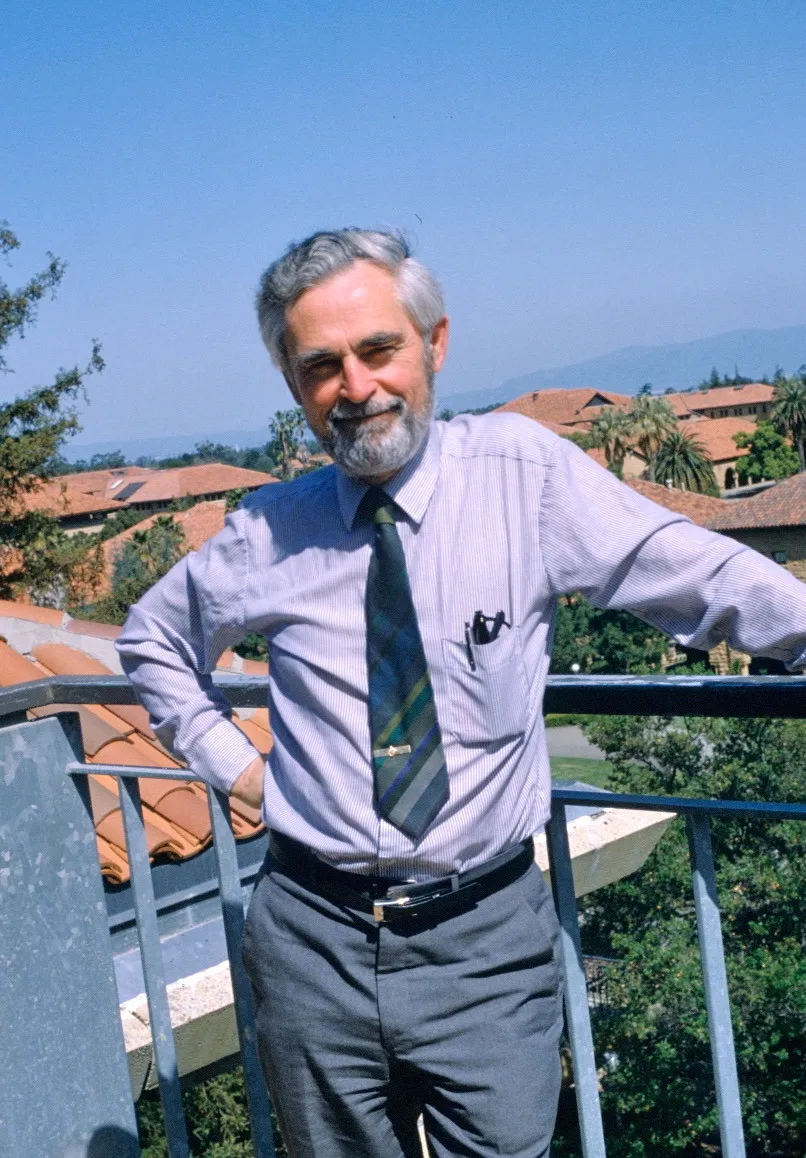
Duncan Lunan was born in 1945 and grew up in Troon. He took a degree in English and philosophy at Glasgow in 1968 and helped found ASTRA, the Association in Scotland to Research into Astronautics. By his own account, John Macvey raised Bracewell's idea with him, and James Strong of the BIS suggested where such a probe might sit: the Earth-Moon L4 or L5 points, two places in the Moon's orbit where an object can ride along with it.
Then the graph. "I tried plotting the delay times against the order in which the echoes were received," Lunan wrote in 2022, and "at only the second attempt I found what looks like a star map". A. T. Lawton, who refereed the paper, mentioned it in a lecture in December 1972. The Sunday Telegraph ran it on its front page, eclipsed, Lunan says, by the Nicaragua earthquake on Christmas Eve.
Fourteen Dots and a Barrier at Eight Seconds
The paper appeared as "Space Probe from Epsilon Bootis" in Spaceflight, the British Interplanetary Society's journal, volume 15, number 4, pages 122 to 131, April 1973. Delay goes across, on the x-axis; the order of arrival goes up the page. Laid out that way, in his words as quoted by the mathematician R. T. Faizullin, "There is a vertical 'barrier' at 8 seconds dividing the diagram into two parts of an equal area."
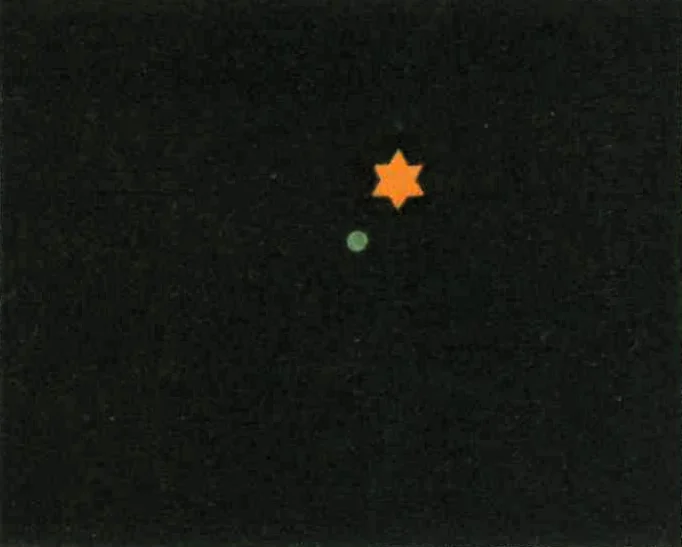
On the left of that barrier sits a single dot, at three seconds. Lunan described it as unique: the one echo that came back as an exact repeat of the transmitted signal, three dots, where the others were two-second dashes. On the right, the main figure bore, for him, "a striking but incomplete resemblance to the constellation Bootes". And here is the strange part. "If the 3 second dot is transplanted across the barrier to a corresponding position on the right, it occupies the position of the star Epsilon Bootis and so completes the constellation figure."
One more detail sharpened it. Arcturus, the brightest star of the Herdsman, sat out of place on the plot. On checking, Lunan wrote, it "was shown at its place about 13,000 years ago". Which would date the map. Elsewhere he gives the arrival as 11,000 BC.
He also argued that the 1920s echoes lacked the time compression and Doppler shift a natural echo off a moving cloud of plasma should show.
Time ran "Message from a Star" on 9 April 1973, printing the opening line of Lunan's translation, "Our home is Epsilon Bootis, which is a double star," and "Our probe is in the orbit of your moon." Christianity Today called him "a 27-year-old astronomer and science writer from Scotland". The reading became a book, Man and the Stars, from Souvenir Press in London in 1974.
If the Herdsman Was Drawn on Purpose
Set aside, for a moment, whether the map is real. The better question is what kind of world this would be if it were.
It would mean that the echoes of 1928 were not weather in the upper air but an answer. A machine heard a Dutch transmitter, held the signal, and sent it back with a delay chosen to carry a picture. On that reading, the first conversation between our species and another mind took place on short wave, between the wars, and was logged as a curiosity.
It would mean the machine had waited a very long time. On Lunan's dating of Arcturus, about 13,000 years: some four hundred human generations. Whoever built it would have planned on a scale no human project has ever attempted, sending something across the gap between stars and trusting it to be patient.
It would mean we were expected. Not discovered by accident, but anticipated, by someone who reasoned, as Bracewell did, that a young civilization would one day start shouting on radio, and parked a listener beside our Moon for the day it did.
And it would leave one consequence still open in front of us. If the listener heard Eindhoven in 1928, it has heard everything since: every broadcast, every radar pulse, every deep-space signal sent past the Moon. The question would not be whether anyone is listening. It would be what it has made of us, and whether it is still waiting for a reply that does more than echo.
The Standard Account
The standard account starts with the plot. Sverre Holm of the University of Oslo, a radio amateur who signs LA3ZA and keeps a page on these echoes, points out that the map needs one point moved, from three seconds to thirteen, to fit the figure, and he calls that "data massaging".
The second objection: the same numbers draw other things. In 2010 Faizullin recorded that enthusiasts, not critics, got other stars from Lunan's sequence: Bulgarian amateurs found Zeta Leonis, and another method found Tau Ceti. His diagnosis is general: "We can always find a configuration in the starry sky that may match the given random configuration of points."
The third came from Lunan. Reference books had given Epsilon Bootis too small a distance. At 203 light-years, the orange giant of the pair would once have been a hot star, "too massive and with too high a radiation output to sustain habitable planets". More accurate records of the echoes, found in the 1970s, ruled out most translations; not his, Lunan wrote, but it too had to be treated as suspect. "I withdrew the entire translation," he wrote; the withdrawal was published in September 1976 in the Journal of the Society of Electronic and Radio Technicians.
For the echoes themselves, the standard account looks to natural plasma: magnetospheric ducting, round-the-world paths, and conversion into ionospheric plasma waves, which Crawford, Sears and Bruce described in 1970 with echoes of up to 40 seconds at 5 to 12 MHz.
What the Counter Leaves Standing
The plot fell. The seconds did not.
Holm's own verdict is that long-delayed echoes "are still not properly explained". In his 2021 talk to the HamSCI workshop he put it briefly: "5 mechanisms - only 1 is understood". The understood one, ducting, gives delays of about half a second or less. The 1928 delays ran to fifteen.
Then the place where the probe should be. In 1979 Robert A. Freitas Jr. and Francisco Valdes photographed the Earth-Moon L4 and L5 points with the 30-inch telescope at Leuschner Observatory in California and reported in Icarus in 1980: "No discrete objects, either natural or artificial, were found."
They did not find it.
Their result had stated edges. The plates reached about 14th magnitude, each position covered an effective field two arcminutes square, and the result excluded an object "having the size of Skylab or larger" with a surface at least as reflective as the Moon. A smaller or darker object lay outside what that search could see; the authors themselves noted that a Schmidt telescope could reach something the size of Pioneer 10.
The active test stopped early too. Lawton, who proposed with S. J. Newton in 1974 that ionized gas at the Trojan points made the echoes, ended his own transmissions after an initial "reply", Lunan writes, because more would "constitute a biassed experiment".
And the Faizullin objection cuts every way. Holm lists Faizullin's own arrows to Procyon and Alpha Centauri in the same numbers. Any picture read from fourteen dots meets the same test, whoever draws it.
Fourteen Numbers, Still on the Page
Lunan did not leave it there. In March 1998 Analog published Lunan's "Epsilon Bootis Revisited", with a search proposed by Alan Evans and Jamie Bentley, and in 2022 he set the argument out again in The Orkney News. Of the 1976 withdrawal he now writes, "it seems I may have gone too far." The map, he says, "if that map meant anything, it would have to be as a time marker, not a navigational reference as I thought." The new anchor is Stonehenge, where around 2840 BC, by his figures, "Epsilon Bootis went through the zenith!" He has never accepted Lawton's natural explanation.
Others kept a smaller door open. Chris Boyce, writing for the SETI League in 2002, found "little in the record to support" a probe, and still judged that "further study is warranted". The hope of reading a message in a radio or field record outlived the map too, from the Wow! signal of 1977 to a crop formation at Chilbolton in 2001 read as a picture sent back.
Which leaves the column itself. Fourteen delays, in whole seconds, in a printed order, from the autumn of 1928. The sources do not even agree whose they are: Faizullin gives them as one of Stormer's series, Holm as van der Pol's from Eindhoven on 11 October.
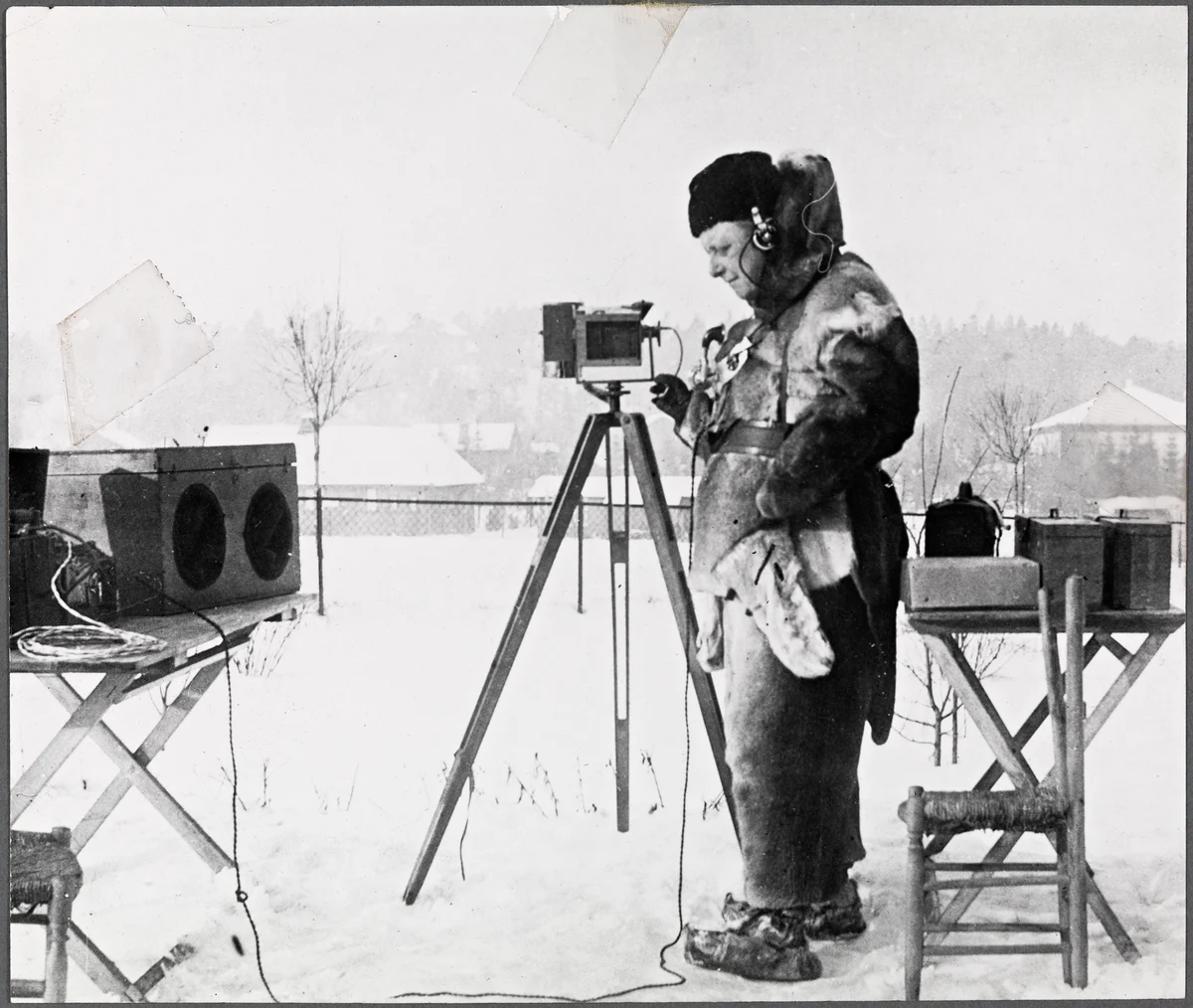
Better records surfaced in the 1970s. What would settle this picture is the timing behind its own fourteen numbers: how each echo was timed, whether any were missed, whether the three-second echo really came back as three dots. That record would not prove a probe. It could end the argument over the picture, one way or the other.
The Herdsman is still where it was. So are the seconds.
Questions This Leaves You With
Is there anything a person can do with this, or is it only history?
Honestly, almost nothing follows for your own life. The echoes are nearly a century old, the map was withdrawn by the man who drew it, and nobody can tell you when, or whether, any probe will be found. Anyone selling you a date is selling something. The larger question is not yours alone, though. It belongs to the people who decide what gets searched: which patches of sky, at what depth, with what money. The 1979 search itself named a larger telescope that could reach something the size of Pioneer 10. Whether that is worth doing is a public question, and an open one.
Does a message from Epsilon Bootis sit against a religious account of the world?
It can be read both ways, and serious writers have read it both ways. Some see a universe crowded with makers as a smaller place for any single story of creation; others see more minds as more of the same handiwork, and nothing in Lunan's reading touches who made the stars he plotted. When the story broke, Christianity Today carried it in its "Eutychus and His Kin" column. Where it falls for you is not something this site will tell you. A message that only says where its senders live leaves the largest questions exactly where they were.
Does it change how you see your own life if something has been listening for thousands of years?
Put your own years beside the scale from earlier: a few decades against some four hundred generations of waiting. For some people that makes a life feel small, a flicker that a patient machine would barely register. For others it makes a life rarer, one of the brief stretches when the species is loud enough to be heard at all. Neither feeling is the correct one. You might notice which one arrived first when you read the numbers, and whether it was the same one you had about the night sky as a child.
What would change your mind, in either direction?
Name it now, before you settle, because it is harder later. Toward a message: the original 1928 logs showing the three-second echo really was a three-dot repeat, a statistical test fixed before anyone looks that finds structure in delay sequences beyond chance, or a deep image of L4 or L5 showing an object that should not be there. Toward a natural cause: a laboratory or ionospheric mechanism that produces clean multi-second delays at those frequencies on demand, or a fair test of many random sequences showing that constellations turn up in nearly all of them.
Why have the long delays of 1928 never been pinned to a cause?
That is the gap nobody has closed. Short echoes have a well-understood cause; the long ones of 1928 sit outside it, and the man who keeps the list of candidates still calls them not properly explained. You could ask whether the 1920s sky was different, with a different solar cycle or fewer transmitters, or whether the listeners were. You could ask whether anyone today, with modern receivers, has listened at the same frequencies in the same way for long enough to know. The honest answer is that the record does not say.
Sources
- R. N. Bracewell, Communications from Superior Galactic Communities, Nature 186:670-671, 28 May 1960 Nature (scan hosted by A. Loeb, Harvard) Primary record
- Duncan Lunan, Epsilon Bootis Revisited, The Orkney News, 29 May 2022 The Orkney News Primary record
- Duncan Lunan, Epsilon Bootis Revisited Part 2, The Orkney News, 5 June 2022 The Orkney News Primary record
- Duncan Lunan, Epsilon Bootis, Clyde Tombaugh, Black Knight and STS-88, The Orkney News, 12 June 2022 The Orkney News Primary record
- Duncan Lunan, Wikipedia, 2026 Wikipedia General reference
- Time, Science: Message from a Star, 9 April 1973 Time Study
- Christianity Today, Eutychus and His Kin, 27 April 1973 Christianity Today Study
- R. T. Faizullin, Geometrical joke(r?)s for SETI, arXiv:1007.4054, 2010 arXiv Study
- Sverre Holm, The Five Most Likely Explanations for Long Delayed Echoes, University of Oslo University of Oslo Study
- Sverre Holm (LA3ZA), Long delayed echoes, HamSCI workshop slides, 19 March 2021 HamSCI Study
- Long delayed echo, Wikipedia, 2026 Wikipedia General reference
- Robert A. Freitas Jr. and Francisco Valdes, A Search for Natural or Artificial Objects Located at the Earth-Moon Libration Points, Icarus 42:442-447, 1980 Icarus (author's copy) Primary record
- Chris Boyce, Do LDEs Emanate From Alien Probes?, SETI League guest editorial, updated 7 Dec 2002 SETI League Study
- Epsilon Bootis, Wikipedia, 2026 Wikipedia General reference