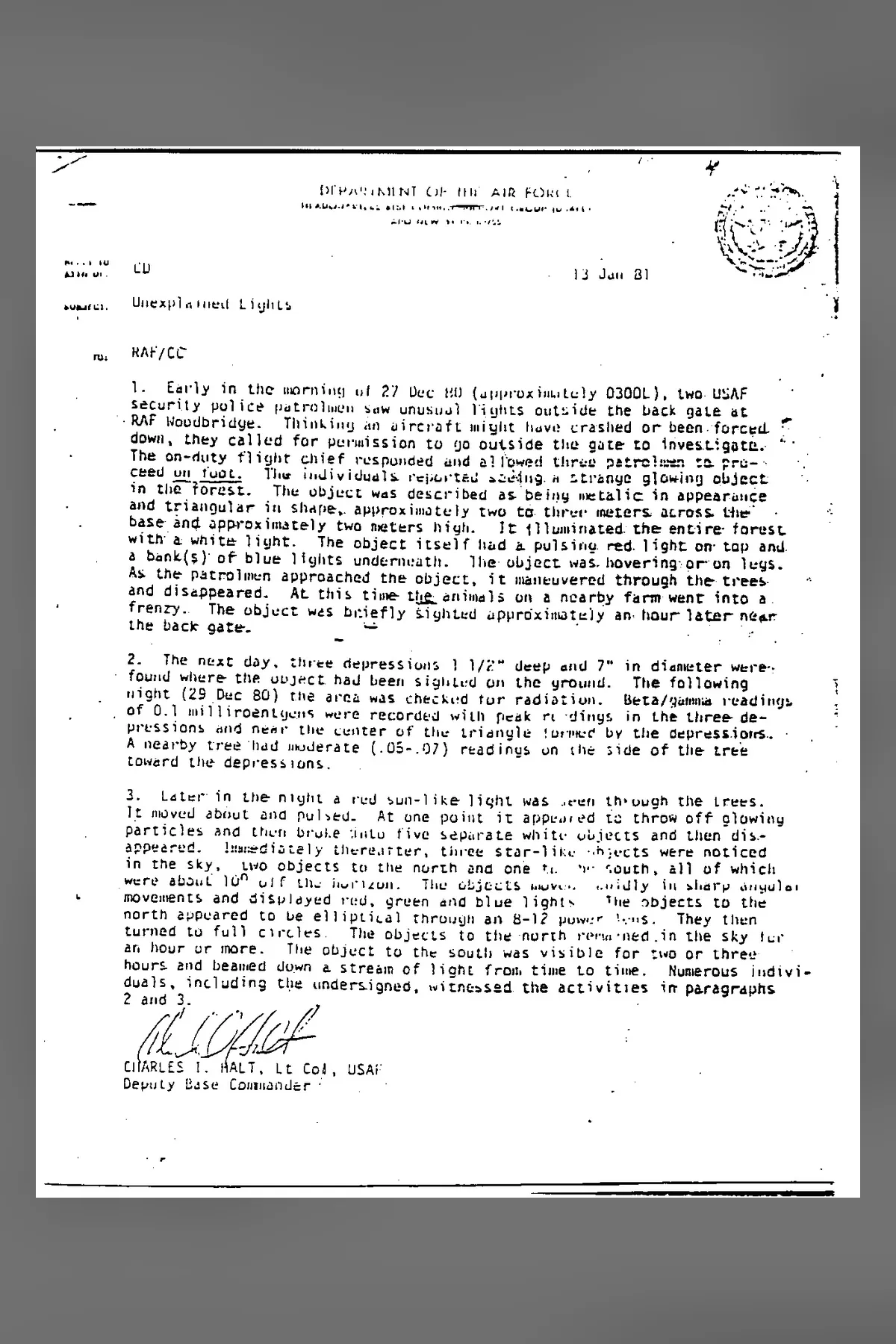
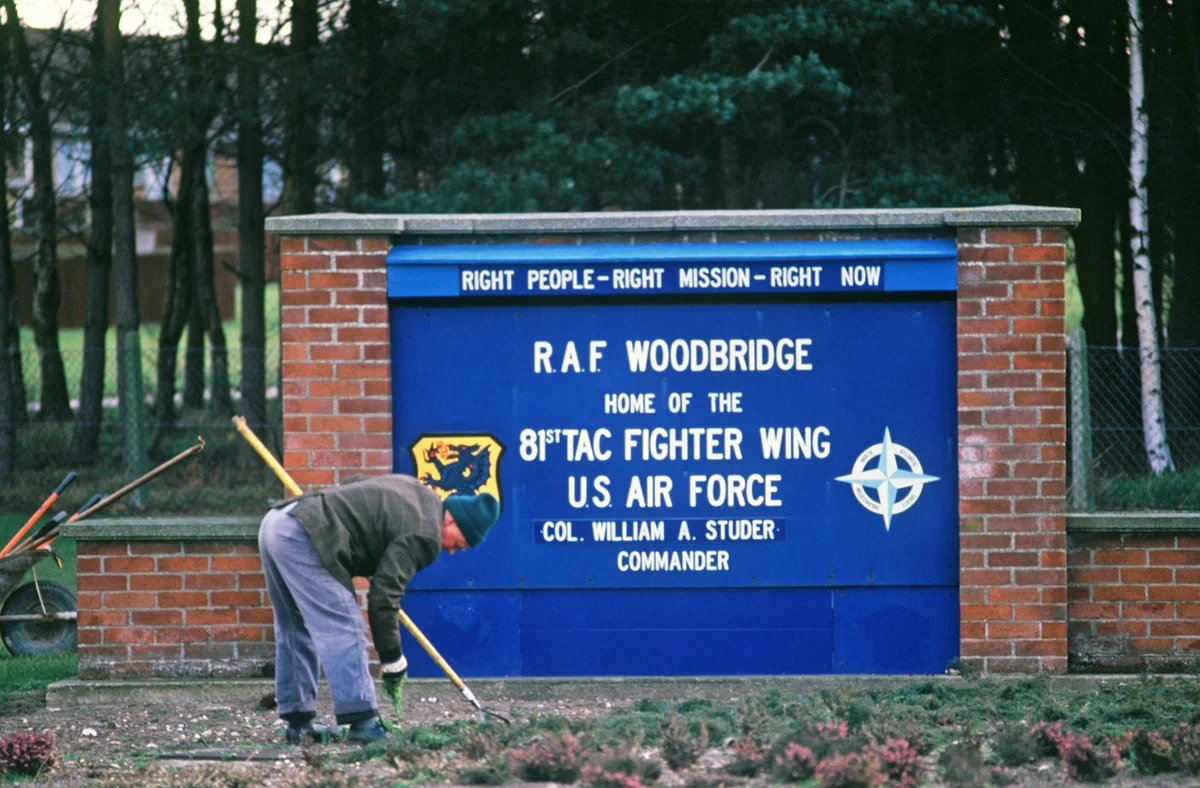
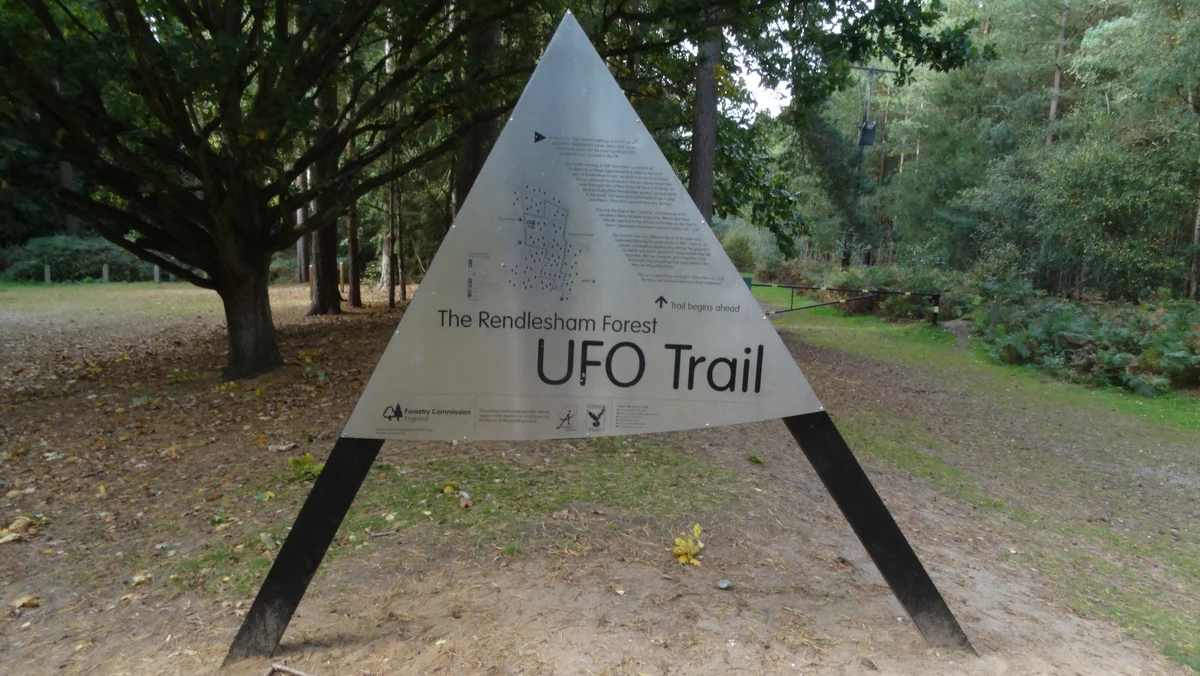
Rendlesham Forest is a pine plantation near the Suffolk coast of England, and in December 1980 it lay between two air bases, RAF Bentwaters and RAF Woodbridge, both home to the United States Air Force's 81st Tactical Fighter Wing. In the small hours after Christmas, American security police walked into those trees after lights. Two nights later the deputy base commander, Lieutenant Colonel Charles Halt, went in himself, with a radiation meter and a pocket tape recorder. On 13 January 1981 he put it on one typed page for the Ministry of Defence, under the subject line "Unexplained Lights".
The page is plain. A letterhead, a date, three numbered paragraphs, a signature. On it are a glowing object "metalic in appearance and triangular in shape", three depressions in the forest floor, and a light low in the south that "beamed down a stream of light from time to time."
It came out of the base on Air Force letterhead, and an officer of the United States Air Force signed it.
Signed.
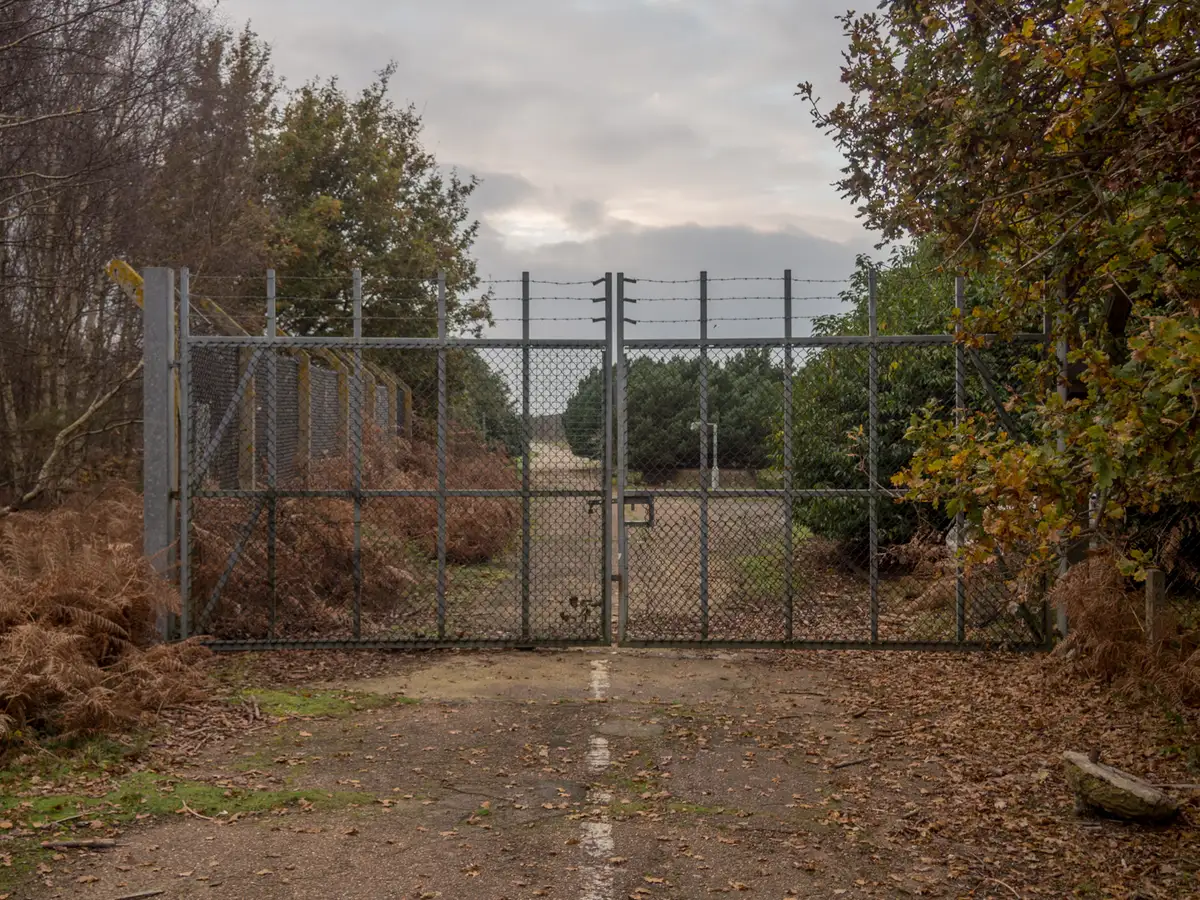
The Back Gate at Woodbridge
At about three in the morning of 26 December 1980, a security patrol at the East Gate of RAF Woodbridge saw lights that seemed to be coming down into the forest. Three men went out on foot: Staff Sergeant Jim Penniston, Airman First Class John Burroughs and Airman Edward Cabansag. Master Sergeant J. D. Chandler relayed their calls. Suffolk police, called twice, found nothing unusual.
That morning, as Burroughs recalls it, Captain Mike Verrano and Master Sergeant Ray Gulyas found marks where the men said the object had been. Gulyas photographed them.
Late on 27 December, at an officers' dinner, Lieutenant Bruce Englund told Halt: "The UFO is back". Halt, carrying a Lanier micro-cassette recorder, went out with Englund, Sergeant Monroe Nevels with a geiger counter, and Sergeant Bobby Ball.
On 13 January, on the advice of the British liaison officer, Squadron Leader Donald Moreland, Halt wrote to the Ministry: "Early in the morning of 27 Dec 80 (approximately 0300L), two USAF security police patrolmen saw unusual lights outside the back gate at RAF Woodbridge."
The date is a day late.
The first night was 26 December, and the memo's "following night (29 Dec 80)" was the night of 27 into 28 December.
Metalic, Triangular, Two Meters High
The first paragraph is the patrolmen's report, passed on by Halt, who was not there that night. "The object was described as being metalic in appearance and triangular in shape, approximately two to three meters across the base and approximately two meters high. It illuminated the entire forest with a white light. The object itself had a pulsing red light on top and a bank(s) of blue lights underneath. The object was hovering or on legs." As the men came closer, "it maneuvered through the trees and disappeared. At this time the animals on a nearby farm went into a frenzy."
The second paragraph is physical. "The next day, three depressions 1 1/2" deep and 7" in diameter were found where the object had been sighted on the ground." "Beta/gamma readings of 0.1 milliroentgens were recorded with peak readings in the three depressions".
The third is Halt's own night, and the tape catches it live. "There is no doubt about it - there's some type of strange flashing red light ahead." Then: "Now we're observing what appears to be a beam coming down to the ground." The memo closes: "Numerous individuals, including the undersigned, witnessed the activities in paragraphs 2 and 3."
The undersigned.
The accounts kept coming, and went further. Penniston, who said at the time he got no closer than about 50 metres, later described a landed "craft of unknown origin" that he touched. He has repeatedly denied that it was extraterrestrial: after regression hypnosis in September 1994 he said its crew were time travellers from our future. "They are us." In December 2010 he said that the day after the encounter he had written down pages of binary code received telepathically. Burroughs told the BBC in 2020 of "a white light silently explode and then a red, oval, sun-like object".
Halt went furthest. In June 2010 he signed a notarized affidavit; in words David Clarke reproduces, he said he believed the objects he saw at close quarter were "extraterrestrial in origin", and that the security services of both countries had tried "to subvert the significance of what occurred at Rendlesham forest and RAF Bentwaters by the use of well-practiced methods of disinformation."
The Page Gets Out
In June 1983 the US Air Force released the memo under the Freedom of Information Act to Robert Todd of Citizens Against UFO Secrecy, using a copy from the Ministry of Defence: it had thrown its own away. On 2 October 1983 the News of the World put it on its front page. Like the FBI's Hottel memo of 1950, one official page was read in public years after it was typed.
Nick Pope, who ran the Ministry of Defence's UFO desk from 1991 to 1994, repeated the name "Britain's Roswell" and in 2005 called the case "our greatest and most important case", meaning the Ministry's. In the Ministry's own file was a line he leaned on: "The value of 0.1 milliroentgens (mr) ... seems significantly higher than the average background of about 0.015 mr." In a 2009 television programme he called it "absolute proof positive that something extraordinary happened". He died on 6 April 2026.
The Ministry released the file to David Clarke in May 2001. The National Archives released it as DEFE 24/1948/1 in August 2010.
If the Page Means What It Says
Set aside, for a moment, whether anything landed. What would it mean if Halt's page records exactly what happened?
On that reading, a machine could come down at the edge of a guarded air base, light a forest and leave, with nothing on any radar recording. Which would put a hole in what we assume our own machines can see.
If Halt is right that what he saw was "extraterrestrial in origin", it would mean more. Something built by hands that were not ours would have come down in a Suffolk forest, within living memory, on a date in an ordinary calendar. Our species would have had company, at an address.
And one consequence would still be in front of us. If Halt is also right that two governments worked to "subvert the significance" of those nights, then part of our history would sit in files held back, or in files that no longer exist. What we know of our place in the universe would rest on the record-keeping of a few offices. Whether that record could ever be rebuilt is a question with no date on it.
The Lighthouse and the Fireball
The standard account comes from Ian Ridpath, an astronomer and writer who has investigated the case since 1983. The falling lights at about 3 a.m. on 26 December, he holds, were a fireball: the British Astronomical Association's Meteor Section logged one at 02.50 UT, +/- 5 minutes, that night, as bright as the gibbous Moon for three or four seconds. The flashing light was the Orford Ness lighthouse, in 1980 one of the brightest in England at 5 million candelas, 28 metres above mean high water against a ridge that peaks at 19 metres, and visible from only a short stretch of the forest edge, in line with the farmhouse at Capel Green. At the time, Chandler recorded Penniston reporting a "beacon light".
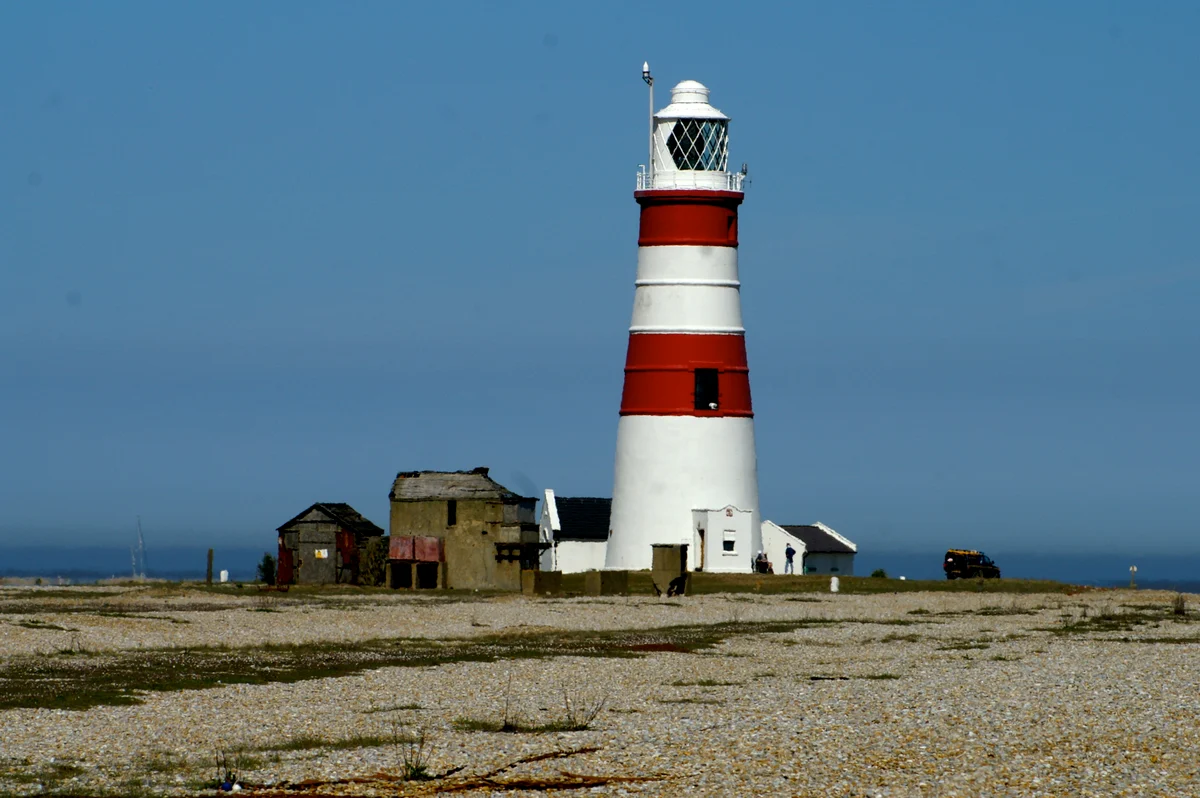
The local police and the forester Vince Thurkettle, shown the marks in early February 1981, took them for rabbit diggings: "an absolutely normal glade in the forest with three rabbit scrapes ... carefully marked," he told the BBC in 2020. The tree marks, he said, were axe cuts by a ranger, Bill Briggs. The meter's American makers said 0.1 was "the bottom reading on the lowest range" and "of little or no significance"; the highest reading on the tape, "seven tenths", Ridpath gives as 0.07 milliroentgens an hour. Halt's star-like objects, on this account, were stars, the brightest to the south toward Sirius. The farm beside the forest was arable, Ridpath notes, and the strange animal sounds were most likely muntjac deer. In 1983 the Ministry told Ridpath that "no unidentified object was seen on any radar recordings". Of Penniston's notebook, Halt wrote in 2019: "No code or missing pages."
What the Lighthouse Does Not Light
A lighthouse accounts for a flashing light in a fixed direction. Not for everything on the tape.
Halt disputes the lighthouse itself. In his 2010 affidavit he puts it as much as 40 degrees to the right of his light. Ridpath's photographs from the forest edge, in October 1998 and 2005, put the lighthouse in line with the Capel Green farmhouse; he suggests Halt took the Shipwash lightship for it. It does not reach the beam: Ridpath ties it to Sirius twinkling, which is his inference, not a measurement. It does not reach the men in suits. Thurkettle told the BBC in 2020 that two men in suits questioned him before Halt's memo existed, and said: "the chronology which is part of this story - it's wrong". Clarke thinks they were most likely local reporters.
The Ministry never interviewed a single witness; its desk staff were told interviews were "inappropriate".
Then the files. When The National Archives released its March 2011 batch of Ministry UFO files, a gap showed: the Defence Intelligence UFO files for 1980 to 1982 had been destroyed. The Rendlesham file itself survives, and Clarke points out that it holds papers and minutes from Defence Intelligence officers, copied from the lost files.
What else they held has not been found.
Clarke has not closed it either. "There is still an element of mystery," he told the BBC in 2020. "Maybe they did see something that was inexplicable."
One Night With No Tape
Burroughs published Weaponization of an Unidentified Aerial Phenomenon in December 2020, linking the night to an energy-field experiment rather than a craft. The Orford Ness lighthouse was switched off in June 2013.
The argument over what a government keeps and what it lets go has moved to Washington, with David Grusch's sworn testimony of July 2023 and AARO's 2024 report on the historical record.
Some of it could still be tested. The original Lanier microcassette, if it can be found, would settle timings and cuts that the circulating copies cannot. Paper and ink tests could date Penniston's notebook; Official X found no record of an independent examination. Thurkettle has told Ridpath he believes the Gulyas photographs show the glade he was shown; an independent match would test that.
That night has no tape. The marks were photographed the next morning and checked for radiation on Halt's night; the minutes themselves are known only from what three men said, then and later.
The lighthouse is dark now. The memo is at Kew, still signed.
Questions This Leaves You With
Is there anything a person can actually do with a case like this?
For your own life, very little follows, and it is worth saying plainly. Nothing in the Rendlesham record points to a date, a warning or a place to go, and anyone who sells you one drawn from it is selling something. The larger question is not yours alone: whether governments keep the records of strange nights well enough that someone can check them decades later. That one is open, and it is a public question rather than a private one. You can carry it without doing anything about it at all.
Does a landing in an English forest sit against a religious account of the world?
It cuts both ways, and serious people have argued each side of it. Some read company among the stars as a widening of creation, room for more than one kind of mind under one maker. Others read it as pressure on the special place a faith gives to human beings. Rendlesham itself does not decide that: even on its strongest reading it is lights, marks and a machine that nobody can now examine. Which way it falls for you is not something this site will tell you, and it is not something the record can settle either.
Does it change anything about how you see your own life?
Put your own life beside the scale the article set out: a few men in a forest for one night, and a page that has outlived both bases. For some readers, the thought that something else might have stood in those trees makes a human life smaller, one kind of mind among others. For others it makes a life rarer, and so larger, lived at a time when the question is asked with signed documents on the table. You probably felt one of those before you reached the end. Which one was it?
What would change your mind, in either direction?
Name it now, before the next documentary names it for you. Toward the extraordinary reading: the original microcassette turning up and showing something the copies lost; an independent dating of Penniston's notebook pages to December 1980; the missing Defence Intelligence files surfacing with an analysis of the case inside. Toward the standard account: an independent match of the Gulyas photographs to the glade Thurkettle identified; an independent survey from Halt's crossing point, settling whether the lighthouse stood in line with his light, as Ridpath's photographs show, or 40 degrees to the right, as Halt says; the men in suits named. Each is a thing that exists, or once did.
What did three men see on the first night?
Everything else in the case has a named candidate, argued over but named: a fireball for the falling light, a lighthouse for the flashing one, rabbits for the marks, stars for the lights low in the sky, background for the meter. The first night's close approach rests on testimony. In January 1981 Burroughs and Cabansag wrote that they followed a beacon, which Burroughs took for a lighthouse, and Penniston said he got no nearer than about 50 metres; the craft touched by hand came years later. What stood, if anything, at the spot where the marks were found is the empty space at the centre of the record. It is still empty.
Sources
- John Greenewald, The Halt Memo - The Rendlesham Forest Incident, The Black Vault, 2021 (scan of DoD FOIA release 97-F-1677) The Black Vault Primary record
- Ian Ridpath, Appendix - Col Halt's memo to the MoD, ianridpath.com, rev. 2021 Ian Ridpath Study
- Ian Ridpath, The Rendlesham Forest UFO case, ianridpath.com, updated Feb 2025 Ian Ridpath Study
- Ian Ridpath, The Orford Ness lighthouse, ianridpath.com Ian Ridpath Study
- Ian Ridpath, The witness statements, ianridpath.com Ian Ridpath Study
- Ian Ridpath, The radiation readings, ianridpath.com Ian Ridpath Study
- Ian Ridpath, The landing site, ianridpath.com Ian Ridpath Study
- Ian Ridpath, The Halt tape (transcript made with Halt's help), ianridpath.com Ian Ridpath Study
- Ian Ridpath, Penniston's notebook, ianridpath.com Ian Ridpath Study
- David Clarke, Rendlesham Forest UFOs, drdavidclarke.co.uk David Clarke Study
- David Clarke, UFO Files break records, drdavidclarke.co.uk, March 2011 David Clarke Study
- Nic Rigby, Rendlesham Forest UFO: Are we any closer to the truth 40 years on?, BBC News, 26 December 2020 BBC News Study
- The Naked Scientists, interview with Nick Pope, 30 October 2005 The Naked Scientists Primary record
- Chris French, Remembering Nick Pope (1965-2026), The Skeptic, 29 April 2026 The Skeptic Study
- Ian Ridpath, Col Halt's affidavit, ianridpath.com Ian Ridpath Study