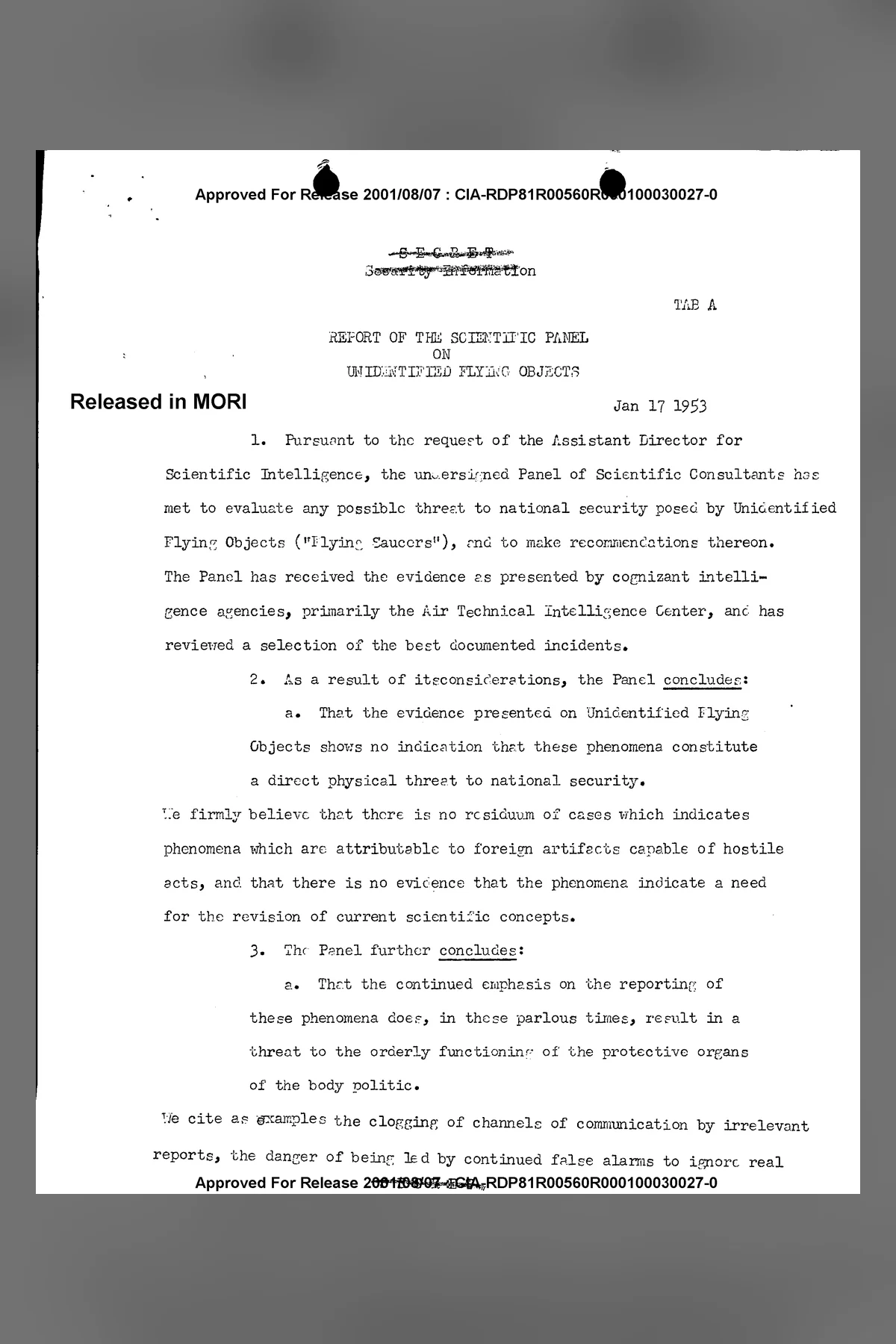
The Robertson Panel was five American scientists whom the CIA's Office of Scientific Intelligence brought together from 14 to 17 January 1953 to answer one question: did the flying saucers threaten the United States? The Caltech physicist H. P. Robertson chaired it. Over four days it watched two films of moving lights, read case files, and on the last day signed a report of two typed pages.
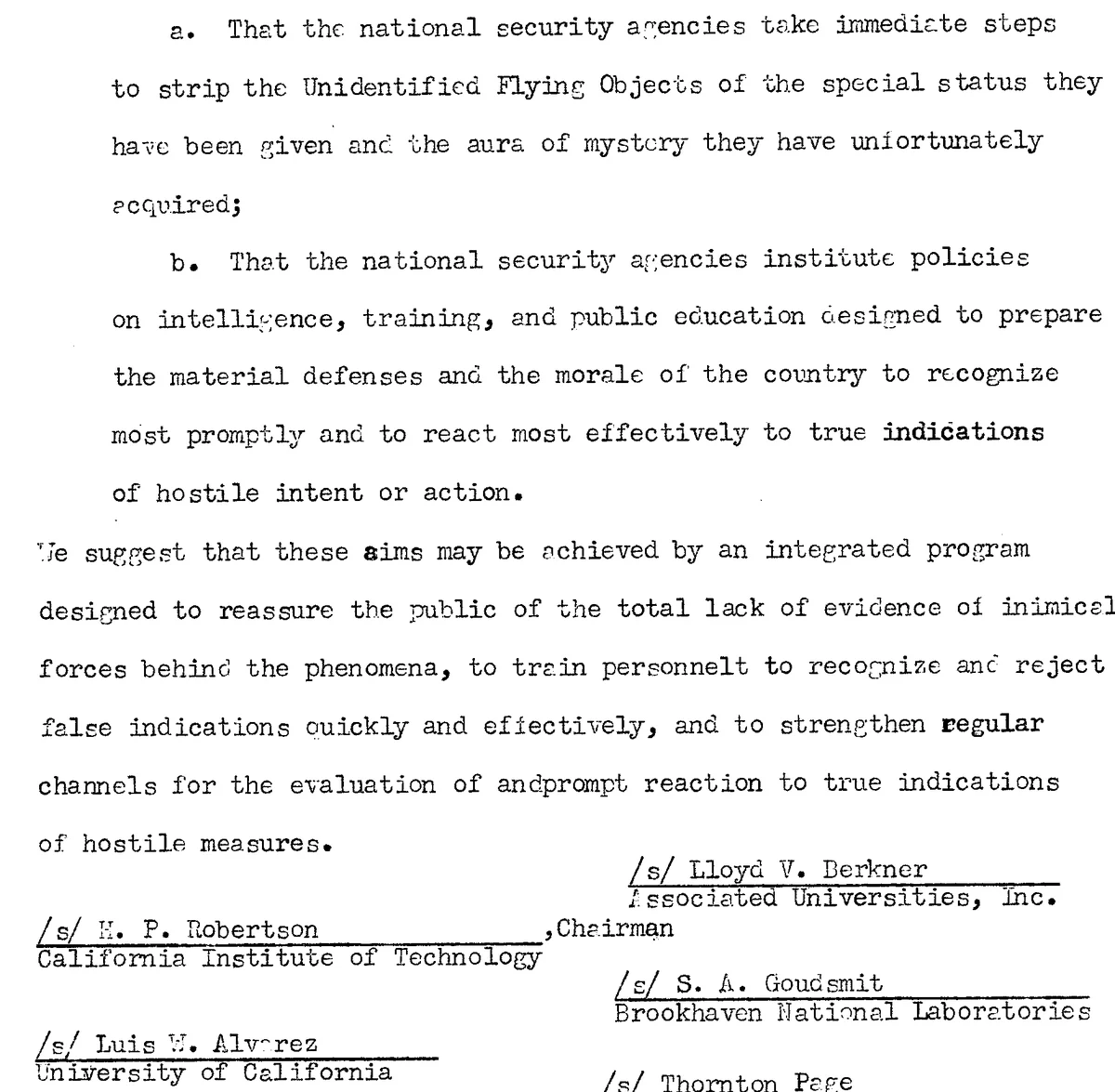
The report is headed "Report of the Scientific Panel on Unidentified Flying Objects" and dated Jan 17 1953. Its recommendation asks the national security agencies to strip the objects of "the special status they have been given and the aura of mystery they have unfortunately acquired."
Behind it sits a second document, a memorandum of the meetings that carries what the panel members kept out of the formal report. Its program has two aims. One is written, in quotation marks, as "debunking." Among the channels it names are television, motion pictures, popular articles and an animation studio.
The studio is Walt Disney, Inc.
Blips Over the Capital
The summer before, the radar scopes had lit up. Gerald K. Haines, the historian who wrote the CIA's own account in 1997, records that radar at Washington National Airport and Andrews Air Force Base "tracked mysterious blips" on 19 and 20 July 1952, and again on 27 July; interceptors "found nothing." In 1950 the FBI's Washington field office had sent J. Edgar Hoover a memo relaying a claim that three saucers had been recovered in New Mexico.
In December 1952 H. Marshall Chadwell, the CIA's Assistant Director for Scientific Intelligence, told the Director of Central Intelligence that sightings near "major US defense installations" were "not attributable to natural phenomena or known types of aerial vehicles."
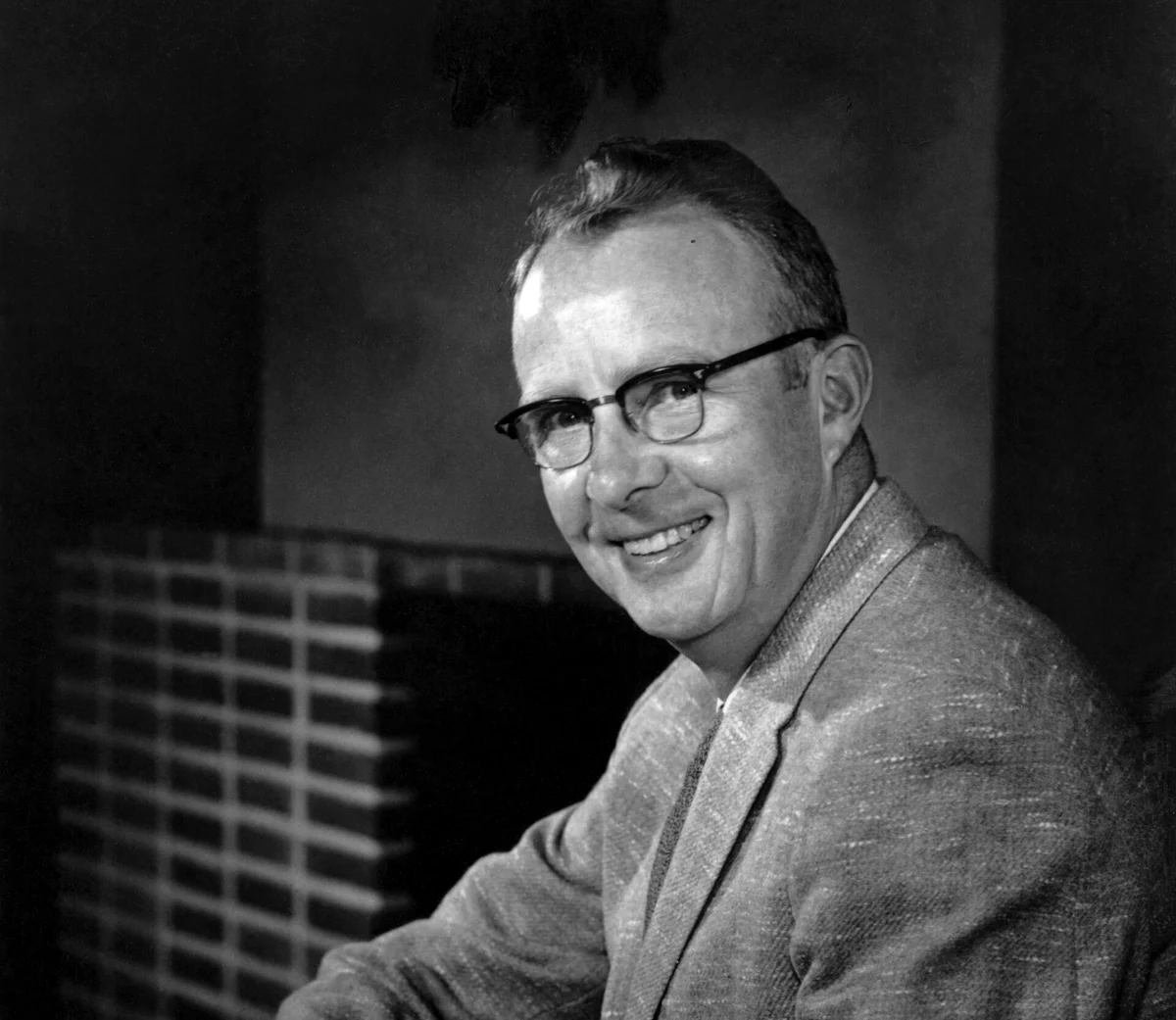
Robertson, of the California Institute of Technology, "Physics, weapons systems." Luis W. Alvarez of the University of California, physics and radar. Lloyd V. Berkner of Associated Universities, Inc., geophysics. Samuel Goudsmit of Brookhaven. Thornton Page of Johns Hopkins, astronomy. Beside them sat the Ohio State astronomer J. Allen Hynek and Frederick C. Durant of Arthur D. Little, Inc., who wrote the memorandum of the meetings.
On the table: "Seventy-five case histories of sightings 1951-1952 (selected by ATIC as those best documented)", a polyethylene "pillow" balloon 54 inches square, and two reels of film. The agency's own name stayed out of it. "Any mention of CIA sponsorship of the panel was forbidden," Haines wrote.
Two Reels of Film
One reel was shot at Great Falls, Montana, on 15 August 1950 by Nick Mariana, manager of the town's baseball team. The other was shot near Tremonton, Utah, on 2 July 1952 by a Navy Chief Photographer, Warrant Officer Delbert C. Newhouse.
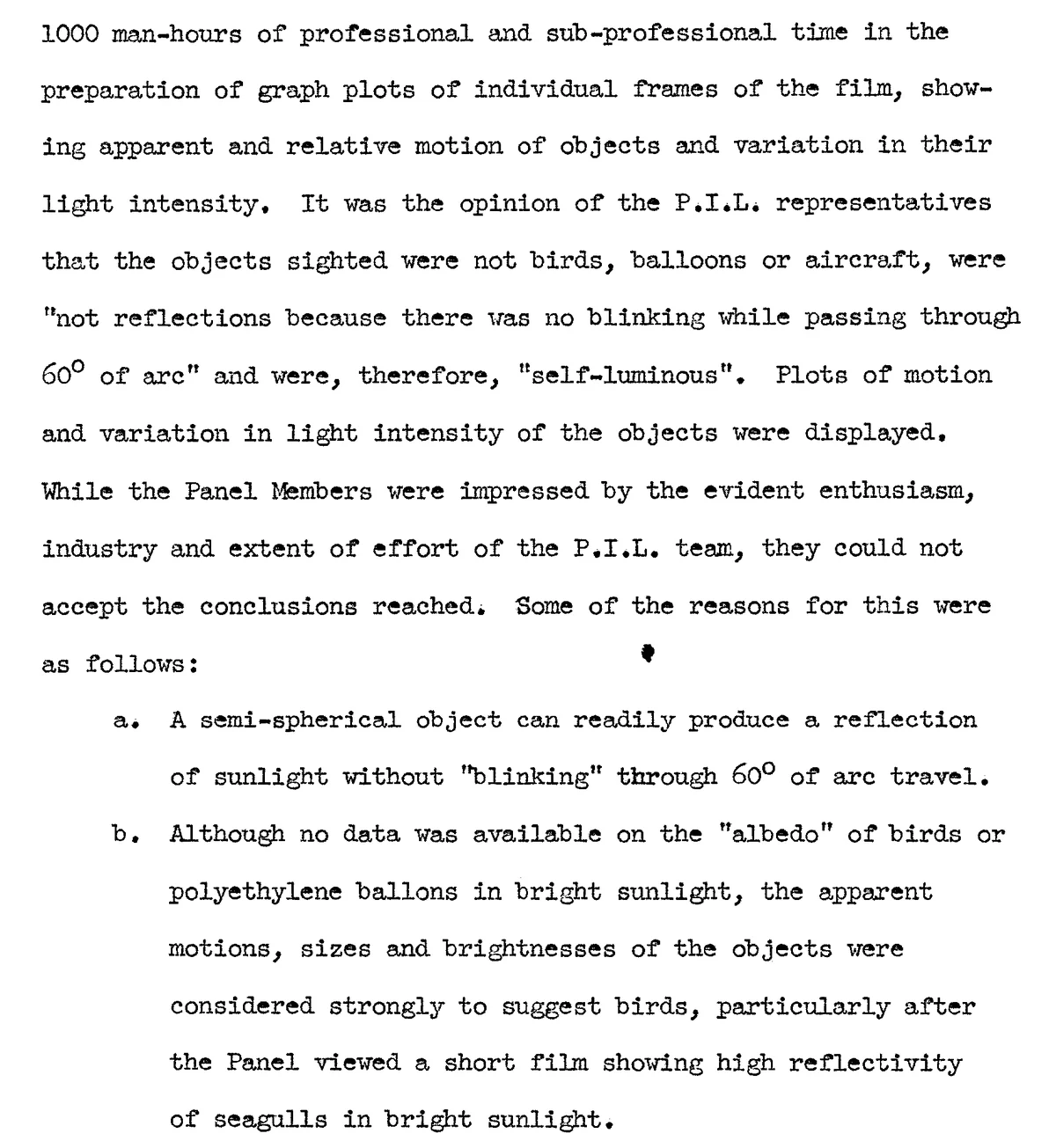
The Navy's Photo Interpretation Laboratory at Anacostia had worked the Tremonton film hard. Its analysts, Lt. R. S. Neasham and Harry Woo, reported approximately 1000 man-hours plotting the motion and brightness of the objects. Their opinion, as the memorandum records it: the objects were not birds, balloons or aircraft, were "not reflections because there was no blinking while passing through 60 degrees of arc" and were, therefore, "self-luminous."
Edward Ruppelt, who ran Project Blue Book, wrote in 1956 that the Navy analysts went further, concluding that "the UFO's were intelligently controlled vehicles." The Air Force's own photo laboratory at Wright Field, on his account, left both reels unknown: "We don't know what they are but they aren't airplanes or balloons, and we don't think they are birds."
Two laboratories. Neither named a known object.
The Plan With Two Aims
The signed answer came on 17 January. The panel found "That the evidence presented on Unidentified Flying Objects shows no indication that these phenomena constitute a direct physical threat to national security." The continued emphasis on reporting, it said, "does, in these parlous times, result in a threat to the orderly functioning of the protective organs of the body politic," with the risk of "the cultivation of a morbid national psychology in which skillful hostile propaganda could induce hysterical behavior and harmful distrust of duly constituted authority."
Berkner, Robertson as chairman, Goudsmit, Alvarez and Page signed the recommendation that the national security agencies "take immediate steps to strip the Unidentified Flying Objects of the special status they have been given and the aura of mystery they have unfortunately acquired," and set "policies on intelligence, training, and public education." The means: "an integrated program designed to reassure the public of the total lack of evidence of inimical forces behind the phenomena."
The signed report never uses the word "debunking." The word is in Durant's memorandum of 16 February 1953, in a Part II he called "An unofficial supplement to the official Panel Report," holding suggestions the members "believed were inappropriate for inclusion in the formal report." There the program "should have two major aims: training and 'debunking.'" And: "The 'debunking' aim would result in reduction in public interest in 'flying saucers' which today evokes a strong psychological reaction." Its tools: television, motion pictures and popular articles. Its logic: "As in the case of conjuring tricks, there is much less stimulation if the 'secret' is known."
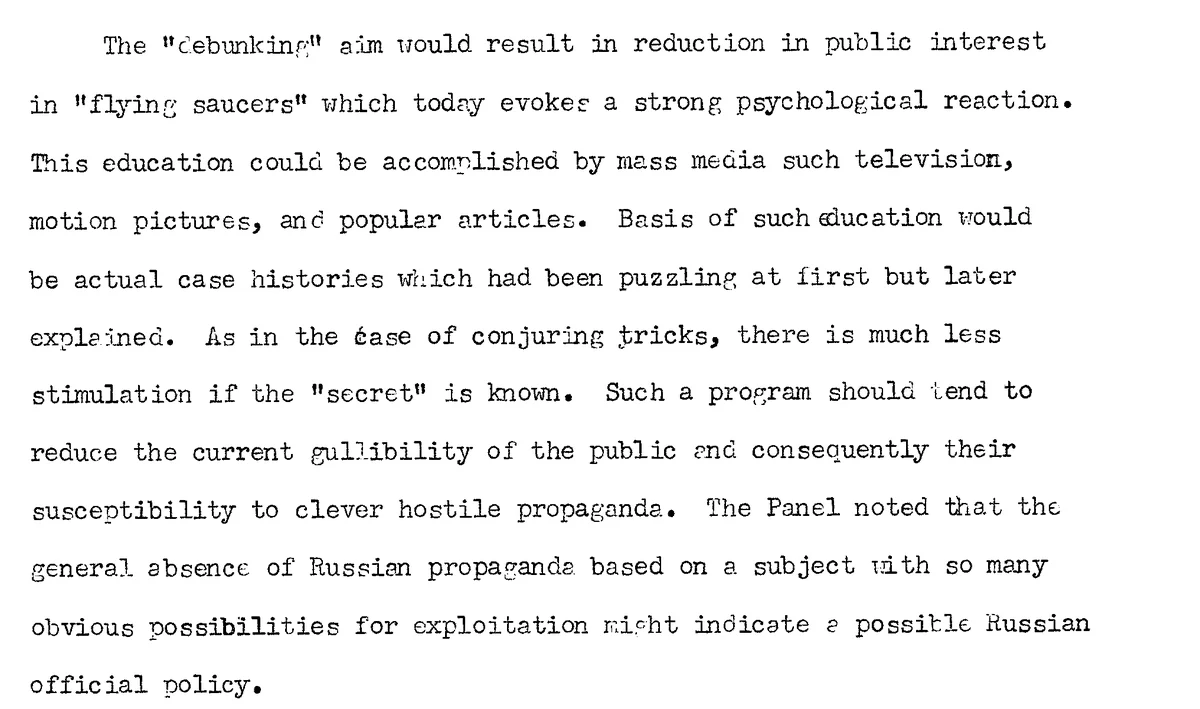
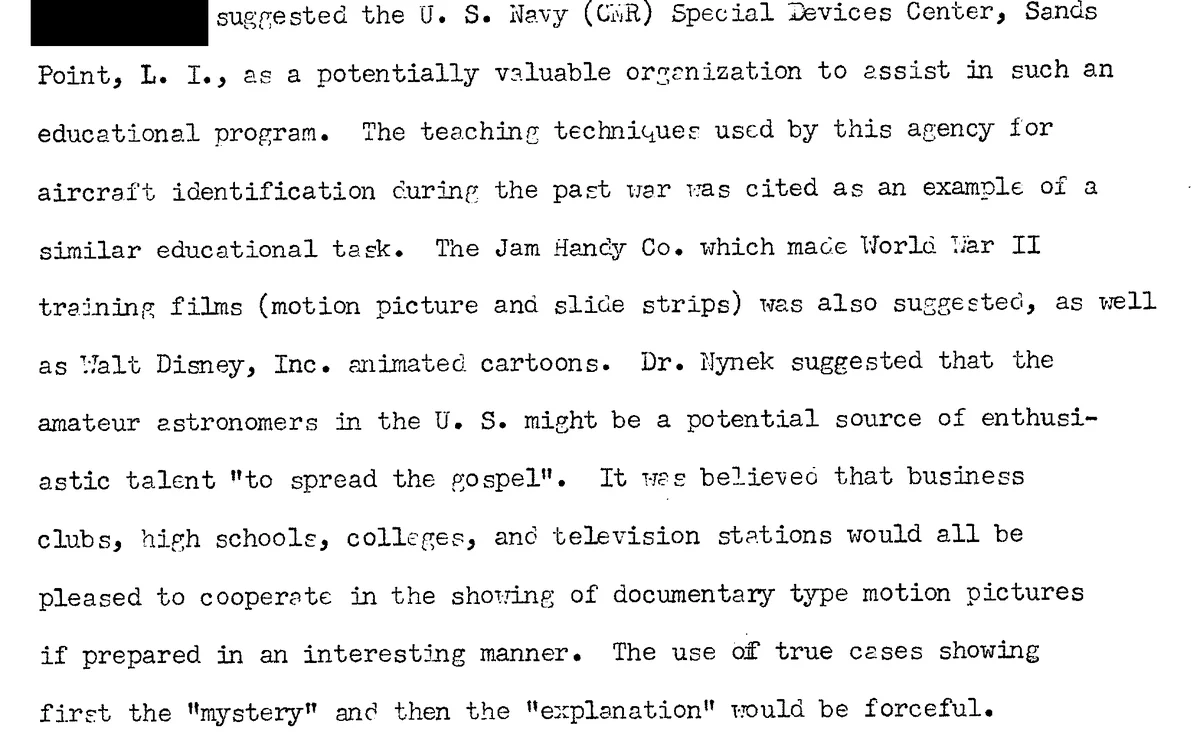
The supplement then names its partners. Hadley Cantril of Princeton was suggested as an adviser on mass psychology, with Don Marquis of the University of Michigan and Leo Rosten. "Arthur Godfrey was mentioned as possibly a valuable channel of communication reaching a mass audience of certain levels." Then: "The Jam Handy Co. which made World War II training films (motion picture and slide strips) was also suggested, as well as Walt Disney, Inc. animated cartoons." Hynek offered the country's amateur astronomers as enthusiastic talent "to spread the gospel." And: "The use of true cases showing first the 'mystery' and then the 'explanation' would be forceful."
Civilian saucer clubs in Los Angeles and Wisconsin, the supplement added, "should be watched." Haines, writing for the CIA in 1997, summed it up: the panel "recommended that the National Security Council debunk UFO reports and institute a policy of public education."
If the Plan Was the Point
Set aside for a moment whether anything was ever up there. Ask the better question. What would it mean if the most lasting product of those four days was never a finding about the sky, but a plan for the people under it?
It would mean the official American story of the flying saucer was shaped at the start by a decision about attention. On that reading, success was never a case solved. It was a public that stopped asking.
It would mean something larger about us. Wonder at the sky is one of the oldest things our species does. If the plan was the point, a government once treated that wonder as a channel to be cleared.
Our curiosity, filed under national defense.
And it would leave a question in front of us. If five scientists in a room could set the tone of public talk for a generation, who sets it now, as new offices report to Congress and old files keep surfacing? That question has no date attached. Only the next file.
The Cold War Reading
The standard account holds that the panel answered a defense problem, not a scientific one. The memorandum counts "the thousand or more reports received through channels each year (1,900 in 1952)." The signed report names the cost: "the clogging of channels of communication by irrelevant reports" and "the danger of being led by continued false alarms to ignore real indications of hostile action."
On the evidence, after the strongest cases and about 15 others, the panel found that "reasonable explanations could be suggested for most sightings," and noted the absence of any recovered "hardware."
The panel judged the Tremonton lights "strongly to suggest birds" and gave eleven numbered reasons for rejecting the Navy analysis, among them that "A semi-spherical object can readily produce a reflection of sunlight without 'blinking'," and that brightness had been measured "from duplicate rather than original film" by a method that "appeared faulty because of unsuitability of equipment." The Great Falls objects it thought "strongly suspected of being reflections of aircraft known to have been in the area." In 1968 the University of Colorado study led by Edward Condon came close on Tremonton: William K. Hartmann wrote that the objects "are thus provisionally identified as birds." On Great Falls it did not: "The case remains unexplained," though aircraft "cannot be entirely ruled out."
What the Seagull Film Does Not Reach
Haines puts the panel's time on the phenomena at 12 hours. The Navy laboratory had put approximately 1000 man-hours into one film. The panel conceded that "no data was available on the 'albedo' of birds or polyethylene balloons in bright sunlight," and named the tests that would settle the film: balloons released near the site, a check with ornithologists. Ruppelt records that the panel wanted the Navy to redo its study, and that "the Navy lab never rechecked their report." Hartmann called the Tremonton data "not conclusive," and wrote of Great Falls that "it strains credibility to suppose that these were airplanes."
Then the secrecy. After Ruppelt's book, Haines records, the CIA "prepared a sanitized version of the report which deleted any reference to CIA and avoided mention of any psychological warfare potential." In 1967 it let the Condon study "release the full Durant report with only minor deletions." The full report reached Spaulding of Ground Saucer Watch after his request of 7 June 1975. Haines's judgment: "This concealment of CIA interest contributed greatly to later charges of a CIA conspiracy and coverup."
Even that history has a crack. Haines writes of "Dr. Robertson's disclosure on a CBS Reports program" in 1966. H. P. Robertson died in Pasadena on 26 August 1961. Either the name or the attribution is wrong.
And the program itself. Official X found no record, in the files opened here, that the Disney cartoons were ever drawn, that Godfrey was ever approached or that Cantril was ever hired. Haines says only that the CIA put UFOs "on the back burner."
An absence. Not a finding.
Where the File Stands
When the Department of Defense announced the end of Project Blue Book on 17 December 1969, its release named among past studies "one conducted by a Scientific Advisory Panel of UFOs in January, 1953 (Robertson Panel)."
In 2024 the Pentagon's All-domain Anomaly Resolution Office, in the historical report that followed David Grusch's sworn testimony of 2023, named it: "There was at least one USG proposal--by the CIA-sponsored Robertson Panel--to engage in an active 'training' and 'debunking' effort using various public media tools to steer the public away from reporting UFOs."
What is left is Part II, the unofficial supplement. Training, "debunking," Godfrey, Jam Handy, Walt Disney, Inc., amateur astronomers ready "to spread the gospel." A plan for how a country should feel about lights in its sky. Whether anyone ever ran it is the one thing the file does not say.
The plan has become one of the mysteries.
Questions This Leaves You With
Does any of this change what I should do if I see something in the sky?
Honestly, no. This is a record from 1953, and nothing in it tells you what a light over your own roof is. What it does hand you is a different question, and a bigger one: how a society decides what its people hear about the unexplained, and who gets to set the tone. That question belongs to everyone and is still unanswered. If anyone uses this file to sell you a date when the full truth comes out, they are selling something. The file itself only shows how one panel wanted the conversation to go.
Does a government plan to shape belief sit against faith?
It can be read both ways, and serious people have read it both ways. One reading sees a state trying to manage what people are allowed to wonder about, which some find a threat to any belief held against official opinion. Another sees ordinary public education, modelled on wartime training films, with nothing to say about God or meaning at all. Notice that Hynek's own phrase was "to spread the gospel." This site will not tell you which reading is right, and neither does the file.
Does it matter that my curiosity was once a line in a security memo?
You might feel smaller. Your interest in the sky, filed next to clogged radar channels and hostile propaganda, as a problem for someone to reduce. Or you might feel the opposite. Five physicists and astronomers, working for the CIA, spent four days worrying that public curiosity was too strong to leave alone. That is a strange kind of compliment to the people who keep looking up. Which reaction came first for you is worth noticing. Nobody is asking you to choose.
What would change your mind, in either direction?
Try to name it now, before you settle. Things that would count toward the plan having been carried out: contracts or correspondence with Walt Disney, Inc. or the Jam Handy Co. about saucer films; CIA or Air Force records of an approach to Godfrey's program; agency files showing what followed the panel's report. Things that would count the other way: a documented decision to drop the program; a fresh analysis of the original Tremonton film that settles what the lights were. Write down which you would accept before you go looking.
Did anyone ever run the program the panel proposed?
This is the gap at the center of the file, and it is the kind of gap paper can close. The answer, if it exists, would sit in places nobody has yet been shown: CIA and Air Force files from 1953 and 1954 beyond the panel's own report, the business records of the Jam Handy Co., the archives of Walt Disney, Inc., the production files of the 1966 CBS Reports program that brought the CIA's role to light. Each is a place a request or a researcher could reach. Until then the space between a plan on paper and a plan carried out is still empty.
Sources
- CIA, Report of Meetings of Scientific Advisory Panel on Unidentified Flying Objects (Durant memorandum, 16 Feb 1953, with Tab A report of 17 Jan 1953), CIA-RDP81R00560R000100030027-0, approved for release 2001/08/07; scan via The Black Vault on Wikimedia Commons Central Intelligence Agency Primary record
- Condon Report Appendix U, Report of Meetings of Scientific Advisory Panel on Unidentified Flying Objects (Robertson Panel), NCAS Internet edition, 1999 NCAS (with permission of the Regents of the University of Colorado) Primary record
- Gerald K. Haines, A Die-Hard Issue: CIA's Role in the Study of UFOs, 1947-90, Studies in Intelligence vol. 40 no. 5, CIA, 1997 Central Intelligence Agency Study
- Edward J. Ruppelt, The Report on Unidentified Flying Objects, Doubleday, 1956 (Project Gutenberg #17346) Project Gutenberg Study
- William K. Hartmann, Case 49 Tremonton, Utah, in Scientific Study of Unidentified Flying Objects (Condon Report), 1968, NCAS edition NCAS / University of Colorado Study
- William K. Hartmann, Case 47 Great Falls, Montana, in Scientific Study of Unidentified Flying Objects (Condon Report), 1968, NCAS edition NCAS / University of Colorado Study
- All-domain Anomaly Resolution Office, Report on the Historical Record of U.S. Government Involvement with Unidentified Anomalous Phenomena, Volume I, 2024 (Black Vault copy) US Department of Defense Primary record
- DoD News Release No. 1077-69, Air Force to Terminate Project Blue Book, 17 December 1969 (scan at patrickgross.org) Office of the Assistant Secretary of Defense (Public Affairs) Primary record
- Caltech Archives, Finding aid to the Papers of Howard Percy Robertson, Online Archive of California California Institute of Technology Archives Study
- Official X, The Hottel memo of 1950 Official X General reference
- Donald Cooksey / Lawrence Berkeley National Laboratory, Portrait of Luis Alvarez, 2 January 1962, Wikimedia Commons Wikimedia Commons (NARA credit) Primary record