
Enuma Elish is the Babylonian epic of creation, about a thousand lines of Akkadian on seven clay tablets, named for its first words, "When on high." In its fourth tablet the young god Marduk kills Tiamat, the sea, and splits her body in two to make the world. In 1976 Zecharia Sitchin read that fight as something else: a collision between planets, remembered and written down.
The scene is made of weather. Marduk rides out with seven winds he has made, the evil wind, the tempest, the dust storm, the whirlwind. He carries a net. Tiamat opens her mouth to swallow the wind, and the wind goes in, and she cannot close it.
Then an arrow. Then a club. Then her blood, carried off on the north wind.
"He split her in two, like a dried fish."
Half of her becomes the roof of the sky. The other half becomes the ground. Rivers run from her eyes. Mountains are heaped from her breasts.
On Sitchin's reading, every word of it happened in the sky.
A poem in pieces
The tablets came out of the ground in fragments. Austen Henry Layard dug at Kuyunjik, the mound of ancient Nineveh, in the late 1840s, and Hormuzd Rassam followed from 1852. Much of what they shipped to London came from the royal archive of the Assyrian king Ashurbanipal, in the seventh century BC.
At the end of January 1875 George Smith, who had found a Babylonian flood story among the same tablets in 1872, began to gather the creation story: "starting with the fragment of the Creation in 'The Daily Telegraph' collection, which I had first noticed, I began to collect other portions of the series." His book The Chaldean Account of Genesis came out in London in 1876. In 1902 Leonard William King of the same museum published The Seven Tablets of Creation and fixed the poem's shape: seven tablets, Marduk's war in the fourth, the making of the world in the fourth and fifth, humankind in the sixth, Marduk's names in the seventh.
The pieces kept coming. The latest edition, made by the electronic Babylonian Literature project at Munich and published in English in 2024 by Johannes Haubold, Sophus Helle, Enrique Jimenez and Selena Wisnom, rests on 288 textual sources: 116 manuscripts, 71 school tablets, 18 further fragments, 27 commentaries and 56 quotations in other texts.
The poem was not a curiosity in its own time. A ritual tablet in the Louvre, MNB 1848, orders that on the fourth day of the month Nisannu, at the New Year, "the high priest recites Enuma Elish from its beginning until its end" before Marduk.
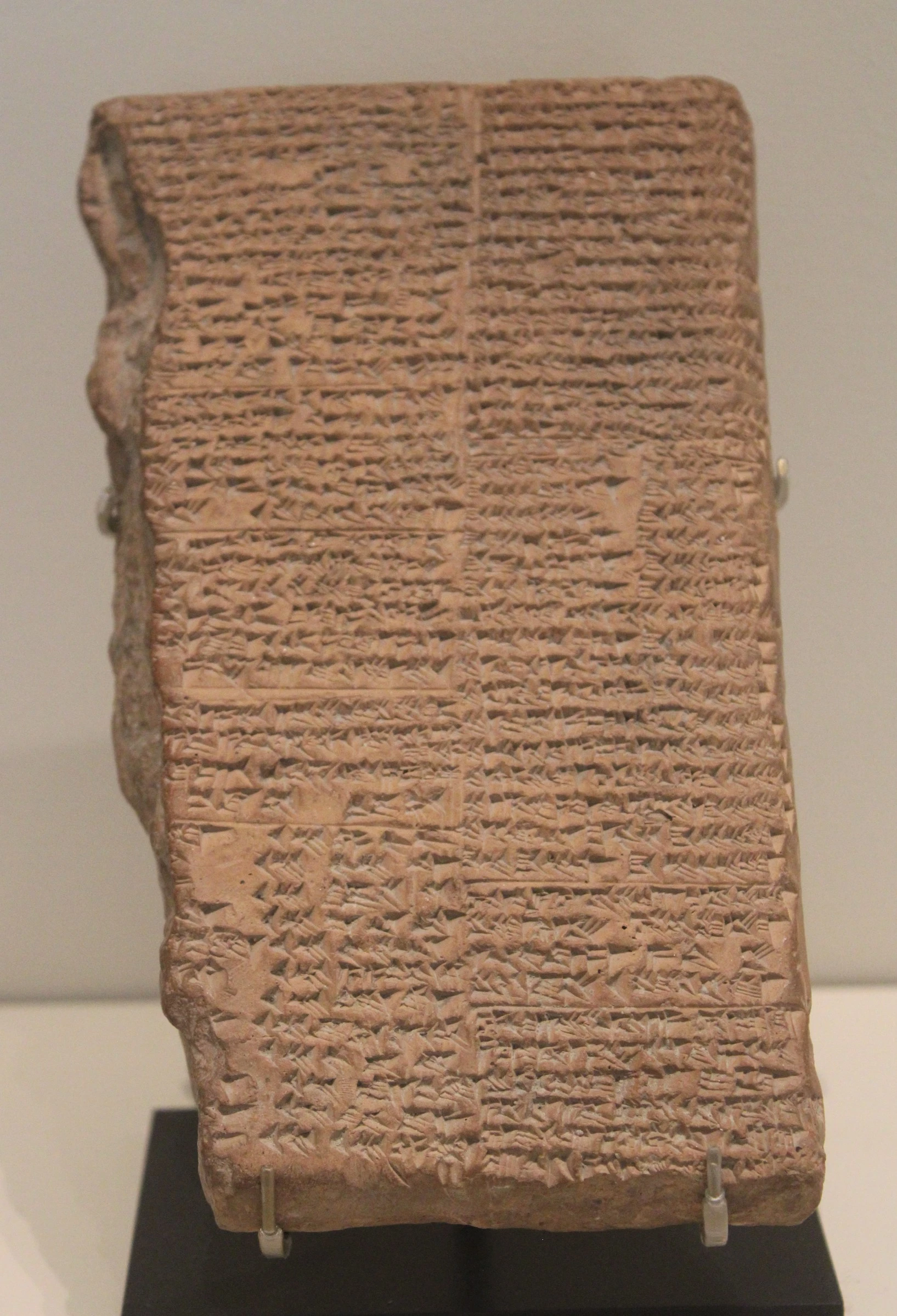
A text that was performed. Copied in schools. Quoted by scholars. And read aloud to its god.
A planet named Tiamat
In The 12th Planet, Sitchin read the fourth tablet as astronomy. As his reading is summarised in the published accounts of his work, Tiamat was a planet, a large one, on an orbit between Mars and Jupiter. Marduk was another planet, the one he called Nibiru, arriving from deep space on a long orbit. One of Nibiru's moons struck Tiamat and split her. On a second pass Nibiru struck again. One half of Tiamat was shattered into the band of rubble between Mars and Jupiter, the asteroid belt. The other half was thrown into a new orbit and became the Earth.
The text gives the reading its handholds. The winds that Marduk sends "inside" Tiamat. The split into two halves. In the fifth tablet, the making of the stars' stations and the Moon. In the seventh, a name for Marduk as a body in the sky: Neberu, "he who unceasingly crosses back and forth inside Tiamat."
On Sitchin's reading, the crossing is an orbit, and the sea is space.
And the reading did not end with one book. Sitchin built it into The Earth Chronicles, a series of books from 1976 to 2007, and from them into a whole literature on Nibiru. Its pull is easy to see. A poem from the second millennium BC that tells, in the language of gods, how the Earth was broken from a larger world and how the Moon came to hang in its sky.
If the poem remembers
Set aside for a moment whether it is true. Ask the better question. What kind of universe are we living in, if it is?
It would mean, first, that Enuma Elish is not a poem about gods but a report, and that the scholars of Babylon who recited it at the New Year were reading out the history of the solar system without knowing it.
It would mean that someone, some time before the poem was written, knew that the Earth had been made by a collision. That knowledge would have to have come from somewhere: from observation, which no one on Earth could have made at the time, or from somebody who was there.
It would mean something stranger about the ground under our feet. On that reading, our planet is half of a lost world, and the asteroids that cross our sky are the other half, still in pieces.
And it would leave one consequence still in front of us. The body that broke Tiamat, on Sitchin's account, is still on its orbit, and the poem says it "unceasingly crosses back and forth." Whether there is anything out there to cross is a question the poem cannot answer.
What the Assyriologists read
The standard account reads the poem as a story of the sea. Tiamat is the salt sea; Apsu, her partner, is the sweet water under the earth. Assyriologists read the battle as a storm god's victory over the sea, and the 2024 edition sets it beside the Baal cycle of Ugarit, on the Syrian coast, where a storm god also fights the sea.
The world made from her body is a world of water and air. As the 2024 edition's introduction puts it, drawing on Wisnom, "Tiamat is essentially turned inside out, creating an air bubble within her expansive waters: that bubble is the cosmos we inhabit." Her upper half holds back the waters above the sky; her lower half becomes the earth, a roof over the waters below. In the fifth tablet Marduk sets her liver in the heights of heaven "and brought forth the Moon." Qingu, often written Kingu, Tiamat's general, is bound and counted "among the gods of death," and in the sixth tablet he is put to death so that humankind can be made from his blood.
Neberu, the edition's translators note, means "crossing," and they identify it as Jupiter, Marduk's planet; Francesca Rochberg, in the same volume, judges that Jupiter "seems the better candidate" than Mercury, which another scholar, Wayne Horowitz, had proposed.
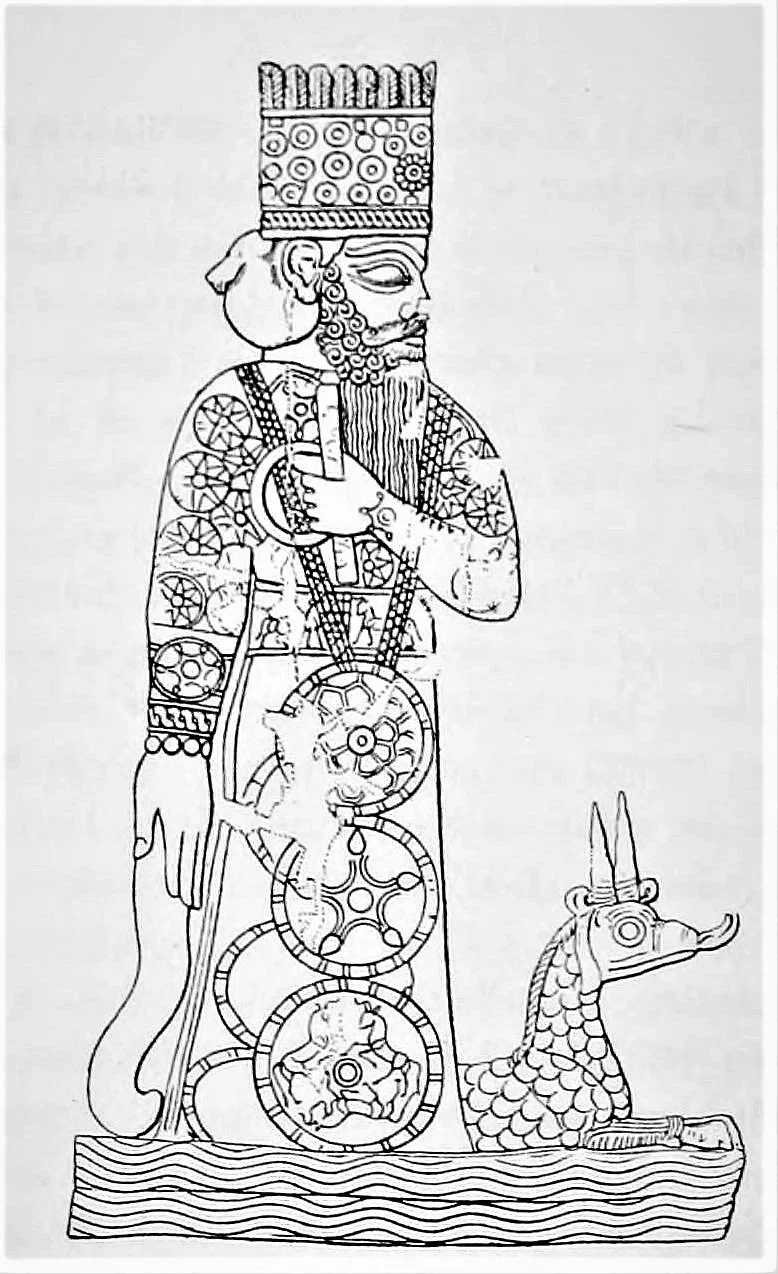
Wilfred Lambert argued in 1964 that the poem was composed under Nebuchadnezzar I, around 1100 BC, when Marduk's statue came home from Elam; most scholars put it in the late second millennium BC, though the editors note there is little direct evidence. On this account it is a poem written to raise Marduk above the gods and Babylon above the cities, and in it Marduk builds Babylon at the centre of the world.
What the readings leave open
The standard reading explains the sea, the storm and the theology. Some things it does not close.
The first is inside the poem. Rochberg writes that the two Neberu passages, in the fifth and seventh tablets, "are not easily reconcilable with one another. Indeed, they seem to refer to two different situations." The fifth tablet, where the sky and the earth are made, is the worst preserved of the seven, and its lines on the making of the earth rest partly on restoration.
The second is where the battle came from. The 2024 edition notes that a god's fight with the sea "is unknown in previous Sumerian and Akkadian literature." Whether it came from the west or grew in Babylon is still argued.
The third is a likeness in the sky.
In 1975 the planetary scientists William Hartmann and Donald Davis proposed in the journal Icarus that the Moon formed from debris thrown off when a large body struck the young Earth. It became the leading explanation for the Moon's origin. The impactor has a name now, Theia. In 2025 a team led by Timo Hopp, at the Max Planck Institute for Solar System Research, reported in Science that iron isotopes in Earth rocks and Apollo samples point to Theia forming in the inner solar system, a neighbour of the Earth.
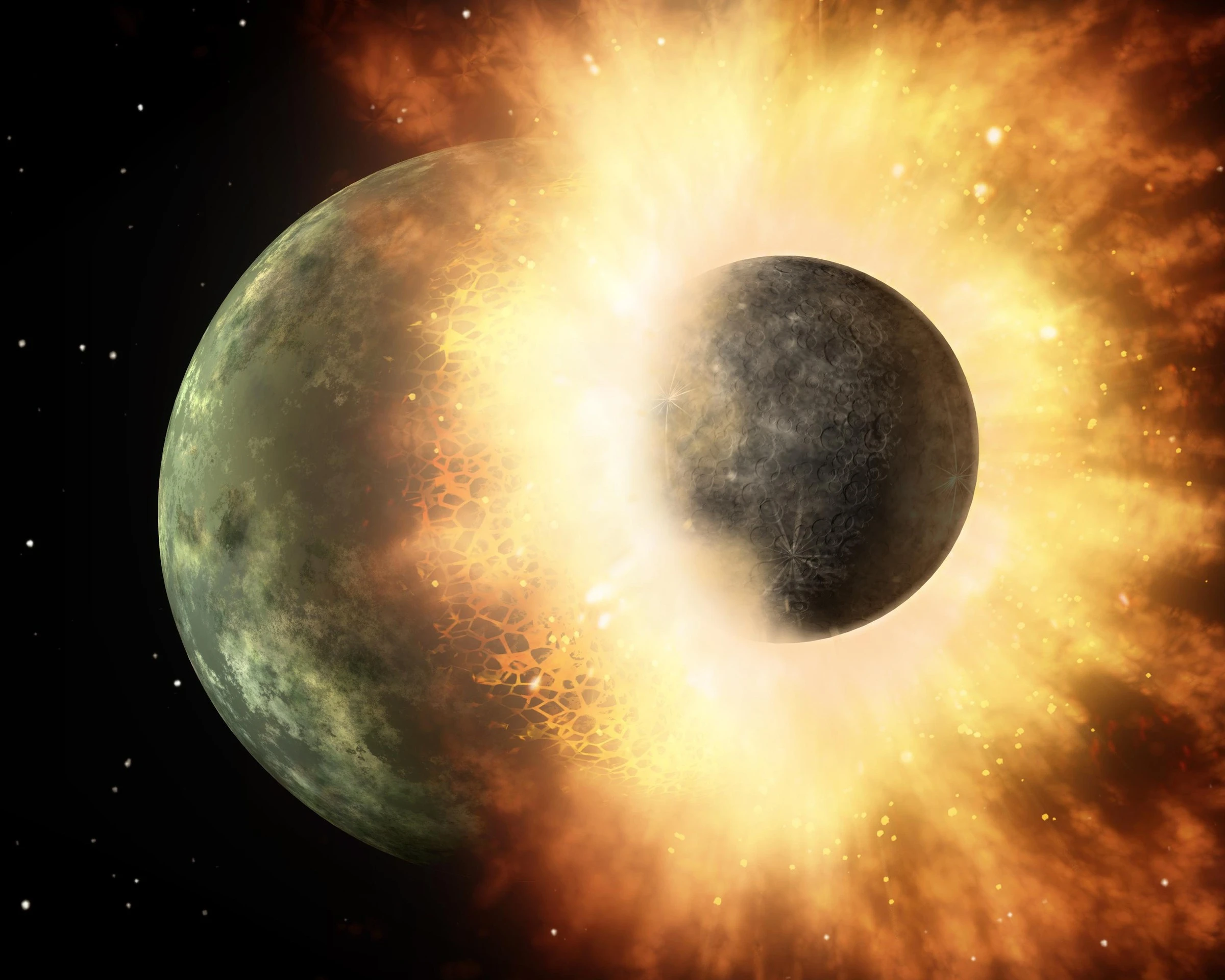
So modern astronomy also begins the Moon with a world struck and remade.
A resemblance of shape. Not a match of events. The likeness is an early body hit by an incoming one, and something new made from the wreck. The differences are as plain: in the poem the halves of Tiamat become sky and earth, not Earth and asteroids, and the Moon is set in heaven by Marduk, not knocked loose by the blow.
Where it stands
The poem is more open now than at any time since Babylon. The electronic Babylonian Literature project keeps adding fragments, and the 2024 edition is free to read online. Wisnom has a study on the way, titled for the poem's own image: Like a Dried Fish.
The asteroid belt has been weighed. A 2018 study by the astronomers Elena Pitjeva and Nikolay Pitjev puts it at about four ten-thousandths of the Earth's mass, around three per cent of the Moon, and NASA describes the asteroids as leftovers from the solar system's formation that Jupiter's gravity kept from becoming a planet. Rocks from the far side of the Moon, brought back by China's Chang'e-6 mission and dated in 2026, show no spike of impacts around 3.9 billion years ago; the geochronologist Mark Harrison has questioned whether they are true impact melts.
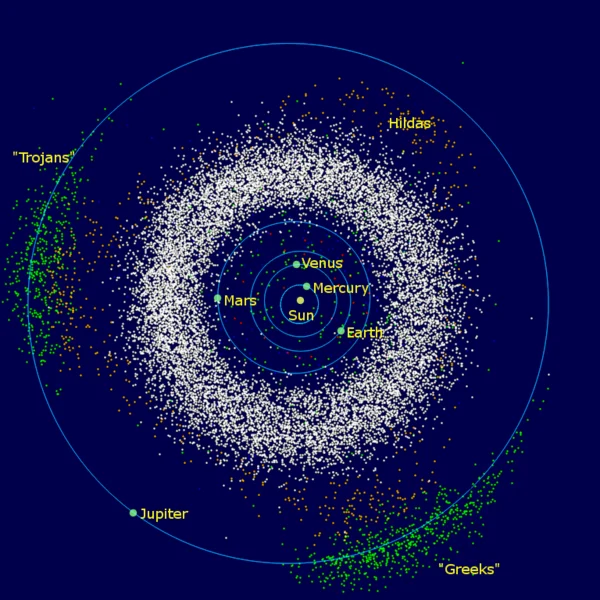
On the poem's words, its date and its sea, the record favours the Assyriologists' reading. For Sitchin's to gain ground it would need a text that names the Earth or the asteroids as parts of Tiamat, or a belt with the mass and chemistry of half a lost planet. Neither has been found. What stays fixed is the line in the fourth tablet: a body split in two, one half raised, one half laid down.
The question is what that image remembers.
Questions This Leaves You With
Is there anything a person actually does with this?
Not in a practical sense, and it is worth saying plainly. Nothing in the poem dates a coming event, and the giant impact that made the Moon happened about four and a half billion years ago. Anyone who reads a warning or a date out of Enuma Elish is selling you something. What you can do is read it: the 2024 English translation is free to download, every line numbered, with the damaged places marked. Few texts this old let a reader check a claim about them in an evening.
Does this sit against a religious account of the world?
It cuts both ways. Enuma Elish was itself a religious text, recited to its god, and the opening of Genesis shares its waters above and below; readers have set the two side by side since George Smith called his book The Chaldean Account of Genesis. Sitchin's reading turns the gods into planets and visitors, which some readers take as a story of where faith came from and others as a challenge to it. Where you land is yours to decide. This site will not tell you.
Does this change what a human life is?
In the poem, people are made from the blood of a defeated god, to carry the work the gods refused. In the science, the ground you stand on was remade in a collision before any life existed. Either way, a human life is very late and very small. You can take that as diminishing, a footnote to a war in heaven. Or you can take it the other way: something survived all of that, and here it is, reading about it. Which one did you feel?
What would change your mind, in either direction?
Name it now, before you are committed. Toward Sitchin: a cuneiform text, from any period, that describes the Earth or the asteroids as parts of a broken body in the sky, in terms that cannot be read as poetry about the sea; or an observation of a large body on the long orbit he gave. Toward the standard reading: more of the damaged fifth tablet, restored from new fragments, showing the making of the earth in the terms the Assyriologists expect; or an earlier storm-against-sea poem that the Babylonian one was built on. Each of these is something a person could actually find.
Why does a creation poem split its world in two?
The poem divides a first body into sky and ground, and modern science begins the Moon with a world struck and remade. The open problem is whether that likeness says something about the sky, about the human mind, or about nothing at all. No one has a test that settles it, and the question sits there, in the fourth tablet, at line 137.
Sources
- Enuma Elish: The Babylonian Epic of Creation (Library of Babylonian Literature 1, 2024) Johannes Haubold, Sophus Helle, Enrique Jimenez and Selena Wisnom (eds), Bloomsbury Academic, open access Primary record
- The Seven Tablets of Creation, vol. 1 (London, 1902) L. W. King, Luzac Primary record
- The Chaldean Account of Genesis (London, 1876) George Smith, Sampson Low Primary record
- Enuma Elish (encyclopedia entry, read 2026) Wikipedia General reference
- George Smith (Assyriologist) (encyclopedia entry, read 2026) Wikipedia General reference
- Zecharia Sitchin (encyclopedia entry, read 2026) Wikipedia General reference
- Satellite-sized planetesimals and lunar origin, Icarus 24 (1975) 504-515 William K. Hartmann and Donald R. Davis Primary record
- Giant-impact hypothesis (encyclopedia entry, read 2026) Wikipedia General reference
- Theia and Earth were neighbors (2025) Max Planck Institute for Solar System Research Study
- Masses of the Main Asteroid Belt and the Kuiper Belt from the Motions of Planets and Spacecraft (Astronomy Letters 44, 2018) E. V. Pitjeva and N. P. Pitjev Primary record
- Asteroids: Facts NASA Science Primary record
- Different moon rocks tell different tales (2026) Lisa Grossman, Science News Study