
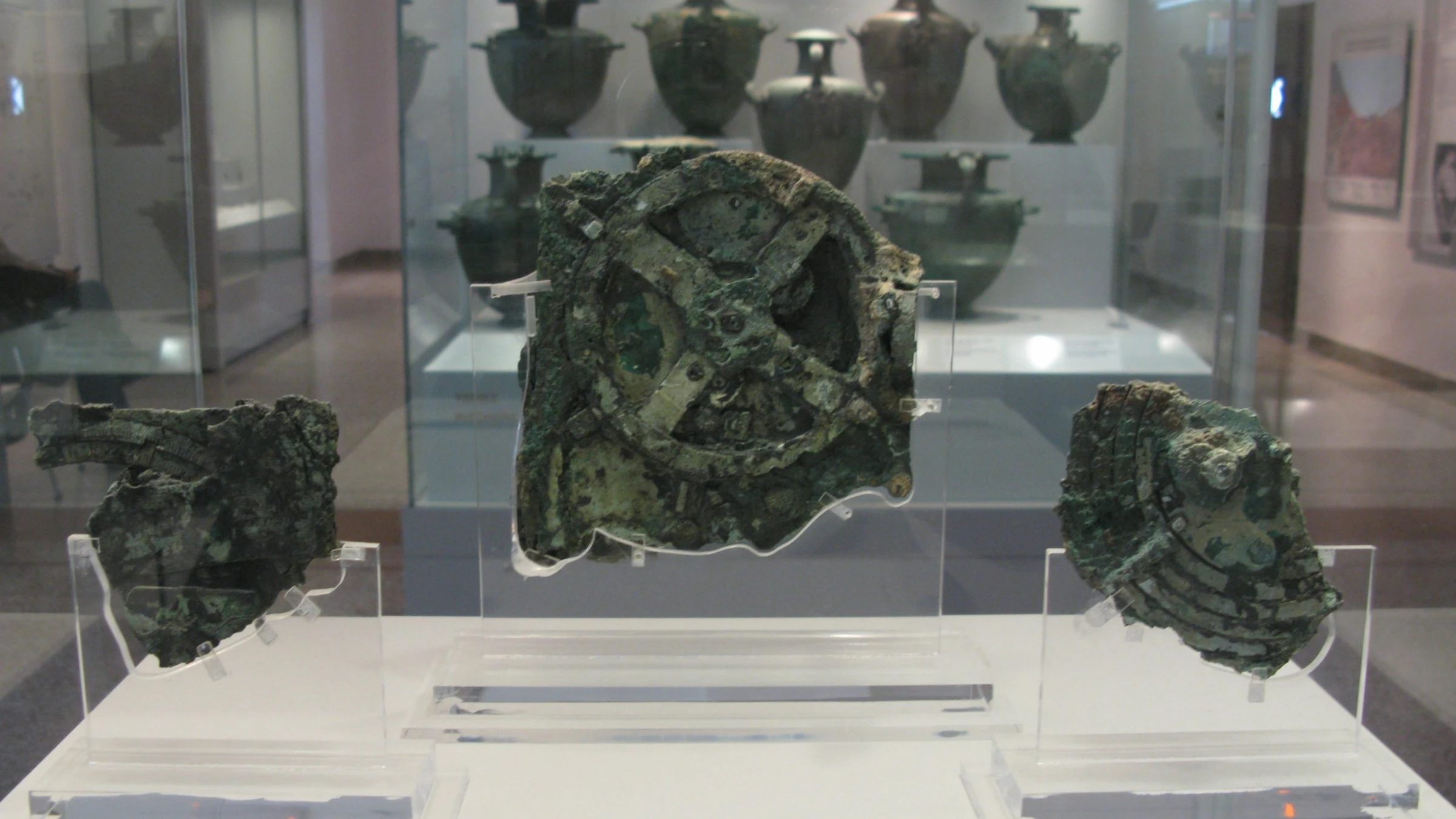
Gears from the Greeks is a seventy-page study published by the American Philosophical Society in November 1974. Its author, Derek de Solla Price, a historian of science at Yale, spent more than twenty years on a single object: the Antikythera mechanism, the corroded bronze gearing raised from a Roman-era wreck off a small Greek island in 1901.
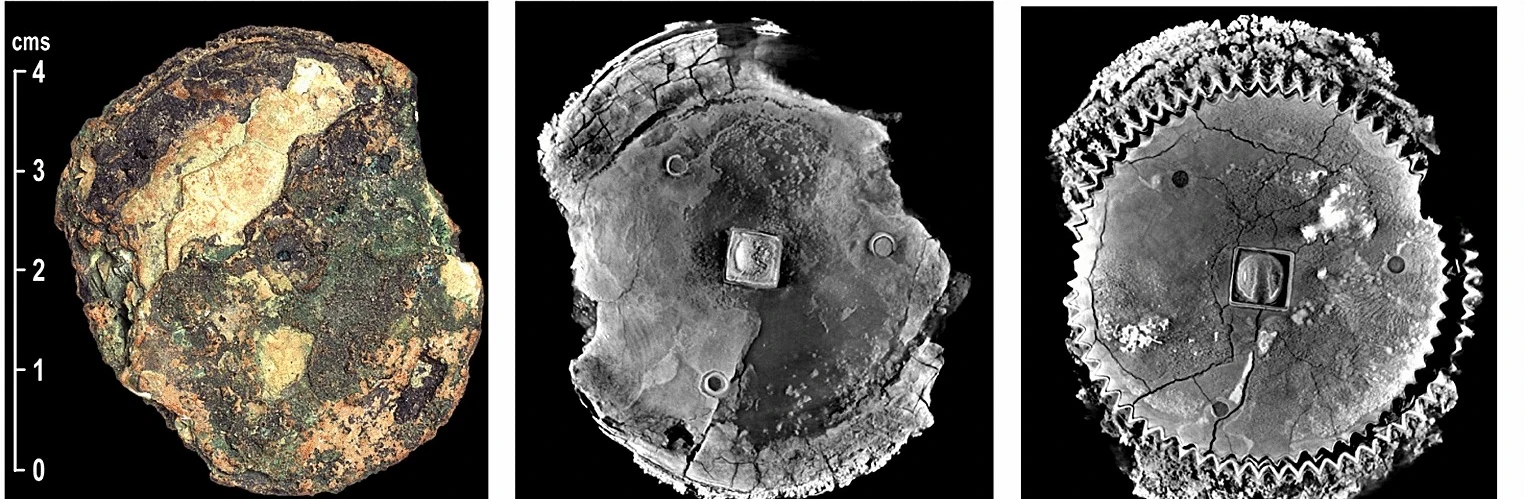
The book's evidence is a set of pictures taken through stone. The fragments had lain two thousand years under the sea and came up sealed in a crust of green and black corrosion, too fragile to clean. On film exposed straight through them, the crust thins to a grey fog. Inside the fog, the rims of wheels appear. On the rims, teeth.
Every one of those teeth had to be counted by hand, on the negatives and again on enlarged prints, and on the prints the tip of each tooth was pricked through with a pin so that none was counted twice.
What the counting produced was not a list of gears. It was a claim about the Greeks.
Ten days, and then the film
Price first took serious notice of the fragments in 1951, during his doctorate at Cambridge. In 1958 the American Philosophical Society gave him a grant of 460 dollars, enough for a return flight from Copenhagen to Athens and about ten days of living costs. That August, in the National Archaeological Museum, he found the pieces kept in shallow boxes, some of them cigar boxes. X-rays were out of the question: the museum had no equipment and, he understood, not enough electricity to run it. The epigrapher George Stamires worked through the inscriptions with him and read, letter by letter, some 793 letters in the end.
On 30 December 1958 Price described the machine to the American Association for the Advancement of Science in Washington. In June 1959 Scientific American ran his article "An Ancient Greek Computer" as its cover story. Arthur C. Clarke had urged him to write it.
Then a report from Oak Ridge, dated October 1970, on radioactive sources in archaeology told Price that gamma rays could see through the corrosion. He reached Charalambos Karakalos, a radiographer at the Greek Atomic Energy Commission's research centre Democritos. Karakalos made the first plates with a weak source of thulium-170, then carried on with two portable X-ray units, every exposure made inside the museum, from 1971. His wife Emily joined the counting of the teeth, a task Price called "delicate, tedious, and subject to maddening errors and repetitions".
Where Price had seen about twenty gears in 1959, the plates now showed, by their count, 29 or 30. Fragment D, mislaid for years, was rediscovered in the museum's store and radiographed in June 1973.
A calendar computer
The mechanism, Price wrote, "can now be identified as a calendrical Sun and Moon computing mechanism which may have been made about 87 B.C." He proposed that it was built by a craftsman connected with the school of the philosopher Posidonios on Rhodes, and lost at sea on its way to Rome around the time Cicero was visiting that school.
The centre of his case was one assembly of gears. In it Price saw "the very sophisticated device of a differential gear assembly for taking the difference between two rotations". A differential is the gearing that lets the wheels of a car turn at different speeds on a bend. The next one Price knew of was in a globe clock built by Eberhart Baldewin at Kassel in 1575. He counted it "one of the greatest basic mechanical inventions of all time", and said its inventor, whether Archimedes himself or someone unknown, "should be accorded the highest honors".
Which put the differential sixteen centuries ahead of its time.
Then the conclusion that gave the book its force. "One must now suppose," he wrote, "that such complex gearing is more typical of the level of Greco-Roman mechanical proficiency than has been thought". Ancient writers such as Cicero describe spheres that showed the heavens, but none of them describes gearing like this. The machine, "the oldest existing relic of scientific technology", "quite changes our ideas about the Greeks". It "transcends all that we had previously known from textual and literary sources".
At the Washington meeting in 1958, as the newspapers reported it, he had described the find as "like finding a jet plane in the tomb of King Tut" and "like opening a pyramid and finding an atomic bomb".
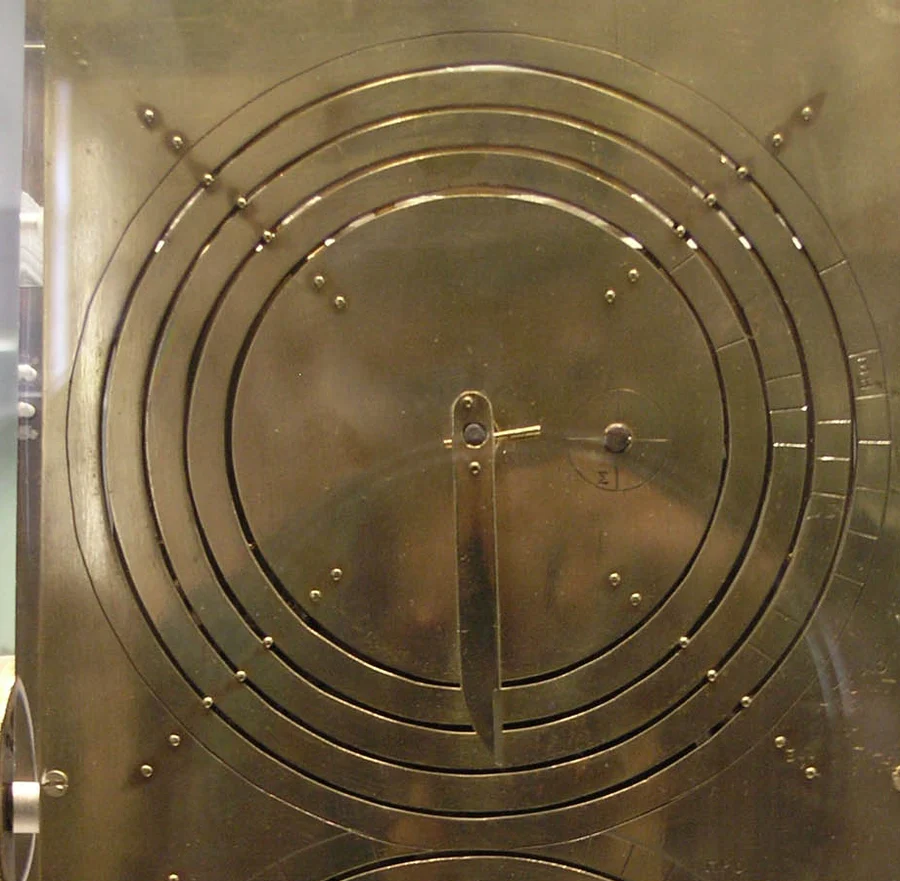
A brass replica built to his reading was photographed in the museum in Athens in 2005. On its back are two large dials, each a set of rings nested one inside the next.
If Price was right about the Greeks
Set aside for a moment which of his gears were right. Ask what follows if his larger claim is.
It would mean the Antikythera mechanism is not a freak. It is one surviving product of a trade: a workshop practice with apprentices, standard parts and buyers. The rest stayed on land, where bronze is worth more melted than whole.
It would mean the history of machines has a missing chapter. Texts survived antiquity because people copied them by hand, again and again. Price pointed out that machines had no such luck. "A technological tradition," he wrote, "is something so much more fragile than anything that was encoded into a written book." On that reading, the books tell us the Greeks built such things, and only the sea has kept one to show how.
It would mean our picture of our own species is built on what happened to survive. The line we draw from ancient thought to modern machinery, through the clocks of medieval Europe, would be the line of what was written down, not of what was known. A whole skill, held by a few people in a few cities, could have reached a level the world did not reach again for more than a thousand years, and left one lump of corroded metal behind.
And it leaves a question still in front of us. Even this machine is still coming to light in its own museum: fragment E turned up in storage in 1976, and fragment F in a tray in 2005. On that reading, if the ancient world made such machines in any number, the next one may already be in a drawer somewhere, mislabelled, waiting for someone to look at it twice.
What the later scans corrected
Today's standard account of the mechanism was built by correcting Price, gear by gear.
In a 1985 lecture the mathematician Christopher Zeeman showed that Price's scheme drove everything from the slow annual wheel through a heavily loaded differential: in the historian Alexander Jones's summary, like driving a clock's minute hand by pushing the hour hand. Michael Wright of the Science Museum in London found that a model built to Price's design did not run properly. Wright and Allan Bromley, who published a critique of his own in 1986, went back to Athens and examined the fragments with linear tomography from the late 1980s to 1994.
In 2005 the Antikythera Mechanism Research Project imaged every fragment with high-resolution X-ray computed tomography. Its 2006 paper in Nature, by Tony Freeth and colleagues, put the making of the machine around the end of the second century BC, earlier than Price's date. The gears Price read as a differential turned out to carry a pin-and-slot device that speeds the Moon up and slows it down across the month. The back dials were spirals, not rings. Price had missed a small gear that reverses the Moon's motion. In Jones's 2018 study of Price's work, two of the gears reported in 1974 are spurious, and some tooth counts were shifted away from what Karakalos had measured to give the outputs Price expected. Jones's verdict is that the gearing diagram made the reconstruction "appear more definitive than it actually was".
What the corrections did not take away
The corrections reached the gears. They did not reach the claim.
Price's placing of fragments A, B and C against each other is now confirmed. So is the general layout of the box, the annual drive wheel, the train that runs the Moon at the ratio of 254 to 19, and most of the gears he and the Karakaloses counted. Where Price moved a count to suit his theory, the right number usually turned out to be Karakalos's: Jones takes the corrected counts of two wheels, 53 and 54, as confirming the quality of Karakalos's work. And the projects that replaced Price's reconstruction were "both inspired by and methodologically extrapolated from" his.
Most of the corrections made the machine more sophisticated, not less. The pin-and-slot carries a mathematical model of the Moon's uneven speed. The lower spiral counts the cycle of eclipses, and the upper one the calendar. The inscriptions read by the 2005 scans name the planets. Price had left room for planetary gearing, but did not attempt it; the 2021 reconstruction by Freeth and colleagues says so in as many words, and then builds it.
Even the differential did not disappear. In the current reconstruction a small gear mounted on a moving carrier subtracts the Sun's motion from the Moon's to turn the small ball that shows the Moon's phase. It is a differential at work. Not where Price put it.
What has not been found is the trade Price argued for. Writing in 1974 about how little ancient technology survives at all, he noted that "there is absolutely nothing but the Antikythera fragments that looks anything like a fine gear wheel" from the ancient world. The workshop he imagined on Rhodes has not been located. His date has not survived. They did not find the rest of the tradition.
The spiral on the film
Price died in London on 3 September 1983, still professor at Yale. In 1980 he appeared on the television series Arthur C. Clarke's Mysterious World, turning working models built to his gearing, in a programme that also visited crystal skulls and the Baghdad battery. His photographs, notes and correspondence went to the Adler Planetarium in Chicago.
The questions he opened are still open, as they are for other lost techniques of the ancient world, Greek fire among them. The date of the machine is argued over to this day; his own rested on a scratch he read as a setting mark, which may be a crack. The planetary display is reconstructed from inscriptions and a handful of surviving parts, and Jones writes that the evidence is not sufficient to establish any specific reconstruction as correct. Who built the mechanism, and where, no inscription says.
And there is one detail in the record that belongs to Price alone. On Karakalos's plates of fragment B, inside the five curved slots, Price could see a short piece of a sixth, ending squarely on the centre line of the plate. It did not fit his rings. He dismissed it as probably an accidental crack.
It was the start of the spiral. It had been on the film the whole time.
Questions This Leaves You With
Is there anything a person actually does with this?
Not much, in your own life, and that is worth saying plainly. The mechanism predicted the Moon and eclipses for people who lived two thousand years ago. Nobody needs it to plan anything now, and anyone selling a date from it is selling something. The bigger question is collective: how a society keeps hold of skills that live in hands rather than books. Price's point was that a written text gets copied and a craft gets melted down. Whether the archives and workshops of our own time are kept well enough is a live question.
Does this sit against a religious account of the world?
It can be read both ways, and serious people have read it both ways. The Greeks who built it believed the heavens moved in an order that could be known, and many religious thinkers since have seen that order as a sign of design. Others have seen the same regularity as proof that the sky needs no hand to run it. The machine itself makes no claim either way; it counts months, eclipses and the years between festivals, some of them sacred. This site will not tell you which reading is right. That is yours to weigh.
Does it change what a human life is?
Think about Emily Karakalos counting, on a print, the teeth of a wheel that someone else cut by hand twenty-one centuries earlier, each tooth tip pricked through with a pin so that none was counted twice. One reaction is that it makes a life small: the maker left no name, and the counters are a footnote. The other is that it makes a life larger: two people who never met, joined across two thousand years by the same patient work. Which one did you feel first?
What would change your mind, in either direction?
Name it now, before you are committed. Toward Price's larger claim, that such gearing was ordinary: a second geared device from the same centuries, a workshop scrap, or a text that describes cutting gear teeth as routine work. Toward the view that the mechanism was rare: a decade more of excavation in Hellenistic cities with still nothing like it, or new scans showing that its own errors were too large for it to have worked well. Be wary of arguments that rest on what the crust still hides; each new scan has added detail rather than removed it.
Where does the open problem actually sit?
It sits between the machine and the trade. Everyone who has studied the mechanism agrees it was not a first attempt; the gearing is too sure of itself. So somewhere there were earlier machines, tools to cut teeth, people taught to use them. None of it has been found. Whether that is the ordinary arithmetic of recycled bronze, or a sign that the craft lived in very few hands and very few places, is the question still open, and nobody yet knows where to dig for the answer.
Sources
- Alexander Jones, 'Like Opening a Pyramid and Finding an Atomic Bomb': Derek de Solla Price and the Antikythera Mechanism (2018) Proceedings of the American Philosophical Society 162(3) Study
- Derek de Solla Price, Gears from the Greeks. The Antikythera Mechanism - A Calendar Computer from ca. 80 B.C. (1974) Transactions of the American Philosophical Society, New Series 64(7) Primary record
- Silvio A. Bedini, Derek J. de Solla Price (1922-1983) (1984) Society for the History of Technology Study
- Derek J. de Solla Price, An Ancient Greek Computer (June 1959) Scientific American Primary record
- Freeth et al., Decoding the ancient Greek astronomical calculator known as the Antikythera Mechanism (2006) Nature 444, 587-591 Primary record
- Freeth, Higgon, Dacanalis, MacDonald, Georgakopoulou and Wojcik, A Model of the Cosmos in the ancient Greek Antikythera Mechanism (2021) Scientific Reports 11, 5821 Primary record
- Derek J. de Solla Price, On the Origin of Clockwork, Perpetual Motion Devices, and the Compass (1959) United States National Museum Bulletin 218 (Project Gutenberg) Primary record