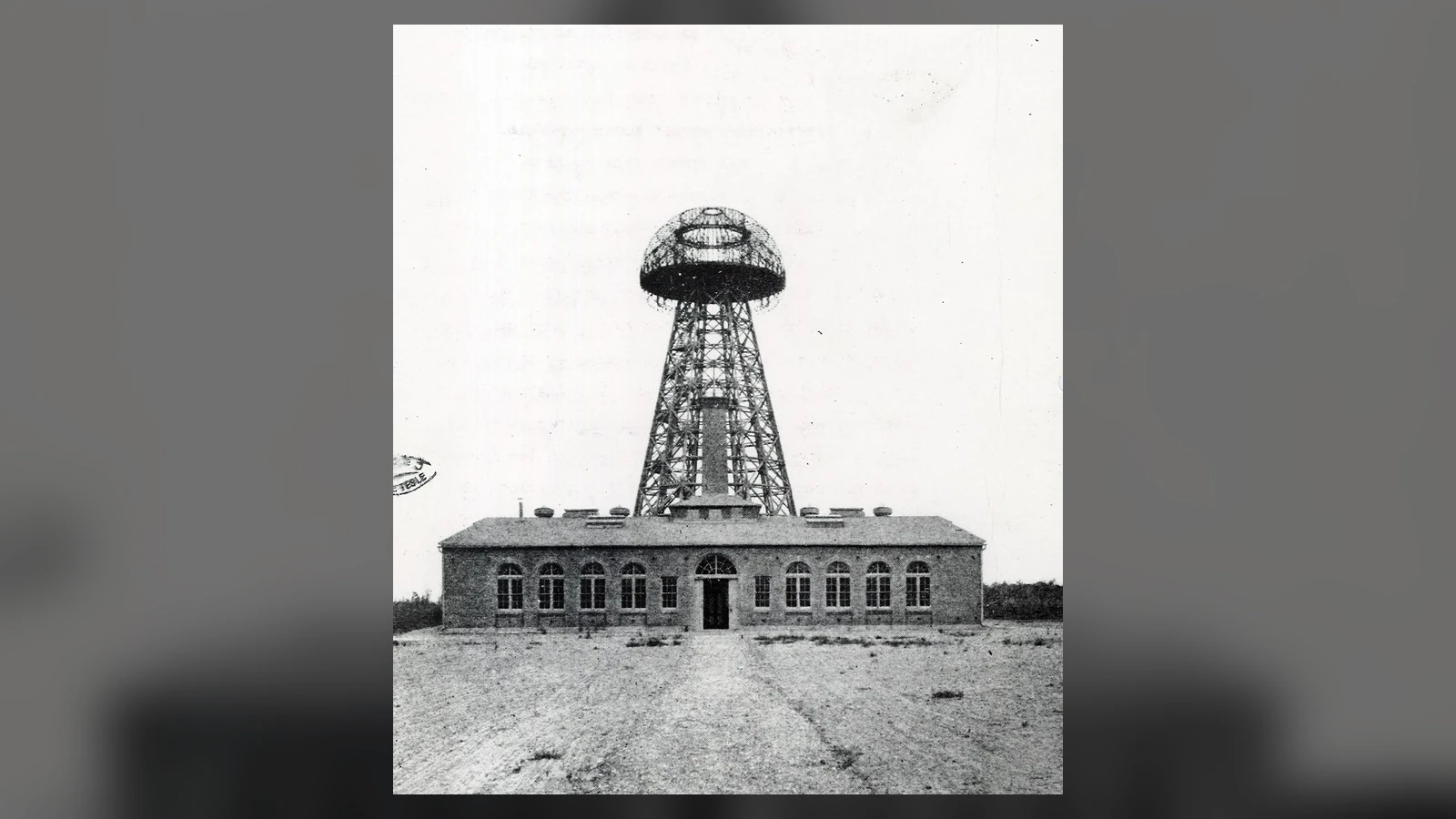
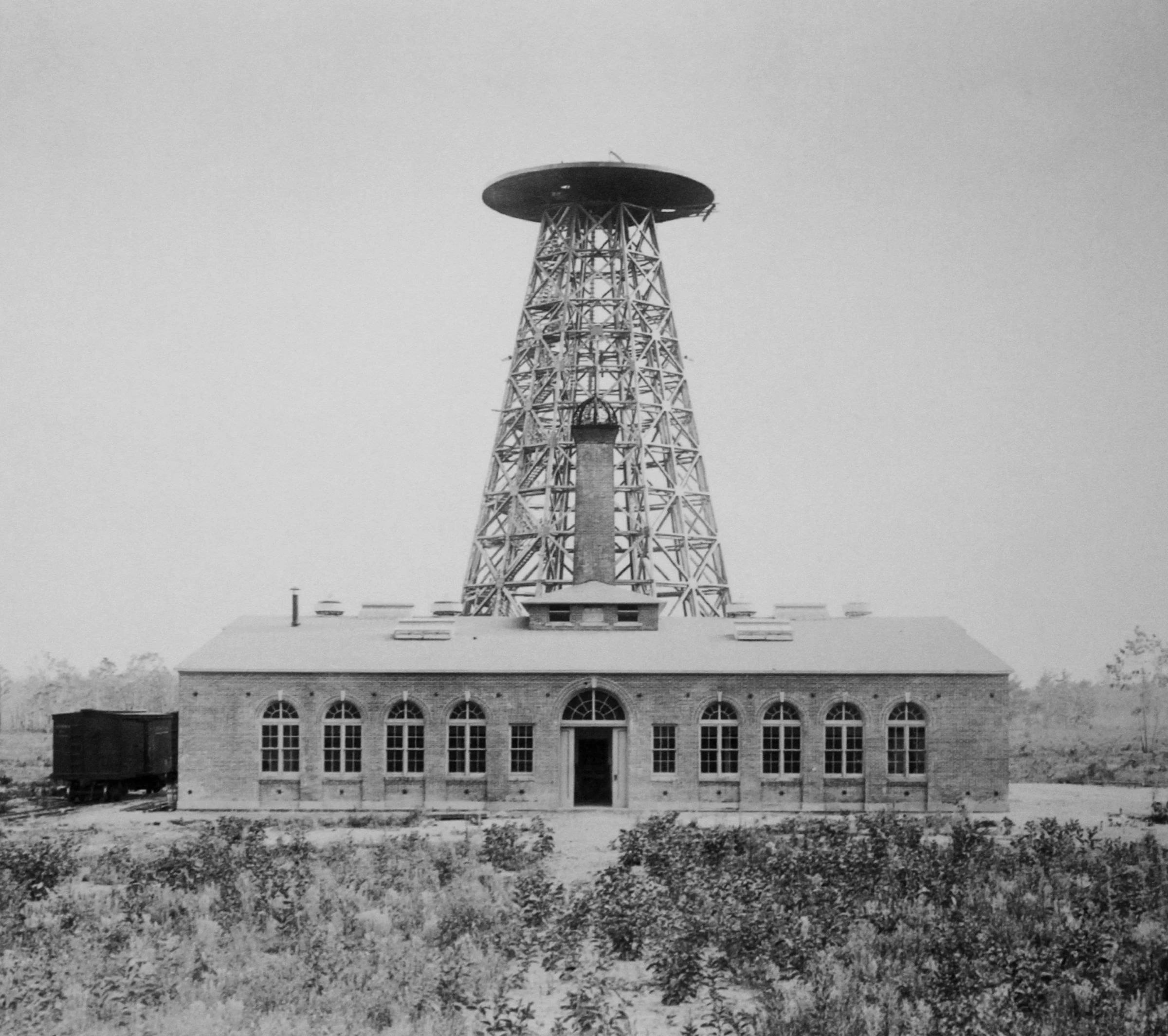
Wardenclyffe Tower stood at Shoreham, on the north shore of Long Island, New York, from 1901 to 1917. Nikola Tesla built it to send messages, and by his own later account power itself, across the Atlantic and around the world without wires. It was 187 feet high by Tesla's figure, an open lattice of beams tapering upward to a great round cap, with a brick laboratory at its foot.
Under the tower a shaft went straight down into the sand, 120 feet deep and 12 feet square, lined with timber, by the count of a local paper in 1902. From the bottom, tunnels ran out sideways. Above ground, the lattice dome was framed and never finished. Tesla gave it as about 68 feet across; other accounts say 55. Either way it was an open cage of a sphere, hung high over the flat ground.
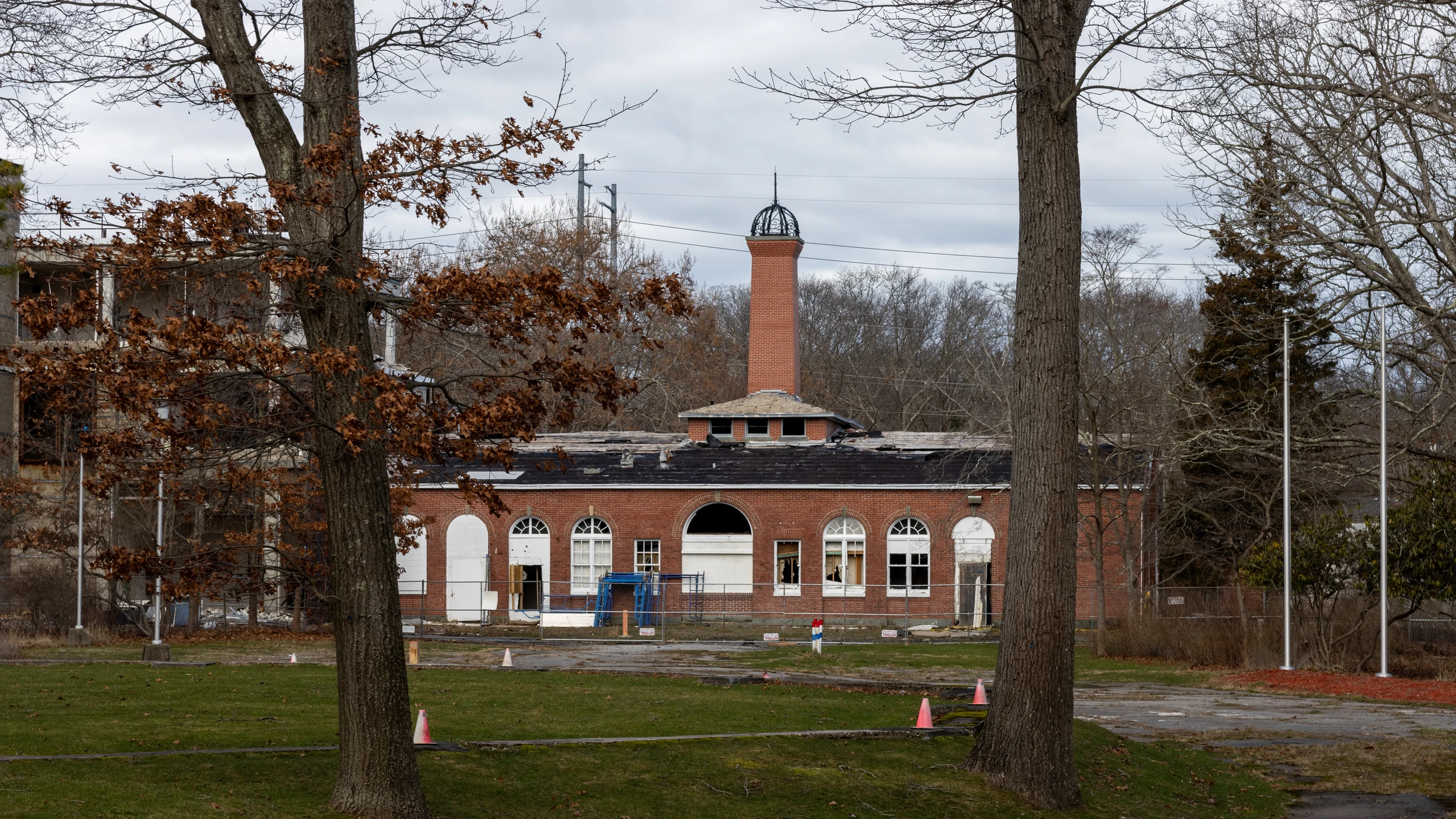
The laboratory is still there. The tower is not.
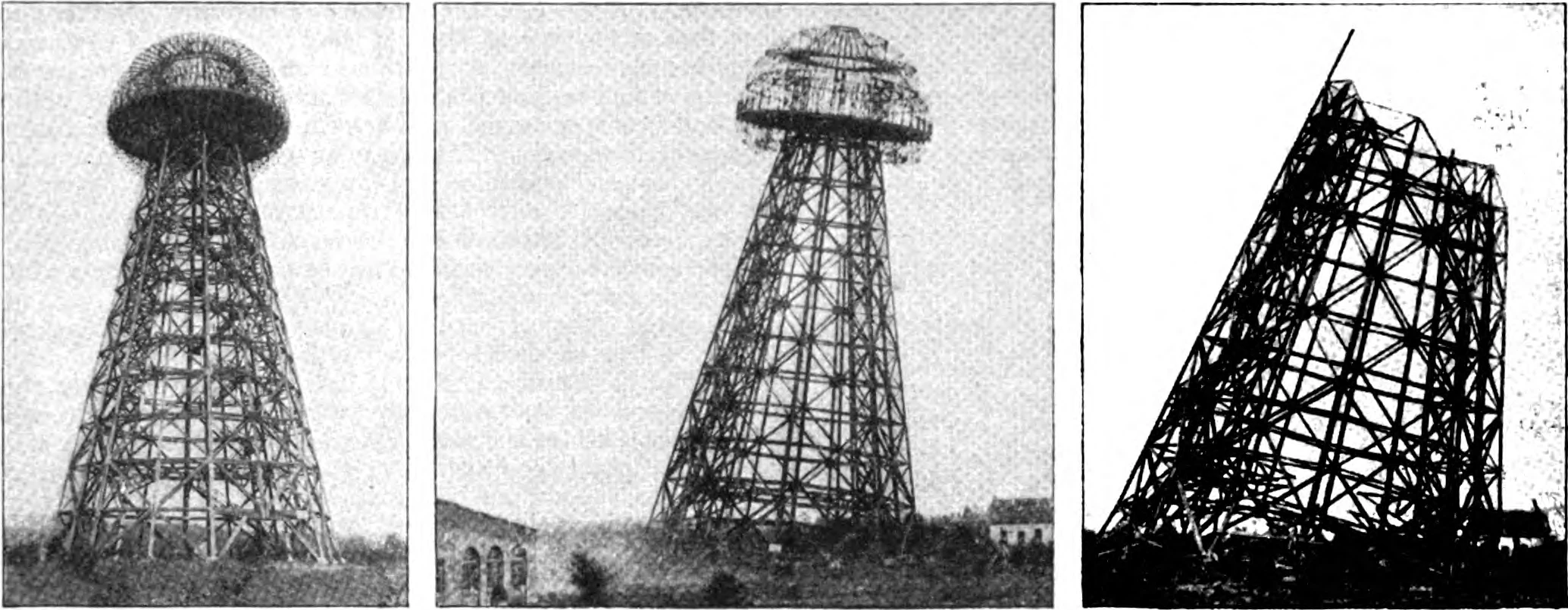
It was brought down with dynamite in the summer of 1917, and its metal sold for scrap. What it was meant to do has been argued over ever since.
A tower on the sand
The money came from J. Pierpont Morgan. In 1901, by the standard accounts, he agreed to put 150,000 dollars into Tesla's wireless system. Tesla took about 200 acres at Shoreham and hired the New York architects McKim, Mead and White, with Stanford White's name on the work. The local Port Jefferson Echo reported the contract signed in August 1901, and through the following winter it kept count: the shaft, a brick building about a hundred feet square, the tower.
Across the ocean, someone else was already listening. On 12 December 1901, at Signal Hill in Newfoundland, Guglielmo Marconi and his assistant George Kemp heard three faint clicks on a wire held up by a kite: the Morse letter S, sent from Poldhu in Cornwall. Marconi announced the first wireless signal across the Atlantic, with Kemp the only other witness, on a cheaper system than Tesla's.
The Echo saw what it meant. In February 1902 it called the Shoreham plant "the beginning of the real war between Marconi and Nikola Tesla".
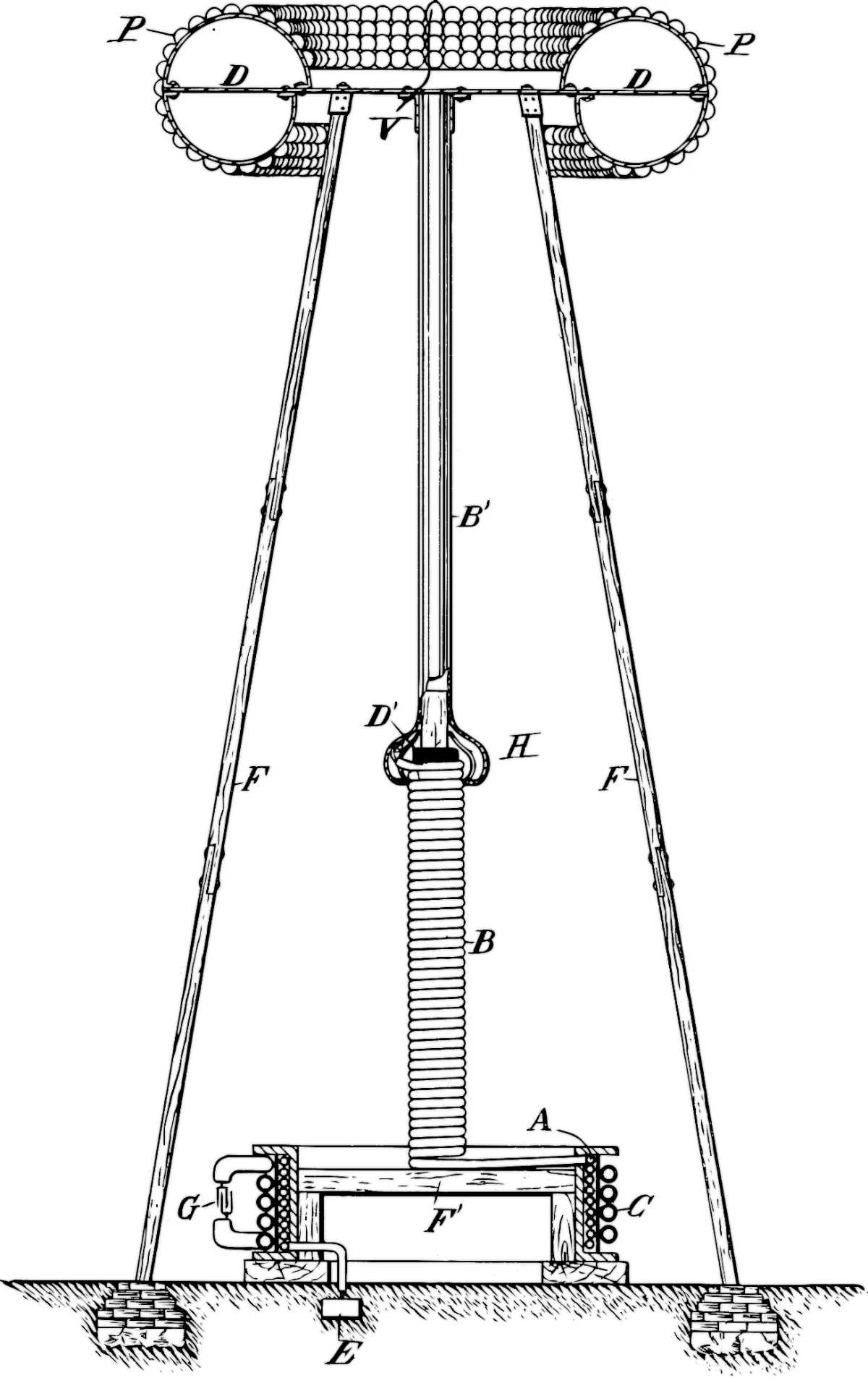
Tesla's patent for the apparatus, "Apparatus for Transmitting Electrical Energy", was filed on 18 January 1902. Its drawing shows a tall tapering frame with a broad terminal at the top and a deep connection to the ground at its base. The patent would not be granted until 1 December 1914.
The machinery was modest to begin with. "Originally only from 200 to 300 K.W. were provided," Tesla wrote, "but I intended to employ later several thousand horsepower."
A world system
Tesla set out the plan in print on 5 March 1904, in Electrical World and Engineer, under the title "The Transmission of Electric Energy Without Wires". It began with what he had seen at Colorado Springs in 1899, where he had recorded what he took to be electrical waves in the earth itself: "No doubt, whatever remained: I was observing stationary waves." The planet, he wrote, "despite its vast extent, behaved like a conductor of limited dimensions."
On Tesla's reading, if the earth rang like that, it could be played like an instrument. The first central plant, Tesla wrote, would distribute "ten thousand horse-power under a tension of one hundred million volts", and the system could "transmit power, in unlimited amounts, to any terrestrial distance and almost without loss."
In 1919, looking back in the Electrical Experimenter, he listed the uses he had promised: linking every telegraph office in the world, running the world's stock tickers, setting cheap clocks everywhere to the same time, a universal service for ships at sea. The same statement promised that power "in any desired amount can be conveyed, clear across the Globe if necessary, with a loss not exceeding a few per cent." He had also planned, he wrote, demonstrations "in the wireless transmission of power on a small scale but sufficient to carry conviction."
In August 1902 a local paper had already quoted him: "We have been sending wireless messages for long distances from this station for some time." In the summer of 1903 the tower lit up. Newspapers reported flashes from Wardenclyffe in the night sky; the New York Sun headlined that Tesla's flashes were startling, but that he would not say what he was trying for.
The quotation names no one who received them.
If the earth could carry it
Set aside whether the tower would have worked. Ask what follows if Tesla was right.
It would mean the planet is a single circuit, and that a well-placed station could reach any point on it. Power would stop being something carried along wires from a plant to a town. It would be something drawn from the ground, anywhere, from a desert to a ship at sea.
It would mean the network arrived a century early. Every telegraph office joined, every ship at sea in reach, every clock in the world set by one signal: the list Tesla published reads like a description of a much later world.
It would mean the last century could have taken a different shape. No wires on poles along every road. No grid. The map of who has electricity and who does not, which still follows the reach of the lines, would have followed the reach of a few towers instead.
It would mean, on the reading of Tesla's admirers, that our species had the key to the next step in its hand in 1903, and set it down unfinished on Long Island.
And it leaves a question still in front of us. On that reading the idea is not lost, only unbuilt. The physics of the earth has not changed since 1903. Whether a modern engineer, with modern instruments, could make the ground carry power the way Tesla described is a question that can still be asked of the planet itself.
What the engineers say
The standard account starts with the record. No transmission of power or messages from Wardenclyffe has been documented. Thomas H. White, a historian of early radio, puts it plainly: "the Wardencliff installation never became operational for any use whatsoever."
The physics is the larger objection. Long-distance wireless, as it developed, ran on radio waves sent through the air and bent around the planet by the upper atmosphere, not on currents driven through the ground. White again: "Electrical currents actually cannot be transmitted effectively through the ground for long distances." In a 2000 interview for the PBS documentary Tesla: Master of Lightning, the University of Maryland physicist Dennis Papadopoulos, who has worked on the upper atmosphere, put the difficulty in one line: "The problem with both modes in terms of really sending a lot of energy, is they attenuate a lot." The energy spreads and fades with distance. Papadopoulos's harsher verdict was that Tesla "was dreaming but he was doing very few calculations on paper."
The money ran out. Marconi's cheaper system was already crossing the Atlantic. Tesla mortgaged the property heavily, and in 1915 he lost it. The tower was dynamited from 4 July 1917 by the Smiley Steel Company of New York, and the scrap was valued at 1,750 dollars.
What the record does not settle
The same physicist who doubted the power also backed the idea. "Tesla's idea of propagation is perfectly valid," Papadopoulos said in the same interview. The doubt is about how much energy arrives, not whether the earth and its atmosphere can carry a signal.
The engineers Kenneth and James Corum, in papers to Tesla symposia in the 1980s and 1990s, reread Tesla's measurements in terms of the cavity between the earth and the upper atmosphere, one paper subtitled "A Discussion of One of the Many Modes of Operation of the Wardenclyffe Tower". James Corum told the biographer Marc Seifer in 1997 that the tower could have produced only about 300 kilowatts and delivered about 10 kilowatts to the far side of the earth. Not a world's power. Not nothing.
What the record lacks is a test at the scale Tesla described. The dome was never finished. Seifer, drawing on Tesla's own testimony of 1916, wrote that the tower was "used in some fashion until 1907", and that its larger functions stopped in 1903, when Westinghouse came to remove equipment; what it was used for, the record does not say. No contemporary record of a signal received from Wardenclyffe by anyone but Tesla appears in the sources this article draws on. Nobody has produced one.
The story of the tower's end that spread fastest is not in the record either. In September 1917 the Electrical Experimenter reported that "the Federal Government ordered the tower destroyed", suspecting "that German spies were using the big wireless tower". Tesla denied it in the same magazine two years later: he would "contradict the widely circulated report that the structure was demolished by the Government". If it were true, he added, he would have been refunded what he spent. No government order has been produced.
What is left on the sand
The laboratory outlived everything around it. From 1939 the site was a photographic plant, Peerless Photo Products, later owned by Agfa; the state cleanup of silver and cadmium it left behind was completed in 2008. In 2012 the cartoonist Matthew Inman, of The Oatmeal, raised over a million dollars online to buy it, and on 2 May 2013 the Tesla Science Center at Wardenclyffe closed on about sixteen acres. Serbia gave a statue of Tesla that September. Elon Musk gave a million dollars in 2014. In 2018 the laboratory was listed on the National Register of Historic Places.
On 21 November 2023 a fire, which the center says evidence points to a demolition contractor's error, badly damaged the 1901 roof. The walls held. A visitor center was set to be dedicated on 11 July 2026; the laboratory itself is still being restored.
Tesla lived on in New York hotels until his death in January 1943, when his papers were taken from his room. He never blamed his backer. Morgan, he wrote, "carried out his generous promise to the letter and it would have been most unreasonable to expect from him anything more." His account of the failure, in 1919, was not about money. "My project was retarded by laws of nature," he wrote. "The world was not prepared for it. It was too far ahead of time."
Under the lawn, by a 2013 report, are the base of the tower and sealed tunnels that have yet to be fully explored.
The tower's story ends in the air. Its foundation is still in the ground.
Questions This Leaves You With
Is there anything a person actually does with this?
Not in the sense of a plan for your own life, and it is worth saying so. Wireless charging pads and radio-frequency tags use some of the same ideas over centimetres, but nothing in Wardenclyffe's story changes what you pay for power or where it comes from. Anyone selling a date or a device on the strength of it is selling something. The larger question is shared: how much invention dies for want of a backer, and who decides which unproven ideas are worth a test.
Does this sit against a religious account of the world?
It can be read both ways. Some see in Tesla's earth that rings like a bell a sign of a world made orderly and generous, built with more in it than we have used. Others see a purely physical planet whose properties are there to be measured and nothing more. The tower makes no claim about either. This site will not tell you which reading is right. That is yours.
Does it change what a human life is?
Think of Tesla in 1919, writing that his project was too far ahead of its time, with the tower already scrap. One reaction is that it makes a life smaller: the most famous inventor of his age, and his largest work ended as 1,750 dollars of metal. The other is that it makes a life larger: a single idea that a century later still has engineers arguing over its equations and strangers raising a million dollars to save the building where he had it. Which did you feel first?
What would change your mind, in either direction?
Name it now. Toward Tesla: a modern experiment that sends measurable power through the earth over a long distance, with losses near what he claimed, or a contemporary record of a message received from Wardenclyffe by someone other than Tesla. Toward the standard account: the Morgan correspondence and any surviving station records showing how little the tower ever ran, or a careful model of the earth-atmosphere cavity showing the losses are as large as the critics say at every frequency Tesla could use.
Where does the open problem actually sit?
It sits in what ran at Wardenclyffe between 1903 and 1907, and what it would take to show Tesla right. The tower shows a real, well-funded attempt that was never finished. The historians' account is a dome left open, money withdrawn and a rival system that worked well enough. What is uncertain is how far the station ever ran; the record holds flashes, Tesla's own claims and Seifer's "in some fashion". What would support the extraordinary reading is a measured transfer of useful power through the earth over thousands of miles, with losses near the few per cent Tesla promised. No such measurement has been published.
Sources
- Nikola Tesla, My Inventions, Part V: The Magnifying Transmitter (1919) Electrical Experimenter, via Wikisource Primary record
- Nikola Tesla, The Transmission of Electric Energy Without Wires (5 March 1904) Electrical World and Engineer, reprinted by PBS Primary record
- Natalie Aurucci Stiefel, Looking Back at Rocky Point (Wardenclyffe excerpt) Tesla Memorial Society of New York Study
- Wardenclyffe added to U.S. National Historic Register (2018) Tesla Science Center at Wardenclyffe Study
- Metal for Tesla (2021) Tesla Science Center at Wardenclyffe Study
- Milestones: Reception of Transatlantic Radio Signals, 1901 IEEE / Engineering and Technology History Wiki Study
- N. Tesla, Apparatus for Transmitting Electrical Energy, US 1,119,732 (1914) US Patent Office, via Google Patents Primary record
- Interview with Dennis Papadopoulos (2000) PBS, Tesla: Master of Lightning Study
- Tesla's Dream (2000) PBS, Tesla: Master of Lightning Study
- Thomas H. White, Nikola Tesla: The Guy Who DIDN'T 'Invent Radio' (2012) Early Radio History Study
- Marc J. Seifer, Ask Dr. Seifer About Nikola Tesla (1997) Extraordinary Science, via Tesla Universe Study
- K. L. and J. F. Corum, Tesla symposium papers (1996) TCBA newsletter, via Tesla Universe Primary record
- U. S. Blows Up Tesla Radio Tower (September 1917) The Electrical Experimenter, via Internet Archive Primary record
- Wardenclyffe Laboratory (2018) National Park Service Study
- Hazardous Waste Cleanup: Agfa Corporation (Peerless Photo Products) US Environmental Protection Agency Primary record
- Spencer Rumsey, Long Island Press (3 May 2013) Long Island Press, republished by the Tesla Science Center Study
- Spencer Rumsey, Tesla Science Center Takes Shape in Shoreham (24 September 2013) Long Island Press Study
- Tekla S. Perry, Elon Musk's $1 Million Birthday Gift to Nikola Tesla Fans (2014) IEEE Spectrum Study
- Wardenclyffe Laboratory, NRIS 100002744 (2018) National Park Service, NPGallery Primary record
- Fire at Wardenclyffe (2023) Tesla Science Center at Wardenclyffe Study
- Brendan Carpenter, Tesla Science Center to dedicate new visitor center (8 July 2026) Riverhead News-Review Study
- Mike Peel, At Wardenclyffe 2024 08 (photograph, 2024) Wikimedia Commons Primary record