
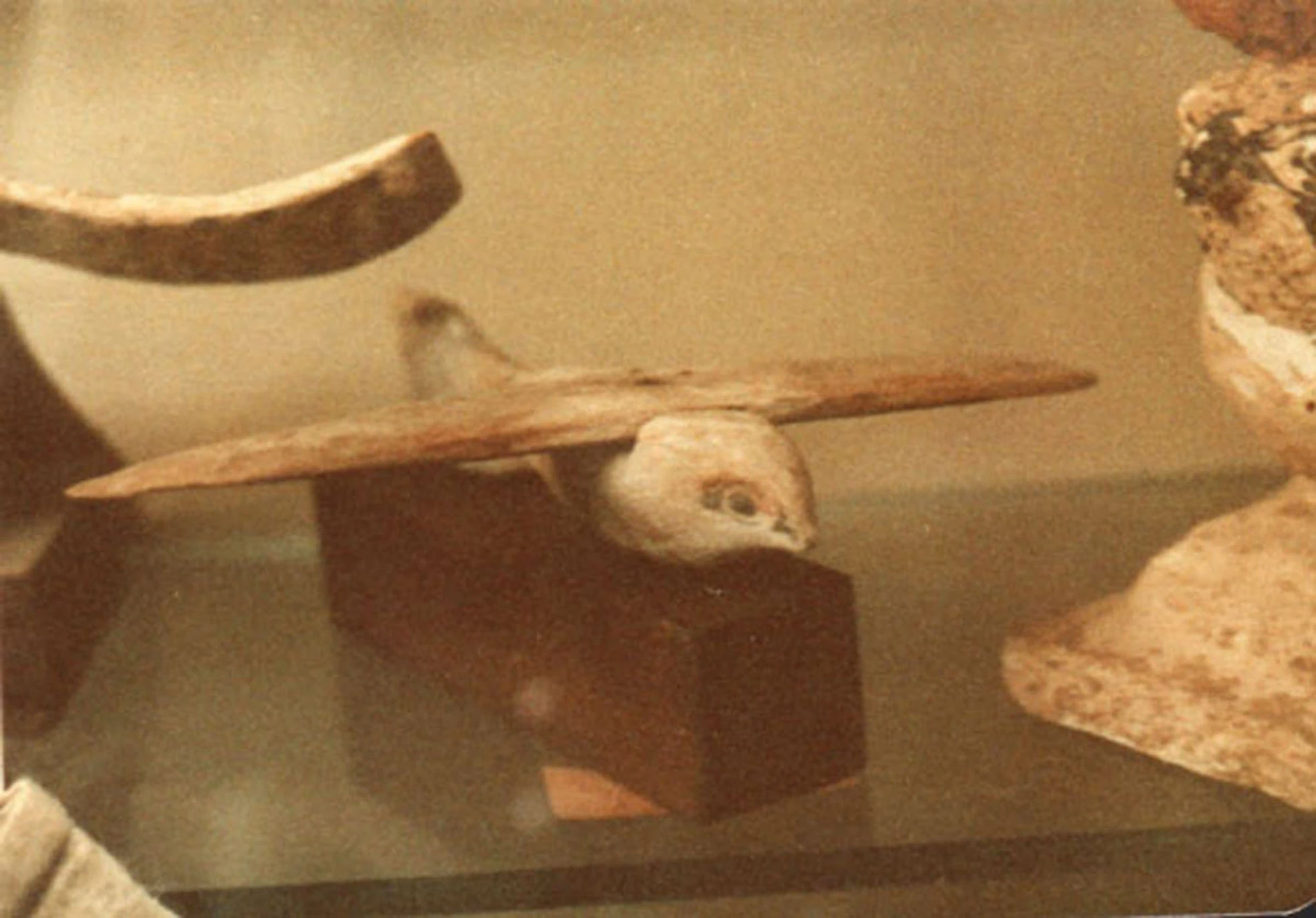
The Saqqara bird is a small wooden carving of a bird with outstretched wings, found in 1898 in a tomb at Saqqara, the great burial ground of ancient Memphis in Egypt, and kept in the Egyptian Museum in Cairo. It is usually dated to about 200 BC. In 1969 an Egyptian doctor named Khalil Messiha looked at it and saw something else: a model of a glider.
It is small enough to hold in one hand. About fourteen centimetres from beak to tail, eighteen across the wings, carved from wood and weighing about 39 grams on Messiha's measurement.
The head is a bird's. A beak, and one painted eye, still dark on the pale wood. But the wings run out straight and stiff from the body, with no feathers carved or painted on them. There are no legs. No inscription names it, and nothing written in its tomb, if anything was, has been published to explain it. And at the back the tail stands upright, not flat.
Like the tail of an aeroplane.
A bird among birds
On the most repeated account, Messiha found it in 1969 among bird models in the museum. He was a physician who, according to Larry Orcutt's summary of his chapter, taught anatomy for artists at Helwan University, a member of aeronautical and model clubs, and, in Lienhard's description, an amateur student of bird models. The engineer and broadcaster John Lienhard of the University of Houston, who later told the story on his radio series The Engines of Our Ingenuity, put it plainly: Messiha "noticed it".
What he noticed was the tail. Every other bird model he knew, Messiha argued, had a horizontal tail, the way a bird holds its tail in flight. This one had a vertical fin. The body was shaped in cross-section like a wing, with no legs and no feather decoration. The wings had a slight downward droop.
Messiha's brother Guirguis, a flight engineer, made a copy in balsa wood. Thrown by hand, Lienhard reported, it glided a short way. Messiha himself later wrote that he had made a similar balsa model "and added the tailplane", the horizontal surface at the back that keeps an aircraft level.
On his measurements, the bird is about 14.2 centimetres long with a span of 18.3, carved from sycamore wood, weighing about 39 grams. His team noted the flat lower edge of the tail, which he read as the place where a tailplane had once fitted.
The claim reached Egypt's Ministry of Culture, which, according to a 1998 newspaper account, set up a committee to look at it. An article, "Flying in Ancient Egypt", is cited as appearing in Egypt Travel Magazine in 1972. In 1983 Messiha set out his full case, with his brother, the scholar Gamal Mokhtar and the journalist Michael Frenchman, in a chapter called "African Experimental Aeronautics: A 2,000-Year-Old Model Glider".
A model of a machine
Messiha's reading was that the bird was not a toy and not a bird at all, but a scale model of a full-size flying machine: a glider, built or at least imagined by Egyptians in the Ptolemaic age, two thousand years before the Wright brothers.
Messiha concluded that it was a scaled-down model of a full-size monoplane. His case rests on the points that make the object strange among bird figures. The vertical fin. The missing legs. The plain, straight wings. The body shaped for air. Mokhtar was quoted making the comparison directly: birds' tails are horizontal; aeroplanes' are vertical.
Lienhard put it on air: "Too much about the model was beyond coincidence," he said on air.
The story grew. In 2010 TIME reported a television segment in which an aerodynamics specialist, Simon Sanderson, tested a larger replica in a wind tunnel, held by cables and without a tailplane, and measured lift of four times its own weight; the programme said a computer simulation with a tailplane added showed it could have flown. Later retellings added a groove under the fin where a tailplane had once been fixed, though Messiha himself, in the account Larry Orcutt has traced, had noted no holes or grooves at all.
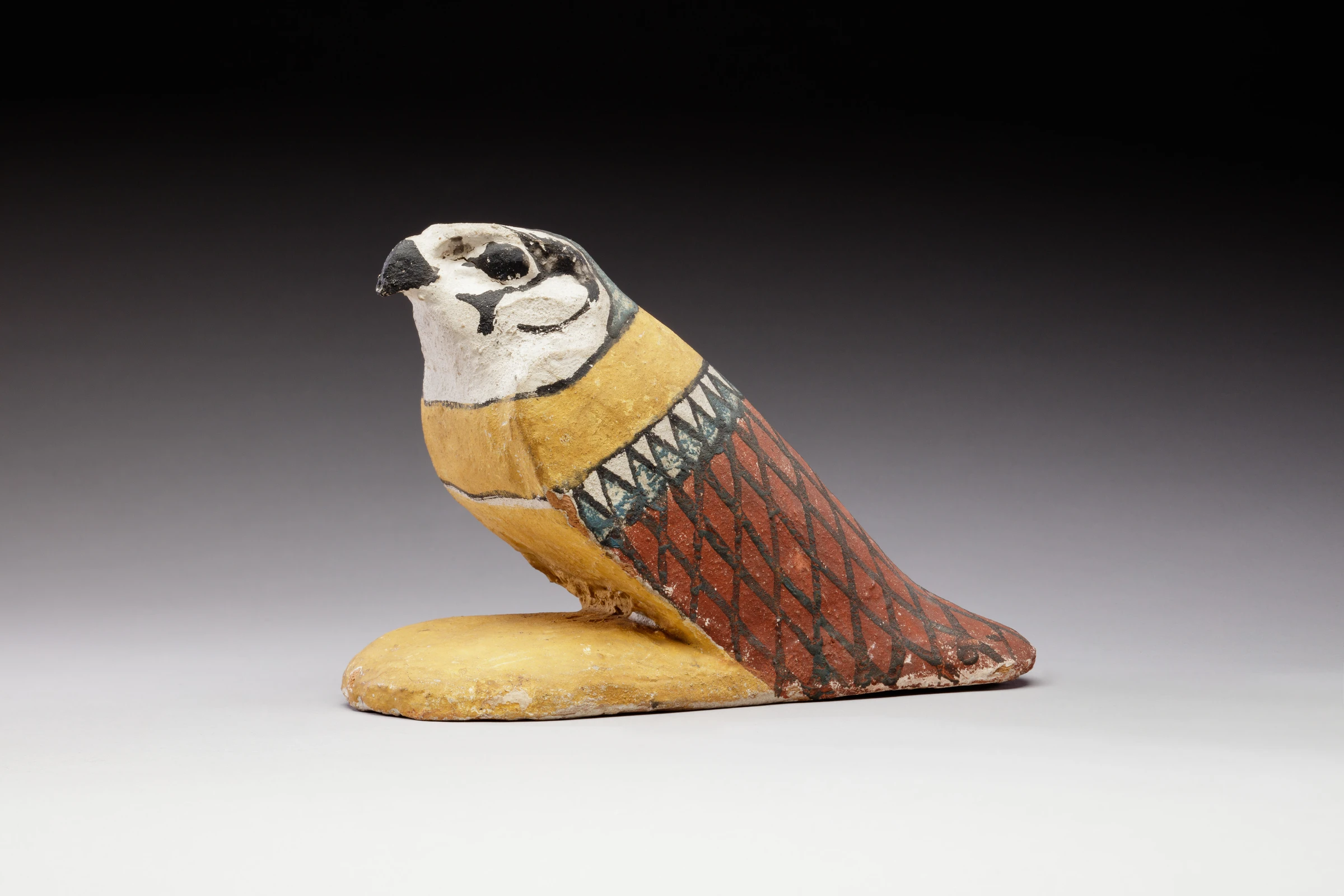
And here is the strange part, on Messiha's reading. Next to the painted wooden falcons that sit with folded wings and painted feathers, like the one in New York shown below, this bird is plain, flat-winged and legless, with an upright tail.
If it was a model
Set aside for a moment whether it could fly. Ask what follows if it was meant to.
It would mean that someone in Ptolemaic Egypt had looked at a bird and thought about flight as a problem of shape: a wing, a body, a fin to keep it straight. That is the kind of thinking that gave the world the aeroplane, done two thousand years early.
It would mean that the history of aviation, which in every textbook starts with kites, balloons and the brothers from Dayton, has an earlier chapter written in wood and never read.
It would mean the idea of a flying machine is far older than its first working form. A scale model implies a full-size design, or at least the dream of one, and somewhere a person who wanted to see it in the air.
It would mean our species carried the idea of flight across twenty centuries without anyone writing it down, and that a small carving in a museum case kept it all that time, waiting for someone who knew what an aeroplane looked like to walk past.
And it leaves a question still in front of us. If ancient people thought about flight in models, then how many other ideas reached the model stage and went no further, in workshops nobody recorded, in materials nobody kept?
What the tests say
The standard account comes from the people who built and flew copies. In 2002 the glider designer Martin Gregorie made balsa models of the bird for Orcutt's Catchpenny Mysteries website, with no tail, with a tail to scale, and with a large tailplane a quarter the area of the wing. Without a real tailplane, his models would not fly; they pitched up or tumbled. With the large tail added, the best glide was about one metre forward for every 2.3 dropped. "The performance of this model proves conclusively that the Saqqara Bird never flew," he wrote, and suggested a child's toy or a weather vane.
In 2011 he built new replicas for a television series and found the same: a glide ratio of about 2.2 to 2.8 to one with a tailplane, a tumble without. Any aircraft of that layout, he concluded, "needs a tailplane if it is to fly stably".
In 2023 Michel Zierow and Leon Lesemann of the City University of Applied Sciences in Bremen ran a computer simulation of airflow over a three-dimensional scan of the real object, made with the Egyptian Museum's staff. Their result: a best ratio of lift to drag of 2.86, a centre of gravity behind the point of stability, and uneven lift that would roll it into a turn and a stall. Knowledge of aerodynamics in ancient Egypt, they concluded, could not be confirmed, and they noted that the upright fin "could also be an indication of its suitability as a weathervane." Egyptologists and other writers have offered other uses too: a toy, a falcon of the god Horus, or a bird figure of the kind that topped the masts of sacred boats in temple reliefs.
The bird has an eye and a beak painted on. No tailplane survives, and nobody has found a trace of one.
What the tests do not reach
The tests reach the flying. They do not reach the fin.
Every test agrees that the carving, as it is, does not fly. None of them explains why a carver gave a bird a tail that stands up instead of lying flat, when, on Messiha's account, other bird models have tails that lie flat. A vane or a pole-mounted figure would explain it. So would a carver's choice nobody recorded.
The find itself is thin on paper. Most accounts give 1898 and a date around 200 BC, though at least one gives a different year, and no excavation report or museum register entry has been published that names the tomb or its other contents. The tomb owner's name that circulates online goes back to a popular magazine, not to an archaeologist. Which tomb, with what else beside it, is not known. They did not find the record.
And the wood itself has never been published in detail. Messiha gave sycamore and 39 grams; other accounts give 14 grams, or 31. No wood analysis, no radiocarbon date and no close study of the broken edge under the tail has been published that this article could find.
Which means the most important questions about the object are questions only the object can answer.
A fin on a falcon
The Saqqara bird is still in Cairo, on its stand, a little longer than a hand. Orcutt placed it in Room 22 of the Egyptian Museum in 2001, and the Bremen team's scan, made with the museum's staff, still shows the pedestal it is displayed on. Whether it has since moved, with so much of the collection, to the new Grand Egyptian Museum at Giza, this article could not confirm. Its claim has been tested more thoroughly than most: two rounds of hand-built replicas, a wind tunnel on television, and a computer model of its exact shape. On the record, it does not fly as it is, and no tailplane survives.
It sits in a wider company of objects that have been read as out of their time, from the Baghdad jars to the bronze gearing of the Antikythera mechanism.
A close look at the underside of the tail would add one fact. A clean break would allow that something is missing, without showing it was a tailplane. A finished edge would make a lost tailplane unlikely, without showing what the bird was for.
Neither result has been published yet.
Questions This Leaves You With
Is there anything a person actually does with this?
Not in daily life, and that is worth saying plainly. The bird changes nothing about how you travel, and anyone selling a date or a secret on the strength of it is selling something. The larger question is shared: how museums decide which objects to study closely, and how many small, strange things in their stores have never had a careful look. The bird was in Cairo for seventy years before anyone asked about its tail, and the question came from a man who happened to know both anatomy and model aircraft.
Does this sit against a religious account of the world?
Not directly, and it can be read both ways. In Egypt the falcon was the bird of Horus, and many bird figures were sacred objects; one reader sees in this carving a devotional piece, made with care for a god. Another sees a child's toy or a practical vane. The bird makes no claim either way. This site will not tell you which reading to hold. That one is yours.
Does it change what a human life is?
Think of the carver, shaping a small bird from a scrap of sycamore, perhaps for a child, perhaps for a temple, perhaps for a pole on a roof. One reaction is that it makes a life small: a whole person reduced to one carving and an argument about its tail. The other is that it makes a life large: a few minutes of someone's work, still being measured and argued over two thousand years later. Which did you feel first?
What would change your mind, in either direction?
Name it now. Toward the glider: a second carving of the same shape from the same period, a fixing slot for a tailplane found on close inspection, or a text describing models made to fly. Toward the ordinary reading: a published excavation record placing it among toys or ritual birds, or a pole socket in its underside that is shown to be ancient. Notice that the tests so far all measure whether it flies; none of them measures what it was for.
Where does the open problem actually sit?
It sits under the tail. The one detail that bears most directly on a missing tailplane is the shape of that broken or finished edge, and the record holds only Messiha's description and a few soft photographs. A careful study of the object, with close photographs published, would add facts replicas cannot, though it would not on its own say what the bird was for. Until then the bird's purpose is open, even if its flying is not. It is a small question about a small object, and it has outlasted every larger argument made about it.
Sources
- Larry Orcutt, Model Airplane? (2001) Catchpenny Mysteries of Ancient Egypt Study
- John H. Lienhard, An Egyptian Model Airplane, Engines of Our Ingenuity no. 328 University of Houston Study
- Cryptids: The Saqqara Bird (2010) TIME Study
- Martin Gregorie, Flying the Saqqara Bird (c. 2002) Catchpenny Mysteries of Ancient Egypt Primary record
- Martin Gregorie, Saqqara Bird, 2011 gregorie.org Primary record
- Zierow and Lesemann, Aerodynamic Investigation on the Artefact 'Bird of Saqqara' (2023) Acta Mechanica et Automatica 17(3) Primary record
- Messiha, Messiha, Mokhtar and Frenchman, African Experimental Aeronautics: A 2,000-Year-Old Model Glider, in Van Sertima (ed.), Blacks in Science (1983) Transaction Books Primary record
- Falcon figurine from a coffin or box, O.C.954 The Metropolitan Museum of Art Primary record