
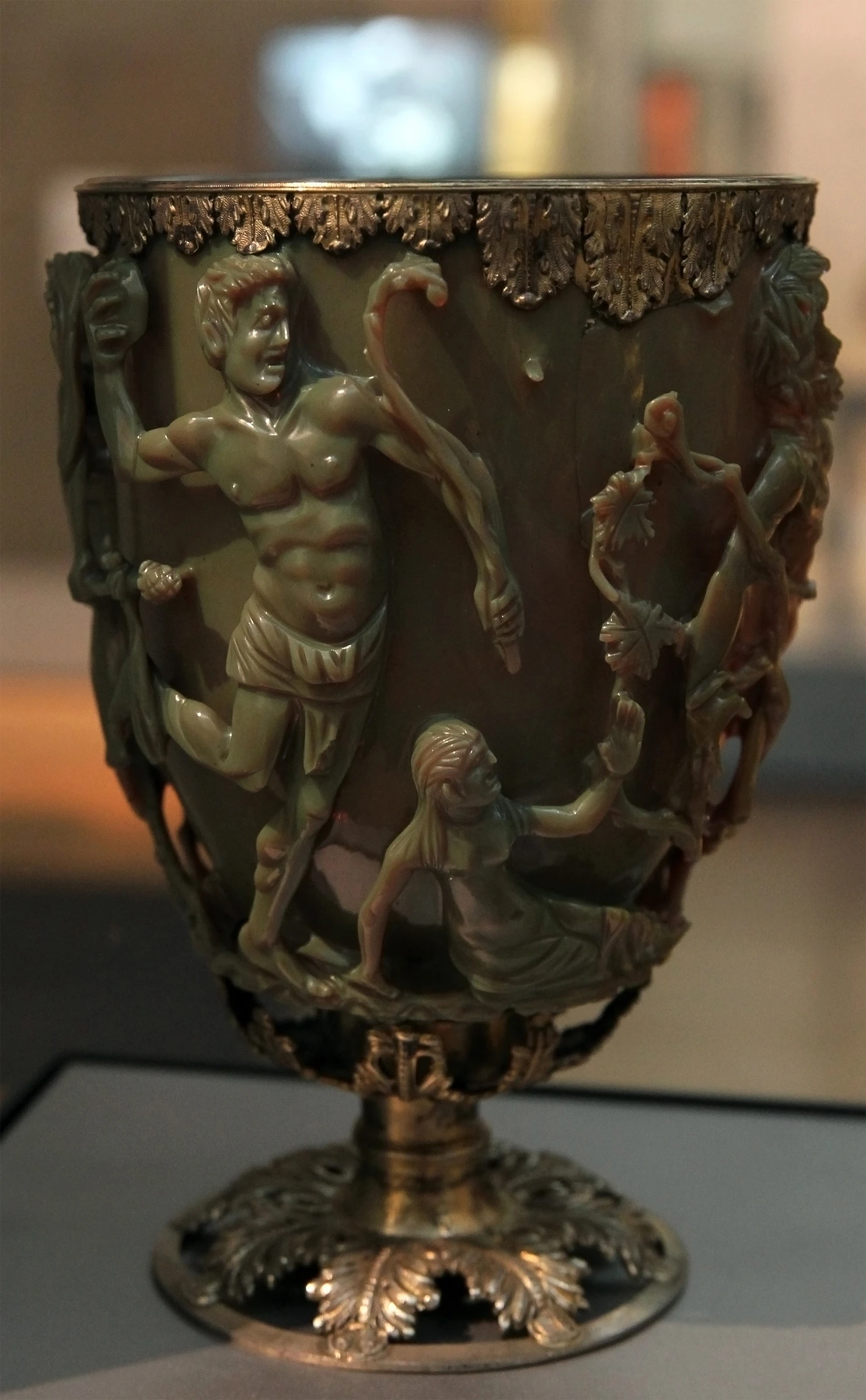
The Lycurgus Cup is a Roman glass cup of the fourth century AD, now in the British Museum, that changes colour. Lit from outside it is an opaque, jade green. Lit from inside it turns a deep, glowing red. The cup is about sixteen and a half centimetres tall with its later silver-gilt mounts, and its outer wall is a scene cut in high relief from the glass itself.
The scene is a death. King Lycurgus of Thrace attacked the god Dionysus, in a story already told in Book 6 of Homer's Iliad. In later versions one of the god's followers, Ambrosia, cried out to the Earth and was turned into a vine. On the cup the vine has him. His body twists inside its coils while Dionysus, a satyr and the god Pan torment him.
Nothing about it is painted, stained or coated. The colour is inside the glass, all the way through.
In daylight it is a green man in green leaves.
With a light inside it, the king is held in a cage of fire.
Forty parts in a million
For a long time nobody was sure what the cup was made of. The Rothschild family, which owned it from the middle of the nineteenth century, asked the scholars Donald Harden and Jocelyn Toynbee to study it in 1950, and an early question was whether it was glass at all, or some unusual stone. A British Museum mineralogist concluded glass, and X-ray diffraction confirmed it in 1959. In 1958 the museum had bought the cup from Lord Rothschild, with help from the National Art Collections Fund.
Then the chemists went in. A sample went to the research laboratories of the General Electric Company at Wembley in 1959, and another to Robert Brill at the Corning Museum of Glass in New York in 1962. They found ordinary Roman glass, soda, lime and silica, with a little manganese and antimony. And they found, in tiny traces, two precious metals: about 40 parts per million of gold and about 300 parts per million of silver.
Adding those traces would not have been enough on its own. The colour needed the glass to be heated in a particular way.
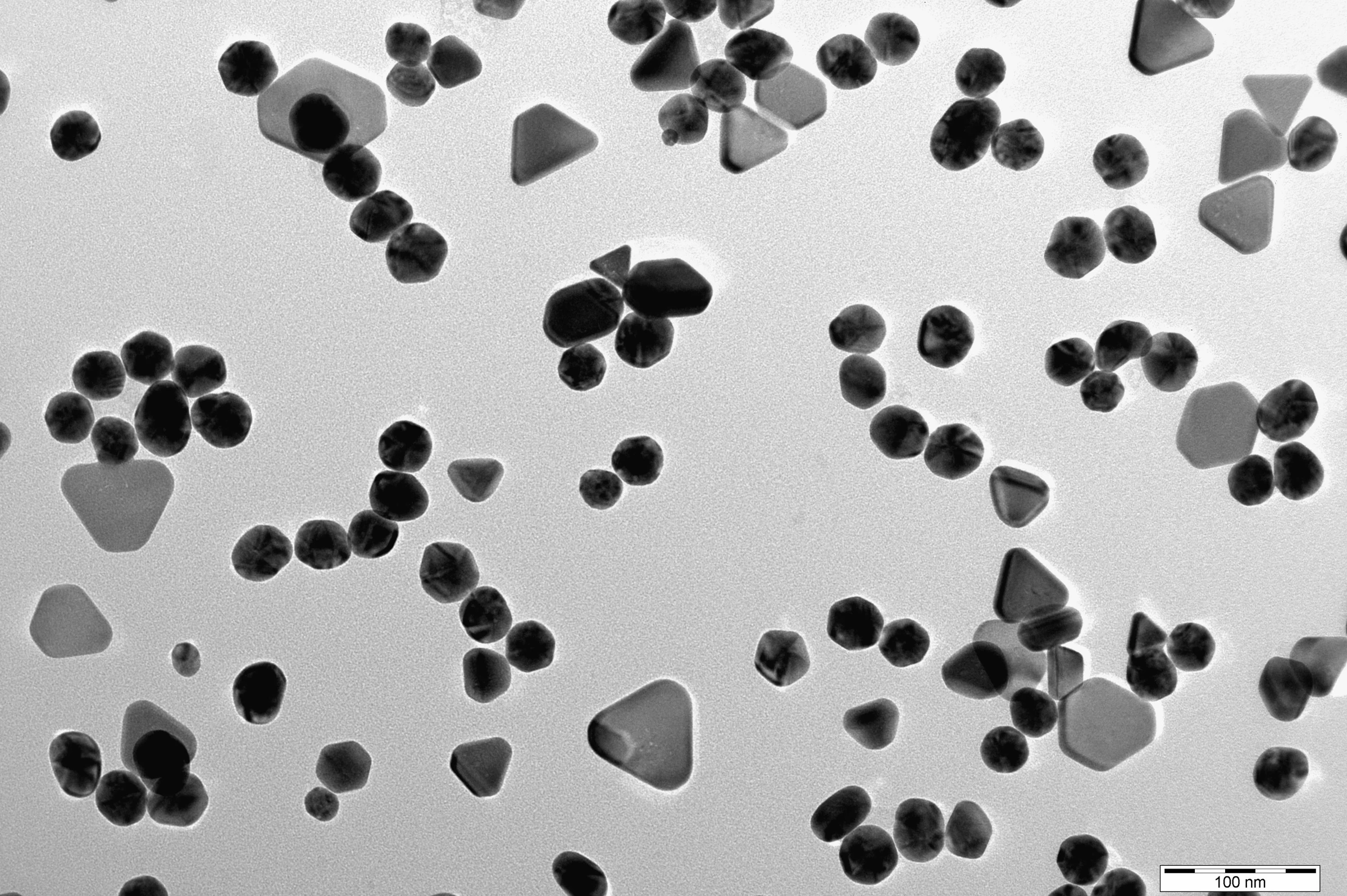
In the late 1980s David Barber and Ian Freestone put a fragment under a transmission electron microscope. Inside the glass were particles of metal, typically 50 to 100 billionths of a metre across, an alloy of roughly seven parts silver to three of gold, with about a tenth copper. Freestone and his colleagues at the British Museum later explained what they do. Dissolved silver and gold, reduced as the glass was heated, came out of solution as a fine scatter of particles. Particles that small scatter some colours of light back and let others through. The silver gives the green reflection. The gold gives most of the red.
Which means the cup's colour is made by particles too small to see with any optical microscope.
A Roman nanotechnology
In 2007 Freestone, Nigel Meeks, Margaret Sax and Catherine Higgitt published their account in the journal Gold Bulletin under a title that has followed the cup ever since: "The Lycurgus Cup - A Roman Nanotechnology."
The workshop seems to have known what the glass could do, even if not why. Freestone's team found that Lycurgus's own body was cut from a part of the glass with a slightly different colour, more violet when lit from behind, more yellow from the front. The wall behind the figures was hollowed out from inside so that light would pass evenly through them. The glass, the team wrote, "seems to have been saved for a very rare type of vessel", and the cup was probably "a special commission". The colour, they concluded, was "likely to be the reason for the creation of the Cup as it is seen."
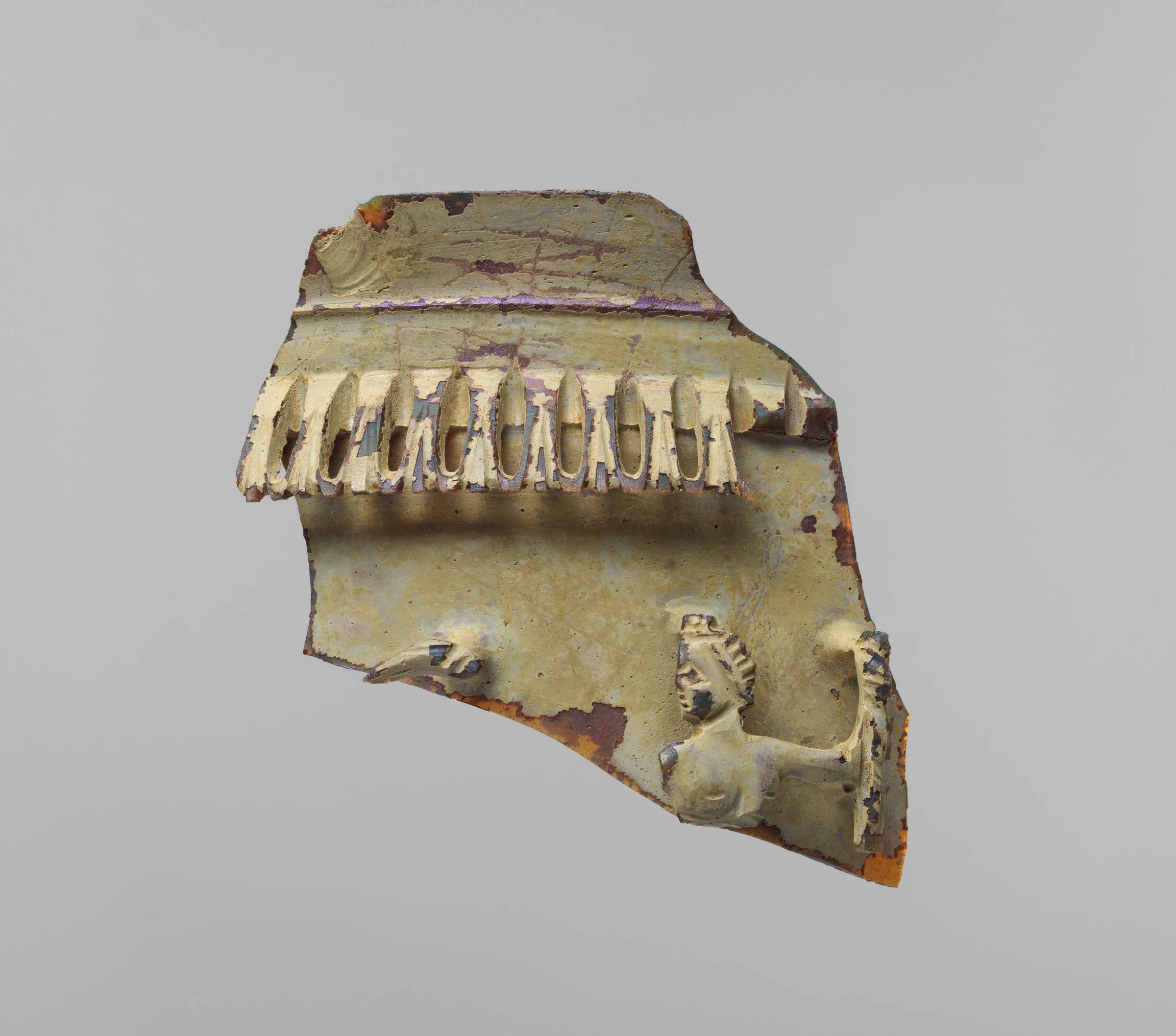
Cage cups like this one were cut and ground from a thick glass blank until the decoration stood free of the wall. Somewhere between 50 and 100 are known. Only a handful of Roman glasses change colour at all.
When the Smithsonian magazine told the story in 2013, Gang Logan Liu, an engineer at the University of Illinois whose team had just built a sensor inspired by the cup, gave his view there: "The Romans knew how to make and use nanoparticles for beautiful art."
There may even be a written echo. A letter in the Historia Augusta, a notoriously unreliable Roman collection of imperial lives, presented as Hadrian's to his brother-in-law, mentions cups "that change colour", a gift from a temple priest. The archaeologist David Whitehouse pointed it out in 1989.
If they knew
Set aside, for a moment, whether the glassmakers understood what they had. Ask what follows if they did.
It would mean that in the fourth century a workshop in the Roman world controlled matter at a scale our own science reached only in the twentieth: a few hundred parts per million of two metals, coaxed into particles of a particular size by a particular firing.
It would mean the cup is a demonstration piece. Not an accident kept because it was pretty, but a material made to order and then cut by a master into a story about light: a king seized by a living vine, glowing when the lamp is lit.
It would mean our species learned to tune light with metal particles, and that the skill went quiet: Freestone's team found that the technique does not appear to have outlasted the fourth century, and gold-ruby glass became routine in Europe only in the seventeenth.
It would mean the principle behind some of the most sensitive sensors in modern laboratories, light tuned by metal particles a few hundred atoms across, was found first by people with a furnace and an eye for colour, and used for nothing but wonder.
And it leaves something in front of us. If the knowledge was real and was lost, then the record of what ancient craftsmen could do is not a measure of what they knew. It is a measure of what survived.
What the specialists say
The standard account, and it is Freestone's own, is that the Romans had a technique, not a theory. His team's conclusion: the glassworkers "discovered that glass could be coloured red and unusual colour change effects generated by the addition of a precious metal bearing material when the glass was molten." But "the inability to control the colourant process meant that relatively few glasses of this type were produced and even fewer survive."
The colouring of glass with gold and silver, they wrote, was "far from routine and something of a hit and miss affair." It is "quite likely that the glassmakers were unaware that gold was the critical colourant, as most of these glasses are richer in silver." A diatretum fragment in the British Museum, 1953,1022.2, carries about 2,270 parts per million of silver and only 13 of gold, and its change of colour is far weaker. No fixed recipe there.
Where the precious metals came from is a guess: perhaps scrap from metalworking, bought to colour glass, which would also explain the copper and lead; perhaps an accident with gold-leaf decoration. The technology, on Freestone's account, "does not appear to have outlasted the fourth century."
In October 2026 Freestone put it more plainly to the Guardian, describing how sensitive the colour was to where the glass sat in the furnace. "It makes me think that, with the Lycurgus glass, they hit the jackpot."
What luck does not explain
Luck can make the glass. It does not make the cup.
The cup suggests a sequence: someone saw that a batch of glass did something unusual, kept it, and gave it to a skilled cutter. The cutter chose the differently coloured patch for the king's body and thinned the wall behind the figures. That is the work of people who understood well what the material would do when light passed through it, even if they did not know why. How the cup was lit in use is not known. The "special commission" is Freestone's phrase, not a romantic one.
The choice of story fits the light, too. Whitehouse suggested that the change from green to red might stand for the ripening of the grape, Dionysus's own fruit, and others have read the god's triumph over a king as an allusion to the emperor Constantine's victory over his rival Licinius in 324. Both are readings. But a cup about a vine, for the god of wine, that turns the colour of wine when it is lit, does not look like an accident of subject.
And repeating it is hard even now. In October 2026 the University of Sheffield announced that a technician, Lisa Hollands, had reproduced the glass "in quantity" from a recipe based on a fragment of the original, after many experiments with furnaces, starting materials and the oxygen in the melt. As IFLScience reported the Sheffield work, it takes far more than adding nanoparticles to glass. If a modern laboratory needed a long run of trials to find the conditions, the Roman furnace that found them by trial and error was doing something difficult.
What has not been found is the Roman recipe itself. No text describes it. No workshop has turned up with the material. Even the cup's find spot is unknown: it first appears in print in 1845. Its original base is lost too; when it was studied in the 1950s, a later foot was taken off and loose pieces of the original base were found.
The cup in the dark
The cup is still being studied. In 2023 a team including Freestone presented a new look at it with modern electron microscopes, micro-CT and ion-beam milling, the first hands-on analysis in about 35 years; the results have not yet appeared in full. In 2013 Liu's team at Illinois built arrays of about a billion tiny cups that change colour the way it does, to detect DNA and proteins without labels. In 2020 a team at Wageningen made a printable plastic that does the same trick with silver and gold.
The cup belongs with the other old materials that laboratories are still taking apart: the watered steel of Damascus blades, and the self-healing Roman concrete of the harbours and the Pantheon.
In November 2026 a sculpture in the Lycurgus glass by the artist Elliot Walker goes on show in Sheffield.
And in Room 41 of the British Museum the cup sits in a case with a light that changes. Green, and then red. Green, and then red.
Nobody knows who made the glass, or where, or how many times they tried before it came out right.
Questions This Leaves You With
Is there anything a person actually does with this?
Not much in daily life, and it is honest to say so. You cannot buy Lycurgus glass, and the nanoparticle sensors it inspired are laboratory tools, not household ones. Anyone selling an ancient secret in a bottle is selling something. The question that belongs to everyone is about memory: how a skill that lives only in a workshop is kept, and how many skills in our own century live the same way: in a few people's hands, written down nowhere, one retirement away from gone.
Does this sit against a religious account of the world?
It can be read both ways. The cup shows a god punishing a king, and it may have been used, as Freestone has suggested, in a drinking ceremony of some kind; one reader sees in its changing light something close to the sacred, another sees good glass in a good lamp. The cup makes no claim either way. This site will not tell you which reading to hold. That one is yours.
Does it change what a human life is?
Imagine the glass cutter, grinding a king and a vine out of a single thick blank, with every stroke a chance to crack it. One reaction is that it makes a life small: the name lost, the workshop lost, the method lost. The other is that it makes a life large: one person's patience still glowing in a museum case sixteen centuries later. Which did you feel first? Neither is wrong, and the cup does not choose between them.
What would change your mind, in either direction?
Name it now. Toward a deliberate, understood recipe: more Roman glasses with the same gold and silver levels and the same colour, or a text that describes adding a metal to make glass change colour. Toward the accident: future analyses, perhaps the 2023 work when it is published, finding particles that vary widely across the cup, as you might expect from a process nobody controlled. Notice that the two are not opposites; a workshop can know what to do without knowing why it works. Most of the craft in human history has worked exactly that way.
Where does the open problem actually sit?
It sits in the furnace. Everyone agrees on what the particles are and how they make the colour. What nobody knows is what the Roman glassmakers put into the melt, how hot and for how long, and how often it worked. Sheffield's recipe shows one way to make the glass now. It does not show that it was the Roman way. Careful measurements of the gold and silver in the few dichroic fragments, set side by side, could show whether one recipe was repeated or each melt differed. They could not show what the makers understood.
Sources
- Freestone, Meeks, Sax and Higgitt, The Lycurgus Cup - A Roman Nanotechnology (2007) Gold Bulletin 40(4) Primary record
- Dalya Alberge, The Guardian (October 2026), syndicated The Guardian via AOL Study
- Technician cracks 1,600-year-old mystery to replicate Roman masterpiece (2026) University of Sheffield Primary record
- Tom Hale, Romans Created Color-Changing Glass 1,600 Years Ago (2026) IFLScience Study
- The Ongoing NanoRomance with the Lycurgus Cup (2013), quoting Smithsonian magazine rogueclassicism General reference
- Rick Kubetz, The world's most sensitive plasmon resonance sensor inspired by ancient Roman cup (2013) University of Illinois Study
- Kool et al., Gold and silver dichroic nanocomposite in the quest for 3D printing the Lycurgus cup (2020) Beilstein Journal of Nanotechnology 11 Primary record
- Wilkinson et al., Analysis of the Lycurgus Cup, revisited (2023) Microscience Microscopy Congress 2023, Royal Microscopical Society Primary record