
In March 1870 a thousand pounds rode on six miles of the Old Bedford, a straight drain in the Norfolk fens. John Hampden, a campaigner for a flat Earth, had bet 500 pounds that nobody could show the curve of standing water; the naturalist Alfred Russel Wallace had taken the bet. The umpire found for Wallace; a court later handed Hampden back his stake; and both sides held up the same two drawings as proof. This is the test they ran, and what each side made of it.
At one end, the iron parapet of Welney bridge, thirteen feet three inches above the water. At the other, six miles off, a brick bridge with a sheet of white calico hung on it, a thick black band along its middle. Halfway between, a long pole carrying two red discs, one above the other.
A telescope on the parapet. Three marks set at the same height above the same water.
If the water is flat, they line up. If it curves, the middle one stands up.
A challenge in Scientific Opinion
The record of what happened is unusually full, because Wallace wrote it down twice: in a pamphlet of 1871, and in his autobiography, My Life, in 1905. "In Scientific Opinion of January 12, 1870," he wrote, "Mr. John Hampden (a relative of Bishop Hampden) challenged scientific men to prove the convexity of the surface of any inland water, offering to stake 500 pounds on the result." Hampden would admit he had lost "if his opponent can exhibit, to the satisfaction of any intelligent referee, a convex railway, river, canal, or lake."
Wallace asked the geologist Charles Lyell whether he should take it. "Certainly," Lyell answered, as Wallace recalled it in 1905. "It may stop these foolish people to have it plainly shown them."
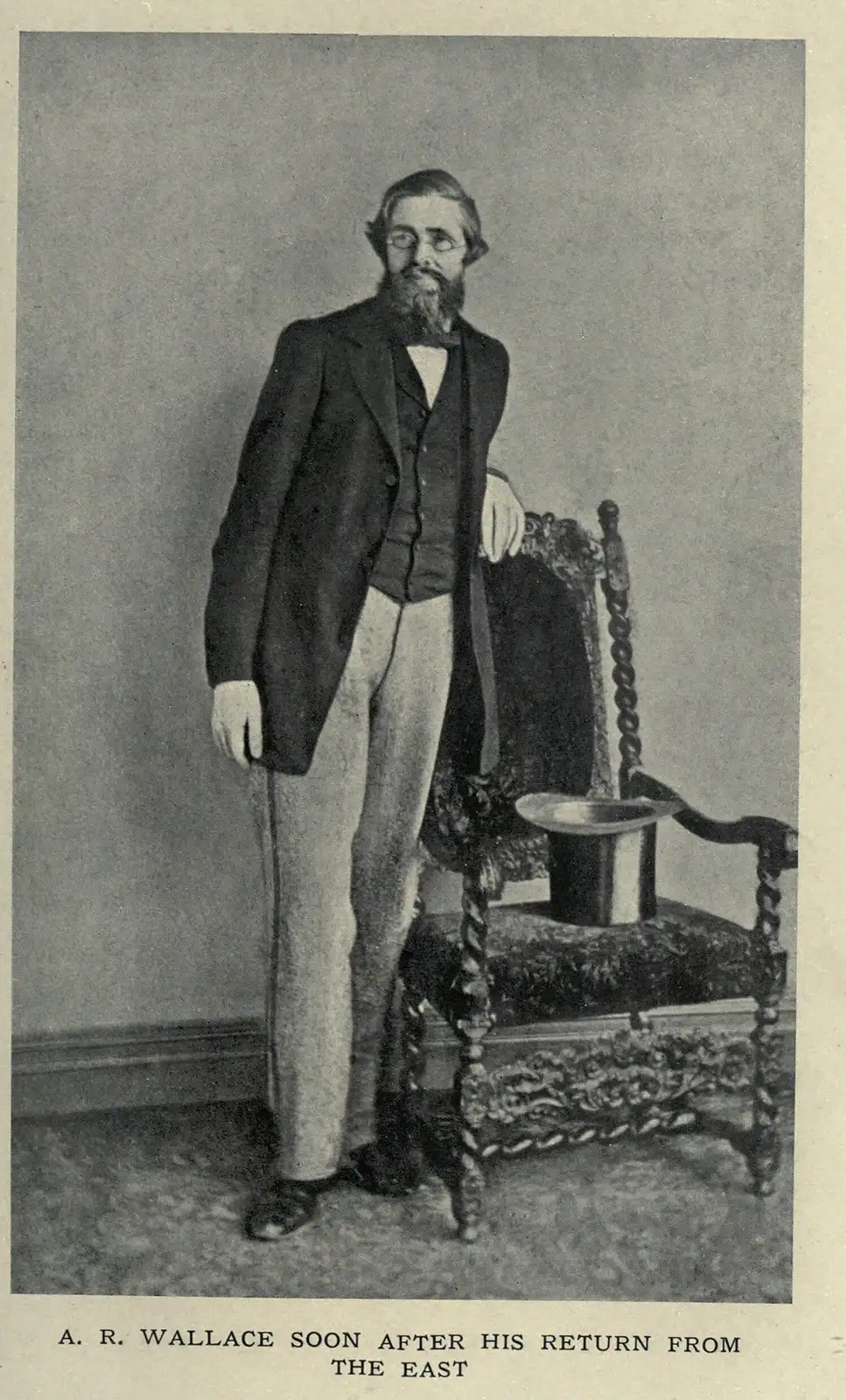
On 15 January Wallace accepted. Each man deposited 500 pounds with John Henry Walsh, editor of The Field. The written agreement, quoted later by the Court of Queen's Bench, gave Wallace until 15 March 1870 to prove "the convexity or curvature to and fro of the surface of any canal, river, or lake, by actual measurement and demonstration," to the satisfaction of Walsh and of Hampden's man, William Carpenter, or of an umpire they chose. Hampden chose the water: the Old Bedford, which near Downham Market, Wallace wrote, "has a stretch of six miles quite straight between two bridges." It was the canal of the most famous flat-earth observation of all, told in Samuel Rowbotham's Zetetic Astronomy, and a Boston paper that year credited Hampden with trying it himself: a boat and flag sent six miles from Welney Bridge to Welche's Dam, watched through a telescope by a man in the water "as a bather, with his eye not exceeding eight inches above the surface." The flag and the boat "down to the water's edge were clearly visible throughout the whole distance."
Carpenter was a journeyman printer who had written a flat-earth book, Common Sense on Astronomy. Walsh could not stay away from London more than a day, so Wallace chose a referee of his own, Mr. Coulcher, "a surgeon and amateur astronomer, of Downham Market."
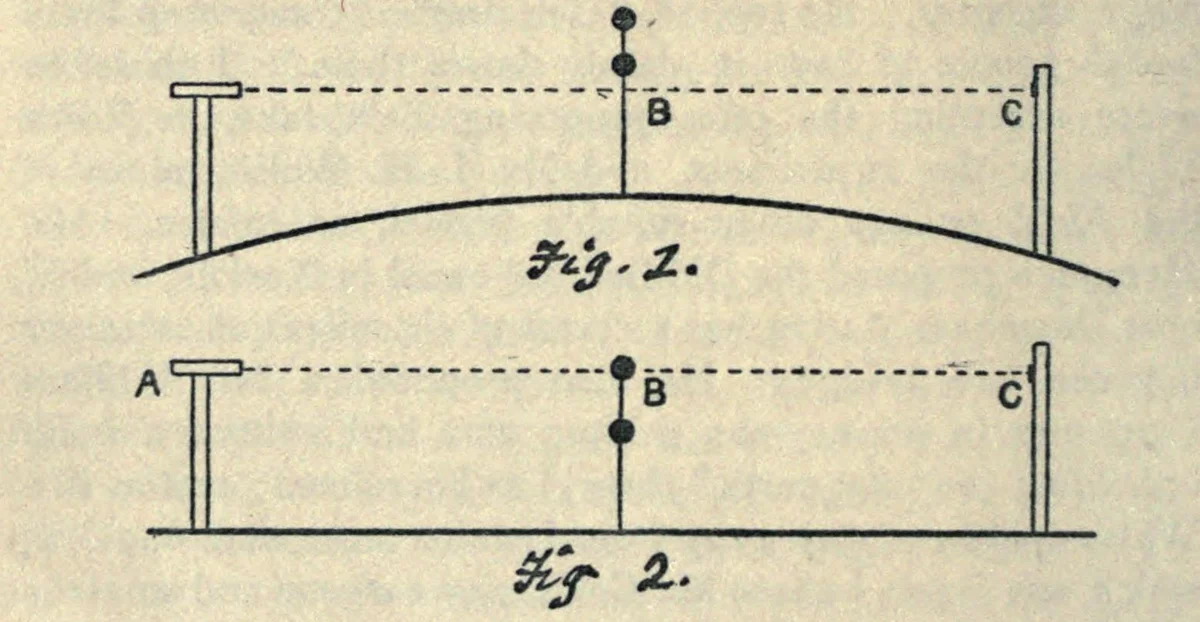
The method was Wallace's, and before the test, he wrote, a diagram "similar to this" "was submitted to Mr. Hampden, his referee Mr. Carpenter, and Mr. Walsh, and all three agreed that it showed clearly what should be seen in the two cases." On a flat Earth the three marks would line up. On a globe, by Wallace's figures, the middle disc would stand about five feet eight inches too high, "reduced a little by refraction to perhaps about five feet." A second disc, four feet lower on the same pole, gave the scale.
A Boston paper, quoting a referee's report, dated the trial to 5 March 1870. Wallace's experiments, he wrote, "occupied a week."
Flat as a billiard-table
Then Carpenter looked.
Wallace had brought a large telescope, and the view through it showed the middle disc standing above the line to the far bridge. Carpenter signed the sketch of it as correct, and then, Wallace wrote, "declared that this proved nothing, because the telescope was not levelled, and because it had no cross-hair!" So Wallace fetched a surveyor's level, a Troughton's, borrowed from King's Lynn, with a cross-hair to mark the true horizontal. Carpenter put his eye to it, and in Wallace's account he said "Beautiful! Beautiful!": the level showed the three points, he said, in "a perfect straight line"; "as level as possible!"
What Carpenter saw was the three marks below the cross-hair, evenly spaced. Three marks in an even row, on his reading, are three marks on a straight line, and the water under them is level. Hampden, Wallace recorded, declined to look through either telescope and relied on Carpenter.
He put his own case in print within weeks. "I asserted then, as I assert now," he wrote in April 1870, "that the water was as flat as any billiard-table in the kingdom," and Wallace, he wrote, had been asked to repeat it for a thousand pounds a side. The heart of his case was what Wallace had promised. Wallace had undertaken, Hampden wrote to The Field, that his centre staff "should be at least five feet higher than those on either side"; read through the level, the line fell away instead, and "instead of a rise of five feet, he would have to show a fall of sixteen feet!" From both ends, "the more distant staff was higher still. Whichever way you looked, there was this perplexing dilemma of a graduated incline from the point of sight." An incline that appears from both ends, on Hampden's reading, is a trick of the eye, not a curve of the water.
And Hampden had more than an argument. Under the agreement the referees were to choose an umpire together. Carpenter would not join in. Walsh, the stakeholder, was made umpire, at Hampden's own request, Wallace wrote; and before Walsh paid the money over, Hampden demanded his 500 pounds back. Six years later the Court of Queen's Bench agreed that he was entitled to it.
If the water held level
Set aside for a moment whether Carpenter read the level rightly. Ask the larger question. What would it mean if six miles of still water in Norfolk lay perfectly flat?
It would mean the oldest certainty in science had been tested once, in the open, by the people who doubted it, and had failed. Not in a laboratory. On a canal in the fens, with bridges, a pole and a borrowed instrument, on terms both sides had signed.
It would mean the umpire had been wrong. Walsh was an editor both men had accepted, Hampden by his own request, and Hampden held to the end that the decision flew in the face of the diagrams. On that reading a public test, run on agreed terms, was lost on a ruling rather than on the water.
It would mean that every other measurement of the planet, from the ship's mast that sinks below the horizon to the surveyors' tables, had a question to answer: why would six miles of still water disagree with all of them?
And it would leave a question in front of us that is larger than any canal: how many of the things we know about our world have we ever checked with our own eyes, and what we would do if one of them failed the check.
Five feet more or less
The standard account is Walsh's decision, and the arithmetic behind it. Walsh found that Wallace had "proved to his satisfaction the curvature to and fro of the Bedford Level Canal," "to the extent of five feet more or less." The Field printed the whole of the particulars, with the referees' sketches, on 18 and 26 March 1870, and said of Carpenter that "he was a most improper person to be selected to act as referee in such a matter."
Wallace answered Hampden's argument in The Field on 2 April. He denied, as Hampden himself complained, that he had ever undertaken to show a rise above the true level; a curve shows itself as the middle mark standing above the line joining the two ends, while all three sink below the true level. Through the big telescope, he wrote, the middle mark stood about five and a half feet above the line to the far bridge, "equal to 11 ft. if measured at the distant signal." Through the level, Carpenter's own sketch put the marks below the true horizontal by about as much again. Together that made 22 feet, "leaving less than 2 ft. for refraction to bring it to the full theoretical amount, which is something less than 24 ft." Three marks of equal height that will not line up from either end, he argued, are not on a straight line, as anyone could check with "three oranges on the parapet of Waterloo-bridge."
The flat-earth readings of the same canal, a boat seen "down to the water's edge" six miles off, came from an eye a few inches above the water, where the air bends light most; Wallace's marks stood thirteen feet up.
Thirty years later someone did it again with a camera. In the summers of 1900 and 1901 the geographer H. Yule Oldham set up the same kind of marks along the six miles "between Welney and Denver," and reported to the British Association that "the middle mark was seen to stand up about six feet above the line of sight, agreeing with the effect calculated to be produced by the curvature of the earth's surface."
What the decision does not reach
The decision settled who got the money. It did not settle everything the two sides fought over.
Nobody records a measurement of the air. Wallace allowed for refraction with a standard estimate, cutting the expected rise of five feet eight inches to "perhaps about five feet," and his later sum left "less than 2 ft." for it. A thermometer would have sharpened those figures. On the standard account it would not have turned them to nothing; Oldham's six feet, thirty years later, came out on the same side.
The documents do not even agree on where the test was run. Wallace puts it between Welney bridge and the Old Bedford bridge, toward Downham Market, and the referees' printed sketches say the same; Oldham's reach in 1901, Welney to Denver, was likely the same water. Only Walsh's decision, as the court quoted it, names "Witney Bridge and Welsh's Dam," the reach of the older flat-earth trial, in the other direction. The two accounts give the parapet as thirteen feet three inches and thirteen feet four; the big telescope as six inches across and as four.
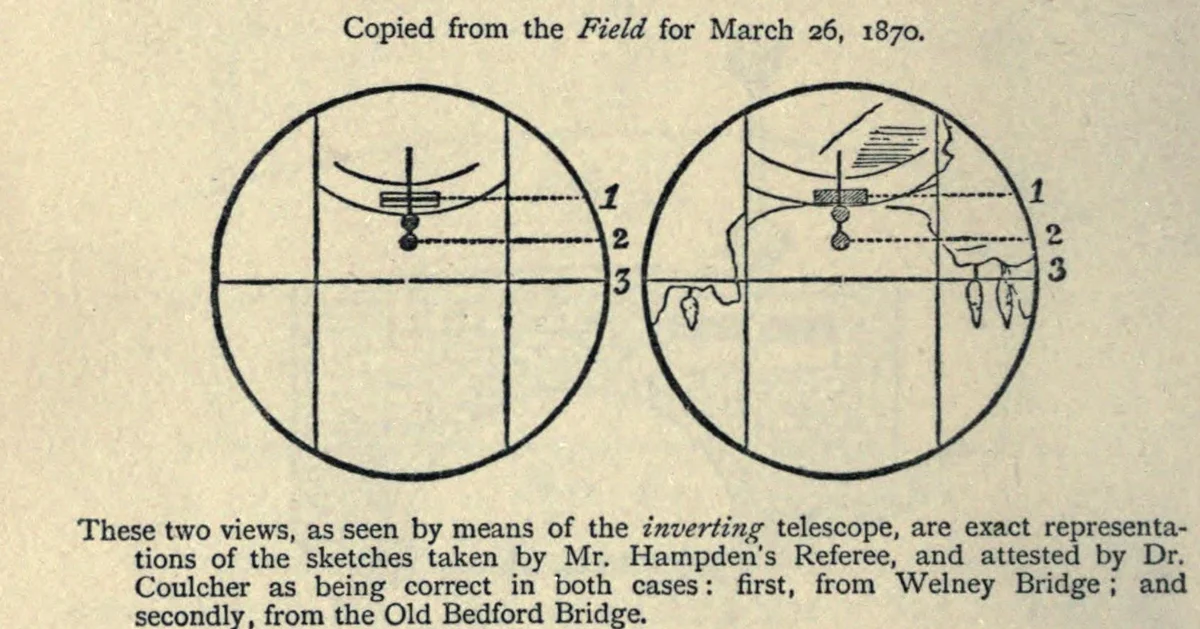
The printed sketches were drawn by Hampden's referee and attested by Wallace's. Each side read the same circles as proof of its own case.
And the law ruled on none of it. The Queen's Bench held that the agreement was a wager, and that Hampden could recover his stake because he had asked for it back in time. The judges did not decide the shape of the water. Nobody ever did, in a court.
Fifteen to twenty years
What followed is in Wallace's memoir and the court records. Hampden wrote to Wallace's wife: "If your infernal thief of a husband is brought home some day on a hurdle, with every bone in his head smashed to pulp, you will know the reason." He was bound over to keep the peace and spent a week in prison until he found sureties. Wallace sued him for libel and a jury gave him 600 pounds. Walsh prosecuted him; Wallace prosecuted him again in 1872 and 1873, and Hampden apologised in print; later he served two months in Newgate. In March 1875, at Chelmsford, Lord Chief Justice Cockburn sentenced him to a year's imprisonment. He was out, Wallace wrote, in about six months.
Then the stake came back to bite. Wallace had given Walsh an indemnity, so when Hampden won his case against Walsh in January 1876, Wallace repaid the 500 pounds and about 200 pounds in costs. Hampden had made himself bankrupt. The wager, the suits and the prosecutions, Wallace wrote, cost him "considerably more than the 500 pounds I received from Hampden," and "between fifteen and twenty years of continued persecution." He called it "the most regrettable incident in my life."
The canal went on drawing people. In 1904 or 1905, by the account of the mathematical historian David Singmaster, the flat-earth writer Lady Elizabeth Blount led an expedition to the Old Bedford "to disprove Wallace's 'three pole trick'," and her photographer, he writes, photographed an object at water level six miles away "and even its reflection." The argument outlived both men. So did the flat maps: a patented flat-earth map was printed in 1892, while Hampden was still alive.
Two circles, drawn on paper in March 1870, with a pole, a band and three numbered lines in each. Drawn by a printer who believed the Earth was flat, attested by a country surgeon. They are still there, reprinted on page 368 of Wallace's memoir, and the argument over what they show is older than anyone now alive.
Questions This Leaves You With
Is there anything a person actually does with this?
Not with your own life, honestly. Whatever the Old Bedford shows, it does not change your work, your health or your next ten years, and anyone who sells you urgency about the shape of the Earth is selling something. The larger question is about how a public test is run: who chooses the method, who referees, who holds the money, and what happens when both sides sign the same evidence and read it two ways. That question is still open, in every field, and it is not yours alone to answer.
Does this sit against a religious account of the world?
It can be read both ways, and serious people have read it both ways. Hampden's own advertisement dared the professors to prove the globe "from scripture, from reason, or from fact," scripture first, and in April 1870 he wrote that "God's Word is not capable of being overthrown by man." Wallace's side never argued from scripture at all; its case was three marks, a telescope and a level. This site will not tell you which way it falls for you. The wager itself was decided by a telescope, a level and a newspaper editor, not by a text.
Does this change what a human life is?
Hold your own life against the scale in this story: six miles of water, a curve of a few feet across them, and two men who spent the next fifteen years of their lives fighting over it. One way of seeing it makes a life smaller; a great naturalist lost years to a quarrel over a canal. The other makes it larger; a few feet of water, measured by hand with a pole and a borrowed level, were enough to carry the shape of the whole world. Which did you feel?
What would change your mind, in either direction?
Name it now, before you are committed, because it is harder later. Toward a flat canal: the same three marks, set on the same water, read through a level whose cross-hair has been checked against a known horizontal, with thermometers at the water and above it, showing all three in line. Toward the curve: the same set-up showing the middle mark standing high by close to the figure the globe predicts, from both ends, on days with different air. Notice that both lists ask for the same water, and for the air above it to be measured as well as the marks.
Which six miles?
This is a small gap, and a telling one. Wallace and the referees' sketches put the far mark on the Old Bedford bridge, toward Downham Market. The umpire's decision, as the court quoted it, says "Witney Bridge and Welsh's Dam," the other way along the canal: very likely a slip by the decision or its reporter for the older flat-earth reach. The Field's full reports of March 1870, which would settle the wording, were not found in the open archives searched for this investigation. So the most famous test of the shape of the Earth in the nineteenth century survives, in its one legal record, with the wrong six miles attached.
Sources
- My Life: A Record of Events and Opinions, vol. II (1905), ch. XXXIX, pp. 364-376 Alfred Russel Wallace, Chapman and Hall; Darwin Online Primary record
- My Life, vol. II (1905), University of Toronto copy Internet Archive Primary record
- Reply to Mr. Hampden's Charges Against Mr. Wallace (1871) Alfred Russel Wallace, ed. Charles H. Smith, The Alfred Russel Wallace Page Primary record
- Experiments on the Convexity of Water; The Convexity of Water, The Field, 2 and 16 April 1870 Alfred Russel Wallace, ed. Charles H. Smith Primary record
- Hampden v. Walsh, 1 QBD 189, judgment 17 January 1876 Court of Queen's Bench, law report reprint via Charles H. Smith Primary record
- Letter to the editor of The Field (1870) John Hampden, via Charles H. Smith Primary record
- The Bedford River Survey, Weston-super-Mare Gazette, 16 April 1870 John Hampden, via Charles H. Smith Primary record
- Is the World Round?, Every Saturday (Boston), 1870, p. 539 Every Saturday, via Charles H. Smith Primary record
- The Rotundity of the Earth, Nature vol. 1 no. 23, 7 April 1870, p. 581 Nature, via Internet Archive Primary record
- Chelmsford Chronicle, 12 March 1875, report of Hampden's libel trial Chelmsford Chronicle, via Charles H. Smith Primary record
- The Experimental Demonstration of the Curvature of the Earth's Surface, BAAS Report 1901, pp. 725-726 H. Yule Oldham, British Association for the Advancement of Science Primary record
- Welney, Norfolk, Mathematical Gazetteer of the British Isles David Singmaster, MacTutor, University of St Andrews Study