
Sedna is a small, reddish world beyond Pluto, discovered on 14 November 2003 with the Samuel Oschin Telescope at Palomar Observatory in California by Mike Brown, Chad Trujillo and David Rabinowitz. When NASA announced it in March 2004, it was the most distant object ever seen in the solar system, some 13 billion kilometres away, three times farther than Pluto.
Its orbit is the strange part. Sedna never comes closer to the Sun than about 76 times the Earth's distance, well outside the Kuiper belt and far beyond Neptune's reach. At the other end it swings out to about 1,010, according to NASA's Jet Propulsion Laboratory. From there, Brown said, the Sun would look so small "that you could completely block it out with the head of a pin."
One trip around takes over ten thousand years. "The last time Sedna was this close to the Sun," Brown said, "Earth was just coming out of the last ice age."
Something put it on that path.
Nobody knows what.
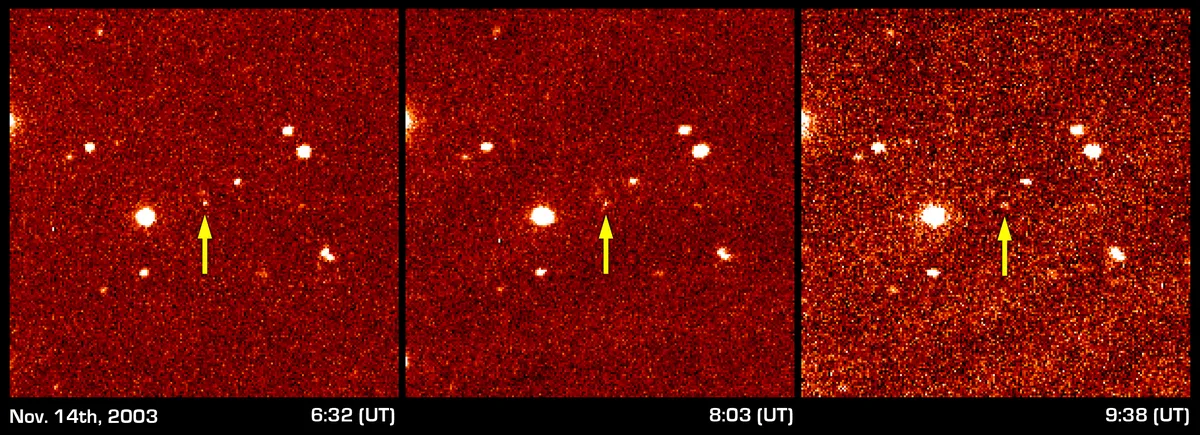
A dot that moved
The search that found it was patient and plain. Brown's team photographed a patch of sky three times over three hours and looked for a point that moved against the stars. On 14 November 2003 one did, slowly enough to be very far away.
The team named it after the Inuit goddess of the sea, "the mother of all sea creatures", in the Minor Planet Center's citation, and on 15 March 2004 NASA and JPL announced "the most distant object in solar system". It was cold, never warmer than minus 240 degrees Celsius, and among the reddest objects known. Its discoverers thought it might have a moon. On 16 March Hubble looked, and Sedna filled a single pixel; no moon was there. "No moon is visible!" Brown wrote on his own page.
The paper came out in The Astrophysical Journal that December under the title "Discovery of a Candidate Inner Oort Cloud Planetoid". Its first sentence: "We report the discovery of the minor planet (90377) Sedna, the most distant object ever seen in the solar system." Its abstract listed what could explain the orbit: an undiscovered planet, a star that passed close to the Sun, or the Sun's birth in a cluster of stars.
The day NASA announced Sedna, Alessandro Morbidelli and Harold Levison posted a paper weighing those scenarios. Of the ones they tested, "the only one giving satisfactory results is the passage of a star." In December Scott Kenyon and Benjamin Bromley, in Nature, put a roughly 10 percent chance on Sedna having been captured from the passing star itself.
Then, for a decade, Sedna had no known twin.
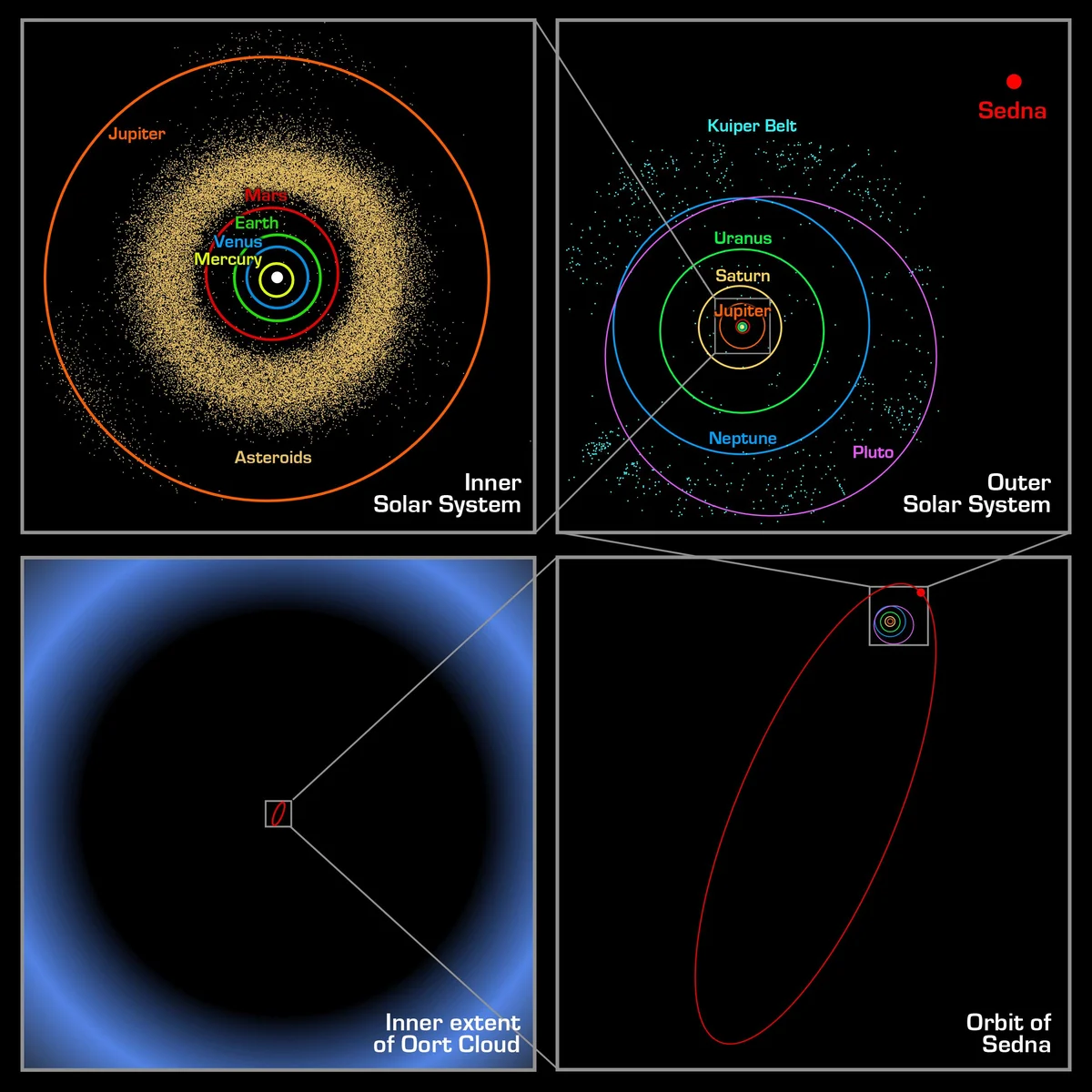
The orbits that point one way
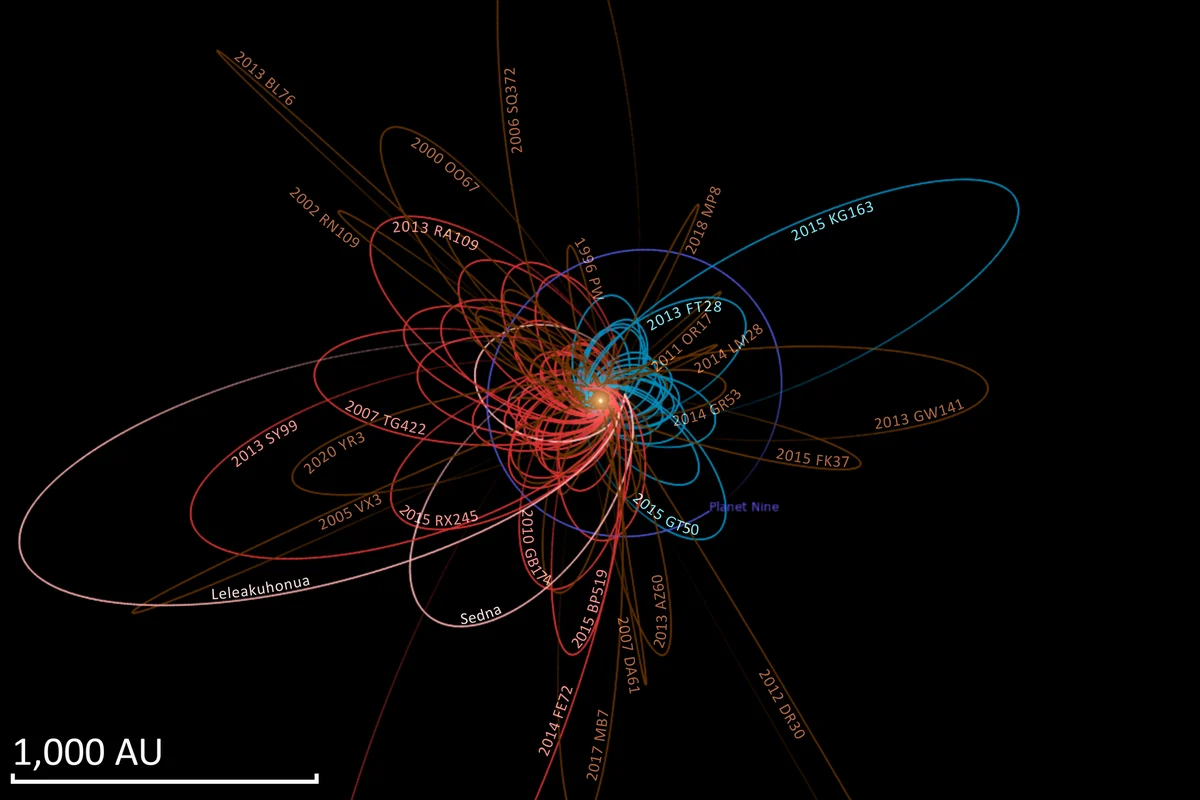
In March 2014 Chad Trujillo and Scott Sheppard reported in Nature a second object of the same kind, 2012 VP113, found with the Dark Energy Camera in Chile. Its closest approach was even farther out, about 80 AU. Sedna, they wrote, "is not isolated and may be part of the putative massive inner Oort cloud". The Carnegie Institution's release added that the similar orbits of the two and their distant neighbours might point to an unseen body "perhaps up to 10 times" the size of the Earth.
Two years later Konstantin Batygin and Mike Brown at Caltech took the pattern further. In The Astronomical Journal in January 2016 they reported that the most distant orbits "cluster not only in argument of perihelion, but also in physical space", with "only a probability of 0.007% to be due to chance", and that the alignment could be kept by "a distant eccentric planet with mass greater than ~10 Earth masses." Planet Nine was announced.
"For the first time in over 150 years," Batygin said in Caltech's release, "there is solid evidence that the solar system's planetary census is incomplete." The release sketched the planet they inferred from six distant orbits: about ten times the Earth's mass, on average about twenty times farther from the Sun than Neptune, taking between 10,000 and 20,000 years to go round once.
The case grew. In 2021 Brown and Batygin estimated the planet at about six Earth masses, averaging about 380 AU from the Sun, and found the clustering "significant at the 99.6%" level. More objects with Sedna's kind of orbit turned up: 2015 TG387, found at Mauna Kea and named Leleakuhonua, swings out to about 2,630 AU; its discoverers found it stable on the kind of Planet X orbit that keeps the others stable too. And every one of them starts with the question Sedna asked first.
If something is out there
Set aside, for a moment, whether it is true. Ask the larger question. What kind of solar system is it, if Sedna was shaped by a planet?
It would mean the solar system has a ninth planet, several times the Earth's mass, hundreds of times farther out than us, unseen in the whole history of astronomy and announcing itself only by the way a few small, frozen worlds line up.
It would mean Sedna is a messenger. A body that has not come near the Sun since the end of the last ice age would carry, in the shape of its path, the signature of a giant that has been circling in the dark since the planets formed.
It would mean something about us. A species that has mapped the planets for four hundred years would have missed one of them, and would have found it not by looking but by reasoning from the orbits of things smaller than its own Moon.
And it would leave one question in front of us. A planet out there now is out there tonight. A new telescope began a ten-year survey of the sky in 2026, built to see faint things that move.
Bias, flybys and an orbit that does not fit
The standard account, or rather the doubters' account, starts with how the objects were found.
Surveys look where they can, and distant bodies are easiest to catch near the closest point of their orbits, in certain seasons, in certain parts of the sky. The Outer Solar System Origins Survey, which recorded exactly where it had looked, reported in 2017 that these biases "substantially weaken the evidence that has been used to justify the need for an additional very massive planet." In 2021 Kevin Napier and 52 colleagues, using the Dark Energy Survey and others, concluded that their sample "provides no evidence for angular clustering."
Sedna's orbit may not need a planet. The passing-star explanation Morbidelli and Levison favoured in 2004 has been worked on since; in September 2026 Susanne Pfalzner and colleagues posted a preprint, not yet peer reviewed, in which a star of 0.8 solar masses passing at about 110 AU reproduces much of the outer solar system and leaves the orbits of Sedna-like objects "basically unchanged" over 4.56 billion years. The authors note that the tilt of those orbits is still not matched.
And the newest objects do not all line up. 2023 KQ14, announced in Nature Astronomy in July 2025 by Ying-Tung Chen and colleagues, has Sedna's kind of orbit, perihelion 66 AU, but its orbit does not line up with the others; the team's Yukun Huang said it "lowers the likelihood of the Planet Nine hypothesis", and the authors favour, if there is a planet, one on a larger orbit, about 500 AU. 2017 OF201, an object some 700 kilometres across on an extremely wide orbit, also sits outside the cluster.
The telescopes have looked, too. In 2024 Brown, Matthew Holman and Batygin reported that Pan-STARRS, together with two other surveys, had ruled out 78 percent of the places their 2021 planet could be.
What the counter does not reach
The planet has not been found. Not by Pan-STARRS, not by any survey since 2016.
But the doubts reach the planet, not the orbit. Bias can make a cluster look stronger than it is; it cannot move Sedna's perihelion in from 76 AU. Something lifted Sedna, Leleakuhonua, 2012 VP113 and 2023 KQ14 away from Neptune, and the count of these sednoids now stands at four. The OSSOS team said it plainly: its results "can not prove, or rule out, the existence of the hypothesized 'Planet 9'", and, of a far smaller body than Planet Nine, "The idea of a dwarf planet, maybe as big as Mars, is still entirely possible."
And here is the strange part. Even the alternatives need something that is not there now. A passing star, a crowded birth cluster, a planet thrown out long ago: every explanation of Sedna invokes an event or a body the solar system no longer shows. In August 2025 Amir Siraj, Christopher Chyba and Scott Tremaine reported a warp in the plane of the distant Kuiper belt, which they explained with yet another unseen world, smaller than the Earth, at 100 to 200 AU.
One small world. Several invisible causes.
The survey that will decide
Where it stands now: the Vera C. Rubin Observatory in Chile began its ten-year Legacy Survey of Space and Time on 30 June 2026, Sky and Telescope reported, expecting to find millions of solar system objects. Its commissioning data alone turned up about 380 bodies beyond Neptune in under two months. Batygin has called it "a direct test of all lines of evidence", SpaceDaily reported; Brown said a null result "would be an important nail to put into yet another planetary theory."
Sedna is coming in. JPL's orbit puts its next closest approach to the Sun around 2075. For the next half century it draws nearer the Sun than at any other point of its orbit, and every telescope that studies it will be measuring a body that last came this way when the ice sheets were retreating.
What is left is the oldest question in this story, the one Brown, Trujillo and Rabinowitz wrote in 2004. Something raised Sedna's orbit out of Neptune's reach. A planet, a star, a crowded nursery. The orbit is the only witness, and it has been travelling for more than ten thousand years without saying which.
Questions This Leaves You With
Is there anything a person actually does with this?
Nothing that touches your own life: Sedna takes over ten thousand years to go around, and Planet Nine, if it exists, is hundreds of times farther away than the Earth is from the Sun. What it offers is a front-row seat to a question that will probably be settled in your lifetime. The Rubin survey is planned to run for ten years, and its data will either show a planet or narrow the room for one sharply. Anyone selling a date is selling something; Rubin is selling ten years of patient pictures.
Does this sit against a religious account of the world?
Both directions have been argued by thoughtful people. One sees a solar system still keeping secrets at its edge, a reminder that creation is larger than the map of it. Another sees a sky that can be read by reasoning alone, which some find awe-inspiring and others find cold. The astronomy does not decide between them, and the astronomers in this story are careful to say only what the orbits show. This site will not tell you which way it falls.
Does this change what a human life is?
The last time Sedna was where it is now, people were living through the end of the last ice age. Its next visit will come after more than ten thousand years more. A human life is less than a hundredth of one of its orbits. On one reading that makes a life small, a flicker against a slow wheel. On another it makes it rare: we happen to be alive in the one century when Sedna is near enough to see and our telescopes are good enough to find what moves it. Which did you feel?
What would change your mind, in either direction?
Name it now. Toward a planet: a faint, slow-moving point in the Rubin data where the orbits say to look, or a much larger sample of sednoids that still clusters after every bias is accounted for. Toward no planet: the Rubin survey ending with nothing in the remaining search space, or a large, unbiased sample with no alignment at all. A passing-star history would be strengthened by finding the inclinations the flyby models predict. Each of those is a result the next decade could produce.
What raised Sedna's perihelion?
This is the open problem, and it is a real one. Sedna's closest approach is about 76 AU, beyond the reach of every known planet. Something moved it there: a planet still in the dark, a planet long since thrown out, a star that passed early, or the crowded cluster the Sun was born in. Each has a published champion, and none has been confirmed. Each also predicts something different about where the next sednoids will be found and how their orbits will tilt. The answer is in the orbits of the next few dozen sednoids, if Rubin finds them.
Sources
- 90377 Sedna (2003 VB12), JPL Small-Body Database (orbit solution of 6 June 2026) NASA Jet Propulsion Laboratory Primary record
- Most Distant Object in Solar System Discovered (NASA/JPL, 15 March 2004) NASA/JPL Primary record
- Most distant object in solar system discovered (Spaceflight Now, 15 March 2004) Spaceflight Now Study
- Mike Brown, Sedna Caltech Primary record
- Sedna mystery deepens as Hubble offers best look at farthest planetoid (opo0414a, 2004) ESA/Hubble Primary record
- M. E. Brown, C. Trujillo and D. Rabinowitz, Discovery of a Candidate Inner Oort Cloud Planetoid (ApJ 617, 645, 10 December 2004) Caltech Authors / The Astrophysical Journal Primary record
- A. Morbidelli and H. Levison, Scenarios for the Origin of the Orbits of the Trans-Neptunian Objects 2000 CR105 and 2003 VB12 (2004) arXiv / AJ Primary record
- S. Kenyon and B. Bromley, Stellar encounters as the origin of distant solar system objects in highly eccentric orbits (Nature 432, 598, 2004) arXiv / Nature Primary record
- C. A. Trujillo and S. S. Sheppard, A Sedna-like body with a perihelion of 80 astronomical units (Nature 507, 471, 2014) Nature (record via RePEc) Primary record
- Carnegie Institution for Science release on 2012 VP113 (26 March 2014) ScienceDaily Study
- K. Batygin and M. E. Brown, Evidence for a Distant Giant Planet in the Solar System (AJ 151, 22, 2016) arXiv / AJ Primary record
- Caltech Researchers Find Evidence of a Real Ninth Planet (20 January 2016) Caltech Study
- M. E. Brown and K. Batygin, The orbit of Planet Nine (AJ, 2021) arXiv / AJ Primary record
- S. S. Sheppard, C. A. Trujillo, D. J. Tholen and N. Kaib, A New High Perihelion Inner Oort Cloud Object: 2015 TG387 (AJ, 2019) arXiv / AJ Primary record
- 541132 Leleakuhonua (2015 TG387), JPL Small-Body Database NASA Jet Propulsion Laboratory Primary record
- OSSOS biases FAQ Outer Solar System Origins Survey Primary record
- K. J. Napier et al., No Evidence for Orbital Clustering in the Extreme Trans-Neptunian Objects (PSJ, 2021) arXiv / PSJ Primary record
- S. Pfalzner, C. Wagner and M. Bischoff, Trans-Neptunian Object dynamics even better explained by a stellar flyby after 4.5 Gyr of evolution (preprint, 3 September 2026) arXiv Primary record
- Y.-T. Chen et al., Discovery and dynamics of a Sedna-like object with a perihelion of 66 au (Nature Astronomy, 2025) arXiv / Nature Astronomy Primary record
- Discovery of 2023 KQ14 (NAOJ CfCA, 15 July 2025) National Astronomical Observatory of Japan Study
- Cheng, Li and Yang, Discovery of a dwarf planet candidate in an extremely wide orbit: 2017 OF201 (ApJL, 2026) arXiv / ApJL Primary record
- M. E. Brown, M. J. Holman and K. Batygin, A Pan-STARRS1 Search for Planet Nine (AJ 167, 146, 2024) arXiv / AJ Primary record
- A. Siraj, C. Chyba and S. Tremaine, Measuring the Mean Plane of the Distant Kuiper Belt (MNRAS Letters, 2025) arXiv / MNRAS Primary record
- Hannah Richter, Vera C. Rubin Observatory Begins Its Long-Awaited All-Sky Survey (30 June 2026) Sky and Telescope Study
- Rubin as a direct test of Planet Nine (SpaceDaily, 28 August 2026) SpaceDaily Study
- Rubin Observatory finds 11,000 new asteroids (2 April 2026) UW News Study
- The fourth sednoid (The Conversation via ScienceDaily, 8 June 2026) ScienceDaily Study