
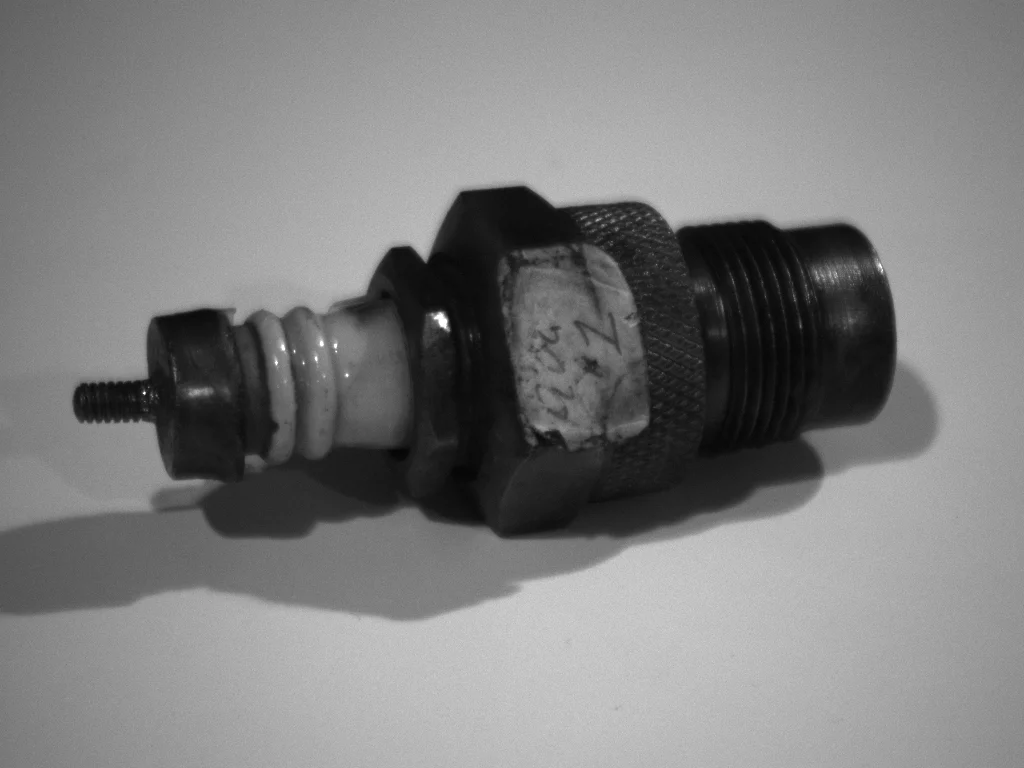
The Coso artifact is a lump of rock found on 13 February 1961 in the Coso Mountains of eastern California, near the town of Olancha, by three rock collectors looking for geodes. When they cut it open, they found inside it something made: a white ceramic cylinder with a metal shaft running through its centre, wrapped in what looked like copper, set in a six-sided casing.
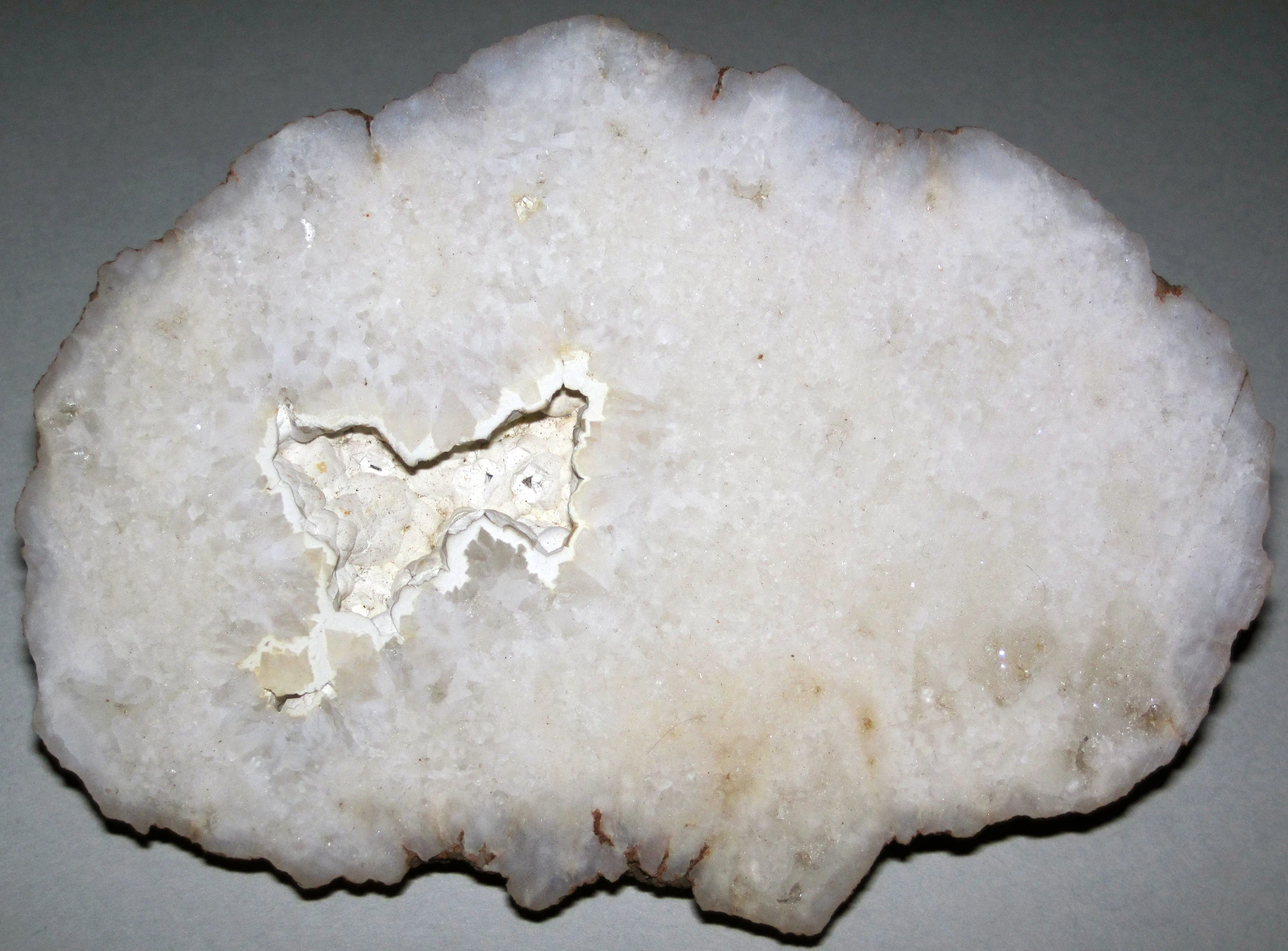
The rock is dark and rough, the colour of rust. Sawn in half, each face shows a pale disc about the size of a coin, a black dot at its middle, and around it a hexagon pressed into the stone.
The saw that cut it was a diamond blade. It did not survive the job.
In the opinion of one geologist, as the finders reported it, the nodule had taken at least half a million years to form.
Three rock hounds and a saw
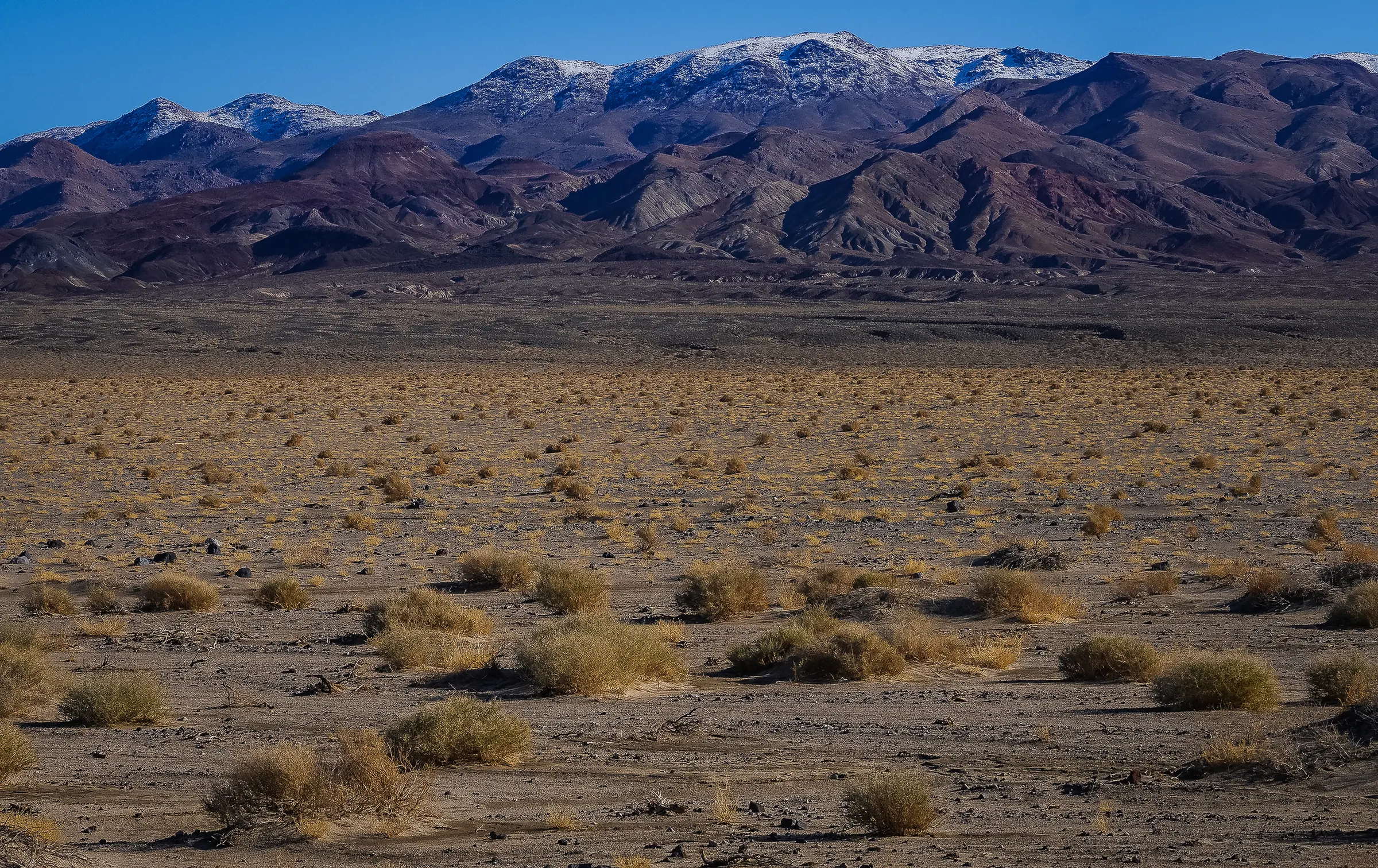
The three were Wallace Lane, Virginia Maxey and Mike Mikesell, who ran a gem and gift shop together, the LM and V Rockhounds, in Olancha at the foot of the Sierra Nevada. Across the Owens Valley from the town rise the Coso Mountains, where they were hunting. On 13 February 1961 they picked up a nodule with fossil-looking fragments in its crust. The next day Mikesell cut it open.
Maxey described it in a letter to Desert Magazine, published in May 1961 under the heading "The Coso Geode". The crust, she wrote, was "of hardened clay containing pebbles and fossil shell fragments". Inside were two metal objects that looked like a nail and a washer, a six-sided casing she took for carved wood, and a hard ceramic disc with a small metal core. "There is some evidence that the ceramic core was encased in copper." She called it a "man-made object". And she reported a date: "In the opinion of one trained geologist, it has taken at least 500,000 years for this nodule to attain its present form."
The object went to X-ray. Ron Calais, who later promoted the object, took the pictures that would follow it for decades: a porcelain cylinder, a bright metal shaft about two millimetres thick that responded to a magnet, a metal sheath, and, at the upper end, as the later account put it, "some sort of tiny spring or helix".
Lane kept it at home. He would not let it be examined further, and, according to the 1969 report, he would sell it for 25,000 dollars.
Half a million years
The Coso artifact became one of the best-known out-of-place objects in the world. The first long account, "The Coso Artifact" by Ronald Willis, ran in the INFO Journal of the International Fortean Organization in 1969. The INFO Journal's editor, Paul J. Willis, suggested it might be a spark plug, and his brother wrote that "suddenly all the parts seemed to fit", but the two could not match the spring at the top, or its threads, to any plug of their day. That gap was enough. Brad Steiger put it into Mysteries of Time and Space in 1974; Rene Noorbergen into Secrets of the Lost Races in 1977. The television series In Search Of... gave it a segment, with a facsimile of the object. Creationist writers took it up too, as evidence that rock can form fast. In 2018 Erich von Daniken included it in his book Impossible Truths.
The case was simple and strong. A made object, with parts no natural process makes: porcelain, a metal shaft, copper, a hexagon. Inside a rock hard enough to wreck a diamond saw. In a crust with fossil shells in it. Dated, by a trained geologist, to half a million years.
On that dating, a manufactured electrical part had lain in the ground since before our own species existed.
The object's champions drew the obvious conclusion. Either someone had made it a very long time ago, or the rocks of the earth form far faster than geologists say. Both conclusions were big enough to keep the story alive. The finders' family later said that geologists at the University of Nevada, Reno, looked at it in the 1960s and told them privately it was most likely a modern spark plug, and that more X-rays were taken at UCLA or USC; no records of either have surfaced.
If the rock was old
Set aside, for a moment, what the object turned out to be. Ask what it would have meant if the dating had held.
It would have meant that someone made porcelain, drew steel wire and shaped copper half a million years ago, in a valley in California, at a time when the ancestors of human beings were making hand axes on other continents.
It would have meant that the dates on which archaeology rests, the layers, the rates at which rock and soil build up, could be wrong by a factor of thousands, or that the object was made by someone the record has no place for.
It would have meant that the history of technology is not one long climb but a story with a missing first chapter, a civilisation or a visitor whose tools were left in the ground and covered over by time.
It would have meant that our species is not the first maker on this planet, or not the first in the way we think: that somewhere behind the stone tools is a layer of something else, and we have found one piece of it.
And it would leave a question in front of us. If one such object can lie in a desert for half a million years, how many others are still there, inside rocks nobody has cut?
What the spark plug collectors said
The standard account came in 1999. Pierre Stromberg, founder of the Pacific Northwest Skeptics, and Paul Heinrich, a geologist at Louisiana State University, sent the photographs and the X-rays to four collectors of old spark plugs who had not seen them before: Chad Windham, president of the Spark Plug Collectors of America, Bill Bond, Mike Healy and Jeff Bartheld.
All four gave the same answer. A spark plug, made by Champion, in the 1920s. "I knew what it was the moment I saw the x-rays," Windham wrote. Bond: "A 1920s Champion spark plug." The "nail and washer" were the brass top cap and the central shaft. The "spring or helix" was the top nut that Champion plugs of the time carried. The hexagon was the shape left by the plug's six-sided body. The authors suggested it had come from a Ford Model T or Model A engine.
Their paper, "The Coso Artifact: Mystery from the Depths of Time?", went up on the TalkOrigins Archive in 2000 and was printed by the National Center for Science Education in 2004. The "geode", they argued, was not a geode at all: no crystal lining, no chalcedony shell, a crust of hardened clay. It was a concretion of iron oxide, formed as the plug's own iron rusted and bound the dust around it.
Then, in 2018, the object came back. The family of one of the finders contacted Stromberg, and on 16 May he examined it. The brass cap was partly exposed. A standard 7/8-inch, 18-thread hex nut "fit perfectly" in the hexagonal cavity. The two halves together were about three inches long, the length of a 1920s Champion plug. In July 2018 the geologist Charlotte Schreiber of the University of Washington looked at it too. Neither found any shells.
What the identification does not reach
The identification reaches the object. It does not reach the dating.
No name for the "trained geologist", and no report giving his reasoning, has ever been published. The creationist writer Joseph Jochmans said in 2009 that the geologist had shown him his report in 1985, would not let him copy it, and later died; the report has not appeared. Maxey's letter gives no reason, and, according to the National Center for Science Education account, she elsewhere suggested the object might be no more than a hundred years old. The later story that he dated fossil shells in the crust was told by others; the shells themselves were not found in 2018, and nobody knows whether they were lost after the cutting or never there. No laboratory has published an age or an analysis for the crust, and the family turned down a study by the United States Navy that would have meant cutting the object apart. The rate at which such a concretion forms around rusting iron, in that desert, has not been measured for this object. They did not find the geologist.
And the earliest photograph of the cut halves, in Desert Magazine in 1961, is the nearest thing to a record of the crust as it was. What happened to the crust in the half century it spent in a family's keeping is not recorded.
The plug is as close to settled as an object seen by few people can be. Four collectors named its maker and decade from the X-rays alone, and the object itself, examined in 2018 by Stromberg and Schreiber, matched them. No independent laboratory has tested it.
The stone that came home
The Coso artifact is still in private hands, with the descendants of one of the finders, who have asked not to be named. All three of the people who found it had died long before it resurfaced in 2018. In 2019 Skeptical Inquirer reported that Stromberg had arranged for it to go on show in an exhibition called What Is Reality? at the Pacific Science Center in Seattle. Whether it did, and where it is now, this article could not confirm.
It belongs with the Saqqara bird and the Baghdad jars among the objects that have been read as out of their time. Unlike those, it now has a maker, a decade and a likely kind of engine.
What it does not have is an answer to the question that made it famous. Somebody told three rock hounds in 1961 that their rock was half a million years old, and nobody has ever found out who, or why.
The spark plug is explained. The geologist is not.
Questions This Leaves You With
Is there anything a person actually does with this?
Not in your daily life, and it is fair to say so. The Coso artifact will not change what is in your car or your house, and anyone selling a hidden history on the strength of it is selling something. The larger lesson is about how claims travel: a single unsourced sentence in a 1961 letter was repeated for decades with no named source, through books, television and websites, each copy citing the one before it. That is a question worth asking of any number you read, however exciting: who measured it, how, and where it was published.
Does this sit against a religious account of the world?
It has been used on both sides. Some writers took it as evidence that rock forms quickly and the earth is young; others took the spark-plug answer as a lesson in testing every claim, sacred or not. The object itself makes no claim about either. This site will not tell you which reading to hold. That is yours to weigh.
Does it change what a human life is?
Think of whoever lost that spark plug on a desert hillside in the 1920s, a miner, a driver, someone whose engine failed far from town. One reaction is that it makes a life small: a forgotten part from a forgotten car, mistaken for a relic of another world. The other is that it makes a life large: one ordinary moment, sealed in rust for forty years, that grew into one of the most famous puzzles of the century. Which did you feel first? Both are true of the same small piece of porcelain.
What would change your mind, in either direction?
Name it now. Toward the extraordinary reading: a laboratory date showing the crust is far older than the 1920s, or shells in it that could only have come from ancient rock. Toward the ordinary reading, which is already strong: a published analysis of the crust showing modern rust and dust, or the name of the 1961 geologist and the reasoning behind the figure. Notice which of those is missing. The identification of the plug does not depend on the crust; the date always did.
Where does the open problem actually sit?
It sits in the crust. The plug inside is identified; the stone around it has been looked at by a geologist but never dated or analysed in a published laboratory report. There is no standard way to date rust directly, so a small sample tested for its minerals would show what the crust is made of, and perhaps modern traces in it, rather than give a clean age. The half million years remains a sentence with no published source. A named geologist, or a published report from 1961, would do more for the date than any new test. The crust is also the part the family can choose to share or keep; the object is theirs, and so is the decision whether anyone ever cuts into it again.
Sources
- Virginia Maxey, The Coso Geode (letter), Desert Magazine, May 1961, p. 4 Desert Magazine, via Internet Archive Primary record
- Pierre Stromberg and Paul V. Heinrich, The Coso Artifact: Mystery from the Depths of Time? (2000, updated 2018) TalkOrigins Archive Primary record
- Stromberg and Heinrich, The Coso Artifact (2004) Reports of the National Center for Science Education 24(2) Primary record
- Coso Artifact Decisively Identified - and it's Hardly Ancient (2019) Skeptical Inquirer 43(2) Study
- Andrew O'Hehir, Archaeology from the dark side (2005) Salon Study