
Vulcan was the planet inside Mercury. For half a century, from 1859 until the first decades of the twentieth, astronomers in Europe and the United States looked for a world circling closer to the Sun than any known planet, so close that it could only be seen crossing the Sun's face or in the few minutes of darkness of a total eclipse.
In March 1859 a country doctor with a telescope on his terrace saw a small dark dot cross the Sun, and timed it. That September the most famous astronomer alive told the Academy of Sciences that something unseen was pulling on Mercury. When the doctor's letter reached him, the two were joined. The dot was given an orbit, a period of under three weeks and, by February 1860, a name: Vulcan, after the Roman god of the forge. It was seen again, by two American astronomers, at the eclipse of July 1878.
Then it was gone.
Eclipse after eclipse was searched without finding it. In the end it was made unnecessary by a physicist in Berlin who did not need it.
Thirty-eight seconds
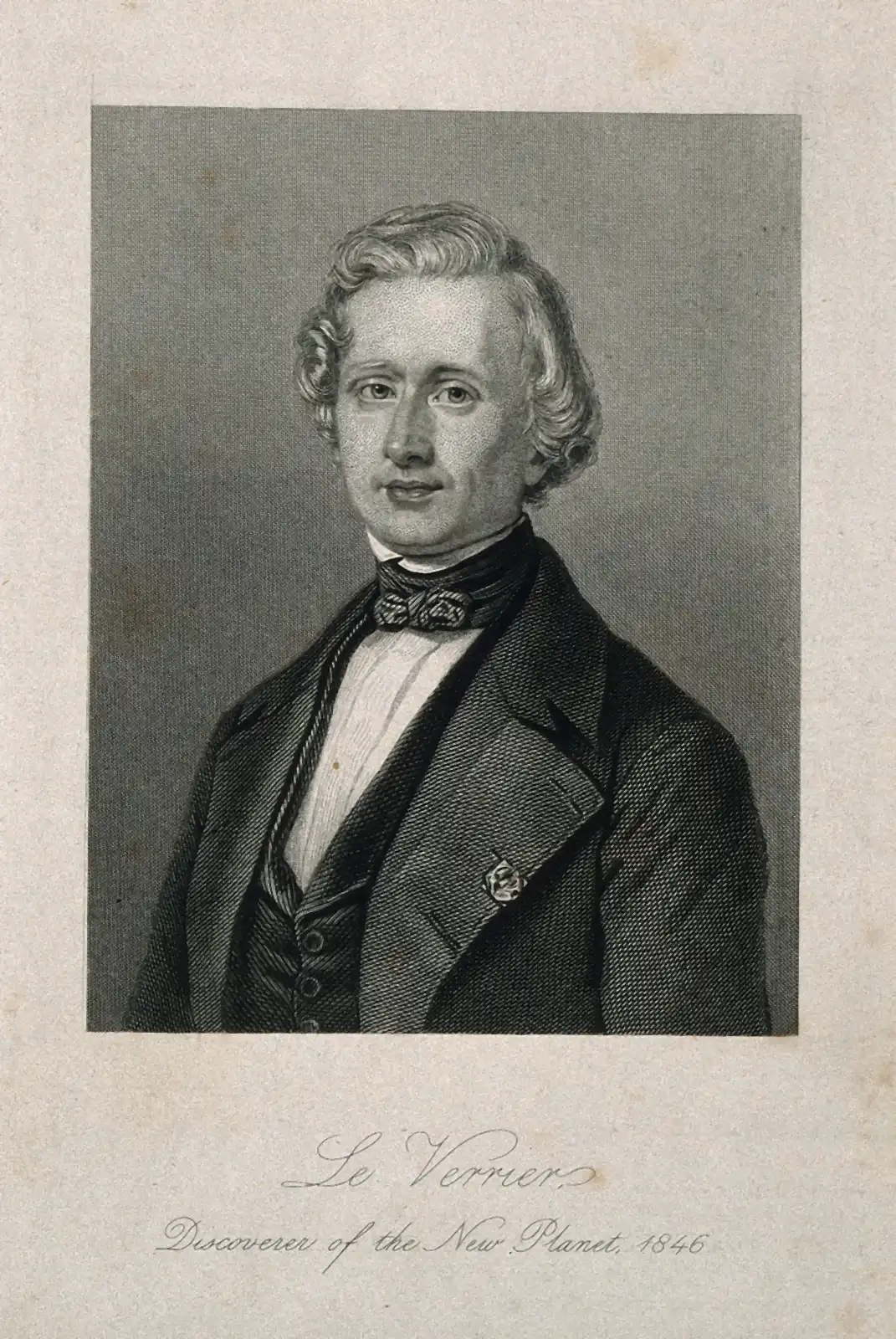
On Monday 12 September 1859 a letter was read to the Academy of Sciences in Paris. Its author was Urbain Le Verrier, director of the Paris Observatory, the man whose calculations had led to the discovery of Neptune thirteen years before.
He had gone through twenty-one observations of Mercury crossing the face of the Sun, from 1697 to 1848, and found that they could all be made to fit, to within a second, only if the point of Mercury's orbit nearest the Sun turned a little faster than the known planets could make it turn. "It was enough," he wrote, in translation, "to increase the secular motion of the perihelion by 38 seconds."
Thirty-eight seconds of arc in a century. About the width of a coin seen from 135 metres, spread over a hundred years.
Something unknown, he concluded, was acting on Mercury. A single planet would need to be about as massive as Mercury, and then, he asked, how could it never have been seen, shining near the Sun at an eclipse or crossing its disc? His own preference was a swarm: "all the difficulties would disappear," he wrote, if instead of a single planet there were "a series of small bodies circling between Mercury and the Sun."
Three months later he had a letter, dated 22 December 1859, from Orgeres, a village in the department of Eure-et-Loir.
The doctor's dot
Its writer was Edmond Modeste Lescarbault, the village doctor, who had watched Mercury cross the Sun in May 1845 and had wanted ever since to search the Sun's edge for other dark bodies; from 1858 he had watched seriously, from a terrace. On 26 March 1859, he wrote, using a refractor with a 10-centimetre lens at about 150 magnifications, he had seen "a black point with a sharply defined circular outline" move onto the Sun and across it, and timed it: 1 hour, 17 minutes and 9 seconds from entry to exit. It was round, black and small, well under a quarter of Mercury's apparent size.
Le Verrier went to see him at once, without warning. They arrived on Saturday 31 December. What he found, he told the Academy on 2 January 1860, was "a man long devoted to the study of science, surrounded by instruments and apparatus of every kind, building them himself," who had had a small revolving dome built. Lescarbault had not seen the dot enter the disc, Le Verrier noted: it was already a few seconds in when he spotted it. But his explanations brought Le Verrier "the entire conviction" that the observation "must be admitted into science."
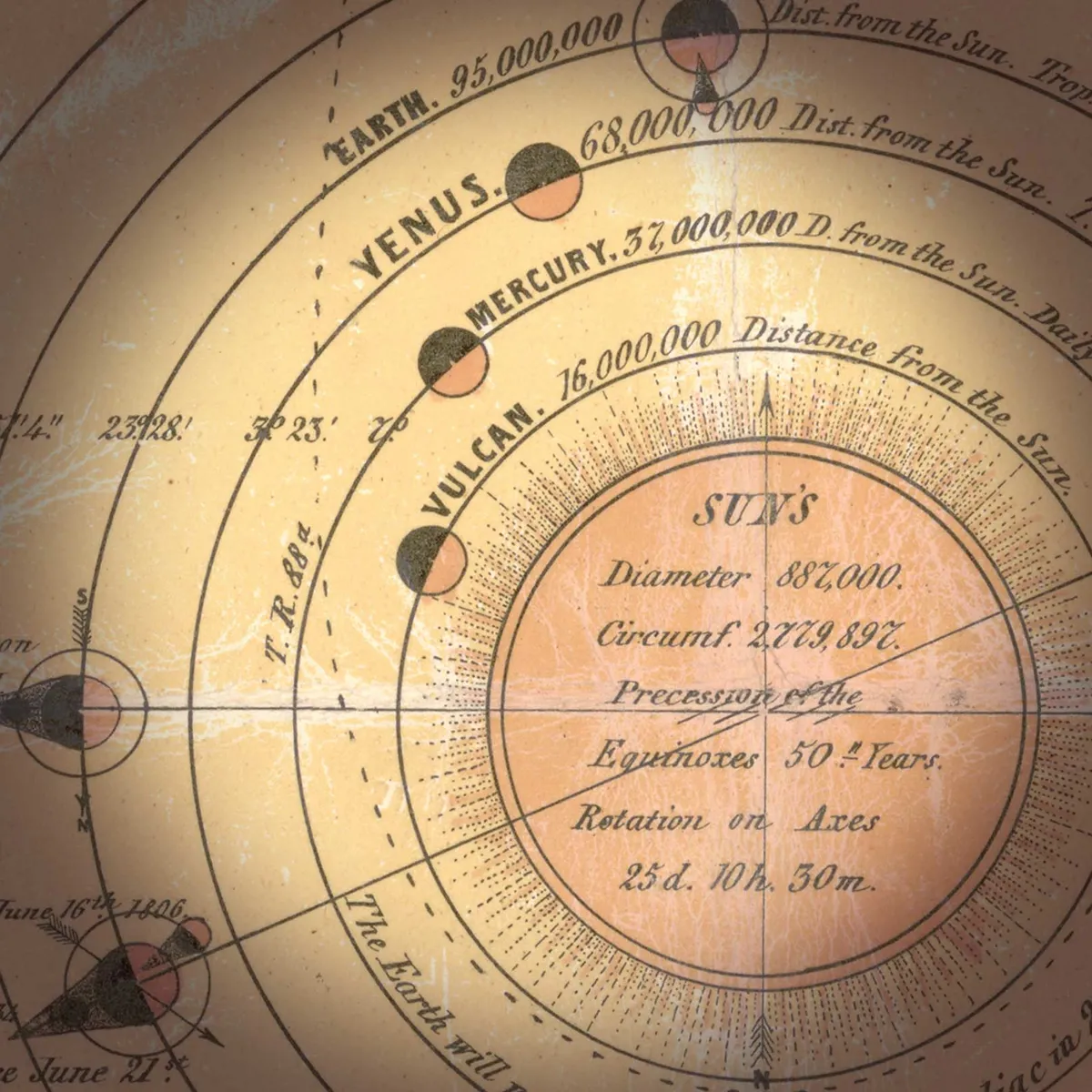
According to the historian Thomas Levenson, Le Verrier secured the doctor the Legion of Honour within the month. Who chose the name Vulcan is not recorded; an American lithograph of 1846 had already labelled a "Vulcan" in the space inside Mercury.
A planet the arithmetic required
Read at full strength, Vulcan was the best-supported unseen planet of the nineteenth century.
The anomaly was real. Le Verrier's 38 seconds came from a century and a half of the most precise timings astronomy had, and in 1882 the American Simon Newcomb, going over all the transits of Mercury from 1677 to 1881, found it larger, not smaller: "greater by 43''". Something was moving Mercury.
The method was proven. Le Verrier had used exactly this reasoning, an orbit that would not fit, to find Neptune in 1846.
And the planet was seen. Le Verrier worked Lescarbault's numbers into an orbit: a world circling the Sun in about 19.7 days, never more than 8 degrees from it, which is why it would be so hard to find. The Swiss astronomer Rudolf Wolf matched the date to older reports of dark spots crossing the Sun. In 1876 Le Verrier himself, gathering five such sightings, worked out a period and asked whether a transit might come in the spring of 1877.
Then the eclipse of 29 July 1878 crossed the American West. At his station in Wyoming, James Craig Watson of Ann Arbor saw near the darkened Sun "a star ... which shone with a ruddy light and certainly had a larger disc than the spurious disc of a star", where he knew no star should be. At Denver, Lewis Swift saw two objects "as red as Mars". "That one or both are intra-Mercurial planets," Swift wrote, "I have no doubt whatever." The astronomer Charles Young wrote in September that Vulcan appeared "at last to have been fairly run down and captured."
If the doctor saw a world
Set aside, for a moment, whether it is true. Ask the larger question. What kind of solar system is it, if Vulcan is there?
It would mean the Sun keeps a planet in its own glare, a world baked by a light many times fiercer than Mercury's, racing around in less than three weeks and hidden from every telescope except in the minutes of an eclipse.
It would mean the old method had not failed. The orbit that would not fit would have pointed, as with Neptune, to a body nobody had yet seen, and every irregular wobble in the heavens would remain an invitation to find another.
It would mean something about us. A village doctor with a home-made cardboard circle would have seen from his terrace what the observatories missed, a first glimpse of a family of bodies hidden in the Sun's glare, even if, as Le Verrier's own sums showed, the one he saw was too small to do the work alone.
And it would leave one question in front of us. If Vulcan, or Le Verrier's swarm, were real, it would still be circling inside Mercury now, and the question of whether today's solar telescopes could catch it would be a live one.
Liais, Newcomb and Einstein
The standard account begins in Brazil, in March 1860.
Emmanuel Liais, a French astronomer then working in Brazil, had been measuring the Sun's brightness from a station on the Bay of Rio de Janeiro on 26 March 1859, in series that by his account covered the time of Lescarbault's transit. He saw nothing. "I am therefore in a position to deny in the clearest and most positive way," he wrote to the journal Astronomische Nachrichten, "the passage of a planet across the Sun at the hour given." He went further, arguing that Lescarbault's timing of an entry he had not seen was too precise to be honest, and that the record was "partly made up afterwards."
Le Verrier's own numbers told against the doctor's planet. Even as he endorsed the observation, his calculation gave the body a mass only about a seventeenth of Mercury's, "much too small," he wrote, to produce the whole of the anomaly.
Watson and Swift did not agree on positions or on the number of objects; Swift himself allowed that one might be the star theta Cancri, and Watson admitted that a gust of wind might have shifted his telescope. In 1882 Newcomb, who had measured the anomaly at 43 seconds, judged that any body massive enough to cause it "seems to be out of the question": it would be conspicuous at every eclipse.
And on 18 November 1915 Albert Einstein told the Prussian Academy of Sciences in Berlin that his new theory of gravity, general relativity, gave Mercury's perihelion an advance of 43 seconds a century with no added body at all. "This means full agreement," he wrote. His paper does not mention Vulcan.
What Lescarbault saw
The planet was not found. Einstein's arithmetic needs no planet, and no solar telescope of the century since has caught one.
But relativity explains the 43 seconds. It does not explain the doctor. Lescarbault reported something, timed to the second, and the man who inspected him, the most demanding astronomer in France, came away convinced he had seen it. Liais's charge that the record was made up afterwards rested on the precision of a timing, not on any document.
And here is the strange part. The dot Lescarbault described crossed the Sun in an hour and seventeen minutes, and the orbit Le Verrier worked out was built from those same figures, so it could check their consistency but not their truth. Either his times were wrong, or something small and dark did cross the Sun that afternoon, or the record is not what it seems. Each of those is a claim about one man's afternoon, and none has been proved.
The eclipse objects of 1878 have a usual answer, the stars theta and zeta Cancri misplaced in the excitement of totality, though it rests on reconstructions; Swift raised theta Cancri himself, and Watson allowed that a gust may have shifted his telescope. But Watson did not back down. "The records of my circles cannot be impeached by all the negative evidence in the world," he had written.
Inside the orbit of Mercury
Where it stands now: there is no Vulcan. The anomaly that called it into being is one of the founding confirmations of Einstein's theory. The search for anything inside Mercury's orbit, according to Patrick Moore, was given up after the eclipse of 1929.
The papers survive. Le Verrier's letter of 1859 and Lescarbault's of 1859, with Le Verrier's report of his visit, are in the Comptes rendus of the Academy, printed and scanned. Watson's account and Swift's letter are in the American Journal of Science for 1878.
What does not survive in print is the record Lescarbault made at his eyepiece that afternoon, the times as he first wrote them down. Only that could show whether they were taken at the telescope or rebuilt afterwards. Whether it still exists, in an archive in the Beauce or anywhere else, is not in any source Official X could open.
So the planet is gone, and the afternoon of 26 March 1859 is not.
Questions This Leaves You With
Is there anything a person actually does with this?
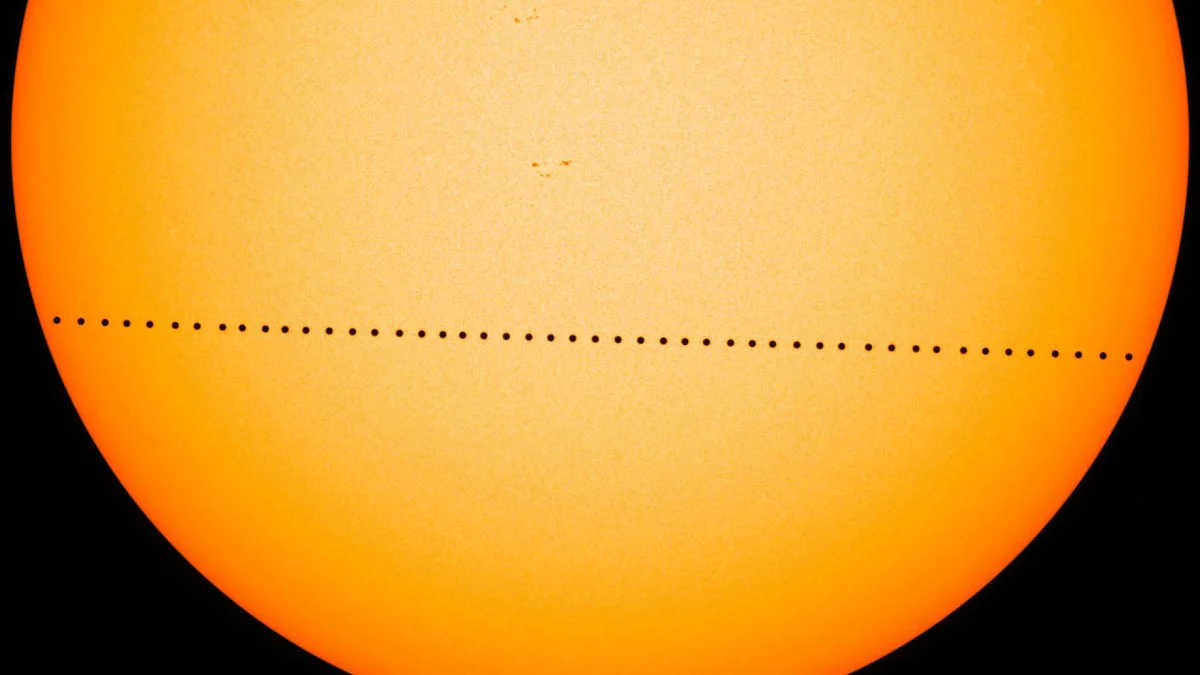
Nothing for your own week: there is no Vulcan to watch for, and the 43 seconds are accounted for. Mercury itself still crosses the Sun from time to time, as it did on 9 May 2016 in front of NASA's Solar Dynamics Observatory, and a safely filtered telescope shows a real planet doing what Lescarbault said he saw. What the story offers is a method of doubt. Le Verrier had the anomaly right and the cause wrong, and the cause he would have reached for again, an unseen mass, had worked for him once before. A correct measurement can point to a wrong explanation for decades. Anyone selling a date is selling something; Vulcan's believers were selling only patience.
Does this sit against a religious account of the world?
It can be read either way, and thoughtful people have read it both ways. One reading sees a universe so lawful that a 43-second discrepancy could only be resolved by a deeper law, which is a kind of order. Another sees how readily even the best minds find what they expect, and takes that as a caution about any confident account of the heavens. Neither is an astronomer's conclusion. Einstein's answer, gravity as the shape of space and time, has been read as a deeper order by some and as a loss of the old clockwork by others. This site will not tell you which way it falls.
Does this change what a human life is?
Lescarbault was a village doctor whose one great observation was accepted by the greatest astronomer of his day and then doubted by others. On one reading that is a small life swallowed by a mistake. On another it is a remarkable one: a man in a farming village who built his own instruments, watched the Sun for years in case something crossed it, and was taken seriously by the Academy of Sciences. Which did you feel?
What would change your mind, in either direction?
Name it now. Toward Lescarbault: his original notes, if found, with times that look taken at the eyepiece, or a small body found inside Mercury's orbit by modern instruments. Toward error or invention: notes that show the times worked out afterwards. Liais's logs would help less than they seem: his photometry might not have shown a dot a fraction of Mercury's size. Any of these would move the argument; none would end it alone.
What crossed the Sun at Orgeres?
This is the open problem. Relativity removed the need for Vulcan; it did not tell anyone what a careful observer saw on 26 March 1859. The usual candidates, a sunspot, a misreading, an invention, each run into a difficulty: the timing, the inspection, the absence of proof. A small asteroid crossing the Sun is possible in principle and unrecorded in fact. Nobody has found the doctor's original notes, and without them the afternoon stays open.
Sources
- U. Le Verrier, Lettre a M. Faye sur la theorie de Mercure et sur le mouvement du perihelie de cette planete (Comptes rendus 49, 379-383, 12 September 1859) Academie des sciences, via Internet Archive (Biodiversity Heritage Library scan) Primary record
- E. Lescarbault, Passage d'une planete sur le disque du Soleil, observe a Orgeres, with Le Verrier's remarks (Comptes rendus 50, 40-46, 2 January 1860); and R. Wolf, letter on earlier passages (Comptes rendus 50, 482-483) Academie des sciences, via Internet Archive (Biodiversity Heritage Library scan) Primary record
- Thomas Levenson, The Hunt for Vulcan (excerpt, Random House, 2015) Science Friday Study
- Solar system lithograph, E. Jones and G. W. Newman, 1846 (Library of Congress g3180.ct003790) Library of Congress via Wikimedia Commons Primary record
- Simon Newcomb, Discussion and Results of Observations on Transits of Mercury, from 1677 to 1881 (Astronomical Papers 1, 1882) US Nautical Almanac Office, via Internet Archive Primary record
- U. Le Verrier, Note sur les planetes intra-mercurielles (Comptes rendus 83, September-October 1876) Academie des sciences, via Internet Archive Primary record
- J. C. Watson, Discovery of an Intra-Mercurial Planet, and C. A. Young, Results of the Recent Eclipse (American Journal of Science 16, September 1878) American Journal of Science, via Internet Archive Primary record
- L. Swift, letter on intra-Mercurial planets, and J. C. Watson, On the Intra-Mercurial Planets (American Journal of Science 16, October 1878) American Journal of Science, via Internet Archive Primary record
- E. Liais, Sur la nouvelle planete annoncee par M. Lescarbault (Astronomische Nachrichten 52, no. 1248, 1860) Astronomische Nachrichten, via Internet Archive Primary record
- A. Einstein, Erklarung der Perihelbewegung des Merkur aus der allgemeinen Relativitatstheorie (Sitzungsberichte der Preussischen Akademie, 18 November 1915) Prussian Academy of Sciences, via Internet Archive Primary record
- Patrick Moore, review of Baum and Sheehan, In Search of Planet Vulcan (Journal of the British Astronomical Association 107, 1997) British Astronomical Association Study
- Mercury transit of 9 May 2016, composite (NASA Goddard / SDO) NASA via Wikimedia Commons Primary record