
Project Mogul was a Top Secret Army Air Forces project of the late 1940s that flew long trains of balloons and radar reflectors over New Mexico, built to listen high in the atmosphere for Soviet nuclear tests. In 1994 the Air Force named one of its flights as the source of the debris found on a ranch near Roswell in 1947. No NYU report lists the flight it named; the Air Force reads one line in a scientist's journal as its launch.
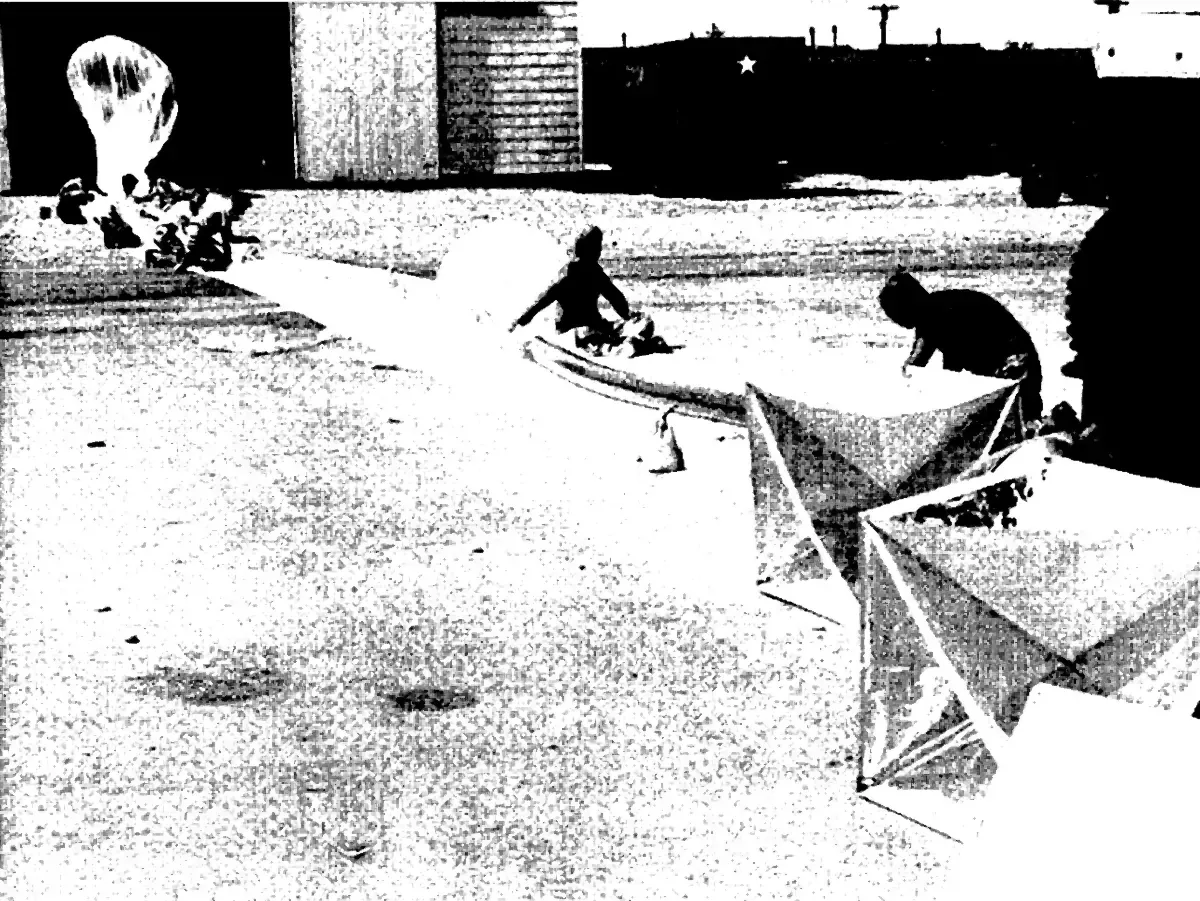
Seen from the ground, a Mogul train was a string of balloons strung out one above another, with kite-like radar targets of foil and wood hanging on the line between them.
The Air Force's 1995 book on Roswell printed a photograph of one, with a caption: these components "can be compared with the debris recovered from the Foster ranch."
The flight the Air Force chose was number 4. In the journal, it has no number.
A congressman asks for the files
The search began with a question from New Mexico. In January 1994 the Washington Post reported that Representative Steven Schiff, a New Mexico Republican, meant to have the General Accounting Office find the government's records of the Roswell event. Schiff had first been told the case was part of the Air Force's old UFO study, Project Blue Book, and then learned from the National Archives that it was not; the Air Force's own report says he apparently felt he had been "stonewalled." On 15 February 1994 the GAO formally notified the Secretary of Defense.
The Air Force ran its own search alongside. Col. Richard L. Weaver, its director of security and special program oversight, dated his report 27 July 1994: Report of Air Force Research Regarding the "Roswell Incident." On 8 September the Secretary of the Air Force, Sheila Widnall, announced it. Its finding: "the material recovered near Roswell was consistent with a balloon device and most likely from one of the Mogul balloons that had not been previously recovered."
Weaver also found that the event "was not even considered a UFO event until the 1978-1980 time frame," and that there had been "overreaction by Colonel Blanchard and Major Marcel." The morning of 8 July and the release itself are the subject of the Roswell press release of 1947.
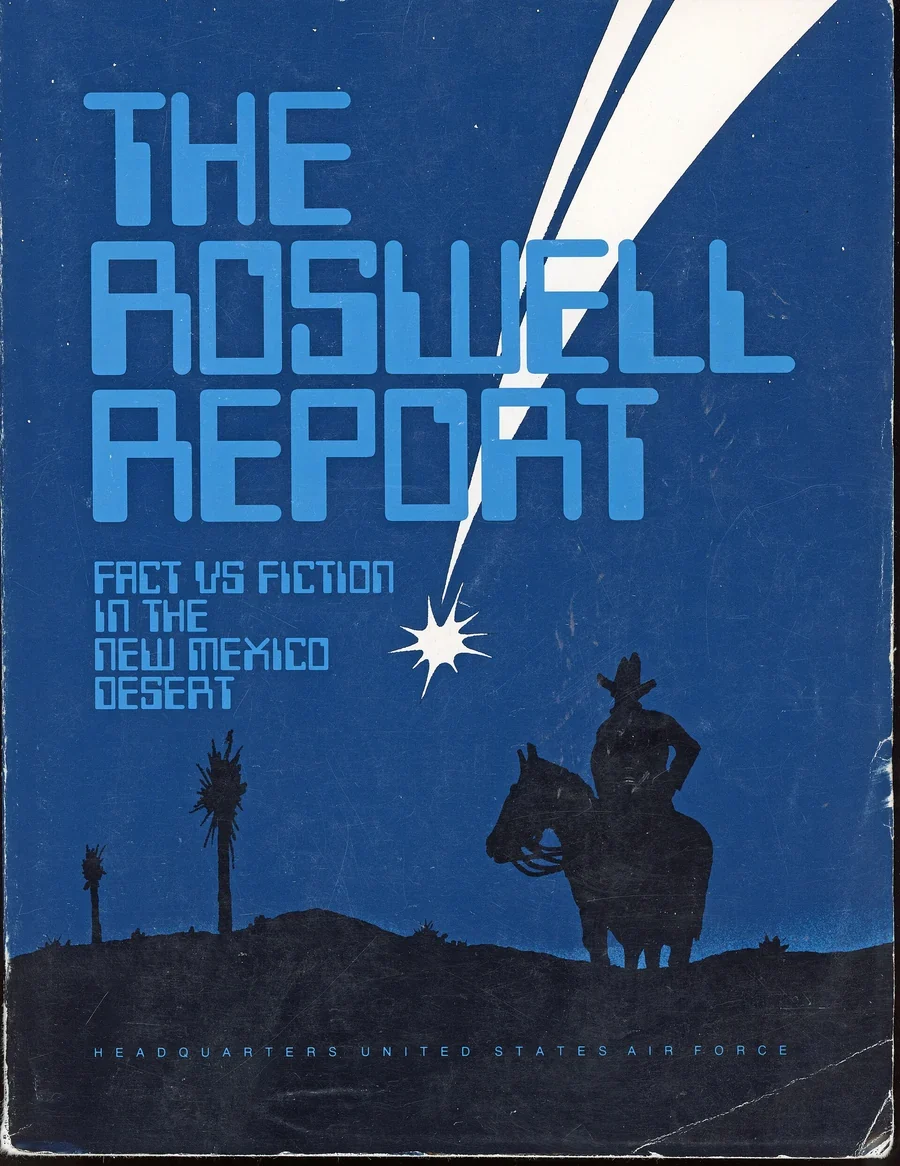
In 1995 the Air Force printed the report with its attachments as a book, The Roswell Report: Fact versus Fiction in the New Mexico Desert, by Weaver and 1st Lt. James McAndrew. In July 1995 the GAO reported to Schiff. Some Roswell Army Air Field records, it found, had been destroyed, among them the base's outgoing messages from October 1946 to December 1949, and "the document disposition form does not indicate what organization or person destroyed the records and when or under what authority the records were destroyed."
Flight 4
Mogul's purpose, McAndrew wrote, was "to develop a long-range system capable of detecting Soviet nuclear detonations and ballistic missile launches." The balloon group from New York University flew its trains from Alamogordo Army Air Field, across the mountains from Roswell. The 509th at Roswell, McAndrew wrote, had high clearances but "were not privy to the existence of MOGUL; their job was to deliver nuclear weapons, not to detect them."
The NYU group numbered its flights. Its reports list flights 1, 5, 6, 7, 8 and 10. Flights 2, 3 and 4 are missing. Weaver's report calls these unlogged "service flights," citing Charles B. Moore, the group's project engineer in 1947 and by 1994 a professor emeritus of atmospheric physics. "I think that Flight #4 was the flight that was launched out of Alamogordo on June 4, 1947," he wrote in a signed statement in June 1994. "This is based on Dr. Crary's actual diary."
Albert Crary was the project's field director. His widow gave his journal to the Air Force, and it was printed in the 1995 book. The entry for Wednesday 4 June 1947 reads, in the faint typed scan: "No balloon flights again on account of clouds. Flew regular sono buoy up in cluster of" - the next word cannot be read - "and had good luck on receiver on ground but poor on plane." The next day's flight was recovered "some 25 mi east of Roswell."
Weaver called it "very probable" that Flight 4 "came to rest some miles northwest of Roswell, NM, became shredded in the surface winds, and was ultimately found by the rancher, Brazel, ten days later." McAndrew's synopsis gave the reasons, concluding "with a great degree of certainty": the debris as Brazel, Cavitt and the Fort Worth photographs showed it matched a Mogul service flight; Brazel dated his find to 14 June, which ruled out the July flights; and of the unlogged flights only 3 and 4 were candidates, and Flight 3, launched on 29 May, came before Moore arrived on 1 June with his radar reflectors.
In 1994 Moore remembered the reflectors' reinforcing tape, printed with "arcs, flowers, circles and diamonds" in pink, which matches the tape "with flowers printed upon it" that Brazel described in July 1947. And Moore said: "When we heard the news back in New York, we joked that they probably found one of our balloons."
If Flight 4 was not a Mogul train
Set aside for a moment whether the Air Force is right. Ask the larger question. What would it mean if what went up on 4 June was not the train the Air Force describes?
It would mean the most detailed official explanation of Roswell rests on a balloon train that no record shows was launched as a train.
It would mean the debris on the Foster ranch still has no identified source, fifty years after the Army first called it a balloon, and that the Air Force, given a congressman's request and full access to its own files, did not find one.
It would mean the secrecy of Mogul, real as it was, explains why the officers at Roswell did not know what they had, but not what they had.
And it would leave a question still open: if not a Mogul train, what else was in the sky over Lincoln County in June 1947, and where are its papers?
What the journal says
The critics start with Crary's own words for 4 June. "No balloon flights again on account of clouds." The researcher David Rudiak reads the entry as a cancellation: the full train did not fly, and what went up was a sonobuoy on a cluster of balloons, a small test of the receiver. "ALL flown constant-altitude flights were recorded," he argues. Kevin Randle, co-author of two books on the case, quotes Moore's own phrase for it, "the jury-rigged flight #4," and concludes it "did not contain any rawin targets and it did not fall on the Brazel ranch." Stanton Friedman wrote in 1997 that "the Mogul explanation doesn't fit."
The journal does not use the words "Flight 4." It does not say "cancelled" either; that is the critics' word. It records no launch time for the cluster, no tracking and no loss. Moore assigned the number in 1994. In his interview with the Air Force that June he dated the flight "something like June 2nd or 3rd," and in his signed statement the same day, June 4. McAndrew's synopsis has "cluster of (meteorological) balloons"; the parentheses are his.
Where it came down rests on reconstruction. McAndrew placed it "on the plains east of the Sacramento Mountains, about 70 miles from the launch point," and Moore later worked out a trajectory for it. Rudiak argues that the trajectory used rise rates Moore adjusted, and that a correct calculation puts the balloons "well north of Roswell." Randle writes that Moore acknowledged a minor change in one of the variables could have placed the array 150 miles away.
On the other side, the materials fit. Brazel in 1947 described rubber, foil, tough paper, sticks and flowered tape; Mogul's radar targets, in the Air Force's description, were aluminized paper glued and taped to balsa wood frames. Cavitt and Newton, the two officers who handled the debris and gave the Air Force statements in 1994, described foil, sticks and a radar target. And Mogul balloons did come down near Roswell that June: Crary recorded the 5 June flight landing east of it.
Dummies and the bodies
The Air Force's second book came in 1997. The Roswell Report: Case Closed, by Capt. James McAndrew, addressed the stories of bodies told by later witnesses. "'Aliens' observed in the New Mexico desert were probably anthropomorphic test dummies that were carried aloft by U.S. Air Force high altitude balloons," it concluded. From 1953 to 1959 the Air Force flew dummies in Projects High Dive and Excelsior; "forty-three high altitude balloon flights carrying 67 anthropomorphic dummies were launched and recovered throughout New Mexico between June 1954 and February 1959." Claims of bodies at the base hospital, it said, were most likely a 1956 KC-97 crash that killed eleven airmen and a 1959 balloon accident.
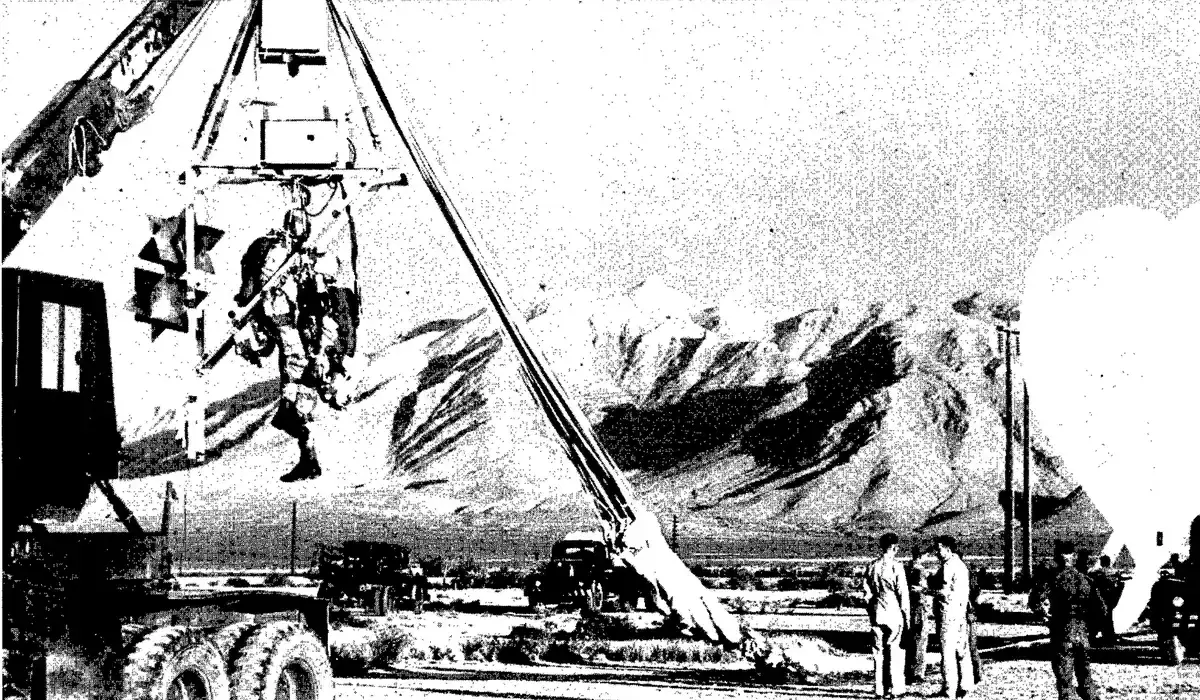
The report's own phrase for the gap was that events of many years had been "consolidated and are now represented to have occurred in two or three days in July 1947." Friedman's answer was short: "none were dropped earlier than 6 years AFTER the 1947 events." The dummies explain, at most, later memories. They say nothing about July 1947, which the Air Force left to Mogul.
What the files do not reach
The two reports and the GAO search answer some questions and leave others.
Whether the 4 June cluster carried radar reflectors or only a sonobuoy, nothing written at the time says. Where it landed, nothing written at the time says. The case for Flight 4 is that it was the right kind of object, in the air at the right time, from the right place; the case against is that no paper of 1947 follows it out of Alamogordo.
What the destroyed Roswell records held, and who destroyed them, the GAO could not say. Its chief archivist said that, from his own experience, many Air Force records of the period had been destroyed without the authority being written down, and the GAO's review of forms for other records, including the base's outgoing messages for 1950, bore that out. That is a reason to think the loss was routine. It does not tell us what the messages said.
And why the base announced a "flying disc" on 8 July, Weaver wrote in 1994, "research failed to locate any documented evidence as to why that statement was made."
The last report
Weaver recommended that his report "serve as the final Air Force report related to the Roswell matter." Three years later there was another one, and the larger claim it answered, of craft and bodies held by the government, has come back since, as in the testimony of David Grusch in 2023.
What the record holds is a project that was real and secret, balloons that did come down near Roswell, and a debris list that matches their materials. What it does not hold is a launch record for the one flight said to have done it, or the base's messages from that summer. The Air Force's answer is a strong reconstruction. It is still a reconstruction, built forty-seven years after the event from one diary entry that says both "no balloon flights" and that a sonobuoy went up in a cluster.
Questions This Leaves You With
Is there anything a person actually does with this?
Not with your own life, honestly. A balloon flight of 1947 changes nothing in your next ten years, and anyone who sells you urgency about it is selling something. The larger question is how far an official reconstruction should be trusted when the papers it needs are missing. That question is open in every inquiry into an old event, and it is not yours alone to answer. What you can do is notice, when an official finding is offered, which parts rest on documents from the time and which on memory and calculation.
Does this sit against a religious account of the world?
It can be read both ways, and serious people have read it both ways. Some readers hold that a universe made by God may well hold other life; others find the idea troubling; many find nothing in a balloon project that touches what they believe. This site will not tell you which way it falls for you. The argument over Flight 4 is about a diary, a trajectory and some foil.
Does this change what a human life is?
Hold your own life against the scale in this story: a secret project to hear atomic bombs on the far side of the world, and a few pounds of foil on a ranch. One way of seeing it makes a life smaller; a joke Moore remembered from 1947 became an Air Force finding forty-seven years later. The other makes it larger; a widow's gift of her husband's diary is the closest record to the event either side has. Which did you feel?
What would change your mind, in either direction?
Name it now, before you are committed, because it is harder later. Toward Flight 4: an NYU or Air Materiel Command record from June 1947 describing the 4 June launch, with radar targets, its tracking or its loss. Toward another source: a record of some other device lost over Lincoln County that June, or the base's outgoing messages for July 1947, if any copy survives. Notice that both sides are waiting for paper from the same few weeks, and that neither paper has yet turned up in an archive anyone has opened.
What went up on 4 June?
This is the real gap. Crary recorded that a sonobuoy flew. He wrote that the balloon flights were off, and that a sonobuoy went up in a cluster of something, and then he wrote about the radio reception. Moore, who was there, gave the Air Force his best memory forty-seven years later and named it Flight 4. The word after "cluster of" cannot be read in the copy the Air Force printed; McAndrew read the line as a cluster of balloons. The original page would settle it.
Sources
- The Roswell Report: Fact versus Fiction in the New Mexico Desert (1995), with the Weaver report of 27 July 1994 Headquarters United States Air Force (R. L. Weaver, J. McAndrew) Primary record
- For the Record: Air Force Report on the Roswell Incident, Skeptical Inquirer, Jan/Feb 1995 Skeptical Inquirer, reprinting Air Force release No. 255-M of 8 September 1994 Primary record
- Government Records: Results of a Search for Records Concerning the 1947 Crash Near Roswell, New Mexico, GAO/NSIAD-95-187 (28 July 1995) U.S. General Accounting Office Primary record
- The Roswell Report: Case Closed (1997) Capt. James McAndrew, Headquarters United States Air Force Primary record
- The Phony Mogul Balloon Trajectory (2002, updated 2024) David Rudiak Study
- Mogul Flight No. 4 - The End (2022) Kevin Randle, A Different Perspective Study
- Scientists Challenge Air Force Regarding UFOs (1997) Stanton T. Friedman; The Black Vault Study