
The paper is called "Planet X: No Dynamical Evidence in the Optical Observations". It appeared in The Astronomical Journal in May 1993, under the name of E. Myles Standish, Jr., of the Jet Propulsion Laboratory in Pasadena, who led its planetary ephemerides, the tables of where the planets are. It runs to seven pages of text and plotted residuals.
On its first page is a small table. It lists the masses of the four giant planets in an odd unit: how many times the planet goes into the mass of the Sun. For Neptune, the old standard figure is 19,314.0. Beside it is the figure measured by Voyager 2 when it flew past Neptune in 1989: 19,412.240. The bigger the number, the lighter the planet.
The difference is about half of one percent.
Since Percival Lowell's day, astronomers had looked for a planet beyond Neptune because Uranus seemed to wander from its predicted path by a fraction of a second of arc.
This is the paper that took the half percent off Neptune.
Weighing Neptune
The method was the oldest triumph in the field. Uranus, found by William Herschel in 1781, drifted from its calculated orbit, and in 1846 the drift led astronomers to Neptune. Before Neptune was allowed for, Standish wrote, the residuals in Uranus's position "had amounted to dozens of arcseconds". After, they "shrank to only a fraction of an arcsecond".
Not quite to nothing. And from that fraction grew a century of searches. Percival Lowell's Planet X came from it, and so did Pluto's discovery in 1930, though Pluto turned out far too small to be the cause. The residuals stayed.
At the US Naval Observatory in Washington, Robert Harrington kept the question alive. He worked on it first with Tom Van Flandern; with Kenneth Seidelmann he reviewed "Planet X: The current status" in 1987; in 1988 he published "The Location of Planet X" in The Astronomical Journal. The Planetary Society describes him as having become "a believer in the existence of a Planet X beyond Pluto". He undertook searches for it.
The weak point was known before anyone fixed it. In 1986 a University of Tennessee thesis, written under the astronomer Conley Powell, tried to predict a planet from Uranus's residuals and found that "the mass uncertainty of the planet Neptune" introduced errors which "rendered the procedure developed here unusable". A prediction, it concluded, "will not be feasible before 1989".
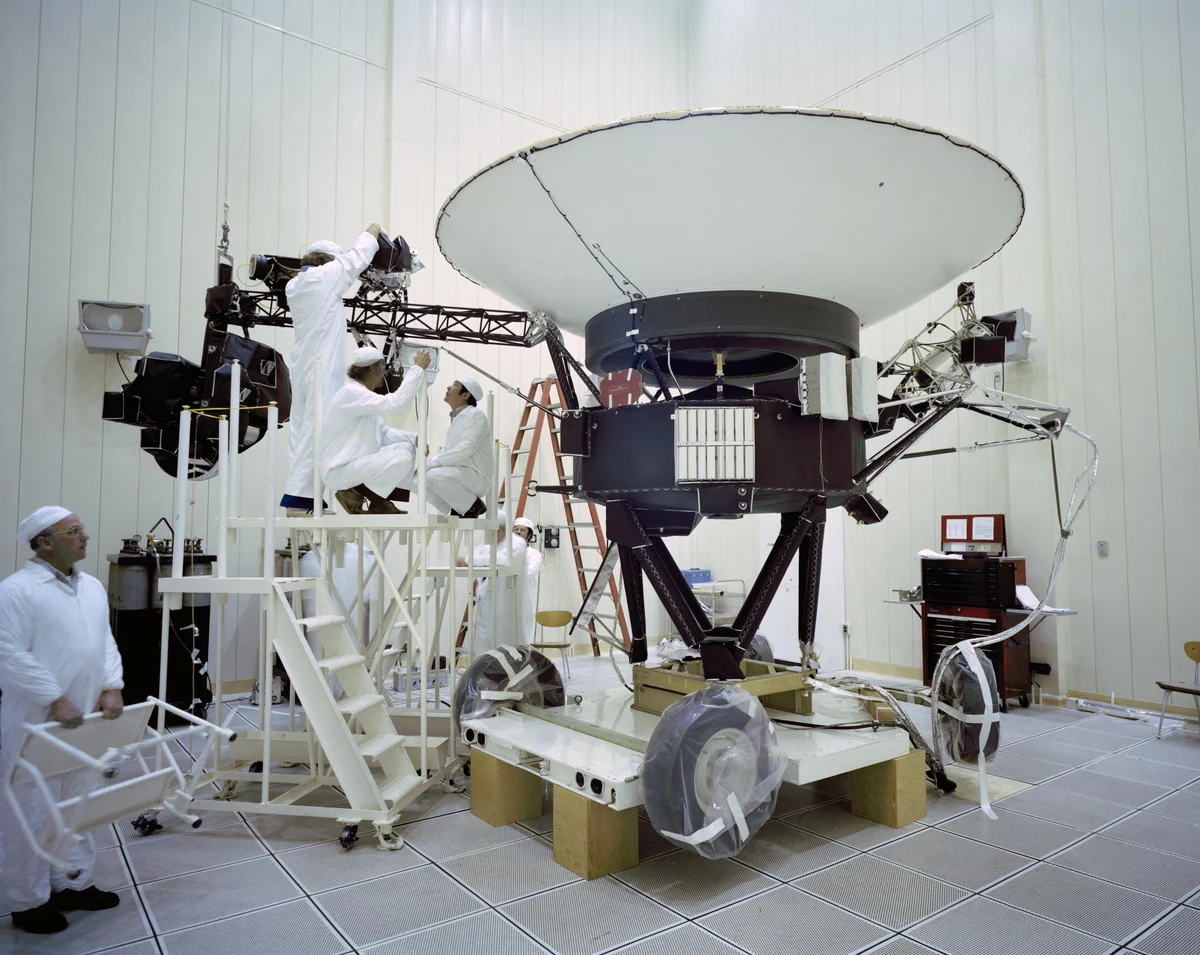
1989 was the year Voyager 2 arrived. On 25 August it passed about 4,800 kilometres above Neptune's cloud tops, and its radio science team, led by G. L. Tyler, measured the masses of Neptune and its moon Triton. They published in Science that December.
Standish took the new mass, and ran the orbit of Uranus again.
The case for the tenth planet
Before 1993, the case for a Planet X was not a fringe case. It was the classical method of celestial mechanics, applied by professional astronomers in the leading journal of the field.
The logic was clean. Neptune had been found by the residuals of Uranus. Pluto had been found in the search for a planet the residuals implied, but Pluto was too light to cause them, so the cause was still out there. Standish's own paper lists the predictions the residuals had produced: Harrington in 1988, Gomes and Ferraz-Mello in 1988, Gomes in 1989, Powell in 1989, Brunini in 1992. Brunini also proposed, the paper notes, a collision of Uranus with a body a thousand kilometres across.
The residuals of the Lowell era, by the later reckoning of Konstantin Batygin and colleagues, implied a planet of about seven Earth masses, and Harrington undertook searches for such a planet.
And even after Standish, Harrington did not concede. "It is true that if you put in the new mass of Neptune, some of the key residuals in Uranus do decrease," he told the science writer Ken Croswell for New Scientist. "But in my opinion it is not correct to say that they disappear entirely." He had always put the odds of a Planet X, Croswell reported, at no better than 50-50.
The article appeared on 30 January 1993. Harrington had died a week earlier, on 23 January, aged 50.
If the wobble was real
Set aside, for a moment, whether it is true. Ask the larger question. What kind of solar system is it, if Harrington was right?
It would mean the solar system has a member as large as a small giant planet that two centuries of telescopes have not seen, revealed only by the faint tug it leaves on the path of Uranus, as Neptune once was.
It would mean the map of the planets every child learns is still a draft. The arrangement we treat as finished, eight planets and a scatter of small bodies, would be missing a world many times the Earth's mass, and the edge of the solar system would sit further out than any diagram shows.
It would mean something about us, too. A species that had found Neptune with a pencil in 1846 would have failed to do it a second time not for lack of method but for lack of a single number measured well enough, the true weight of Neptune, and the moment that number arrived would have been the moment to look again.
And it would leave one question in front of us. The residuals Harrington defended are small, and old. If a planet were behind them, its pull would still be acting on Uranus, and modern tracking of the planets would be the place to look for it.
The paper's answer
The standard account is Standish's paper, and it is short.
Received by the journal on 16 July 1992 and published in May 1993, it takes the masses of the giant planets as Voyager measured them, adjusts the orbit of Uranus to fit the observations, and plots what is left. Before the last stage the residuals show structure. In the last, "the residuals ... have no appreciable structure; the 'anomalies in the motion of Uranus' have disappeared."
The abstract is blunter. The "unexplained anomalies in the motion of Uranus" disappear "when one properly accounts for the correct value of the mass of Neptune and properly adjusts the orbit of Uranus to the observational data". Each of the reported irregularities in Neptune's own positions "has a complete explanation within the framework of the presently known solar system." Small systematic errors remain, Standish wrote, easily explained by the observations themselves. Croswell's report pointed to measurements made between 1895 and 1905, most of the irregular ones from a single telescope. "There remains no need to hypothesize the existence of a tenth planet."
The field took it as settled. The American Astronomical Society's dynamical astronomers gave Standish their Brouwer Award in 2000, citing work showing "there is no dynamical evidence for Planet X". In 2019 Batygin and colleagues, reviewing the hunt for Planet Nine, wrote that the irregularities "were fully resolved by a 0.5% revision of Neptune's mass, following the Voyager 2 flyby".
What the residuals could never show
The anomalies were not found. Standish looked for them with Voyager's mass, and they were not there.
But the abstract closes on a sentence with a stated scope: "For the meridian circle observations, there is still no evidence which requires or even indicates the existence of any planet-sized object; there remains no need to hypothesize the existence of a tenth planet in the solar system." The scope is the point. Meridian circle observations: the positions of Uranus and Neptune, measured over two centuries, as they crossed the meridian at observatories on Earth. A planet that pulls on Uranus too gently to show in those positions, because it is small or very far away, was never within their reach. The paper closed the case built on Uranus. It could not close the sky.
And here is the strange part. The same abstract that buries Planet X names a new object in its place. "There is now known to be a mass concentration of significant size in the outer solar system - 1992 QB1." David Jewitt and Jane Luu had found it in August 1992, the first body seen beyond Neptune since Pluto. Standish called it "miniscule" beside the major planets. It was the first of a crowd.
The search for a planet beyond Neptune did not end in 1993. It changed its evidence. The cases made since, from the WISE survey to Planet Nine, rest on infrared light and on the orbits of small distant bodies, not on the path of Uranus.
A half percent
Where it stands now: Standish's result stands. In 2023 Gomes and colleagues asked a newer question in The Planetary Science Journal: whether the gravitational effect of a distant planet could be detected in current-era tracking of the known planets and small bodies. The method Lowell trusted is not dead. It needs better numbers, and the numbers are better now.
There is an irony in the record. In June 1978 James Christy found Charon at the Naval Observatory, in work with the same Robert Harrington, and NASA credits both men with the discovery: Charon, the moon whose orbit weighed Pluto and showed it far too light to be Lowell's planet. He helped close the first answer to the residuals, and spent the rest of his life looking for the second.
And in 1993 Neptune itself had not yet gone once around the Sun since it was found in 1846, Croswell noted. Its own path was still too short a record to carry much weight.
What is left of the old Planet X is a single figure in a small table: 19,314 against 19,412. One is the Neptune astronomers believed in for most of the twentieth century. The other is the Neptune Voyager weighed.
Everything that followed from the first figure, decades of searching included, followed from a scale that read half a percent heavy.
Questions This Leaves You With
Is there anything a person actually does with this?
Nothing for your own life, on any timescale. Uranus has gone round the Sun two and a half times since 1781, and the residuals in this story are measured in fractions of a second of arc. What it offers is a way of reading any claim built on a small discrepancy: before asking what is causing it, ask whether every known number feeding the calculation is right. The Planet X of the residuals was a real search built on one number nobody could yet measure well enough. Anyone selling a date is selling something.
Does this sit against a religious account of the world?
It cuts both ways, and both have been said by thoughtful people. One reading sees a universe that keeps faith with careful measurement: the anomaly vanished when the scales were set right, which is a kind of order. Another sees a warning about any certainty, scientific or otherwise, that rests on a figure nobody has checked. Neither is settled by Voyager. What the story does show is two astronomers, a JPL ephemeris maker and a Naval Observatory planet hunter, disagreeing in print over the same numbers and leaving the record for others to check. Which way it falls for you is not something this site will tell you.
Does this change what a human life is?
Robert Harrington searched for a planet he put at 50-50, and died a week before an article quoting his reply to Standish was printed. On one reading that is the smallness of a life against a question that outlasts it. On another it is what a life in science looks like at its best: holding a position honestly, in print, with the odds stated, while the evidence is still coming in. Which did you feel?
What would change your mind, in either direction?
Name it now. Toward a planet: a residual that survives in modern, high-precision tracking of the outer planets and spacecraft, pointing the same way in independent data. Toward none: the same tracking, run with ever better masses, staying clean. The 2023 study by Gomes and colleagues is the kind of test that could do either, within limits it states. Old meridian circle positions cannot settle it now; new tracking can narrow it.
How small a planet could still hide behind Uranus's path?
This is the open problem. Standish showed the old residuals need no planet. That does not say how large a planet could be, and how far, before its pull would show in the measurements astronomers now make. Gomes and colleagues forecast in 2023, from spacecraft ranging to Jupiter, Saturn and Mars, that a planet of five Earth masses at 400 AU should be detectable anywhere in the sky, but at 800 AU over only about 5 percent of it. Beyond that, the question is open, and it is a calculation, not a sighting.
Sources
- E. Myles Standish, Jr., Planet X: No Dynamical Evidence in the Optical Observations (The Astronomical Journal 105, 2000, May 1993) American Astronomical Society, via NASA ADS Primary record
- 2000 Brouwer Award Winner - E. Myles Standish AAS Division on Dynamical Astronomy Primary record
- Ken Croswell, Hopes Fade in Hunt for Planet X (New Scientist, 30 January 1993) Ken Croswell Study
- Konstantin Batygin, Fred Adams, Michael Brown and Juliette Becker, The Planet Nine Hypothesis (Physics Reports, 2019) arXiv Study
- Voyager 2 NASA Primary record
- G. L. Tyler et al., Voyager radio science observations of Neptune and Triton (Science 246, December 1989) NASA Technical Reports Server Primary record
- Robert Harrington The Planetary Society Study
- Deborah S. Brooks, A study of the perturbations on Uranus (MS thesis, University of Tennessee, 1986; major professor Conley Powell) University of Tennessee Primary record
- New Planet Found in the Outer Solar System (ESO press release eso9214, 2 October 1992) European Southern Observatory Primary record
- Daniel C. H. Gomes, Zachary Murray, Rafael C. H. Gomes, Matthew J. Holman and Gary M. Bernstein, Can the gravitational effect of Planet X be detected in current-era tracking of the known major and minor planets? (The Planetary Science Journal, 2023) arXiv Primary record
- P. K. Seidelmann and R. S. Harrington, Planet X: The current status (Celestial Mechanics 43, 1987) Springer Primary record
- R. S. Harrington, The Location of Planet X (The Astronomical Journal 96, 1476, 1988) American Astronomical Society Primary record
- Charon at 40: Four Decades of Discovery on Pluto's Largest Moon (2018) NASA Primary record