
On Tuesday 8 July 1947 the public information office at Roswell Army Air Field, in New Mexico, home of the 509th (Atomic) Bomb Group, as the wire called it, told the press that the Army had a flying disc. A rancher had found it, the release said, and the base's intelligence officer had collected it. By that evening, in Fort Worth, the Army had called it a weather balloon.
The wire carried it across the country within hours. The Bakersfield Californian put it under a banner across its front page, in letters taller than the baseball scores.
FLYING DISC FOUND; IN ARMY POSSESSION.
The story under it was a short column. It gave no description of the disc at all.
A release from the 509th
The words reached most readers through the Associated Press. The AP quoted the statement from the base: "The many rumors regarding the flying disc became a reality yesterday when the intelligence office of the" 509th "(atomic) Bomb Group of the Eighth Air Force, Roswell Army Air Field, was fortunate enough to gain possession of a disc through the co-operation of one of the local ranchers and the sheriff's office of Chaves county."
"The flying object landed on a ranch near Roswell sometime last week," it went on. "Not having phone facilities the rancher stored the disc until such time as he was able to contact the sheriff's office, which in turn notified Major Jesse A. Marcel." It ended: "It was inspected at Roswell Army Air Field and subsequently loaned by Major Marcel to higher headquarters."
The wire named the officer who issued it as "Lieutenant Warren Haught." His name was Walter Haut, a first lieutenant and the base's public information officer. The Bakersfield text also turned the 509th into the "Four Hundred Ninth." That is what the country read that day.
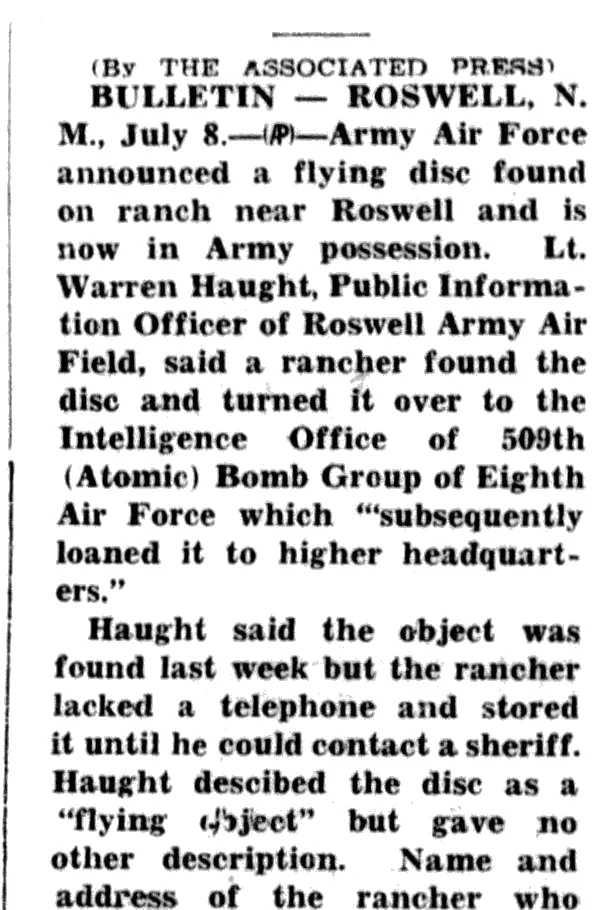
The Roswell Daily Record wrote its own story under the banner "RAAF Captures Flying Saucer On Ranch in Roswell Region." The intelligence office, it said, "announced at noon today, that the field has come into possession of a flying saucer," and "no details of the saucer's construction or its appearance had been revealed."
Then the debris went to Fort Worth, to the headquarters of the Eighth Air Force. By the next morning the AP was reporting from there that an examination "revealed last night that a mysterious object found on a lonely New Mexico ranch was a harmless high altitude weather balloon - not a grounded flying disc." Brig. Gen. Roger M. Ramey, commander of the Eighth, had "cleared up the mystery." The weather forecaster at the field, Warrant Officer Irving Newton, explained the targets: "we use them because they go much higher than the eye can see."
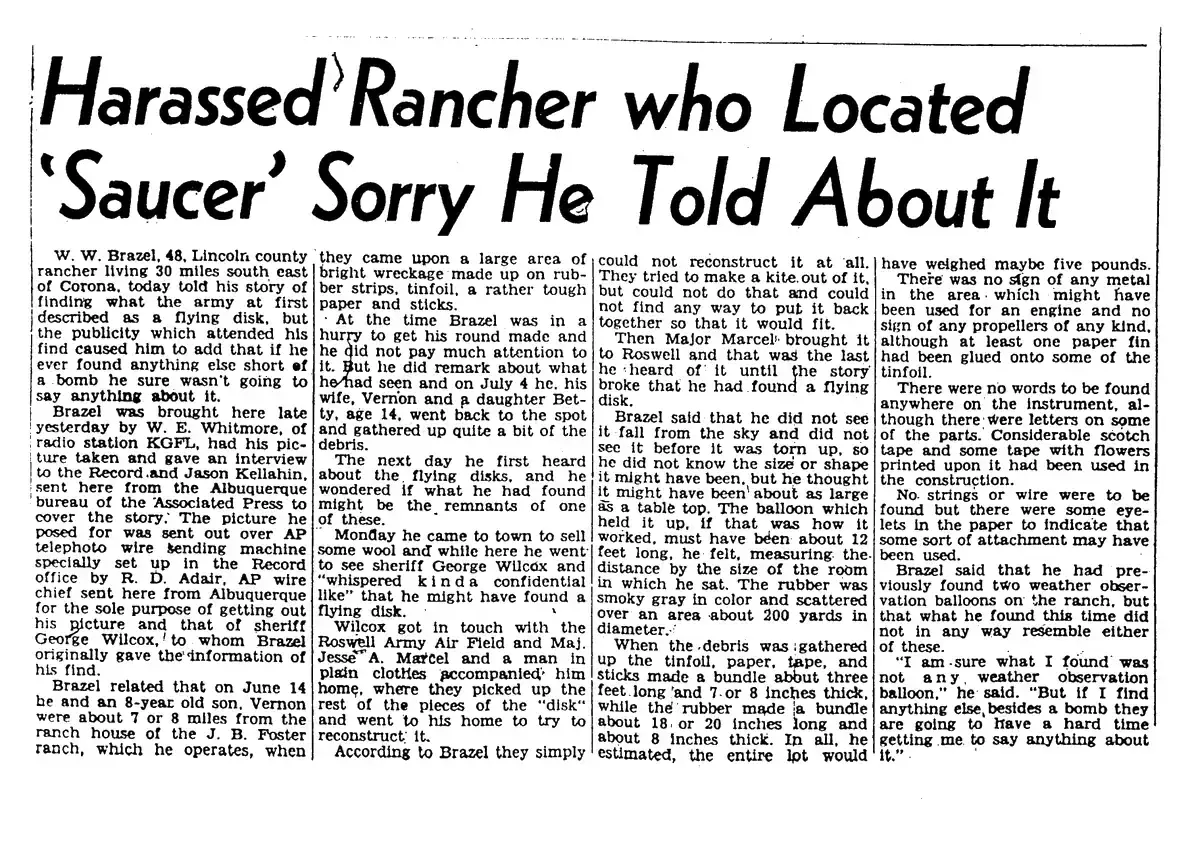
On 9 July the Daily Record ran an interview with the rancher. W. W. Brazel, 48, said that on 14 June he and his son had come upon "a large area of bright wreckage made up on rubber strips, tinfoil, a rather tough paper and sticks." All of it, he estimated, "would have weighed maybe five pounds." And then: "I am sure what I found was not any weather observation balloon."
Why the release still matters
For thirty years the story stopped there. Then, at the end of the 1970s, Marcel, by then retired, told UFO researchers, among them the physicist Stanton Friedman, that the balloon had been a cover story. In 1980 Charles Berlitz and William Moore published The Roswell Incident. Kevin Randle and Donald Schmitt followed in 1991, Friedman and Don Berliner in 1992.
The case they made rests first on the release itself. It was issued by the base of the 509th, the bomb group the wire itself called atomic. Its intelligence officer handled the material. Its commander, on the account of later witnesses, approved the words. Those writers asked why trained officers would announce a disc at all.
Then Brazel's own line, printed on 9 July: not any weather observation balloon. He said he had found two such balloons on the ranch before.
Then the papers that are gone. In 1995 the General Accounting Office, after a search for records, reported that Roswell Army Air Field's administrative records from March 1945 to December 1949 and its outgoing messages from October 1946 to December 1949 had been destroyed, and that the form recording it did not say who destroyed them, or when, or on whose authority.
And then Haut. In a signed statement in 1993 he said he was "convinced that the material recovered was some type of craft from outer space." A longer affidavit dated 26 December 2002, sealed until his death and published in Thomas Carey and Donald Schmitt's Witness to Roswell (2007), went further: a morning meeting on 8 July with Ramey present, wreckage passed around the table, a craft and "a couple of bodies under a canvas tarpaulin" seen in a hangar. "I am convinced that what I personally observed was some type of craft and its crew from outer space."
If the first release was right
Set aside for a moment whether it was. Ask the larger question. What would it mean if the first statement from Roswell was the true one, and the second the cover?
It would mean the base of the 509th recovered something that was not made on earth, and that its officers, in the first hours, said so in plain words to the local radio stations.
It would mean the weather balloon shown to the press in Fort Worth was a substitute, set out on an office floor to end a story that had already gone round the world.
It would mean every official account since, from 1947 onward, has been built on that substitution, and that the records which could have shown it were among those destroyed.
And it would leave a question that is still in front of us. A base does not lose a craft and its crew without paperwork: shipping orders, flight logs, the names of the people who moved it. On this reading those papers existed, and someone knows what happened to them. Later claims of recovered craft raise the same question of paper, from an FBI memo of 1950 about saucers in New Mexico, the Hottel memo, to the testimony of David Grusch to Congress in 2023.
Foil, rubber and sticks
The standard account starts with what Brazel described in 1947, before anyone had a theory. Rubber strips, tinfoil, tough paper and sticks; scotch tape, some of it "with flowers printed upon it"; eyelets in the paper; "no sign of any metal in the area which might have been used for an engine." Five pounds in all. The material photographed in Ramey's office is foil, paper and broken sticks.
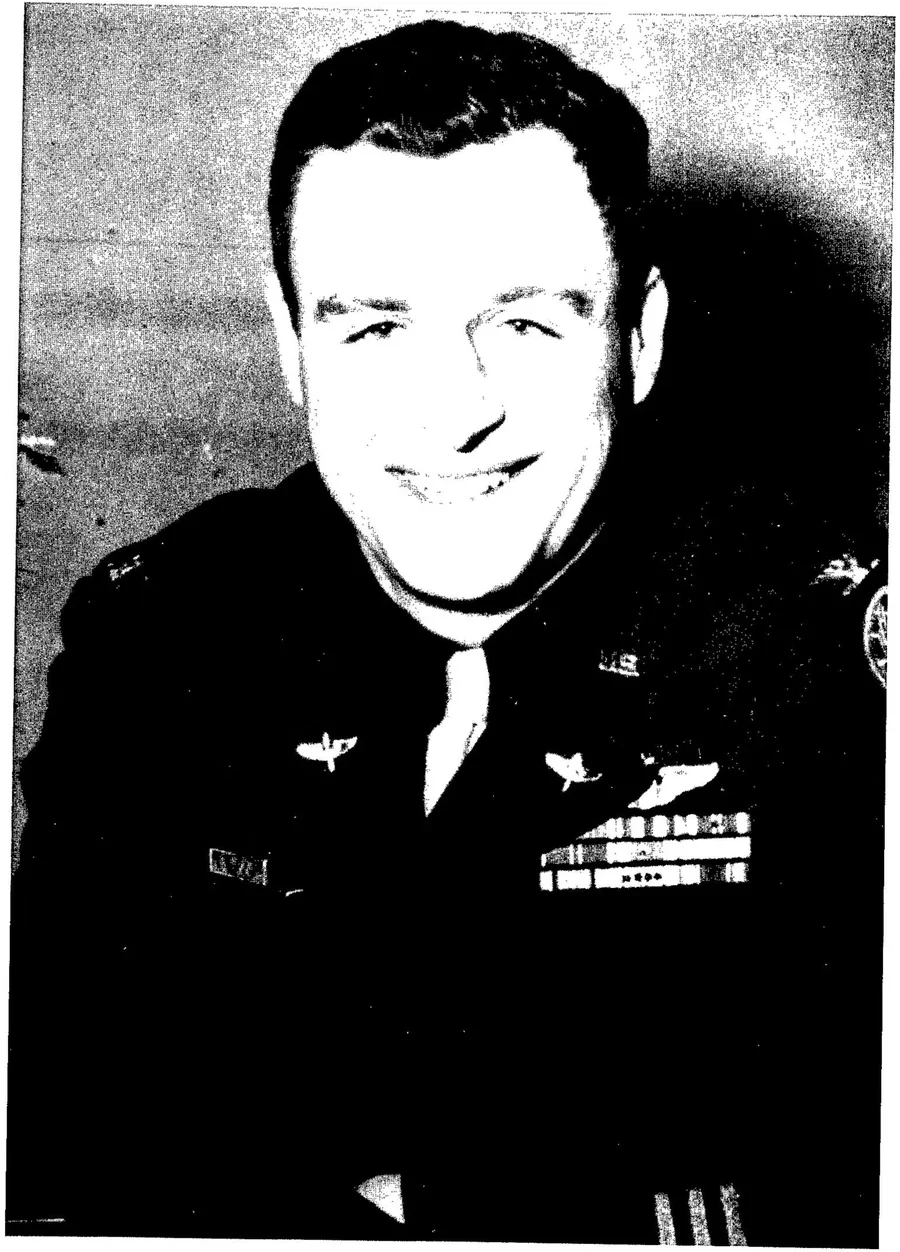
Newton, the forecaster who examined it, signed a statement in 1994 for the Air Force's own inquiry. "As soon as I saw it, I giggled and asked if that was the flying saucer," he wrote. "I told them that this was a balloon and a RAWIN target." Marcel, he added, kept picking up pieces of the sticks "trying to convince me that some notations on the sticks were alien writings." Sheridan Cavitt, the counterintelligence officer who went to the ranch with Marcel, told the same inquiry that the material in the Fort Worth photographs was consistent with what they had recovered.
The Air Force report of 1995, The Roswell Report: Fact versus Fiction in the New Mexico Desert, concluded that there had been "overreaction by Colonel Blanchard and Major Marcel in originally reporting that a 'flying disc' had been recovered when, at that time, nobody knew for sure what that term even meant, since it had only been in use for a couple of weeks." The words "flying disc" were new that summer, and the papers were full of them. The same AP column that carried the Roswell bulletin in Juneau ran under a headline that 43 states had now seen mystery discs.
Haut's two statements do not agree. In 1993 Blanchard "told me to write a news release." In 2002 Blanchard "dictated" it. The 1993 statement has no meeting with Ramey, no craft that he saw and no bodies. The 2002 one puts Ramey at a staff meeting in Roswell that morning; the wire reports and Newton's statement place him at Fort Worth that evening, and say nothing of where he was before. Proponents read the 2002 text as what Haut held back while he lived; it was sealed until his death and first published in 2007. The 509th's own history for July 1947 records only that the information office was busy "answering inquiries on the 'flying disc,'" which "turned out to be a radar tracking balloon."
What it was in more detail, and why the Air Force came to name a secret project, is the subject of the next article in this series.
What the record does not reach
The standard account explains the debris. It does not fully explain the release.
No copy of the release in the base's own files has been found; its words survive in the newspapers that printed them. No document of 1947 found for this investigation says why the base used the word disc. The only first-hand accounts of how the words were chosen are Haut's, given forty-six and fifty-five years later, and they disagree.
Marcel's own words from 1947 have not been found in any record opened for this investigation. What he thought he had in his car on the way back from the ranch is known only from what he said more than thirty years later.
And on 8 July, by the date the library that holds the photographs gives them, a paper was photographed in Ramey's hand in his Fort Worth office. In 1994 the Air Force asked its national imagery specialists to read it, and they reported that even after digitizing, the photographs were "of insufficient quality" to show the details sought. Private readings since then have found words on it, and others have disputed them.
Ramey's own words that day are not quoted directly in the wire stories of 8 and 9 July opened for this investigation; they give them in paraphrase.
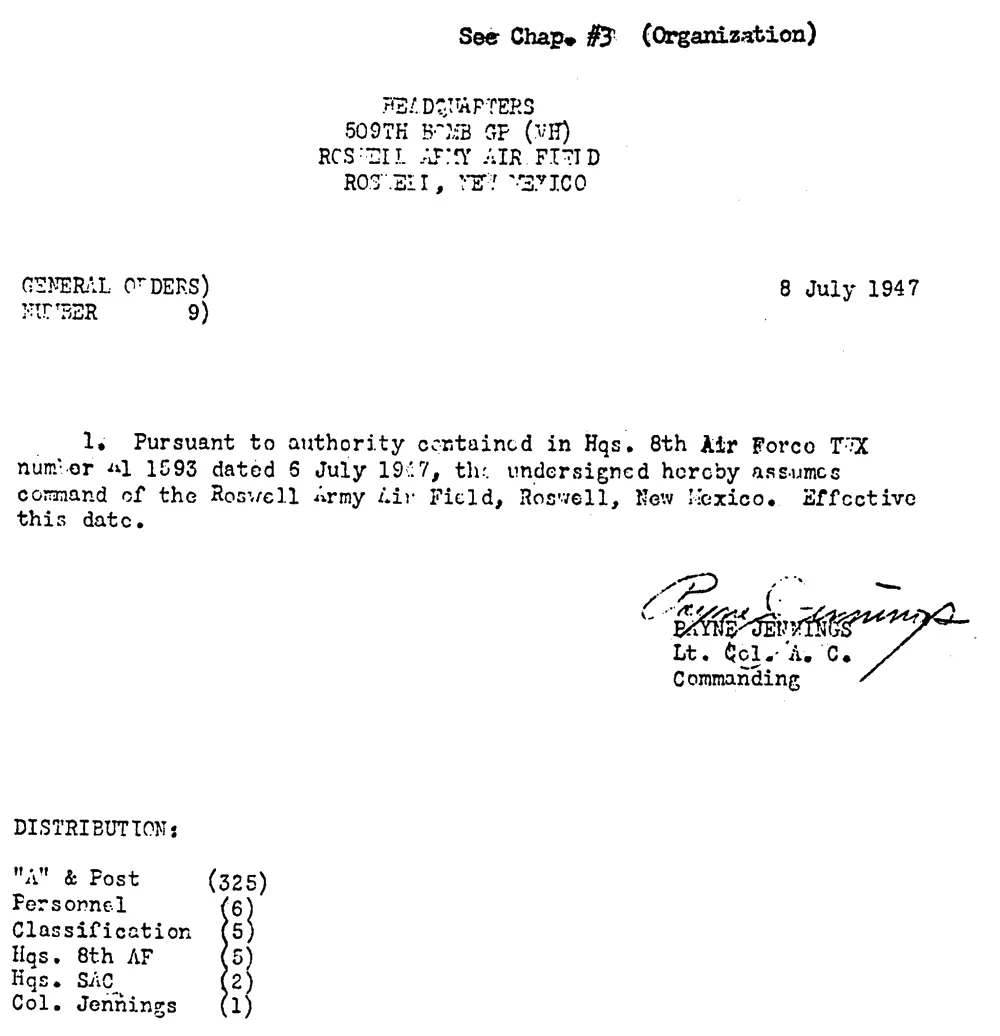
One more paper from that day survives. General Orders No. 9, dated 8 July 1947, records that Lt. Col. Payne Jennings "hereby assumes command" of the field, "pursuant to authority contained in" an Eighth Air Force teletype "dated 6 July 1947." The Air Force's records show Blanchard on leave from 8 July to 23 July. Its 1995 report called the leave "a somewhat unusual maneuver" for a man said to be directing the first recovery of extraterrestrial material, and noted that detractors read it as a ploy to go to the scene. An authority dated two days before the release fits a leave already planned. The order itself does not say why.
A day in July
The release was a few sentences long and lasted less than a day. It promised a disc and described none. The debris it led to weighed about five pounds, and the man who found it said he would never report anything again "short of a bomb."
What it began has lasted longer. The town of Roswell now has an International UFO Museum, and its name is shorthand for the idea that the government knows more than it says.
The record leaves both a balloon and a question. The photographs show foil, paper and sticks that the Army identified as a balloon and radar target; Haut's 2002 affidavit says Marcel told him that was not what he had brought. The question is why, on one morning in July, a base that answered for the atomic bomb told the world it had a flying disc, and who chose those words.
Questions This Leaves You With
Is there anything a person actually does with this?
Not with your own life, honestly. A press release of 1947 changes nothing in your next ten years, and anyone who sells you urgency about it is selling something. The larger question is how a government corrects a public statement, and how anyone outside can tell a correction from a cover. That question is open, and it is not yours alone to answer. What you can do is ask, of any official statement, what first-hand record stands behind it and when it was written down.
Does this sit against a religious account of the world?
It can be read both ways, and serious people have read it both ways. Some readers find that the idea of other beings in the universe fits a creation larger than we can see; others find it unsettling to their faith; many find nothing in a rancher's bundle of foil that touches what they believe. This site will not tell you which way it falls for you. The record of 8 July is about a statement, a bundle of debris and the officers who handled it.
Does this change what a human life is?
Hold your own life against the scale of this story: a base built to carry the atomic bomb, a rancher with five pounds of foil, and an argument that has lasted three generations. One way of seeing it makes a life smaller; a few lines from an office can outlast everyone who wrote them. The other makes it larger; Brazel's plain account of tape and sticks, given to a local paper, is still the earliest first-hand description anyone has. Which did you feel?
What would change your mind, in either direction?
Name it now, before you are committed, because it is harder later. Toward the first release: a 1947 document, such as an order, a message or a shipping record, that describes something other than a balloon train, from a file with a clear history. Toward the standard account: Marcel's or Blanchard's own written words from July 1947, or the base's copy of the release, showing who chose the word disc and why; that would settle why the release was written, though not by itself what the debris was. Notice that both lists ask for paper from that month.
Who chose the word disc?
This is the real gap. Haut wrote the release, by his own account on Blanchard's order. Whether Blanchard dictated the word, approved it, or left it to a young lieutenant, nothing from 1947 says. The base's outgoing messages for those years were destroyed. The two men who could have answered are dead, and their later accounts, where they exist, were given decades afterward. If any page from that morning survives, in a family's papers or a misfiled box, it would answer the question this story began with.
Sources
- The Bakersfield Californian, 8 July 1947, p. 1, 'Missile Located at Roswell' (AP) The Bakersfield Californian; Internet Archive Primary record
- The Daily Alaska Empire (Juneau), 8 July 1947, p. 1, AP bulletin Library of Congress, Chronicling America Primary record
- The Daily Alaska Empire, 9 July 1947, p. 1, AP from Fort Worth Library of Congress, Chronicling America Primary record
- Roswell Daily Record, 8 July 1947, p. 1 (photograph of a reprint) Roswell Daily Record; Wikimedia Commons Primary record
- The Roswell Report: Fact versus Fiction in the New Mexico Desert (1995) Headquarters United States Air Force (R. L. Weaver, J. McAndrew) Primary record
- Government Records: Results of a Search for Records Concerning the 1947 Crash Near Roswell, New Mexico, GAO/NSIAD-95-187 (1995) U.S. General Accounting Office; Federation of American Scientists mirror Primary record
- Die beiden Eidesstattliche Versicherungen von Walter Haut (2009) Ulrich Thieme, Gesellschaft fuer Anomalistik General reference
- The Roswell Incident (Grosset and Dunlap, 1980) Charles Berlitz and William L. Moore Primary record
- UFO Crash at Roswell (Avon, 1991) Kevin D. Randle and Donald R. Schmitt Primary record
- Crash at Corona (Paragon House, 1992) Stanton T. Friedman and Don Berliner Primary record
- Witness to Roswell (New Page Books, 2007) Thomas J. Carey and Donald R. Schmitt Primary record
- UFO Crash at Roswell: The Genesis of a Modern Myth (Smithsonian, 1997) Benson Saler, Charles A. Ziegler and Charles B. Moore Study
- Fort Worth Star-Telegram photograph: Ramey with the debris University of Texas at Arlington Libraries, Special Collections Primary record