
In April 1818 a retired army captain in St. Louis, John Cleves Symmes, had a single printed sheet mailed to learned societies, governments and colleges across the world. It declared that the earth is hollow, that it holds other spheres inside it, and that it is open at both poles. He asked for a hundred men to go and look.
The sheet survives. A short column of type, a motto across the top, and under the main paragraph a signature in brown ink, "Jno. Cleves Symmes." The words that matter take four lines.
"I declare the earth is hollow, and habitable within; containing a number of solid concentrick spheres, one within the other, and that it is open at the poles 12 or 16 degrees; I pledge my life in support of this truth, and am ready to explore the hollow, if the world will support and aid me in the undertaking."
A hole at the top of the world, sixteen degrees across. Wide enough, on his figures, to sail into.
To all the world
The sheet is dated "ST. LOUIS, (Missouri Territory,) North America, April 10, A. D. 1818," and addressed "TO ALL THE WORLD!" Symmes signed himself "Of Ohio, late Captain of Infantry." He had joined the army as an ensign in 1802 and, by the inscription on his monument, fought at Lundy's Lane and in the sortie from Fort Erie in the war of 1812.
The rest of the circular is a programme. He had "ready for the press, a Treatise on the principles of matter." He named three scientific "protectors": the New York naturalist Samuel L. Mitchill, the English chemist Humphry Davy and Alexander von Humboldt. And he asked for an expedition: "one hundred brave companions, well equipped, to start from Siberia in the fall season, with Reindeer and slays, on the ice of the frozen sea; I engage we find warm and rich land, stocked with thrifty vegetables and animals if not men, on reaching one degree northward of latitude 82."
He had five hundred copies printed at his own cost, according to his own later account, and sent them to governments, princes, legislatures, colleges and learned societies. The historian Peter Sinnema, in a close study of the circular for the journal BRANCH in 2012, records that he attached a certificate of his own soundness of mind. In Paris, his friend and biographer James McBride wrote in 1826, the circular was laid before the Academy of Sciences by Count Volney, and the Academy "decided that it was unworthy of their consideration."
The idea had a respectable ancestor. In 1692 the astronomer Edmond Halley proposed to the Royal Society, in its Philosophical Transactions, that the earth was a shell with smaller globes inside it, to explain why the compass needle's variation slowly drifts. "I allow five hundred Miles for the thickness of its Shell," Halley wrote, and he made his inner orbs "capable of being inhabited." Symmes went further. He opened the shells at the poles.
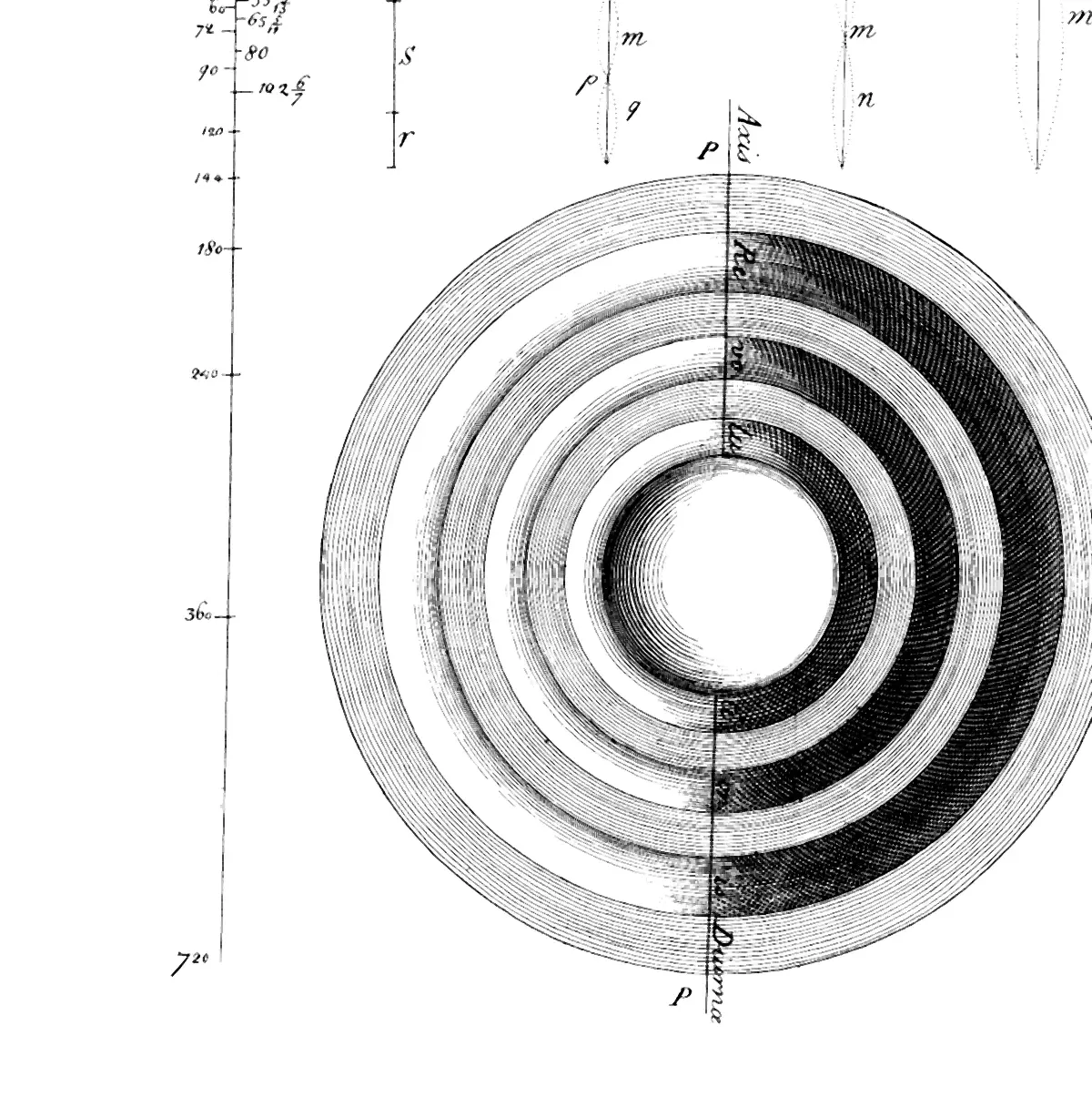
Symmes's hole
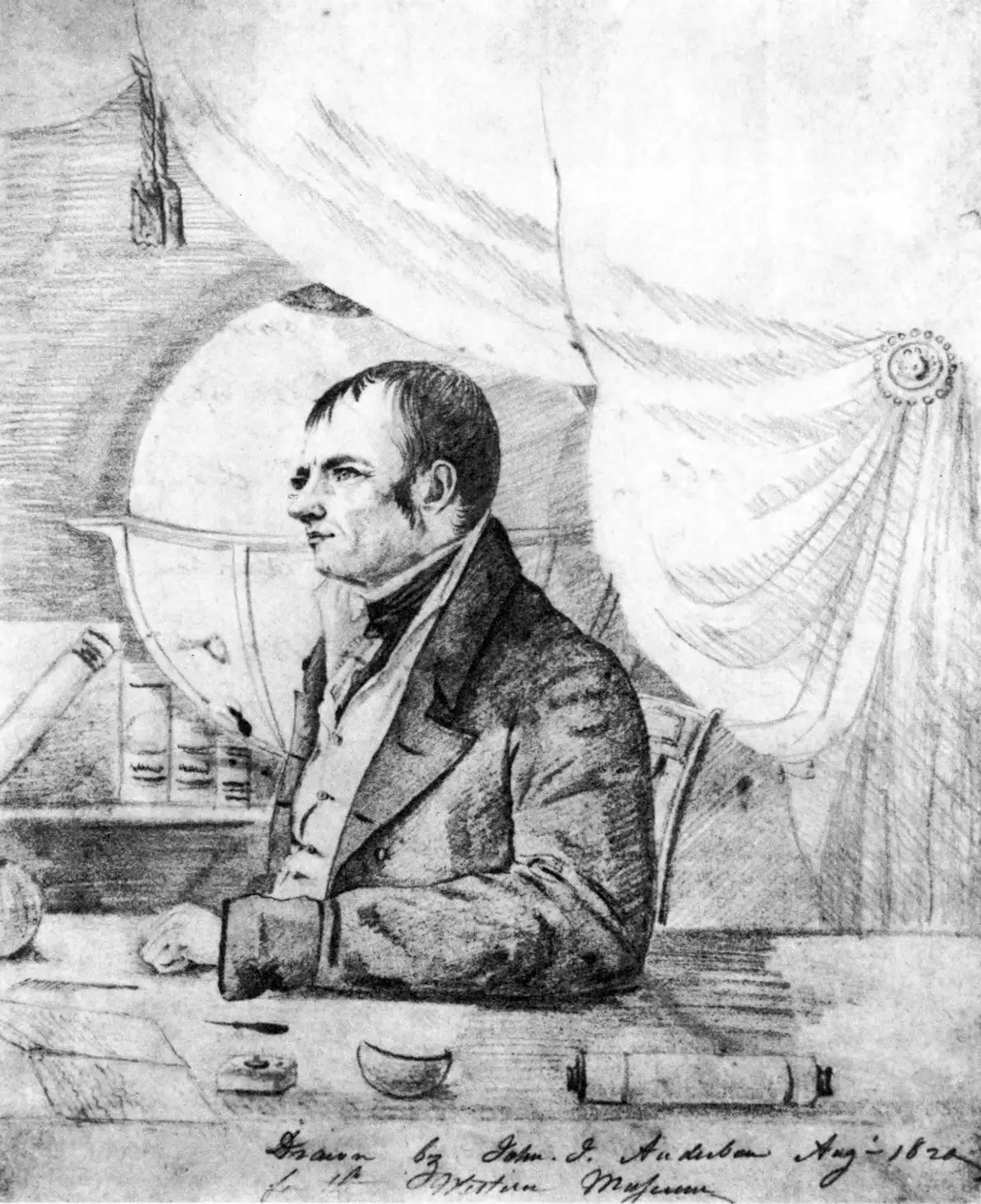
From 1820 he lectured on it, first in Cincinnati, then across the country, with a wooden globe whose polar caps had been cut away. That August the naturalist John James Audubon drew him for Cincinnati's Western Museum: a lean man at a desk, a large globe behind his shoulder.
The case, as McBride set it out in Symmes's Theory of Concentric Spheres in 1826, a book he wrote with Symmes's help, ran from physics to field reports. Matter, on Symmes's reading, gathers in concentric shells, as Halley had allowed. Animals that migrate north in the spring, the warm currents and open water reported by Arctic voyagers beyond the ice, the driftwood on polar shores: all pointed, on his account, to a warmer country past the rim, and to an opening through which it could be reached.
He wanted a government ship. On 7 March 1822 Senator Richard M. Johnson of Kentucky presented his petition to the Senate, as a Wilmington newspaper reported that week: Symmes stated "his belief of the existence of an inhabited concave to this Globe" and asked Congress to equip "two vessels of 250 or 300 tons" for a voyage to one of the polar regions. A motion to send it to the Committee on Foreign Relations was refused, and the petition was laid on the table. In December 1823, McBride wrote, he sent similar petitions to both houses, "which met with a similar fate."
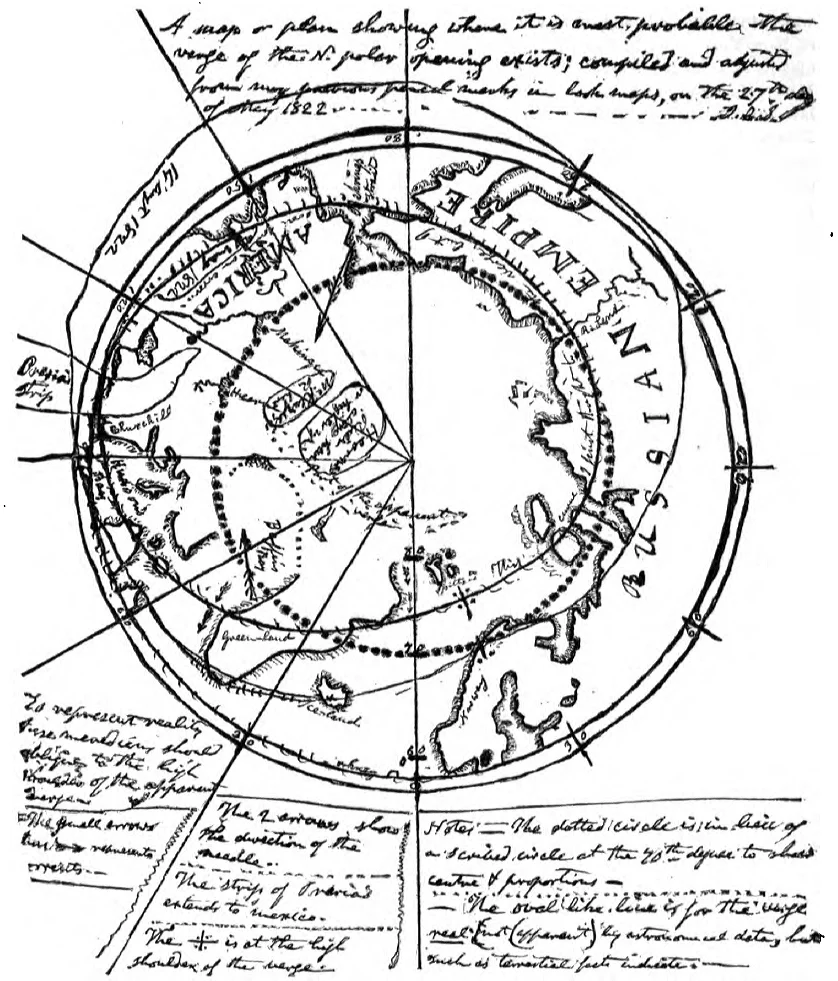
By then the idea had come to be called Symmes's Hole, and it had a novel. In 1820 a book called Symzonia, by a "Captain Adam Seaborn," described a voyage through the southern opening to a civilisation inside the earth. Its frontispiece showed a sectional view of the earth "showing the openings at the poles." Who wrote it is still disputed: Symmes himself, or a sailor named Nathaniel Ames.
If the poles were open
Set aside for a moment whether Symmes was right. Ask the larger question. What would it mean if the earth were open at the top and bottom, and lived in?
It would mean the map of the world had a second side that nobody had drawn: continents on the inner face of the shell, lit, on Symmes's account, by light coming in through the openings, and reached by sailing over the rim.
It would mean that every voyage that turned back at the ice had turned back at a door. The explorers who wrote of open water and warm currents beyond the pack would have been describing the approach to it, without knowing what they were seeing.
It would mean we were not alone on our own planet. "Animals if not men," Symmes wrote, and on his reading the people of the interior would be the oldest neighbours our species has, living under our feet the whole time.
And it would leave a question in front of us still. Symmes asked the world for ships, reindeer and a hundred brave companions, and the world declined. If he was right, the most important exploration in history was put off for want of a vote.
What the ships found
The standard account is the record of the voyages that went.
Symmes died in May 1829 in Hamilton, Ohio. His best-known convert, the Ohio newspaper editor Jeremiah Reynolds, lectured beside him in 1825 before the two fell out. Reynolds did not drop the polar campaign. He changed it. In a speech to Congress in April 1836 Reynolds argued for a national expedition to the Pacific and the southern ocean. The historian Nathaniel Philbrick, in an essay for the Smithsonian Institution Libraries, calls the United States Exploring Expedition that followed "the grand, sweeping vision of a former newspaper editor from Ohio named Jeremiah Reynolds."
The expedition sailed in 1838 under Lieutenant Charles Wilkes and came home in 1842. Among much else, Philbrick writes, it charted "1,500 miles of the Antarctic coast." Not a rim around an opening: a coast, with ice and rock behind it.
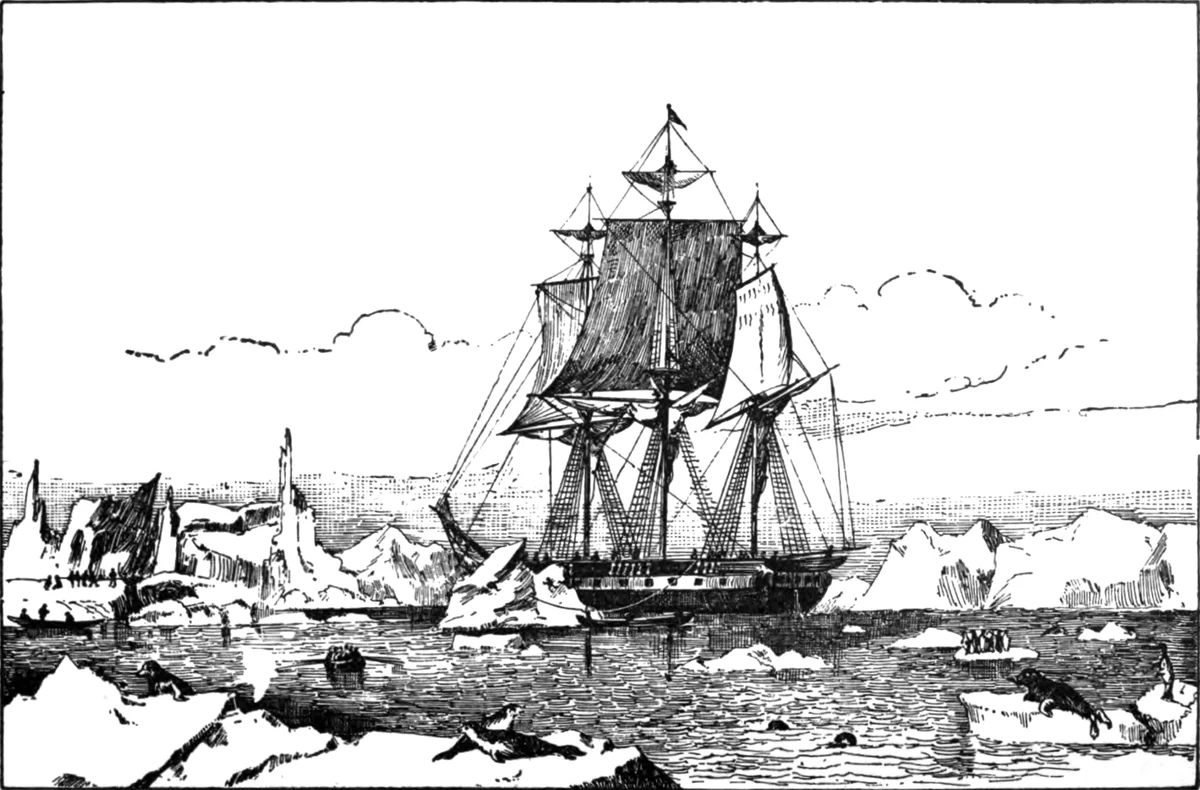
The expeditions that followed went further, to the coast the Antarctic Treaty now covers, and the twentieth century reached both poles and flew over them. Richard Byrd flew to the South Pole and back in 1929, and over it again in 1947, as told in Admiral Byrd, Operation Highjump and the warning on page 23. Nobody who reached either pole found a hole sixteen degrees wide. Halley's own reason for the shells, the drifting compass, is put down today to the earth's liquid outer core.
What the voyages do not reach
The record answers the openings. It does not answer everything Symmes asked for.
What happened to his petitions is thinly recorded. The Wilmington paper says only that, after some conversation, the 1822 petition was laid on the table. McBride's page adds two bare words, "Ayes, 25," with no other count and no explanation. A fifty-six to forty-six vote that circulates today was not found in anything opened for this investigation, and the Senate and House journals of 1822 and 1823, where a recorded division would be, were not checked.
The certificate of his sanity has not been found either. Sinnema writes that Symmes attached one; the surviving copy of the circular, whole and signed, carries none, and its wording is unknown.
Nor is it known how many copies of the circular survive, or where. The scan that circulates online came from a private blog, and the owner of the sheet is not recorded. Some copies are said to carry the heading "No. 1. Circular"; the surviving image has no such heading.
And the theory's one solid descendant is not a hollow earth but a voyage. Symmes did not get his ship. Reynolds's vision, by Philbrick's account, became the expedition Wilkes led.
A stone globe in Hamilton
In Symmes Park in Hamilton, Ohio, his son Americus raised a monument to him: a stone column with a globe on top, and a hole through the globe. The inscription calls him "a philosopher and the originator of 'Symmes's Theory of Concentric Spheres and Polar Voids'," and says that "he contended that the earth is hollow and habitable within." When it went up is itself uncertain: one record says 1840, another 1873, and an engraving of it was printed in 1865.
The idea never quite stopped. William Reed published The Phantom of the Poles in 1906, Marshall Gardner A Journey to the Earth's Interior in 1913, and the hole at the pole found its way into stories of Admiral Byrd for the rest of the century.
What is left of the man himself is one printed page. A motto, a dateline, four lines of declaration and a signature, sent to the whole world in 1818 by someone who pledged his life on it. Wherever that copy rests now, it is the founding document of an idea that has outlived every expedition sent to test it.
Questions This Leaves You With
Is there anything a person actually does with this?
Not with your own life, honestly. No opening at the poles has a date or a danger attached to it, and anyone selling you one is selling something. The larger question is about how a society decides which bold claims to test. Congress tabled Symmes; a decade later it funded an expedition that Reynolds, who had lectured beside him, did more than anyone to bring about. What gets explored often depends on how the question is put. That question is open, and it is not yours alone to answer.
Does this sit against a religious account of the world?
It can be read both ways, and serious people have read it both ways. Some readers have found in an inner world an echo of the underworlds and hidden lands in many traditions; others, with equal faith, see nothing in polar geography that touches what they believe. This site will not tell you which way it falls for you. Symmes's circular itself makes no religious claim. It dedicates the work to his wife and her ten children, and asks for reindeer.
Does this change what a human life is?
Hold your own life against the scale in this story: a whole planet, and one man in St. Louis who signed his name under a claim about all of it and pledged his life on it. One way of seeing it makes a life smaller; the world said no, and the ice said no. The other makes it larger; one man's printed sheet set a campaign going, and a friend of his went on to argue for the expedition that charted fifteen hundred miles of a continent. Which did you feel?
What would change your mind, in either direction?
Name it now, before you are committed, because it is harder later. Toward Symmes: a measured polar opening, or seismic evidence of a hollow interior rather than the dense core and mantle that earthquake waves are read as showing today. Toward the standard account: what the polar flights, the satellite images and the seismic record already show. Notice that Symmes asked for a journey to look. Later journeys were made, by ship and by air, and none found an opening.
Where is the sanity certificate?
This is a real gap, and a strange one. Symmes is said to have sent his circular with a certificate of his soundness of mind, an unusual thing for anyone to attach to a scientific claim. The surviving copy has none. Nobody has published its wording, said who signed it, or shown whether it was printed, handwritten or a separate sheet. If any of the five hundred copies still sits in a learned society's archive with its certificate attached, it would say a good deal about how Symmes expected the world to receive him.
Sources
- Circular, St. Louis, 10 April 1818 (signed copy, scan) John Cleves Symmes; Wikimedia Commons Primary record
- 10 April 1818: John Cleves Symmes's 'No. 1 Circular' (2012) Peter W. Sinnema, BRANCH: Britain, Representation and Nineteenth-Century History Study
- Symmes's Theory of Concentric Spheres (Cincinnati, 1826) James McBride, Morgan, Lodge and Fisher; Internet Archive Primary record
- An Account of the cause of the Change of the Variation of the Magnetical Needle, Philosophical Transactions No. 195 (1692) Edmond Halley, Royal Society; scan via Zenodo Primary record
- American Watchman (Wilmington, Del.), 12 March 1822, Senate report Library of Congress, Chronicling America Primary record
- The Scientific Legacy of the U.S. Exploring Expedition (2004) Nathaniel Philbrick, Smithsonian Institution Libraries Study
- Symzonia; Voyage of Discovery (New York, 1820) Captain Adam Seaborn (pseud.); Project Gutenberg Primary record
- Symmes monument, Ohio Outdoor Sculpture Inventory Sculpture Center, Cleveland Study