
Ur is a ruined city in southern Iraq, beside its ziggurat, on the plain where the Euphrates once ran. In the spring of 1929 the archaeologist Leonard Woolley sank a test shaft there below the deepest of its royal graves, and his workmen hit a bed of clean, water-laid clay more than eight feet thick. Under it was the rubbish of an older village. Woolley announced that he had found the Flood.
The shaft starts in a pit already cut deep into the city's past: the floor of the largest death pit in the royal cemetery, where the dead of a royal burial lay. Below that floor the ground is rubbish, broken pottery and ash, the trash of centuries. Then, all at once, nothing.
Clean clay. No sherds, no ash, no brick. Foot after foot of it, the colour and grain of river silt.
Then, at the bottom, the rubbish starts again. Different pottery. Painted by hand. Older.
Between two layers of human life, a layer of water.
A shaft under the death pit
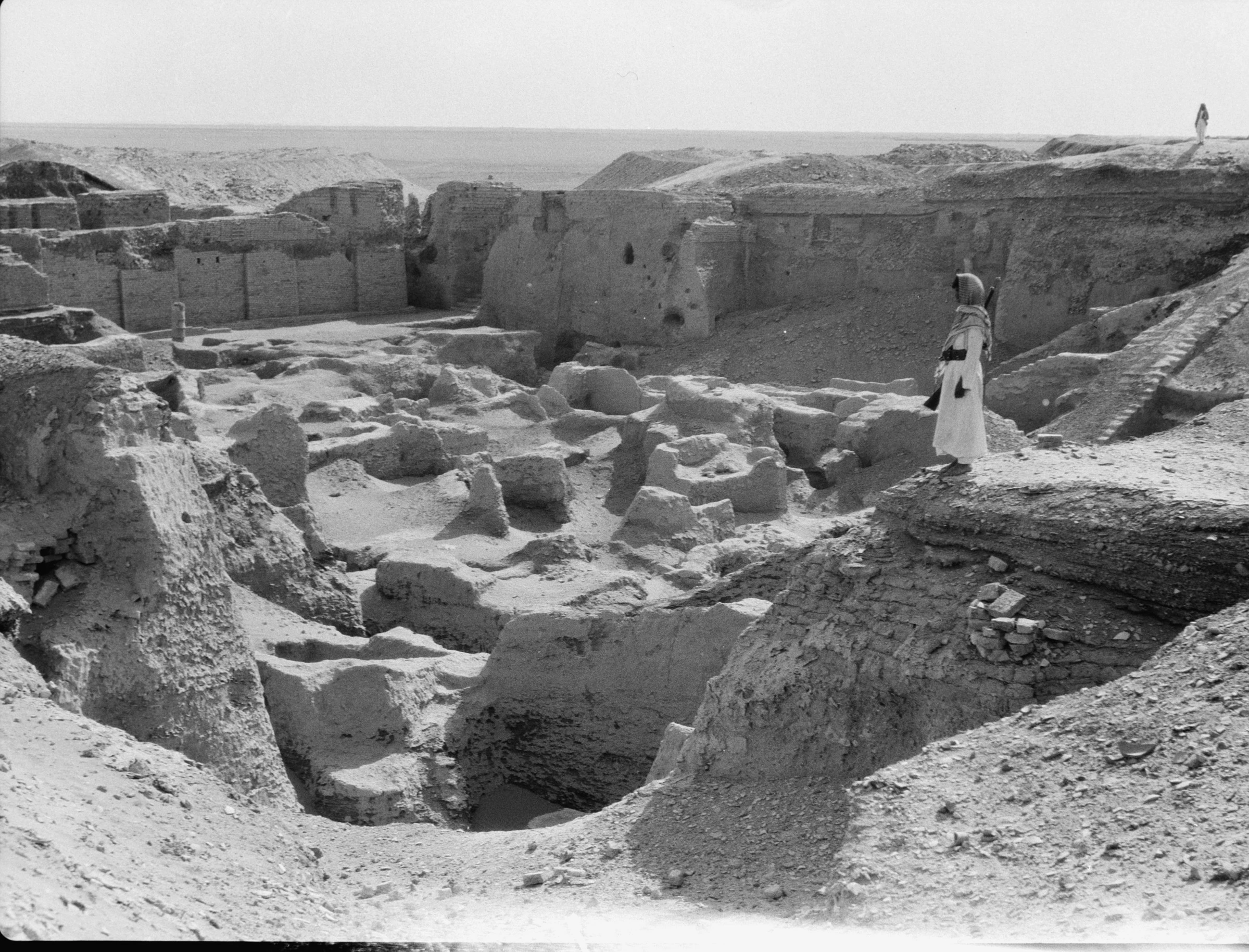
Woolley was director of the Joint Expedition of the British Museum and the University of Pennsylvania Museum to Mesopotamia, which dug at Ur every winter from 1922 to 1934. By 1929 it had spent two seasons on the royal cemetery, inside what Woolley described as "a huge pit some 200 feet across and between 30 and 40 feet deep" of layered rubbish. "In the early spring of 1929," he wrote, "we began sinking shafts below the level of the deepest graves."
The first shaft began, according to his final report of 1955, "at the level of the floor of the Great Death-pit, PG/1237." A metre and a half down, the rubbish "changed, quite suddenly, to perfectly clean clayey sand." The workmen took it for virgin soil, the natural ground under the city. Woolley noticed that it lay well above sea level, too high for the first ground of a city built on the river plain, and sent them back down.
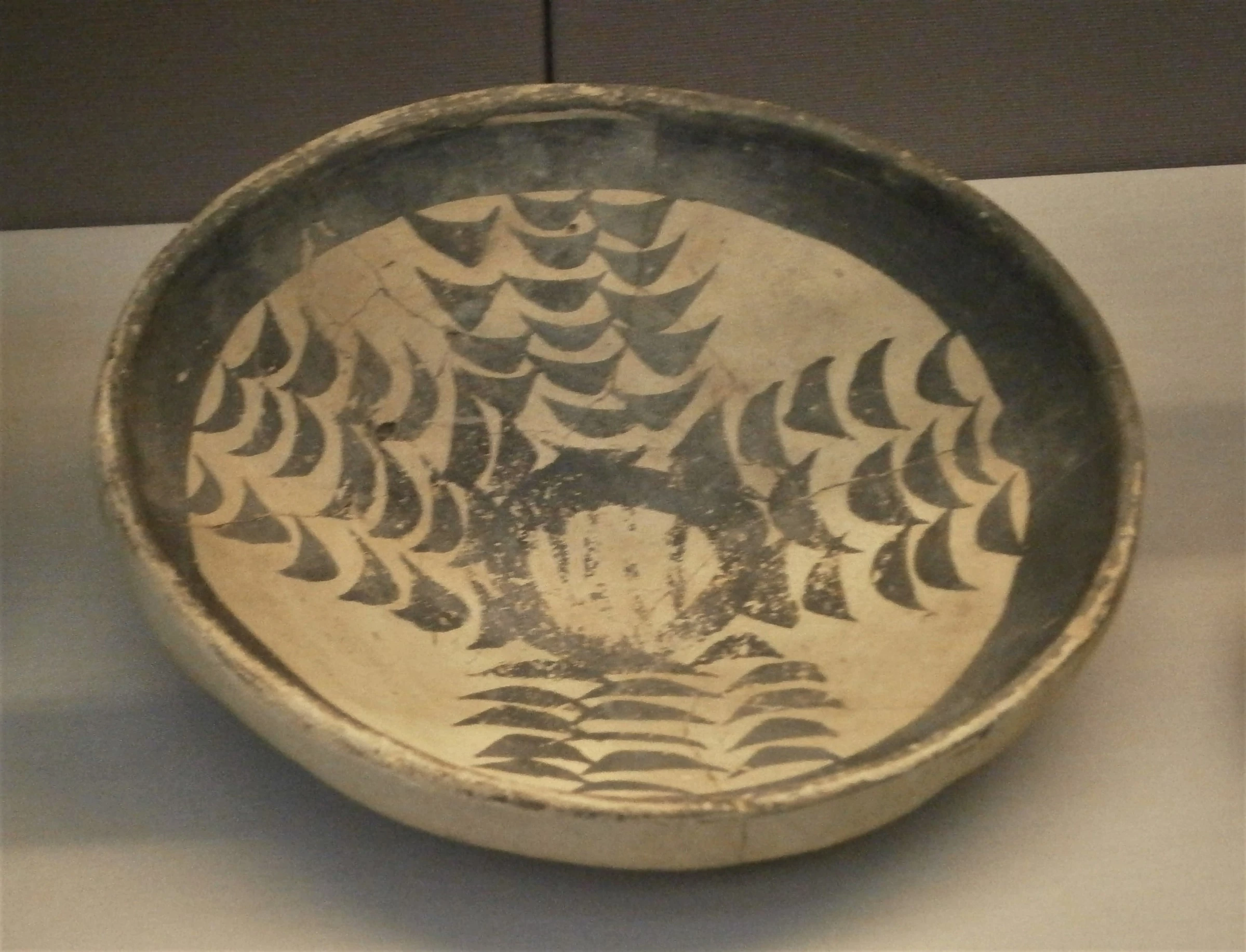
In his book for general readers, Ur of the Chaldees, published that December, the clean clay "attained a thickness of a little over 8 feet." The only object in it was "a fragment of fossilised bone." Below it came flint tools and hand-made painted pottery of the kind that "distinguishes the pre-Sumerian village of al 'Ubaid," the people who lived in southern Mesopotamia before the cities. A second shaft, "300 yards away to the north-west," gave "the same bed of water-laid clay."
His wife Katharine, he wrote in 1955, "came independently to the same conclusion." On 16 March 1929, in a letter to The Times, Woolley published it. Two days later Stephen Langdon of Oxford announced that his own expedition had found evidence of the Flood at Kish, the year before.
The next season the expedition dug to check. Pit F, inside the later sacred enclosure, was "planned on a large scale which should confirm or refute the witness of our small pits." In Pit F the clay averaged three and a half metres deep, about eleven and a half feet.
The Flood of Sumerian history and legend
Woolley did not hedge. "Taking into consideration all the facts," he wrote in 1929, "there could be no doubt that the flood of which we had thus found the only possible evidence was the Flood of Sumerian history and legend, the Flood on which is based the story of Noah."
His reasoning ran from the clay to the story. The deposit was river silt, laid "by water action, and that all at one time," as samples analysed in Paris and by Britain's Geological Survey confirmed. Water deep enough to leave several metres of silt on a mound already above the plain was, on his reading, no ordinary spring flood. In his final report he reckoned that a deposit "nearly four metres deep" meant water at least half as high again, and more probably twice as high: an inundation at Ur, in his figure, of some eight metres. In a footnote he set that beside the fifteen cubits by which, in Genesis, the waters rose above the mountains.
He was clear about its scale. "This deluge was not universal," he wrote, "but a local disaster confined to the lower valley of the Tigris and Euphrates, affecting an area perhaps 400 miles long and 100 miles across; but for the occupants of the valley that was the whole world!"
And it fitted the record the Babylonians kept of themselves. The Sumerian King List divides its history in two at the Flood: the long reigns before it, the shorter ones after. The flood stories on the clay tablets, the eleventh tablet of Gilgamesh that George Smith read out in London in 1872 and the older Atrahasis, told of one great flood that ended an age. Here, on Woolley's reading, was the age it ended.
He held to it. In 1955, five years before his death, he wrote in the final report that he "was convinced that we had found material evidence of the Flood recorded by the Sumerian King-lists and described in the Flood legend," and that "The dimensions of the Ur flood in themselves constitute an argument in favour of the assumption." Then: "It is never wise to reject traditions off-hand; in most cases they contain a modicum of truth."
If the clay is the Flood
Set aside for a moment whether it is true. Ask the better question. What kind of past are we living in, if it is?
It would mean, first, that the Flood is not only a story but a layer: something that can be cut with a spade, measured with a tape and sent to a laboratory.
It would mean that the oldest stories humans wrote down kept a real event for thousands of years, through the change from villages to cities, from pictures to writing, from Sumerian to Akkadian to Hebrew, and that the details survived the telling.
It would mean something about how memory works in our species. The people of the plain lost their world to water, and their descendants never stopped talking about it, until scribes wrote it down and the story outlived every city it was told in.
And it would leave one question still in front of us. If a flood on one river plain could become the story of the whole world, then every flood is a candidate for the next such story, and the line between a local disaster and the end of the world is only the line of the horizon.
What the other pits showed
The standard account starts from the other excavations of the same years. At Kish, Langdon's flood layer was, by Woolley's own figures, "eighteen inches thick" and lay above graves like those of Ur's royal cemetery: "Clearly this cannot be the same as the Ur flood," he wrote. At Shuruppak, the home of the Flood hero in the Babylonian stories, Erich Schmidt of the University of Pennsylvania found a flood layer in 1931 from around 2900 BC. Eridu, a short distance from Ur, showed none.
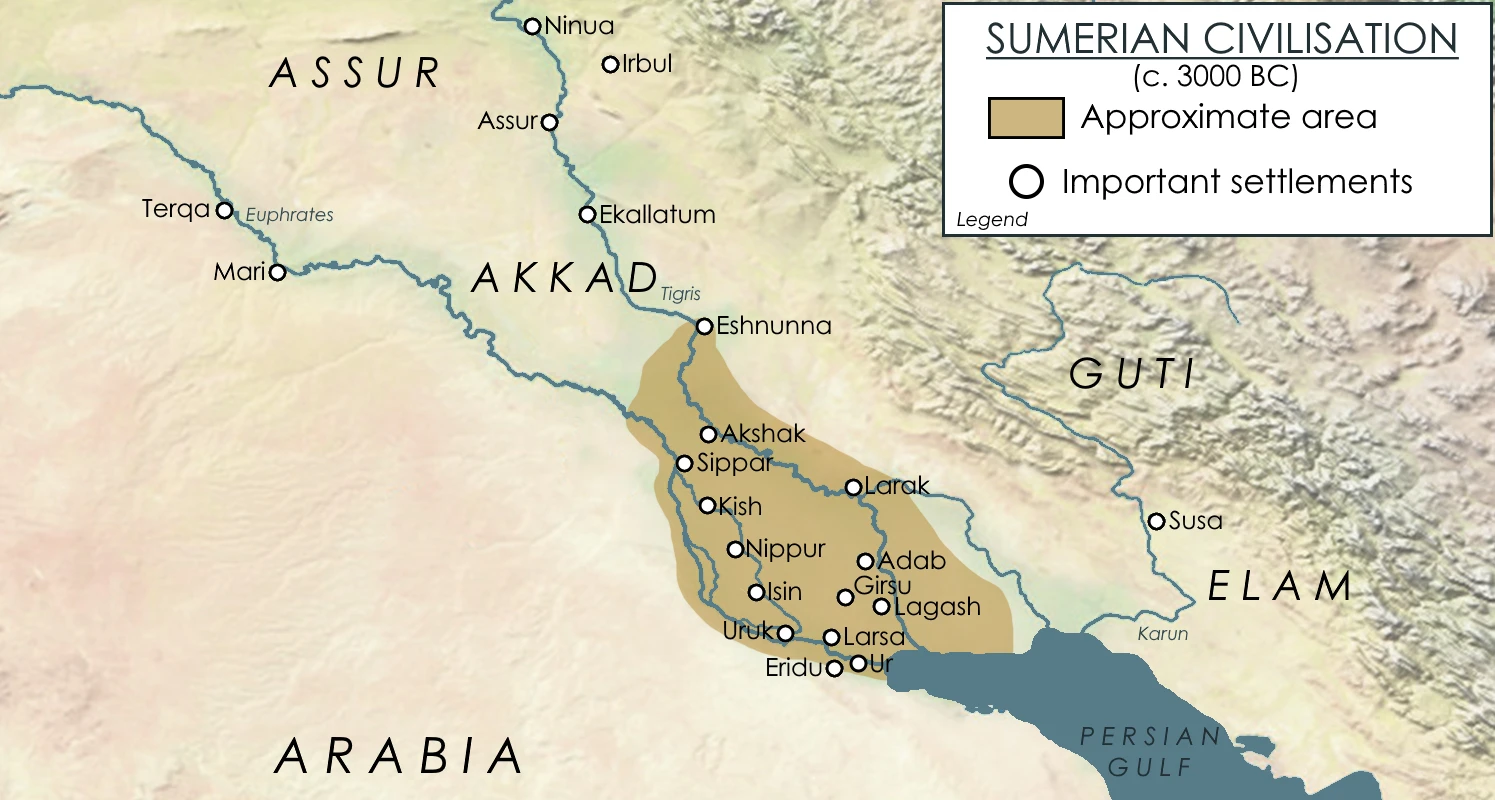
Max Mallowan, who had been Woolley's assistant at Ur, reviewed the evidence in 1964 in a paper in the journal Iraq titled Noah's Flood Reconsidered; in David MacDonald's 1988 summary of the debate, Mallowan favoured the horizon around 2900 BC at Shuruppak and Kish, not Ur's earlier silt, as the background to the tradition. The archaeologist Harriet Crawford, writing in 2015, described the evidence as "a series of local floods, each devastating over the local area, rather than one gigantic flood."
The Ur clay itself had limits. Woolley's own final report lists it in some pits and not others: present in A, B, F, W and X, absent in pits Y and Z. In Pit F, he records, "some 49 graves" were dug "down to and into the Flood deposit, all containing pottery of the al 'Ubaid type": the people of the painted pottery lived on after the water. And their period, the Ubaid, is now dated by the Penn Museum to about 5500 to 4000 BC, long before the King List's dynasties and their written flood.
On this account the clay at Ur is a real flood, a large one, and one of many, in a delta where rivers broke their banks and moved their beds.
What the pits do not settle
The standard account says the floods were many. It does not say which one, if any, the story remembers.
The layers are known only where someone dug. Woolley's pits lay to the north and east of the old town; he wrote in 1955 that a shaft "some fifty metres away to the south-west" would probably have found no trace at all, and that it was "by the accident of discovery that our pits were sunk in just those places which could produce the only possible material evidence." No one has traced how far the Ur clay runs under the plain.
The deposit has no date of its own. It is dated by the pottery above and below it.
And the story itself chose Shuruppak, not Ur, for its hero's city, and the King List treats the Flood as the break between two ages of the world. Woolley argued in 1955 that a disaster on the scale of the Ur clay was exactly the kind that would leave such a break in memory. Others looked to the later layers. No one found a layer with a name on it.
No flood deposit in Mesopotamia has been found that covers the whole plain.
Where it stands
The work did not end with Woolley. In 2014 the Penn Museum, digitising the Ur records with the British Museum, found in its own storage a skeleton from Pit F, a man of about fifty or older, buried in the Ubaid period into the silt, some 6,500 years ago. He was nicknamed Noah; one of the researchers, William Hafford, suggested that Utnapishtim, the Flood hero of the Babylonian story, would suit him better.
The methods have moved on as well. In 2025 a team publishing in the journal Geoarchaeology dated, by the light-sensitive signal in its sediment, a flood that wrecked the city of Lagash to about 2390 BC, give or take 220 years, and tied the destruction to the conquest of the city by Lugalzagesi, a king of Uruk and Umma. Floods, on that evidence, struck the early cities more than once, and not always by nature alone.
What is left is the layer in the shaft under the death pit. Clean clay, more than eight feet of it, between two layers of people.
A flood. Not yet the Flood.
Questions This Leaves You With
Is there anything a person actually does with this?
Not in a practical sense, and it is better to say so. The Ur flood happened more than six thousand years ago and nothing in the clay predicts another. Anyone who turns it into a date or a warning is selling something. What it can change is how you read a flood story: as something that may rest on an event someone could dig up, measure and date. The bigger question is not personal at all: how a civilisation remembers the disaster it nearly did not survive.
Does this sit against a religious account of the world?
It can be read both ways. Woolley's find was hailed in 1929 as confirmation of the Bible, and some readers still take it that way. Others read it the opposite way: a local flood, magnified by memory, behind a story later told as the whole world's. Serious people have argued both, and Woolley himself held that a tradition usually keeps "a modicum of truth." Where that leaves your own faith is for you to decide. This site will not tell you.
Does this change what a human life is?
The clay in Pit F is a measure of what one generation can go through. Above it and below it, people lived the same kind of life, with the same painted bowls. Between them, water. You might find that a small, frightening thing to learn: a whole world can be one flood deep. Or you might find it the opposite: they came back, and dug their graves into the silt, and lived on it. Which did you feel?
What would change your mind, in either direction?
Name it now, before you are committed. Toward Woolley: the Ur clay dated directly and found to be far younger than its pottery suggests, close to the age of the first written flood stories; or a text that ties the Flood to Ur. That is a high bar, since the Ubaid pottery puts the clay two thousand years or more before writing. Toward the standard reading: direct dates on the Ur, Kish and Shuruppak silts that keep them centuries apart, or sediment work showing the Ur clay was laid by a river shifting its bed. On the record so far, the evidence leans toward many local floods.
Which flood does the story remember?
This is the open problem, and it is a real one. Every flood layer found in southern Mesopotamia is local and dated by the pottery around it. The stories remember one flood, with a hero, a boat and a city. Between the layers and the story there is no inscription, no name, no date that joins them. Until something does, eight feet of clean clay at Ur stays what it was in 1929: the candidate Woolley put forward, still the most famous, and not proven to be the one.
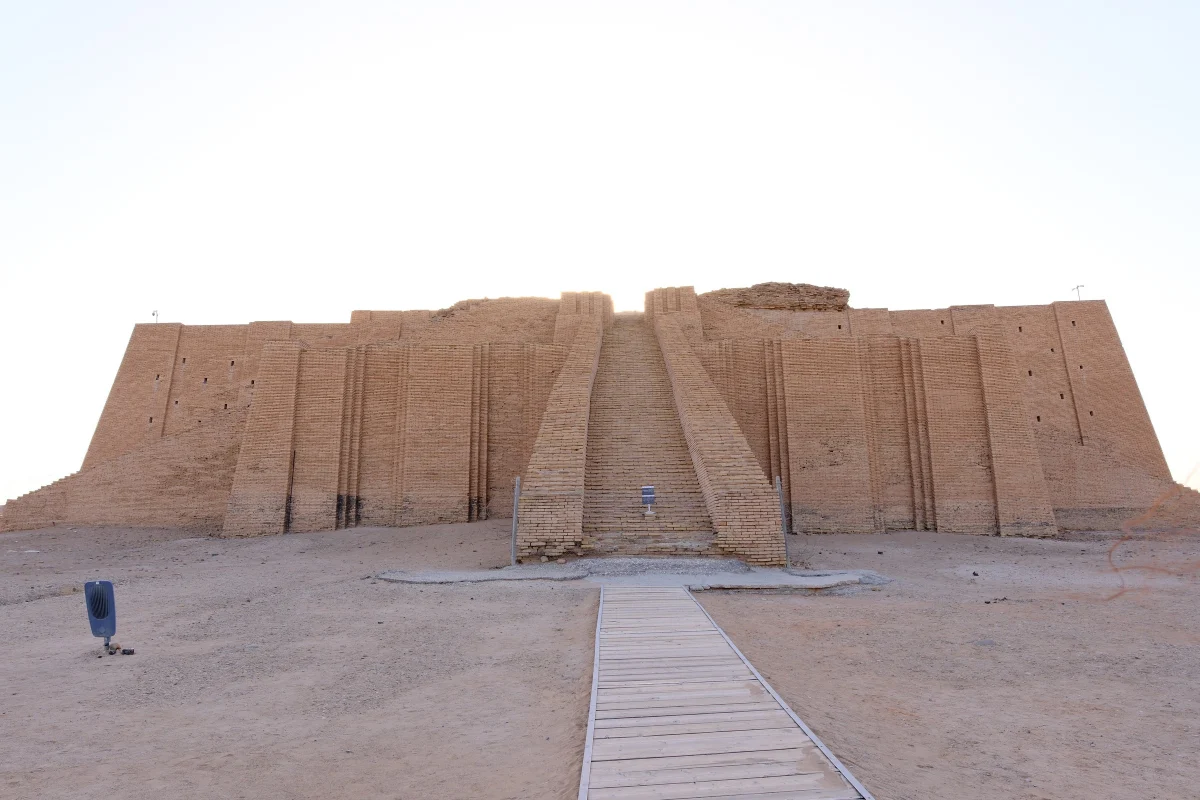
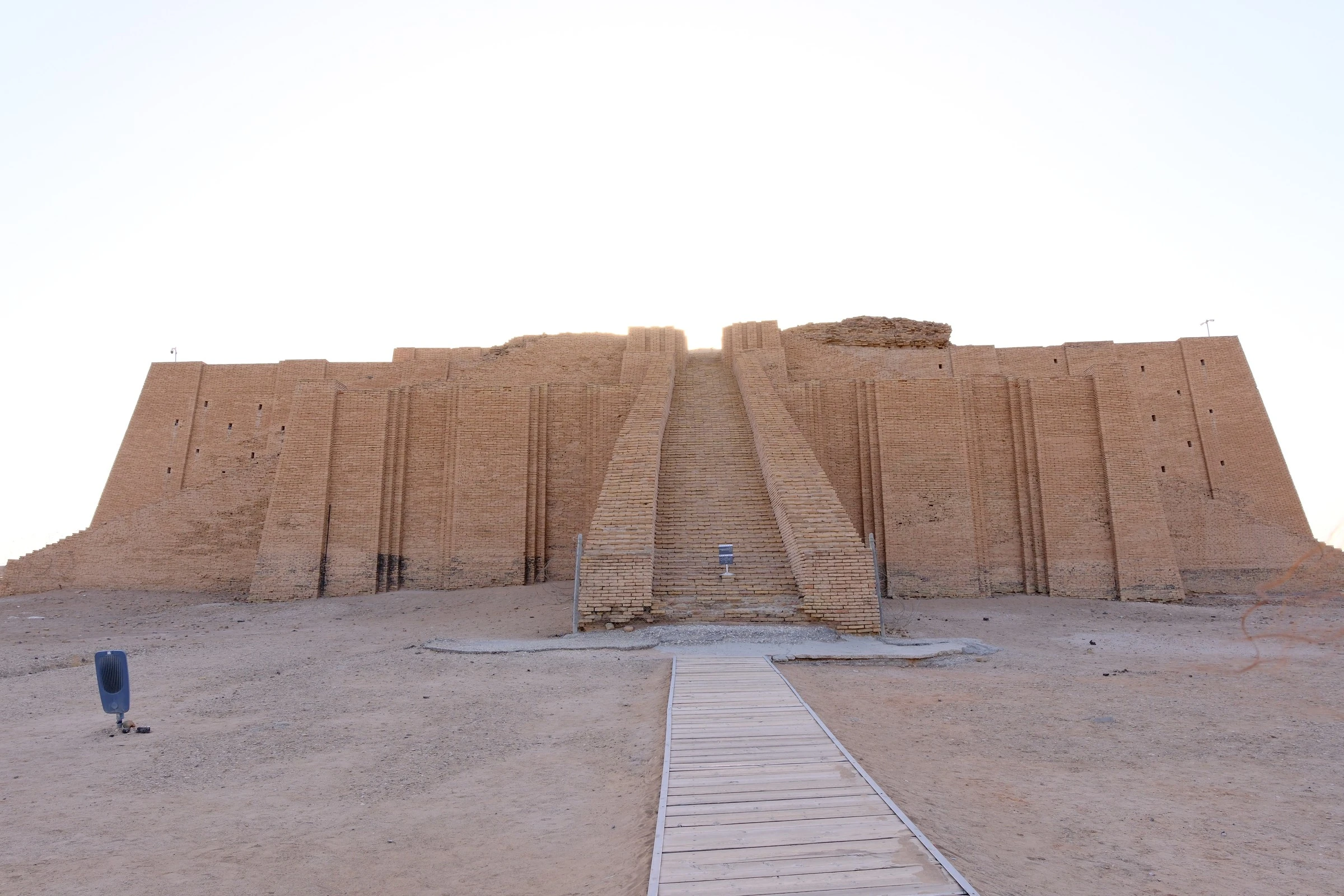
The ziggurat of Ur, the city's temple tower, restored, in 2024. The ziggurat of Ur, 2024. Photo: Alli Khalil, CC BY-SA 4.0 (creativecommons.org/licenses/by-sa/4.0), via Wikimedia Commons. Resized.
Sources
- Ur of the Chaldees: A Record of Seven Years of Excavation (London, December 1929) C. Leonard Woolley, Ernest Benn Primary record
- Ur Excavations IV: The Early Periods (1955) C. Leonard Woolley, Joint Expedition of the British Museum and the University of Pennsylvania Primary record
- 6,500-year-old skeleton rediscovered (2015) Penn Museum Study
- Sir Leonard Woolley and Ur of the Chaldees (2015) Harriet Crawford, Bible and Interpretation Study
- The Flood: Mesopotamian Archaeological Evidence (1988) David MacDonald, Creation/Evolution Journal 8(2) Study
- Noah's Flood Reconsidered, Iraq 26(2) (1964) 62-82 M. E. L. Mallowan Study
- The Flooding of Lagash (Iraq), Geoarchaeology 40 (2025) R. Goodman et al. Primary record
- The New York Times, 16 March 1929 (Woolley's announcement in New York) The New York Times, via the Internet Archive Primary record
- Leonard Woolley (encyclopedia entry, read 2026) Wikipedia General reference