
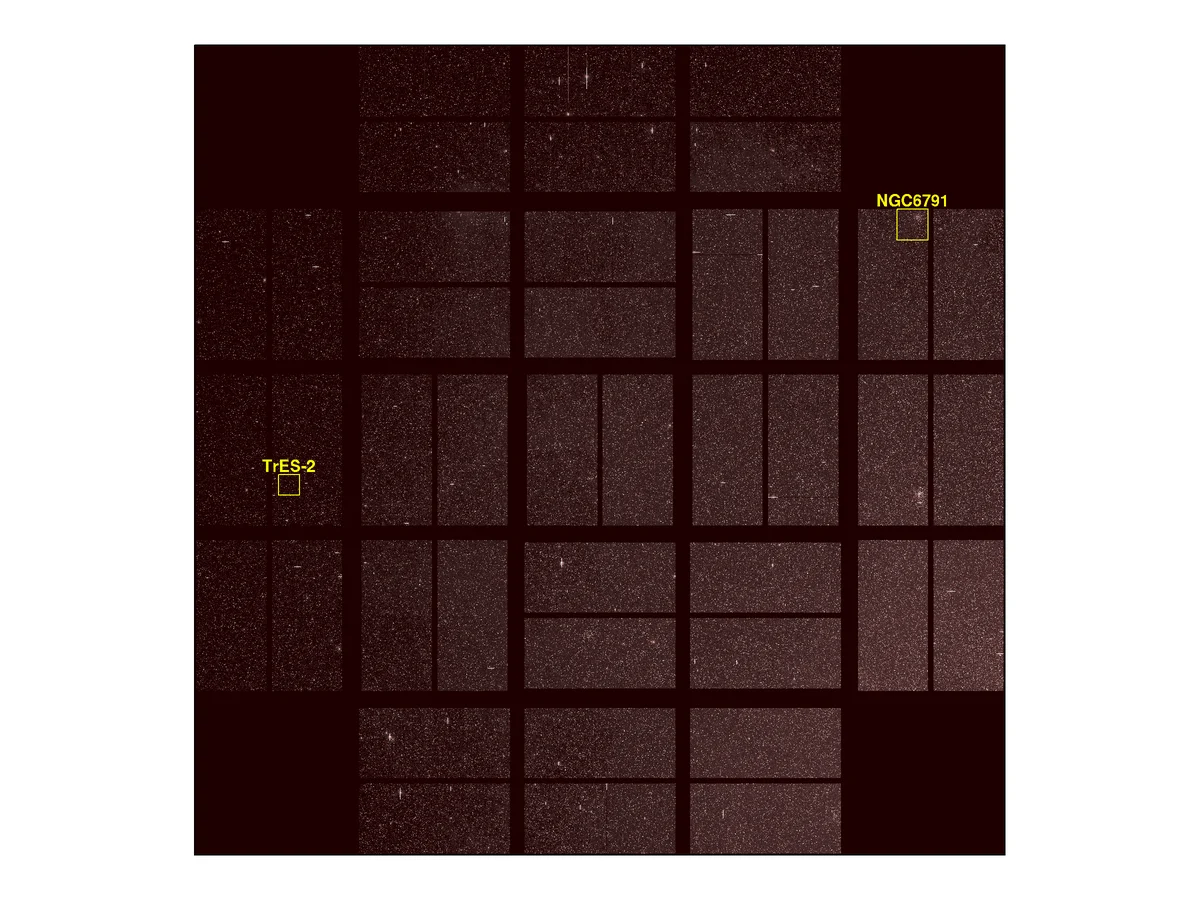
Tabby's Star, catalogued as KIC 8462852, is an F-type main-sequence star, about 1,470 light-years away in the constellation Cygnus. From 2009 to 2013 NASA's Kepler space telescope watched it, among a great many others, looking for the tiny regular dips in brightness that mean a planet is passing in front.
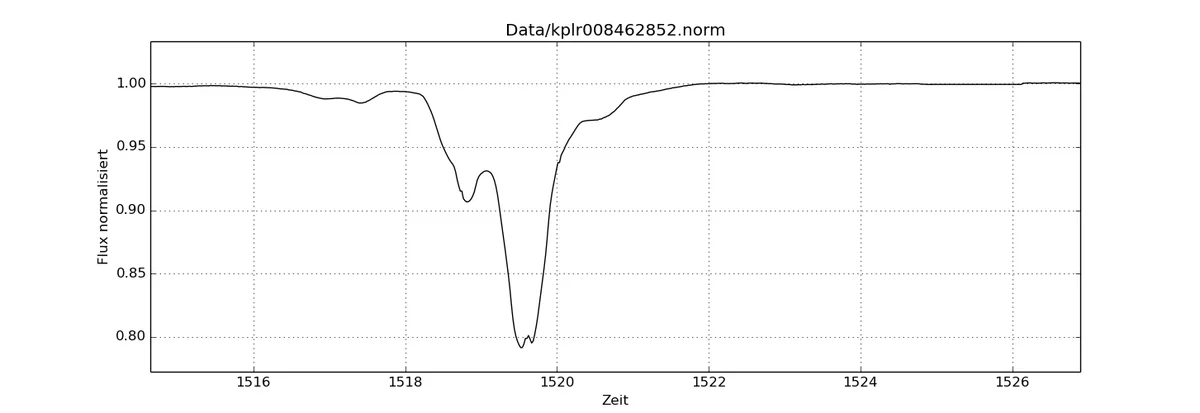
Tabby's Star dimmed by up to about a fifth. Not regularly. Not on any schedule. In irregular plunges that lasted days to weeks, the deepest taking away some 22 percent of its light, before the light came back.
It has three names. KIC 8462852 is its number in the Kepler Input Catalog. Tabby's Star and Boyajian's Star come from Tabetha Boyajian, the astronomer who led the first study of it. And astronomers nicknamed it the WTF star, after the subtitle of her paper: "where's the flux?"
Its discoverers had seen nothing like it.
Something large, or many things, was passing between the star and the Earth. Nobody knew what.
Where is the flux?
Kepler watched it from December 2009 to May 2013. On 5 March 2011 the light fell by up to 15 percent. On 28 February 2013 it fell by about 22 percent. On 17 April 2013, by about 8.
The dips were not found by a computer. They were found by people: volunteers in a citizen-science project called Planet Hunters, who went through Kepler's light curves and flagged this one.
The astronomer Tabetha Boyajian led the team that worked out what Kepler had recorded. Their paper, posted in September 2015 and published in the Monthly Notices of the Royal Astronomical Society in January 2016, had 49 authors and a subtitle that became the star's other nickname: "where's the flux?"
What they had was this. "Over the duration of the Kepler mission, KIC8462852 was observed to undergo irregularly shaped, aperiodic dips in flux of up to ~20%. The dipping activity can last for between 5 and 80 days." The team checked the spacecraft, the software and the processing, and confirmed that "the dipping signals in the data are not caused by any instrumental or data processing artifact, and thus are astrophysical in origin."
The star itself looked normal: "a typical main-sequence F3 V star that exhibits no significant IR excess", with none of the warm glow that dust around it would usually give off.
The team's best idea was a family of comet fragments from a single break-up, passing in front of the star. The fragments would add up, they estimated, to a body more than 100 kilometres across.
Something you would expect a civilisation to build
The other idea came within weeks.
On 13 October 2015 the journalist Ross Andersen, in The Atlantic, quoted the astronomer Jason Wright, who had seen Boyajian's data. "When [Boyajian] showed me the data, I was fascinated by how crazy it looked," Wright said. "Aliens should always be the very last hypothesis you consider, but this looked like something you would expect an alien civilization to build."
Two days later Wright and colleagues posted a paper on how to recognise large artificial structures passing in front of stars. KIC 8462852, they wrote, had "a bizarre light curve consistent with a 'swarm' of megastructures. We suggest this is an outstanding SETI target."
Then the star got stranger. In January 2016 the astronomer Bradley Schaefer, going through a century of photographic plates held at Harvard, reported that KIC 8462852 had faded by about 0.16 magnitudes per century from 1890 to 1989. "This century-long dimming is unprecedented for any F-type main sequence star," he wrote. The comet idea, by his count, would need "648,000 giant comets (each with 200 km diameter) all orchestrated to pass in front of the star within the last century."
In August 2016 Ben Montet and Josh Simon, going back over Kepler's calibration images, found the star had faded by about 3 percent over Kepler's four years, 2 percent of it in about 200 days. Of hundreds of comparison stars, none did the same. "No known or proposed stellar phenomena can fully explain all aspects of the observed light curve," they wrote.
The public paid to keep watching. In 2016 Boyajian's team raised more than 100,000 US dollars on Kickstarter for a year of monitoring at the Las Cumbres Observatory network.
If something is in front of it
Set aside, for a moment, whether it is true. Ask the larger question. What kind of galaxy is it, if Wright's last hypothesis is the right one?
It would mean that 1,470 light-years away, someone has built on the scale of a star: structures large enough to cut a fifth of a sun's light, passing in irregular swarms, visible from here with a telescope built to find planets.
It would mean the light that left that star in the sixth century carries the record of engineering built while our own world was in the early Middle Ages, and that we found it by accident, while looking for something else.
It would mean something about us. The species that had just learned to see planets around other stars would have found, in its first big survey, the work of hands. Our first glimpse of another civilisation would come not as a message but as a shadow.
And it would leave one question in front of us. A structure does not end. If the dips are engineering, they will go on, and every telescope pointed at the star for the next century would be watching it be built, or used.
Dust
The standard account is that the star is being dimmed by dust, and much of the evidence for it came from the dips of 2017.
The searches for a signal found nothing. In a study published in 2016, astronomers using the Allen Telescope Array listened from 1 to 10 gigahertz and found no narrowband signals stronger than 180 to 300 janskys in a 1-hertz channel. In 2019 Breakthrough Listen analysed 177 spectra from the Automated Planet Finder for laser flashes and found nothing that was not cosmic rays or ordinary emission; it would have caught lasers stronger than about 24 megawatts.
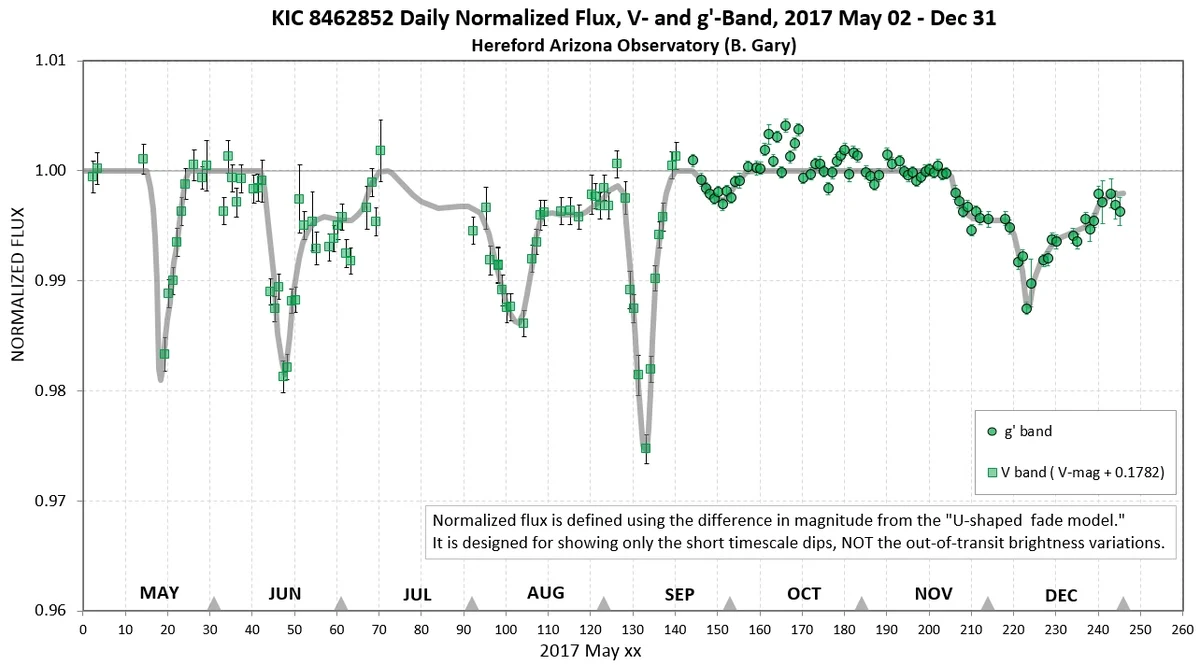
Then, in May 2017, the star dipped again while the Las Cumbres telescopes were watching. Boyajian and colleagues, in a paper with 206 authors that thanked more than 1,700 Kickstarter supporters, named the four main dips of 2017 "Elsie", "Celeste", "Skara Brae" and "Angkor". And they measured them in several colours at once. The dips were deeper in blue light than in red, the signature of fine particles. Their data, they wrote, are "inconsistent with dip models that invoke optically thick material", and instead fit "an occulter consisting primarily of ordinary dust", with grains much smaller than a thousandth of a millimetre. Those 2017 dips were shallow, 1 to 2.5 percent; the deep dips of 2011 and 2013 were never measured in colour. Schaefer's own 2018 study of the newer data reached the same conclusion: the colour changes are "the same as that expected for ordinary extinction by dust clouds."
NASA, presenting a related result in October 2017, said such reddening is "inconsistent with more fanciful 'alien megastructure' concepts, which would evenly dim all wavelengths of light."
Even the century-long fade is disputed. Hippke and Angerhausen argued in 2016 that the Harvard plate measurements could not support such a trend, and in a later study of plates from Sonneberg Hippke and colleagues found the star constant "within 0.03 mag per century".
Dust from what
Dust is the best answer to how, at least for the dips measured in colour. It is not the answer to what.
The megastructure was not found. Nothing in the signal searches, nothing in the colours, points to one.
But dust is a material, not an explanation. Where it comes from, how so much of it gathers, and why it blocks a fifth of the light at one moment and nothing at the next, are still open. Montet and Simon's line has not been retired. Boyajian's own 2018 paper noted that its colours did "not place constraints on the color of the longer-term 'secular' dimming", so whether the slow fade and the sudden dips share a cause is not settled. Wright and Sigurdsson, surveying the natural explanations in 2016, rated dust in the space between the stars, or a disc passing between us and the star, as "more plausible than the other natural models", which would mean the cause is not at the star at all.
And here is the strange part. The newest work points in three directions at once. In July 2026 Madurga-Favieres and colleagues, in a paper accepted by the Monthly Notices, reported a single transit seen by NASA's TESS satellite in 2019 and "tentative evidence" of a companion of about nine Jupiter masses, at a statistical significance of 2.3 sigma. In September Socas-Navarro reported statistical support for dips that repeat every 782 days, while warning that his result "does not prove orbital recurrence". In October Zhu and Liu proposed, in a paper not yet refereed, that the transit was a planet with a ring, a model they found only marginally favoured. Neither of the last two has been through peer review.
A telescope looked in 2023
Where it stands now: the James Webb Space Telescope observed the star in 2023, under a programme led by Massimo Stiavelli with Boyajian and Wright among the investigators, designed to tell whether the dimming material is around the star or between us and it. Its abstract set out the stakes: "a detection would confirm the circumstellar nature of the occulting material; a non-detection would be highly constraining". No result had been published in any source found for this article by the end of October 2026.
Madurga-Favieres and colleagues expect Gaia's next data release to reveal whether their tentative giant companion is real.
The star turned out to have company of its own. In 2021 Pearce and colleagues showed that a faint companion star nearby is bound to it, about 880 astronomical units away. Young and Wyatt then tested whether that companion could be throwing comets inward, and in 2023 judged it unlikely to be the cause.
What is left is a star about 1,470 light-years away that still dims, a dust that explains how, and no agreed answer to what the dust is or where it came from.
The light was flowing out of KIC 8462852 long before anyone was watching. It still is.
Questions This Leaves You With
Is there anything a person actually does with this?
Nothing for your own life: whatever is passing in front of Tabby's Star is 1,470 light-years away. What the story offers is a model of how a strange claim gets tested in public. An astronomer said the unthinkable out loud, labelled it the last hypothesis, and invited checks; volunteers found the signal, the public funded the follow-up, and the colours of the dips answered part of the question. Anyone selling a date is selling something; the star keeps no schedule.
Does this sit against a religious account of the world?
It can be read either way, and thoughtful people have. One reading sees in the search for builders among the stars a hope as old as any faith, that the universe holds other minds. Another sees the dust result as a reminder that nature makes stranger things than we expect without anyone building them. Whether a galaxy with other civilisations would sit easily with your beliefs is yours to answer. This site will not tell you which way it falls.
Does this change what a human life is?
The light that reaches Kepler from Tabby's Star left it about 1,470 years ago. Every dip Kepler recorded between 2009 and 2013 happened, at the star, around the sixth century. On one reading that makes a human life tiny, a moment against light that has been travelling since the sixth century. On another it makes it remarkable: we are the first people able to see a star's light flicker by a percent, and to ask why. Which did you feel?
What would change your mind, in either direction?
Name it now. Toward something built: a narrowband or laser signal from the star's direction, or deep dips that dim every colour equally and keep a shape no cloud of dust could hold; equal dimming alone would rule out fine dust, not prove a builder. Toward a natural cause: Webb showing the dust at the star and what it is made of, or Gaia confirming a companion that could stir up comets. A regular 782-day repeat, if confirmed, would fit an orbit of either kind and would not decide it. Each of those can be measured, and some are already in the data. It helps to write your answer down now: a result that arrives in a few years is easier to weigh if you decided in advance what it would mean.
What is the dust, and where did it come from?
This is the open problem. The colours say dust: fine grains, mostly thin. They do not say whether it is the remains of comets broken up near the star, the rings or debris of a giant planet, material passing far between us and the star, or something not yet proposed. The Webb data taken in 2023 were designed to tell the first from the third. Until they are published, the question stays where Montet and Simon left it in 2016.
Sources
- T. S. Boyajian et al., Planet Hunters IX. KIC 8462852 - where's the flux? (MNRAS 457, 3988, 2016; arXiv preprint titled Planet Hunters X, September 2015) arXiv / MNRAS Primary record
- JohnPassos, KIC 8462852 light curve of the dip of 28 February 2013 (Kepler data) Wikimedia Commons Study
- Tabby's Star Wikipedia General reference
- Ross Andersen, The Most Mysterious Star in Our Galaxy (The Atlantic, 13 October 2015) The Atlantic Study
- J. T. Wright et al., The G Search for Extraterrestrial Civilizations with Large Energy Supplies. IV (ApJ 816, 17, 2016) arXiv / ApJ Primary record
- B. E. Schaefer, KIC 8462852 Faded at an Average Rate of 0.164 Magnitudes per Century from 1890 to 1989 (ApJL 822, L34, 2016) arXiv / ApJL Primary record
- B. T. Montet and J. D. Simon, KIC 8462852 Faded Throughout the Kepler Mission (ApJL 830, L39, 2016) arXiv / ApJL Primary record
- Josh Hrala, Astronomers Have Successfully Crowdfunded an 'Alien Megastructure' Study (ScienceAlert, 21 June 2016) ScienceAlert Study
- G. R. Harp et al., Radio SETI Observations of the Anomalous Star KIC 8462852 (ApJ 825, 155, 2016) arXiv / ApJ Primary record
- D. Lipman et al., The Breakthrough Listen Search for Intelligent Life: Searching Boyajian's Star for Laser Line Emission (PASP, 2019) arXiv / PASP Primary record
- T. S. Boyajian et al., The First Post-Kepler Brightness Dips of KIC 8462852 (ApJL 853, L8, 2018) arXiv / ApJL Primary record
- B. E. Schaefer et al., The KIC 8462852 Light Curve From 2015.75 to 2018.18 Shows a Variable Secular Decline (MNRAS, 2018) arXiv / MNRAS Primary record
- Tabby's Star (Illustration), PIA22081 (4 October 2017) NASA/JPL-Caltech Primary record
- M. Hippke et al., Sonneberg plate photometry of KIC 8462852 (ApJ 837, 85, 2017) arXiv / ApJ Primary record
- J. T. Wright and S. Sigurdsson, Families of Plausible Solutions to the Puzzle of Boyajian's Star (ApJL 829, L3, 2016) arXiv / ApJL Primary record
- Madurga-Favieres et al., Evidence for a giant companion orbiting Tabby's star (accepted MNRAS, July 2026) arXiv Primary record
- Socas-Navarro, Revisiting orbital recurrence in the dimmings of Boyajian's star (preprint, September 2026) arXiv Primary record
- Zhu and Liu, The anomalously large transiting planet around Boyajian's star: evidence for a circumplanetary ring (preprint, October 2026) arXiv Primary record
- JWST GTO programme 2757, Understanding the origin of Boyajian's Star occultations STScI Primary record
- L. A. Pearce et al., Boyajian's Star B: The Co-moving Companion to KIC 8462852 A (ApJ 909, 216, 2021) arXiv / ApJ Primary record
- Young and Wyatt, on Kozai-Lidov driven exocomets around KIC 8462852 (2023) arXiv Primary record
- JohnPassos, KIC 8462852 full Kepler light curve, December 2009 to May 2013 Wikimedia Commons Study
- M. Hippke and D. Angerhausen et al., A statistical analysis of the accuracy of the digitized magnitudes of photometric plates ... KIC 8462852 (ApJ 825, 73, 2016) arXiv / ApJ Primary record